A Freezing German Shepherd Guarded a Bundle in Snow—What the Officer Found Inside Left Him Stunned – Part 3
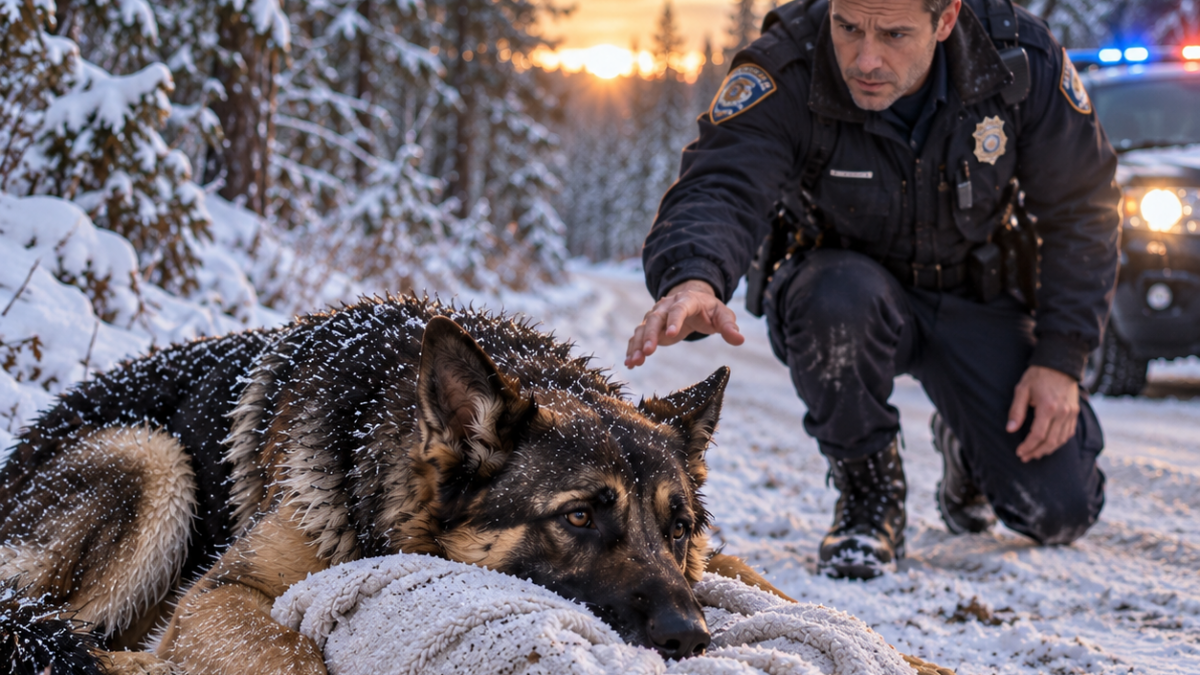
Huck was exhausted, underfed, and sore, but there was no serious injury or lasting damage. His paw pads needed time to heal, and his weight would have to be restored gradually.
Yet, Aaron expected a full recovery with regular meals, water, and several weeks of rest. Clark, who had stopped by during his shift, looked from the veterinarian to Huck and quietly observed that rest might be the one treatment the dog refused to accept. Huck proved him right almost immediately.
Later that morning, a nurse began wheeling Anna’s bassinet down the hallway for a routine pediatric examination.
Huck had been asleep beside the wall, his head flat between his paws, but the soft movement of the wheels brought him upright before anyone called his name. He followed the bassinet at once, moving carefully on stiff legs and staying close enough that his nose occasionally brushed the hanging edge of the blanket. When the nurse passed through a set of doors where Huck was not permitted to follow, he stopped directly in front of them and waited.
He did not bark or scratch. He simply sat facing the narrow glass panel until Anna returned. The same thing happened again during another check later in the day.
By then, the nurses had stopped trying to redirect him. Huck had created his own routine. Eat when someone placed food close enough, sleep when Anna slept, and stand whenever her bassinet moved.
Someone from the hospital staff eventually brought him a large orthopedic dog bed donated by a local pet store. It was thick, clean, and soft enough that even Clark thought it looked more comfortable than some motel mattresses he had encountered during winter road assignments.
The bed was placed in the corner of Anna’s room, only several feet from the bassinet.
Huck walked over, sniffed it carefully, stepped onto it with his front paws, and seemed to consider the offer. Then he turned around, crossed the room, and lowered himself back onto the hard floor beside Anna. Clark watched the entire performance from the doorway.
“Looks like he didn’t read the catalog,” he said.
Meredith smiled and one of the nurses laughed quietly. The moment was small, but it mattered. For the first time since the roadside rescue, laughter entered the story without immediately being followed by another emergency.
Alisa’s recovery was less visible, but no less important.
She had begun meeting regularly with a mental health specialist and a hospital social worker, and the staff were careful not to rush her simply because her physical condition had improved. By the third afternoon, she could walk short distances with assistance and sit near the window for long conversations without becoming overwhelmed. Her long chestnut hair had been brushed and tied loosely behind her neck, and some color had returned to her face, though exhaustion still showed around her eyes.
Clark visited after checking on Anna and found Elise holding a cup of tea with both hands while snow melted slowly from the hospital roof outside. She no longer spoke in the broken fragments he had heard in the cabin. For the first time, she was able to describe clearly what had frightened her most before she drove into the mountains.
Elise told Clark that she had never wanted to leave Anna and had never imagined herself as a mother who would walk away from her child. What terrified her was something different. She had become afraid that exhaustion was making her unreliable.
She would finish feeding Anna and then find herself wondering whether she had actually done it or only thought about doing it.
She checked the baby’s breathing repeatedly during the night and sometimes could not remember the last time she herself had eaten.
The notes at the cabin had not been casual reminders. They were a system she created because she no longer trusted her own mind to hold every detail. At first, writing things down made her feel safer.
Later, even following the list became difficult. The cabin had seemed like a place where quiet might help her recover, but isolation only removed the people who might have noticed how far she had slipped.
When the Subaru became trapped, and her phone died, Elise still believed she could manage. She carried Anna to the cabin, kept the stove warm, prepared formula, changed diapers, and followed the schedule she had written for herself.
What changed was not her love for Anna, but her confidence that love alone could keep the baby safe. By the time she decided to take Anna toward the road, Elise knew she was running out of strength.
She had intended to remain beside the carrier until someone passed, but each step through the snow became harder. Huck kept circling between her and Anna, waiting whenever Elise stopped. When they finally reached the roadside, she realized the dog was more capable of staying alert than she was.
That was why she placed Anna where she could be seen and gave Huck the instruction that Clark would later understand had carried the entire rescue forward. She had trusted him because Huck had guarded Anna from the day the baby came home.
He slept near the bassinet, followed Elise during late night feedings and appeared beside the crib whenever Anna cried.
In Elise’s exhausted mind, he was the one member of the household who still seemed completely dependable.
Leaving Anna with him had not felt like abandoning her. It had felt like handing her to the only protector Elise still trusted when she could no longer trust herself. Clark listened without interrupting.
Nothing in Elise’s explanation erased the danger Anna had faced, but it gave that danger a different meaning.
Elise had not chosen distance from her child. She had recognized, however imperfectly and desperately, that her daughter needed help beyond what she could provide in that moment.
The decision had nearly broken her, but it had also saved Anna’s life because Huck had obeyed.
Before Clark left the room, Meredith entered with an update from the military family liaison.
Mason’s command had approved emergency arrangements, allowing him to begin returning home earlier than planned.
Travel still required coordination, and no one could yet say exactly when he would arrive in Berlin. But for the first time, Mason was no longer simply waiting overseas for news about a family he could not reach. Elise covered her face for several seconds after hearing it.
The relief was quiet rather than dramatic, but Clark could see how much weight left her shoulders.
That evening, Clark stopped once more outside Anna’s room before finishing his shift.
The expensive dog bed remained untouched in the corner. Anna slept beneath a light blanket, breathing evenly while Huck lay on the floor beside her with his head resting near the wheels of the bassinet. His eyes were closed, but one ear remained slightly raised.
The dog had been fed, warmed, examined, and declared safe. Anna was surrounded by nurses and doctors.
There was no roadside anymore, no falling snow, and no need for Huck to stand between the child and the world. He guarded her anyway. Elise had trusted Huck when she had nothing else left to trust, and the German Shepherd had carried that responsibility farther than anyone could reasonably have expected.
Safe inside the hospital with his own body finally beginning to heal. Huck still behaved as though someone might ask him to surrender his post.
He had no intention of doing so. Mason Hartwell returned to New Hampshire 3 days later. Arriving in Berlin beneath a pale winter sky with the mountains still carrying the white remains of the storm that had nearly taken his family from him.
He came directly from the airport in uniform, traveling with little more than a duffel bag and the exhaustion of a man who had crossed several time zones while sleeping only in brief stretches. At 35, Mason was tall and lean with close-cut dark hair, strong features, and the disciplined posture of someone who had spent years in the army, learning how to keep moving, no matter how tired he felt. Yet, when he stepped through the hospital entrance that afternoon, there was none of the calm confidence Clark remembered from the family photograph.
Mason paused beneath the fluorescent lights, as though the building itself required courage to enter. He had spent the entire journey imagining Elise in the cabin, Anna beside the frozen road, and Huck standing between the infant and the winter.

