“You Handle the House. Stay Out of My Way,” the Former Navy SEAL Said—Until Her Scarf Slipped – Part 2
The radio stayed plugged in. Outside, May Rain kept the Flint Hills green. Inside Red will people were beginning to know where everyone would sit.
June gave way to July, almost without ceremony. The Flint Hills stayed green longest in the low country, where creek beds held the last of the spring moisture, but the higher slopes had begun turning the dull gold that came before the harder heat of August.
By mid-afternoon, dust followed the ranch trucks in long red brown ribbons, settled into boot seams, and worked its way beneath collars. No matter how tightly a person buttoned them, there were days when the temperature climbed past 90 before lunch.
Mara still wore the scarf. By then, everyone at Red Willow had noticed.
Nobody asked. The scarf changed with her clothes, sometimes pale gray, sometimes faded blue, once a thin cream colored cotton that looked light enough to pass for decoration, but it always circled her neck loosely and always fell across the left shoulder.
One particularly hot morning, Walt came into the kitchen with sweat darkening the band of his felt hat and found Mara pulling biscuits from the oven. Looking at that thing makes me 10° hotter.
Mara glanced at the scarf, then at the heavy hat still planted firmly on Walt’s head.
I was about to say the same thing. Rey laughed into his coffee. Walt removed the hat, considered it as though betrayed, and carried on with breakfast.
The question disappeared. Harlon did not forget it. He had spent too much of his adult life around people whose habits meant something.
A man who always chose the same seat might simply like the view. Or he might need to see the door.
A person who checked a watch three times in 5 minutes might be impatient, anxious, or measuring something nobody else knew mattered. Patterns were not answers.
They were invitations to pay attention. Mara had several. She disliked being touched unexpectedly near her left shoulder.
The first time Harlon saw it clearly was when a feed supplier came through the mudroom carrying paperwork and reached around her to set a clipboard on the counter. His hand never actually touched Mara, but it passed close behind her shoulder. She moved sideways before he finished the motion.
Not dramatically, one step enough to put the counter at her back and the man within view. Then she signed the invoice and continued discussing the delivery as if nothing had happened. The driver never noticed.
Harlon did. At the beginning of July, Mara replaced the batteries in two smoke detectors and tested both twice.
Nobody had asked her to do it.
When Ry helped move shelving in the pantry to make room for bulk supplies, Mara’s first question was not whether the shelves were level.
She asked whether the new position narrowed the path to the side door. It did. By 6 in, the shelves moved back.
Those things could have come from years managing housekeeping in large buildings. Some probably did, others had a different weight. Harlon knew something about that kind of weight.
His own life was full of harmless looking habits that had survived the circumstances that created them. Weather was one. A thunderstorm forecast did not mean rain to Haron.
It meant wind direction, creek crossings, visibility, whether the livestock trailer should remain near the north lot or be moved closer to the house, which pasture held enough shelter, and whether a radio dead zone mattered if somebody had to be reached quickly. When the stock tank pump on the western section quit during the first hot week of July, Walt wanted to take it apart immediately. Harland stopped him.
He checked the breaker first, then the line pressure, then the float, then whether there was enough water available elsewhere if the pump remained down through the afternoon. Only after knowing what could fail next did he open the housing. Ry watched from beneath the brim of his cap.
One of these days we’re going to have a problem so simple it disappoints you.
Haron kept working.
I’m prepared for that.
It drew a laugh, but there was truth beneath it. Preparation had once kept men alive. Harlon had learned to think past the first problem toward the problem waiting behind it.
One route was never enough. One communication method was not enough.
One assumption should never carry more weight than the evidence beneath it. Those instincts fit ranch life surprisingly well.
Cattle ignored schedules. Weather lied.
Machines failed when needed most. Yet there was another side to the habit. One Harlon understood less willingly.
If a man spent enough years believing preparation could reduce loss, eventually he began to believe loss meant something had been missed. A detail, a warning, a better option.
Catherine’s illness had taught him otherwise.
His mind had not entirely accepted the lesson. Mara seemed to have her own version of that argument with the past, though whatever had created it remained hidden beneath a strip of cotton around her neck.
Haron let it remain there. The moment the scarf came off happened on an ordinary Thursday. That was the strange thing about moments people remembered for years.
They rarely announced themselves beforehand. Mara had driven into Cottonwood Falls after lunch for groceries, cleaning supplies, coffee filters, and a replacement gasket for a kitchen faucet that had started dripping. She returned shortly before 4 in the afternoon in heat that made the gravel shimmer.
Harlon was crossing the yard with a tub of mineral supplement when she backed her sedan near the mudroom and opened the trunk. She had dressed differently for town, a simple summer dress, dark blue and practical with short sleeves and a wider neckline than the work shirts she normally wore around the ranch.
The same thin scarf rested around her neck, one end falling toward the left shoulder. Ridge came out from beneath the porch and inspected the grocery bags with professional interest. Mara handed Harlon a sack containing coffee and canned goods without asking.
He took it. The last paper bag sat toward the rear of the trunk. Mara leaned in.
The loose end of her scarf caught on the metal latch near the trunk opening. She did not realize it.
She straightened and turned. The fabric pulled. For a second, it held.
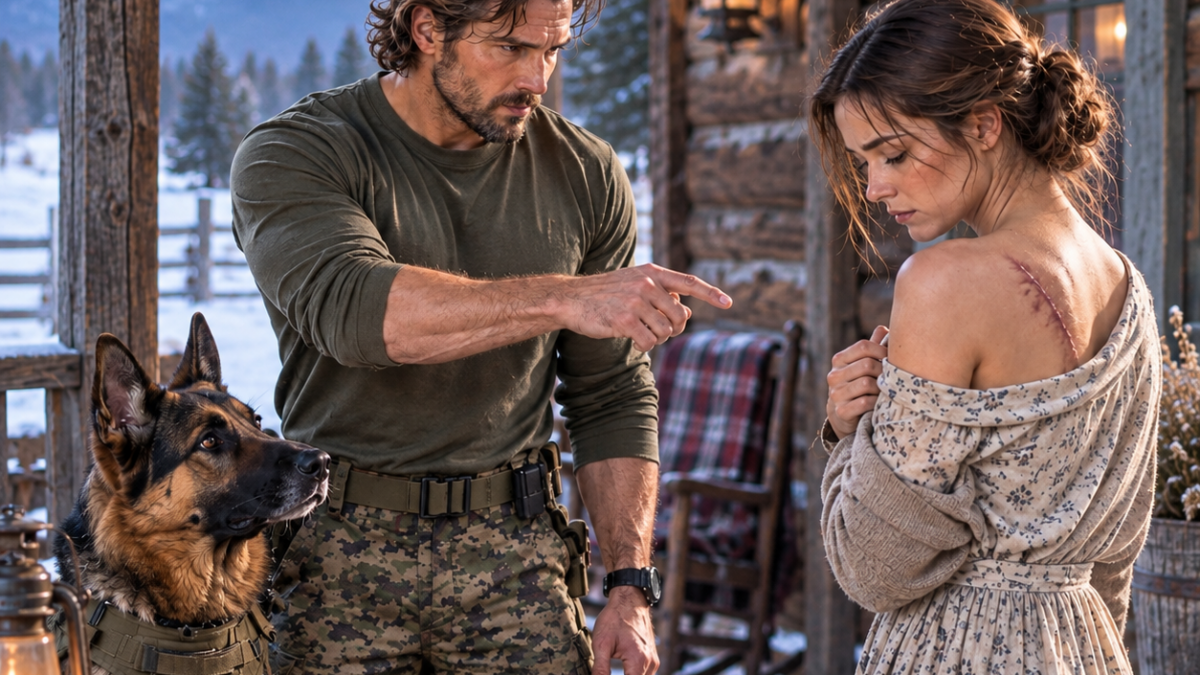
Then it slipped free of her neck, dragging lightly across the back of her dress and shifting the left side of the neckline downward. Harlon saw the scar. It began beneath the hairline on the back left side of her neck, passed over the upper curve of her shoulder, and continued across part of the shoulder blade before disappearing beneath the dress.
It was old, healed. The skin there was pale and uneven, different in texture from the surrounding skin, but no longer wounded.
There was nothing grotesque about it, nothing that required staring. What caught Harlon was not the scar itself.
It was Mara’s reaction.
Her hand went immediately to her neckline. The other reached for the fallen scarf.
For one brief moment, the composed woman, who had learned everybody’s coffee habits, organized a ranch pantry without offending Walt, and calmly handled three kinds of weather in one week, looked as if the ground beneath her had shifted.
Then it was gone. She pulled the fabric back over her shoulder. Harlon lowered his eyes to the grocery bag in his hands.
Mara wrapped the scarf again. Old injury.
Her voice was level. Harlon nodded once.
He did not ask how. He did not tell her she did not need to hide it. He did not offer sympathy she had not requested.
They carried the groceries inside. By supper, nothing about the day appeared different.
But for the next several mornings, Harlon caught himself remembering what he had seen. Not the shape of the scar so much as the speed with which Mara had covered it.
He knew what it was to own a piece of history that other people believed entitled them to questions, so he left hers alone. 11 days passed.
Red Willow continued as though nothing had happened. That may have mattered more than either of them realized. Ridge brought his leash to Mara twice that week.
Once while Haron was standing 10 ft away. The second time, the dog ignored Haron completely and sat in front of her with such solemn expectation that Mara finally took him down the lane herself.
The radio developed a morning routine of its own. Weather at 6:30 market report afterward.
Then music turned low enough that conversation did not have to compete with it. Harlon never unplugged it. Mara never asked whether she should.
On a Tuesday near the middle of July, Haron finished replacing a section of fence on the south pasture and checked the time. 11:42. There was another post he could have set before lunch.
Normally, he would have. Instead, he put the tools in the truck and drove back toward the house. Halfway there, he realized why.
Mara had mentioned beef stew that morning. Harlon slowed slightly. The realization embarrassed him more than it should have.
For 3 years, coming back to the house in the middle of the day had meant forgetting something, needing paperwork, or fixing a problem. Home had become a location between tasks. Now he had left a perfectly useful 20 minutes of daylight sitting in a pasture because there would be stew on the table and coffee on the counter.
He parked beside the barn but did not get out immediately. Ridge riding in the passenger footwell looked at him. Harlon rested both hands on the steering wheel.
He was not sure whether the feeling in his chest was guilt or relief. Perhaps there were seasons when the difference was too small to matter.
Ridge sneezed against the dashboard. Harlon opened the door.
Good talk. Life went on.
Walt still argued with Ry over baseball. Mara still left the inventory clipboard exactly 3 in from the mudroom phone because that was where everyone eventually learned to find it. The scarf stayed around her neck.
Then Walt made a parts run to Witchita. One of the livestock trailers needed a replacement brake assembly that the usual supplier did not have in stock.
and Walt volunteered mostly because he wanted an excuse to eat lunch at a place he claimed had the last respectable chicken fried steak in Kansas. He returned after dark.
Nothing about him seemed different. That changed just after 9.
Walt was sitting at his kitchen table in the small house he rented near Strong City when his phone buzzed. A man he had spoken with at the parts counter had sent him a message.
Thought I recognized that name you mentioned. Below it was a link.
Walt opened it. The article was four years old.
Ashdown house. A fatal fire in Witchita.
Two adults dead. Questions surrounding the building, its owner, and a housekeeping employee investigators had interviewed after the incident. Walt read halfway down the page before he found the name Mara Ellison.
He went back to the beginning. Read it again, then a second time. At 9:17, the Red Willow crew group text lit up.
Walt had sent the link. The next morning, Red Willow looked exactly as it had the day before. The same light came through the kitchen windows.
The same radio sat low on the shelf, murmuring weather and cattle prices beneath the clink of coffee cups. Outside, a pickup coughed to life near the barn while Ridge slept with his chin across one paw.
Nothing visible had changed. The room had Mara knew it before anyone said a word. Rey came in, poured coffee, and left without waiting to see what she had put in the skillet.
Another hand carried a lunch cooler through the mudroom, even though Mara had already packed sandwiches for the crew. Walt entered last, removed his hat, and chose a chair at the far side of the table instead of the place he had occupied almost every morning since she arrived.
Nobody accused her of anything. That made it worse.
People who wanted a fight were easier to understand than people who had suddenly become careful around you. Mara set a plate on the table anyway. Walt thanked her without looking up.
Ridge remained where he always was. The dog had no reason to change his routine because a link had appeared on a phone. Mara watched him for a moment and understood.
She had been here before. Different kitchens, different uniforms, different towns. The sequence changed less than people thought.
Someone found the article. Then came the quiet.
After that came questions. Haron walked in 10 minutes later.
He had already read it twice. The article was four years old and badly balanced in the way early reporting often was when facts arrived slower than public curiosity.
The headline named Ashdown house a fatal fire. And a former employee questioned after the incident. Richard Talbot the building owner was quoted repeatedly.
Investigators had not ruled out employee negligence. A laundry and housekeeping supervisor named Mara Ellison had been interviewed regarding her movements inside the building that night.
Two adult residents had died. Several others had gotten out. The article did not say Mara started the fire.
It did not say she had been charged. It did not say a witness had seen her do anything wrong.
Harlon knew the difference. For years, his work had depended on separating what somebody reported from what somebody believed and what somebody could actually confirm. A rumor repeated three times did not become three sources.
A confident statement did not become evidence because a person wore a title when he made it. He read the article a third time before breakfast. Then he found Walt near the equipment shed.
Who saw her start it? Walt shifted the coil of hose in his hands.
Nobody told me that. who saw her do anything that caused it?
Walt frowned. The article says they questioned her.
That’s not what I asked.
Walt looked toward the house. Haron waited. Finally, Walt shook his head.
I don’t know.
That was the problem. Nobody did. By noon, the ranch had settled into work, but the discomfort remained.
Mara moved through lunch preparation with the same efficiency she had shown every other day. If she was upset, she kept it inside the boundaries of the job. Harlon came in while she was chopping carrots.
He should have known better than to begin the way he did. But old habits had long lives. What time did the alarm go off?
Mara did not stop cutting. A little after 9. Where were you?
Laundry room. Who else had access? She slowed.
Haron continued before noticing. Did Talbot have a master key? Yes.
Who used the service corridor? Mara set the knife down carefully, not angrily. That was worse.
She wiped her hands on the towel beside the cutting board and turned toward him. Are you trying to understand what happened or are you trying to clear me?
The question stopped him. For a second, Harlon heard his own voice from outside himself.
Short ordered timeline first, contradictions later. The kind of questioning built to remove uncertainty. Mara was not an incident report.
He pulled out a chair, sat. That was the last question he asked for a while.
4 years earlier, Ashdown House had stood on the edge of downtown Witchah. An old brick residential hotel that had been renovated more cheaply than well. Some people stayed a week, others stayed 6 months.
Traveling nurses used it between contracts. Divorced men rented rooms while waiting for leases elsewhere.
A few older tenants had lived there long enough to know which pipes knocked in winter and which stairwell smelled like dust after rain. Mara had been the laundry and housekeeping supervisor. The title sounded larger than the job.
Mostly, it meant there was always something she was responsible for that nobody else noticed until it failed. Linens, cleaning supplies, room turnover, laundry schedules, storage, lost keys, things running out, things being put where they should not be.
She knew the building because her work required knowing where people moved through it. That knowledge mattered the night of the fire. Ashdown had a service corridor on the upper floor that connected several rooms to a secondary stairwell.
Tenants sometimes used it at night because it was quieter than the main hall. Richard Talbot disliked that. He called it a security problem.
Instead of repairing the access system properly, he had a steel bar installed across part of the service door. Cheap, simple, easy to control, the kind of solution that worked perfectly until the day it mattered.
Mara had complained. Others had too. Talbot said the door could still be opened when needed.
The night of the fire, Mara was working in the rear laundry room when the alarm sounded. She never told Haron where the fire started because she did not know that mattered.
What she knew was that the main stairwell became unusable quickly and people on the upper floor began looking for another way down. Mara moved through the service side of the building because she knew another route.
At the upper corridor, the barred door had already become difficult to move. The metal had warped.
The frame had shifted. She worked at it long enough to get it open. Four adults came through that way.
Two others did not. Mara did not describe them.
She did not describe the hallway. She did not describe what she remembered from the minutes before help reached that part of the building.
She simply told Haron those two people had been beyond her reach by the time the door finally moved. That was enough. The scar Harlon had seen beneath her scarf came from that night.
The heat had caught the back of her neck, shoulder, and upper back while she was working at the door and moving people toward the stairwell. She healed. The story around her did not.
In the first days after the fire, Talbot told investigators there had been no unauthorized bar on the service door. Then he suggested Mara had been careless around the laundry area.
She often worked late. She had keys.
She knew the building. At one point, he claimed she had used a personal electric appliance in a staff area against policy. None of it proved the origin of the fire.
It did not need to. It gave people somewhere to look.
Detective Paul Renshaw handled part of the early inquiry. Mara later learned he knew Talbot before the fire.
Not secretly. Witchita was not so large that businessmen and police officers never crossed paths.
They had been at the same charity events Talbot had donated to organizations Renshaw supported. People described them as friendly. No one had to invent an elaborate conspiracy.
Something much smaller was enough. A question that should have been pressed was allowed to rest.
A witness statement about the service door was treated as uncertain.
Talbot’s explanation was given more weight than the people renting rooms from him.
The newspapers reported what investigators were considering before investigators knew what had happened. By the time officials stated there was not enough evidence to charge Mara, the first article had already traveled farther than the correction.
That was how it worked. Questioned, stayed searchable, not charged, lived several paragraphs down in a later story nobody shared.
Mara left Witchita within weeks. She found another job, then another.

