Gun to Her Head, the Quiet Nurse Saved Him—Then “Ghostline Six” Was Revealed – Part 3
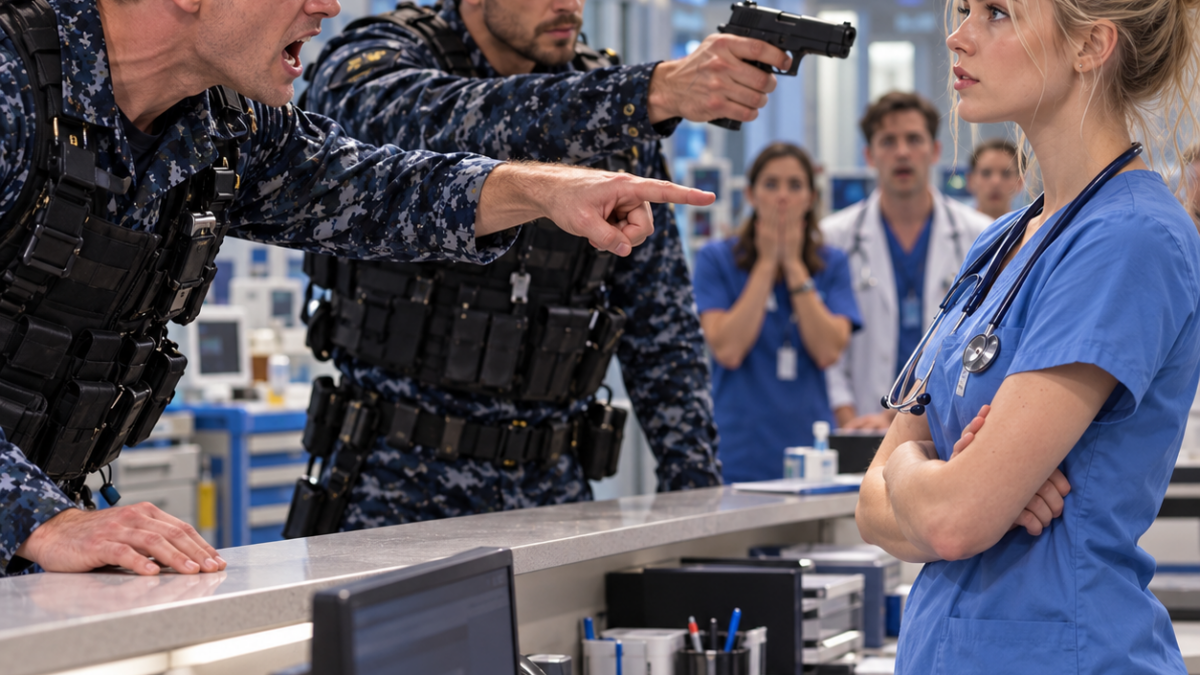
He was a long way from fixed, but he was being fixed, and there was a difference. Mara charted the two 19 vitals set and straightened up and noticed for the first time since Ror had lowered the weapon, that her back achd, not badly, just the dull ache of having held herself in a specific configuration of controlled alertness for longer than bodies were designed for. She became
aware that Dr.
Ren was watching hers from across the room. Not the watching of someone assessing a clinical situation, the other kind.
The kind that meant something spec specific had been noticed and was being thought about. Mara looked back at her.
Ren said quietly enough that it didn’t carry to the others.
Field context. Yes.
And the call sign on the emergency channel.
Ren’s tone was careful.
Not prying, just precise. The response chief called you ghost line 6 before we reestablished communication.
Mara had heard it too.
She’d been aware of it in the same way she was aware of anything in a room automatically completely.
And she’d made a decision about it in approximately 1 second, which was to continue doing what she was doing.
Old designation, she said. How old?
Long enough ago that it shouldn’t be relevant.
Ren considered that it was relevant tonight. Everything was relevant tonight. Ren was quiet for a moment.
Then you knew what the compound was before the labs. I had a hypothesis based on field exposure.
Yes. To a classified operational context. Mara said nothing.
Ren nodded slowly, the nod of someone filing something that they are choosing for now, not to pursue. Okay, she said.
It was the most useful word Ren had said all night, which was saying something because Ren had said a lot of useful words. The commander had moved to the corner of the bay and was on her own radio, speaking in the controlled clipped tone of someone initiating a series of events rather than responding to one.
The distinction being that she was no longer reacting to what had happened inside this room. She was setting something in motion outside it.
Mara understood without needing to hear the words that Commander Grant Sloan’s evening had just changed fundamentally.
He was at home or at the base facility or somewhere he believed was safe and he was wait for his phone to tell him that the situation at Harrove had been contained. He was rehearsing his version of events. He was perhaps already drafting the administrative narrative that would position him as a concerned superior responding to a trainee crisis.
He was doing all of this without knowing that his own voice transmitted into a room he thought he controlled had given everyone in it a 45second account of his culpability that would never leave the chain of evidence.
Mara crossed to Bay 3’s secondary supply cabinet, opened the top drawer, and took out a fresh pair of gloves.
She put them on, went back to Noah. He was still unconscious, but his color had changed.
The bluish tint at his lips was gone, replaced by something closer to normal. The specific pinkish bge of a fair skin with oxygenated blood reaching their capillaries in the quantities it was supposed to. She checked his IV sites, checked the blood product bag, checked the line for kinks.
His hand, lying at his side, made a small involuntary movement. Fingers curling and releasing, fingers curling, and the kind of unconscious gesture that sometimes meant the brain was starting to reassert itself from beneath whatever the compound had done to it. She noted the time, too, 27a.
She was charting it when the secondary access door opened again and a man came through that she didn’t recognize.
Not hospital staff, not security, not the liaison commander.
He was older, wearing the uniform of a Navy chief petty officer, and he moved the way people moved when they’d come a long distance quickly.
And we’re not going to let that show.
He took in the room in the practice sweep of someone accustomed to arriving in situations and needing to understand them immediately. His eyes found Mara and he stopped.
Not a long stop. 2 3 seconds. But in those seconds, his expression moved through several things recognition.
Something that might have been disbelief and then something that settled into a look she recognized, even if she couldn’t have named it precisely, which was look of someone confronting a piece of their past that they’d assumed was permanent and finding it altered.
I heard your call sign, he said. She looked at him on the emergency band 40 minutes ago.
He hadn’t moved from just inside the door.
I was running the external response coordination. I heard the channel and I heard the chief respond and then I heard your voice and he stopped. Chief Navaro, she said, because she recognized him, too.
He exhaled once through his nose. Vance.
The room had gone slightly quieter around this exchange, the way rooms did when something was happening that the people in them didn’t have context for, but could recognize as significant.
You’re working here, he said.
5 years as a nurse, she said trauma nurse, night shift. He absorbed that.
His expression was complicated in the way that expressions were complicated when they were trying to accommodate new information against an old and fixed image and the two didn’t quite fit the same frame.
You handled this alone, he said. Dr. Ren, before Ren got in here, he said, you handled this alone.
She didn’t answer that.
It wasn’t a question.
Behind Navaro, the door to the bay had sw sw sw sw sw sw sw sw sw sw sw sw sw sw sw sw sw sw sw sw sw sw sw sw sw sw sw sw sw sw sw sw sw sw sw sw sw sw sw sw swung open further in the movement of his entry, and through it Mara could see the corridor, the security team still positioned there, the additional hospital staff who had assembled at the outer perimeter and at the far end through the now unlocked
access door, the flicker of more lights being added, more people arriving, the investigation already widening from this one sealed bay outward into everything that had produced it. She became aware of her own hands gloved still resting at her sides. The battered silver trauma shears were still clipped to her badge.
They’d been there the whole time.
She hadn’t um thought about them once in the last 2 and 1/2 hours, which was unusual cuz she always knew they were there, always felt them, always carried their specific weight as the thing they were.
She thought about them now.
The sound from Noah’s monitor changed, not an alarm.
The opposite the monitor’s rhythm indicator shifting from its irregular warble to something irregular warble to something cleaner, steadier, more like the rhythm of a heart that remembered how to be a heart.
Everyone in the room heard it.
Ren leaned over, checked the readout, checked Noah’s color, put her stethoscope to his chest.
She straightened up.
“He’s stabilizing,” she said.
“Not fixed, but stabilizing.”
Mara let out a breath she’d been holding for so long she’d stopped noticing it was held.
And then her phone, her personal phone in the pocket of her scrubs, which had been silent the entire night, vibrated once with a text message from an external number. She pulled it out.
The number was unfamiliar. The message was four words.
We know what happened. She stared at it for 3 seconds.
Then she looked up at the room at Ror on the floor in his zip ties, at Ortega with his wet eyes, at the commander in the corner on her radio, at Navaro still standing inside the door watching her with that complicated expression at Ren bent over Noah doing what she always did, which was the next right thing. And her phone vibrated again.
Same number. Sloan is requesting the training facility security footage from tonight be pulled and reviewed.
He’s claiming there’s exculpatory evidences on tape.
She read it twice. The footage.
She hadn’t thought about the footage.
The training facility where the injections had occurred was a separate location from the hospital. If there was footage of the session of Sloan administering the compounds, of the trainees physiological responses, of Noah going down, then what Sloan believed was exculpatory was about to become something else entirely, but only if it still existed. She looked at the commander, who was still on her radio, and she crossed the room toward her.
The commander’s name was Delgado, and she listened to Mara for exactly 45 seconds before she was back on her radio with the particular efficiency of someone who had learned that the difference between evidence and destroyed.
Evidence was often measured in minutes rather than hours. Mara had delivered it in the same compressed clinical format she used for patient handoffs. The text message, the source unknown, but the content specific.
Sloan’s apparent belief that the training facility footage contained something favorable to him.
The implication that he was moving to access it through official looking channels that would not immediately flag as obstruction. Delgato had not asked how Mara received the text.
She had simply acted on it. training facility security archive.
She said into her radio full preserve order. Nobody pulls, copies, or reviews any footage from the past 72 hours without written authorization from this office. If anyone is already in that system, I want to know who and I want them stopped.
Now, she listened for a response.
Mara couldn’t hear the other side, but she could read Delgato’s face, and what she saw there told her the answer was something between complicated and bad.
“How long ago?”
Delgato said into the radio. A pause.
“Which segments?”
Another pause longer.
“Don’t touch anything else.”
“I’m sending someone directly.”
She clicked off. She looked at Mara. Someone accessed the archive remotely 18 minutes ago.
requested a pull of three specific segments from tonight’s session.
Did they get them?
The request is logged, but the transfer hadn’t completed.
The system requires a manual authorization from the facility security officer for archive pulls over 60 minutes long. A beat.
The facility security officer was offsite. They were waiting for call back. 18 minutes.
The timeline fit. Sloan had been on his radio to Ror at some point before 20A M had not reached him, had waited, and had then moved to the footage. His second layer, the version of the plan that existed in case the first one failed.
The access log shows who requested it, Mara asked. It shows an authorized facility credentials log in, Delgato said, with the specific precision of someone choosing their words to mean exactly what they said and nothing more.
We’ll establish who used those credentials.
They both understood what that meant. Authorized credentials could be shared, stolen, used by someone other than the registered holder. Establishing who had physically been at a keyboard at a specific time was a different process than knowing whose login name appeared in a log.
And that distinction was exactly the kind of thing that administrative inquiries spent months untangling. But the footage existed. That was the thing.
The footage existed and was now under a preserve order. And the preserve order had come before the transfer completed.
And that meant whatever was on those three segments was still in the archive intact with a fresh access log showing that someone had tried to pull it tonight at a time that corresponded precisely with Sloan’s call to Ror’s radio.
Mara went back to her patients.
Noah’s fourth transfusion cycle had completed.
Ren was running the post cycle assessment, moving through the checks with the focus of someone who has been working for three straight hours and is running on the particular fuel of a of a situation that isn’t finished yet.
His blood pressure had reached 102 over 68. Still low, but within a range that no longer demanded the same aggressive intervention.
His oxygen saturation held at 98. His heart rate was 70.
Sinus rhythm. The brief irregular stuttering of the earlier arhythmia absent now for 41 minutes.
“He’s going to make it,” Ren said.
“Not triumphant about it, just stating a clinical fact that happened to be a good one.”
“Yes,” Mara said.
She checked his temperature. Still slightly low, but warming.
She adjusted the blanket over him. a a small a small practical thing, the kind of thing that got done automatically after years of doing it. He was still unconscious, but his face had changed.
The taught effortful quality of someone whose body was fighting something had softened into something that looked more like ordinary sleep, and ordinary sleep was an enormous improvement over where he’d been at midnight.
Ror across the room was being assessed by one of the physicians who’d come in with the chief of staff call as his IV was running.
His rhythm was normal sinus following the medication push and his color was better, better than it had been 40 minutes ago. He was not going to need exchange transfusion.
the compound in his system had been a lower concentration or his body had responded differently or the timing of intervention had been earlier enough that the cascade hadn’t reached the same threshold.
He was also looking at Noah had been Mara noticed for some time not the anxious surveillance of someone managing a threat.
The other kind, the kind that didn’t have a clean name, but that she recognized from the faces of people in trauma bays who were waiting to find out if something they had done or failed to do, had taken something away from someone else permanently.
She didn’t speak to him.
There was nothing to say that was her job to say. At 3:4 a. m.
, the chief of staff arrived in person. His name was Caldwell. He was 61 years old and had the look of a man who was accustomed to institutional crises and had long since stopped being rattled by them without stop being serious about them.
He spoke with Ren for 4 minutes, spoke with Delgato for eight, and then came to stand beside Mara at the nurse’s station where she was completing the documentation she’d been maintaining throughout the night.
He looked at the chart, at the medication log, at the intervention timeline. You documented everything in real time, he said.
Yes. During an active hostage situation, the documentation was part of managing the situation, she said. If I stopped charting, the record became incomplete.
An incomplete record was one of the things they wanted. Caldwell absorbed that.
He was the kind of man who absorbed information physically. Could see him taking it in, settling it into the framework of what he was going to have to explain to a very long list of people over the next very long period of time.
The expanded toxicology order.
He said you ordered that within He checked the timestamped 12 minutes of the patient’s admission.
His presentation was inconsistent with the stated cause. What made you order the performance drug expansion? specifically.
The question landed in the same territory as Ren’s question from earlier.
Different words, same map, clinical judgment, she said. Caldwell looked at her for a moment.
He was not a stupid man, and the answer was not quite an answer, and he knew it. Okay, he said, the same word Ren had used.
It seemed to be the word that people landed on tonight when they encountered something they had filed under to be understood more fully later. He moved away to speak with Delgato again.
Mara finished the chart section she was on, reviewed it once, and submitted it. The unknown number texted again at 3:11 a. m.
Sloan is at the base. Jag has been notified.
He doesn’t know the footage preserve order went through.
She stared at the message for a moment.
Then she typed back, “Who is this?”
The response came in under a minute.
Someone who has been watching Sloan’s program for 8 months and needed to tonight to happen before anything could move.
Your call sign confirmed you were the nurse on shift.
I’m sorry we couldn’t give you more warning.
She read it twice. 8 months.
Someone had been watching the program for 8 months, which meant someone had known, not suspected, known, that Sloan was running unauthorized human subjects research on trainees for the better part of a year and had been building something rather than acting immediately and had needed a specific event to provide the kind of evidence that would make an kind of an evidence that would make an investigation stick rather than evaporate under the pressure of Sloan’s reputation and rank.
She thought about what that meant for the trainees, for Noah, for Ror sitting across the room with his zip tied wrists and his IV line, who had been a tool in someone else’s patient accumulation of evidence as surely as he’d been a tool in Sloan’s program.
She thought about Ortega, who had broken because he’d chosen to, and whether the timeline would have allowed him to break sooner if anyone watching had created an opening for it.
She put the phone back in her pocket. There was nothing to say back to that message that she trusted herself to say cleanly at 3:11 in the morning after what had been in this room tonight. The investigation materialized in the way investigations did when military institutions were involved formally, procedurally with the specific organizational weight of a system to that had protocols for serious incidents and was now deploying them.
Delgato coordinated the first wave. A second commander arrived at 3:20. A judge advocate general officer appeared at 3:35 and began the process of formally advising the trainees of their rights, which required the zip ties to come off Ror and for both he and Ortega to receive council contact before any formal questioning began.
Mara observed all of this from the periphery of Bay 3, where she remained until she was certain that both her patients were in a stable configuration that the other physicians could manage. It took until 3:47 a. m.
for her to feel that certainty clearly enough to step back.
She noted the time, noted the handoff to the attendant who was taking over Noah’s monitoring and walked out into the corridor for the first time since the lockdown had sealed it.
The corridor looked different. Not physically, same floors, same lights, same smell of antiseptics and recycled air. But the texture of it was different.
The way any space feels different when what happened in it is still sitting in the air. She walked to the family waiting area at the end of the wing, which was empty at this hour, and sat down in one of the chairs that were specifically designed to be functional rather than comfortable, and let herself be still for approximately 3 minutes. Her hands were shaking slightly.
She noticed this with the detached interest of someone inventorying damage after the fact. Not badly. Not the shaking of someone in distress, more the low-level physical release of an adrenaline system that had been running at a sustained elevation for 4 hours and was now recalibrating.
She’d experienced it before.
She knew what it was and what it wasn’t, and she let it happen without making anything out of it.
At 3:51, Chief Navaro came around the corner and found her there. He had the good sense to not say anything immediate. He sat down two chairs away, which was the right distance, and looked at the wall across from them for a moment.
When did you get out? He asked finally.
Seven years ago.
And you’ve been here?
Five. He nodded slowly. Nobody here knew.
Nobody needed to. Tonight they do.
She looked at him. Tonight some of them do.
It’s not the same thing.
He thought about that. Fair.
He had aged since she’d last seen him, which was both obvious and irrelevant.
People aged.
The specific way he’d aged, the lines around his eyes, the gray that had come into his temples, told her things about the years between then and now that she didn’t have context for and didn’t need.
What she registered about him now was the same thing she’d registered about him when she’d worked with him before.
He was someone who operated at the level of what was actually true rather than what was convenient to believe. That was rarer than it should have been.
The program, she said, Sloan’s program, was it known?
He was quiet for a moment.
There were questions, performance improvements in his cohort that didn’t track with standard training protocols.
a candidate who left the program after de developing unexplained cardiac symptoms 9 months ago. He transferred to a different base and listed the cause as personal.
A pause. Nobody followed up on it. Someone did, she said, and told him about the texts.
He listened without interrupting. When she finished, he sat with it for a moment. 8 months, he said.
Yes. Whoever it is, they let it run long enough to have a body of evidence. He said it without inflection, not approving, not condemning, just naming what it was.
Yes, she said.
That’s a hard calculation to sit with.
Yes, she said again, because it was the truest thing she could say about it.

