A Female Marine Saved a SEAL and His K9—His First Words Changed Everything – Part 3
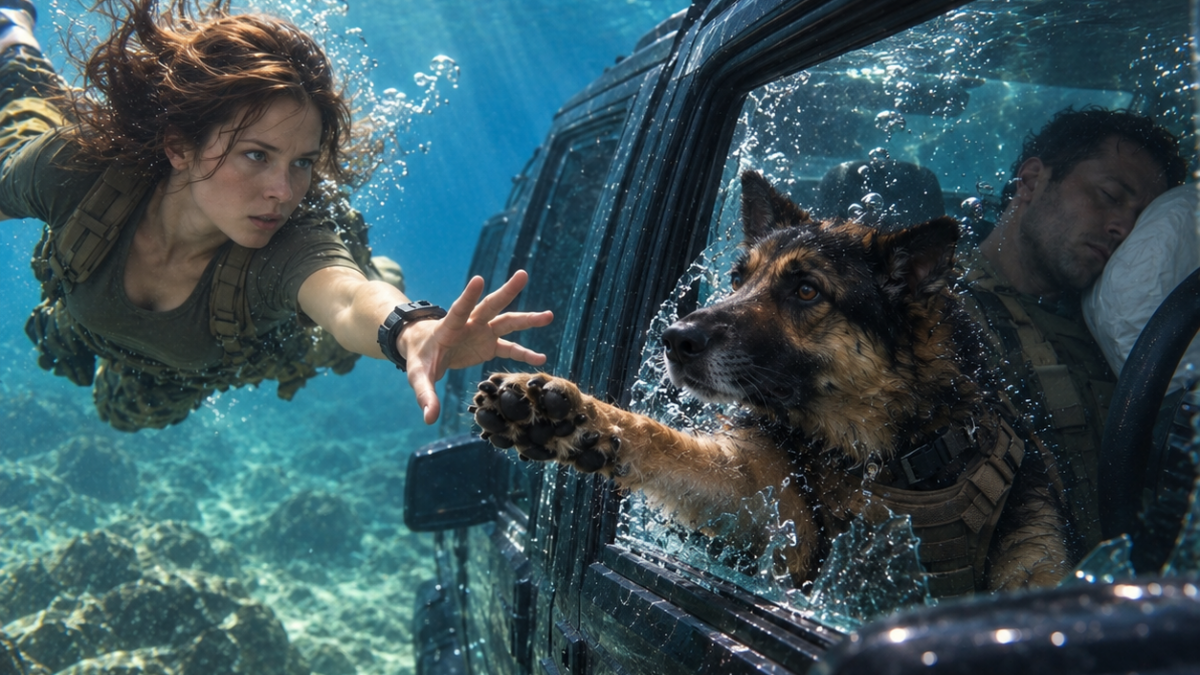
Caleb arrived before Rowan. Through the intensive care doors, she heard him arguing that the approaching festival created an urgent public safety need to question Elias. He wore his emergency jacket and carried a folder as if official paper entitled him to the room.
Witcom blocked him. You have no investigative authority here. I have responsibility for 10,000 people.
Then go protect them. You are not entering that room. Caleb glanced at Keel.
The shepherd stood quietly beside Rowan, but his weight shifted backward. Caleb left without another word.
The neurologist permitted a brief visit after warning that Elias might recognize nothing. Rowan brought Keel inside on a short lead. The dog did not rush the bed.
He approached until the monitors changed pitch, then stopped and waited.
Elias’s eyes opened at the sound of his tags.
Recognition arrived slowly, his brow tightened. Keel raised his head, and Elias moved a trembling hand across the blanket. Rowan guided the dog close enough for that hand to rest between his ears.
The heart rate on the screen eased. Wickham stood near the wall with a state investigator and a hospital witness. She asked only whether Elias understood where he was.
He blinked, swallowed, and managed broken sounds. Lake Keel Owen.
None formed a statement. Rowan refused to fill the gaps for him.
Then Witcom asked, “Did Owen Pike cause your vehicle to enter the water?
Elias’s fingers tightened weakly in Keel’s fur.
The ventilator hissed. A cart rattled in the corridor, then passed, leaving the room suspended in the soft pulse of monitors. His voice emerged, scraped thin, but complete.
Owen didn’t put me in that lake.
He pulled me out the first time. Every assumption in the room shifted.
The neurologist limited them to 10 more minutes broken by rest. Elias spoke in fragments and Witcom repeated each answer to confirm it.
Owen had discovered six explosive charges missing from a dam maintenance store. Because he distrusted local channels, he contacted Elias, whose military connections could help transfer evidence to federal authorities. Elias had been visiting Silver Lake for a veterans water safety program when Owen approached him.
Owen chose him because Elias was outside county government and could authenticate the military-grade components without returning them to the local chain Owen feared was compromised. Elias arranged a federal handoff, but the meeting never occurred.
3 days before the crash, Owen loaded the six sealed cases into the SUV while Elias photographed them at the gas station. They later moved the charges to a concealed pickup point before the federal contact arrived.
Men wearing orange reflective jackets attacked them inside a maintenance warehouse. A fire started.
Owen dragged the injured Elias out through smoke and used his own jacket to bind a wound.
That was why Elias’s blood covered it.
“Third blood sample?”
Whitam asked. Elias looked at Keel.
“He bit one.”
The answer gave the unknown DNA a possible owner, but not a name. Whitam noted that it still required independent confirmation.
Elias said the attackers recovered the six real charges. Someone later placed two disabled training blocks inside his SUV to construct a terrorism narrative. Owen separated from him to protect copies of financial records.
Elias drove toward a meeting point, but a vehicle barricade appeared ahead. His accelerator locked, the brakes stopped responding, and his doors sealed.
“I still had steering,” he whispered.
He had seen Rowan’s maintenance boat beyond the trees.
The SUV’s rear window had already been broken during the warehouse escape, giving Keel a path out.
Elias chose the launch road because the lake offered a chance, while the armed blockade offered none. He had tried to uncip Keel before turning, but the locked doors and accelerating vehicle left no time.
Instead, he folded the rear seat release and shouted the dog’s exit command.
Keel had moved behind him as the SUV struck the water. That memory ended in glass, cold, and the crushing weight of the airbag.
Rowan remembered his body under the water and felt cold gather beneath her ribs. He had not missed the turn.
He had aimed for the only witness he could see.
The neurologist ended the interview, but Elias caught Witcom’s sleeve.
Wrong place. She leaned closer.
Not main dam. Each word cost him.
East auxiliary outlet. Six charges.
Pressure line. That third correction completed the reversal. Owen was not the attacker, but the man who had saved Elias after the first ambush.
Elias was not preparing an attack, but documenting stolen explosives for federal delivery. And while every inspection team searched the main dam, the actual charges waited at an auxiliary outlet excluded from public inspection routes.
Witkim sent a sealed warning directly to the state command post, bypassing county communications. She requested covert surveillance rather than an immediate local evacuation.
A public alarm issued through Caleb’s network could tell whoever held the detonator that Elias had spoken.
State officers began moving toward the outlet under the cover of routine festival patrols. When Elias slept, Wickham addressed everyone in the hall. His statement redirected the investigation.
It did not settle it. A brain injured witness could misremember details. They still needed the original vehicle data, the complete station video, Owen himself, the unidentified blood match, and physical evidence at the East Outlet.
Rowan agreed, believing Elias merely because she had saved him would repeat the same error as condemning him because the evidence had been staged.
Well, later she showed him photographs of the items Whitam had sealed from Keel’s harness.
Elias focused on the half-claim ticket, then the brass key. His hand lifted from the sheet but fell short.
Locker, he said, ferry terminal, Owens copies, payments, shell companies. Witcom immediately began the warrant process.
She would take state police and forensic staff, preserving every link in the evidence chain. No one would walk into the terminal alone. Keel touched his nose to the clear evidence pouch containing the key.
Then he turned toward the hospital window.
Beyond the rooftops, fairies crossed the bright water and cameras along their terminal still fed images to Caleb’s emergency center.
For days, investigators had hunted the man who saved Elias, suspected the man trying to protect Silver Wake and left the correct outlet unguarded. Now, six real charges waited there while the official who controlled the cameras could watch them move toward the first proof bearing his shadow.
By the time Mara Witcom secured the warrant, Dawn had begun whitening the windows of the old silver wake ferry terminal. Rowan stood outside the evidence perimeter with Keel pressed against her left leg.
The 5-year-old Sable German Shepherd wore his coyote brown harness, but no one treated him as a search instrument. He was there because the torn claim ticket had been found in his pouch and because Elias had recognized the brass key.
every movement would be documented. Witcom arrived with two state investigators and Llaya Chen, a compact forensic specialist with black hair braided beneath an evidence cap and a habit of speaking only after she had checked a fact twice. She photographed the half ticket matched its faded number to the terminal ledger, then led them to a row of dented blue lockers.
Camera timestamps were announced aloud. Gloves were changed.
The key passed from an evidence bag into Witcom’s hand.
Locker 314 opened with a dry click. It was empty.
Even Keel’s breathing seemed loud in the narrow aisle.
Rowan felt the small hope Elias had given them collapse into the smell of rust and floor wax. One investigator suggested that brain trauma might have mixed two memories. Witcom did not answer.
She swept a light across every seam while Laya measured the interior. Keel did not put his nose inside. He moved along the neighboring lockers, returned and pressed his muzzle to the narrow gap behind the cabinet.
His ears tipped forward. Then he sat.
Laya crouched. A thin line of fresh silver showed beneath old blue paint.
She inserted a plastic inspection card and felt resistance where the factory wall should have ended. Magnets released one by one with soft metallic taps.
Behind the false panel lay a sealed pouch containing a flash drive, a handwritten payment ledger, four draft contracts, and a county map covered in numbered property parcels. For several seconds, no one spoke. The fairy horn sounded out on the lake low enough to tremble through the lockers.
Keel flinched, then looked toward Rowan. She rested two fingers against his harness and waited while that mournful note faded. An empty box had become a doorway, and everyone in the terminal understood that opening it had placed them inside the danger.
Laya photographed each object before removing it. The state cyber crime technician mounted the drive through a right blocker, preserving the original data.
The first video showed Caleb Ror seated in a private room with two regional contractors and a county procurement officer. Caleb looked nothing like the calm public servant from the rescue site. His sleeves were rolled neatly, his gray hair combed back, and his voice remained mild as he assigned percentages of federal reconstruction money that did not yet exist.
The contracts described emergency work following an anticipated structural failure at the eastern auxiliary spillway. Shell companies had already purchased distressed lakeside parcels through intermediaries.
If the spillway failed, evacuation orders and falling property values would clear the shore for redevelopment. Federal disaster funds would pay the same companies to rebuild what their partners had destroyed.
The ledger made the conspiracy measurable. Dates matched transfers.
Initials matched corporate filings.
But another document corrected the darkest part of the town’s assumption.
Caleb’s original timetable called for a controlled evacuation before the blast.
The criminals expected property destruction, not a crowded shoreline. They had planned to manufacture a disaster large enough to unlock money while keeping deaths low enough to call the event tragic negligence.
That distinction did not make them merciful. It made them calculating. The map identified the eastern spillway, but not the exact placement of the six charges.
The latest entry simply read, “Final array moved, CR only.”
Then Laya opened a second video recovered from the terminal camera archive. Owen Pike entered the station six nights earlier, lean and bearded, one shoulder held stiffly beneath a dark field jacket. He placed the pouch behind the false panel.
9 minutes later, two men in Silver Wake emergency response jackets approached him.
One blocked the exit while the other drove a fist into Owen’s injured shoulder.
They dragged him through a service door alive.
He didn’t run, Rowan said.
Wickham’s face tightened.
And if they wanted a body to blame after the spillway failed, they had a reason to keep him alive. The finding was radioed only over the state police encrypted channel.
Yet above them, a tiny green indicator on the terminal camera continued blinking. The officers had isolated their own devices, but no one had realized that the municipal camera sent an automatic duplicate feed to the emergency operations center. Across town, Caleb watched the locker panel come off.
The first failure came quietly.
Witcom’s radio lost access to the municipal repeater.


