A Female Marine Saved a SEAL and His K9—His First Words Changed Everything – Part 5
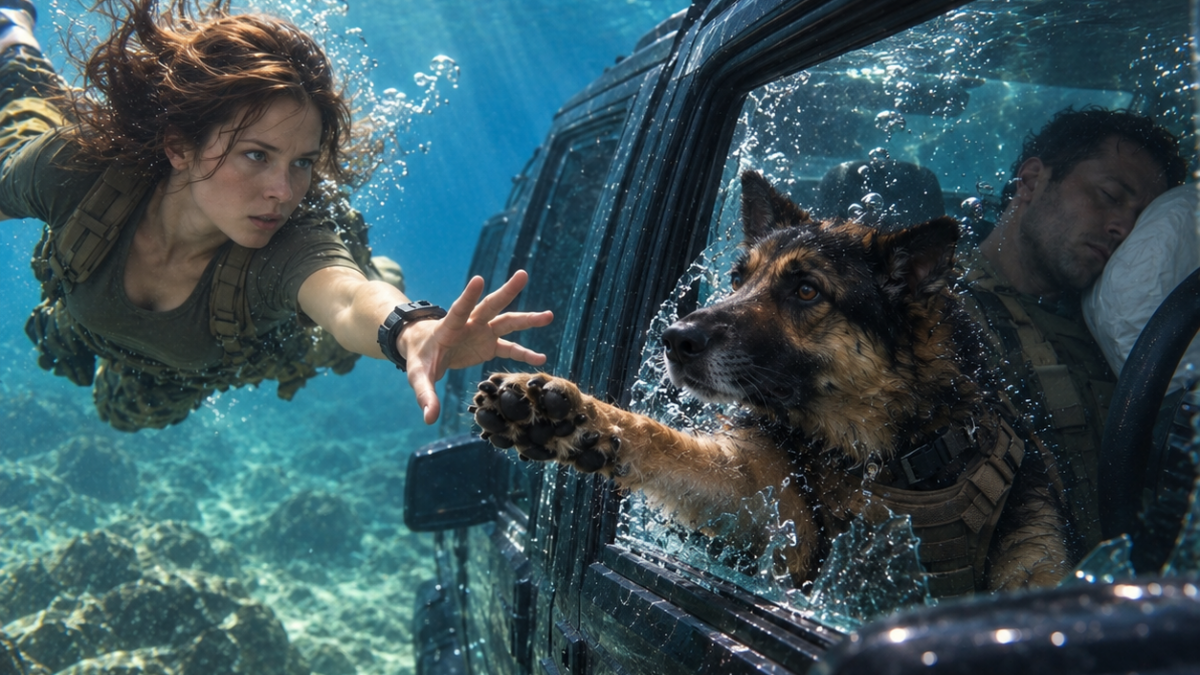
Her pressure regulator clipped a brace and began leaking in a violent stream of silver bubbles. The sound filled the chamber, a rushing roar, then the fast mechanical pulse of her remaining air. For a suspended second, every person on the communications line went silent.
Rowan stared at the red indicators through a storm of bubbles. One light flickered out.
Continue only if stable,” Belle said.
Tessa checked Rowan’s mask seal and clipped a redundant air hose to her chest ring.
Rowan forced herself to pause long enough to signal that she could see, breathe, and move both arms. The discipline felt almost unbearable with the timer running.
Yet, this was precisely what the old training accident had taught her too late. Urgency never canled verification.
Belle read back the remaining pressure and only then authorized the final movement. Rowan checked her gauge, showed Tessa the reading, and received her backup mouthpiece. Together, they forced the wheel through its final turn.
Water flooded the repeater pocket. Four red lights died.
Two remained on the surface. Caleb backed toward the emergency skiff with a pistol leveled at Whitam.
Keel stood behind cover at her side, barking whenever Caleb glanced away, but holding the distance Rowan had trained into him.
Owen staggered upright near the ambulance and shouted that the skiff’s fuel line had been shut at the tank.
Caleb looked toward him. That single distraction gave Wickham room to drop behind a Ballard.
Two state troopers moved from opposite angles. Caleb fired into the decking, then lost the weapon when Wickham struck his wrist with a boat hook. Troopers drove him face down and cuffed him before Keel took one step beyond the command to stay.
Underwater, the countdown reached zero. A blunt flash turned the conduit white. One secondary charge detonated, but the flooded relay prevented the six-part sequence.
Equalized water pressure absorbed the blow. The spillway gate groaned and shifted several inches, yet its supports held.
The shock wave threw Rowan into a crossbar. Her helmet struck steel.
Her tether looped beneath the bent brace and pulled tight as the current reversed toward the open bypass. Tessa caught the railing, but Roman drifted beyond her reach, unconscious.
The trapped line kept her from being drawn deeper into the machinery while also preventing the surface crew from hauling her out. Tessa reported the obstruction and followed the tether through silt. Her light found only the snapped regulator hose and a curtain of bubbles.
She could not see Rowan beyond the bent brace. At the dock, Keel stopped barking at Caleb.
His head turned toward the lake. A cluster of bubbles surfaced 20 ft east of the dive marker, carried sideways through the conduit before rising. The surface team was searching along the original line angle, unaware that the current had displaced it.
Keel ran to the edge, claws scraping wet boards. He barked at the drifting bubbles, moved with them, then pawed the exact plank beside their newest rise. Witcom followed his line of sight.
Your diver is east,” she shouted.
“The bubbles are east of the marker.”
The tender-fed slack. Tessa changed direction, trace the displaced tether beneath the brace, and cut the snagged outer loop without touching the explosive array.
She locked an arm through Rowan’s recovery harness.
The surface crew hauled both women toward daylight. Rowan emerged limp, her face pale behind the mask.
Medics pulled her onto the dock, removed her gear, and began assisted breathing while checking for a pulse.
Keel approached only when Wickham released him, then lay close to Rowan’s boot.
He did not climb on her or interfere.
He watched the medic’s hands and listened to the oxygen valve hiss.
Caleb was alive in custody. Owen was alive in an ambulance.
The gate still stood and people were moving safely uphill. None of it mattered to Keel in that moment.
The woman who had once followed his warning into deep water was motionless again. He lowered his head between his paws and waited for the smallest sign that she had found her way back.
Rowan woke to the rhythm of an oxygen monitor and the pressure of a bandage around her head. Her ribs hurt when she breathed, but the first sound she recognized was not a machine.
It was Keel shifting his weight beyond the hospital door. Witcom had persuaded the staff to let him remain in the family waiting al cove.
He had refused food and watched every person enter Rowan’s room.
When she managed to say his name, one sable ear appeared around the doorway. A nurse opened it wider. Ke walked to the bed, stopped short of the equipment, and laid his chin against the mattress.
“You found me,” Rowan whispered.
Keel closed his eyes beneath her hand. The blast had left Rowan with a concussion, a bruised shoulder, and mild lung irritation. Tessa had escaped with cuts, and a strained wrist.
The auxiliary gate required repairs, but it had not collapsed, and no civilian had died. The evacuation assembled from bells, radios, and patrol speakers had moved the festival crowd beyond the danger zone before the partial detonation.
Elias visited by video from his neurological unit. He was propped upright, his face thinner than before the lake, one hand still slow to obey him.
When Keel heard his voice, he turned from Rowan and touched his nose to the screen. Elias smiled through tears.
“Good work, partner,” he said.
His first statement after waking had not convicted anyone. It had pointed investigators toward evidence that could stand without his damaged memory.
Vehicle records confirmed the throttle and brake override. The unedited service station video showed Owen and Elias documenting the six real cases.
The locker drive tied Caleb to two contractors and a procurement officer. DNA from the third blood sample matched a response team member arrested while trying to leave Michigan.
The underwater relay carried Caleb’s access credentials and tool marks matching equipment seized from the emergency center.
Owen’s testimony established the kidnapping and final placement plan.
The fairy footage showed his abduction.
Together, those independent facts transformed Elias’s account from a wounded man’s recollection into a verified path through the conspiracy.
Caleb and his partners faced federal and state charges involving fraud, sabotage, kidnapping, attempted murder, and interference with emergency systems. Owen was publicly cleared.
He accepted the news without celebration, saying, “Innocence returned on paper faster than trust returned in a small town.”
Weeks later, Witcom stood before the town council and described where her investigation had failed. She had allowed planted evidence to harden too quickly into a complete story.
Miles Danner returned to oversee a new independent communications audit. A civilian board took control of spillway modernization and contract review. Property owners kept their homes.
Marina workers kept their jobs and the lake remained open under temporary safety restrictions.
Witcom also released the corrected timeline with the court’s permission.
It showed which conclusions were known facts which had been reasonable but wrong inferences and which records Caleb had altered. For residents who had repeated accusations against Owen, the distinction was uncomfortable. Some apologized in person, others left unsigned notes at his cabin.
Owen kept none of them, but he agreed to serve on the civilian board because preventing the next lie mattered more than winning the last argument. At the first public gathering after the arrests, Silver Wake tried to place Rowan alone beneath a banner that read hero.
She stepped aside and called the others forward. Tessa and Belle, Ruiz and Witam, Miles, Owen, the volunteer radio operators, the medics, and Elias on a screen. Keel sat between the rows, unimpressed by applause.
The sound swelled against the community hall walls. Then Keel rose and crossed to Owen, resting briefly against his knee. The room quieted.
That simple movement held what speeches could not. The man once hunted as a terrorist had been remembered by the dog who had known him as a rescuer.
Elias entered long-term rehabilitation for his brain, spine, and lungs.
Rowan remained Keel’s temporary caregiver.
She took him to outdoor therapy visits whenever doctors allowed. At first, Elias could only sit while Keel performed familiar obedience drills.
Later, he stood between parallel bars and gave the commands himself. Ke learned to walk slowly beside him, matching a pace that would once have frustrated the powerful working dog.
Months passed. Summer Green turned to Copper along the shoreline.
Rowan repaired her family’s boat, returned to counseling, and finally spoke Danny Kesler’s name without making his death a verdict on every choice she had made since.
Ke slept near her bedroom door, ran the trails with her each morning, and still brightened whenever the rehabilitation van brought them to Elias. Their routine became ordinary in the best possible way.
Elias kept a jar of Keel’s training treats beside his therapy mat.
Rowan learned when to push him and when fatigue had turned his silence brittle. None of them pretended that recovery erased what the lake had taken.
They simply accumulated mornings in which fear did not make the decisions.
The transfer happened only after Elias’s physicians confirmed that he needed many more months of residential care and could not provide Keel the daily work and stable home he deserved.
An attorney familiar with retired military working dog transfers reviewed the records. Elias signed the ownership papers himself. His hand shook above the last line.
Rowan almost stopped him.
He doesn’t have to lose you to stay with me.
He isn’t losing me.
Elias looked at Keel, then at her.
We’re changing the address of his home.
Rowan admitted what she had hidden beneath practical objections. Loving another life meant accepting another chance to fail it. She had believed distance could protect both of them.
Elias set down the pen.
Keel doesn’t need someone who never fails.
He needs someone who always comes back. Rowan signed. On a bright morning near the end of autumn, the three of them returned to the white dock where the lake lay calm beneath a cold blue sky.
Rowan walked ahead in her olive drab shirt. Keel beside her in his coyote brown harness. Elias followed with a cane.
Each step measured but his own. Keel reached the end of his leash, looked back, and stopped.
He did not choose between the man who had carried him through war and the woman who had carried them both out of the lake. He waited until Elias caught up. Then he moved into the space between them, keeping contact with both legs as they walked.
The day Rowan had dived beneath Silver Wake, she thought she was saving a Navy Seal and his dog. Months later, she understood that courage had never meant pulling everyone to shore alone. It meant listening, returning, and allowing others to hold the line when her own strength failed.
No one in their small family would ever have to sink alone again. Sometimes the miracle is not that danger disappears. It is that at the moment fear tells us to turn away, someone finds the courage to return.
Rowan saved Elias and Keel from the lake. But Keel later guided others back to her. And Elias helped her understand that love does not demand perfection.
It asks for presence, patience, and the willingness to try again. In everyday life, we may never face a sinking vehicle or a threatened town.
Yet, we all meet people and animals who need protection, kindness, or one more chance. Treat animals with compassion. Listen when the vulnerable cannot explain their fear and remember that loyalty is a responsibility as much as a gift.
Perhaps God’s grace often reaches us through ordinary hands, faithful hearts, and the quiet devotion of a dog who refuses to leave anyone behind.

