They Called the Nurse a Liability—Then Her Secret Navy Past Exposed a Deadly Chemical Cover-Up – Part 3
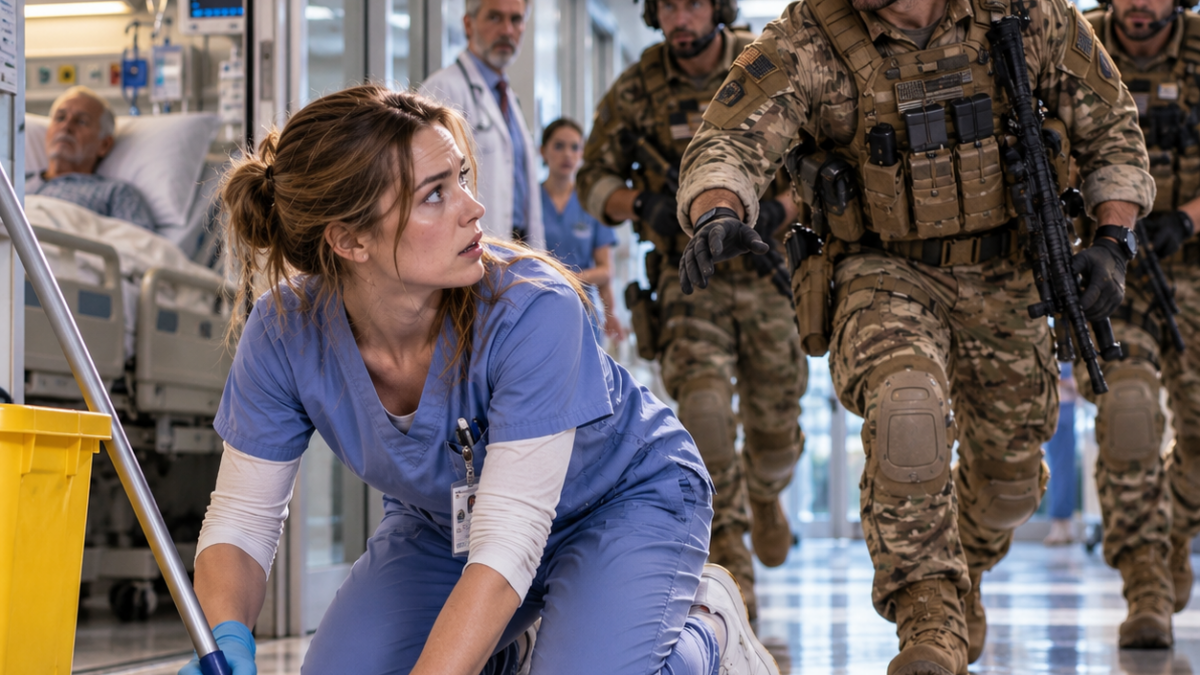
Aldrich came through the door 40 seconds later, and behind him, slightly flushed, moving fast, was Ruth, who had apparently escorted him personally from the ambulance bay rather than trust the message to anyone else. Aldrich took in the room in one sweep. You have about 4 minutes, he said.
I know. Lena looked at him. I want to formally transmit my complete field documentation from the nightclass operation into your active oversight proceeding.
That includes the contamination warning I filed before the evacuation, the corridor authorization from command, my compliance record, and everything I have documented about this compound’s metabolic profile.
Aldrich’s expression didn’t shift.
You understand what the compliance record shows?
I understand exactly what it shows and you’re transmitting it anyway.
I should have transmitted it 3 years ago, she said.
I didn’t.
I’m doing it now.
He held her gaze for 2 seconds. Then he opened a case that one of his staff members had carried in communications equipment, encrypted interface, and he began the process. Talbot gave his encryption key.
Lena gave hers. It took 3 minutes and 40 seconds.
At 4:28 p. m.
, Puit appeared in the Bay 6 doorway.
He looked at Aldrich’s equipment.
He looked at the tablet in Voss’s hands.
He looked at Talbot sitting on the edge of the bed and at Lena standing beside him, and the calculation that moved across his face was visible even through the professional composure.
“Admiral,” he said carefully.
“It’s done, Puit,” Aldrich said.
He didn’t look up from the equipment.
Whatever authority you think you had over those materials transferred jurisdiction the moment formal oversight intake was completed. You can verify the time stamp with your office. He closed the case and this is an active patient treatment area.
If you don’t have medical clearance to be in it, I’d suggest the the waiting room.
Puit stood in the doorway for a moment longer. Then he left. The room exhaled.
Voss turned to Lena, the Ellis patient. I need you back in bay 4.
The collation timing is coming up and I want your eyes on it. Give me 2 minutes.
Voss went. Aldrich began the process of securing the equipment with his staff. Talbot, whose body had apparently decided it had reached the limit of what it would permit him to do upright, lay back against the bed with the controlled movement of someone conserving energy.
Lena stood in the center of bay six and looked at her hands, still shaking, both of them, not worse than before, not better, just present the quiet, persistent tremor that had been with her since the first week at Harrove Valley, the thing Hol had noticed and
categorized as weakness, and Ruth had noticed and categorized as something else. She looked up.
Hol was in the basis doorway.
She didn’t know how long he had been standing there.
long enough to have heard most of it. She suspected because he had the expression of someone who expression of someone who has just received information that reorganizes a significant portion of what he thought he understood about the last 3 hours.
He didn’t say anything about the transmission or about what she had voluntarily included.
He said foresight is at 92%. The hpatic markers are stabilizing. Barker, 88 and holding.
She nodded. He stayed in the doorway.
He said with the slightly stiff quality of a man who has not practiced at this kind of speech.
Bay 9’s patient is asking for you.
He’s conscious and he said he stopped.
He said he wants the nurse who told him why the oxygen mask mattered. She moved toward the door.
Holt stepped aside to let her pass. Marsh, he said.
She stopped. He looked at her for a moment with the expression of someone working through the arithmetic of what they owe and how to say it and not quite arriving at either. You were right, he said, about the intake, about the decontamination corridor, about all of it from the beginning.
She didn’t tell him it was fine.
She didn’t accept it graciously or dismiss it with generosity.
She looked at him and said, “The next probationary nurse who comes in here trembling.”
Before you, you decide what that means. She stopped.
That’s all.
Then she went to Bay 9.
12 minutes later, she was standing in the corridor between Bay 9 and the nurse’s station when Ruth appeared beside her with the quiet footfall of someone who has been in motion for 6 hours and has made peace with the fact that there is no moment when it will stop.
All 10 of the critical hour patients, Ruth said, they’re holding all of them.
Lena did not exhale. She breathed normally evenly because she had learned a long time ago that holding breath was a superstition and caused oxygen and produced nothing. Voss is staying through the night.
Ruth said she’s already called in two colleagues for the day two monitoring.
Good.
Aldrich’s people are still in the building.
I know. Ruth was quiet for a moment.
What’s in that record that you handed over?
She said.
The part that’s about you.
Lena looked at the wall across the corridor. The part where I knew something was wrong and I did it anyway.
Ruth absorbed this. Does it take away what you did today?
She said finally. No, Lena said.
And it doesn’t cancel the other thing either.
Ruth nodded once as if this were the answer she had expected and had simply wanted confirmed.
From Bay Six, the monitor above James Barker’s bed showed 89%.
From the corridor outside it, no sound, which meant Theo Barker had finally, sometime in the last 20 minutes, accepted Ruth’s earlier offer of the family waiting room and a better chair.
Lena turned toward bay 4.
She passed the ambulance bay entrance doors on the way, and through the narrow window in the door panel, she could see the exterior lot Aldrich’s vehicles, the departing figure of Puit walking toward a dark sedan, a hazmat unit still operating near the outer perimeter.
The drive was in Aldrich’s equipment case.
The record was transmitted. Both versions of the night glass incident report the original and the amended one where in the formal proceeding alongside every field log she had carried for three years inside a pocket she had sewn herself into the lining of whatever scrub top she was wearing. She had given all of it up.
She was not certain how she felt about that yet. The feeling had not fully arrived.
It was somewhere behind the last 3 hours of acute clinical work. waiting for the moment her system had the capacity to process it. She pushed through the doors toward bay 4.
Voss looked up when she entered. Good timing, Voss said. I want to walk you through a discrepancy in the Liscalation data before we hit the next dosage window.
Something in the metabolic breakdown rate isn’t matching the timeline from your documentation.
and I want to know if it’s an individual variation or if there’s a factor we haven’t accounted for.
Lena leaned over the tablet. She looked at the numbers and then she went still in a way that was entirely different from the controlled stillness she had maintained for the last 4 hours.
Because the discrepancy Voss was pointing to wasn’t a metabolic variation.
It was a pattern she recognized.
A pattern that should not have been present in a patient exposed to the Caldwell compound unless Ellis hadn’t been exposed at Caldwell.
Unless Ellis had been exposed before he arrived here. She looked at the patient intake information attached to the Bay 4 chart. Ellis, 63 years old, occupation listed on intake as retired logistics coordinator.
The admission time stamp 2:31 pm 12 minutes before the Caldwell casualties arrived. She looked at Voss.
Voss was watching her face. When was he brought in?
Lena said. Voss checked the admission log.
Her expression did not change, but something in it sharpened. He was already here when the Caldwell wave came in, Voss said quietly.
Admitted for chest pain at 29. Lena looked at the bay for curtain and then at the data and then at the pattern in the metabolic breakdown that was not a Caldwell pattern. That was not an industrial accident pattern.
That was a pattern she had seen documented exactly once in a classified field record that until 90 minutes ago had existed in only one place in the world. Her drive. Her voice came out level.
Dr. Voss, she said.
who referred this patient to Harrove Valley today? Voss scrolled the admission record.
Then Voss went very still.
The referring physician’s name on the record was a name that meant nothing to Lena.
But the institutions listed below it, the clinic network that had sent Ellis here this afternoon for chest pain that was apparently something else entirely, had a registration number. a registration number Lena had memorized from the Savar facilities contractor documentation three years ago.
The same network, the same contractor chain in Clarkfield today. and a patient with pre-existing exposure to the same compound that had just killed two of her former teammates, now lying in bay 4 of the ER, where she had spent 3 weeks trying to be invisible, admitted hours before an explosion that Talbot had just told her was not an accident.
She was not supposed to be in this city. She was not supposed to be in this hospital.
Her name on the staff roster of Harrove Valley Medical Center was the most ordinary thing in the world. a probationary nurse with a strange razume.
No one important, easy to miss.
Except someone hadn’t missed her.
Someone had known she was here before the explosion. Had known she would surface the drive when the clinical need was acute enough. Had known that the one thing that would make Lena Marsh break 3 years of silence was 10 patients dying in front of her.
And they had put a man in bay for 16 minutes before the first casualty arrived who was carrying the same compound signature that was now in official Navy custody inside Aldrich encrypted case. A man who had heard everything they had said in this room.
Voss looked at her. Marsh Voss said.
The bay four curtain shifted in the air movement from the vent above the bed. Ellis turned his head toward them.
He looked at Lena with eyes that were quiet and watchful and not at all the eyes of a 63-year-old retired logistics coordinator with chest pain.
And in the outside corridor from the direction of the ambulance bay entrance, all three of Aldrich’s vehicles started their engines simultaneously.
Lena moved before she made a conscious decision to move. She crossed bay four in four steps, put herself between Voss and the bed, and looked at Ellis with the specific attention she had previously reserved for patients who were more dangerous than they appeared. His eyes tracked her without hurry.
Not the eyes of a sick man, not the eyes of someone frightened by the monitor alarms or the clinical conversation they had just had at his bedside. Quiet eyes, watchful eyes, the eyes of someone who has been waiting for this moment and has the patience that comes from knowing it was always going to arrive. Dr.
Vos Lena said without turning around. Step outside, please.
Marsh now a beat then Vosix’s footsteps and the soft displacement of the curtain and they were alone.
Lena looked at Ellis.
He said, “You’re faster than I expected.”
His voice was different. The slight raspiness from intake, which he had attributed to the chest pain presentation, was gone.
His breathing was easy.
His posture had shifted in a way so subtle that a physician doing a 10-minute intake round wouldn’t have noticed it, but which Lena read in approximately 2 seconds as the posture of someone who no longer needed to perform illness.
The metabolic pattern in your blood work, she said. What about it?
It’s preexposure, not from the Caldwell event.
You came in with it, she held his gaze, which means you’ve been in contact with this compound before today.
Long enough for the metabolic markers to show secondary accumulation. He looked at her with something that might have been appreciation, if appreciation were completely stripped of warmth. How long have you known?
He said, 4 minutes.
And you didn’t call for security.
I’m deciding whether to He was quiet for a moment.
Then you transmitted everything to Aldrich. Yes.
Both versions of the night glass incident report. Yes. He nodded once, as if confirming something he had calculated earlier.
The people I work for wanted to know whether you would do that. Whether you would release the compliance record alongside the warning. He looked at his bandaged hands actual injury.
she noted, sustained before today. Old burns that the intake team had documented without questioning.
That was the test. Lena went very still.
The explosion, she said, was not directed at Talbot. His voice remained even, conversational, the voice of someone delivering information rather than confessing to anything. Talbot was the mechanism.
His documentation combined with yours is exa is exactly what three separate oversight proceedings have failed to produce in the last 18 months.
They’ve had the amended incident report.
They haven’t had your compliance record.
Without it, the chain of command failures can be explained away. A warning filed too late. A contamination assessment that was genuinely ambiguous.
He held her gaze with it. The person who issued the corridor authorization has no remaining procedural cover. She heard herself breathe.
You engineered this, she said. I placed pieces where they needed to be.
He shifted slightly against the pillow, the first movement she’d seen that looked like genuine discomfort.
The chest pain was real, since you’re wondering.
Side effect of the compound accumulation.
I’ve been managing a low-grade exposure for 7 months, which is what happens when your job requires you to verify that a storage facility is actually producing what its manifest says.
Who do you work for?
An office that doesn’t appear on any organizational chart that Puit or his people have access to.
He paused. the same office that has been trying to put the Savar Contractor network in front of a credible network in front of a credible proceeding since before you disappeared.
She looked at him for a long moment. You used 10 people, she said.
10 patients who had no idea the Caldwell explosion was going to happen. He said the compound was already unstable. The storage conditions Talbot documented made a release event a question of weeks, not months.
We didn’t cause the instability.
His voice didn’t shift, didn’t become defensive.
We knew the timeline and we positioned assets in the response corridor. I am not an asset.
No, he said, you’re a witness.
There’s a difference.
He held her gaze.
And you’re the only one who had both pieces.
The compound data and the compliance record. We could have found the compound data elsewhere eventually. The compliance record exists nowhere but inside you.
The curtain opened. Aldrich came through.
He looked at Ellis with an expression that was not surprise, which told Lena that whatever Aldrich knew about Ellis’s office, it was more than he had told her in the consultation room.
“How is he?”
Aldrich said, directing the question at Lena.
“Conscious and apparently finished maintaining his presentation,” she said flatly.
Aldrich’s jaw tightened.
He looked at Ellis.
“The vehicle’s outside,” he said.
“Leaving, Ellis said.
The case transfer is complete. Everything transmitted to your proceeding has been simultaneously routed to two external oversight bodies that your chain of command cannot access or suppress, including the names on the corridor authorization. He paused.
You have what you need. So do we.
Aldrich said nothing for a moment.
The expression on his face was the expression of a man processing information he doesn’t entirely like and doesn’t entirely dispute.
He looked at Lena. Did you know about this?
She said to him, “I knew there was a parallel operation.
” He said, “I didn’t know the mechanism.”
“That’s a very careful answer.”
“Yes,” he said.
“It is.”
She left them in bay 4. She walked to the supply corridor and stood with her back against the wall and her eyes in the ceiling and her eyes on the ceiling and her hands at her sides shaking.
Not the faint tremor she had carried for 3 years. Actually shaking both hands visibly and she let them and she breathed and she counted tiles on the ceiling because she needed something concrete and countable and external to hold on to for 30 seconds.
30 seconds. Then she went back to work.
What she needed to know was whether it mattered. The engineering of it, the position of pieces, the decision someone in an office without a name had made to put a sick man in bay 4 and a chemical plant explosion on her doorstep, and trust that Lena Marsh would do what Lena Marsh had in the end done.
whether the record
being transmitted because she had chosen it was different from the record transmitted because someone had built a situation designed to make her choose it. She did not resolve this question in the supply corridor. She was fairly certain she would not resolve it today.
What she did in the next 40 minutes was finish her shift. The day two monitoring protocols that Voss and her colleagues had built from the compound documentation were solid.
Ellis’s real name, she would learn later, was something bureaucratic that the hospital would would file under a different admission record, was transferred out of Hardrove Valley’s care at 5 12p m by a team that arrived with the kind of quiet institutional authority that doesn’t invite questions.
Puit’s vehicles had left the parking lot by 4:45.
Aldrich remained. Marcus Talbot remained.
He was the patient she checked on last.
He was sitting up when she came in, the blanket still around his shoulders, and he had the look of someone who had spent 14 months carrying something very heavy and has recently set it down in a place he’s not entirely sure is safe.
“They got it,” she said.
“All of it.”
Aldrich’s proceeding in the external bodies.
Talbot exhaled a long, slow release that seemed to come from somewhere deeper than his lungs.
“Your documentation,” she said.
“Both versions of the incident report.”
The contractor forwarding evidence, she paused.
“It’s going to hold up.
It’ll hold up.
” His voice was steadier than it had been.
14 months of documentation. I made copies, physical copies, offsite. He looked at her.
I learned that from the people who initially buried it. She nodded.
The two people who died in the night glass evacuation, she said.
I don’t know if you know their names.
I know their names. The amended report listed their deaths as unavoidable.
She held his gaze. The original before the amendment had a different characterization. I know what the original said.
She was quiet for a moment. The proceeding will get there.
Yes, he said eventually. She looked at his hands. Your injury, the chemical burns.
How long have you had those? 7 months. Same as Ellis, roughly.
I spent 2 months trying to convince Caldwell’s medical officer that my exposure wasn’t from routine industrial contact.
He looked down at the bandaging. He filed it as occupational dermatitis.
Voss is going to want to see you again tomorrow, she said. The extended dosing protocol applies to you too from what I can see in your presentation.
I figured. She turned to leave.
Marsh, he said. She stopped. You released the compliance record, he said.
Yes, you didn’t have to.
She looked at the curtain in front of her for a moment. Yes, I did. Then she went back to the floor.
At 5:34 p p. m. M Garrett Holt found her at the medication station.
She was processing the end of shift handoff documentation, the part of nursing work that is invisible and essential and that exists in direct proportion to how much happened during the hours it documents. She had been writing for 11 minutes.
The stack next to her right hand was substantial. He stood beside her without speaking for a moment. She kept writing.
The review board, he said finally.
Hospital administration wants to convene a formal review of today’s events.
Standard protocol after a mass casualty event. He paused.
They’re going to ask about the decontamination corridor decision.
The delay in establishing it. The initial intake assessment discrepancy. Yes, she said they should.
Your assessment was on record 6 minutes before the first casualties arrived. he said.
I rejected it. I know the review board will have that timeline. She kept writing.
I know that too. It was quiet for a moment. I intend to give an accurate account.
She looked up from the paperwork then briefly. His expression had the quality of something that had been worked through, not resolved, not comfortable, but arrived at by someone doing the actual work of arriving rather than circling.
She recognized the look. She had seen it in her own face distantly in various mirrors over the last 3 years.
That’s the right thing to do, she said.
She went back to writing, he said. Marsh, what you included in that transmission today? The compliance record.
He stopped. Started again.
That required something. Yes.
I don’t know what to do with that.
She thought about this for a moment.
Then you don’t have to do anything with it.
It’s not about you.
She sat down her pen and looked at him directly. The review board, the documentation, giving an accurate account of what happened today.
That’s what you do with it.
The rest is mine. He nodded. He walked away.
Lena picked up her pen and kept writing. At 5:58 p. m.
, Ruth came to the medication station and stood next to her in the particular way that Ruth particular next to things when she had information. She had been waiting for the right moment to deliver.
Barker, Ruth said. Lena stopped writing.
87% stable.
He’s been holding for the last 40 minutes without intervention.
Ruth paused.
Weston thinks he’ll be breathing without supplemental support by morning.

