The Nurse Was Called a “Relic” — Then Navy SEALs Arrived Calling Her “Captain” – Part 2
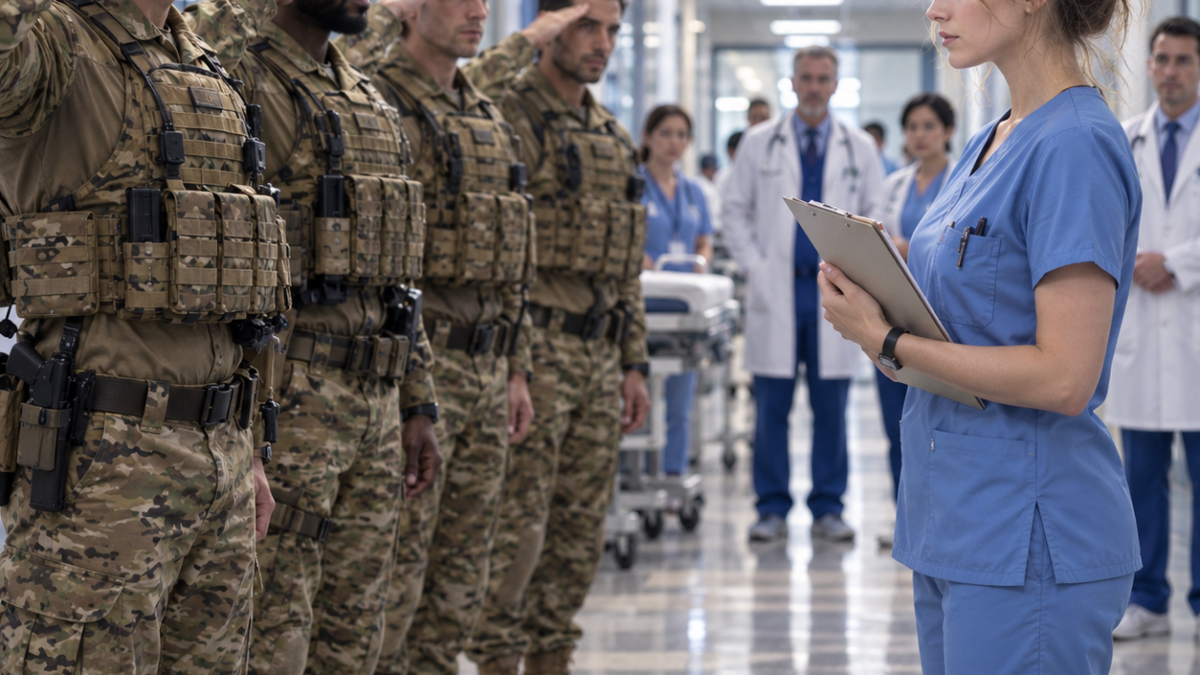
At 4:47 in the morning, every light in the administrative wing of Harrow Creek General came on at once. Part three. At 4:47 in the morning, every light in the administrative wing of Harrow Creek General came on at once.
Margaret saw it from the trauma bay. The sudden brightness bleeding under the internal corridor door, visible even from where she stood.
The kind of light that doesn’t belong to night shift protocol.
The monitors kept their rhythms. The truck driver kept sleeping.
She kept her hands moving on the chart she was updating because the chart needed updating and because standing still in the direction of whatever was happening in that corridor was not going to change its outcome. Tobias looked up from his station.
He’d been awake long enough that his responses to stimulus had slowed perceptibly.
Not dangerous, just tired.
“What is that?”
he asked.
“Administrative,” Margaret said.
At 5 in the morning, “Apparently.”
He looked at her in the way that young residents sometimes looked at her, like she was a terrain feature that had been there longer than the road and might know something about where the road was going.
She didn’t elaborate.
What she knew was this. The investigators had moved from the corridor.
The state woman who’d been on the phone and the federal man with the document case had gathered Ostraki and had gone.
And the going had a quality of intention that suggested they were not waiting for morning. Conrad Voss had gone in the same direction 11 minutes earlier, walking fast without running, which was the specific speed of a man who still believed he had time to control a situation that had already moved past him.
She finished the chart, filed it,
and pulled up the respiratory note she’d flagged on the truck driver.
The irregularity was still there on the monitor, periodic, shallow, the kind of thing that could be managed another 4 hours or could tip into something requiring intervention. And the determining factor was usually a combination of patient weight, existing respiratory history, and the specific character of the irregularities interval.
She studied it for about 90 seconds and decided it was going to hold, but flagged it for the morning, attending anyway with a note specific enough to be actionable. Then she heard the voices.
Not loud, not arguing, not yet, but audible through the corridor door in the distinctive way that voices carry through institutional space when multiple people are speaking with purpose in a room that doesn’t normally contain that much directed energy.
She couldn’t make out words.
She could make out tone. And the tone had the quality of several conversations happening simultaneously with the particular organizational chaos of a formal process being applied to a situation that the participants had been building toward for weeks and had now reached its first point of contact.
Desawn came through the trauma unit doors at 503, still in her scrubs from the previous shift, which told Margaret she hadn’t gone home.
Boss’s assistant just called every board member, Deshawn said without preamble.
the one she could reach at this hour. Anyway, I heard her in the hallway before the administrative doors closed. Which board members?
I don’t know.
She was going through a list. She looked terrified.
Margaret considered this. Voss was lawyering up in the only way immediately available to him, activating the institutional relationships that had protected his decisions for 8 months. It was a reasonable move.
It might even buy him time. Board members reached at 5 in the morning and told something vague and alarming tend to respond by closing ranks first and asking questions second.
Who’s the board chair?
Margaret asked. Miriam Holst, Deshawn said.
She’s been chair for 4 years.
I don’t I don’t know what she knows about any of this.
Is she local? She lives about 20 minutes out. Margaret took this in.
20 minutes.
If Voss’s assistant had reached Holst, Holst was either on the phone with lawyers or in her car.
Either way, the board’s initial response was going to reach the administrative wing before the investigators had finished their first formal hour of documentation.
“Go home, Deshawn,” she said.
“I’m not going home.”
“You’ve been here since yesterday afternoon.”
“So have you.”
Desawn looked at her with the specific stubbornness of someone who has decided they’re part of a situation whether or not they were invited.
I’ve been writing down everything you told me to write.
Every case I can remember, every date, every time Voss came in here and made a call he had no business making.
I’ve got three pages.
I want someone official to have it. Give it to the woman in the gray jacket when you find her.
State investigator.
Don’t give it to Ostraki.
Why not Ostraki?
Because Ostrouski approved two of Voss’s staffing decisions, and right now I don’t know whose side he’s on.
Desawn’s jaw tightened.
Okay. She paused.
What about you? Are you okay? It was such a plain question asked in such a plain way that it caught Margaret slightly off center.
She looked at Deshawn, this woman who had worked beside her for 4 years, who had delivered the suspension notice with her eyes down, who had stayed in the building until 5 in the morning, writing notes on a yellow legal pad because it was the right thing to do.
I’m fine, Margaret said, which was not entirely true, but was true enough.
Deshawn nodded and went to find the woman in the gray jacket. At 5:20, Commander Ashby reappeared.
He came through the trauma unit doors with less of the deliberate quiet he’d carried earlier, not hurried, but the pace of a man moving through a situation that was developing and required presence.
The board chair is here, he said. Margaret looked up. Holst arrived six minutes ago.
She came directly to the administrative wing, not the lobby. Someone let her in through the side entrance. He paused.
She brought someone with her.
A man we’re not certain of yet.
Not legal counsel. His identification is different.
He’s been on the phone since they arrived.
Different how? State level.
Possibly the commissioner’s office.
This changed the shape of the next few hours considerably.
The commissioner’s office had a different relationship to the state health authority inquiry than the hospital board did.
They could either accelerate the process or complicate it depending on where their interests aligned. And at 5:20 in the morning, interests were still being sorted. I need to go up, Margaret said.
To the administrative wing. Yes. Ashby looked at her carefully.
You’re suspended.
Your presence up there could give Voss’s team a procedural argument.
I know, she said.
I’m not going to argue with Voss.
I have information the investigators need to hear that isn’t in any file.
She looked at him.
You said this wasn’t my burden to carry alone.
I’m asking you to get me in the room.
He held her gaze for a moment. Give me 2 minutes, he said.
He gave her three, which she used to check the truck driver one more time, verify Tobias had current orders for both patients, and drink approximately half a cup of water from the station sink because she had been on her feet for the better part of 10 hours, and hydration was not a metaphor. It was physiology.
Then she followed Ashb into the corridor. The administrative wing of Harrow Creek General at 5:30 in the morning had the specific quality of a place that was accustomed to one kind of activity being subjected without warning to an entirely different kind.
The hallway leading to the department offices was well-lit, carpeted in the institutional blue gray of a space designed to feel professional rather than warm with framed certificates on the walls and a fus and a planter near the conference room entrance that looked
like it hadn’t been watered in several weeks.
The conference room door was closed. Through it, Margaret could hear multiple voices, organized rather than chaotic.
The sound of a meeting that had an agenda, even if the agenda had not been agreed upon by everyone present.
Outside the conference room in the hallway, stood two people Margaret didn’t know, and one she did.
The one she knew was Priya Anand, who had changed out of surgical gear into street clothes, but still had the demeanor of someone who hadn’t slept, standing against the wall with her arms crossed and a look on her face that said she had been here for some time and was not planning to leave.
“What are you doing out here?”
Margaret asked.
“Waiting to be called in,” Anna said.
The state investigator asked me to stay available.
She said she’d need me to walk through the Bayour case on the record.
She paused. I also sent her the written account.
The one you told me to do. How long ago? About an hour.
1 hour.
Written, sent, timestamped in the investigator’s possession before the board chair arrived.
Margaret felt the specific satisfaction of a process running correctly. Not cleanly, not easily, but correctly.
She turned to Ashby. I need to be in that room working on it. He had his phone out and was texting someone.
The response came within 30 seconds and he read it then looked at the conference room door. Kolowski, the federal investigator, says he can bring you in as a clinical witness. Your direct clinical involvement in the TR case tonight qualifies you, but the board chair may object.
Letter. He knocked twice on the conference room door.
A pause. The door opened.
The room was fuller than she’d expected.
The federal investigator, the man with the document case, whose name was apparently Kolowski, sat at one end of the conference table with a laptop open and a recording device placed in the center of the table. The state investigator in the gray jacket sat to his left with her own documentation.
At the far end of the table, Conrad Voss sat in his administrator’s jacket with his hands flat on the table in front of him, and beside him was a woman Margaret didn’t recognize who had the specific stillness of legal counsel.
Miriam Holst sat to Voss’s right.
She was perhaps 65 with white hair cut close and the kind of face that had made a lot of decisions over a long career and knew how to hold itself neutral while doing it. The man who had come with her sat one chair removed, phone face down on the table.
Holse looked at Margaret when she entered, and there was a moment of assessment that was quick and thorough and gave nothing away. Dr. Kolowski requested the clinical presence of Mrs.
Oay as the treating nurse on the TR case, Ashb said from the doorway. Ms. Oay Voss said his voice was careful.
Is on administrative suspension effective pending review, the state investigator said without looking up from her notes. Not termination.
She retains clinical standing.
Voss’s legal counsel leaned close and said something Margaret couldn’t hear.
Have a seat, Miss Oay,” Kolowski said, gesturing to the chair across from Voss.
She sat. Ashb remained in the doorway.
What followed was not dramatic in the way that scenes of institutional reckoning are sometimes portrayed. It was slower than that, more procedural, built from the accumulation of documented specifics rather than from confrontation. Kolowski walked through the federal interest in the Tron case, the patients military health coverage, the nature of the Route 9 incident, the treatment provided, and the timeline of decisions made.
He asked Margaret to describe on the record her clinical observation in Bay 4 the information she communicated to Dr. Anand and the outcome.
She answered in precise clinical language, not defensive, not elaborate, exactly what she had seen, exactly what she had said, exactly what had happened. Then Kolowski turned to a different section of his documentation and the temperature in the room changed.
He laid out in the same precise language the 17 cases that had been flagged in the complaint not as accusations as documented discrepancies, dates, patient identifiers, procedural notations that had been filed and then revised, revision timestamps that didn’t align with clinical rationale.
He was methodical and unhurried. And Margaret watched Conrad Voss across the table and watched his face do the thing that faces do when a person is working to maintain a composure that is being tested from multiple directions simultaneously.
Holst was watching Kolowski, not Voss. That was notable.
The legal council intervened twice with procedural objections. Both times the state investigator addressed the objection with specific statutory language that indicated she had anticipated both objections in advance.
The second time, the legal council’s response was shorter, and she made a note on her pad that had the quality of a person updating their assessment of the situation.
At 6:15, Kolowski set down a specific page from his documentation and said, “Dr.
Voss, the revision to the Palro file on November 14th.
Can you walk me through the clinical rationale for that revision?”
The room was very quiet. The Palro file?
Margaret didn’t know the name specifically, but she saw something in the way Voss looked at the page that told her this was the thread Kowski had been building toward.
Not the most recent case, not the flag 17. One specific case, one specific revision, one specific timestamp.
Voss looked at his council.
His council said carefully, “Dr.
Voss is reviewing the documentation.”
The revision was made at 11:42 p. m.
on November 14th, Kolowski said, 14 hours after the patient was discharged. The original notation indicated a recommendation for follow-up imaging. The revised notation removed that recommendation.
The patient was readmitted 6 days later with a condition that the original recommendation would likely have identified. The silence in the room was the kind that contains multiple people not speaking for different reasons. Miriam Holse turned and looked at Conrad Voss directly for the first time since Margaret had entered the room.
Voss said, “The revision reflected additional clinical context that became available after the initial notation.”
“What clinical context?”
Kolowski asked. Another pause slightly too long.
“I’d need to review the full file before.
” “The full file is on page 47,” Kolowski said and slid the relevant section across the table.
Margaret watched Voss pick up the pages. She watched his legal counsel lean over and read simultaneously.
She watched the specific quality of silence that follows when two people are reading a document and both of them understand that the document does not contain what one of them needs it to contain. Miriam Holst cleared her throat.
I think we should take a 10-minute recess, she said, not to Kowski, to the room.
I’d prefer to continue, Kolski said pleasantly.
Holse looked at him. Something passed between them. the specific negotiation of two institutional authorities establishing whose process had primacy in this room at this moment.
5 minutes, Kowski said. Pulse nodded. Margaret stood and stepped into the hallway where Ashb was still positioned with the patience of someone who had learned to wait for things to unfold at their own speed.
Anand was still against the wall.
The two people Margaret didn’t know had moved further down the corridor, and one of them was now on the phone.
The Palomero case, Margaret said to Ashby quietly. You knew that was the one.
It was the clearest documentation, he said. Revision outside clinical hours, adverse patient outcome directly traceable. No supporting evidence for the change in recommendation.
Who else is in that file? Three cases adjacent. Palro is the clearest, but the others establish pattern rather than isolated incident.
He paused. The board may try to characterize it as a documentation error, a systemic failure rather than an individual act. Is that possible?
It’s possible to argue.
It’s not possible to sustain under the full timeline.
He looked at her sideways. The former corman, Sandra Reeves, she kept her own contemporaneous notes, dated, detailed, not shared with anyone until 3 weeks ago. Her notes cover the period before and after the Palro revision.
Margaret absorbed this. Sandra Reeves, who had worked the overnight trauma rotation, and who had been terminated in November under a restructuring rationale, had been keeping notes, had seen enough to know that notes mattered, had waited until there was someone to give them to.
She’s more prepared than I was, Margaret said.
She had a different kind of warning, Ashby said. The conference room door opened.
Kowsk’s assistant, a young woman who had been taking supplementary notes at a chair against the wall, leaned out and said, “We’re resuming.
Margaret went back in. The 5 minutes had done something to the dynamic in the room.
Hol’s posture had shifted, not dramatically, but the careful neutrality had acquired a quality of resolution, as if the recess had been used not for strategy, but for some private decision.
Voss’s legal council had a new page on her notepad and had into something very controlled.
Voss himself looked like a man who had made several calculations in the last 5 minutes and had not liked any of the results. Kowski resumed with the Palomero case for 11 more minutes.
He asked specific narrow questions. He received specific narrow answers, careful answers, the answers of people operating under legal counsel. And into every space between the question and the answer, the documentation spoke for itself.
the revision timestamp, the absent clinical rationale, the patient readmission, the original notation intact in the system history because system history could be accessed but could not itself be revised. Then the state investigator took over and she moved to the staffing decisions. Sandra Reese Patterson, the two internal candidates who had not been appointed.
Dolores Webb, whose name entered the official record for the first time in this room when the investigator spoke it aloud.
At 7:03 in the morning, Voss’s legal council requested a formal adjournment.
Kowski said the session would conclude at a natural stopping point and that he had approximately 40 minutes of material remaining.
The legal council said, “My client will not be responding to further questions at this time.”
Kowski noted this for the record. He looked at Holst.
Madame Chair, he said, “Do you have any questions you’d like to place on record before we adjourn?”
Miriam Hol looked at Conrad Voss for a long moment. The look was not angry.
It was the look of someone who had approved an appointment, had trusted a process that had been manipulated, and was now sitting in a room with the documentation of what that trust had been used for.
“No,” she said.
“Not at this time.”
The session closed at 7:41. Margaret walked out of the conference room into a corridor where the sun had started somewhere in the last hour to make itself felt.
Not through windows, because this corridor didn’t have windows, but in the way the building’s general atmosphere shifts when the dayshift arrives and the overnight staffing begins to hand off and the hospital starts performing its daytime version of itself.
She could hear the elevator. She could hear more voices at the nurses station down the corridor. The smell of coffee had appeared from somewhere.
the institutional coffee that was never quite right but was always welcome at a certain hour. Anand was still there.
She looked at Margaret with the expression of someone who had been waiting to say something for the last 2 hours and had been choosing the right moment. I looked you up. Anand said Margaret stopped.
Not online.
There’s not much online.
She paused. I asked Commander Ashby during the recess. I asked him what your background actually was.
Not the vague version, the actual version. What did he tell you?
Anan looked at her steadily. That you spent 12 years as a Navy special warfare medic.
That you completed three overseas deployments in environments where the nearest surgical support was sometimes days out. That you trained advanced combat medicine to two graduating classes of special operators and that every person you certified is still active.
She paused. He also told me about a specific incident in your third deployment that resulted in a commendation you never accepted publicly. I accepted it privately, Margaret said.
I just didn’t need it hung on a wall.
You’ve been working this floor for 6 years, Anun said, with credentials that would qualify you for a clinical directorship at any hospital in this state.
That’s not what I wanted.
I know, but I spent 8 months calling you the relic behind your back, and I need you to know that I She stopped, started again. I missed that presentation in bay 4 because I was moving too fast and reading the monitor instead of the patient. You saw it because you read the patient.
That’s not instinct.
That’s 12 years of reading patients when monitors weren’t available.
She let out a slow breath. I have a lot to learn. You saved his life.
Margaret said the surgery was yours.
Don’t give that away.
I saved his life because you made sure I had something to save. Anen looked at her.
That’s not a small distinction.
It wasn’t.
Margaret knew that.
She also knew that standing in a hospital corridor at 7:45 in the morning, accepting credit from a colleague she’d spent six years watching have her competence quietly compressed by institutional pressure was not the moment for debate.
Get some sleep, Margaret said. And eat something.
You’ve been on since yesterday.
Anna and almost laughed. Almost.
She went. The hallway emptied in stages over the next several minutes.
Kolowski’s team packed their documentation with the efficient specificity of people who had done this before and knew which materials needed to be organized before transport and which could wait.
The state investigator Margaret had learned her name was Flores had a brief exchange with Ostki near the administrative office and Ostrousk’s face during that exchange had the quality of a man revising his understanding of his own situation rapidly.
Ashb found her near the corridor intersection. There will be a formal notice to Voss by end of day. He said the board has been informed of the federal interest Hulse position.
He paused.
She’s not defending him.
She wasn’t expecting what she saw in that room.
Did you know that before tonight?
We knew she wasn’t part of the appointment irregularity.
Beyond that, he shrugged slightly.
You can’t always read a room before you’re in it.
Margaret nodded.
There’s something I need to do, she said.
He read her face. recovery.
Yes. Marcus Tran was on the second floor in the post-surgical recovery ward in a room at the end of the hall. The morning light was coming in from the east-facing window.
Actual light now, not the gray pre-dawn quality, but the specific clear light of a morning that had followed a storm. The sky outside washed clean and very blue.
He was awake. She had expected him to be thinner.
He was The face she was looking at was not the 19-year-old face from Ashby’s photograph.
And that should have been obvious, but it still required a moment of adjustment.
He was 38 and he looked it in the way that people look their age when they’ve been unconscious for the better part of a night and have woken up in a hospital room without full clarity yet on the timeline.
He saw her in the doorway.
He didn’t say anything for a moment.
Neither did she. You look exactly the same, he said finally.
I don’t, she said.
But thank you. She came in, pulled the chair from the wall, and sat in it the way she sat in all chairs, forward, practical, not making herself comfortable.
He looked at her for a long moment with the specific expression of someone taking inventory, making sure the person in front of them matches the person they’d been carrying in memory.
“I heard you pulled the right call on the flank,” he said.
The attending surgeon pulled the right call. I read the presentation.
“Same thing.”
“It isn’t actually.
” He almost smiled, but the pain medication was still heavy in his system, and it made the expression lopsided.
You’re still doing that thing where you give away the credit.
I’m being accurate.
You told me that once, he said.
When I was in recovery the first time, I’d been trying to thank you for something specific, and you kept redirecting to the team, and eventually I gave up.
He paused, breathing carefully in the way that postsurgical patients breathe when the chest muscles are reminding them of their current situation. I was 19.
I didn’t have the vocabulary yet for what I wanted to say.
Marcus, I’m saying it now.
His voice was steady in spite of the effort it was taking. You were the only one who stayed with me the whole time.
You didn’t have to.
The field station had other casualties, some of them worse than me. But you stayed. The others were stable.
See, you’re doing it again.
She stopped. He looked at her.
16 hours, he said quietly.
That’s how long the extraction took.
And you stayed for 16 hours. She remembered those 16 hours in a way that was not linear, not a clean narrative, but a collection of tactile details. The temperature of that room, the sound the ventilation made, the way she had learned by approximately hour 4 exactly how his breathing changed when the pain broke through the medication threshold and had adjusted accordingly so the breaks were shorter.
She had been 28 years old. It had been her second deployment. She had not thought about those 16 hours in quite some time.
She had put them in the same interior space where she put everything from that period. Not buried, not suppressed, just set aside.
The way you set aside a tool you’re no longer using, but don’t want to discard.
You didn’t have to come here, she said.
It came out more quietly than she intended. I know.
I wasn’t looking for you.
If that he paused, adjusted his position slightly, winced. I was doing a training rotation at the facility north of the city.
The accident was I wasn’t expecting it.
When I came around enough to understand what hospital they were taking me to, I didn’t know you were here.
I found out. He stopped.
When? She asked.
When they were loading me, one of the paramedics said the nurse who’d flagged my case.
She said the name. He looked at her.
It’s not a common name.
Margaret said nothing. I needed to know it was you. he said.
“That’s all I needed them to find out and to make sure you knew.”
“I knew,” she said.
He nodded slowly. The room was quiet. Outside the window, a car moved through the parking lot below, catching the morning light on its roof panel.
A bird landed briefly on the outside sill and left again.
“What’s happening downstairs?”
he asked. Ashby told me the basics. The investigation.
It’s proceeding.
Because of tonight, or was it already? It was already moving tonight.
She considered how to characterize it. Tonight made it harder to slow down. He looked at her steadily.
Good.
It’s complicated.
I know what complicated looks like.
He said, “This is still good.”
She stood because she had been sitting for a collective total of perhaps 40 minutes in the last 12 hours, and her back was informing her of this with the specific eloquence of a body that has been running on discipline and has now identified a moment where discipline is temporarily optional. She
moved to the door.
Margaret, he said, she turned. He was looking at her with an expression that had none of the lopsidedness of the earlier almost smile.
It was direct and clear in the way that things are clear when they’ve been distilled over a long time into something that doesn’t require many words.
“Don’t disappear again,” he said.
She held his gaze.
She didn’t make a promise.
She wasn’t a person who made promises lightly, and she wasn’t ready to make this one specifically, because making it would require an acknowledgement of something she’d been managing from a careful distance for 6 years.
the possibility that the quiet life she’d chosen had also been a way of not being known, and that not being known had its own cost that she’d been absorbing slowly enough not to notice.
She said, “Get some rest.”
She stepped into the corridor and pulled the door closed behind her.
In the hallway, there was a nurse she didn’t recognize, morning shift, new face, who nodded at her as she passed, an orderly with a medication cart.
The normal human traffic of a hospital returning to its daytime operational weight. She took the stairs down because the elevator felt slow and she needed to move. The lobby was different in the morning light.
The tactical SUVs were gone from the parking lot. She could see that through the front glass.
The night desk had been relieved by the day staff. Everything that had happened in this lobby between 2:00 and 5:00 in the morning had left no visible trace, which was either comforting or disturbing, depending on how you chose to interpret institutional surfaces. She was crossing toward the main corridor when the overhead intercom clicked on.
It was not an emergency code. It was a standard announcement, the kind that happens a dozen times a day in a hospital.
Routine, administrative, not designed to stop anyone in their tracks. But the name it used made three people in the lobby stop simultaneously, including Margaret. Dr.
Oi, please report to the chief of medical operations office, Dr. Margaret Oi.
She stood very still. Not Mrs.
Oay, not Miss Oay, not the nurse who overstepped, not the relic, not the dinosaur. Dr.
Shei hadn’t used the title in 6 years.
She had specifically not used it, had stripped it from her employee profile, had listed only RN on her badge, had allowed the institutional assumption that the woman in the blue scrubs was what the blue scrub suggested, and nothing more. Someone had looked at her record, the full record.
Not the civilian employment file, the other one.
She looked at the intercom panel on the wall, the generic gray box that could not tell her who had made the announcement or what was waiting in the chief of medical operations office, which had been Conrad Voss’s office 12 hours ago, and whose occupancy status was now, she realized, genuinely unclear.
The lobby was quiet in the particular way of a space where several people are managing the impulse to watch something without appearing to watch it. Margaret looked at the corridor leading to the administrative wing, at the elevator bank to her left, at the lobby doors behind her and the morning light coming through them and the parking lot beyond, empty of tactical vehicles, the stormwash sky above it, a blue that had no reason to be as clear as it was.
She had not slept. She was suspended.
She was wearing yesterday’s scrubs and she had a letter folded against her chest that she hadn’t read since the consultation room and wasn’t sure she was ready to read again.
She walked toward the administrative wing.
The door to what had been Voss’s office was open.
Miriam Holst was standing in the middle of it, not seated, standing with the deliberate quality of someone who has made a decision and has positioned herself to deliver it without the intermediary of a desk between them.
Beside her, the man who had come with her from the commissioner’s office was near the window, still on his phone, but he turned when Margaret entered and the phone went to his side.
“Sit down, Dr.
Oay,” Hol said.
Margaret looked at the chairs in front of the desk. She looked at Holst.
“I’ve been sitting a lot,” she said.
Something moved in Hol’s expression that was not quite amusement, but was adjacent to it.
“All right,” Hol said.
“Then I’ll be direct.”
She looked at Margaret with the same thorough assessment she had applied in the conference room, but closer now, without the table, without the other bodies in the space. I owe you an apology.
The board approved Dr.
Voss’s appointment on the basis of a process that I now understand was not conducted the way I was told it was.
That is a failure of oversight that I own, and I’m not here to minimize it.
Margaret said nothing.
I’m also here to tell you, Holse continued, that the performance review filed last night has been suspended pending the conclusion of the federal inquiry.
Any adverse notation from that review will be removed from your file, she paused.
That’s not contingent on anything.
It’s effective immediately.
All right, Margaret said, “And I want to know.”
Hul stopped and in the stopping was the brief visibility of a person navigating between institutional language and something more direct. She chose the direct.
I want to know what you need, not what the board can offer procedurally, what you actually need. Margaret looked at her. It was such an unexpected question asked in such a plain way by a woman who had every reason to stay within the procedural frame and had chosen not to, that it took her a moment to process it as a genuine inquiry rather than a formality.
She thought about the trauma unit, about Tobias and the truck driver’s respiratory flag, about the teenager with the femur who would wake up in a few hours and need someone who knew how to explain the next two weeks to a 17-year-old in language that was honest without being crushing.
She thought about Sandra Reeves, who had taken contemporaneous notes for months and waited for the right moment to give them to someone who could use them. She thought about Dolores Webb, who had left the field entirely.
“I need to go back to the floor,” she said.
Hol nodded as if this was exactly what she’d expected.
That’s already arranged, she said.
Effective this shift, if you’re willing.
I’m willing.
There’s one more thing.
Holse glanced briefly at the man near the window who had been listening but had kept his expression neutral throughout.
The commissioner’s office has an interest in the broader clinical oversight structure here.
They’ll be recommending systemic changes not just to the appointment process, but to clinical review, reporting channels, the documentation of scope decisions.
She paused.
They’re looking for someone to lead that implementation, someone with the clinical background and the institutional knowledge to understand both what should exist and what actually gets built when you’re not watching.
The room was quiet for a moment. Margaret looked at Holst.
She looked at the man near the window who was now watching her with the specific quality of attention that belongs to people who have come to a meeting knowing what outcome they’re hoping for but not knowing whether the person on the other side of the room is going to provide it.
She thought about 6 years of being Mrs.
Oay about the badge with nothing on it but the name and the unit number about the choice she had made and why she had made it and whether the reasons that had made sense at 38 still made sense at 54 with Marcus Tran’s letter against her chest and a lobby that had announced her full title over the intercom that morning without asking her permission.

