“You Won’t Last 10 Seconds!” Black Belt Mocked Him—Then His First Move Left Everyone Speechless
“You Won’t Last 10 Seconds!” Black Belt Mocked Him—Then His First Move Left Everyone Speechless
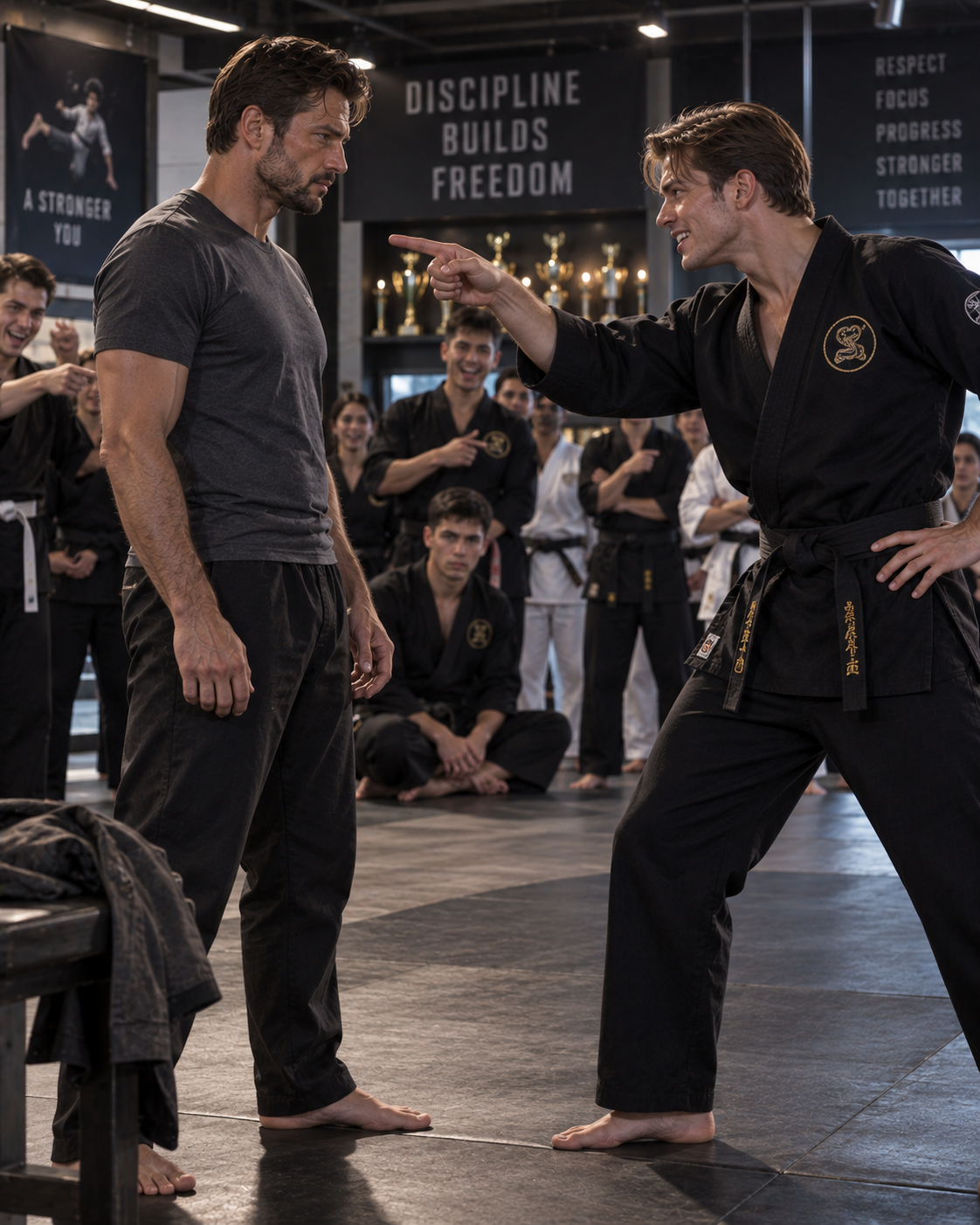
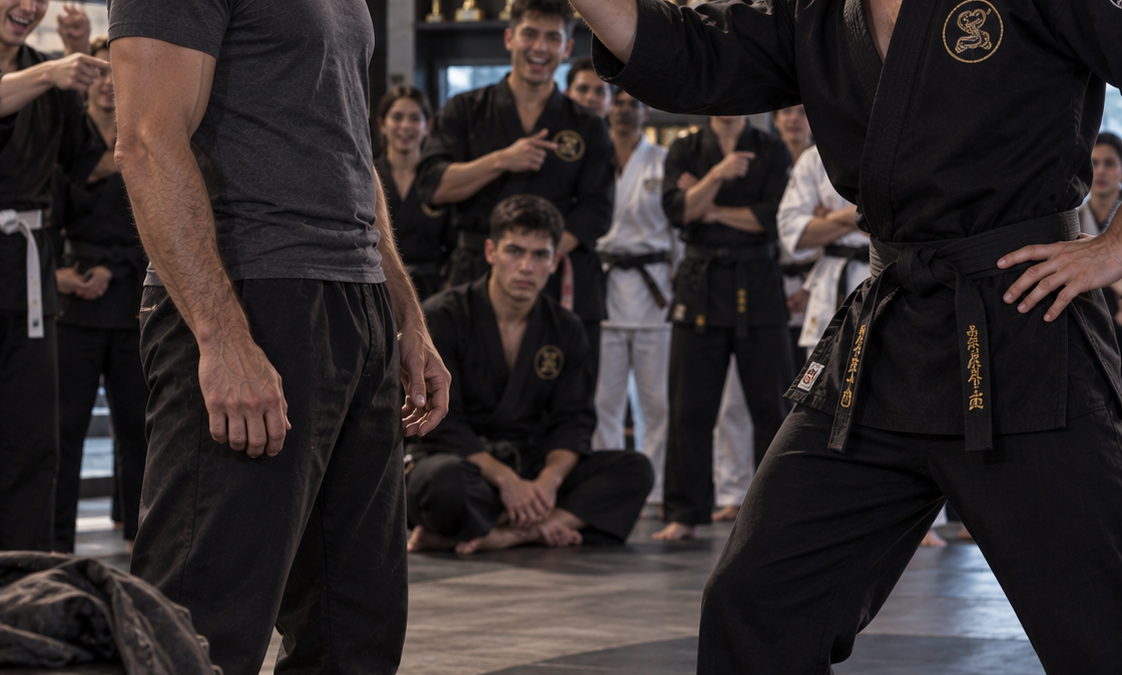
Ryan Mitchell pointed straight at him and laughed. Not a small laugh, a loud chest deep. Look at this guy laugh that turned every head in the gym.
You He was pointing at Daniel Carter like he was identifying something that had wandered into the wrong place.
Sir, seriously, you won’t last 10 seconds against me.
Not 10. Someone needs to tell you before you embarrass yourself.
40 people laughed with him.
Daniel didn’t move, didn’t blink, didn’t say a single word.
He just reached up slowly, quietly unbuttoned his jacket, folded it, set it down, and stepped onto the mat. The laughing stopped so fast it felt like someone had cut a wire.
The first thing people noticed about Daniel Carter when he walked through the front door of Pinnacle Martial Arts Academy that Saturday morning was that he didn’t belong there.
Not because he looked weak, not because he looked scared, but because he looked like a man who had already been through a war that nobody in that building could ever understand and survived it without anyone ever knowing his name.
He was wearing a plain gray jacket, the kind you’d find folded at the bottom of a closet for years.
His work boots were scuffed at the toes.
His hands, if you looked closely enough, carried the permanent stain of engine grease in the creases of his knuckles, the kind that doesn’t fully wash out no matter how hard you scrub.
His face had the particular quality of a man who hadn’t slept past 6:00 in the morning in over 4 years.
Not tired in the way someone looks after a bad night. Tired in the way a person looks when they have made peace with tiredness because there is simply no other option.
He stood just inside the doorway for a moment, taking in the room with the quiet, measured attention of someone who had learned long ago to assess his surroundings before committing to them. The academy was impressive. That much was undeniable.
The mats were clean. The mirrors along the far wall were spotless.
The equipment was clearly expensive and well-maintained. Trophies line shelves behind a long reception desk. Photographs covered the walls action shots.
Tournament victories. Students midkick and mid throw frozen at the peak of their power.
Daniel looked at those photographs for a moment. Then he stepped fully inside and let the door close behind him. The Saturday morning demonstration had been advertised as a community event.
Self-defense basics for adults. No experience required.
Daniel’s neighbor, a retired postal worker named Frank, had handed him the flyer two weeks ago with a particular enthusiasm of a man who had been trying to get Daniel out of the house for months.
“Just come look,” Frank had said.
“You don’t even have to participate.
Just sit in the back and watch.”
“When’s the last time you did something for yourself, Danny?”
Daniel hadn’t been able to argue with that because the honest answer was that he couldn’t remember.
So, here he was.
He wasn’t nervous.
That surprised him actually that he felt no nervousness at all. But then again, Daniel had learned that nervousness was a luxury reserved for people who still believed the worst thing that could happen to them was somewhere in the future.
When you’d already lived through the worst thing, when you’d already gotten the phone call and stood in the hospital corridor and driven home alone to explain to a 7-year-old boy why mommy wasn’t coming back after that.
walking into a room full of strangers, didn’t move the needle much.
He found a spot along the sidewall about 2/3 back from the main mat area and stood there with his arms folded loosely watching. There were maybe 40 people in the room.
Some were clearly regulars, teenagers, and young adults warming up on the mats, stretching, sparring lightly in the corners. Others, like Daniel, had come for the demonstration. Curious adults.
a few parents with older kids, a couple of men about his age or older who looked just as out of place as he did. The energy in the room was high, young, confident, and at the center of it all was Ryan Mitchell.
You couldn’t miss Ryan Mitchell.
He carried himself the way certain men do when they’ve been told they’re exceptional for so long that they’ve stopped being able to see themselves any other way.
He was 29 years old, built with the kind of lean, explosive athleticism that comes from years of dedicated training, and he moved through the room like a man who had never once in his adult life doubted his right to be the most important person in the space he occupied. He was wearing a black ghee with a belt that matched, and the name of his championship tournament victories was stitched in gold thread on the left breast.
His dark hair was pulled back tight. His jaw was sharp and his eyes were quick, the eyes of someone who was always, even at rest, categorizing threats and opportunities. He had 17,000 followers on social media.
He had three regional championship titles. He had been featured twice in a local sports magazine and once on a regional news segment about the next generation of martial arts excellence.
He was by every visible measure a man at the top of his world. And he had a particular habit, a small almost reflexive cruelty that people around him had come to accept as simply part of who he was of identifying the weakest looking person in a room and making sure that person understood exactly where they stood in the hierarchy. He did it without malice or so he would have told you.
He did it. He would have said to teach people humility to show them where the real skill was to make sure newcomers understood that this was a serious place and that respect had to be earned.
But that wasn’t really it.
The truth, the truth that Ryan hadn’t examined closely enough to name was that humiliating someone who couldn’t fight back was the easiest way to feel powerful without the risk of losing.
He spotted Daniel about 4 minutes after Daniel walked in. Ryan was talking to two of his senior students, a pair of 20somes named Cole and Marcus, who followed him with the particular devotion of people who have built their identity around proximity to someone they believe is great. He was mid-sentence about an upcoming tournament when his eyes drifted to the far wall and found Daniel standing there, still quiet watching.
He stopped talking. Something about Daniel bothered him immediately.
He couldn’t have said exactly what it was.
Maybe it was the stillness. Most newcomers fidgeted.
They looked around too much. Or they tried too hard not to look around. They revealed their insecurity through motion.
But this guy, this tired looking plain jacketed guy with the work boots and the grease stained hands, just stood there like a man who had absolutely nowhere else to be and was perfectly fine with that.
Ryan didn’t like it.
Hang on, he said to Cole and Marcus. He walked across the floor toward Daniel, not hurrying, letting the distance close at his own pace. Several students noticed and turned to watch.
They knew that walk they’d seen it before.
Daniel saw him coming.
He watched Ryan approach with the same calm attention he’d been giving the rest of the room.
Ryan stopped about 4t away and looked him over slowly. The boots, the jacket, the hands, the face.
Hey, a half smile. the smile of someone who has already decided how this conversation ends.
You’re here for the beginner demo, right?
That’s right.
Thought so. Ryan tilted his head slightly. You might want to know the beginner section is on the far side.
Through that door over there, this mat area is for our competitive team. I appreciate that.
I’ll stay here for now.
Something shifted in Ryan’s expression just slightly.
Most people when he pointed them elsewhere went they apologized. Sometimes they thanked him for the correction.
They moved.
This man didn’t move.
I’m Ryan Mitchell, head instructor here.
Regional champion, three years running. He let that sit for a beat. And you are Daniel.
Daniel. Ryan repeated it like he was sampling it.
What brings you in today, Daniel? You train anywhere?
Not recently. Not recently.
Ryan glanced back at Cole and Marcus with a look that was threearters amusement and one quarter disbelief. What does that mean?
Like you took a class once, watched some videos online. I trained for a while. A long time ago.
I’m here to learn something new.
How long ago?
Daniel thought about it for a moment in the way someone does when they’re calculating.
Not performing about 11 years. Ryan laughed.
It wasn’t a mean laugh technically.
It was the kind of laugh that comes with a slow shake the head.
The kind that says, “Oh, you sweet, naive man.
The kind that’s almost worse.”
11 years. He turned back to his students. 11 years.
Guys, back to Daniel.
Listen, I respect that you’re here.
I really do. It takes guts to walk in at your age.
Starting over, but I’d be doing you a disservice if I didn’t level with you.
Whatever you learned back then, it’s gone.
Use it or lose it.
You understand what I’m saying?
I understand what you’re saying.
Good.
So, I’d really recommend the beginner session.
Get yourself reacquainted with the basics.
Don’t be embarrassed about it.
Everyone starts somewhere. Daniel looked at him for a moment without speaking. Then he said quietly and without any particular heat.
I’ll stay here.
The room had gotten quieter. People were watching now.
There was a particular social electricity that moves through a group when a confrontation is taking shape. a collective attention that happens almost involuntarily. Everyone tuning in to see which way the tension resolves.
Ryan felt it and instead of walking away instead of letting it go, letting the strange quiet man stand against his wall and watch the demonstration, Ryan Mitchell did what Ryan Mitchell always did when someone didn’t do what he expected.
He escalated. He crossed his arms and smiled wider this time.
A performer’s smile.
a smile for the audience that was now clearly watching.
Tell you what, Daniel, since you want to stay, why don’t we make it interesting?
He raised his voice just enough to carry. You and me right here, right now.
Simple sparring.
I’ll keep it light.
Somebody in the back snickered.
That’s not necessary, Daniel said.
No, no, I insist.
It’ll be good for you.
Ryan began to roll his right shoulder slowly, loosening it.
Tell you the truth, I’ve never met a guy your age walking in off the street who lasted more than 10 seconds with me.
I don’t think you’ll be the exception.
But hey, prove me wrong. More laughter now.
Cole said something under his breath to Marcus that Daniel couldn’t hear.
Marcus grinned. Daniel looked at Ryan for a long moment.
He looked at the room, the watching faces, the young students, the other adult newcomers who had frozen with their coffee cups halfway to their mouths. He felt something inside him, not anger, not pride, not fear, something quieter than all of those.
He thought about his son Caleb, who was 10 years old now, and who had told him last week with the particular directness of a 10-year-old, “Dad, I want to be brave like you.”
And Daniel had sat with that for 3 days because he didn’t think of himself as brave.
He thought of himself as someone who simply kept going because there was no acceptable alternative. He thought about his wife Emma, about the way she used to tell him that he underestimated himself constantly as a point of personal policy and that one day she was going to make him stop.
She didn’t get the chance to make him stop, but maybe she was right.
Daniel reached up and began to unbutton his jacket. The room got very quiet.
He folded the jacket carefully. The way a man folds something he intends to pick up again when the work is done and set it on the bench beside him.
Underneath he was wearing a plain white t-shirt. His arms were lean, but there was a density to them, a functional, unshowy strength that comes from years of real physical labor.
Not from a gym, the kind of strength you don’t see until someone moves.
He stepped onto the mat. Ryan stared at him for just a fraction of a second. A fraction so brief that almost no one in the room caught it.
Something crossed Ryan Mitchell’s face.
Not worry, not quite, but a flicker of something that wasn’t pure confidence either.
Then it was gone, replaced by the smile.
“All right then,” Ryan said.
“Don’t say I didn’t warn you.”
He settled into his fighting stance fluid. Practiced the body language of someone who has this 10,000 times.
His weight balanced perfectly, his hands up, his eyes sharp and focused. Daniel settled into a stance too, and the room caught its breath.
Because Daniel’s stance was not the stance of a man who hadn’t trained in 11 years.
It was measured. It was economical.
There was no wasted tension in it, no performance, just a kind of settled, rooted readiness that several of the more experienced students in the room recognized immediately for what it was. Cole and Marcus exchanged a look. The first attack came in 3 seconds.
Ryan moved fast, faster than he usually opened against a newcomer.
Because something about Daniel’s stillness was irritating him in a way he couldn’t quite place.
He came forward with a controlled strike, the kind he used to test an opponent’s reaction time.
The kind that showed him within one exchange everything he needed to know about who he was dealing with. Daniel was no longer where he had been.
It wasn’t a dramatic dodge.
There was no leap, no lunge, no Hollywood theatrics. He simply moved. A small precise shift of weight and angle.
And Ryan’s strike found empty air.
Ryan pulled up and reset. 30 people watched in absolute silence.
Okay, Ryan said softly. And there was a new quality in his voice now.
Still controlled, still calibrated, but recalibrated. All right, he came again.
Faster. Daniel moved again.
the same quality of movement, not reactive, anticipatory, like he’d read the sentence before Ryan finished writing it.
The snickering from the back of the room had stopped. Ryan attacked three more times in rapid succession. Each time with more speed, each time with more precision, and each time Daniel moved with exactly enough displacement to make the technique miss, not by a dramatic margin, not by a foot or two, but by inches, controlled inches.
the inches of someone who knew exactly how much space they needed and wasted nothing beyond that. Hold on.
Ryan stepped back and held up one hand, breathing slightly harder than he’d been breathing 30 seconds ago.
He turned to look at his students and the room, and Daniel could see him doing the calculation, the social calculation, the performance calculation, the what does this look like right now calculation. Where did you train? Ryan asked.
Does it matter?
I’m asking.
a dojo in Columbus.
Daniel said, “From when I was 19 until I was 23, four years, and then you just stopped.”
Life happened. Ryan studied him.
“You’re not a white belt?”
“No.”
“What rank?”
“I was a firstderee black belt when I stopped.”
The room reacted to that a murmur. A shift. Several people exchanging looks.
Ryan’s jaw tightened almost imperceptibly.
He nodded slowly, and Daniel could see him recalculating again. This time, not the performance calculation, but the real one. The internal one, the where do this actually go calculation.
You could have said that at the beginning, Ryan said, and there was a new edge in his voice. Not anger, not yet.
Something more like the beginning of accountability, trying to disguise itself as grievance.
You didn’t ask.
That landed in the room. Nobody moved.
Ryan’s eyes narrowed very slightly.
And then something changed in him. Some dial turned.
Some switch was thrown and Daniel recognized it immediately because he’d seen it before in the dojo in Columbus when he was 20 years old in the face of every fighter who had started a match expecting to win easily and had suddenly understood that they would not.
Pride kicking into overdrive, the place where control breaks and something harder takes over. You know what, Ryan said?
Good. Good.
Because I was going easy on you. I know.
I’m not going easy anymore.
I know that too, Daniel said. And he reset his stance.
What happened next lasted less than 40 seconds. But the people in that room would talk about those 40 seconds for the rest of the year.
Ryan came at him differently this time. The showmanship was gone.
The calculation was gone. This was the Ryan Mitchell that his serious students knew. The Ryan Mitchell who had won three regional championships.
the fighter who trained six days a week and whose technique had been refined over a decade of serious dedicated uncompromising work. He was genuinely excellent.
Whatever his flaws as a person, whatever the smallalness of his character in certain moments, his skill was real and it was significant and it was not to be dismissed.
He attacked with a combination high, mid, low, the kind of sequence that was designed to overload a defender’s processing speed to make the body choose between two bad options and pay for whichever one it picked.
Daniel moved through it like water, finding the shape of a vessel. Not perfectly, not untouched.
Ryan’s second strike clipped his left forearm, and Daniel absorbed it without reaction, rolling with it in a way that reduced its force to almost nothing.
But he absorbed it.
He didn’t step back.
He didn’t wse.
He didn’t blink.
And then he was inside Ryan’s guard.
For one suspended moment, the entire room saw it saw that Daniel was exactly where he needed to be. That he had created the position without anyone quite seeing how.
That Ryan’s balance was compromised and Daniels was not.
That if Daniel chose to continue the sequence to its logical conclusion, Ryan Mitchell would be on the floor.
Daniel didn’t continue the sequence.
He stopped. He held the position for exactly long enough that everyone in the room understood what they were looking at, what had happened, and what could have happened.
And then he stepped it back.
He didn’t say anything.
He just stepped back. Ryan stumbled slightly as he refound his footing. And the stumble was small, but everyone saw it and the room understood.
Nobody laughed. Ryan looked at Daniel. His chest was rising and falling with the effort of the last 40 seconds.
His jaw was set. His eyes were doing something complicated, cycling through things too fast to name. Anger and disbelief and something underneath both of those that was much harder to look at directly.
You had me, Ryan said. His voice was quieter now.
The performance had left it right there. You had me. Yes.
Why did you stop? Daniel met his eyes.
Because winning doesn’t mean destroying someone.
The room was absolutely still. Ryan Mitchell, three-time regional champion, local legend.
The man who had said, “You won’t last 10 seconds,” stood on his own mat and had no answer for that.
And in the silence, every single person standing in that gym felt something shift. Not just about the man standing calmly in the white t-shirt and scuffed work boots, about everything they thought they knew, about what strength actually looked like.
“Go again,” Ryan said.
His voice had changed. The lightness was gone. The easy performance was gone.
And what was left was something raarer, not rage, not quite.
But the desperate energy of a person who has been shown something about themselves they weren’t ready to see.
Ryan, one of his senior students, started. Go again. Daniel looked at him for a moment.
He understood what was happening. He had seen it before.
Had felt it before.
for the way certain truths when they arrive make you want to push harder against the thing that revealed them as though forcing a different outcome could somehow undo what you’ve already seen.
He understood it because he had been there himself not in a gym, not on a mat in a hospital parking lot at 2:17 in the morning 4 years ago, screaming at a universe that had already made its decision. He nodded. Ryan attacked with everything and this time there was no calculation behind it.
It was pure honest force, the last resource of someone who has run out of strategy and is left with nothing but will. Daniel moved one clean movement, the product of four years of daily labor and 11 years of dormant memory and something that cannot be trained into a person but only discovered by someone who is already lost.
everything that isn’t essential.
Daniel moved and redirected Ryan’s momentum with a precision that required no strength at all because leverage and timing and position had already done the work.
And Ryan Mitchell went down, not hard, not violently, with a controlled guidance that placed him safely on the mat, the way you’d lower something valuable that you didn’t want to damage.
And then the room erupted, not in cheering exactly, in something more complicated than cheering. the noise of 40 people processing something simultaneously something that had gone beyond a sparring match and become in the way rare moments sometimes do a demonstration of something much larger and harder to name.
Ryan lay on the mat for a moment looking up at the lights. Daniel stood over him and he reached down his hand. Not in triumph, not in the way someone extends a hand to show that they have won and are being gracious about it.
in the way someone extends a hand when another person’s is on the floor and needs to get up.
The simplest possible gesture, the most human possible gesture. Ryan looked at the hand and took it.
He didn’t let go right away.
After he stood, he held Daniel’s hand for a second longer than a handshake strictly required.
And Daniel let him because he understood that something was trying to find its way out of Ryan Mitchell right now and it needed a moment to get there. I owe you an apology, Ryan said finally. You know I do.
He said it firmly with the firmness of someone making a decision. I judged you the second you walked in. Before you said a word, before I knew anything about you, I decided who you were, and I made sure everyone in this room knew exactly what I thought of you.
He looked down for a moment, then back up.
That was wrong, and I’m sorry.
Daniel held his gaze. Everyone has a moment when they realize they still have something to learn, he said. This was yours.
Ryan nodded slowly. What happened to you?
Ryan asked. Not in a prying way.
More in the way someone asks a question when they’ve just understood that the person in front of them has a story worth knowing.
You stopped training for 11 years.
That’s a long time.
What happened? Daniel was quiet for a moment.
Around them, the room had gone soft. People were still watching, but differently now. Not with the electric attention of witnesses to a contest, but with something quieter and more respectful.
My wife died, Daniel said four years ago. She got sick very fast and then she was gone.
I’ve been raising our son alone since then.
Ryan absorbed that in silence.
I stopped training because for a while there wasn’t room in my life for anything except keeping us both alive.
Daniel continued. Working, making sure my son 8 did his homework.
Didn’t feel like the world had ended just because our world had ended.
A pause. It almost did end several times, but we kept going.
And now, and now my son told me he wanted to be brave like me. So, I thought it was time to stop hiding from things I used to love. Ryan Mitchell, three-time champion, local legend.
The man whose name was stitched in gold thread blinked several times.
He said, “You’re the bravest person who’s ever walked into this gym.”
Daniel shook his head slightly.
I’m a tired man who needed to leave the house on a Saturday morning.
But the way he said it with just the faintest lift at the corner of his mouth, just the faintest suggestion of a smile made Ryan laugh. A real laugh, small and surprised, and entirely without performance. And Daniel smiled back just briefly.
the smile of a man who had not smiled like that easily and without weight in longer than he could quite remember. The demonstration resumed. Daniel sat against the sidewall for the rest of it, watching.
Nobody asked him to move to the beginner section again.
At the end, the academyy’s assistant instructor, a woman named Patricia, who had been training martial arts for 23 years and who had watched the entire morning unfold from near the equipment room door, walked over to Daniel as he was putting his jacket back on.
Daniel, he looked up. I want you to come back next Saturday, she said.
And the Saturday after that, I’m not sure I’m ready to I’ve been teaching here for 9 years, she said.
I’ve watched a lot of people walk through that door.
Some of them were talented and some of them weren’t.
And I can usually tell within the first five minutes which category someone falls into. She looked at him steadily.
You’re not in either category.
He paused buttoning his jacket.
You’re something else.
She said something this gym needs. Come back.
He thought about it for a moment. What time does it start? 8:00.
I’ll be here at 7:45.
He said, “I like to see a place before it gets loud.”
Patricia smiled. I know the feeling.
Daniel drove home through a Saturday that had gone golden with midm morning light.
The kind of light that makes even ordinary streets look like they’re carrying some kind of significance.
He had the windows down slightly. The radio was off.
He was thinking he was thinking about a conversation he’d had with his son 3 weeks ago when Caleb had come home from school upset because some boys in his class had been cruel to a kid who was smaller and quieter than the rest.
And Caleb had stood there and watched and hadn’t said anything and felt terrible about it afterward.
Daniel had sat with him at the kitchen table and said, “The hardest kind of brave is the kind nobody claps for.
The kind where you do the right thing and nobody even notices, but you notice.
You always notice and that matters.”
Caleb had thought about that.
Then he’d asked, “Were you ever scared, Dad?”
Like really scared? Daniel had thought about his honest answer for a long time before giving it.
Yes, he’d said every day for about a year after your mom died.
I was the most scared I’ve ever been.
Not of anything I could fight. Just of the future, of not being enough, of you growing up without what you needed. But you kept going.
I kept going. Why?
Daniel had looked at his son. Because you were there. Caleb had nodded in the serious, thorough way he had of taking information in.
Then he’d said, “I think you should go to that martial arts thing Frank keeps talking about.”
Daniel had laughed.
“A real one?”
“Yeah,” he’d said.
“Maybe I should.”
He pulled into the driveway of the small house they’d lived in for 6 years.
The one with the slightly overgrown front garden that Daniel kept telling himself he’d get to on the weekend and never quite did.
The one with the porch step that creaked on the left side if you stepped on it wrong. A sound so familiar now that Daniel barely heard it anymore.
Caleb’s bike was leaning against the side of the house.
He could hear the faint sound of the television through the front window.
His son, who had arranged to be at his friend Marcus’s house this morning, must have come home early.
Daniel sat in the car for a moment.
He thought about Ryan Mitchell’s face when he hit the mat.
He thought about Patricia telling him to come back. He thought about the room going quiet and the weight of the jacket in his hands and the moment he had stepped onto the mat knowing that 40 people expected him to fail. He thought about Emma who had told him a hundred times in different ways that he had no idea what he was capable of.
You underestimate yourself, Dany, as a point of personal policy. He got out of the car.
Caleb appeared in the doorway before he’d made it halfway up the front walk.
leaning against the frame with the studied casualness of a 10-year-old, pretending he hadn’t been watching for the car.
How was it? Daniel walked up the porch steps. The left one creaked.
Interesting, he said. Did you do anything or just watch? Daniel looked at his son.
I did something.
Caleb’s eyes lit up.
What happened?
Daniel put his hand on his son’s shoulder and gently steered him back inside.
I’ll tell you about it over lunch, he said.
Make yourself useful and find us something to eat. Caleb groaned dramatically and turned toward the kitchen, already asking what counted as something to eat and whether cereal applied, and Daniel stood in the doorway of his house for just a second before following him inside. The Saturday light came through the kitchen window in long, straight lines.
His hands still carried the faint ache of muscles woken up after a long sleep. He was tired. He was always tired.
But underneath the tired, quiet and steady and solid as a foundation beam, there was something else now. Something that felt, if he was being honest with himself, if he was using the word the way it deserved to be used, the way Emma would have used it, like being alive.
He didn’t know yet what would happen next.
He didn’t know that Ryan Mitchell would call him on Tuesday evening, hesitant and honest in a way he’d probably never been with a stranger before.
He didn’t know that Patricia would leave him a voicemail on Sunday saying she’d already cleared a training slot.
He didn’t know that the 23-year-old student who’d been standing near the equipment room door, the one nobody had noticed during the sparring, the one who’d been watching everything would approach him next Saturday and say, “I want to train the way you move.
” And that this would begin something neither of them expected.
He didn’t know any of that.
All he knew standing in the doorway of his house while his son argued about cereal from the kitchen was that he had walked into a room where everyone expected him to fail. And he had not failed.
And it had felt in a way he hadn’t expected, like coming home.
Ryan Mitchell sat in his car for 11 minutes after everyone left.
He didn’t start the engine.
He just sat there with both hands on the steering wheel, staring at the concrete wall of the parking structure in front of him, replaying the same 60 seconds over and over in his head with the particular misery of someone who cannot make a memory stop running. The way Daniel had moved, the way the room had gone quiet, the way Daniel had reached down and offered his hand without any expression of victory on his face. No satisfaction, no smuggness, nothing that Ryan could have used to build a wall of resentment against.
Just a hand, just a plain simple here, let me help you up hand extended without ceremony, the way you’d help a stranger who’d tripped on a sidewalk.
Ryan had won three regional championships. He had been in that gym every single day for 9 years.
He had trained through injuries, through exhaustion, through the kind of doubt that visits every serious athlete at 3:00 in the morning and tells them they’re not as good as they think they are.
He had beaten every single person who had ever stepped onto that mat with him. And a tired father in worn out boots had walked in off the street and made him look like a student.
His phone buzzed. Cole, you okay?
He stared at the message, didn’t answer.
Another buzz. Marcus this time. That was wild, bro.
Who is that guy? He put the phone face down on the passenger seat.
The thing that was eating at him, the thing he couldn’t shake.
The thing that kept circling back no matter how many times he tried to push it away, wasn’t the loss.
He could process a loss.
He’d been beaten before in tournament settings by fighters with more experience, more reach, better conditioning on a given day.
Losses happened. Losses were part of the sport. What was eating at him was the moment before the loss.
The moment he had stood in the middle of his own gym, in front of his own students, and pointed at a stranger and told him he wouldn’t last 10 seconds.
He kept seeing Daniel’s face in that moment.
Not angry, not humiliated, just watching him with those quiet, worn in eyes that had seen something Ryan hadn’t seen yet and were waiting with complete patience for Ryan to figure out what that something was.
He had been cruel, not in a dramatic, obvious way, in the small, casual, almost automatic way that was worse because it revealed that cruelty had become a habit, a reflex, something he did without thinking, because he had done it so many times that it no longer required thought. He hit the steering wheel once with the heel of his hand. Not hard, just enough to feel something solid.
Then he started the engine and drove home. Patrician Nwan locked the academy at 6:15 that evening, same as she did every Saturday and stood outside for a moment in the cooling air before walking to her car. She had been teaching martial arts for 23 years.
She had seen thousands of students come through doors like that one talented students, mediocre students, students who quit after 3 weeks and students who stayed for decades. students who trained for competition and students who trained for something harder to name. She had seen prodigies and late bloomers and people who started at 45 and became the best in the room by 50.
She had seen a lot, but she kept thinking about Daniel Carter. Not about the sparring, though. The sparring had been something to see.
the kind of technical economy that took years of serious work to develop and then years more of something else entirely to maintain through a decade of not practicing.
What she kept thinking about was the way he had held Ryan’s hand for that extra second after he helped him up.
The way he had waited without impatience, without agenda, for Ryan to find his way to the apology that was clearly fighting to get out.
And then what he’d said.
Everyone has a moment when they realize they still have something to learn. This was yours.
Not it’s okay.
Not don’t worry about it.
Not the easy, slightly dishonest grace of someone who wants the uncomfortable moment to be over. Something truer than that.
Something that acknowledged the mistake fully and then offered the person who made it a way to carry it without being destroyed by it. She unlocked her car door and sat inside for a moment before putting the key in the ignition.
She thought about the voicemail she’d left Daniel that afternoon.
short and direct. I want you back in this gym.
I think you have things to teach that I can’t.
She didn’t know if he’d come back.
Some people, when they’ve proven something to themselves, don’t need to prove it again.
They check the box and move forward, and the thing they proved becomes a private treasure they carry, but don’t display.
She hoped he wasn’t that kind of person.
She hoped he’d come back.
She started the car and pulled out of the lot into the early evening, already thinking about what next Saturday might look like if he did. Daniel heard the voicemail on Sunday morning while he was making breakfast. He was standing at the stove with a spatula in his hand.
Scrambled eggs in the pan. Caleb still in his room doing the particular kind of not waking up that 10-year-old boys specialize in on Sunday mornings.
His phone was on the counter and the voicemail notification had been sitting there since last night when he’d been too tired to check messages.
He listened to it twice. Then he put the phone back on the counter and stood there looking at the eggs and thinking.
He hadn’t gone back to martial arts 11 years ago because he’d decided to stop.
He’d gone back because life had made the decision for him.
the way life sometimes does abruptly without asking, leaving you to reorganize everything around the new shape of your days. When Emma got sick and then when Emma died.
And then in the long brutal aftermath of learning to be one person doing the work of two, while also being the only thing standing between a six-year-old boy and the full weight of incomprehensible loss, there simply hadn’t been room.
Time was not the issue. time he could have found probably in the margins. The issue was capacity.
The issue was that he had a finite amount of himself to give each day and every molecule of it was spoken for. So he had let the training go without drama, without ceremony. One day he was a martial artist and the next day he was a widowerower and a father and a mechanic.
And those were the identities that mattered now. Those were the ones that had someone depending on them. So those were the ones he fed.
He hadn’t missed it.
Not exactly. Or he had missed it.
But in the way you miss a version of yourself you can’t afford to be anymore, which is different from missing something you lost.
You don’t grieve that kind of thing.
You just set it down and walk away from it.
And occasionally in quiet moments, you feel its absence the way you feel a tooth that’s no longer there.
Not painfully. Just as a fact about the shape of your mouth.
Yesterday had been the first time in 11 years he had stood on a mat with another person and his body had remembered everything. That was the part that surprised him.
He had expected rust. He had expected the disconnect between intention and execution.
The gap between what your mind knows how to do and what your body can actually produce after a decade of doing something else. He had expected to be slow.
He hadn’t been slow.
He had moved the way he’d moved at 23.
may be better than at 23 because the thing the years had added wasn’t just rust.
It was also weight.
The particular ballast of a life that had been tested and had held the kind of calm that doesn’t come from confidence exactly but from something older and harder one.
The knowledge that you have already survived the worst thing and that this this moment this matt this inert in front of you is not the worst thing. Caleb appeared in the kitchen doorway in his pajamas, hair at a 45° angle from the pillow, squinting. Are you burning the eggs?
Daniel looked at the pan. He was slightly.
No, you’re burning them.
I’m monitoring them at elevated temperature.
Caleb stared at him for a long moment with the expression of someone deciding whether to pursue this argument. He decided not to.
He climbed onto the stool at the counter and rested his chin in his hands. You were going to tell me about yesterday.
I was, “So tell me,” Daniel moved the eggs off the heat and turned around, leaning against the counter with his arms folded.
He looked at his son, this boy who had his mother’s eyes and his own stubbornness, and who had been for 4 years.
The entire reason Daniel Carter got out of bed every single morning. There was a man at the gym, Daniel began, a black belt, young guy, very good at what he does.
And and when I walked in, he decided I didn’t belong there.
He said it out loud in front of everyone.
Said I wouldn’t last 10 seconds against him.
Caleb’s eyes sharpened.
What did you do? I took my jacket off a pause and I stepped onto the mat. Caleb sat up straighter.
Dad, he came at me. Fast, good technique.
Serious fighter. What happened? Daniel considered how to say the next part.
I moved, he said finally. Like I used to move.
And then I was where I needed to be and he wasn’t.
Caleb was very still now the way he got when a story had his complete attention. This child who got it from his mother. This quality of total presence when something mattered.
Did you beat him? I stopped the match when I had the position.
Why?
Because I didn’t need to finish it.
He already understood what had happened. Caleb thought about that for a moment. Was he a good sport about it?
Eventually, Daniel said. He apologized.
It took him a minute to get there. But he got there. What did you say?
I told him everyone has a moment when they realize they still have something to learn. I told him this was his.
Caleb was quiet. He looked down at the counter and traced a small circle with his finger.
The way he did when he was processing something. Then he looked up.
That’s a good thing to say.
Your mom used to say something like it. Different words, same idea. Caleb nodded slowly.
He did this sometimes received the mention of his mother, not with the flinching that had characterized the first two years, but with a kind of careful steadiness, as though he was holding something breakable, and had learned to trust his own grip. Are you going back? Daniel glanced at the phone on the counter.
Yeah, he said. I think I am, Ryan called.
On Tuesday evening, Daniel was in the garage working on a neighbor’s carburetor that had been sitting on his workbench for a week when his phone rang with an unknown number.
He almost didn’t answer.
Unknown numbers were rarely anything good.
In his experience, usually a robocall or something he’d have to deal with and didn’t have the bandwidth for on a Tuesday night.
But something made him pick up. Is this Daniel Carter?
He recognized the voice immediately. Younger than it had sounded in the gym.
Less certain. This is Daniel.
A pause. This is Ryan Mitchell from Pinnacle Saturday. I know who you are, right?
Another pause. Longer.
I got your number from Patricia. She said it was okay to call.
I hope that’s I mean I should have asked first.
I can It’s fine.
What do you need? The question hung there for a moment.
Daniel could hear Ryan on the other end doing some kind of internal reorganization.
Searching for a way into whatever he’d called to say.
“I wanted to apologize again,” Ryan said finally properly.
“Not just not like Saturday where I said it in front of everyone and it was all caught up in everything else that was happening.
I wanted to call and say it directly, okay? What I did was wrong. I made a judgment about you the second you walked in and I made sure everyone knew it.
That was arrogant and it was cruel and it didn’t have anything to do with teaching or discipline or any of the things I tell myself justify how I act in that gym.
He stopped.
It was just arrogance and I’m sorry.
Daniel set the carburetor down and sat on his workbench stool. I accept your apology, he said.
I don’t want you to just accept it.
I want you to know I mean it. I can hear that you mean it. Okay.
Ryan exhaled. Okay, good. A pause that had a different quality to it.
Something coming next that was harder to say than the apology. Can I ask you something? Go ahead.
How did you do that on Saturday? The movement, the way you read what I was going to do before I did it.
I’ve sparred with a lot of people, a lot of people who are very good.
And I’ve never he stopped himself started again.
I’ve never had someone make me feel like I was moving in slow motion while I was going full speed.
Where does that come from? Daniel thought about how to answer that honestly.
It doesn’t come from training, he said.
Not just from training. Anyway, technique you can train speed.
You can train timing to some extent, but what you’re describing, he paused.
That comes from years of having to read a situation before it becomes a problem, of not being able to afford to be surprised. What does that mean?
It means that when you’re the only person responsible for everything for a kid, for a household, for keeping the lights on and food in the refrigerator, and making sure someone else’s world stays stable while your own is still
rebuilding, you learn to see things coming.
Not because you’re gifted, because you can’t afford not to.