“You Won’t Last 10 Seconds!” Black Belt Mocked Him—Then His First Move Left Everyone Speechless (part 2)
Part 2
Ryan was quiet on the other end.
“Patricia told me about your wife,” he said carefully.
“I hope that’s okay.
I’m sorry.
I didn’t know.
You didn’t need to know.”
What happened between us on Saturday didn’t require you to know my history.
Still, Ryan’s voice was different now.
Softer in a way that didn’t sound performed.
I keep thinking about what you said.
That winning doesn’t mean destroying someone.
I’ve been thinking about it since Saturday and I can’t stop.
Good. Good.
If you can’t stop thinking about it, it means something in you already knew it was true and was waiting for someone to say it out loud.
Another long pause. Can I ask you one more thing? Sure.
Will you come back to the gym? Not to teach, not to. I mean, however you want to do it.
Even just to train, but I’d stopped, reconsidered.
I’d like to learn from you if that’s something you’d be willing to do.
Daniel sat in the garage with the phone against his ear and the smell of motor oil around him and the particular quiet of a Tuesday night when his son was already asleep and the world had narrowed down to this small lit space.
He thought about Patricia’s voicemail.
He thought about Caleb asking if he was going back. He thought about Emma telling him he underestimated himself as a point of personal policy.
Saturday at 7:45, he said, “I’ll be there before it gets loud.
If you want to talk, come early.
He could hear something release in Ryan’s voice.
I’ll be there.
And Ryan, yeah, leave the ego at the door. Not for my sake, for yours.
It’s been making you smaller than you are.
A long pause. Yeah, Ryan said quietly.
I know.
Patricia arrived at the academy at 7:38 on Saturday morning and found two things she hadn’t expected.
The first was that the parking lot light near the entrance had burned out overnight and needed to be replaced. which she made a note of on the small pad she kept in her jacket pocket for exactly this category of thing. The second was Daniel Carter sitting on the front steps with a paper cup of coffee in his hands.
Watching the morning, she stopped in front of him. You said 7:45.
I’m early.
I can see that. She unlocked the front door and pushed it open.
Get in out of the cold. He stood tucking the coffee under his arm and followed her inside. She hit the lights.
The gym came up around them clean, quiet, all that equipment and space looking different in the early morning before the noise and the movement filled it in. Different and somehow more honest.
This was what a gym was before it became a performance. Just a place, just a floor and walls and the tools for work.
I listened to your voicemail three times, Daniel said. I meant every word of it.
What did you mean by things you can’t teach?
She set her bag down behind the front desk and turned to look at him directly. The way she had a habit of doing no softening around the edges, just straight attention, the attention of someone who had spent a long time looking at people and had learned that most of the important things were visible if you paid close enough attention.
Presence, she said, patience. The ability to be in a room without needing to dominate it.
Those things can be demonstrated, described, pointed at, but I’ve never found a way to actually transfer them from one person to another.
Either someone has them or they’re still in the process of earning them.
She paused. You have them?
Ryan is still earning them.
He’s talented.
But he’s been coasting on talent for long enough that the talent has started to mask the gaps.
He called me Tuesday.
She nodded as though she’d expected this.
What did he say? He apologized properly and he asked to learn. What did you say?
I told him to come early. Patricia looked at him for a moment. Then she almost smiled.
Coffee any good? She nodded at the cup. Gas station, Daniel said.
So, no, I’ll make some.
The real kind. She moved toward the back room.
We have about 20 minutes before anyone else gets here. I want to talk to you about what Saturdays could look like if you were willing to be part of this place. Daniel followed her.
stepping over the threshold of the gym in the early Saturday. Quiet, the lights still warming up overhead, the mats empty and waiting.
“I’m listening,” he said.
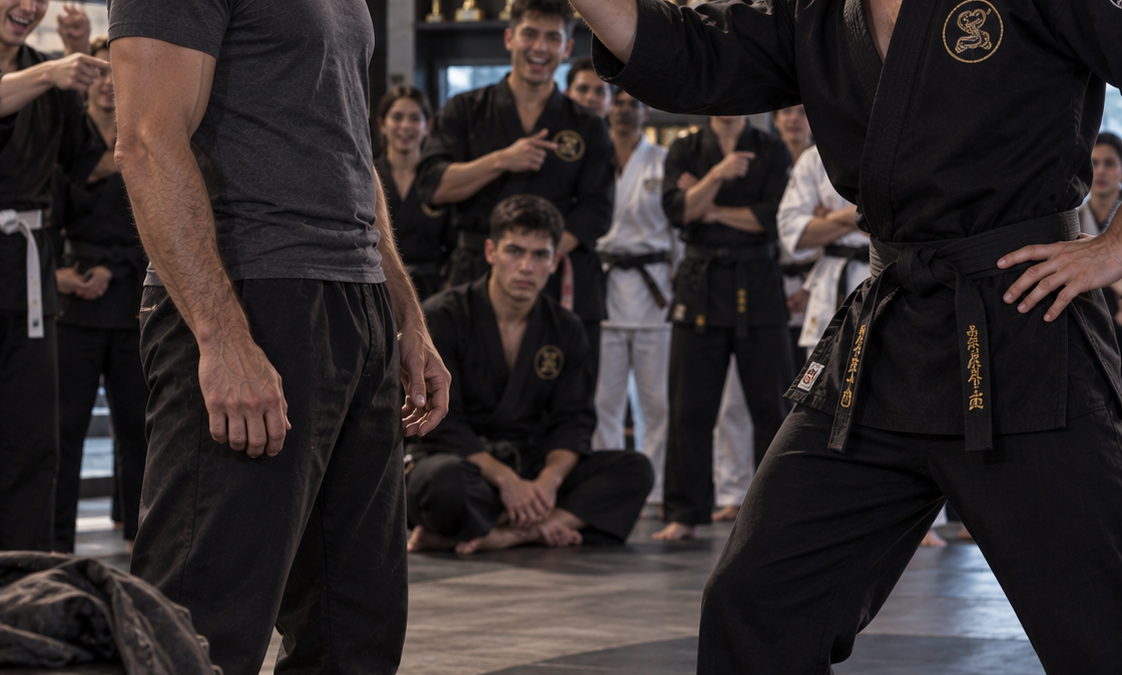
Ryan arrived at 7:49. He came through the door quickly, slightly out of breath, his bag over one shoulder and stopped when he saw Daniel standing near the main mat with a cup of coffee and no particular urgency about him at all. I said 7:45.
Daniel said, “I know.
I’m sorry.
traffic.
There’s no traffic at 7:45 on Saturday.
Ryan opened his mouth and then closed it. He set his bag down.
You’re right.
I overslept by 4 minutes and I drove faster than I should have.
I’m sorry.
Daniel looked at him for a moment.
That’s better.
Ryan stood there in the early morning quiet of the gym, looking at the man he’d mocked 6 days ago, and something he couldn’t quite name was working its way through him.
A mix of humility and something almost like relief.
The relief of someone who has finally stopped pretending a thing isn’t true and can now deal with it directly.
I’ve been doing this since I was 15.
Ryan said martial arts and I realized something this week.
I’ve been treating it like it’s mine, like I own this mat.
Like everyone who walks in here is either a student of mine or an inconvenience. He paused. Where did that come from?
When did I turn into that person? Probably gradually, Daniel said.
the way most things turn into other things.
One day at a time, one choice at a time until the choices have accumulated and you look in the mirror and don’t quite recognize what you’re seeing.
Ryan absorbed that. How do you come back from it?
You already started, Daniel said. Coming in early on a Saturday and telling the truth about why you were 4 minutes late.
That’s not a small thing.
That’s exactly the kind of thing the version of you from last week wouldn’t have done.
Ryan looked at him.
“You see a lot.
I’ve had a lot of time to practice,” Daniel said.
“Now, are we going to stand here talking or are we going to warm up?”
Ryan almost smiled.
“Yeah, let’s warm up.”
They stepped onto the mat together in the early morning quiet, and Patricia watched them from the doorway of the back room with her coffee cup in her hands, and she thought about all the students she had watched come through this gym over the years, and how the ones who change the most were never the ones you expected at the beginning. She thought about a tired father in worn out boots, standing against the wall on a Saturday morning, watching a room full of people who had already decided who he was. She thought about what happened when someone refused to become who you decided they were.
And she thought, not for the first time and not for the last, that the most important lessons in this gym had never happened during competition. They happened in moments like this one, before the crowd arrived, before the noise, when it was just two people on a mat, and the truth between them and the work still to be done. The third Saturday was when things started to change in ways nobody had planned for.
It began with a kid named Jordan. Jordan Reeves was 17 years old, 5 foot nine, and had been training at Pinnacle for two years with the particular intensity of someone who had found in martial arts the one place in his life where the rules were clear and the results were
honest. He was good, genuinely good, with fast hands and good instincts, and the kind of athletic potential that Patricia had quietly noted in his file, with a small star next to his name the way she did for students.
she thought were worth watching. He was also on this particular Saturday morning sitting on the bench near the equipment room with his bag still zipped and his arms crossed and an expression on his face that said he was not going to participate today and was prepared to defend that position against all comers.
Daniel noticed him while he was warming up.
He didn’t say anything immediately.
He finished his stretching, moved through his warm-up at his own pace, and let the room fill up around him. the regular Saturday students arriving in ones and twos.
The newer adults who had started showing up after word spread about the demonstration three weeks ago. Ryan working with a pair of intermediate students on the far side of the mat. Then he walked over to the bench and sat down next to Jordan, not across from him, not in front of him, next to him at the same angle, looking in the same direction.
Jordan glanced sideways, looked away. His jaw was tight.
Daniel didn’t open with a question.
He just sat there for a moment.
The way someone sits when they’re not in a hurry and have decided the other person’s timeline is the one that matters.
After about 30 seconds, Jordan said, “I’m not in the mood to train.”
“Okay, you’re not going to tell me I should get on the mat.”
“No.”
Another silence.
Jordan’s arms were still crossed, but something in his shoulders had shifted slightly.
An almost imperceptible degree of release. My coach benched me, Jordan said.
Coach Darren, he said my attitude has been off and he’s not putting me in next month’s invitational until I fix it.
Is he right?
Jordan’s jaw tightened again.
I’ve been dealing with some stuff at home.
That’s not what I asked.
A pause. Longer this time. Yeah, Jordan said finally, very quietly.
He’s probably right.
Daniel nodded slowly and said nothing. My parents are splitting up, Jordan said. The words came out flat.
The flatness of someone who has practiced saying a thing in the most neutral possible way in order to keep the feeling attached to it at a manageable distance.
It’s been it’s been bad for about 4 months and I’ve been coming in here with all of it still on me and I’ve been taking it out on people I’m sparring with and I know that’s not right.
I know. I just He stopped.
Daniel let the stop breathe.
I just don’t know where else to put it, Jordan said.
Daniel looked at the mat in front of them. How old are you?
17. When I was 17. My dad left.
He said it simply without drama.
The way you state a fact that stopped hurting in a particular way a long time ago, but that you’ve never forgotten.
Just one morning he was there and the next morning he wasn’t.
Left a note on the kitchen counter. My mom found it before I did. Jordan turned to look at him.
His arms had dropped from their crossed position without him seeming to notice.
“What did you do?”
“I went to school,” Daniel said.
“Because I didn’t know what else to do.
Sat through 6 hours of classes and didn’t absorb a single word of any of it.
Went home, helped my mom make dinner, didn’t talk about it, didn’t know how to talk about it.”
He paused. Then for about 6 months, I was angry at everything.
Teachers, coaches, kids at school who hadn’t done anything to me.
the whole world because the thing I was actually angry about was too big to be angry at directly. Jordan was very still now. Did it get better?
Eventually, not fast. And not because anything external changed.
My dad didn’t come back.
My mom was still devastated. The circumstances stayed what they were. It got better because I found something that helped me put the the anger somewhere productive.
For me, that was martial arts. He looked at Jordan. for you.
It sounds like it was supposed to be martial arts, too. But somewhere along the way, the thing that was supposed to help became the place you were bringing the thing that needed help.
Jordan absorbed that slowly. His eyes had the quality of someone working through something complicated in real time, turning it over, checking it from different angles.
How do you separate them? Jordan asked.
The stuff you’re carrying from the thing you’re doing, you don’t entirely, Daniel said.
But you get honest about what you’re carrying.
You stop pretending it isn’t there.
Because when you pretend it isn’t there, it sneaks into everything anyway, into your technique, into how you treat the person across from you on the mat.
Your opponents can feel it. Your coach can see it.
Everybody knows except the part of you that’s decided to pretend.
Jordan looked at the mat. His foot was moving slightly. A small unconscious bounce of nervous energy.
I don’t want to lose the invitational spot.
Jordan said, “Talk to Coach Darren.
Tell him what you told me, not the version where you explain it and justify it, but the honest version where you own what’s been happening.
What if he doesn’t give me the spot back?
Then you earn it the same way you earned it the first time.”
Daniel stood up.
But you won’t earn anything sitting on this bench with your arms crossed.
Jordan looked up at him.
Something moved across the boy’s face.
something young and complicated and ultimately resolving into something simpler and more determined. He reached down and unzipped his bag.
Yeah, he said. Okay. Daniel walked back to the mat without ceremony and after about 30 seconds followed.
Patricia, who had watched this entire exchange from across the gym with the specific attention of someone filing something important away, turned back to the student she was working with and said nothing about what she’d just seen, but she made a small note on the pad in her jacket pocket.
Ryan had also been watching. He was mid drill with his intermediate group, calling out a combination and observing their execution. But a portion of his attention had been on the bench the entire time on Daniel sitting down next to Jordan without any preamble, without any authority, without anything except the willingness to sit in the same discomfort and wait.
He thought about his own approach with struggling students. He went through a mental catalog of the last 6 months. All the times a student had been off, distracted, resistant, underperforming.
What had he done?
He’d pushed harder.
He’d challenged them publicly.
He’d pointed out the problem in front of others because he’d believed, genuinely believed that exposure was its own form of motivation.
He thought about how many of those students had quietly stopped coming. four in the last 6 months, three in the six months before that.
He told himself they weren’t serious enough, that the ones who couldn’t handle the pressure weren’t cut out for competitive training, that his job was to elevate the serious students, not to manage the feelings of the ones who couldn’t commit.
He watched Jordan step onto the mat, watched the way the boy’s posture changed from 15 minutes ago.
shoulders back, jaw unclenched. The particular re-engagement of someone who has set something down and can now use their hands again.
Daniel hadn’t pushed, hadn’t challenged, hadn’t exposed anything.
He’d just sat down.
Ryan turned back to his students.
“Take a 5-minut break,” he said.
Cole looked at him, surprised. They were only 20 minutes into the session.
“You okay?”
“I’m fine.
5 minutes.
Get some water.”
He walked to the edge of the mat and stood there for a moment, not looking at anything in particular, doing the internal work he’d been doing in increasing quantities over the past 3 weeks.
The uncomfortable necessary work of looking at things he’d previously preferred to look away from.
Daniel came up beside him. You do that intentionally?
Ryan asked. The sitting do what intentionally?
The not talking first. Sitting down and waiting.
I learned it from my son.
Daniel said when he was going through the worst of it after Emma died, he didn’t want me to fix things.
He didn’t want advice or solutions or perspective.
He just wanted me to be in the same room with him while the hard thing was hard. So, I learned to sit. Ryan was quiet for a moment.
Most people would have called the boy out, told him to get off the bench or go home. Most people would have made it about themselves, Daniel said without particular judgment, about their mat, their rules, their program.
I don’t have any investment in being the person with the authority here.
I just saw a kid who was carrying something heavy and had run out of room to carry it alone. Where did you learn that? The not needing authority, Daniel thought about it.
Mostly from being the only adult in a house with a grieving child.
When you’re in that situation, you either make it about control, about maintaining order and structure, because that’s how you manage your own fear, or you make it about him, about what he needs, about showing up in the form that actually helps.
He paused. Control is easier.
It feels productive, but it doesn’t help.
Ryan leaned against the edge of the mat, arms folded.
Something he’d been turning over all week was working its way closer to the surface.
Can I show you something? he asked. Daniel looked at him.
Ryan walked over to the shelves along the side wall, the shelves that held trophies and framed photographs, the visual record of the gym’s competitive history.
He pointed at a photograph near the end. A younger Ryan, maybe 22 or 23, holding a trophy at some regional tournament. Huge grin, both fists in the air.
That was my first championship, Ryan said. I trained for 3 years for that.
woke up at 5 every morning, ran six miles, then trained for two hours before school.
He looked at the photo for a moment, and when I won it, I thought, “This is it.
This is who I am.
The winning is who I am.”
Daniel looked at the photograph and said, “Nothing, and then I kept winning,” Ryan continued.
“And every time I won, the winning got more necessary.
Not because I was afraid of losing.
I mean, I was, but that’s not.”
He stopped, searched for the right words. It got necessary because it was the only language I had for who I was. The trophies were the sentence.
Without them, I didn’t know what I was saying about myself.
He turned away from the photograph.
Saturday, when you put me down, the worst part wasn’t being beaten.
He met Daniel’s eyes.
The worst part was realizing that I had built my entire identity on something that a tired man in work boots could dismantle in 60 seconds. The gym moved around them. Students warming up.
The sound of movement on the mat.
Patricia’s voice on the far side running a drill.
Life going on, indifferent to the conversation happening at its edges.
That’s not a small thing to realize, Daniel said.
No, it’s not.
What are you going to do with it? Ryan looked at the trophies for another moment.
then at the students on the mat, then at Jordan, who was working through a combination with focused, grounded energy that hadn’t been there an hour ago.
I don’t know yet, Ryan said honestly.
But I think I need to start caring more about what happens to them than about what happens to my record. Daniel considered him.
That’s where it starts, he said.
Caring about the right things. Everything else arranges itself around that.
Ryan nodded slowly. Then with the slight awkwardness of someone attempting a new mode of communication.
Thank you for what you said just now and for Saturday and for coming back. Daniel looked at him steadily. You called me on Tuesday.
He said you earned that. The thing about Patricia Dwin was that she had learned over 23 years of teaching that the most significant moments in a gym rarely look significant while they were happening. The breakthroughs never came with announcement.
They came quietly at the edges of sessions in conversations that happened while people were catching their breath or taping their hands or watching someone else work. They came in the form of one person finally saying the true thing out loud and another person receiving it without flinching and something between them shifting permanently as a result. She had been trying to create those moments for years, engineering them, designing her curriculum around the conditions that made them possible, adjusting the atmosphere in the gym to keep the temperature right for the kind of honesty that produced real change.
And in 3 weeks, without trying, without curriculum or engineering or careful atmospheric management, Daniel Carter had produced more of those moments than she’d managed to create in the previous year.
She thought about this on Tuesday afternoon, sitting at the desk in the back office where she did the administrative work that kept the academy running, going through the previous month’s enrollment numbers.
They were up. Not dramatically.
This wasn’t a movie where the fortunes of a struggling business reverse overnight because of one magical intervention, but they were up.
Three new adult enrollments in the past two weeks. All of them people who had been at the demonstration and had quietly come back and asked about starting. Two students who had been on the verge of dropping out had re-engaged.
Jordan specifically had gone to coach Darren the day after that Saturday and had a conversation that by all reports had been difficult and honest and had ended with Darren giving him a conditional reinstatement to the invitational team.
None of that was Daniel’s doing exactly, but all of it was adjacent to Daniel.
All of it had happened in the weather that Daniel had changed simply by being the way he was. She picked up her phone and called him.
He answered on the third ring. The particular background sounds of the garage audible behind his voice.
The metallic muffled sounds of a working space. Patricia, am I interrupting?
Give me a second. A brief silence.
the sound of something being set down. Okay.
What’s up?
I want to talk to you about something. Not on the phone.
Can you come in Thursday evening?
I’ll be here until 8.
A pause. She could hear him calculating the mental arithmetic of a single parent.
Checking the pieces of the schedule against each other. Caleb has soccer practice until 6:30.
I can be there by 7:15. 7:15 works. Should I be concerned?
No. I have something to offer you.
Whether you take it is up to you. Another brief silence.
All right, he said. 7:15 on Thursday. He arrived at 7:12.
still in his workclo, having come directly from picking up Caleb, dropping him at Frank’s house next door, with the easy familiarity of a long-standing arrangement, and driving across town with engine grease on his forearms, and his mind already turning over the possibilities of what Patricia might
want to discuss.
She had coffee ready, the real kind, as she described it, the first morning. Actual ground coffee from an actual coffee maker, not the gas station variety. She poured him a cup without asking and set it on the desk between them and sat down.
How much are you making at the garage? She asked. He looked at her over the cup.
That’s direct.
I’ve been told I’m direct.
It saves time. How much? He told her.
The number was what? It was honest work.
Consistent work enough to keep the house and feed his son and cover the bills with a margin that wasn’t generous but was reliable.
Patricia nodded. She slid a piece of paper across the desk.
He looked at it.
That’s what I can offer you to come in Tuesday and Thursday evenings and Saturday mornings.
She said, “Teaching the adult program and the intermediate youth group.”
Not instead of your job.
I know you can’t do that.
Alongside it, Daniel looked at the number on the paper for a long time without speaking.
It wasn’t a life-changing sum.
It wasn’t the kind of money that rearranges your circumstances in any dramatic way, but it was real.
And it was for doing something that he had done every Saturday for the past 3 weeks. Not because anyone was paying him, but because it turned out that standing on a mat and being present for people was something his body and mind had needed without him fully knowing it.
I don’t have a teaching certification, he said.
I’ll handle the certification.
You have something better than certification right now, which is the actual ability to make people better. The paperwork I can deal with.
The other thing can’t be taught in a certification course.
He was quiet for a moment. His hands were wrapped around the coffee cup. Both of them.
The working man’s habit of taking warmth where you find it.
Why, he asked. You could hire someone younger, certified.
Someone who’d be here full-time eventually.
I could, she said.
I’ve hired several of those people over the years.
You know what I’ve noticed?
Certified is easy to find. Present is rare.
Patient is rarer. And the particular kind of presence you have, the kind that comes from having been broken open by life and having chosen to stay kind anyway that I have never been able to hire.
It either walks through the door or it doesn’t.
He looked at her for a moment.
You’re good at this, he said.
At what? making a person feel like they have something worth giving.
I’m not making you feel anything, she said simply.
I’m telling you what I see.
What you do with it is your call. Daniel set the paper down on the desk and looked out through the office window at the empty gym, the mats in the low evening light. The quiet that a training space holds when no one is in it, the particular quality of a room that has been built for the purpose of making people stronger and is resting between the moments when that purpose is active.
He thought about Caleb at Frank’s house next door, probably on his second cookie and deep into some argument about which superhero would win in a fight.
He thought about Emma, who had spent 10 years telling him that his gift, the way he had with people who were struggling. The ability to sit in the hard thing without needing to fix it was not ordinary, was not something everyone had, was something the world needed more of.
He thought about a 17-year-old boy sitting on a bench with his arms crossed and nowhere to put the weight.
I’ll need to adjust the Tuesday schedule.
He said, “My neighbor watches Caleb, but I need to be home by 9.”
Patricia didn’t blink.
Done. And I want to be clear with the students from the beginning.
I’m not here to compete with Ryan’s coaching or anyone else’s.
I’m here to add something.
If there’s overlap, we figure it out together.
That’s exactly how I want it to work.
and Patricia. He met her eyes.
Don’t put me on a poster, she almost laughed.
A real one, small and surprised and genuine. Deal, she said. He picked up the paper, folded it once, and put it in his jacket pocket.
I’ll see you Saturday, he said.
He walked out through the empty gym. The lights down low, his footsteps quiet on the mat, and he stopped for a moment in the middle of the space.
He didn’t know what it looked like from the outside.
a tired man in workclo standing alone in a dim gym at 7:30 on a Thursday evening. Nothing dramatic, nothing that would have attracted attention or told any particular story to a person walking by and glancing through the window. But inside the particular privacy of his own mind, Daniel Carter stood on that mat and felt something that he had almost forgotten was possible.
Not happiness exactly. Not the uncomplicated bouncing happiness of someone whose life is going easily.
Something older and quieter and more durable than happiness. He felt like he was in the right place.
He couldn’t remember the last time he’d felt that.
Not this clearly. Not without the weight of everything he was also carrying.
Pressing down on the feeling from above and reducing it to something smaller and dimmer. He was still carrying the weight.
That hadn’t changed.
He would carry it forever.
Some version of it, the absence of Emma, the responsibility for Caleb, the daily labor of holding his life together with the particular combination of discipline and love and stubbornness that had gotten him through four years, he would not have believed survivable if you’d described them to him in advance.
But the weight and the feeling could coexist. He was learning that or relearning it. He had known it once before everything and lost it in the aftermath of losing her and now slowly unevenly it was coming back.
He walked out, let the door close behind him and drove home through the city in the dark. The paper was in his jacket pocket.
He didn’t take it out and look at it again.
He didn’t need to.
The following Saturday, something happened that nobody planned and nobody could have scripted. It was 40 minutes into the morning session.
Daniel was working with a group of six adults on the far side, the new enrolles, the ones who’d come back after the demonstration.
All of them at the beginning of something.
Learning to move in ways their bodies hadn’t been asked to move before.
He was patient with them in the way he was patient with everything. Not indulgently patient. Not patient in the way that avoids challenge, but patient in the way that gives each person exactly the time they actually need.
And no more and no less. Ryan was across the room with his competitive group.
He was different in there now, not transformed, not a different person, but shifted, still demanding, still technically rigorous. But something had come down from the ceiling of the space he created.
Some pressure had released that had been there so long that his students had simply incorporated it as part of the air in the room. Cole noticed it first and mentioned it to Marcus.
And Marcus had said, “Yeah, he’d noticed it, too.”
And neither of them had been able to fully articulate what had changed, only that it had. What changed was that Ryan had started listening, not performing listening, the kind where you wait for the other person to finish talking so you can tell them what they should have done differently.
actual listening with attention with the willingness to let what you’re hearing land before you respond to it.
He’d picked it up from watching Daniel from three Saturdays of paying attention to how a person could be present with another person in a way that asked nothing in return except honesty.
He was mid session with his group when a new student walked in.
Late arrival, a man in his mid-4s, compact and quiet, who introduced himself to Patricia at the front desk as Marcus Webb, said he’d heard about the gym from a friend, said he hadn’t trained in about 15 years.
Said he wasn’t sure if he was in the right place.
Patricia, without hesitation, pointed across the room. See that man over there with the adults group? Go introduce yourself to him.
Marcus Webb walked across the gym and stood at the edge of Daniel’s group.
Waiting for a pause in the instruction, Daniel turned and looked at him.
Marcus Webb, the man said, I haven’t done this in 15 years.
I’m probably terrible.
Daniel looked at him for a moment. Then he stepped slightly to the side, creating a space in the circle.
Everyone here started somewhere, Daniel said. Get in. Marcus Webb stepped into the circle.
And Ryan Mitchell, watching from across the room, thought about the morning three weeks ago when a tired man in worn out boots had walked through that door and nobody had made room for him. He thought about the sentence he had said into a room full of people who were ready to laugh.
You won’t last 10 seconds.
He looked at Daniel at the way he had simply moved and made space without ceremony, without judgment. The way you make room for someone who needs to be somewhere.
and he thought about all the people who had walked through this gym’s door over the years who had been met with a version of what he’d said to Daniel.
The ones who had turned around and left, the ones he would never know about. He turned back to his students.
“Okay,” he said.
“Let’s talk about what we’re actually here for.”
Cole and Marcus exchanged a look. Ryan had never opened a session that way before. Technique is the tool, Ryan said.
What you build with it, that’s the point.
And I’ve been spending too much time teaching you about the tool and not enough time talking about what you’re supposed to build.
He paused.
I’m going to try to do better with that.
Nobody said anything. But the quality of the attention in the group changed, became more alive, more real, more like a group of people who believed they were about to be told something that mattered.
Across the room, Daniel was showing Marcus Webb how to stand. just that, just how to stand. The most basic thing, the first thing, the beginning.
6 weeks after Daniel Carter first walked through the door of Pinnacle Martial Arts Academy, Caleb Carter showed up on a Saturday morning and sat in the chairs along the sidewall and watched his father teach.
He hadn’t told Daniel he was coming.
He’d arranged it with Frank, who had driven him over and was now sitting beside him with a cup of gas station coffee and the particular satisfied expression of a man who has been trying to make something happen for months and has finally seen it happen.
Caleb was 10 years old and he watched his father with the total unblinking attention of a child who is seeing a parent as a full person for the first time. Not just as dad, not just as the man who makes breakfast and checks homework and falls asleep on the couch sometimes on Friday nights, but as someone who exists in the world in ways that have nothing to do with being a father.
Daniel was working with the intermediate youth group. Six kids between the ages of 14 and 17. Jordan Reeves among them.
Daniel was moving through them one at a time, adjusting, demonstrating, asking questions instead of giving answers the particular teaching style that Patricia had noted in her office notebook as something she had never been able to fully articulate in a curriculum, but recognized immediately as the real thing. He was showing Jordan a weight transfer issue that had been costing him half a second on his pivot.
a half second.
That didn’t sound like much, but at Jordan’s level of competition was the difference between landing a technique and missing it entirely.
Feel the difference? Daniel had Jordan in the position.
Both of them in motion, slowing it down. I think so.
Don’t think.
Feel it. Close your eyes.
Jordan looked slightly uncomfortable with this instruction, but complied. Now do the pivot. Jordan pivoted slowly.
His weight came through differently.
Daniel had spent the last 10 minutes on this one adjustment, and the repetition was starting to lay down something new in the body’s memory.
There, Daniel said quietly.
That’s it.
Open your eyes, Jordan opened them. That felt different, Jordan said.
There was a quality of genuine surprise in his voice. The surprise of someone who had been told a thing and then actually experienced the thing and found that the two matched. Different how?
Like it wasn’t work.
It just happened.
That’s what right feels like.
Daniel said, “When a technique is actually correct, it stops feeling like effort.
It starts feeling like falling the right direction.”
He stepped back. Do it 10 times.
Don’t think about it.
Jordan ran it 10 times. By the seventh repetition, three of the other kids in the group had stopped their own work and were watching.
From the sidewall, Caleb watched his father’s face while Jordan was running the repetitions.
He wasn’t watching Jordan.
He was watching Daniel. The quality of attention Daniel gave to the student.
The way his whole focus narrowed to that one person and that one movement. The way he tracked it with his eyes and his body simultaneously like a person reading two texts at once.
Frank leaned over.
Your dad’s pretty good at this.
Caleb didn’t look away from the mat.
I know. Did you know before today? A pause.
I knew he was good at things. Caleb said carefully.
with the particular precision of a child choosing their words like they’re placing them on a scale.
I just didn’t know he was good at this.
What’s the difference?
Caleb thought about it. The other stuff he does because he has to this.
He stopped, watched his father put a hand briefly on Jordan’s shoulder after the 10th repetition.
A small affirming gesture, quick and unscentimental.
He does this because it’s him.