“Speak English!” the Doctor Snapped at the Nurse — Then the SEAL Commander Spoke Her Native Language
“Speak English!” the Doctor Snapped at the Nurse — Then the SEAL Commander Spoke Her Native Language
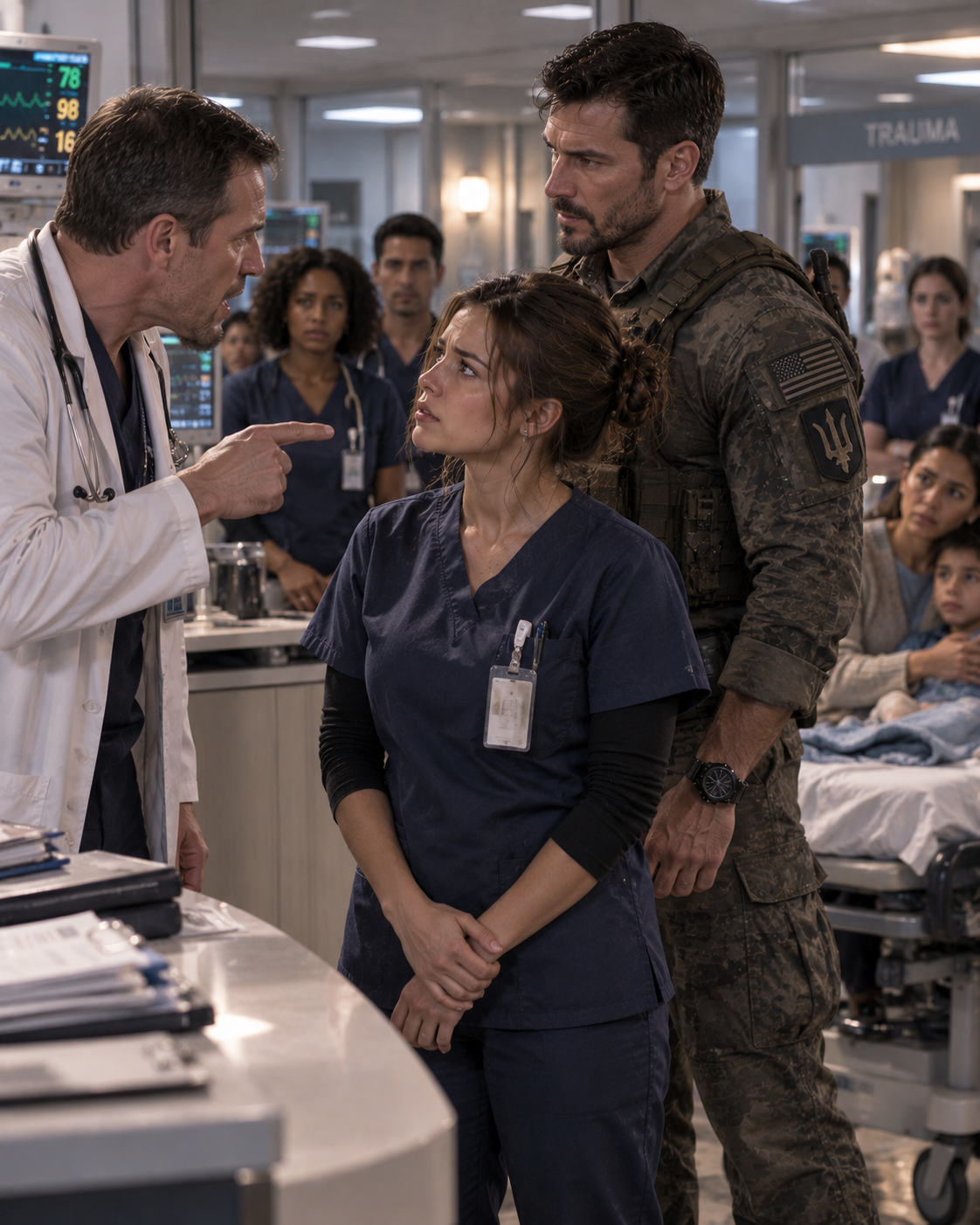
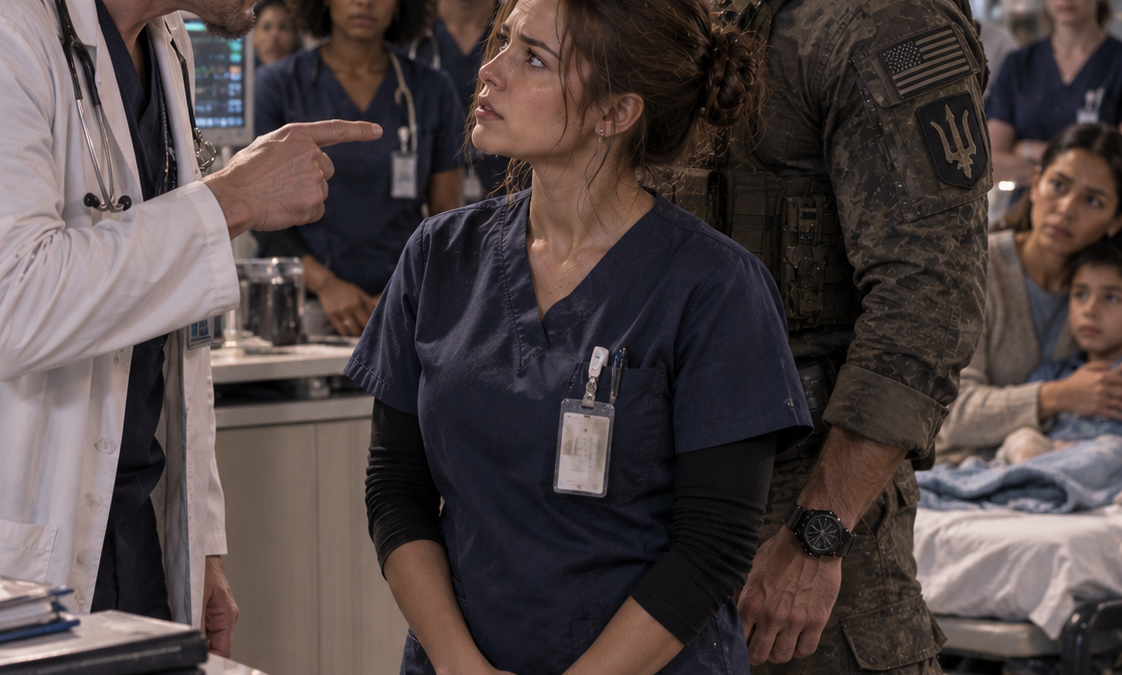
The trauma ward at Veltham Cross Medical Center stopped breathing the moment Dr.Conrad Hale threw a patient chart across the nurses station and pointed at Marisol Vega like she was something he’d tracked in on his shoe.
“English,” he said, loud enough for the entire floor to hear.
“We speak English in this hospital.
” She had been giving discharge instructions to a terrified mother whose son had nearly bled out, explaining wound care in the only language that woman could understand.
And Hale had just made that a crime. He told her she was off trauma duty effective immediately.
He told her if she spoke Spanish on his floor again, she wouldn’t have a job to come back to.
Nobody moved. Nobody spoke.
Nobody knew that Marisol Vega had once given orders in that same language under live fire.
The morning had started the way most of Marisol’s mornings started at Veltham Cross, quiet, purposeful, and slightly behind schedule because the overnight nurse had left the medication reconciliation half finished and someone had to absorb the gap.
That someone was always Marisol. She had been on the trauma floor for 4 years.
Not because she couldn’t go elsewhere, she’d had offers, better paying ones, positions with more title and less blood.
But because trauma was where the work was hardest and where having the right nurse made the largest difference between a patient leaving the hospital upright or leaving it in a bag. She understood that math. She stayed because she understood it.
The unit was built around a central nurses station shaped like a horseshoe with trauma bays extending outward in both directions and a set of double doors at the far end that connected to the surgical suites. The fluorescent lighting gave everyone the same gray pallor, regardless of their actual skin tone. The air smelled permanently of antiseptic and something underneath it that no cleaning product ever fully neutralized.
The monitors beeped, the IV pumps clicked. On a normal morning, the rhythm was almost meditative.
This was not a normal morning. Conrad Hale had transferred to Veltham Cross eight months ago from a hospital in a wealthier district two counties over, and in those eight months he had reorganized the trauma department according to a principle that nobody stated out loud but everyone understood.
Things should run the way Conrad Hale preferred, and Conrad Hale’s preferences were not subtle.
He was 46, thinning at the top, built like someone who had played competitive sports two decades ago and was still carrying the attitude, if not the body. He walked fast.
He spoke faster. He did not particularly enjoy being questioned, and he had an almost clinical ability to identify the person in any given room most likely to absorb punishment without visible consequence.
He had identified Marisol in his second week.
She wasn’t the kind of nurse who fought loudly.
She didn’t complain to administration in ways that left paper trails.
She arrived early, stayed late when the unit needed it, and possessed the particular skill that only experienced trauma nurses develop.
The ability to anticipate a deteriorating patient’s next problem before it fully announced itself.
She was good at the work in the quiet, unargued way that people are good at things they’ve been doing long enough that excellence has become reflex.
Hale found her competence irritating in a way he never examined too closely.
The morning’s first collision came at 7:40 a.m.A woman named Lorena Sandoval had been brought in the night before when her 9-year-old son suffered a severe laceration from a piece of farm equipment.
The boy, Tomas, had been stabilized, stitched, and was ready for discharge, but Lorena spoke almost no English, and the hospital’s contracted interpreter service had a two-to-four-hour wait time that nobody had bothered to flag during the overnight shift.
Marisol had checked on the room during morning rounds and found the woman sitting rigid in a plastic chair beside her son’s bed holding both of his hands in hers, eyes fixed on the door with the expression of someone who understood she was surrounded by people trying to help and couldn’t access a
single word of it.
Marisol had sat down and started explaining discharge instructions in Spanish. Wound care, signs of infection, the follow-up appointment at the outpatient clinic on Thursday, when to bring Tomas back immediately.
She had a printed instruction sheet in English and she had translated every item line by line, watching Lorena’s face shift from locked down terror to something approaching comprehension.
Not relief, the situation still scared her, but comprehension. Lorena could act on comprehension. Hale had been walking past the open door when he heard the Spanish.
He stopped. He stood in the doorway for long enough that Marisol noticed him in her peripheral vision, but continued through the instruction sheet because the alternative was abandoning a frightened woman mid-sentence.
That was when Hale walked in, picked up Tomas’s chart from the bedside table, looked at it without reading it, and said, “Wrap this up.”
Marisol said, “She needs the full discharge instructions, Dr.Hale.
The interpreter service has a “I’m aware of the interpreter service.
Use it.”
“The wait is 2 to 4 hours.
We need this bed.”
He looked at her with an expression that was not quite contempt and not quite boredom, something hovering between the two.
“Then she can wait 2 to 4 hours.
That’s what the service is for.”
Lorena understood that something was wrong. She looked between them.
Tomas had woken up and was watching with the particular stillness of a child who has learned that adult conflict carries collateral risk.
Marisol said quietly, “I’m almost finished.”
“You’re finished now.”
She held his gaze for a half second. Then she told Lorena in Spanish that someone would come to help her soon. That the papers on the table explained everything and that she should not leave until she had spoken to someone who could walk her through them.
She stood up. Hale carried the chart out with him.
Marisol followed.
What she did not expect, what nobody in the hallway expected, was that he wouldn’t stop at a verbal reprimand.
He walked directly to the nurses station at the center of the horseshoe where four nurses were charting, a first-year resident was reviewing labs, and two surgical techs were waiting on a supply console. He set the chart down on the counter with enough force that the sound carried.
“This nurse,” he said, pointing at Marisol, “was just observed conducting a patient interaction in a foreign language contrary to unit protocol.
Effective immediately, she is removed from trauma duty pending a formal review.”
The word foreign landed in the room like a stone dropped into still water. Nobody moved.
Marisol said, “There’s no unit protocol prohibiting “I’m establishing one now.”
He looked directly at her.
“If I hear you speaking anything other than English on this floor again, I will escalate this to a termination hearing.
Do I make myself clear?”
The resident looked at his tablet. The surgical techs found something to examine near the supply cart.
Three of the four nurses at the station kept their eyes down with the practiced deliberateness of people who had learned exactly what looking up at the wrong moment cost. The fourth nurse, a young woman named Priya Okafor, who had been at Veltham Cross for all of seven months, opened her mouth, then closed it.
She would think about that closed mouth for weeks afterward. Marisol said nothing else. She reached past Hale, picked up the chart she had been working from, set it back in its correct slot in the rack, and walked toward the staff lounge.
Her face was still. Her hands were still. Her breathing was even.
Inside, she was cataloging.
That a skill she’d picked up in a previous life.
The ability to observe her own emotional state the way a flight instrument measures altitude with accuracy and without judgment. She was angry.
She was tired in a way that had nothing to do with the shift.
She was aware that she had just been publicly degraded in a manner calculated to maximize visibility because Hale hadn’t needed an audience to pull her from duty.
He had chosen one. She knew something else, too.
Something she had carried quietly for 4 years and had never once volunteered to anyone at Weltham Cross. She knew what she was capable of.
She had changed into street clothes in the staff lounge and was considering her options. Filing a formal grievance, calling the union representative, or simply sitting with the anger until it compressed into something useful. When Priya appeared in the doorway, she was still in scrubs.
She looked like someone about to say something she had already rehearsed and decided to say anyway.
“That was wrong.”
Priya said. Marisol looked at her.
“What he did.
It was wrong.”
“Yes.”
Marisol said.
“It was.”
“Are you going to HR?”
“I’m thinking about it.
” Priya glanced down the hallway, then back.
“I want you to know that I’ll say what I saw if you file.
I’ll say what I saw.”
She paused.
“A few of the other nurses, not all of them, but some, they’d probably say it, too.
He’s done things before, smaller things, but nobody ever made it official because he has Caldwell’s ear and Caldwell runs the department.
” “Yeah.”
Marisol nodded. She was aware of the political architecture of the hospital. Dr.Nolan Caldwell was the chief of surgery and Caldwell had brought Hale on personally, which created a protection structure that HR complaints alone were unlikely to penetrate.
This was not the first time she had encountered a system designed to absorb complaints and return them safely to the person who filed them.
“Thank you,” Marisol said.
“I mean that.”
Priya nodded and went back to the floor. Marisol sat alone in the staff lounge for another few minutes.
Through the single window above the sink, she could see a slice of the parking structure and a gray November sky pressing down over the city of Veltham, a mid-sized former industrial town that had transitioned unevenly into something trying to be a medical and university hub. The hospital was one of the anchors of that transition. Veltham Cross Medical Center, six floors, 340 beds, a level two trauma designation that the administration had been lobbying to upgrade for 3 years.
She was thinking about how to frame a grievance that would survive Caldwell’s interference when the building shook.
Not violently, not earthquake level, but distinctly. A low thudding vibration that traveled up through the floor into her feet and rattled the window frame in its casing.
She stood up. In the hallway outside the staff lounge, she could see nurses and aides moving toward the windows on the north side of the building.
One of the aides, young, probably a student worker, said, “Is that a helicopter?”
It was. And it was close.
Marisol walked to the nearest north-facing window and saw it.
A military helicopter, olive and gray, without commercial markings, descending in a controlled arc toward the hospital’s rooftop landing pad.
The pad was technically Veltham Cross’s, but it rarely saw military traffic.
The hospital had a mutual aid agreement with three military installations within a 100-mile radius, but those activations were rare and usually came with advanced coordination. There had been no advanced coordination.
She knew this because the unit coordinator would have flagged it during morning huddle. She watched the helicopter touch down.
Something moved in her chest, not quite recognition, not quite dread, something older and more precise. She went back to her locker and started changing back into her scrubs. She did not know why exactly.
Only that the feeling in her chest had the specific texture of a situation about to require someone who knew what they were doing and that sitting in a staff lounge in street clothes was not where she intended to be when it arrived. She was still lacing her second shoe when she heard the commotion start at the far end of the hallway.
It began as the sound of fast movement, multiple people.
The particular cadence of a stretcher being pushed at maximum safe speed, which is slightly different from a cart or a supply trolley in ways that a trauma nurse’s brain encodes automatically.
Then voices speaking in clipped overlapping fragments the way people speak when they are managing a situation that has not yet stabilized. Then the double doors at the end of the trauma wing burst open. Marisol was already moving.
The man on the stretcher was in his mid-30s with the kind of physical build that spoke spoke of systematic conditioning. He was in civilian clothes, dark tactical pants, a gray compression layer.
But the people around him were not civilian. Two of them wore military utility uniforms.
One wore tactical gear that hadn’t been fully doffed.
All of them moved with the organized urgency of people who had done this before in worse conditions. His pressure cuff was on. His IV access was established bilaterally.
Whoever had worked on him before arrival had done it correctly. He was conscious but deteriorating.
She could see it in the color at his lips and in the way his eyes were tracking, present but having to work for it. His abdomen was rigid in a way that had nothing to do with muscle tone.
Hale emerged from a trauma bay where he had been reviewing imaging, saw the stretcher, and stepped forward. He had the institutional reflex that senior physicians develop, the movement toward the complicated case before any assessment has been made.
“Trauma one.”
he said. Who do we have?
One of the uniform personnel, a woman with a staff sergeant’s insignia, said, “Operator, abdominal trauma, possible internal hemorrhage.
He’s been declining for 20 minutes.”
What’s his pressure?
84 over 50 and dropping. Hale looked at the stretcher and started issuing orders.
He was not entirely incompetent. Marisol had always been clear-eyed about that. He had real training and real experience.
What he had was a particular cognitive style that prioritized the presentation he understood over the presentation that was actually in front of him.
She had watched him make that mistake twice in the eight months he’d been at Beltham Cross, both times in situations where the obvious reading of the trauma pattern was not the correct one.
She stepped closer.
She wasn’t officially on trauma duty.
She was standing in the hallway watching, which was technically within her rights. The stretcher wheeled past her, and then the double doors opened again.
The man who came through them was in his early 40s, wearing tactical gear that had seen real use, not the pristine kind that got issued before exercises, but the worn, creased kind that accumulates over years of deployment. He was built lean and moved like someone for whom physical efficiency was a professional requirement, rather than a personal preference.
His eyes swept the room in a single pass that Marisol recognized, not as threat assessment, exactly, but as the kind of rapid environmental mapping that becomes automatic in people who have spent enough time in environments where the wrong read costs lives. He scanned past the nurses, past the resident, past Hale, and stopped on Marisol.
It was not a long pause. It lasted perhaps two seconds, but it was absolute, a full stop in the middle of a situation that was moving fast enough that no one else in the room had two seconds to spare for anything other than the patient. Then he crossed the room in eight strides, and Marisol felt the floor shift slightly under her feet in a way that had nothing to do with the building.
He stopped 2 ft in front of her. He was still wearing his gear. His jaw was set.
His eyes were completely steady in the way that very calm people’s eyes are steady when they are actively managing something enormous.
He brought his right hand up. The salute was crisp and formal and utterly genuine.
“Capitana Vega,” he said in Spanish that carried the specific cadence of someone who had learned it in a field under pressure from people who needed him to understand them exactly.
“Tenemos un operador con hemorragia interna progresiva.
Necesito sus manos en esta sala.”
“Captain Vega, we have an operator with progressive internal hemorrhage.
I I need your hands in this room.”
The trauma ward did not go silent dramatically the way silence happens in films. It went silent the way it does in real emergencies, a gradual dampening person by person as the significance of what just happened filtered through to each individual like a slow pressure change. Hale turned from the stretcher.
He looked at the man. He looked at Marisol.
His face moved through something complex.
“Who are you?”
he asked. The man lowered his hand.
He did not look at Hale immediately.
He was still looking at Marisol, and Marisol was looking back at him, and something was happening between them that everyone else in the room was trying and failing to read because it was written in a language that predated their presence in each other’s lives by nearly a decade.
His name was Commander Darian Reyes. She knew him.
She had last seen him in a forward surgical unit in a country whose name she had not spoken in 4 years. She had known him the way you know someone when the situation you share has stripped every professional pretense down to function and need, when rank is real but the gap between roles collapses under pressure. When the relevant truth is not who outranks whom, but who can do what in the next 90 seconds.
He knew her, too. Not as a civilian nurse in a trauma ward in an industrial city that was becoming a medical hub. He knew her as something older and more specific, something that the institution of Weltham Cross Medical Center had no frame for.
She finally looked at Hale. He was still waiting for someone to explain what had just happened. She said nothing.
Darian Reyes turned toward him then with the patient-controlled focus of a man who has decided that a particular obstacle is not worth his anger, but also will not be indulged.
“The man on that stretcher is my responsibility,” he said.
“Every second matters.
Are you the attending?”
“I’m the chief trauma attending, yes, and I need to understand then understand while you’re moving.
What’s his pressure now?”
A nurse called out from trauma one.
“79 over 46.”
Reyes looked at Marisol.
The look said, “We don’t have much time and we both know it, and I am asking you to make a decision.
” Hale took a step toward Marisol.
His voice dropped into the register he used when he wanted to be heard as authoritative rather than loud.
“You are off trauma duty.
If you step into that bay, I will have you escorted from this hospital.”
The room held. Marisol looked at the doors to trauma one.
Through the narrow window in the door, she could see the screens, the pressure trace going shallow, the rhythm on the monitor that wasn’t quite wrong, but was heading somewhere wrong fast.
She could see the resident standing at the head of the bed with the expression of someone who knows they are outpaced by the situation, but doesn’t know what to do about it.
She looked at Hale. She looked at Reyes.
She thought about Lorena Sandoval sitting rigid in a plastic chair 2 hours ago trying to understand what was happening to her son, and the look on Tomas’s face when his mother’s comprehension had finally arrived like a small rescue.
She thought about a night 8 years ago in a tent with generators failing and a man bleeding out on a cot, and the voice on the other end of the satellite link speaking in fragmented terrified Spanish that nobody else in that tent could parse.
And what would
have happened to the men in that tent if she hadn’t been there to answer it?
She said to Hale, “Step aside.”
He didn’t.
She walked around him.
Behind her she heard Darian Reyes say quietly to Hale, “That was the wrong move.”
She pushed through the doors to trauma one and the monitors hit her full volume, the alarms, the pressure reading, the rhythm that was starting to break down at the margins. And she looked at the man on the stretcher who was losing the battle with consciousness, whose abdomen under her hands told her the story that the obvious wound site was trying to obscure.
“Someone get me a second large-bore IV and tell the blood bank we need emergency release O-negative,” she said.
“And get me Dr.Hessler from surgery, not a not a resident.
Hessler herself.”
The team moved.
In the hallway outside trauma one, through the door she had just walked through, she could hear Conrad Hale’s voice.
He was not speaking to anyone directly.
He was saying, with the particular edge of someone who feels authority slipping, “She is not authorized.
” And then Darian Reyes said something short and level that she didn’t fully hear.
And then Conrad Hale went quiet. The man on the stretcher opened his eyes and looked at her.
His name, she would learn later, was Marcus Webb. He was 31 years old.
He had a wife whose name was tattooed in small letters on the inside of his left wrist, which she noticed when she placed the second IV line.
“Hey,” she said to him in the same quiet direct voice she had used in a dozen worse places than this.
I’ve got you.
Breathe slow.”
He blinked at her. His lips moved.
“Stay with me,” she said.
His pressure dropped to 71 over 40.
And outside in the hallway, the man who had thrown her off his trauma floor 40 minutes ago was standing in front of a navy commander and beginning very slowly with the particular dawning of someone who has just understood the shape of the mistake they’ve made to realize that the woman he had tried to make disappear was
the only person in the building who might be able to fix what was in front of them.
The monitor screamed.
The monitor screamed and Marisol was already moving before the sound fully registered in anyone else’s nervous system.
She called for the ultrasound without looking up from Marcus Webb’s abdomen.
Her hands were on him.
Not gentle, not rough, but purposeful in the way that hands are purposeful when they’ve learned to read tissue the way other people read faces.
She pressed two fingers beneath his right costal margin and felt what she expected to feel. The wrong kind of resistance in the wrong place.
A fullness that hadn’t been there 20 minutes ago and was growing.
The ultrasound cart arrived. The resident, a second year named Dr.Felicity Bram, who had the particular wide-eyed steadiness of someone working very hard not to show how far out of her depth she was, positioned the probe.
Right upper quadrant, Marisol said. Hepatorenal space first. Bram ran the probe.
The screen populated with gray and white static that resolved into anatomy and there it was, a dark stripe of fluid where there should have been none. The sonographic signature of blood accumulating where it had no business being.
Positive Morrison’s pouch, Bram said with a kind of controlled neutrality that was actually impressive for someone her level.
And pelvis. Bram moved the probe.
Another stripe. Wider.
Marisol stood up straight. I need Hessler.
Where are we on Hessler?
A nurse named Dominguez, one of the trauma floor’s most experienced, a man who had worked with Marisol long enough to anticipate her next three moves, said, “She’s scrubbing out of an appendectomy.
4 minutes.
” 4 minutes was a long time.
She looked at the pressure trace. 68 over 39. Blood bank?
Two units O neg on the way up, 4 minutes behind the first two. Everything was 4 minutes. The universe had decided on 4 minutes as its interval of choice today, and none of those 4-minute gaps were going to line up in ways that made the math comfortable.
Marcus Webb’s hand found her wrist.
It wasn’t a grip.
He didn’t have the strength for a grip.
It was more like a landing, the way a bird lands on a branch, with just enough weight to establish contact. His eyes were open, tracking her with the effortful concentration of someone burning through their last reserves of clarity.
She leaned in. Still here.
His lips moved. She tilted her head.
He said very quietly, “Don’t let Reyes And then he stopped.
“Don’t let Reyes what?”
But he was gone again. Not dead, the monitor confirmed that, but past the threshold where language was available.
His hand stayed on her wrist. She left it there. In the hallway, she could hear Darian Reyes.
Not his words. She had closed the trauma bay doors, and the acoustic insulation was decent.
But the cadence of his voice, which she recognized the way you recognize music you haven’t heard in years, the pitch and pace of a man who is operating at the intersection of authority and controlled fury, where everything he says is technically measured, and every syllable carries the weight of someone who has been in rooms where the wrong word costs lives.
She did not know what was happening in that hallway. She focused on what was happening in front of her. The first two units of blood arrived at 3 minutes and 40 seconds, which was technically 4 minutes if you were generous.
She started the transfusion. She talked to Marcus while she worked.
Not because he could hear her, necessarily, but because she had learned a long time ago that talking to patients in crisis, whether or not they’re conscious, changes something in the room.
The quality of attention shifts. The team works differently when the person on the table is being addressed as a person.
She’d seen it enough times that she’d stopped trying to explain it and just did it.
“You’re going to be fine,” she told him.
“Your pressure is going to come back up with the blood, and then we’re going to figure out exactly what’s bleeding, and we’re going to fix it.
That’s the plan.
” Dr.Hessler came through the doors at 4 minutes and 12 seconds, still drying her hands on a sterile towel with the efficient no-ceremony entry of a surgeon who didn’t believe in dramatic pauses.
Dr.Yael Hessler was 51, had trained at three institutions across two continents, and had the particular quality that the best surgeons develop over time.
She was impossible to rattle, and she never pretended to know things she didn’t know.
She looked at the ultrasound images, looked at the pressure trace, looked at Marisol.
“Talk to me,” she said.
Marisol talked.
She laid out the presentation in the compact sequenced way she’d learned in environments where brevity and accuracy were the same value.
Mechanism of injury, vital sign trajectory, ultrasound findings, response to initial resuscitation, her read on the likely source of hemorrhage based on the distribution of the free fluid. Hessler listened without interrupting.
When Marisol finished, Hessler said, “You’re thinking vascular?
The fluid distribution is wrong for a solid organ injury.
It’s tracking in a pattern that suggests something posterior, possibly a branch off the right hepatic.
He could have both. He could.
But if we chase the obvious one and miss the vascular component, we lose him on the table.”
Hessler looked at Marcus Webb for a long moment, then she looked at Bram, then back at Marisol.
“OR 3 is open,” she said.
“I want a vascular surgery consult on standby, and I want” She stopped.
The doors had opened. Conrad Hale came through them. He had a look on his face that Marisol had not seen from him before.
Not the dismissive authority he deployed that morning, not the controlled aggression he used to manage nurses he’d identified as potential problems.
This was something raw and less managed, something that happened to faces when the ground shifts under them and they haven’t finished deciding how to stand.
“Dr.Hessler,” he said, “I need to address a protocol issue before we proceed.”
Hessler turned toward him with the patience of a woman who has worked in hospitals long enough to have encountered every variety of turf conflict.
“Can it wait 90 seconds?
We’re about to move this patient.”
“No, it cannot.”
He looked at Marisol.
“This nurse was formally removed from trauma duty at 7:52 this morning.
Her presence here is unauthorized and constitutes a protocol violation that I intend to Her presence here,” Hessler said, “resulted in a correct identification of probable vascular hemorrhage that I might have spent 15 minutes arriving at on my own.
So, we can talk about protocol after this man is out of danger.”
Hale’s jaw moved.
“Conrad,” Hessler said, and there was something in her voice that wasn’t quite compassion, but was adjacent to it.
The tone of a colleague delivering information they’d been holding for a while.
Go back to your bay.
We’ll talk when this is done.
” He looked at Marisol one more time.
She was already looking past him at the door, at the corridor beyond it, and at Darian Reyes, who had apparently followed Hale through the doors and was now standing just inside the trauma bay with his arms at his sides and his face arranged in the expression of someone who has seen this kind of interference before and is deciding in real time how to respond to it. Hale left.
Reyes watched him go, then he looked at Marisol.
“How long to OR?”
“We’re moving now.”
“I’m coming.”
“Families wait in” “I’m not family.
I’m his commanding officer and I have legal authorization to accompany this patient through all phases of care under the military cooperative agreement this hospital signed.
He produced a folded document from the front pocket of his vest, laminated, worn at the creases from being folded and unfolded many times. The agreement is current. I checked it before we landed.
Marisol looked at the document. She looked at Reyes.
You checked it before you landed? I checked it before we took off.
She handed the document to Dominguez without looking at it further. Walk with us.
They moved.
The corridor between the trauma wing and the surgical suites was one of the longest in the hospital, designed that way she’d always assumed because the architect had never personally tried to push a deteriorating patient through it.
The wheels of the stretcher caught slightly on the transition between flooring types, which had been a maintenance complaint for 2 years and would apparently remain one. The overhead lights were the harsh efficient kind that flattened everything.
Reyes walked on the left side of the stretcher, slightly behind the head, in a position that kept him out of the clinical teams’ way while maintaining visual contact with Marcus.
He wasn’t hovering.
He wasn’t asking questions that would slow the movement.
He was doing what trained people do in situations they can’t control but can contribute to, minimizing his footprint and staying available.
She had forgotten that about him. The economy of it. The refusal to perform concern when actual concern was present.
They were halfway down the corridor when he said, without looking at her, I didn’t know you were here.
I know. I would have He stopped.
I know. She said again.
A pause. The stretcher wheel caught and released.
He’s been losing ground for 6 hours, Reyes said.
We were doing a joint training exercise, no active operation. He took a fall during a vehicle extraction drill, nothing that should have done this, but the imaging at the base facility flagged the abdominal presentation and their surgeon said he needed a level two center. We were an hour out from Veltham.
I authorized the flight. Was there any earlier imaging?
At the base, it showed some fluid, not the volume you’re seeing now.
He’s been accumulating for 6 hours.
Yes. She processed this. It changed the picture slightly.
Not the immediate surgical picture, but the contextual one. A slow accumulation over 6 hours meant the source was not a massive rupture.
It was something that had been bleeding incrementally. Enough to compromise him over time, but not fast enough to kill him in the first hour. Which actually supported her read on the vascular component.
A large vessel injury wouldn’t have given him 6 hours.
A branch injury could. Good.
She said, “The tattoo on his wrist?”
Reyes glanced at her.
“His wife’s name?
Is she contacted?
She’s flying in from Galveston.”
Good. They reached the surgical suite doors. Beyond this point, Reyes could not follow.
He knew it. He stopped before she had to say anything, which was either protocol familiarity or the kind of situational reading she remembered from before.
She stopped and looked at him properly for the first time since he’d saluted her in the trauma ward.
He was older than she remembered. Not dramatically.
It hadn’t been that long, and he’d been 40 when she’d known him.
But the years showed differently on him than on the people she worked with at Veltham Cross. The lines on his face were the kind that came from weather and stress and the specific fatigue of sustained high-stakes responsibility.
His eyes were the same, though.
That hadn’t changed.
Clear and level and carrying more than they showed.
“Marisol,” he said.
“He’s going to be all right,” she said.
“I’m going to make sure of it.
” She pushed through the surgical suite doors.
Behind her, she heard him say quietly something in Spanish.
She didn’t catch all of it.
What she caught was “I know you will.”
She had a job to do. She She it.
The surgery took 93 minutes.
Hessler opened and Marisol worked beside her in the capacity she’d been cleared for, not as primary surgeon, but as the person in the room who knew this patient’s presentation in its entirety and could anticipate the intraoperative findings before they fully revealed themselves.
They found what Marisol had suspected, a laceration to a hepatic arterial branch, small enough to have been missed on the base facility’s imaging, significant enough to have been quietly redistributing Marcus Webb’s blood into his abdomen for the better part of a day.
There was also a splenic contusion that was not actively bleeding, but would need monitoring. Hessler repaired the arterial laceration with the focused efficiency of someone who had spent 30 years doing this and then did the thing that separated good surgeons from great ones. She stopped and looked at everything else before closing, methodically, without rushing toward the end.
No other active sources. The contusion could be managed conservatively.
The closed. When Marisol walked out of the OR, still in her surgical gown with her mask pulled down, the corridor outside had more people in it than it should have.
Darian Reyes was there, still in his gear, standing against the wall with his arms crossed and his eyes on the door she’d just come through.
Beside him was a younger man, mid-20s, military utility uniform, the posture of someone waiting in a situation where waiting was all they could do.
Down the hallway, three more individuals in various stages of tactical gear were arranged along the wall in the way that groups of people arrange themselves when they’ve agreed, without saying it out loud, to be present without being intrusive.
She understood suddenly that all of them had come off the helicopter, that Marcus Webb had people. Reyes pushed off the wall the moment he saw her face.
She said, “He’s out of surgery.
The hemorrhage is controlled.
He’ll need monitoring for the next 24 hours and the recovery is going to take time, but he’s going to make it.
Reyes didn’t move for a moment.
Something passed across his face, not the relief she might have expected, but something more complicated. The expression of someone who has been managing fear at a professional distance for several hours and is now experiencing the cost of that management all at once.
“Okay,” he said.
“He’s in recovery.
They’ll bring him to the surgical ICU in about 40 minutes.
You can see him then.”
He nodded, then after a beat, “Thank you.”
“It’s my job.”
He looked at her.
“Not today it wasn’t.”
She didn’t answer that.
She stripped off her surgical gown at the hallway bin and started walking back toward the trauma wing. She needed to chart.
She needed to follow up on two other patients whose morning had been interrupted.
She needed at some point to eat something because she’d been running since before 7:00 a.m.on a coffee and half a granola bar, and her body was beginning to register a complaint.
She had made it about 30 ft down the corridor when she heard the footsteps behind her and turned to find not Reyes, but Priya Okafor, who had clearly been waiting in the corridor outside the OR wing with the specific patience of someone who had information and had
decided that delivering it required a particular moment.
“He’s been in Caldwell’s office,” Priya said without preamble.
Marisol slowed to a stop.
“Hale?”
“For the last hour, since before you went into surgery.”
Priya’s voice was steady, but her eyes were doing something more complicated.
“Caldwell’s assistant told one of the coordinators that he’s filing a formal complaint about your presence in the trauma bay.
Unauthorized clinical intervention, liability exposure.
That’s the language he’s using.”
Marisol absorbed this.
“He’s also saying Priya paused.
“He’s saying that the Navy commander overstepped and that the hospital’s agreement with the military installation doesn’t cover the kind of override that happened in this trauma bay.
He’s framing it like Reyes coerced the clinical team.
Reyes didn’t coerce anyone.
I know that. You know that. Hessler knows that.
Priya’s jaw tightened.
Caldwell is going to know whatever Hale tells him first. Marisol stood in the corridor and looked at the middle distance for a moment. Down the hallway, she could see the entrance to the trauma wing.
The same double doors she’d walked through that morning to give a frightened woman discharge instructions in the only language available to her.
The same floor she’d been removed from 40 minutes later.
The same unit where a man in navy tactical gear had saluted her in front of people who had never known that salute was possible. The day had the quality of something that had been moving too fast to fully process and was now asking her to process it all at once, which was not a request she had the time to honor.
“What do you need from me?”
Priya said. Marisol looked at her.
“Right now, nothing.
Go finish your shift.”
“Marisol, I mean that kindly.
Go finish your shift and document everything you saw this morning accurately and completely.
That’s the most useful thing anyone can do right now.”
Priya searched her face for something, apparently found it, and nodded. She went.
Marisol continued toward the trauma wing. She pushed through the doors.
The floor was operating at its normal rhythm. Monitors, movement, the layered sound of a unit in controlled motion. A few of the nurses looked at her when she came through.
Some of them looked away quickly. One, an older nurse named Ballard, who had worked trauma for 15 years and had the thousand-yard neutrality of someone who had seen administrations come and go, gave her a single, level nod that contained a full paragraph of meaning. She went to a charting station and began documenting.
She was 12 minutes into the charting when her phone buzzed.
The number was internal, a hospital extension she didn’t immediately recognize.
She answered.
“This is Marisol Vega.”
“Ms.Vega.”
The voice on the other end was the measured, careful voice of someone who had been trained to deliver institutional communications without inflection. This is Andrea Lusk from the office of the chief of surgery.
Dr.Caldwell would like to meet with you at your earliest convenience to discuss this morning’s events.
His schedule has an opening at 4:30 this afternoon. 4:30.
Two and a half hours from now.
“I’ll be there.”
Marisol said. She hung up and sat for a moment with her hands flat on the desk and looked at the charting screen and thought about the word convenient, about how the people who scheduled inconvenient things always framed them as convenient, as though the
framing changed what they were.
She She finished the documentation.
Then she made a call of her own to the hospital’s employee relations office, where she left a message requesting a formal record of the incident that morning on the trauma floor.
Not a complaint, exactly. Not yet. Just a record.
Time-stamped. Permanent.
Then she went to check on her other patients.
It was Dominguez who found her at 2:47 p.m.outside the room of a 63-year-old man named Walter Pruitt, who had come in the night before with a fractured hip and a subdural hematoma that hadn’t been identified on the initial imaging.
“The Navy commander is asking for you.
” Dominguez said.
She looked up from the chart she was reviewing.
“Webb’s in the SICU.”
“Reyes can see him through the normal visiting.”
“It’s not about Webb.”
Dominguez’s expression was careful.
“He’s been talking to people.”
She waited.
“Staff, nurses mostly.”
“A couple of the residents.”
Dominguez glanced down the hallway in both directions, which was a thing people did in this hospital when they were about to say something they didn’t want attributed.
“He’s been asking about Hale specifically, what he’s like to work for.”
“Whether this morning was unusual.”
Marisol set the chart down.
“How many people has he talked to?
I don’t know exactly.
I know Priya talked to him. I know at least two of the overnight nurses from last week talked to him. Dr.Bram.
A pause.
He’s not pressuring anyone.
He’s just asking very quietly and people are answering.
She thought about that.
Darian Reyes moving quietly through the staff areas of a hospital he’d been inside for less than 6 hours conducting what was recognizably, if you’d ever seen it done, a methodical informal inquiry.
Not an interrogation, not a confrontation, just questions asked of people who had been waiting, in some cases for months, for someone to ask them. She knew this skill of his. She had watched him use it in a different context, in a different kind of facility, asking different questions of people who had more immediate reasons to be frightened of the asking.
He had the quality of someone fundamentally trustworthy, not because he performed trustworthiness, but because he was constitutionally incapable of the kind of tactical dishonesty that makes people guard themselves. People answered him because answering him felt like the correct response.
“What did they tell him?”
she said.
Dominguez’s jaw worked for a moment.
“Enough,” he said.
“I think enough.”
She nodded slowly.
She picked the chart back up because Walter Pruitt’s subdural needed attention regardless of what was unfolding in the rest of the building.
She had almost made it back into the room when Dominguez said from behind her, “There’s one more thing.
” She turned.
“Hale knows Reyes has been talking to people.
Caldwell’s assistant apparently told him and Hale Dominguez stopped.
He was choosing his words with the care of someone who understood that the precise version mattered. Hale went to the SICU about 20 minutes ago, not to check on Webb. He went to speak to Commander Reyes directly.
To tell him that his presence on the civilian hospital floor constitutes interference in clinical administration and that Hale intends to have him formally removed from the premises before the 4:30 meeting. The corridor felt very quiet suddenly.
“What did Reyes say?”
Marisol asked. Dominguez almost smiled.
It wasn’t a warm smile.
It was the expression of someone who has witnessed an interaction that will stay with them for a while.
“He thanked him,” Dominguez said, “very politely, and then he made a phone call.”
Marisol looked at him.
“We don’t know who he called,” Dominguez said, “but about 15 minutes later, Caldwell’s office called the SICU and told the charge nurse that Commander Reyes was to be extended full professional courtesy for the duration of his patient’s admission.
” She stood in the corridor with that information for a moment.
4:30 was 90 minutes away.
Conrad Hale was in Caldwell’s office building a case against her.
Darian Reyes was somewhere in this building having just made a phone call that had reversed a direct order from the chief trauma attending within 15 minutes.
And Marcus Webb was in the surgical ICU with a repaired hepatic artery and a wife flying in from Galveston and a tattoo on his wrist that said a name Marisol hadn’t been close enough to read.
She went back to work.
At 4:15, she washed her face in the staff bathroom, changed into a clean set of scrubs, and walked toward Caldwell’s office.
She took the long way through the main atrium, past the patient services desk, up the administrative elevator, not because it was faster, but because it was the route that took her past the SICU on the second floor.
She didn’t stop.
She walked past the SICU entrance and glanced through the interior window as she passed.
Reyes was sitting in the chair beside Marcus Webb’s bed.
Webb was awake.
They weren’t talking, or if they were, it was too quiet and too far away to read.
Reyes had his arms resting on his knees and his head tilted toward Webb, and the posture between them was the posture of two people who have been through something together and have arrived at the part that doesn’t require words.
She walked past and kept moving.
She was outside Caldwell’s office at 4:28.
The assistant told her to go in. She opened the door. Caldwell was behind his desk.
He was a large man, late 50s, with the bearish quality of someone whose physical presence had once been an asset in clinical settings and had translated imperfectly into administrative ones. He wore reading glasses on a cord and had his hands folded on the desk in the way of someone who has prepared for a meeting.
Hale was in the chair to the right of Caldwell’s desk.
He looked at her when she came in with an expression she couldn’t immediately classify, and then she understood it because she’d seen it before in different contexts.
It was the look of someone who is committed to a position and is bracing for the room to agree with them, which is a different thing from confidence. There was a third person in the room. He was sitting in the chair against the wall, slightly outside the desk geometry, the position of an observer rather than a participant.
He was wearing a suit that was not a hospital suit or a military uniform, something in between, the kind of clothing that belonged to a category of person whose role was institutional without being clearly institutional. He had a notepad on his knee and a pen in his hand. Marisol sat down in the chair Caldwell gestured toward.
She put her hands in her lap and looked at Caldwell and waited.
“Ms.Vega,” Caldwell began.
“Thank you for coming in.
We have some concerns to discuss regarding the events of this morning, specifically as they pertain to protocol and chain of command.”
He glanced at Hale.
“Conrad, do you want to start?”
Hale leaned forward. He had been building this, she realized.
The hour in Caldwell’s office, the language about liability and unauthorized intervention, the attempt to have Reyes removed, all of it had been preparation for this moment, this room, with Caldwell as the audience and Marisol as the subject.
He had done this before. Not to her specifically, but he had done this.
The construction of a narrative that positioned his actions as institutional necessity and the other person’s response as the problem.
He started to speak. He was three sentences in when the door opened without a knock.
Darian Reyes walked into the room. Behind him was the man in the suit who had been sitting against the wall, which was impossible because the man in the suit was also sitting against the wall, and then Marisol understood.
There were two of them. The man who came in behind Reyes was not the same man.
He was older, with the bearing of someone at the top of a command structure, and he was carrying a physical file folder that he set on Caldwell’s desk with the deliberate placement of someone who has thought carefully about where things go.
Hale stopped speaking. The room recalibrated. Caldwell looked at Reyes.
He looked at the file folder. He looked at the man who had set it there.
“I apologize for the interruption,” Reyes said to Caldwell in the tone of someone who is not apologizing.
“But there are some materials relevant to this conversation that I think should be part of the record before we proceed.
” He sat down in the remaining chair.
Marisol looked at the file folder on Caldwell’s desk.
Hale looked at it, too.
The man in the suit opened it, and the first page on top was not, as Marisol had assumed, something related to the military cooperative agreement or Marcus Webb’s case record.
It was a printout of an email.
Hale’s face did something she had never seen it do before.
Hale’s face did something she had never seen it do before, and what it did was go still.
Not the controlled stillness of a man managing a room. The other kind.
The stillness of a person whose internal calculation has just encountered information it wasn’t prepared for, and and paused the performance while it runs the numbers.
The email printout was face up on Caldwell’s desk.
From where Marisol sat, she could see the header, but not the body. The sender line was enough.
It was Hale’s name, his hospital email address.
The timestamp in the upper right corner read 8 months ago, which put it within the first 2 weeks of his arrival at Veltham Cross. The man who had come in with Reyes, older, suit, file folder, sat down in the chair against the wall and opened the folder across his knees with the methodical patience of someone who had done this kind of work before and understood that the documents did most of the talking if you let them.
“My name is Warren Spate,” he said to Caldwell, not to Hale.
“I’m with the office of patient rights and institutional accountability for the regional health consortium that oversees Veltham Cross’s compliance framework.
I was asked to be present today in a listening capacity.”
He paused.
“That capacity has changed.”
Caldwell looked at the email. He looked at Hale. His hands unfolded on the desk and refolded in a different configuration.
“Conrad,” he said quietly.
Hale said, “That’s an internal communication taken out of context.”
“What context,” Spate said, “would make it read differently?”
Hale didn’t answer immediately.
I was doing something Marisol recognized.
He was working the problem, not the room, running through the available responses and their consequences with the speed of someone who has rehearsed for a version of this conversation that didn’t include Warren Spate or the folder on Caldwell’s desk.
Reyes, from his chair, said nothing. He was watching Hale the way a person watches a clock, not with urgency, but with the patience of someone who knows the interval will complete itself regardless.
Caldwell picked up the email printout and read it.
His expression moved through something she couldn’t fully track from her angle, but by the time he set it back down, the configuration of his face had shifted in a way that was not recoverable.
He had walked into this meeting as Hale’s institutional patron.
He was now reading something that had been written by the person he’d patronized, and whatever it said had done something to the geometry of that relationship.
He set it down.
“There are nine more,” Spate said, “behind that one.”
Caldwell looked at the folder. He did not reach for it yet.
“The first email was sent to the department coordinator 11 days after Dr.Hale joined the staff,” Spate continued.
“It concerns the bilingual patient services program, and specifically references several employees by name.
The language used to describe those employees is” He glanced at his notepad.
“I’m going to use the word categorical.
The rest of the file documents a pattern of communications over the subsequent 7 months.”
Hale said, “I want legal counsel present before this conversation continues.”
Spate looked at him.
“You’re not being questioned, Dr.Hale.
You’re in a meeting.
You’re welcome to have legal counsel present for any formal proceeding that follows, which may or may not occur, depending on how the next 20 minutes go.
” The word following dropped into the room, and nobody touched it.
Marisol sat with her hands in her lap and said nothing.
She was watching Caldwell, because Caldwell was the room’s actual pivot point.
Not Hale, not Reyes, not Spate. Caldwell had brought Hale here, had vouched for him, had absorbed the complaints about him as administrative friction rather than institutional signal.
The folder on his desk was not a problem for Hale alone. Caldwell seemed to understand this. The particular stillness that had settled over him was the stillness of a man recalculating.
He looked at Marisol for the first time since she’d sat down.
She met his eyes.
She didn’t say anything.
He looked back at the folder.
Reyes said, “Dr.Caldwell, I want to be straightforward with you about why I’m here.
I came to this hospital 6 hours ago because one of my people needed a level two trauma center and this was the closest one.
What I found when I arrived was a situation I wasn’t expecting and over the course of the afternoon I did something I want to be transparent about.
I spoke to members of your staff, nurses, residents, a coordinator.
I asked them questions about Dr.Hale and about this morning’s events and I listened to their answers.
He paused.
I’m not a hospital administrator.
I have no standing to conduct any kind of formal inquiry here. But I have contacts in institutional accountability structures and when I heard what I heard from your staff, I made some calls. Mr.Speight is one result of those calls.
Caldwell absorbed this. What I heard from your staff, Reyes continued, was not a single incident.
It was a pattern. He looked at Hale.
And this morning I watched that pattern play out on a woman who deserved the opposite of what she received.
Hale’s jaw tightened.
You have no idea what you’re I know exactly what I saw, Reyes said.
I walked into your trauma bay and I found a navy trained combat medical officer who had just correctly identified a life-threatening vascular injury being told to leave the room by the man whose unit she outperformed. I know what that looked like.
I know what it would have cost your patient if she’d left.
The room was very quiet. Hale said, She is a floor nurse. She held the rank of lieutenant commander in the United States Navy, Reyes said.
She completed three overseas deployments supporting special operations medicine. She has field experience in trauma management that most of your attending physicians will never acquire in a clinical setting.
And this morning you pointed at her in front of her colleagues and told her to speak English.
He hadn’t raised his voice.
He hadn’t needed to.
I’m not here to argue the medical question.
The medical question answered itself when Marcus Webb came out of surgery.
I’m here because what you did to her this morning was not a protocol decision.
It was something else. The silence that followed was the particular kind that accumulates in rooms where something true has been said in a space where truth had been in short supply.
Caldwell took off his reading glasses. He set them on the desk.
He said, “Marisol, I want to hear from you.”
She had not expected that. She looked at him.
“Tell me what happened this morning,” he said.
“From the beginning.”
She told him. She was precise, and she was complete, and she did not editorialize because editorializing would have given Hale a surface to push against, and she had learned in contexts more dangerous than this one that the unadorned account was always the stronger weapon.
She described the Sandoval room, the instruction sheet, Lorena’s comprehension arriving in increments as each line translated.
She described Hale’s entrance, the exchange at the nurses station, the words he had used, the audience he had chosen, the removal.
She described walking back to the staff lounge and changing into street clothes. She described the helicopter, the feeling in her chest, the decision to change back into scrubs before she knew what she was changing back for.
She described walking around Hale when he blocked the trauma bay door.
She described what she found when she looked at Marcus Webb’s abdomen.
She stopped there. Caldwell nodded slowly. He looked at Hale.


