“Speak English!” the Doctor Snapped at the Nurse — Then the SEAL Commander Spoke Her Native Language (part 2)
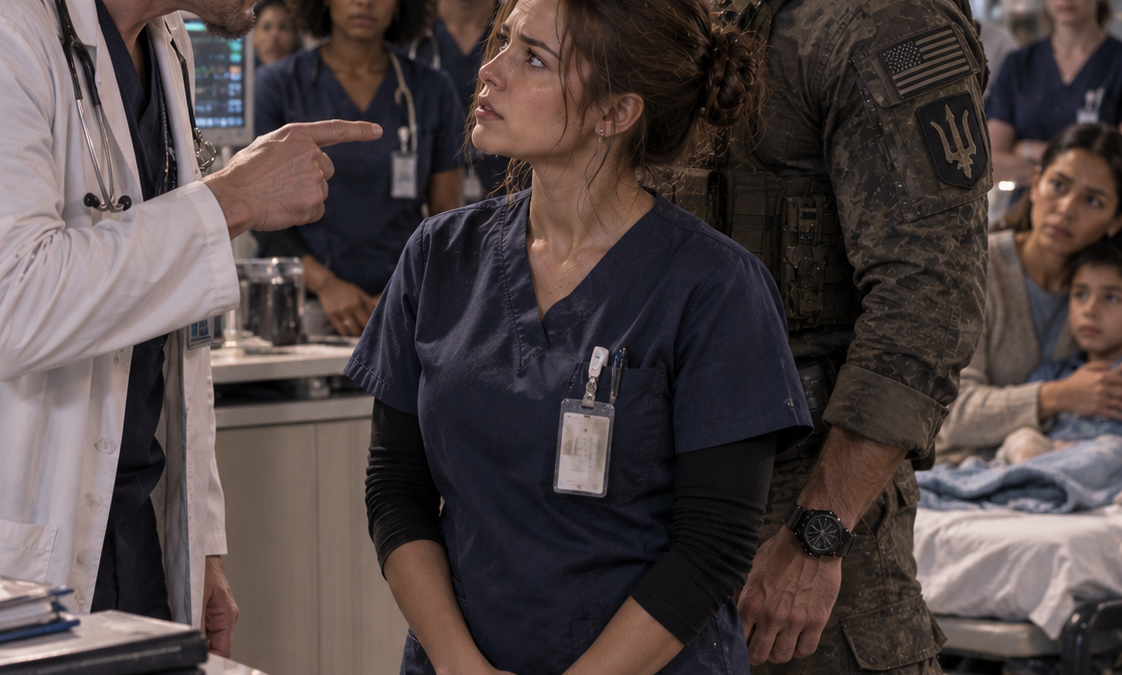
Part 2
Hale said, “There are two sides to There’s a patient in my surgical ICU with a repaired hepatic arterial laceration,” Caldwell said, “who would very likely have died if the nurse you removed from duty had actually left the building.”
He said it the way surgeons sometimes delivered hard information, flat, factual, without theater.
“That is a side of the situation that I need to think carefully about.”
Something moved across Hale’s face.
The calculation running again, faster. Spate opened the folder and laid three more documents on the desk.
“These are written statements,” he said, “obtained this afternoon voluntarily from three members of the nursing staff and one resident.
They detail incidents spanning the last 7 months.
There’s also a series of saved internal messages that one of the nurses retained.
She had a practice of documenting communications she felt were inappropriate, which turns out to have been prescient.”
Marsali looked at the documents.
She recognized Priya’s handwriting on the top page, even upside down.
She’d seen it often enough on patient charts.
Hale stood up.
Caldwell said, “Sit down, Conrad.”
He didn’t sit, but he stopped.
“I want legal counsel,” he said.
“I want this meeting paused and rescheduled with legal counsel present, and I want those documents reviewed for “You’ll have every due process protection available to you through the formal review,” Spaight said.
“This meeting is informational.
Sit down or leave.
Either is acceptable, but if you leave, I’ll note that in my report.”
A long moment. Hale sat.
Marsali looked at her hands. She was aware of something happening in her chest that was not satisfaction.
She didn’t feel satisfied, exactly.
She felt something more complicated, the feeling of a process that had been stuck for a long time beginning to move, which carried its own weight. Things that had been stuck for a long time sometimes moved badly when they finally broke free. The meeting continued for another 40 minutes.
Spaight asked questions of Caldwell primarily about the department’s language access policy, about the complaint resolution process, about the institutional awareness of what staff had apparently been documenting for months.
Caldwell answered with the careful honesty of a man who understood that the more careful the honesty now, the more manageable the consequences later. Hale said very little.
When he spoke, he used the language of process and procedure, words like clarification and context and chain of command, and the words sat in the room without doing the work he needed them to do. Reyes said almost nothing after his initial statement.
He sat in his chair and watched, and the watching itself was a kind of statement. At 6:15, Caldwell adjourned the meeting. He told Marisol she was reinstated to the trauma floor effective immediately.
He told Hale that he was placed on administrative leave pending a formal review, and that he should contact the hospital’s legal office in the morning.
He said both things in the same flat, factual voice, and neither thing seemed to cost him anything observable, which told Marisol something about what the meeting had done to whatever relationship had existed between them. Speight collected his documents and left with a handshake for Caldwell and a nod for everyone else.
Hale left without speaking to anyone. The door closed.
Caldwell looked at Marisol.
“I owe you an apology,” he said.
“Not just for today.
For the months before today when this should have been addressed.”
She looked at him. She thought about the months, eight of them. The small erosions, the incremental recalibrations that happened when a person in authority decides another person is a manageable problem rather than an individual with standing.
She thought about the other nurses who had been documenting quietly, saving emails, waiting for a moment that might not have come without a military helicopter landing on the roof.
“Yes,” she said.
“You do.”
She stood up.
She shook Caldwell’s hand, not because she felt warmly toward him, but because the gesture was correct for the situation, and she had learned that correctness in gesture was not the same as endorsement.
Then she left. In the hallway, Reyes was waiting. They walked toward the elevator without discussing where they were going.
The corridor was emptying out. It was past 6:00 now, and the administrative wing had the particular quiet of a place whose normal occupants had left for the day, leaving behind the institutional hum of a building that never fully slept.
She said, “The phone call you made, who did you call?”
“Someone who knows someone in the regional consortium oversight structure.”
He paused.
“I’ve worked with a lot of hospitals in a lot of places.
I know how institutional protection works, and I know what it takes to interrupt it.
You needed someone from outside the building who had standing Caldwell couldn’t manage.
Spate.
” “Spate?”
He glanced at her.
“He was in Veltham anyway for a different review.
The timing was fortunate.”
“You made that sound like luck.”
“Some of it was.”
She looked at him sideways.
He was not smiling exactly, but something around his eyes had shifted in a direction that wasn’t quite seriousness.
“The emails,” she said.
“How did you get them before the meeting?”
“I didn’t.
Priya Okafor had them.
She’d been holding them for 3 months waiting for the right moment to know what to do with them.
When I spoke to her this afternoon, she decided the moment had arrived.”
He paused.
“She’s going to be all right, that one.”
Marisol thought about Priya in the staff lounge doorway that morning.
“I want you to know that I’ll say what I saw.”
She’d meant it.
Marisol had believed her, but meaning it and acting on it were different things, and Priya had done both. The elevator arrived. They got in.
“How’s Marcus?”
she asked.
“Awake.
Complaining about the food, which I’m told is a good sign.”
“It is.”
“His wife landed an hour ago.
She’s with him now.”
He was quiet for a moment.
“He asked about you.
Wanted to know the name of the nurse who He said, ‘The nurse who didn’t leave.’
” She didn’t respond to that.
The elevator stopped at the second floor. The SICU was down the hall to the left.
She wasn’t heading there.
She was heading to the trauma wing to finish the charting she’d left incomplete and check on Walter Pruitt and do the remaining work of a shift that had expanded well past its boundaries.
She stepped out of the elevator. He followed her into the hallway and then stopped because the SICU was his direction and the trauma wing was hers.
Marisol, he said. She turned.
He was standing in the hallway with his hands at his sides and the tactical vest finally removed.
She hadn’t noticed when he’d taken it off, but he was in just the base layer now and it made him look slightly less like the version of himself she had known, who was tired and had been through a long day and was standing in a hospital corridor at 6:30
in the evening trying to say something.
I’ve thought about Sierra Paloma, he said, more than you probably know.
She didn’t say anything.
The night of the extraction, the communications failure, I’ve run that sequence in my head enough times that I can tell you exactly where every person was standing when the relay went down.
I can tell you the ambient temperature and the direction the wind was coming from and the sound the generators made when the backup power kicked in. He paused.
And I can tell you that the variable that held everything together in that tent was you. Not your rank, not your training, though both of those mattered, you.
The way you moved and the way you spoke and the fact that you stayed functional when the people around you stopped being functional. She held his gaze.
This was not a comfortable conversation.
It was the kind of conversation that people avoided because the things said in it couldn’t be unsaid and the weight of them resettled everything that came after.
I stayed functional, she said carefully, because someone had to.
I know, that’s my point.
She looked at the floor for a moment then back at him.
I spent the morning being told I didn’t belong in the trauma bay of a hospital I’ve worked in for 4 years by a man who had no idea who I was.
And the worst part she stopped. Say it.
The worst part wasn’t the humiliation.
I’ve survived worse.
The worst part was that for 30 seconds I wondered if he was right. Not about the language, about the other thing.
Whether I’d been diminished somehow by 4 years of being treated as less than what I actually am.
He looked at her for a long moment. Were you?
He asked. She thought about the trauma bay.
She thought about her hands on Marcus Webb’s abdomen and what they found and what they did with what they found.
She thought about Hessler saying you’re thinking vascular.
And the conversation that followed, which had been two people at the top of their respective competences working a problem together. No, she said.
I wasn’t.
I know, he said. I saw. She nodded once.
She turned toward the trauma wing. She was 12 steps down the hallway when his voice followed her. The work you do here matters, Captain, no less than what you did there.
She kept walking. But she took those words with her.
The trauma wing received her back the way spaces receive people who belong in them with indifference and purpose and the constant forward motion of work that doesn’t pause for sentiment.
Ballard gave her the same level nod from the nurses station.
Dominguez handed her a tablet with the afternoon’s updated charts without being asked.
Bram, the resident, appeared at her elbow within 2 minutes with a question about Walter Pruitt’s neurological follow-up.
That was actually a good question asked without the apologetic preamble that residents usually attached to questions directed at nurses, which meant she was learning. Marisol answered it. Bram took notes.
She checked on Pruitt, awake, grumpy, demanding better coffee, which was the correct trajectory for someone with his presentation. She updated his chart. She made two phone calls on behalf of patients who needed specialist consultations that the overnight team could prepare for.
She did the work. It was nearly 9:00 when Dominguez appeared at her elbow again.
You should go home, he said. 40 minutes.
You’ve been here since before 7:00.
40 minutes.
He didn’t argue.
He knew better.
She was finishing the last chart update when the notification came through on the nursing station’s main screen.
A system-generated alert from hospital administration timestamped 8:57 p.m.She almost missed it in the routine flow of system updates, but the subject line caught her eye. It was a notification of emergency privileges review for one attending physician effective immediately. The name on the notification was Conrad Hale.
She read it twice. An emergency privileges review was faster than a standard administrative leave process. It was the mechanism the hospital used when the concern was not merely disciplinary, but clinical.
When the question being asked was not did this person behave badly, but is this person safe to practice? Someone had escalated.
She looked up from the screen.
Across the nurses’ station, Ballard was also reading the notification on his terminal.
He looked at Marisol. The nod he gave her this time was different from the earlier one. It carried something more specific.
She looked back at the screen. The name listed under initiating authority on the privileges review was not Caldwell.
It was Dr.Yael Hessler. Marisol stood with that information and felt the shape of it settle. Hessler, who had come out of surgery and listened to a 12-second debrief and immediately understood what the situation was.
Hessler, who had told Hale to go back to his bay.
Hessler, who had operated on Marcus Webb for 93 minutes beside a nurse she’d met 45 minutes before and trusted because the trust was clearly warranted.
Hessler had apparently spent the hours since the operation doing her own accounting. It was a different kind of power than the kind Reyes had deployed.
Quieter, institutional, rooted in the specific standing of a surgeon with 30 years at the top of her field. But it was effective in a different dimension. A compliance review could be managed, delayed, absorbed by administrative process.
A privileges review initiated by the chief of trauma surgery could not. Marisol saved her chart, logged out of the terminal, and gathered her bag from her locker. She was walking toward the exit when her phone buzzed.
Unknown number. She almost let it go to voicemail.
It was past 9:00. She was running on empty. The day had been long enough to qualify as several days stacked on top of each other.
She answered. The voice on the other end was male, institutional, with the particular accent of someone who worked in a regulatory environment and had trained himself out of regional inflection. Ms.Vega?
This is the duty officer for the regional healthcare compliance board.
We’ve received a referral regarding events at Velthem Cross Medical Center, and we’d like to schedule a formal interview with you at your earliest availability.
We’re looking at tomorrow morning, if that’s possible.
She stopped walking. A referral from whom? She asked.
I’m not at liberty to share the referral source at this stage, he said.
But I can tell you that the scope of the interview extends beyond today’s events.
We’re looking at a documented pattern of conduct and its impact on patient care standards and employee rights.
She stood in the corridor near the main exit with her bag over one shoulder, and the November cold already bleeding through the automatic doors every time they opened, and she thought about the words documented pattern and what they
implied about the reach of what Spate had set in motion in Caldwell’s office.
Tomorrow morning, she said. Yes. What time?
He gave her a time and a location, a building downtown, not the hospital. Neutral ground. Thank you, Ms.Vega.
We’ll see you then.
She hung up. Through the automatic doors, she could see the parking structure and the November sky, which was solid dark now, no stars, the clouds too thick.
The air that came through smelled of cold pavement and something distant, like rain that hadn’t arrived yet.
She was almost to her car when her phone buzzed again. This time it was a text.
The number was Reyes’s.
She’d had it stored for years, never used, never deleted.
The message was four words. Call me when you can.
She stopped between two cars and read it twice. Then she looked at the time. Then she called him.
He answered on the second ring. Marcus is asking for you, he said.
Tonight?
He’s awake and he’s asking.
His wife is here. She wants to meet you. A pause.
I told him you’d probably gone home.
I’m in the parking structure.
A beat.
So, you haven’t gone home.
No. Then come back up.
She stood in the parking structure in the cold and looked at her car and looked at the hospital entrance and thought about the regional compliance board interview tomorrow morning and the privileges review and the email chain in Space’s folder and Priya’s handwriting and Hessler’s name on the initiating authority line.
She thought about a man with a name tattooed on his wrist who had reached out and put his hand on her arm because it was the only gesture available to him and she had let it stay there. She went back inside. The SICU at night had a different quality than the trauma ward at night, more contained, more monitored, the beeping more deliberate and the movement more purposeful in the way of a unit where every patient was close enough to the edge that proximity required continuous attention.
The lights were dimmer in the rooms and brighter at the station. The nurses moved quietly.
The whole unit had the quality of sustained vigilance, not crisis, but the readiness for crisis, which was its own kind of fatigue.
Room seven was Marcus Webb’s.
Through the interior window she could see the arrangement of the room. The bed and the monitoring equipment and the IV lines and beside the bed two people.
One was Reyes in the chair he’d had occupied for most of the afternoon.
The other was a woman, mid-30s, dark hair pulled back, wearing a jacket that said she’d come directly from the airport, still holding a bag.
She was facing the bed and her hand was on Marcus’s arm and something in the set of her shoulders said she had been holding herself together for a long time and had only recently allowed herself to stop.
Marisol pushed the door open
quietly. Marcus Webb was awake. He looked worse than he had in surgery, the post-operative pallor, the reduced animation of someone whose body was diverting every available resource to repair, but his eyes were tracking clearly and when he saw her in the doorway, something in his face shifted.
“You’re the one,” he said.
His voice was raspy from the intubation.
“Reyes told me.”
She came to the side of his bed.
“How are you feeling?”
“Like someone fixed a hole in me.”
He glanced down at himself. Which is apparently what happened.
“Approximately.”
The woman beside him looked at Marisol.
Her eyes were dry but the tracks on her face said they hadn’t been dry long.
“I’m Adrienne,” she said.
His wife.
“Marisol.”
Adrienne reached out and took her hand, not a handshake, something more than a handshake, the kind of contact that happens between people when the available gestures can’t fully carry the weight they need to carry.
Marisol let her.
“Thank you,” Adrienne said.
It was a small sentence with nothing decorative about it.
“He did the hard part,” Marisol said.
Marcus made a sound that might have been a laugh and regretted it. Reyes, from his chair, watched all of this with the quiet attention of someone who had arranged the room for this specific moment and was now content to be peripheral to it.
She stayed for 20 minutes.
She answered Marcus’s questions about the surgery, what they’d found, what they’d done, what the recovery looked like, with the same precision she’d used in Caldwell’s office, but warmer because the context was different and the audience needed different things from her.
She told Adrian what to watch for overnight, who to call at the nursing station if something seemed wrong, how the next 48 hours would likely feel. When she stood to leave, Marcus reached out and caught her wrist.
She looked down at him.
He said, “Reyes told me what happened this morning before we got here.”
He paused. The effort of speaking was visible.
He was burning reserves he needed for recovery, and he knew it. And he was spending them anyway.
“That doctor, is still in this hospital?”
“He’s on administrative leave.
” “That’s not” He stopped.
His jaw worked.
“I want to give a formal statement about what I saw when we got here, what Reyes saw.”
“Whatever process is” “Whatever helps you.”
She looked at him.
“You don’t have to” “I know I don’t have to.”
His hand on her wrist was light, the way it had been in the trauma bay when it had first landed there, but his eyes were clear and direct and carrying something that had nothing to do with painkillers or post-operative fatigue.
“I’d like to.”
She looked at Reyes.
He gave her a small nod that said, “I already asked him, and he already decided.”
She looked back at Marcus.
“Get some rest first.”
“Tomorrow?”
“Tomorrow.”
She left the room.
In the hallway, Reyes walked her toward the elevator, and they stood in the corridor for a moment with the SICU behind them and the hospital’s night sounds around them, the beeping, the ventilators, the soft rubber footfalls of the night nurses.
“The compliance board called me tonight,” she said.
He looked at her.
“When?”
“40 minutes ago.”
“Interview tomorrow morning.”
Something moved in his face, not surprise. He had been expecting this, or something like it.
“Spate moves fast.”
“Does he?”
“When there’s documentation and a clear pattern and an acute incident all in the same file?”
Yes. He looked at the elevator doors.
They’re going to ask about the pattern, not just today.
That’s going to be broader than Veltham Cross.
She understood what he meant.
Hale had come from somewhere before he’d come here.
He hadn’t arrived with the emails already written.
He’d arrived with a particular disposition, a particular way of operating that the emails documented but didn’t create.
“Has anyone contacted his previous institution?”
she asked. Spite mentioned it.
“What did he find?”
Reyes looked at her. His expression was careful.
“I don’t know exactly,” he said.
“But the fact that he mentioned it suggests he found something.”
The elevator arrived. She stepped in. He held the doors.
“Get some rest,” he said.
“I’ll try.
” Marisol.
He was looking at her with the particular directness that she had stopped finding uncomfortable sometime around the third hour of this day.
“What they’re going to ask you tomorrow, about the pattern, about the months before to today.
You don’t have to protect anyone.
Not Caldwell, not the institution.
You just have to say what was true.”
She met his eyes.
“I know how to do that,” she said.
The elevator doors closed. She was on the ground floor, moving through the main atrium toward the exit, when her phone buzzed one more time.
Not a call.
An email notification from an address she didn’t recognize, with a subject line that made her stop walking in the middle of the atrium floor.
The subject line read, “Re: Northgate Meridian.
Similar complaint.
2019.”
She opened it. The sender identified herself as a nurse. Former nurse, she specified.
She’d left the profession after the incident she was describing, which she had never formally reported because at the time she hadn’t believed anyone would listen.
She had heard, through a network she didn’t name, that something was happening at Veltham Cross involving a doctor whose name she recognized.
Marisol read the email. She She it twice.
Then she stood in the atrium of Veltham Cross Medical Center at 9:43 at night and understood that what she had believed to be a story about one hospital and one morning and one man’s particular contempt was something considerably larger.
Conrad Hale had done this before. Not a version of this.
This. The same mechanism, the same targets, the same institutional maneuvering.
A different city, a different hospital, a different woman standing in a different corridor realizing she was not the first. Her hands were steady. She forwarded the email to Warren Spate.
Then she called the number the compliance board duty officer had given her and left a message saying she had new information relevant to tomorrow’s interview and asking whether they could add time to the scheduled slot.
She put the phone in her pocket. She stood in the atrium for one more moment in the overnight quiet of a hospital building surrounded by the low hum of machinery keeping people alive.
And she thought about all the women who had stood in all the corridors before her and found nobody ready to listen. She thought about what it meant that tomorrow someone was finally going to. Then the lights above the main entrance flickered once sharply and went out.
The lights above the main entrance flickered once and came back on the way they always did in old hospital wings when the HVAC system cycled a particular load. A facilities complaint that had been on the maintenance log for 8 months and would probably remain there.
Marisol stood in the atrium for another moment, phone in her pocket, the forwarded email already on its way to Spate’s inbox, and then she walked to her car.
She did not sleep well. That was not unusual.
She rarely slept well after long trauma shifts. Something in her nervous system had wired itself over years of practice to stay partially alert after days that had required sustained high function output as though her body understood that rest was not the same as safety and kept one ear open regardless of what her brain told it. What was different tonight was the quality of the wakefulness.
It wasn’t the residual clinical alertness she recognized from her Navy years or from difficult shifts.
It was something older and more specific. The particular insomnia of someone who has been carrying a thing alone for a long time and has, within the last 12 hours, begun the process of setting it down.
She lay in the dark of her apartment and thought about the email, about the woman who had written it.
She hadn’t given her name, just a city and a year and a description that tracked closely enough with what Marisol had experienced.
That reading it had produced the specific physical sensation of parallel recognition, the feeling of seeing your own silhouette in a photograph you didn’t know existed.
She thought about Priya saving emails for 3 months. The discipline of that. The loneliness of it.
She thought about Hale in the chair to Caldwell’s right, watching his documentation laid out on a desk and trying to perform composure when what was actually on his face was the stripped-down version of a man encountering consequences he had consistently believed would not arrive.
She slept for 4 hours. She woke at 5:30, made coffee, and read the email from the former nurse twice more in the kitchen light.
Her name was Dina Warwick. She had included it in a follow-up message that arrived at 11:00 p.m.Apparently, she had decided sometime in the 2 hours between the first message and the second that anonymity was a form of protection she no longer needed. She had worked at a hospital called Rushmore Valley Medical in a city called Carlin, 3 hours north of Veltham.
The incident she described had occurred in the fall of 2019. The doctor she described, whom she identified by name, the same name, had been the incoming chief trauma attending, brought in from a previous institution in another state on the strength of a recommendation letter.
Warwick had later discovered was written by a professional contact rather than a direct supervisor. The mechanism was almost identical. A public humiliation on the floor, a removal from duty, a complaint that was processed into the administrative structure and absorbed there, effectively neutralized by institutional loyalty to the incoming physician.
The difference was outcome. Warwick had not had a Navy commander walk through the door behind a critical patient.
She had not had a Warren Spade or a Yale Hessler or a file folder that arrived before the narrative could set. She had filed her complaint, waited 6 weeks, received a letter that used the word unsubstantiated twice, and resigned 3 months later. She had kept every document.
Marisol replied to both emails. She told Warwick what was happening at Veltham Cross and asked whether she would be willing to speak with the compliance board.
She gave her Spade’s contact information and her own.
She sent the message and drank her coffee and watched the November sky outside her kitchen window go from black to the particular deep gray of a morning that had decided against color.
She was at the Regional Healthcare Compliance Board’s downtown office at 8:45.
The building was the kind of civic architecture that communicated institutional weight without drama. Broad stone steps, brass fittings, interior lighting that was adequate rather than welcoming. The interview room was on the third floor.
A rectangular table, six chairs, a pitcher of water that nobody had poured, and two compliance investigators who introduced themselves as investigator Nadine Trask and investigator Paul Severn. Trask was the lead.
She was somewhere in her mid-50s with the compact efficiency of someone who had spent decades asking people to tell her things they’d rather not.
And the particular neutrality of expression that comes from having heard most versions of most stories. Spade was also present in an observer capacity with his folder. The interview lasted 3 hours.
Marisol told them everything.
Not the edited version, not the version that protected anyone’s institutional standing, not the version that smoothed the parts that reflected badly on her own choices, including the 30 seconds of self-doubt she had experienced in the staff lounge, which she described with the same precision she applied to everything
else.
Because Trask had asked for the complete account, and the complete account included the moments that were harder to say. Trask listened without interrupting except to ask clarifying questions that were specific and well-aimed, the questions of someone who understood the clinical environment and was not going to be satisfied with vague approximations.
Severn took notes on a physical notepad and occasionally cross-referenced a document from the file in front of him.
Midway through the interview, Trask looked at her and said, “You mentioned a previous employment context before Veltham Cross.
Can you characterize your experience in that context relative to what you’ve described this morning?”
Marisol understood what she was being asked.
“I’m not sure I’d make a direct comparison,” she said.
“The environments were different.
The stakes were more immediately visible in the previous context.
But the mechanism you’re describing, the dismissal based on perceived identity rather than demonstrated competence, was that present in the previous context as well?”
She thought about it honestly.
“In different forms.
The military has its own hierarchies and its own blind spots. What was different was that in the previous context, the work spoke for itself fast enough that blind spots became operationally untenable.
A hospital environment has more insulation between the error and the consequence.”
Trask wrote something down.
At the 2-hour mark, Trask’s phone buzzed.
She looked at it without expression, excused herself, and stepped out. She was gone for 7 minutes. When she came back, she looked at Severn in a way that communicated something, and then looked at Marisol.
“We’ve received confirmation that Adina Warwick has agreed to be interviewed,” Trask said.
“She’s also sent us documentation from a 2019 incident.
I want to ask you, how did you come to contact Ms.Warrick?
I didn’t contact her, she contacted me.
Through what channel? Email.
Unsolicited.
She said she’d heard through a network she didn’t name that something was happening at Veltham Cross involving a doctor she recognized.
Trask absorbed this.
The network she didn’t name.
I don’t know what it was.
I didn’t ask.
Marisol paused. The email arrived at 9:20 last night. I forwarded it to Mr.Speight within 10 minutes of reading it.
Speight confirmed this with a nod. Trask looked at her folder.
The 2019 incident, if the documentation holds, represents a prior substantiated pattern at a different institution that changes the scope of our review considerably. I understand.
It also means Trask paused choosing her words. The relevant question stops being whether what happened at Veltham Cross was an isolated incident of inappropriate conduct and become something with broader implications for professional licensure and reporting obligations.
The words landed in the room with the specific weight of something that had been building toward this specific destination for a long time. Marisol nodded.
Is there anything else you want to tell us? Trask said, before we close this session?
She thought about Lorena Sandoval sitting rigid in a plastic chair beside her son’s hospital bed trying to understand what was being said around her.
She thought about Tomas watching the adult conflict with the stillness of a child calculating risk. She thought about all the patients, not only the ones she knew about, not only the ones at Veltham Cross, who had moved through a system administered in part by a man who understood language access as a problem to be suppressed rather than a standard to be met. Yes, she said.
The Sandoval family. I want to make sure the record reflects that Lorena Sandoval and her son Tomas received complete discharge instructions before they left the hospital and that the process by which those instructions were initially delayed is documented as
part of the patient impact record, not just the employment record. Trask looked at her for a moment.
We’ll note it.
Thank you. She left the building at 11:50.
Outside on the broad stone steps, the November cold was sharp and direct and felt after 3 hours in a climate-controlled interview room like something her lungs had been waiting for. She stood on the steps for a minute and breathed it.
Her phone was full of messages.
She didn’t look at them yet.
She looked at the street.
Veltham’s downtown, which was attempting a renovation that was about 60% complete and would probably remain 60% complete for another 5 years, and she gave herself 60 seconds of not being in motion.
Then she looked at her phone. Three messages from Priya sent between 9:00 and 11:30. The first said that Hale had arrived at the hospital at 8:00 a.m.despite his administrative leave citing a personal effects retrieval and that security had been called.
The second said that Caldwell had spoken to the full nursing staff of the trauma unit at 10:00, a meeting that was described as brief and that Priya summarized in four words, he said he’s sorry.
The third message said only people are talking, good talking. A message from Dominguez.
Walter Pruitt’s neuro consult went well.
He’s being moved to a step-down unit.
Thought you’d want to know.
A message from a number she didn’t recognize that turned out to be Hessler’s personal cell.
The privileges review goes to the full credentialing committee on Thursday.
I’ll be presenting.
You’re not required to attend, but you’re welcome to.
YH and one from Reyes sent at 10:15. Marcus walked to the door of his room this morning. 12 feet, took him 8 minutes.
Thought that counted. She read that one twice.
Then she started walking back toward the hospital. The trauma floor received her differently than it had the previous morning.
The difference was not dramatic. Nobody applauded.
Nobody made speeches. The monitors beeped at their usual intervals, and the IV pumps clicked their usual click.
But there was a quality in the air of the unit that she recognized from other transitions. The specific atmosphere of a space where a power structure has shifted, and the people who live in that space are in the early hours of adjusting to the new weight distribution.
Ballard said, when she came through the doors, “Caldwell wants to see you at 2:00.”
“Okay.”
He called down personally, not through his assistant. She looked at Ballard.
“Seemed relevant,” he said.
She went to work. The shift was not a light one. Trauma floors did not schedule their workload around institutional crises.
And the census was high enough that the morning had generated a backlog that the afternoon team was working through with the efficiency of people who understood that the work existed independently of whatever had happened in the administrative wing. She moved through it with the focused attention of someone returning to a familiar task from a necessary interruption.
Not quite normal. Not the same as yesterday, but close enough to normal that the work itself was grounding.
At 1:15, she went to the SICU. Marcus Webb was sitting up.
Not fully. The head of his bed was elevated to about 45°, which was where post-operative abdominal patients lived for the first few days.
The angle negotiated between surgical repair and respiratory function. Adrienne was in the chair beside him, reading something on her phone. She looked up when Marisol came in, and the expression on her face was the morning after version of the previous evenings.
Still carrying the weight of what the last 24 hours had been, but more settled. Less like someone bracing for catastrophe. Marcus looked at her.
“8 minutes,” he said.
“Reyes told me.”
He made it sound more heroic than it was. I held onto the IV pole the whole time and Adrian walked backward in front of me like I was going to fall.
“I was not walking backward,” Adrian said without looking up from her phone.
“She was a little backward.
” Marisol looked at him properly.
The color was better, not good exactly, but on the trajectory toward good. His eyes were clear. The rigidity in his abdomen was resolving, which she confirmed with a light assessment that he tolerated without complaint.
She checked his drain output. She reviewed the overnight nursing notes on the tablet and found what she expected, steady, unremarkable, the beautiful boredom of a recovery proceeding as planned.
“You said you’d give a statement,” she said.
“I did.”
“You don’t have to.”
“I know.”
He looked at her with the directness that people sometimes have after physical crisis strips their social editing away.
“Reyes told me what you told him, about the 30 seconds in the staff room, the wondering.”
She went still.
“He told me because he thought I should know,” Marcus said.
“Not to He wasn’t gossiping.
He’s not a gossip.”


