“I love you. I should have said it before. I didn’t know how.”
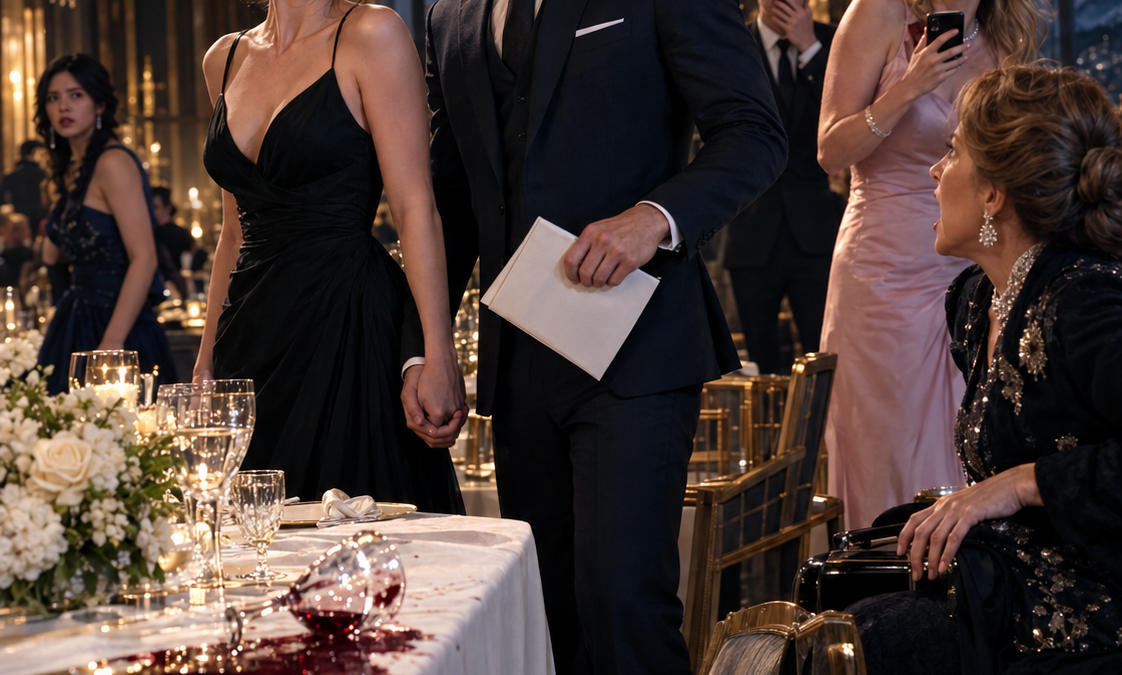
“I love you. I should have said it before. I didn’t know how.”
She thought she was exposing a corrupt family. She never planned to fall for the man who leaked their secrets.
The first thing Seo-jun registered was the smell of jasmine—his wife’s perfume—and the second was that it was coming from the wrong direction.
He stood in the doorway of the hotel suite’s bedroom, one hand still on the brass handle, and looked at the scene he had walked into for the past three months without ever once being meant to see it. His mother sat at the vanity, her back straight as a blade, dabbing something at her throat. His wife stood by the window, arms crossed, still in her coat.
“The doctor said the same thing to me,” his mother said, meeting Da-eun’s eyes in the mirror. “Twice. Three times. Every time, the same answer. You know what he told me? He said the Seo family doesn’t produce weak women. So I kept trying.”
Da-eun said nothing.
“You’ve been married two years. Two years, and not one grandchild. I’ve been patient. I’ve been generous. But patience has a shelf life, and yours has expired.”
Seo-jun watched his wife’s jaw tighten. She didn’t flinch. She never did—not visibly. But he knew the exact angle of her shoulders when she was holding herself together, the way she pressed her thumb into her palm hard enough to leave a mark.
“You want me to leave him,” Da-eun said. It wasn’t a question.
“I want you to choose,” his mother said, rising. “You’ve been choosing yourself for two years. That’s not a marriage. That’s a residency.”
Seo-jun stepped into the room.
His mother’s expression didn’t change. She had known he was there—she always knew. Da-eun’s eyes flicked to him, then away, fast, like she’d been caught doing something shameful rather than being cornered in her own marriage.
“Mother,” he said. “Downstairs. The investors are waiting.”
“Let them wait. This is more important.”
“Nothing is more important than the investors.” He said it flatly, without heat, and watched the small, satisfied flicker cross his mother’s face. She had won this round, and she knew it. She gathered her coat—mink, the one his father had given her for their thirtieth anniversary, a decade before he died—and swept past him.
“Two years, Seo-jun,” she said at the door. “I’ll give you six more months. Then I’m choosing for you.”
The door clicked shut.
Da-eun let out a breath she’d been holding for what felt like the entire conversation. She moved to the bed, sat on the edge, and stared at the carpet. “You could have told her to stop.”
“I could have.”
“She’s your mother.”
“She’s also the largest single shareholder of Seoul Group. If she pulls her bloc, the family loses control by Friday. You know this.”
Da-eun looked up at him then, and he saw something he hadn’t seen in a long time—not anger, not hurt, but calculation. Like she was doing math in her head and the numbers were coming out ugly. “So I’m the cost of doing business.”
“You’re not a cost.” He crossed to the window. Below, the Han River cut through the city, gray and indifferent. “You’re a variable.”
“Jesus, Seo-jun.”
“I don’t have time for this.” He checked his watch—a habit, mostly performative. “The Haeundae deal closes tomorrow. If the environmental audit flags anything, we lose the resort license and the land reverts to the city. Do you understand what that means?”
“I understand you’d rather argue about soil samples than defend your wife to your mother.”
He turned. “Defend you from what? She talks. You don’t listen. The math is simple.”
“The math,” Da-eun repeated. She stood, smoothed her skirt, and picked up her bag. “You know, for a man who runs a company built on reading people, you’re remarkably bad at it.”
She left.
Seo-jun stood alone in the suite his mother had commandeered for her monthly “family meeting”—which, in practice, meant an hour of passive-aggressive remarks delivered over tea while his wife sat in silence. He had attended exactly two of these in two years. He had learned to schedule conflicts.
His phone buzzed. His assistant: The auditor’s report on Haeundae is ready. I’ve sent it to your private server.
He read the message twice, then deleted it.
Chapter 2: The Lucky Streak
Da-eun’s editor was a man named Kang Min-ho, and he had the distinct look of someone who had spent twenty years watching bigger papers eat his scoops. His desk was a monument to failed ambition: yellowed clippings, a dead plant, a mug that read World’s Okayest Editor.
“So let me get this straight,” Min-ho said, leaning back in his chair. “You’ve got a source inside Seoul Group. A real source. Someone willing to hand you documented environmental violations at the Haeundae resort site.”
“I have documents,” Da-eun said. “Water samples. Soil reports. Internal memos that contradict the public statements.”
“Who’s your source?”
“Protected.”
“Protected.” Min-ho’s eyebrow twitched. “Da-eun, this is the kind of story that could put us on the map. Actual investigative journalism. And you’re telling me it fell into your lap?”
“Not my lap. My inbox.” She slid a folder across the desk—photocopies, since she never carried originals. “Three weeks ago. The first envelope came without a return address. I almost threw it away. But the numbers matched public filings that didn’t add up, so I dug. Then another envelope. Then another.”
“And you’re sure this isn’t a setup?”
“I’m sure the documents are real. I had them verified by a hydrologist at Yonsei. He nearly choked on his coffee.”
Min-ho flipped through the pages. He was quiet for a long minute. Da-eun watched his face, the way his skepticism slowly shifted into something hungrier. She knew that look—she’d felt it herself, the first time she’d read the memos. Seoul Group was dumping untreated wastewater into a tributary that fed the Haeundae wetlands. A protected zone. They had been doing it for eleven months.
“This is gold,” Min-ho said. “This is front-page gold. But it’s wasted on us. We’re a two-room operation with an Instagram account. You know who would eat this up? The Hankyoreh. The Korea Herald. We take this to a real outlet, we get a byline credit, and you get a future.”
Da-eun’s stomach dropped. “We agreed. We publish here.”
“We agreed when we thought it was a zoning dispute. This is bigger. This is criminal.” He tapped the folder. “If we sit on it, someone else finds out, and we’re the idiots who had it first. If we sell it to a major outlet, we get paid, we get credit, and the story actually makes a difference.”
“What about my source?”
“What about them? They’ll be a hero. Anonymous whistleblower. The public loves a whistleblower.”
“They’ll be fired. Or worse. You know how these companies work. If the story goes national, the family’s fixers will tear apart every communications log, every server, every phone. And they’ll find who leaked.”
Min-ho set the folder down. “Da-eun. Sweetheart. You’re a reporter, not a bodyguard. Your job is to get the story out. The source knew the risks.”
“That’s not—” She stopped. She pressed her thumb into her palm. “I need more time. There’s something else in the documents I haven’t figured out yet. A name that keeps appearing. Someone inside the company who might be more than a witness.”
“Then figure it out fast. I’m giving you one week. After that, I’m making calls.”
She walked out of his office with the folder clutched to her chest and the distinct feeling of a noose tightening. She didn’t know who her source was. That was the truth. But she knew it wasn’t a random employee.
The first envelope had arrived the day after she’d argued with Seo-jun about his mother. The second, two days after he’d left for a business trip to Busan—where the Haeundae site was.
She had been married to him for two years. She knew his handwriting. She knew his printer. And she knew—with a certainty that made her feel sick—that her husband was leaking his own company’s crimes to her.
Chapter 3: The Man Who Noticed Too Much
Seo-jun watched his wife across the dinner table and felt the familiar ache of wanting to tell her the truth.
They were at his mother’s house—not the main estate, but the smaller Gangnam residence, the one his mother used for “intimate” family dinners, which meant the table seated twenty and only eight people were invited. His sister, Seo-yeon, sat across from him, scrolling through her phone under the tablecloth. His mother’s secretary hovered by the door. A cousin he barely tolerated was explaining his new golf handicap.
Da-eun sat beside him, her posture perfect, her wine untouched. She had been quiet all evening. Quieter than usual. He noticed the way she kept glancing at her phone, the faint crease between her brows.
She knew.
He wasn’t sure how, but she knew. He had been careful—too careful, maybe. The envelopes were mailed from different post offices, the documents redacted, the language neutral. He had chosen her outlet specifically because No One Reads It—a small online magazine with a readership of maybe five thousand, mostly retirees and policy wonks. His family’s monitoring team checked the major outlets, the broadcasters, the big blogs. They didn’t check The Seoul Ledger.
But he had underestimated his wife.
“You’re staring,” Da-eun murmured, not looking at him.
“I’m thinking.”
“About the resort?”
“About many things.”
His mother’s voice cut through the table. “Seo-jun. I heard the Haeundae deal is facing delays. Something about an environmental review?”
The table went quiet. His cousin stopped mid-sentence about golf. Seo-yeon looked up from her phone.
“The review is routine,” Seo-jun said. “The paperwork is in order.”
“Is it? Because I received a call from the Ministry of Environment this morning. Someone filed a complaint. Anonymously.”
He kept his expression flat. “Anonymous complaints are common. Competitors use them to delay permits. It will be resolved.”
“It had better be. Your father would never have allowed a project to be held up by paperwork.” She said the word like it was a personal insult. “And speaking of delays—Da-eun. You look tired. Are you sleeping well?”
“I’m fine, Mother.”
“You’re not eating. You’ve lost weight.” His mother’s tone was sweet, concerned, and utterly venomous. “I hope you’re not getting sick. We can’t afford for you to be sick right now.”
The implication hung in the air. Da-eun’s hand tightened around her fork.
“She’s not sick,” Seo-jun said. “She’s been working. Unlike some people at this table, she has a job.”
His mother’s smile didn’t waver. “How admirable. A reporter. I read your last piece, Da-eun. The one about the parking fees at City Hall. Very… thorough.”
“It won an award,” Da-eun said quietly.
“Did it? How nice.” His mother turned to Seo-yeon. “Darling, tell your brother about the art foundation. He needs to be more involved.”
The conversation shifted. Seo-jun felt Da-eun’s knee press against his under the table—not a gesture of affection, but a signal. She wanted to leave. He pressed back, a small acknowledgment, and then stood.
“We should go. I have an early call.”
His mother’s eyes flicked between them. “Of course. Drive safely.”
In the car, Da-eun stared out the window. The city lights blurred past. Seo-jun kept his eyes on the road.
“You know,” she said, “for a man who runs a company built on reading people, you’re remarkably bad at it.”
“You said that already.”
“It bears repeating.” She turned to him. “Who is Park Min-seok?”
The name hung in the air. Seo-jun’s hands stayed steady on the wheel. “He’s a junior manager in the Haeundae development office. Why?”
“I found his name in some documents. He appears as a signatory on several environmental reports. Reports that contradict the public filings.”
“Then he’s either incompetent or complicit. Either way, not my concern.”
“I think he’s your concern.” Da-eun’s voice was quiet, but there was steel underneath. “I think he’s the one who’s been feeding me information. And I think you know that.”
Seo-jun said nothing.
“Pull over.”
He pulled over.
Da-eun unbuckled her seatbelt and turned to face him fully. In the dim light of the car, she looked younger than her thirty years—and harder. “I’m going to ask you one question, and I need you to answer honestly. Are you the one sending me those documents?”
He met her eyes. “Yes.”
The word landed between them like a dropped glass.
“Why?”
“Because someone has to.”
“That’s not an answer.”
“It’s the only answer I have.” He gripped the wheel. “If you publish this story, Da-eun, you will make enemies you can’t imagine. My mother will destroy you. The family lawyers will bury you in litigation. You’ll lose your job, your reputation, possibly your freedom. And you’ll do it while I stand by and watch, because if I publicly defend you, I lose the company, and if I lose the company, my mother wins, and if my mother wins, everything my father built—every reform, every ethical standard, every protection for the workers—disappears. Do you understand?”
“Then why send the documents at all?”
“Because the violations are real. Because people are getting sick. Because I can’t fix it from inside without proof, and I can’t get proof without someone on the outside who isn’t on their payroll.” He exhaled. “I chose your outlet because no one watches it. I chose you because you’re good enough to figure it out and stubborn enough not to stop.”
Da-eun was quiet for a long moment. Then she laughed—a short, humorless sound. “You’ve been using me.”
“I’ve been trusting you.”
“Same thing.”
“No. It’s not.” He turned to her. “Using you would mean giving you false information. Trusting you means giving you the truth and hoping you survive it.”
She looked at him—really looked—and he felt the weight of her gaze like a physical thing. “Your mother. She knows, doesn’t she? About the leak?”
“Not yet. But she will. She has people watching.”
“Then why are we still married?”
The question hit him harder than he expected. He had asked himself the same thing a hundred times, in a hundred different contexts. Why had he married her? Because his father had chosen her—the daughter of a newspaper editor, respectable, educated, unconnected to the chaebol world. Because she was supposed to be safe. Because he had looked at her across a conference table five years ago and thought: She doesn’t want anything from me. Because he had been wrong.
“Because divorce would trigger a shareholder review,” he said. “And because I don’t want to.”
Da-eun stared at him. “That’s the first honest thing you’ve said all night.”
“Don’t get used to it.”
She smiled—small, reluctant, real. “Drive. I have a story to edit.”
Chapter 4: The Editor’s Ultimatum
Da-eun didn’t sleep. She sat at her kitchen table until 4 a.m., spreading the documents across the surface like a detective’s wall. Park Min-seok’s name appeared on eleven separate reports—always as a secondary signatory, never the primary. The primary signatory was always someone else: a rotating cast of mid-level managers, none of whom stayed in the Haeundae office for more than six months.
She pulled up old personnel files from the company’s public disclosures. Park Min-seok had been transferred to Haeundae two years ago. Before that, he had worked in the Seoul headquarters—in the office of the CEO.
In Seo-jun’s office.
She sat back. The pieces clicked into place.
Park Min-seok wasn’t the leak. Park Min-seok was Seo-jun’s inside man—the person who had gathered the documents, copied the reports, and passed them to Seo-jun, who then passed them to her. The chain was longer than she’d thought, and more dangerous. If the family found out, both men would be ruined.
Her phone buzzed. Min-ho.
One week. I mean it.
She typed back: I need ten days.
Eight. Final.
She threw the phone onto the couch and put her head in her hands.
Chapter 5: The Sister’s Warning
Seo-yeon found Da-eun at a coffee shop three blocks from the Ledger’s office. She slid into the booth across from her, ordered an Americano she didn’t drink, and said, “You need to stop.”
Da-eun looked up from her laptop. “Hello to you too.”
“I’m serious. I know what you’re working on. I know who’s helping you.” Seo-yeon’s voice was low, urgent. She was the only member of the Seo family who had ever treated Da-eun like a person rather than a complication. “My mother has already hired a private investigator. She suspects a leak in the Haeundae office. She doesn’t know it’s Seo-jun yet, but she will.”
“And you’re telling me this because?”
“Because I don’t want my brother destroyed. And I don’t want you destroyed either.” Seo-yeon leaned forward. “The story is real. I know it’s real. But if you publish it now, the family will circle the wagons. They’ll discredit the documents, fire everyone involved, and bury the evidence. You’ll get one day of headlines and then nothing.”
“Then what do you suggest?”
“Wait. Build a stronger case. Get testimony. Get proof that the violations were ordered from the top—not just tolerated, but directed. My mother’s fingerprints are all over this. If you can prove she knew, the story becomes unkillable.”
Da-eun studied her sister-in-law. “Why are you helping me?”
“Because I’ve spent my whole life watching my mother ruin people. I’m tired of it.” Seo-yeon stood. “Eight days. That’s how long you have before the investigator files his first report. Use them.”
She left.
Da-eun sat alone, her coffee cold, and wondered how many more people were going to risk everything for a story that might never see print.
Chapter 6: The Name in the Ledger
Min-ho called her at midnight. She was half-asleep, her laptop still open on the bed.
“I found something,” he said. “I couldn’t sleep, so I started cross-referencing the documents you gave me with public records. There’s a name in the internal memos—an executive assistant. She signed off on the waste disposal orders. Her name is Yoon Ji-won.”
Da-eun sat up. “Ji-won? That’s—”
“Your husband’s assistant. The one who’s been with him for six years.” Min-ho’s voice was grim. “She’s not just a witness, Da-eun. She’s the one who ordered the dumping.”
“That doesn’t make sense. Seo-jun wouldn’t—”
“Maybe he didn’t know. Maybe she did it on her own. But either way, she’s the linchpin. If she testifies, the story holds. If she disappears, it falls apart.”
Da-eun’s mind raced. Ji-won. The quiet woman who had greeted her at company events, who had once slipped her a note during a particularly brutal dinner with the family: He talks about you when you’re not there. He just doesn’t know how to say it to your face.
“Where is she now?”
“According to the company directory, she’s on personal leave. Effective three days ago.”
Three days ago. The same day his mother had mentioned the anonymous complaint.
“I have to go,” Da-eun said.
“Be careful.”
She was already pulling on her coat.
Chapter 7: The Assistant’s Secret
Ji-won lived in a small apartment in Mapo-gu, the kind of building that had been fashionable in the nineties and had never quite recovered. Da-eun knocked at 1 a.m., fully expecting to be ignored. Instead, the door opened.
Ji-won looked terrible—pale, hollow-eyed, still in her work clothes from three days ago. She stared at Da-eun for a long moment, then stepped aside.
“I wondered when you’d come,” she said.
They sat in the kitchen. Ji-won made tea—a habit Da-eun recognized, because Seo-jun did the same thing when he was nervous. The same precise movements, the same refusal to meet her eyes.
“You ordered the dumping,” Da-eun said.
“Yes.”
“Why?”
“Because the chairman ordered it.” Ji-won wrapped her hands around her mug. “Not Seo-jun. His mother. She came to the Haeundae office eight months ago with a directive: cut costs on waste disposal, find a way to bypass the environmental review, and don’t put anything in writing. I was the one who had to make it happen.”
“And Seo-jun?”
“He found out three months ago. He was furious. He wanted to shut it down, report it, take the loss. But his mother controls the board. If he’d gone public, she would have removed him and installed one of her allies. So he did the only thing he could think of.” She looked up. “He started leaking the evidence to you.”
Da-eun’s throat tightened. “He told you.”
“He didn’t have to. I know him. He’s been different since he met you—less careful, more reckless. He stopped caring about protecting himself. He started caring about protecting you.” Ji-won smiled, sad and tired. “I’ve worked for him for six years. He’s never once asked me about my personal life. But three months ago, he asked if I had a safe place to go. If I had savings. If I needed help disappearing.”
“He knew you’d be the fall guy.”
“He knew his mother would need a scapegoat. He tried to protect me. But I told him I’d stay. I’d take the fall if it meant the story got out.” Ji-won set down her mug. “The thing is, Da-eun, I have proof. The chairman’s directive was verbal, but I recorded it. I have the audio. If you publish it, the story becomes about her. Not about Seo-jun. Not about you.”
She reached into her bag and pulled out a USB drive.
“Take it. Finish this.”
Da-eun took the drive. Her hands were shaking. “Why are you doing this?”
“Because I’ve spent six years watching that family destroy people. I’m done.”
Chapter 8: The Wife’s Choice
Da-eun found Seo-jun in his office at 3 a.m. He was sitting in the dark, staring at his computer screen. He didn’t look up when she entered.
“You should be asleep,” he said.
“So should you.”
She sat across from him. The USB drive was in her pocket, heavy as a stone.
“I know about Ji-won. I know about your mother. I know everything.” She paused. “I’m going to publish the story. All of it. Including the audio.”
Seo-jun closed his eyes. “If you do, my mother will be arrested. The company will collapse. The shareholders will flee. Everything my father built will be gone.”
“Everything your father built was built on corruption. You know that.”
“I know it.” He opened his eyes. “I also know that if you publish this, you become the enemy of one of the most powerful families in Korea. You’ll never work in journalism again. You’ll be harassed, surveilled, possibly threatened. And I won’t be able to protect you—not publicly. Not without losing everything.”
“Then don’t protect me publicly.” Da-eun leaned forward. “Protect me by standing next to me. When the story breaks, hold a press conference. Resign from the company. Tell the truth. Do the one thing your mother has spent your whole life convincing you never to do.”
Seo-jun was silent for a long moment. Then he laughed—a real laugh, surprised and rueful. “You’re asking me to destroy my own life.”
“I’m asking you to build a better one.”
He looked at her—really looked, the way he had in the car, the way he had on their wedding day, the way he had when he first realized he loved her and didn’t know how to say it. “If I do this, I lose everything.”
“You lose the company. You don’t lose me.”
The words hung between them. Da-eun hadn’t planned to say them. She wasn’t sure she meant them—not entirely, not yet. But they were true in the way that mattered.
Seo-jun reached across the desk and took her hand. His grip was firm, warm, and slightly unsteady.
“Eight days,” he said. “We do this together.”
“Together.”
Chapter 9: The Photograph
The first three days were a war room.
Da-eun moved into Seo-jun’s private office at the Seoul Group headquarters—not the CEO suite, which was bugged and monitored, but a disused records room on the basement level that still had a working Ethernet port and a door that locked from the inside. Seo-jun brought her coffee at odd hours. She brought him the documents she’d been holding back, the ones she hadn’t shown Min-ho yet, the ones that made her hands shake when she read them.
On the fourth day, she found the photograph.
It was tucked inside a folder of Haeundae personnel files—a glossy print, the kind that came from a company event. A dinner, by the look of it. Round tables with white cloths. A banner in the background: Seoul Group Annual Partner Appreciation Gala.
Seo-jun was in the foreground, mid-conversation with a woman Da-eun didn’t recognize. She was tall, elegant, with the kind of face that belonged on a magazine cover—sharp cheekbones, dark hair swept over one shoulder, a hand resting on Seo-jun’s forearm.
Da-eun stared at the hand for a long time.
She knew it was nothing. She knew these events were full of women who touched his arm, laughed at his jokes, angled for his attention. She had attended enough of them herself, standing at his side like a decoration, watching other women watch him.
But this woman wasn’t looking at the camera. She was looking at him. And Seo-jun—her husband, the man who hadn’t touched her in months, the man who kissed her forehead like she was a child he was fond of—was looking back.
She turned the photo over. On the back, in neat handwriting: Haeundae, October. Park Chae-rin.
Park Chae-rin.
The name was familiar. Da-eun pulled out her phone, searched, and found her within seconds. Park Chae-rin, thirty-four, daughter of Park Sung-ho, chairman of Daewon Construction. A rival family. A rival company. A woman whose family had been circling Seoul Group for years, waiting for a weakness.
Da-eun set the photo on the table and pressed her thumb into her palm until it hurt.
She didn’t confront him that night. She didn’t confront him the next morning. She worked. She cross-referenced. She built the story. And she watched.
Chapter 10: The Woman Who Knew His Coffee Order
Park Chae-rin walked into Seoul Group headquarters on the fifth day like she owned the building.
Da-eun was in the lobby, on her way to the basement, when the elevator doors opened and Chae-rin stepped out. She was even more striking in person—dressed in a cream-colored coat that probably cost more than Da-eun’s entire wardrobe, her hair pulled back, her smile polished.
She walked straight to the reception desk. “I’m here to see Seo-jun. He’s expecting me.”
The receptionist checked her screen. “I’m sorry, Ms. Park, but I don’t have you on the schedule.”
“Tell him it’s about the Haeundae partnership. He’ll see me.”
Da-eun stood frozen by the elevator bank. Partnership. Haeundae. The resort.
She stepped forward before she could stop herself. “The Haeundae partnership is with Daewon Construction?”
Chae-rin turned. Her eyes swept over Da-eun—recognition flickering, then settling into something colder. “You’re the wife.”
“I’m Seo-jun’s wife, yes.”
“Ah.” Chae-rin smiled. It didn’t reach her eyes. “I’ve heard so much about you. The reporter. The one who married beneath her station.”
“Excuse me?”
“Not beneath your station. Beneath his.” Chae-rin tilted her head. “You’re not one of us, Mrs. Seo. You never will be. That’s not an insult—it’s just a fact. The sooner you accept it, the easier this becomes.”
“The easier what becomes?”
Chae-rin didn’t answer. She turned back to the receptionist. “Call his office. Tell him Chae-rin is here.”
The receptionist made the call. A moment later, Seo-jun appeared at the elevator bank—not from the executive floor, but from the basement stairwell. He was wearing the same shirt he’d worn yesterday. His eyes found Da-eun first, then Chae-rin.
“Chae-rin. I didn’t know you were coming.”
“Your mother invited me. She said we needed to discuss the future.” Chae-rin stepped closer to him, and Da-eun watched her hand—the same hand from the photograph—rest lightly on his sleeve. “I hope I’m not interrupting.”
Seo-jun looked at Da-eun. His expression was unreadable.
“You’re not interrupting,” he said. “My wife was just leaving.”
Da-eun felt the floor drop out from under her.
She walked to the elevator. She pressed the button. She didn’t look back. But she heard Chae-rin’s voice, soft and amused: “She’s prettier than I expected. Not that it matters.”
The elevator doors closed.
 [Tap here for the Next Part ]