“I’ve been watching you for six months. You’re not the only one who’s been investigating.”
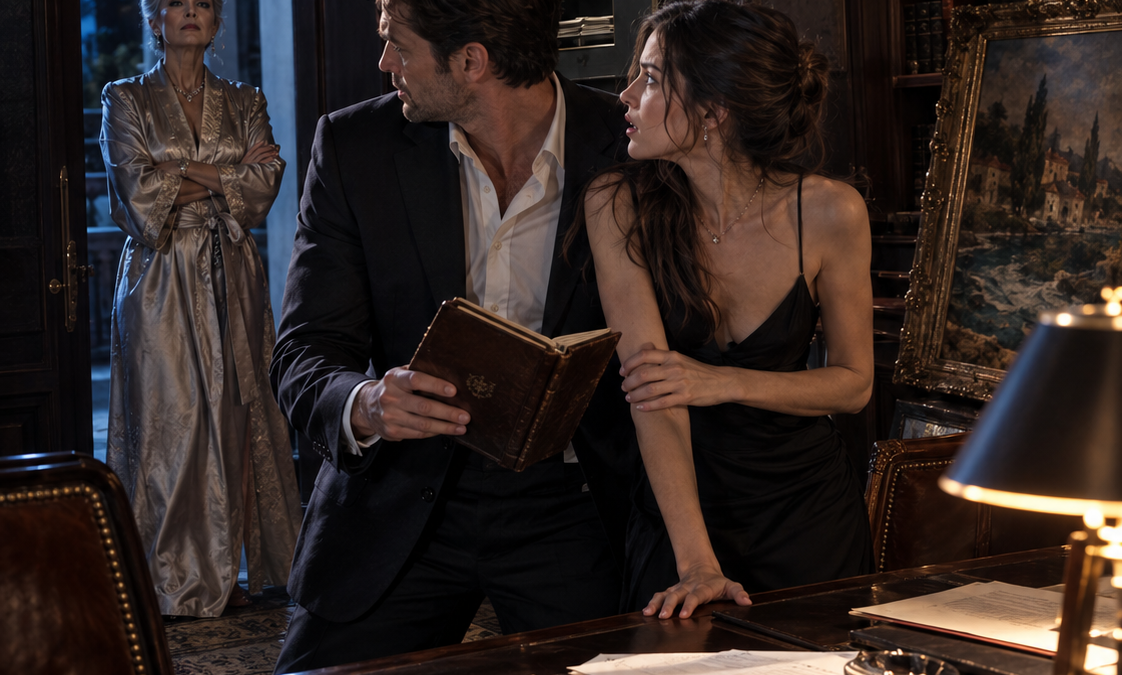
“I’ve been watching you for six months. You’re not the only one who’s been investigating.”
She was sent to expose his family’s crimes — she never planned to become the one person he couldn’t live without.
Elena Vasquez had been staring at the same spreadsheet for forty minutes when she found it — a single line item buried in the operating expenses of the Meridian Tower project, code 7742-G, listed as “structural remediation” to the tune of four point three million dollars.
There was no structural damage at Meridian Tower. She’d walked every floor herself.
“Tell me I’m wrong,” she said, sliding the printout across the conference table.
Marcus Webb didn’t look at it. He kept his eyes on her, that particular stillness he had when he was deciding how much truth to dole out. Behind him, the floor-to-ceiling windows of the State Attorney’s Financial Crimes Division framed Biscayne Bay in postcard blue — sailboats, a cruise ship crawling toward the port, the kind of view that made you forget the building housed people whose job was to ruin other people’s lives.
“You’re not wrong,” he said.
“Then why is this case still sitting in my pending file instead of an indictment?”
Marcus leaned back. He was fifty-three, silver at the temples, a former federal prosecutor who’d traded convictions for a government salary because, he said, he wanted to sleep at night. Elena had believed that for three years. She was starting to wonder if she’d ever actually seen him sleep.
“Because Rafael Costa doesn’t break laws,” Marcus said. “He bends them until they’re unrecognizable, and then he hires lawyers who can prove they’re still standing.”
“Four million dollars disappeared into a project that’s now sitting empty. That’s not bending. That’s laundering.”
“That’s a construction cost overrun.”
“On a building that’s never had a tenant.”
“On a building that’s never been marketed to tenants. There’s a difference, and you know it. Costa Development has every legal right to build whatever it wants and then not rent it out.”
Elena stood up. She was thirty-one, five-foot-four in flats, and she’d learned in her first year out of law school that height didn’t matter when you had a subpoena. What mattered was patience. What mattered was the ability to sit across from men who thought they owned the world and wait for them to make a mistake.
“Six projects,” she said. “Six luxury developments in three years, all funded through Costa Development, all sitting empty or half-sold, all bleeding money on paper. The SEC flags the pattern, the IRS flags the pattern, and somehow every single one comes back clean. You know what that tells me?”
“That someone’s very good at their job.”
“It tells me there’s a reason no one’s looking too hard.”
Marcus’s jaw tightened. It was the only tell he had.
“Let it go, Elena.”
“No.”
“That’s not a request.”
She picked up the printout. “Then make it an order. In writing. And explain to the ethics board why you’re shutting down an active investigation into the largest real estate developer in South Florida.”
The silence stretched. Outside, the cruise ship sounded its horn — a low, mournful note that vibrated through the glass.
“Sit down,” Marcus said.
She didn’t.
“Elena. Sit. Down.”
She sat. But she kept the printout.
“There are things you don’t know,” he said quietly. “Things about the Costa family that go back further than you or me. The father — Vicente — he built that empire out of nothing. And I mean nothing. When he came to Miami in ’79, he had a suitcase and a cousin who knew a guy. By the time Rafael took over in 2005, they owned half the skyline.”
“I know the history.”
“You know the Wikipedia version. What you don’t know is that Vicente Costa had partners. Silent partners. The kind who don’t show up on incorporation documents.”
Elena felt something cold settle in her stomach. “You’re talking about the cartels.”
“I’m talking about money that came into this city when the cocaine wars were still running and never left. It got laundered through real estate, then it got respectable. Vicente went legit. His son is legit. But the money that built the foundation of that company — that money has grandchildren, and those grandchildren want their inheritance.”
“And Rafael Costa is still tied to them.”
“Rafael Costa is trying to bury them. That’s what those empty buildings are.”
Elena frowned. “That doesn’t make sense. If he’s trying to distance himself, why keep the money tied up in unsellable inventory? Why not just sell and be done with it?”
Marcus was quiet for a long moment.
“Because selling means the money starts moving again,” he said finally. “And moving money is traceable. As long as it’s frozen in concrete and glass, no one can prove where it came from. The cartel gets their investment back eventually, minus what Costa skims for himself, and everyone walks away clean.”
“That’s a theory.”
“That’s the truth. And it’s why you’re going to let this go.”
Elena stood again. This time she didn’t sit when he told her to.
“There’s a seventh project,” she said. “The one on Brickell that broke ground last month. Costa Development filed permits for a forty-two-story residential tower. Estimated cost: three hundred million. But the financing structure is a shell game — twelve different LLCs, all registered to addresses that don’t exist, all funded through a bank in the Caymans that’s been flagged for suspicious activity three times in the last five years.”
Marcus’s face had gone very still.
“If I’m right,” Elena continued, “this isn’t just legacy money from the eighties. This is active. Ongoing. And Rafael Costa isn’t burying anything — he’s building a new mausoleum.”
“Elena—”
“I want a subpoena for the project’s financial records. All twelve LLCs. And I want a meeting with Costa himself.”
“Denied.”
“Then I’ll get a warrant.”
“You won’t.”
She paused at the door. Turned. “Why not?”
Marcus looked at her the way you look at someone who’s about to walk into traffic.
“Because the last investigator who tried,” he said, “is currently living in a townhouse in Coral Gables that she can’t afford on a government salary, driving a car she didn’t buy, and sending her kids to a private school with a tuition bill that goes to a P.O. box in Panama.”
Elena’s hand tightened on the door frame.
“His name was David Chen,” Marcus said. “He was my partner for six years. He got too close to the Costa family, and now he doesn’t work here anymore. He doesn’t work anywhere. He just… exists. In a nice house. With a nice car. And a nice life that someone else is paying for.”
“Are you threatening me?”
“I’m warning you. There’s a difference.” Marcus stood, walked to the window. “The Costa family doesn’t destroy people, Elena. They acquire them. And the worst part is, by the time you realize you’ve been bought, you’ve already signed the paperwork.”
Elena left the office at seven-forty. Miami in June was a wet blanket — humidity so thick the air felt solid, the kind of heat that made the palm trees droop and the tourists retreat to air-conditioned lobbies. She walked three blocks to her car, a ten-year-old Honda with a dent in the passenger door and a check-engine light that had been on so long it felt like a feature.
She sat in the driver’s seat without starting the engine.
Four point three million dollars in fake structural remediation. Six empty buildings. A seventh under construction with financing that stank of offshore accounts and shell companies.
And Marcus, her boss, her mentor, the man who’d hired her straight out of a clerkship and told her she was the best investigator he’d ever trained — Marcus was telling her to walk away.
She thought about David Chen. She’d never met him, but she’d heard the name. A cautionary tale, people said. Burned out. Took a payout. Moved on.
But Marcus had said acquired.
That was different.
Elena pulled out her phone. Scrolled through her contacts until she found a name she hadn’t used in two years: Tommy Reyes, a former Miami Herald reporter who’d been squeezed out of the paper when his editors got tired of his obsession with the Costa family. He ran a blog now, barely read, barely funded, but he knew things. He’d been chasing the Costas for a decade.
She typed a message: Need to talk. Off the record. Tomorrow.
The reply came in thirty seconds: I was wondering when someone would finally call.
CHAPTER TWO: The Man in the Glass Tower
Costa Development occupied the top eight floors of a building on Brickell Avenue that Rafael Costa had built in 2012, when he was thirty-four and had just taken over from his father. The building was seventy stories of black glass and steel, angled so that every office faced the water. It was, everyone agreed, a masterpiece.
Elena had been inside once before, during a routine audit three years ago. She’d met with a mid-level CFO who’d answered every question with a smile and a referral to legal. She’d left with nothing.
This time, she wasn’t here as an investigator.
She was here as a lawyer representing a client who didn’t exist.
The cover story had taken her two days to build. A wealthy widow from Tampa, recently inherited, looking to invest in Miami real estate. Elena had created the identity through a shell company of her own — she’d learned enough from watching the Costas to know how it worked — and sent an inquiry through the company’s investor relations portal.
The reply had come within four hours. A meeting with the principal. Tomorrow at ten.
She’d expected to meet with a junior executive. A sales director. Someone whose job was to flatter rich widows and separate them from their money.
She had not expected to be escorted to the seventy-first floor — the penthouse, the one that didn’t appear on the building’s public directory — and left alone in a conference room with a single chair, a single table, and a view that made her feel like she was floating above the city.
Rafael Costa walked in seven minutes late.
He was taller than she’d expected. The photos didn’t capture the way he moved — deliberate, unhurried, like a man who’d never once had to run for anything. Dark hair, dark eyes, a suit that probably cost more than her car. He was forty-six, she knew from the file, but he looked younger in person, the kind of aging that came from money and good genetics and never having to worry about whether the check would clear.
He didn’t sit down. He stood at the window, looking out at the bay.
“Mrs. Harrington,” he said. “I’m told you’re interested in the Brickell project.”
“Among other things.”
“You’re from Tampa.”
“I was.”
“And now?”
“Now I’m looking for a place to put my money that won’t disappear.”
He turned. Looked at her. And something in his expression shifted — a flicker of recognition, or maybe suspicion, or maybe just the natural wariness of a man who’d spent his life assuming everyone wanted something.
“You’re not a widow,” he said.
Elena kept her face neutral. “I’m sorry?”
“Your shoes. They’re practical. A widow with your kind of money would be wearing something that costs more than my first car. Your watch is a Timex. Your bag is from Target.” He walked toward her, slow, measured. “And your eyes keep moving to the door. You’re not here to invest. You’re here to investigate.”
Elena’s heart rate spiked, but she didn’t look away.
“That’s a lot of assumptions from a pair of shoes.”
“I’ve been doing this a long time, Ms…” He paused. “It’s not Harrington, is it?”
She said nothing.
“Let me guess. State Attorney’s office. Financial crimes division. You’ve been looking at our financing structures, you found something that didn’t add up, and your supervisor told you to drop it. But you didn’t. So you decided to come see for yourself.”
Elena stood. “You’re very confident.”
“I’m very informed.” He pulled out his phone, tapped the screen, turned it toward her. A photo of her. Government ID. Her real name underneath.
“You ran my face.”
“I ran your face the moment you walked in the lobby. Facial recognition is a wonderful thing.” He pocketed the phone. “Elena Vasquez. Thirty-one. Graduated University of Miami Law, top ten percent. Clerked for Judge Alvarez. Joined the State Attorney’s office six years ago. Outstanding performance reviews until eighteen months ago, when you started asking questions about Costa Development. No disciplinary actions, but your supervisor has flagged you as ‘overly aggressive’ and ‘unable to prioritize.'”
Elena felt the floor tilt slightly. “You have access to my personnel file.”
“I have access to a lot of things.”
“That’s illegal.”
He smiled. It didn’t reach his eyes.
“So is impersonating a widow to gain access to a private meeting. But here we are.”
They stared at each other. The silence stretched. Outside, a helicopter crossed the sky, a distant thrum.
“Sit down, Ms. Vasquez.”
“No.”
“I’m not going to hurt you.”
“I don’t believe you.”
“Smart.” He walked to the table, pulled out the chair she’d refused, and sat down himself. “Then let me be clear. I know why you’re here. I know what you think you’ve found. And I know that if you keep pulling on this thread, you’re going to find things that will ruin more lives than just mine.”
“Your financing is a shell game. Twelve LLCs, all funded through a Caymans bank. The money traces back to cartel operations from the eighties that never got cleaned up.”
“That’s one theory.”
“It’s the truth.”
Rafael leaned back. His face was unreadable. “Let me tell you a story, Ms. Vasquez. When my father came to Miami, he had nothing. He was nineteen years old, he didn’t speak English, and the only people who would help him were people who made their money in ways that would make your skin crawl. He took that money. He built an empire with it. And then he spent the rest of his life trying to pretend it never happened.”
“That doesn’t erase what he did.”
“No. But it complicates it.” He stood again, walked to the window. “My father died in 2018. Lung cancer. Three months from diagnosis to funeral. In those three months, he told me things. Things about the business. Things about the money. Things about the people who still, to this day, consider themselves owed.”
“And you’re paying them back by building empty buildings?”
“I’m paying them back by making sure the money can’t move. Every project I build with their cash is a project they can’t liquidate. As long as it’s in concrete, it’s frozen. And as long as it’s frozen, it can’t fund the kind of operations that destroyed my father’s soul.”
Elena frowned. “That’s… that doesn’t make sense. You’re a billionaire. You could just pay them off.”
“With what? I don’t have four hundred million in liquid assets. No one does. My wealth is in real estate, in holdings, in things I can’t just write a check for. If I tried to pay them off, I’d have to sell assets, which means the money starts moving, which means it becomes traceable.”
“To you.”
“To them.” He turned. “And they don’t like being traceable. They’ve made that very clear.”
Elena thought about David Chen. Living in a house he couldn’t afford. Driving a car he didn’t buy.
“They got to someone,” she said. “An investigator. David Chen.”
Rafael’s expression flickered. Just for a moment.
“David Chen,” he repeated. “Yes. I remember him.”
“What happened?”
“He got too close. Not to me — to them. He found a thread and pulled, and the thread led somewhere it shouldn’t have. They didn’t kill him. That’s not their style. They just… made him an offer. A very generous offer. And he took it.”
“Because you let him.”
“Because I had no choice. If I’d warned him, they would have known I was cooperating with an investigation. If I’d protected him, they would have seen it as a threat. The only way to keep him alive was to let them think they’d won.”
Elena’s hands were shaking. She pressed them flat against the table.
“You’re telling me you’re the good guy.”
“I’m telling you I’m not the villain you think I am. But I’m not a hero, either. I’m a man trying to clean up a mess my father made, using the only tools I have. And those tools require patience. And silence. And people like you not poking around where you don’t belong.”
“Is that a threat?”
“It’s a fact.” He walked toward her, close enough that she could smell his cologne — something expensive, something that made her think of leather and rain. “You have two choices, Ms. Vasquez. You can walk away. Go back to your office, tell your boss you’ve decided to focus on other cases, and live a long, comfortable life where you don’t have to look over your shoulder.”
“And the other choice?”
“You keep digging. You find more pieces of the puzzle. And eventually, you attract the attention of people who won’t offer you a house in Coral Gables — they’ll offer you a bullet.”
Elena met his eyes.
“I’m not going to walk away,” she said.
Rafael was silent for a long moment. Then, slowly, he smiled. This time it was different — not cold, not calculated, but something else. Something almost like relief.
“No,” he said. “I didn’t think you would.”
CHAPTER THREE: The Offer
He didn’t let her leave.
Not by force — he just walked to the door, opened it, and said, “Coffee?”
Elena blinked. “What?”
“Coffee. There’s a café on the ground floor that makes a decent espresso. You look like you haven’t slept in three days, and I have a proposition that’s going to require you to be sharp.”
“I’m not—”
“I’m not asking you to join my team. I’m asking you to hear me out before you storm off and get yourself killed.”
She hesitated. Every instinct told her to leave. To call Marcus. To file a report and let the system work the way it was supposed to.
But the system wasn’t working. It hadn’t worked for David Chen. It hadn’t worked for her for eighteen months.
“Fine,” she said. “One coffee.”
The café was small, tucked into a corner of the lobby, with windows facing the street. Rafael ordered two espressos without asking what she wanted. They sat at a table near the back, and he waited until the barista disappeared into the kitchen before he spoke.
“I’ve been watching you for six months,” he said.
Elena set down her cup. “Excuse me?”
“You’re not the only one who’s been investigating. When I saw your name come up in the SEC’s internal queries about my projects, I started looking into you. Elena Vasquez. Daughter of Diego and Maria Vasquez. Your father was a contractor — built custom homes in Coral Gables. Your mother taught elementary school. You have a brother, Miguel, who’s a firefighter in Broward County. And you have no idea how much danger you’re in.”
Elena’s blood ran cold. “How do you know about my family?”
“Because I needed to know who I was dealing with. And because I needed to know if you had vulnerabilities.”
“And do I?”
“Everyone does.” He took a sip of coffee. “Your vulnerability is that you’re honest. You believe in the system. You think if you just pull the right thread, everything will unravel, and justice will prevail.”
“That’s not a vulnerability. That’s integrity.”
“It’s a death sentence.” He leaned forward. “The people who fund my projects — they don’t care about justice. They care about control. As long as the money is frozen, they’re patient. But if you force me to move it — if you bring this to a court, if you expose the financing structure — they will panic. And when they panic, people die.”
“So what do you want me to do? Forget I found anything?”
“No.” He set down his cup. “I want you to help me.”
Elena stared at him. “Help you do what?”
“End it. Not just freeze the money — destroy it. Break the cycle permanently. Find the evidence that can take down the men who’ve been laundering cartel cash through this city for forty years. And do it in a way that doesn’t put your family in a crosswalk.”
“You’re asking me to work with you. In secret. Against the people who fund your business.”
“I’m asking you to work with me against the people who’ve been using my family as a front for two generations.”
“This is insane.”
“Yes.”
“I don’t trust you.”
“You shouldn’t.”
“You could be setting me up.”
“I could be. But if I wanted you dead, you’d already be dead. If I wanted you discredited, I’d have sent your name to the press this morning, along with proof that you falsified a cover identity to gain access to a private meeting.” He raised an eyebrow. “I didn’t.”
Elena’s mind raced. She thought about Marcus. About his warning. About the townhouse in Coral Gables and the car David Chen didn’t buy.
“David Chen,” she said. “Is he still in touch with you?”
Rafael’s expression didn’t change. “David Chen is dead.”
Elena’s cup rattled against the saucer.
“He died six months ago. Heart attack. At least, that’s what the coroner said. But David was thirty-nine years old, a marathon runner, and had no history of heart problems.” He paused. “You can draw your own conclusions.”
Elena closed her eyes. “Oh God.”
“The people we’re dealing with don’t leave loose ends. David took their money, but he also knew things. And eventually, that knowledge became a liability. They made him disappear in the most natural way possible.”
“And you didn’t warn him?”
“I didn’t know until it was too late.” There was something in his voice — a raw edge she hadn’t heard before. “David and I were… we had an arrangement. He fed me information about the investigation, I fed him information about the cartel’s movements. We were trying to build a case. But someone found out. Someone on the inside.”
“You had a mole.”
“I still have a mole.” He met her eyes. “That’s why I need you. You’re outside the family. Outside the business. Outside everything. You’re the only person I can trust who isn’t already compromised.”
Elena sat back. The espresso had gone cold.
“You’re asking me to trust you based on a story. Based on your word. I don’t know you.”
“No. But you know Marcus.”
She froze. “What about him?”
“Marcus Webb has been on the Costa payroll for eight years. Not directly — he’s too smart for that. But his wife runs a nonprofit that receives anonymous donations. His son got a full scholarship to a university that my family endows. He’s not dirty, exactly. But he’s been… softened. The way David was softened before they killed him.”
Elena thought about Marcus’s face when she’d shown him the spreadsheet. His stillness. His careful words.
Let it go.
“You’re lying.”
“I’m not.”
“Prove it.”
Rafael reached into his pocket and pulled out a folded piece of paper. Slid it across the table.
Elena unfolded it. A wire transfer receipt. Fifty thousand dollars. From an LLC she recognized — one of the twelve — to an account in Marcus Webb’s name.
Dated three months ago.
“That’s… that could be anything.”
“That could be the reason your investigation is still sitting in a pending file instead of an indictment.”
Elena stared at the paper. Her hands felt numb.
“I need to think,” she said.
“Take all the time you need. But not too much.” Rafael stood. “The men who killed David Chen are patient, but they’re not infinitely patient. And the longer you keep digging, the more likely it is they’ll decide you’re a problem.”
He placed a business card on the table — just a name and a phone number. No title, no company.
“Call me when you’ve decided.”
CHAPTER FOUR: The Web
Elena didn’t call him that night.
Or the next night.
She went home to her apartment in Little Havana — a one-bedroom on the second floor of a building that had been renovated in the nineties and not touched since — and sat on her couch with a glass of wine and tried to think.
The wire transfer receipt was real. She’d verified the account number, the routing information. The LLC was one of the twelve she’d flagged. And the destination account was listed under Marcus Webb’s name, though it was through a holding company she’d never heard of.
It could be innocent. It could be a consulting fee, a legal settlement, something that had nothing to do with her investigation.
It could be a bribe.
She thought about Marcus’s face when he’d told her to drop the case. His careful, measured words. The way he’d warned her without actually threatening her.
The Costa family doesn’t destroy people. They acquire them.
Maybe he was speaking from experience.
On the third day, she got a call from her brother.
“Hey,” Miguel said. “You okay? You sound weird.”
“I’m fine. Just tired.”
“You working too much again?”
“Something like that.”
There was a pause. “Elena, is something going on? Mom said you didn’t come to dinner on Sunday.”
“I had a case.”
“Mom’s worried about you.”
“Mom’s always worried.”
“Yeah, well.” Another pause. “I’m worried too. You’ve been different lately. Ever since you started looking into those Costa people.”
Elena’s grip tightened on the phone. “What do you mean?”
“I don’t know. You’re just… intense. More than usual. And you never talk about work anymore, which is weird because you used to talk about it all the time.”
“I’m just busy.”
“Elena.” His voice was serious now. “If you’re in trouble, you can tell me. I’m your brother. I don’t care what it is.”
“I’m not in trouble.”
“You’re lying.”
She closed her eyes. “Miguel, I can’t—”
“Can’t what?”
“I can’t talk about it. Not yet. But I promise, I’m okay. I’m just… trying to figure something out.”
“Something dangerous?”
“Maybe.”
“Then stop.”
“I can’t.”
Silence. Then: “You’re just like Dad. You know that? He never knew how to walk away either.”
Elena felt tears prick her eyes. “I know.”
“Just… be careful. Okay? I can’t lose you too.”
After she hung up, she sat in the dark for a long time. Then she picked up her phone and called the number on Rafael’s card.
He answered on the second ring.
“Ms. Vasquez.”
“I need proof.”
“Of what?”
“That you’re telling the truth. That you’re not just using me to cover something up. That this isn’t a trap.”
There was a pause. “What kind of proof?”
“I want to see the money. The frozen accounts. The projects. I want to see everything.”
“That’s a lot to ask.”
“I’m not asking. I’m demanding.”
Another pause. Then, unexpectedly, a low laugh. “You’re not afraid of me at all, are you?”
“Should I be?”
“Probably. But I’m glad you’re not.” He exhaled. “Fine. Tomorrow. Eight AM. I’ll send a car.”
“I’ll drive myself.”
“No. If you’re going to be involved in this, you’re going to do it my way. At least for now.”
“Why?”
“Because the people who are watching me are also watching you. And if you show up at my office in that Honda of yours, they’re going to know you’re not just a lawyer looking for a client.”
Elena hesitated. “Fine. But I’m bringing a gun.”
“I’d be disappointed if you didn’t.”
CHAPTER FIVE: The Vault
The car was black, unmarked, driven by a man who introduced himself only as Tomás and didn’t speak again for the entire forty-minute drive. They went north, past the Design District, past the upscale neighborhoods where Elena had grown up, and into an industrial area near the airport that she’d never had reason to visit.
The building was unmarked. A warehouse, or what looked like one — gray concrete, no windows, a single steel door. Tomás parked, got out, and opened her door without a word.
Rafael was waiting inside.
The warehouse wasn’t a warehouse. It was a vault — climate-controlled, temperature-regulated, lined with rows of filing cabinets and computer servers. In the center of the room, a long table held stacks of documents, folders, photographs.
“Welcome to the archive,” Rafael said.
Elena walked slowly, taking it in. “What is this place?”
“Everything my father ever did. Every deal, every payment, every conversation. He kept records of everything — not because he was careful, but because he was paranoid. He didn’t trust anyone, so he documented everything, thinking he could use it as leverage if he ever needed to.”
“And you’ve been using it.”
“I’ve been trying to.” He gestured to the table. “This is what I’ve been able to piece together over the last five years. The structure of the cartel’s financial network. The names of the men who run it. The properties they’ve laundered money through. And the people on the inside who’ve been helping them.”
Elena picked up a photograph. A man in a suit, shaking hands with someone she didn’t recognize. “Who is this?”
“That’s my uncle. Vicente’s brother. He was the one who brought the cartel money into the business in the first place.”
“Was?”
“He died in 2009. Car accident. At least, that’s what the police report said.” Rafael’s voice was flat. “He was going to talk. He was going to go to the FBI and confess everything. The cartel found out.”
Elena set down the photograph. “And now?”
“Now there’s only me. And my mother. And my sister, though she doesn’t know anything about this — she thinks the family business is just real estate.”
“Your mother knows?”
“She knows more than she’ll admit.” He paused. “My mother is… complicated.”
Elena thought about the woman she’d seen in photographs — Isabel Costa, seventy-one years old, still beautiful, still sharp, still ruling the family from a mansion in Coral Gables. There were rumors about her. Rumors about how much she’d known. How much she’d been involved.
“Does she know what you’re doing?”
“She knows I’m trying to clean things up. She doesn’t know how far I’ve gone.” He met Elena’s eyes. “She wouldn’t approve.”
“Why not?”
“Because my mother believes in preserving the family at all costs. Even if that means preserving the things that should be destroyed.”
Elena walked the length of the table, scanning documents, photographs, spreadsheets. It was overwhelming — a history of crime and corruption that went back decades, that touched every corner of the city.
“This is enough,” she said. “This is more than enough. If I brought this to the state attorney—”
“You’d be dead within a week. And so would I.”
“Then what’s the point? If we can’t use any of this—”
“We can use it. But we have to be strategic. We have to find a way to expose the network without exposing ourselves. And we have to do it in a way that doesn’t give them time to react.”
Elena turned to face him. “You have a plan.”
“I have the beginnings of a plan. But I need someone who understands the legal system. Someone who knows how to build a case that will actually stick.”
“And you think that’s me.”
“I think you’re the only person who’s shown the courage to keep going when everyone else told you to stop.”
She looked at him — really looked at him, for the first time since she’d walked into his office. He was exhausted. She could see it now, in the lines around his eyes, the tension in his shoulders. This wasn’t a man who was playing a game. This was a man who’d been fighting a war alone for years.
“Why me?” she asked. “Why not go to the FBI? The DEA? Someone with more resources?”
“Because I don’t know who’s compromised. I’ve been burned before — people I trusted, people I thought were on my side. I don’t know who I can trust anymore.”
“And you trust me?”
“I trust that you’re not corrupt. I trust that you actually believe in justice, even when it’s inconvenient. And I trust that you’re too stubborn to walk away, even when you should.”
Elena let out a breath. “That’s not trust. That’s desperation.”
“Maybe. But it’s a start.”
CHAPTER SIX: The Rules
They spent the next four hours going through the documents. Rafael explained the structure of the network — the way the money moved, the shell companies, the real estate holdings, the legitimate businesses that served as fronts. Elena took notes, asked questions, and slowly began to understand the scope of what they were dealing with.
It was bigger than she’d imagined. The cartel money didn’t just flow through Costa Development — it flowed through banks, law firms, politicians, and at least two other major real estate families. It was a network that had been built over forty years, and it had tendrils in every corner of Miami’s power structure.
“If we expose this,” Elena said, “it won’t just take down the cartel. It’ll take down half the city.”
“Yes.”
“Are you prepared for that?”
“I’ve been preparing for it for five years.” Rafael leaned against the table. “The question is whether you are.”
Elena thought about her career. Her family. The life she’d built. All of it could disappear if this went wrong.
But then she thought about David Chen. About the house in Coral Gables and the car he didn’t buy. About the heart attack that wasn’t a heart attack.
“I’m in,” she said.
“Good.” Rafael straightened. “Then we need to establish some rules.”
“Rules?”
“Boundaries. The things we don’t do, no matter how tempting.” He held up a finger. “One: no lying to each other. Not even by omission. If you find something, you tell me. If I find something, I tell you. No secrets.”
“Agreed.”
“Two: no acting alone. If you want to follow a lead, you run it by me first. If I want to make a move, I run it by you. We’re partners in this, or we’re nothing.”
“Fine.”
“Three:” He paused. “No falling in love with me.”
Elena blinked. “What?”
“I’m serious. This is a business arrangement, nothing more. I’ve seen what happens when lines get blurred. People get hurt. People get killed. I won’t let that happen to you.”
“You’re assuming I’d be interested.”
“I’m assuming nothing. I’m just making the rules clear.”
Elena folded her arms. “You know, for a man who’s asking for my help, you’re being awfully presumptuous.”
“I’m being careful.”
“There’s a difference?”
“Yes.” He stepped closer. “Careful is making sure we both survive this. Presumptuous is assuming I know what you’re thinking. I don’t. But I know what I’m thinking, and I know that if I let myself feel anything for you, it will compromise my judgment. And I can’t afford that.”
Elena met his eyes. “Then maybe you should be the one worried about breaking your own rules.”
Something flickered in his expression — surprise, maybe, or respect.
“Maybe I should,” he said.
 [Tap here for the Next Part ]