“I want you to destroy my mother.”
“I want you to destroy my mother.”
She thought she was investigating a corrupt nursing home. She ended up married to the man whose family owned it — and fighting to take it all down.
“The inspection date on this report is wrong.”
Han Ji-eun didn’t look up from the document when she said it. She kept her voice level, professional, the way she’d been trained to speak in rooms where the stakes were higher than anyone else realized. The fluorescent light of the conference room hummed overhead, and somewhere down the corridor, a cart rattled past with the evening meal trays for the dementia ward.
Across the polished table, Director Park Min-ho’s smile didn’t waver. He was a small man with careful eyes and the kind of expensive watch that suggested he was paid more than his government salary should allow. “Ms. Han, I assure you, our records are impeccable. We’ve received the highest ratings from the National Health Insurance Service for three consecutive years.”
“I’m not questioning the ratings.” Ji-eun slid the paper across the table. “I’m questioning the date. This inspection was logged as conducted on March 15th, 2023. But March 15th was a Wednesday, and according to the lunar calendar that year, it was also the day of the Suneung make-up exam. Every government inspector in the district was reassigned to exam security. No health inspections were conducted that day.”
The silence that followed was the kind that told her she’d hit something. Director Park’s smile stayed in place, but his fingers—resting on the table—curled slightly inward.
“An administrative error,” he said smoothly. “The date was likely entered incorrectly during data migration. We can pull the original paper logs if you’d like.”
“I would like that very much.” Ji-eun stood, gathering her documents into her leather briefcase. She was thirty-two years old, dressed in a navy blazer that had cost her two months of savings, and she had spent the last four years of her life investigating eldercare facilities for the Seoul Metropolitan Government’s Ombudsman Office. She knew when she was being lied to. She also knew that proving it required patience, not confrontation.
“I’ll return tomorrow morning,” she said. “Nine a.m. Please have the original logs ready. All of them—not just for March, but for the past three years. And I’d like to speak with some of the residents.”
Director Park rose as well, his chair scraping against the floor. “That won’t be possible. Many of our residents have cognitive impairments. Their recollections can’t be relied upon.”
“I’m not interested in their recollections.” Ji-eun paused at the door, her hand on the frame. “I’m interested in what they wrote down.”
She left before he could respond, her heels clicking down the corridor with the kind of steady rhythm that masked the adrenaline spiking through her veins. The nursing home—Silver Lining Care Center, one of twelve facilities operated under the Silver Lining Foundation umbrella—smelled of antiseptic and something sweeter underneath, like wilted flowers. The walls were painted a soothing sage green, and framed photographs of smiling staff members lined the hallway. Everything about the place was designed to reassure.
That was precisely what made her suspicious.
Ji-eun’s apartment was a one-room studio in Mapo-gu, cluttered with case files and the remnants of a life that had once included a husband, a mortgage, and the naive belief that doing the right thing would be enough. She poured herself a glass of water, sat down at her desk, and opened her laptop.
The Silver Lining Foundation. She’d been investigating it for six weeks now, ever since a whistleblower—a former nurse’s aide who had quit after being asked to falsify medication logs—had sent an anonymous tip to the ombudsman’s office. The tip had been vague: They’re paying off inspectors. The ratings are fake. People are dying who shouldn’t be.
The nurse’s aide had disappeared two weeks later. Ji-eun had tried to track her down, but the woman’s phone was disconnected and her last known address was vacant.
She pulled up the foundation’s corporate registration. The documents listed a board of directors: a retired professor, a former hospital administrator, a woman identified only as “Chairwoman.” No names that led anywhere. The foundation’s registered address was a PO box in Gangnam.
But the money trail—that was where things got interesting. Ji-eun had a contact at the Financial Services Commission who owed her a favor, and he’d run a quiet search on the foundation’s funding sources. The results had been… unusual. Donations from a series of shell companies, all registered in the same building in Yeouido, all incorporated within the same three-month period two years ago. The building’s lease was held by a holding company called Haneul Holdings.
Haneul Holdings. Ji-eun had seen that name before. She couldn’t remember where, but it nagged at her, like a word on the tip of her tongue.
She made a note to dig deeper tomorrow. For now, she needed sleep. Tomorrow she would return to Silver Lining, demand the paper logs, and find the evidence that would blow the whole thing open.
She didn’t know that tomorrow would change everything.
CHAPTER 2: The Man in the Hallway
The next morning, Ji-eun arrived at Silver Lining Care Center at exactly 8:55 a.m. The receptionist—a young woman with elaborate nails and a bored expression—told her that Director Park was in a meeting and she should wait.
Ji-eun waited for forty minutes.
At 9:35, she stopped waiting.
She walked past the reception desk, down the corridor toward the administrative offices, and that was when she saw him.
A man stood at the end of the hallway, speaking in low tones to Director Park. He was tall—taller than most Korean men she knew—with broad shoulders and dark hair slicked back from a face that belonged on a magazine cover, not in a nursing home corridor. His suit was charcoal gray, impeccably tailored, and his shoes were the kind of Italian leather that cost more than Ji-eun’s monthly rent. He held himself with the coiled stillness of someone accustomed to being obeyed.
Director Park was nodding rapidly, his earlier confidence replaced by something that looked like fear.
Ji-eun’s instincts flared. She stepped back, pressing herself against the wall, and pulled out her phone. She pretended to be checking messages, but her eyes stayed on the two men.
“—can’t keep stalling her,” Director Park was saying, his voice carrying in the quiet hallway. “She found the date discrepancy. She’s asking for the paper logs.”
“Then give her the paper logs.” The tall man’s voice was low, controlled. “The real ones are in the basement archive. She won’t know the difference.”
“The real ones are in the basement archive,” Director Park repeated. “Right. Of course.”
The man turned slightly, and for a moment, his gaze swept down the hallway. Ji-eun froze.
Their eyes met.
His expression didn’t change—no surprise, no guilt, no acknowledgment of any kind. He looked at her the way one might look at a piece of furniture, something beneath notice. Then he turned back to Director Park, said something she couldn’t hear, and walked away in the opposite direction.
Director Park watched him go, then turned and saw Ji-eun. His face went pale.
“Ms. Han. I didn’t realize you’d arrived.”
“I’ve been here for forty minutes.” Ji-eun pocketed her phone and approached him, her heels steady on the linoleum. “Who was that?”
“A… a representative from our parent organization. Routine visit.” Director Park’s smile was back, but it was brittle now, like old paint. “Please, come to my office. I have the logs you requested.”
Ji-eun followed him, but her mind was elsewhere. The man’s face. She’d seen it before, she was certain of it. Not in person—in photographs. In newspaper articles. In the business section that she skimmed while waiting for her coffee.
She couldn’t place it. But she would.
The paper logs were flawless.
Ji-eun spent three hours reviewing them, cross-referencing dates, signatures, and inspection notes. Everything matched the digital records. The handwriting was consistent—perhaps suspiciously so—and the inspector signatures all belonged to the same five names.
She asked to speak with residents. Director Park escorted her to the common room, where a dozen elderly people sat in wheelchairs or dozed in armchairs, a television playing a drama at low volume. The air smelled of institutional cleaner and boiled vegetables.
Ji-eun approached a woman in her eighties who was awake, her hands folded in her lap. “Hello. My name is Han Ji-eun. I’m from the city ombudsman’s office. May I ask you a few questions?”
The woman looked at her with clear, sharp eyes. “You’re the third one this year.”
“The third what?”
“The third person who’s come asking questions.” The woman’s name tag read Yoon Mi-sook. “The other two stopped coming. One of them moved to Busan. The other one… I don’t know what happened to her.”
Ji-eun felt a cold prickle at the back of her neck. “What did they ask you about?”
“Same thing you’re going to ask. Whether the staff treats us well. Whether the food is good.” Yoon Mi-sook’s lips curved in a thin smile. “I tell them what I tell everyone. The food is fine. The staff is fine. Everything is fine.”
“Is it?”
The old woman was quiet for a long moment. Then she said, “Do you know what a precedent is, young lady?”
“I do.”
“I was a judge for thirty-two years. I know how to read a record. I know when something’s been altered.” Yoon Mi-sook glanced toward the door, where a nurse’s aide stood watching them. “But I also know when someone’s watching me. So I’ll tell you what I told the others: everything is fine.”
Ji-eun followed her gaze. The aide was young, with a pleasant face and eyes that didn’t blink. She was holding a medication tray and smiling.
“Thank you for your time,” Ji-eun said.
As she left the common room, she felt Yoon Mi-sook’s eyes on her back. The old woman had said something important—something about records, about alterations—but she couldn’t ask more, not here, not with the aide watching.
She needed to come back alone.
CHAPTER 3: The Name on the Building
That evening, Ji-eun sat in a coffee shop near her office, her laptop open, a half-finished Americano growing cold beside her. She was supposed to be drafting her preliminary report, but instead, she was staring at a photograph on her screen.
The man from the nursing home hallway.
She’d found him on the website of a business magazine: Kang Tae-jun, CEO of Kang Industries. The accompanying article was titled “The Reluctant Heir: How One Man Transformed His Family’s Conglomerate.”
Kang Industries. The name sent a shock through her system. It was one of the largest conglomerates in Korea—construction, logistics, hospitality, healthcare. A chaebol in every sense of the word, with fingers in dozens of pies and a reputation for ruthless efficiency.
And Haneul Holdings, the shell company that had been funding the Silver Lining Foundation?
Haneul was Korean for “sky.”
Kang Tae-jun’s father, the late Kang Sung-ho, had been known as the “Sky of Korean Industry.” The nickname was everywhere—in obituaries, in business textbooks, in the reverent whispers of older executives. The old man had built Kang Industries from nothing, and when he died five years ago, his son had taken over.
Ji-eun stared at the photograph. Kang Tae-jun’s face was cold, composed, the expression of a man who had learned early that showing emotion was a weakness. But there was something else in his eyes—a flicker of something she couldn’t name. Not cruelty. Something more complicated.
She thought of the way Director Park had looked at him. The fear.
She thought of the whistleblower’s words: People are dying who shouldn’t be.
She thought of Yoon Mi-sook, the retired judge, saying I know when something’s been altered.
And she thought of her own husband—her ex-husband now—who had once told her, during their divorce proceedings, You always think you’re the smartest person in the room. That’s going to get you killed someday.
She closed her laptop.
She needed to talk to someone. But who?
The next morning, Ji-eun went to see her former colleague, Kim Soo-ah, who had left the ombudsman’s office two years ago to work for a private law firm. Soo-ah was one of the few people Ji-eun trusted completely—a woman who had seen her through her divorce, who had listened to her cry over cheap soju in a noraebang, who had never once told her to stop chasing impossible cases.
They met at a small café in Insadong, tucked away from the tourist crowds. Soo-ah arrived in a designer coat and a cloud of expensive perfume, her hair perfectly styled. She looked like she belonged in a different life than the one she’d left behind.
“You look terrible,” Soo-ah said, sitting down. “What’s wrong?”
Ji-eun told her everything. The nursing home, the falsified dates, the shell company, Kang Tae-jun.
Soo-ah was quiet for a long moment after she finished. Then she said, “You need to drop this case.”
“What?”
“I’m serious, Ji-eun. Kang Industries is not a normal company. They have lawyers—an army of them. They have connections in the Blue House. They have a security team that’s rumored to be ex-military.” Soo-ah leaned forward, her voice dropping. “And Kang Tae-jun… I’ve heard stories about him. The way he treats people who cross him. You don’t want to be on his radar.”
“I’m already on his radar.” Ji-eun wrapped her hands around her coffee cup, trying to warm her fingers. “He saw me at the nursing home. And Director Park knows I’m investigating.”
“Then you need to be careful.” Soo-ah reached across the table and gripped her wrist. “Listen to me. I know you. I know you think you can fix everything, save everyone. But some things are too big to fix. Some people are too powerful to fight.”
“Then who will?” Ji-eun pulled her hand away. “If I don’t do this, who will? The other two investigators who came before me? One moved to Busan, and the other one disappeared. What does that tell you?”
Soo-ah’s face went pale. “What do you mean, disappeared?”
“I mean no one knows where she is. She stopped answering her phone. Her apartment was cleared out.” Ji-eun’s voice was steady, but her heart was pounding. “I think something happened to her. And I think the same thing could happen to me.”
“Then stop. Go to the police. Let them handle it.”
“The police?” Ji-eun laughed, a short, bitter sound. “Soo-ah, the police can’t touch Kang Industries. You know that as well as I do.”
Soo-ah was silent.
“I have to do this my way,” Ji-eun said. “I have to find proof—solid, undeniable proof—and then I have to give it to someone who can’t be bought. A journalist. A prosecutor. Someone.”
“And if Kang Tae-jun finds out what you’re doing?”
Ji-eun thought of his eyes in the hallway, cold and assessing. She thought of the way he’d looked at her, as if she were nothing.
“Then I’ll deal with that when it happens,” she said.
CHAPTER 4: The Fifth Floor
Three days later, Ji-eun returned to Silver Lining Care Center. This time, she didn’t announce her arrival. She parked her car two blocks away and walked through the back entrance, the one used by delivery trucks and maintenance staff.
She’d spent the past three days studying the building’s layout, pulling old permits from the city archives. The basement archive was where the real records were kept, according to the conversation she’d overheard between Director Park and Kang Tae-jun. But the basement was locked, accessible only by key card.
The fifth floor, however, was different.
The city permit records showed that the fifth floor had originally been designed as administrative offices. But when Ji-eun had asked Director Park about it during her first visit, he’d told her it was “storage.” She’d noticed the way he’d glanced at the elevator when he said it.
Something was on the fifth floor.
She took the stairs, avoiding the elevator’s security camera. Her heart was pounding, and her palms were sweating, but she forced herself to move slowly, quietly. The stairwell smelled of bleach and dust.
On the fifth floor, the door was locked, but the lock was old—a simple pin tumbler that yielded to the tension wrench and pick she’d bought from a shady online store weeks ago. She’d never thought she’d actually use them.
The door swung open.
Ji-eun stepped into a room lined with filing cabinets. The air was thick with the smell of paper and something else—something sour, like old sweat. The lights were off, but she used her phone’s flashlight to navigate, her footsteps echoing on the linoleum.
The first cabinet was labeled 2020 – Inspection Records. She pulled open the drawer.
The files inside were different from the ones Director Park had shown her. These were handwritten logs, not typed reports. They listed resident names, dates, and observations—the kind of detailed notes that a diligent caretaker might keep.
And at the bottom of each page, in different handwriting, were notes like: Falsified entry. Actual date: 3/17. Inspector absent. Payment made to Inspector Choi.
Ji-eun’s hands were shaking as she took photos with her phone. Page after page, the same pattern: false dates, absent inspectors, payments made. The whole system was a sham.
She opened the next drawer. 2021 – Medication Logs.
These were worse. Residents who had been prescribed medications that were never administered. Doses that had been skipped to save money. And in one case, a resident who had died after being given the wrong medication—a death that had been recorded as “natural causes.”
Ji-eun’s stomach turned. She took more photos, her fingers moving frantically.
She was so focused on the files that she didn’t hear the footsteps behind her until it was too late.
“Ms. Han.”
She spun around.
Kang Tae-jun stood in the doorway, his silhouette backlit by the hallway light. He was wearing a dark suit, his hands in his pockets, his expression unreadable.
“I was wondering when you’d find this place,” he said.
CHAPTER 5: The Offer
Ji-eun’s first instinct was to run. But there was nowhere to go—he was blocking the only exit, and she was on the fifth floor of a building she’d entered illegally.
So she did the only thing she could think of: she straightened her spine and met his eyes.
“I’m conducting a lawful investigation on behalf of the Seoul Metropolitan Government,” she said, her voice steady despite the fear coursing through her. “You have no right to interfere.”
Kang Tae-jun smiled. It was not a warm expression. “A lawful investigation conducted through a picked lock and a stolen key card? I don’t think so.”
He stepped into the room, and Ji-eun took an involuntary step back. The filing cabinet pressed against her spine.
“Let me be clear,” he said, his voice low and calm. “I know exactly who you are, Ms. Han. Han Ji-eun, thirty-two, formerly married to Lee Jae-won, no children. You’ve worked for the ombudsman’s office for four years. You have a reputation for being… persistent.”
“Then you know I won’t stop.”
“I know you think you won’t.” He stopped a few feet away from her, his eyes never leaving her face. “But I also know that persistence without power is just stubbornness. And stubbornness can be… managed.”
He reached into his jacket and pulled out a checkbook. Ji-eun watched, disbelief and fury rising in her chest, as he wrote something on a slip of paper and tore it off.
He held it out to her.
“Five hundred million won,” he said. “Enough to pay off your debts, buy a new apartment, start a new life somewhere far from Seoul. All you have to do is walk away.”
Ji-eun stared at the check. Then she looked up at him.
“You think I’m doing this for money?”
“I think everyone has a price.” His voice was flat. “I’m offering you yours.”
She took the check from his hand. For a moment, she looked at it—the zeros, the signature, the promise of a life without struggle.
Then she tore it in half.
“I’m not for sale,” she said. “And neither are the people in this building. The people who trusted this facility to care for them, who died because someone decided their lives were worth less than a profit margin. I’m going to expose what you’ve done. And I’m going to make sure everyone knows about it.”
Kang Tae-jun’s expression didn’t change. But something in his eyes shifted—a flicker of something that might have been respect, or might have been calculation.
“That’s a shame,” he said.
He stepped aside, gesturing toward the door. “You can leave. But I should warn you—the files you photographed? They won’t be there when you come back. And the whistleblower who tipped you off? She’s already been found. She’s safe, for now. But if you continue down this path, I can’t guarantee she’ll stay that way.”
Ji-eun’s blood went cold. “What have you done to her?”
“Nothing. Yet.” He smiled again, that cold, empty smile. “But I have resources, Ms. Han. Resources you can’t imagine. And I’m not the only one watching you.”
He pulled out his phone and showed her a photograph. It was her apartment building, taken from across the street. The timestamp was from two hours ago.
“You’re being watched,” he said. “Every move you make, every person you talk to. The moment you become a threat to my family’s interests, I’ll know. And I’ll act.”
Ji-eun’s hands were shaking. But she forced herself to hold his gaze.
“Then I guess you’d better get used to watching me,” she said. “Because I’m not going anywhere.”
She walked past him, down the stairs, out of the building. The night air hit her face like a slap, and she realized she was crying—not from fear, but from rage.
She had never hated anyone the way she hated Kang Tae-jun in that moment.
But she had also never been more determined.
CHAPTER 6: The Judge’s Ledger
The next morning, Ji-eun woke to a text message from an unknown number.
The old woman on the third floor. Room 312. She wants to talk to you. Come alone.
Ji-eun stared at the message for a long moment. It could be a trap. It probably was a trap. But she had no other leads—her whistleblower was gone, the files she’d photographed had likely been destroyed, and Kang Tae-jun’s threat echoed in her mind.
She went.
Room 312 was at the end of a quiet corridor. The door was slightly ajar, and Ji-eun pushed it open to find Yoon Mi-sook sitting in a chair by the window, a blanket over her knees and a notebook in her lap.
“Close the door,” the old woman said.
Ji-eun obeyed.
“Sit.”
Ji-eun sat on the edge of the bed, facing her.
Yoon Mi-sook studied her for a long moment. Then she said, “You’re the one who came asking questions. The one who didn’t stop.”
“I’m trying not to.”
“Good.” The old woman opened the notebook and held it out. “I’ve been keeping this for three years. Every inspection that never happened. Every date that was falsified. Every resident who died when they shouldn’t have. I wrote it all down.”
Ji-eun took the notebook. It was filled with neat, precise handwriting—dates, names, observations. A meticulous record of fraud and neglect.
“Why?” she asked. “Why did you keep this?”
“Because I was a judge for thirty-two years.” Yoon Mi-sook’s voice was firm. “I know evidence when I see it. And I know that eventually, someone would come who was thorough enough to ask the right questions. Someone who would look at the residents, not just the paperwork.”
She paused, her eyes sharp. “You’re that someone.”
Ji-eun’s throat tightened. “I don’t know if I am. I don’t know if I can win this.”
“You can.” Yoon Mi-sook leaned forward. “But you need to understand something. The man who runs this place—the man you met—he’s not the real enemy.”
Ji-eun frowned. “What do you mean?”
“The Silver Lining Foundation is a shell. The real owners are hidden behind layers of holding companies and fake boards.” Yoon Mi-sook’s voice dropped. “But I’ve been listening. I’ve been watching. And I know who’s really in charge.”
She reached out and tapped the notebook. “It’s not Kang Tae-jun.”
Ji-eun’s heart skipped. “Then who?”
“His mother.” Yoon Mi-sook’s eyes were cold. “Chairwoman Kang. She’s the one who built this empire. She’s the one who pays the inspectors. She’s the one who decides which residents get proper care and which ones are… neglected.”
Ji-eun thought of the woman listed on the foundation’s board—the one identified only as “Chairwoman.” She’d assumed it was a figurehead.
“She’s dying,” Yoon Mi-sook continued. “Cancer. She has maybe six months left. And when she dies, control of the foundation will pass to her son. Unless someone stops it.”
“Stops it how?”
“By exposing the fraud. By proving that the foundation is not a legitimate charity but a criminal enterprise.” Yoon Mi-sook gripped Ji-eun’s wrist. “If you can do that—if you can prove what’s been happening here—then the courts will seize the foundation’s assets. They’ll distribute them to the victims’ families. And the Kang family will lose everything.”
Ji-eun stared at her. “You want me to destroy them.”
“I want you to do your job.” Yoon Mi-sook released her wrist and sat back. “I’ve spent three years watching people die because of greed. I’m not going to die watching the people responsible get away with it.”
She closed her eyes. “Now go. Before someone notices you’re here.”
Ji-eun stood, clutching the notebook to her chest. At the door, she paused.
“Thank you,” she said.
Yoon Mi-sook didn’t open her eyes. “Don’t thank me yet. The hard part is just beginning.”
Ji-eun returned to her apartment and spent the rest of the day scanning the notebook, photographing every page, uploading the files to three different cloud storage accounts. She emailed copies to Soo-ah, to a journalist she trusted, and to a prosecutor she’d worked with years ago.
Then she sat back and waited.
The next move was Kang Tae-jun’s.
She didn’t have to wait long.
At 9 p.m., her phone buzzed with a text from the same unknown number as before.
We need to talk. Alone. Tonight. I’ll send a car.
Ji-eun stared at the message. Every instinct told her to refuse. But she thought of Yoon Mi-sook, of the residents who had died, of the whistleblower who had disappeared.
She typed a response: Where?
My office. Kang Industries headquarters. 10 p.m.
She should have said no.
Instead, she typed: I’ll be there.
CHAPTER 7: The Tower
Kang Industries headquarters occupied the top fifteen floors of a glass tower in Yeouido, overlooking the Han River. At night, the building glowed like a beacon, a monument to wealth and power that could be seen from across the city.
Ji-eun had never been inside. She’d passed it on the bus, stared up at it from the street, wondered what kind of people worked in a place like that. Now, as the black sedan pulled into the underground garage, she felt like she was walking into enemy territory.
The driver—a silent man in a dark suit—led her to a private elevator. The doors closed, and the car shot upward, so fast that Ji-eun’s ears popped.
The doors opened onto a reception area that looked more like a luxury hotel than an office. Marble floors, abstract art on the walls, a receptionist’s desk that was empty at this hour. The driver gestured toward a set of double doors at the far end of the hall.
“He’s waiting for you.”
Ji-eun walked toward the doors, her heels clicking on the marble. She pushed them open.
Kang Tae-jun’s office was enormous—a corner suite with floor-to-ceiling windows that offered a panoramic view of the city. He stood by the window, his back to her, a glass of whiskey in his hand.
“Ms. Han,” he said, without turning. “Thank you for coming.”
“I didn’t come because you asked.” Ji-eun stayed by the door, her arms crossed. “I came because I want to know what you’re planning to do.”
He turned. In the dim light of the office, his face looked different—less cold, more tired. There were shadows under his eyes that she hadn’t noticed before.
“I’m not planning to do anything,” he said. “That’s why I asked you here.”
Ji-eun frowned. “What do you mean?”
He gestured toward a chair. “Sit down. Please.”
She didn’t move. “I’m fine standing.”
He shrugged and sat down himself, in a leather chair behind a massive desk. He set his whiskey glass on the desk and folded his hands.
“I know about the notebook,” he said. “The judge’s ledger. I know you have it.”
Ji-eun’s heart lurched. “How?”
“I have eyes everywhere.” He leaned back. “But I’m not going to try to take it from you. I’m not going to threaten you. I’m not going to bribe you.”
“Then what do you want?”
He was quiet for a long moment. Then he said, “I want you to destroy my mother.”
Ji-eun stared at him. Of all the things she’d expected him to say, that had not been one of them.
“What?”
“My mother is dying,” Kang Tae-jun said, his voice flat. “She has pancreatic cancer. The doctors give her six months, maybe less. She’s been running the Silver Lining Foundation for the past decade—using it as a front for money laundering, insurance fraud, and God knows what else. She’s been doing it with my name on the paperwork, without my knowledge, without my consent.”
He stood and walked to the window, his back to her again. “I found out three years ago. I confronted her. She laughed at me. She said the foundation was her legacy, and I was too weak to stop her.”
Ji-eun’s mind was racing. “Why are you telling me this?”
“Because I want her stopped.” He turned to face her. “I want her crimes exposed. I want the foundation dismantled. But I can’t do it myself—she has too much control, too many people in her pocket. If I move against her, she’ll destroy me. She’ll leak stories to the press about my ‘involvement’ in the fraud. She’ll turn the board against me. She’ll take everything.”
“But if someone else exposes her—”
“Then she’ll be too busy defending herself to come after me.” His eyes met hers. “And I’ll be free.”
Ji-eun studied him. His expression was still cold, still controlled. But there was something underneath—a desperation that he was trying to hide.
“You’re using me,” she said.
“Yes.”
“You’re using me to do your dirty work.”
“Yes.” He didn’t flinch. “But I’m also giving you what you want. Evidence. Access. Protection. Everything you need to take her down.”
“And what do you get out of it?”
He was quiet for a moment. Then he said, “Peace.”
Ji-eun didn’t believe him. Not entirely. But she also didn’t have a better offer.
“If I agree to this,” she said slowly, “I do it my way. I don’t take orders from you. I don’t compromise my investigation. And when this is over, I don’t owe you anything.”
“Agreed.”
“And you have to prove you’re serious. I want access to everything—financial records, internal communications, the foundation’s real board members. I want names, dates, documents.”
Kang Tae-jun nodded. “I’ll have a file delivered to your office tomorrow morning.”
Ji-eun hesitated. “Why should I trust you?”
“You shouldn’t.” He picked up his whiskey and took a sip. “But you don’t have a choice, do you?”
She hated that he was right.
“Fine,” she said. “We have a deal.”
She turned to leave, but his voice stopped her at the door.
“Ms. Han.”
She looked back.
“Be careful,” he said. “My mother is not the only one watching you. There are people in this company who would kill to protect her secrets. If they find out you’re working with me—”
“I can handle myself.”
“I hope so.” He raised his glass in a mock toast. “For both our sakes.”
CHAPTER 8: The File
The file arrived at Ji-eun’s office the next morning, delivered by a courier who didn’t speak and didn’t wait for a signature. Inside was a USB drive and a single sheet of paper with a handwritten note: This is everything. Don’t disappoint me.
Ji-eun plugged the drive into her laptop.
What she found made her blood run cold.
The foundation’s real financial records. Payments to inspectors, doctors, and government officials. Offshore accounts. Shell companies. And at the center of it all, Chairwoman Kang Mi-ja—Kang Tae-jun’s mother—directing the entire operation with the precision of a general.
But there was more. Emails between the Chairwoman and her subordinates, detailing the deaths of residents who had become “too expensive” to care for. Euphemisms like “terminal transfers” and “resource reallocation.” A spreadsheet listing residents who had been designated for “palliative-only” care—which, in practice, meant they were denied medication, food, and water until they died.
Ji-eun had to stop reading. She closed the laptop and pressed her hands to her face, breathing deeply.
She’d known the foundation was corrupt. She hadn’t known it was murder.
She thought of Yoon Mi-sook, sitting in her room with her notebook, cataloging every death. The old woman had known. She’d known all along.
And she’d been waiting for someone to do something about it.
Ji-eun spent the rest of the day organizing the evidence, cross-referencing it with the judge’s notebook, building a case that would hold up in court. By evening, she had a comprehensive file—timelines, names, financial trails, everything a prosecutor would need.
She sent it to Soo-ah with a single line: This is it. We’re going to bring them down.
Then she called Kang Tae-jun.
“I have everything,” she said. “But there’s something you need to know.”
“What?”
“Your mother isn’t just defrauding the government. She’s been killing people. Residents who were too expensive, too troublesome, too inconvenient. She had them starved to death.”
There was a long silence on the other end of the line.
“Kang Tae-jun?”
“I know,” he said finally. His voice was hoarse. “I’ve suspected for years. But I couldn’t prove it without—”
“Without someone else doing it for you.”
“Yes.”
Ji-eun closed her eyes. “I don’t know if I can forgive you for that.”
“I’m not asking for forgiveness.”
“Good. Because you’re not getting it.”
She hung up.
CHAPTER 9: The Dinner
Three days later, Ji-eun received an invitation she couldn’t refuse.
Chairwoman Kang Mi-ja requests the pleasure of your company at a private dinner. Kang family residence. Saturday, 7 p.m.
The invitation was printed on heavy, cream-colored cardstock, embossed with gold. It was the kind of invitation that was not actually an invitation—it was a summons.
Ji-eun stared at it for a long time. Then she called Kang Tae-jun.
“Your mother invited me to dinner.”
“I know. She told me.”
“Is this a trap?”
“Probably.” He paused. “But it’s also an opportunity. She wants to size you up. She wants to see if you’re a threat.”
“And if I am?”
“Then she’ll try to destroy you.” His voice was calm, matter-of-fact. “But she’ll do it in person, in her own house. That’s how she operates. She likes to watch.”
Ji-eun thought of the residents in the nursing home, the ones who had died because of this woman’s greed. She thought of Yoon Mi-sook, waiting for justice.
“I’ll be there,” she said.
The Kang family residence was a sprawling estate in Pyeongchang-dong, surrounded by high walls and security cameras. Ji-eun arrived in her best dress—a simple black sheath that she’d bought secondhand years ago—and felt instantly out of place among the marble floors and crystal chandeliers.
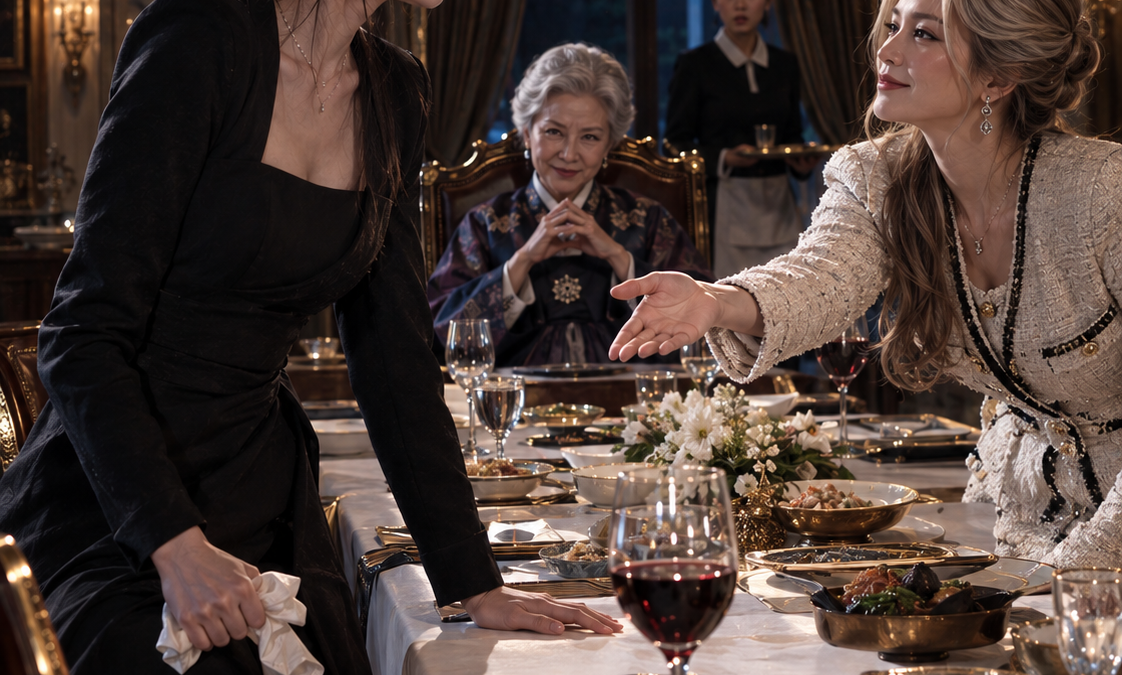
A housekeeper led her to a dining room where a table had been set for four. Chairwoman Kang Mi-ja sat at the head of the table, a tiny woman in her seventies with silver hair pulled back in a severe bun. She was thin, almost frail, but her eyes were sharp as broken glass.
Next to her sat a woman Ji-eun didn’t recognize—younger, maybe forty, with expensive blonde highlights and a designer dress. She smiled at Ji-eun with the kind of warmth that didn’t reach her eyes.
“Ms. Han,” Chairwoman Kang said, her voice a rasp. “How kind of you to come.”
Ji-eun bowed politely. “Thank you for the invitation.”
“Sit. Sit.” The Chairwoman gestured to the chair across from her. “I’ve heard so much about you. My son tells me you’re quite… dedicated.”
Ji-eun sat. “I take my job seriously.”
“As you should.” The Chairwoman picked up a glass of water and took a slow sip. “I understand you’ve been investigating the Silver Lining Foundation. Such a wonderful charity. We do so much for the elderly.”
Ji-eun said nothing.
“Of course, there are always people who misunderstand our methods. Who think we’re not doing enough, or doing too much.” The Chairwoman smiled. “But we always prevail. We have friends in high places.”
“I’m sure you do.”
The woman beside the Chairwoman spoke up. “Ji-eun, darling, you must try the wine. It’s a 1998 Bordeaux. Absolutely divine.”
Ji-eun looked at her. “I’m sorry, I don’t think we’ve met.”
“Oh, how rude of me.” The woman extended a manicured hand. “I’m Seo-yeon. Kang Seo-yeon. Tae-jun’s wife.”
The world tilted.
Ji-eun’s hand froze halfway to the woman’s. She looked from Seo-yeon to Chairwoman Kang, then back again.
“His… wife?”
“Yes.” Seo-yeon’s smile widened. “We’ve been married for six years. Didn’t he mention me?”
Ji-eun’s mind was reeling. Six years. Six years. Kang Tae-jun had been married this entire time, and he hadn’t told her. He’d let her think—he’d let her believe—
“Sit down, dear,” Chairwoman Kang said, her voice dripping with false sympathy. “You look pale.”
Ji-eun sat. Her legs were shaking.
“I’m sure Tae-jun had his reasons for not mentioning me,” Seo-yeon said, reaching over to pat Ji-eun’s hand. “He’s always been so… private. But I’m sure you understand. After all, you’re just an investigator. It’s not as if you were… personal.”
Ji-eun pulled her hand away.
“I think I should go,” she said.
“So soon?” Chairwoman Kang’s eyes glittered. “But we haven’t even discussed the foundation. I was so hoping you’d tell me what you’ve found.”
Ji-eun stood. “I’ve found enough.”
She walked out of the dining room, her heels echoing on the marble. She could feel their eyes on her back—two women, watching her leave, enjoying her humiliation.
In the car, she called Kang Tae-jun.
“You’re married,” she said.
Silence.
“Six years. You have a wife. And you didn’t tell me.”
“Ji-eun—”
“Don’t.” Her voice cracked. “Don’t explain. Don’t apologize. Just—tell me why.”
He was quiet for a long moment. Then he said, “Because it would have changed how you saw me. And I needed you to see me clearly.”
“See you clearly?” She laughed, a bitter sound. “I don’t see you at all. I don’t know who you are. I thought you were a man trying to take down his mother. But you’re just—you’re just another liar.”
“I’m not lying about my mother. Everything I told you is true.”
“Then why didn’t you tell me about Seo-yeon?”
“Because it’s complicated.”
“It’s not complicated. You’re married. You have a wife. And you let me—” She stopped, her throat tight. “You let me think there was something between us.”
There was a long pause. Then he said, quietly, “There is something between us.”
“No. There isn’t.” She wiped her eyes. “There can’t be. I’m done.”
She hung up.
She drove home in a daze, her hands gripping the steering wheel too tightly, her mind replaying every conversation, every moment, every look. She’d been so stupid. She’d let herself believe that Kang Tae-jun was different—that beneath the cold exterior, there was a man who wanted justice, who wanted to do the right thing.
But he was just like everyone else. Rich, powerful, and willing to use whoever he needed to get what he wanted.
She thought of Seo-yeon’s smile. The way she’d said his wife. The way she’d looked at Ji-eun like she was a bug on the floor.
She’d been played.
And she’d almost fallen for it.
 [Tap here for the Next Part ]


