“You didn’t win anything today, Mr. Volkov. You just proved you have more money than taste.”
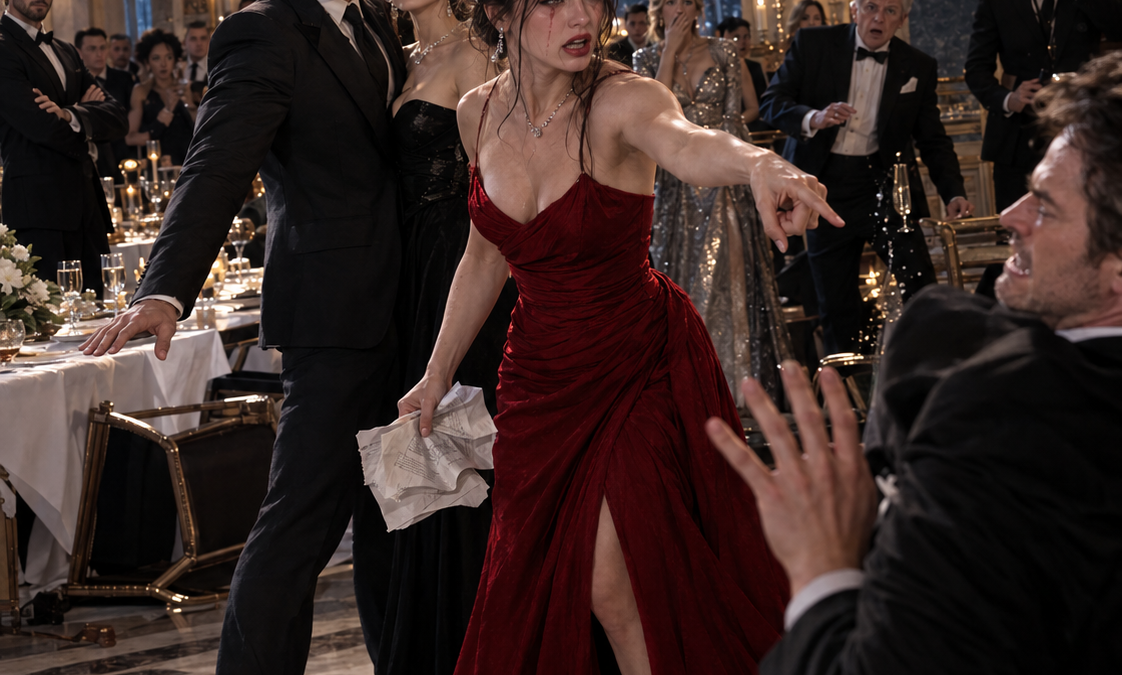
“You didn’t win anything today, Mr. Volkov. You just proved you have more money than taste.”
She married him to save her family’s legacy. She never expected to save his soul instead.
The gavel hit the mahogany table like a gunshot, and Elena Marchetti watched her family’s legacy get carved into pieces.
“Lot forty-seven,” the auctioneer announced, his voice dripping with the particular relish of a man who knew he was selling someone’s dignity by the square inch. “The Marchetti Collection — Renaissance bronzes, seventeen pieces, provenance documented. Opening bid: two million euros.”
Elena’s fingers curled around the edge of her chair. Seventeen pieces. Her grandfather had spent forty years assembling them, one by one, from estates and dusty auctions and the kind of quiet deals that never made the papers. Now they sat under museum lighting in a Geneva auction house while strangers with deep pockets and shallow consciences decided their fate.
“Two million.”
“Two point five.”
“Three.”
The bids climbed. Elena’s jaw tightened with each one. She was thirty-two years old, dressed in a black suit she’d bought secondhand, sitting in the back row because she couldn’t afford a proper seat. The irony wasn’t lost on her. She’d grown up in a villa with frescoed ceilings and servants who called her signorina. Now she was watching her inheritance sold to the highest bidder while her mother sat three rows ahead, dabbing at dry eyes with a handkerchief she kept for show.
The Marchetti fortune hadn’t disappeared overnight. It had been bled dry — slowly, methodically, by bad investments, bad advisors, and the kind of bad luck that followed her father like a curse. When he died two years ago, he’d left behind debts that swallowed everything: the villa, the vineyard, the art collection. Everything except Elena’s pride.
And that, she thought grimly, isn’t worth much at auction.
“Sold. Four point two million euros to bidder number two-twelve.”
A ripple of applause moved through the room. Elena didn’t clap. She was too busy staring at the man in the third row who hadn’t moved since the auction began.
He was impossible to miss, even in a room full of wealthy people. Tall, dark-haired, with the kind of stillness that made you notice him precisely because he wasn’t doing anything. He wore a charcoal suit that probably cost more than her monthly rent, and he watched the proceedings with an expression of mild boredom, as if he’d seen this particular drama play out a hundred times before.
She knew who he was. Everyone in the art world knew who he was.
Alexei Volkov. Head of the Volkov Group. Shipping, logistics, private security, and — according to the rumors that followed him like shadows — a quiet, lucrative side business in moving things across borders that customs officials never quite managed to find.
He was also, according to those same rumors, the man who had destroyed her father.
“Lot forty-eight. A Vermeer attributed to the studio of—”
“Five million.”
The bid came from the third row. From Alexei Volkov, who hadn’t moved, hadn’t raised a hand, hadn’t done anything except speak two words in a voice that carried just enough to reach the auctioneer.
The room went silent.
The Vermeer was worth maybe eight hundred thousand on a good day. Five million was absurd. It was the kind of bid designed to end a conversation before it started.
“Five million to bidder number—”
“Ten million.”
Elena’s head snapped toward the voice. A woman in a red dress, seated on the opposite side of the aisle. Mid-thirties, blonde, with diamonds at her throat and a smile that looked surgically enhanced. Elena didn’t recognize her, but she recognized the type: new money, hungry, looking to make a statement.
Alexei Volkov didn’t even glance at her. “Twenty.”
The room was no longer breathing. Elena could feel the tension coiling through the rows like a wire pulled taut. The auctioneer looked like a man who’d just realized he was standing between two predators.
“Twenty million euros to bidder two-twelve. Do I hear—”
“Fifty.”
The woman in red was on her feet now, her face flushed with something between fury and excitement. “You can’t be serious.”
Alexei finally turned his head. He looked at her the way you might look at a fly that had landed on your dinner plate — mildly inconvenienced, not remotely threatened. “I’m always serious.”
“Sold. Fifty million euros to bidder two-twelve.”
The gavel came down. The woman in red sat back down, her mouth a thin line. And Alexei Volkov returned his attention to the front of the room as if nothing had happened.
Elena’s hands were shaking. Not from fear. From rage.
Fifty million euros. He’d just spent fifty million euros on a painting that wasn’t worth a tenth of that. Not because he wanted it. Because he wanted to win. Because he could.
And my family’s entire legacy, she thought, didn’t even cover his opening bid.
She stood up. She didn’t plan to. Her body just moved, the way it sometimes did when her mouth was about to get her into trouble.
“Excuse me.”
Her voice cut through the murmur of the crowd. Several heads turned. The auctioneer looked up, confused. And Alexei Volkov — slowly, deliberately — turned to face her.
Up close, he was worse. Not handsome in a conventional way — too sharp, too angular, with cheekbones that looked like they’d been carved by someone with a grudge. His eyes were the color of winter ice, and they fixed on her with an intensity that made her want to step back.
But Elena Marchetti had been stepped on enough for one lifetime.
“You just paid fifty million euros for a painting that isn’t worth five,” she said. “I’m curious. Is that a tax write-off, or do you just enjoy watching people lose?”
A muscle moved in his jaw. Something flickered in those pale eyes — surprise, maybe. Or interest.
“The Marchetti daughter,” he said. His voice was low, textured, with an accent she couldn’t quite place. “I was wondering when you’d introduce yourself.”
“You know who I am?”
“I know everyone who matters.” He tilted his head, studying her. “And I know you’re about to make a scene in an auction house that’s already counted your money and moved on. So I’ll ask you once: is this the part where you accuse me of something, or the part where you storm out?”
The room was watching. She could feel their eyes on her — the gossips, the collectors, the vultures. Her mother, three rows ahead, had gone very still.
Elena took a breath. She could feel the edge of the moment, sharp as glass. One wrong move and she’d shatter.
“I’m not going to accuse you of anything,” she said, and her voice was steady now, colder than she’d expected. “I’m going to tell you something. You bought those pieces because you could. Because it amused you. But there’s a difference between owning something and understanding it. My grandfather built that collection over forty years. He knew every provenance, every story, every crack in every frame. You’ll hang them in some climate-controlled vault and forget they exist.”
She paused. The silence was absolute.
“You didn’t win anything today, Mr. Volkov. You just proved you have more money than taste.”
She turned and walked out before he could respond. Her heart was pounding so hard she could hear it in her ears. Her hands were still shaking.
But she didn’t look back.
She didn’t see the way Alexei Volkov watched her go — the way his expression shifted, just for a moment, from boredom to something else entirely.
She didn’t see him lean toward the man beside him and murmur, “Find out everything about her. And I mean everything.”
And she didn’t see the small, dangerous smile that touched the corner of his mouth as he added, “I think we just found our next problem.”
CHAPTER 2: The Inheritance Clause
The letter arrived three days later, hand-delivered to Elena’s apartment by a courier who looked like he bench-pressed small cars for fun.
She signed for it without thinking. Then she read it, and her knees nearly gave out.
Dear Ms. Marchetti,
It has come to our attention that you are the sole surviving heir of the Marchetti estate. As such, you are entitled to certain assets that were previously held in trust, including but not limited to: the Marchetti Collection, currently valued at approximately sixty million euros; the Villa Marchetti in Lake Como; and a controlling interest in Marchetti Shipping, S.p.A.
However, per the terms of your late father’s will, these assets may only be claimed if you meet certain conditions. Specifically, you must be married.
You have ninety days to comply.
The letter went on, but Elena couldn’t read the rest. The words blurred, her vision swimming with shock and fury and the kind of helpless rage that made her want to throw something through a window.
Married.
Her father had written this clause into his will. He’d known — he’d known — that he was bankrupting the family, that he’d leave her with nothing but debts and a name that no longer opened doors. And he’d still found a way to control her from the grave.
She sank onto the edge of her couch, the letter crumpling in her fist. She thought about calling her mother. She thought about calling her lawyer. She thought about packing a bag and disappearing to a country where no one had ever heard of the Marchetti name.
None of those options would give her back what she’d lost.
Sixty million euros. The collection alone was worth enough to clear her debts, restore the villa, rebuild the shipping company. It was everything she’d ever wanted and everything she’d been denied.
All she had to do was marry someone in ninety days.
There was a knock at her door.
She didn’t move. Maybe if she stayed perfectly still, whoever it was would go away. Maybe—
“Ms. Marchetti. I know you’re in there.”
Her head snapped up. That voice. Low, textured, with an accent she’d spent three days trying to forget.
She opened the door.
Alexei Volkov stood in the hallway of her crumbling apartment building, looking like he’d wandered out of a different world. His suit was impeccable. His shoes probably cost more than her rent. And behind him, standing at the top of the stairs, were two men in identical dark coats who looked like they ate threats for breakfast.
“You,” she said.
“Me.” He tilted his head, studying her the way he had at the auction. “I heard about your father’s will. The marriage clause. I imagine you’re not thrilled.”
“You imagine correctly.” She crossed her arms, blocking the doorway. “How do you know about the will?”
“I know a lot of things.” He glanced past her, into the apartment. “May I come in?”
“No.”
“Then I’ll say this quickly.” He reached into his jacket and produced a folded piece of paper. “I’m proposing a solution to your problem.”
She took the paper. Unfolded it. Read it.
It was a marriage contract.
Alexei Volkov and Elena Marchetti agree to enter into a marriage of convenience, to dissolve after a period of eighteen months or upon the satisfactory resolution of all outstanding legal matters…
She looked up at him. Her mouth was dry. “You’ve got to be joking.”
“I don’t joke.” He said it flatly, without inflection. “You need a husband. I need a wife. Specifically, I need a wife with a name that matters in certain circles — circles where your family’s reputation still carries weight. You get your inheritance. I get access to markets that have been closed to me. It’s a business arrangement.”
“It’s insane.”
“Possibly.” His eyes met hers, and there was something in them — something cold and calculating and just underneath, a flicker of something else. “But it’s your only option. Your ninety days started three days ago. That leaves eighty-seven. Unless you have another proposal of marriage waiting in the wings?”
She didn’t. He knew she didn’t.
“Why me?” she asked. “You could marry anyone. You could marry a thousand women. Why would you want the daughter of a bankrupt shipping family?”
“Because,” he said, and his voice dropped, “I don’t want any of those women. I want you.”
The words hit her somewhere below the ribs. She hated that they did.
“Let me think about it,” she said.
“Take all the time you need.” He turned to go, then paused. “But not too much. I’m not a patient man, Ms. Marchetti. And I don’t like waiting.”
He was halfway down the hall when she called after him.
“Volkov.”
He stopped. Turned.
“Why did you really buy that Vermeer? Fifty million euros. For a painting that’s barely worth a million. That wasn’t a business decision.”
For a long moment, he didn’t answer. The men in dark coats shifted, uncomfortable, but Alexei Volkov stood perfectly still, his gaze locked on hers.
“Because someone else wanted it,” he said. “And I don’t like losing.”
Then he was gone, and Elena was left standing in her doorway, holding a marriage contract and wondering what kind of man she’d just invited into her life.
CHAPTER 3: The Devil’s Terms
The lawyer’s office smelled like old books and new money.
Elena sat across from a man named Dmitri Volkov — Alexei’s brother, she’d learned, though he looked more like a soldier than a lawyer — and tried not to flinch as he slid the contract across the table.
“Read it carefully,” Dmitri said. His English was good, but his accent was thicker than Alexei’s, rougher at the edges. “My brother doesn’t like surprises.”
“Your brother doesn’t like anything.”
Dmitri’s mouth twitched. It wasn’t quite a smile. “You’re not wrong.”
She read the contract. All thirty-two pages of it. It was thorough — exhaustively, almost insultingly thorough. Clause after clause detailed exactly what she would and wouldn’t get: access to her inheritance, a living allowance, a penthouse apartment in Moscow, personal protection. And in exchange, she would attend public events on Alexei’s arm, provide access to certain business contacts through her family name, and surrender all right to question his personal affairs.
“You’ll live separately,” Dmitri said. “My brother values his privacy. You’ll have your own floor of the house. You’ll eat together when there are guests, but otherwise your time is your own.”
“How generous.”
“Ms. Marchetti.” Dmitri leaned forward, and something in his face shifted — became harder, more honest. “I’ll tell you what the contract doesn’t say. My brother has enemies. Dangerous ones. If you marry him, you become a target. You’ll have security around you at all times. You’ll have to follow his instructions precisely, even when you don’t understand them. And you’ll have to trust him, even though he’s given you no reason to.”
She stared at him. “You’re really not selling this.”
“I’m not trying to sell it. I’m trying to make sure you understand what you’re walking into.” He paused. “My brother is not an easy man. But he is a man of his word. If he says he’ll protect you, he will. If he says he’ll give you back your inheritance, he will. He doesn’t lie. He just…” He shrugged. “He doesn’t always explain.”
“That’s supposed to comfort me?”
“It’s supposed to warn you.” Dmitri slid a pen across the table. “Sign or don’t. But decide now.”
Elena picked up the pen. Her hand didn’t shake — she wouldn’t let it. She thought about her grandfather’s collection, sitting in a vault somewhere, waiting to be hung on the walls where it belonged. She thought about the villa, with its frescoed ceilings and its gardens that had been in her family for four generations. She thought about her mother, who had cried at the auction but hadn’t said a word.
She signed.
Dmitri took the contract, checked the signature, and nodded. “Good. The wedding is in three days.”
“Three—”
“Alexei doesn’t like delays.” He stood, gathering the papers. “Someone will come by tomorrow to help you pack. Don’t bring much. You won’t need it.”
He was at the door when Elena found her voice.
“Dmitri.”
He paused, looked back.
“Your brother. Why does he want this? And don’t tell me it’s about business contacts. There are a hundred easier ways to get what he wants.”
Dmitri was quiet for a moment. His hand rested on the doorframe, and for just a second, he looked tired.
“Because he’s been watching you for three years,” he said. “And he’s not the kind of man who watches something he doesn’t intend to have.”
He left before she could ask anything else.
CHAPTER 4: The Silent Ceremony
The wedding was held in a private chapel on the Volkov estate, and it was over in fifteen minutes.
No white dress. No flowers. No guests except Dmitri and a priest who looked like he’d been paid very well to not ask questions. Elena wore a dark suit — the same one from the auction, actually, because she was determined not to pretend this was anything other than what it was.
Alexei wore black. He stood across from her, expressionless, as the priest recited words neither of them listened to.
“Do you, Elena Marchetti, take this man—”
“I do.”
“And do you, Alexei Volkov—”
“I do.”
The rings were plain platinum. They felt like handcuffs when he slid them onto her finger.
“You may kiss the bride.”
Alexei didn’t move. Neither did she. The priest cleared his throat, uncomfortable, and Dmitri watched from the back of the chapel with an expression Elena couldn’t read.
“We’ll skip that part,” Alexei said. “Thank you, Father.”
They walked out into the gray afternoon light, and Elena took her first breath as a married woman.
It was the same air she’d been breathing all her life. But somehow, it felt thinner.
“Your room is the second floor, east wing,” Alexei said as they crossed the gravel toward the main house. “Dmitri will show you. There’s a study, a bathroom, and a small kitchen. You won’t need to come to the main house unless I send for you.”
“Send for me? I’m your wife, not your servant.”
“You’re a business partner.” He stopped walking, turning to face her. “Let’s be clear, Elena. This marriage is a contract. You’ll fulfill your end, and I’ll fulfill mine. But I don’t want you to mistake it for something it isn’t.”
She met his gaze. “What, exactly, do you think I’m mistaking it for?”
He didn’t answer. But something flickered in his eyes — a crack in the ice, quickly sealed.
“Enjoy your rooms,” he said. “Dinner is at eight. Don’t be late.”
He walked away, leaving her standing on the gravel with the ring on her finger and the taste of something bitter in her mouth.
She’d done it. She’d married the devil.
Now she had to find out what she’d bargained for.
CHAPTER 5: The House With Too Many Doors
The east wing was beautiful, and Elena hated how much she liked it.
Her rooms were larger than her entire apartment had been. The bedroom had floor-to-ceiling windows overlooking the estate’s frozen gardens. The bathroom had marble tiles and a claw-foot tub. The study had a fireplace that someone had already lit, and a desk that looked antique and probably cost more than a small car.
She unpacked her one suitcase — she hadn’t brought much, just clothes and a few photographs — and stood by the window, watching the winter sun sink below the tree line.
This is my life now, she thought. A stranger’s house. A stranger’s name. And a husband who looks at me like I’m a problem to be solved.
She heard footsteps in the hall and turned.
A woman stood in the doorway. Mid-fifties, elegant, with silver-streaked hair pulled back in a severe knot. She wore a dark dress and carried a tray with a pot of tea and a single cup.
“Mrs. Volkov.” The woman’s voice was cool, formal. “I’m Irina. I manage the household.”
“Elena. Please.”
“Irina.” The woman set the tray on the desk. “Mr. Volkov instructed me to ensure you have everything you need. I trust the rooms are satisfactory?”
“They’re beautiful.”
“Good.” Irina turned to go, then paused. “One thing, Mrs. Volkov. The west wing is off-limits. Mr. Volkov’s private quarters. The library on the third floor is also restricted. And the greenhouse is not to be entered without an escort.”
“The greenhouse?”
“It belonged to Mr. Volkov’s mother. He doesn’t permit visitors.”
Irina left before Elena could ask anything else. The door closed behind her with a soft click.
Elena poured herself tea. It was jasmine, delicate and fragrant, and she drank it slowly as the fire crackled in the grate.
West wing. Library. Greenhouse.
Three locked doors. Three secrets.
She thought about Alexei’s face when he’d mentioned her family’s name. She thought about the way he’d said I know everyone who matters. She thought about Dmitri’s warning: He’s been watching you for three years.
What kind of man watched a woman for three years and then married her in a business deal?
And what was he hiding behind those locked doors?
CHAPTER 6: The Dinner
At eight o’clock exactly, a servant appeared to escort her to the dining room.
The main house was a maze of corridors and staircases, all dark wood and old paintings and the kind of silence that felt like it was holding its breath. Elena followed the servant — a young woman named Katya who looked terrified of her own shadow — through a series of rooms that grew progressively grander until they reached a set of double doors.
Katya knocked. A voice said something in Russian. Katya opened the door and gestured for Elena to enter.
The dining room was enormous. A table that could seat twenty stretched beneath a crystal chandelier. Only one end was set, with two places, and Alexei sat at the head, reading something on his phone.
He looked up when she entered. His eyes swept over her — a quick, clinical assessment — and then returned to his phone.
“Sit.”
She sat. The chair was heavy, ornate, uncomfortable. Across from her, Alexei set down his phone and picked up his wine glass.
“You’ve settled in?”
“Yes.”
“Good.”
They ate in silence. The food was excellent — some kind of roasted meat with vegetables she didn’t recognize — but Elena barely tasted it. The silence pressed against her ears, thick and suffocating, and she found herself counting the seconds between her heartbeat.
Finally, she couldn’t stand it anymore.
“Why did you really marry me?”
Alexei didn’t look up from his plate. “We’ve discussed this.”
“No, we haven’t. You gave me a contract and a story about business contacts. But there are a hundred women in Moscow who could give you better contacts than I can. So why me?”
He set down his fork. Slowly, deliberately, he raised his eyes to hers.
“Because you’re not afraid of me.”
She blinked. “What?”
“At the auction. You stood up and told me I had more money than taste. In front of two hundred people.” His expression didn’t change, but something in his voice shifted — became almost curious. “Everyone else in that room was afraid of me. You weren’t.”
“I was terrified.”
“You were angry.” He picked up his wine glass, swirled the liquid. “Anger is more useful than fear. Fear makes people stupid. Anger makes them honest.”
She stared at him. “That’s… not an answer.”
“It’s the only answer you’re going to get tonight.” He stood, pushing back his chair. “I have work to do. You’re free to explore the grounds, but stay away from the west wing. And Elena?”
She looked up at him.
“The greenhouse. If you go there, take an escort. There are things in there that are… delicate.”
He left before she could respond.
Elena sat alone at the enormous table, surrounded by empty chairs and a silence that felt like a warning.
Things that are delicate.
What kind of man kept a locked greenhouse full of delicate things?
And why did she feel like she was one of them?
CHAPTER 7: The First Crack
Three days into the marriage, Elena found the greenhouse.
She wasn’t supposed to. She’d been walking the grounds — there was nothing else to do, no job to go to, no friends in this frozen country — and she’d wandered off the main path, following a trail through the snow that led to the back of the property.
The greenhouse stood apart from the main house, a glass structure that gleamed in the afternoon light. It should have been beautiful. Instead, it looked abandoned — the windows fogged, the door slightly ajar.
She should have turned back. She knew she should have.
She went inside.
The air was warm and damp and smelled like earth and something else — something sweet, almost cloying. Plants grew everywhere, vines climbing the walls, flowers blooming in colors she’d never seen before. But it was the center of the greenhouse that made her stop.
A stone bench. A single orchid in a pot. And a photograph, framed and weatherproof, propped against the orchid’s base.
Elena moved closer. The photograph showed a woman — young, beautiful, with dark hair and eyes that looked like Alexei’s. She was laughing, holding a child in her arms. The child was maybe three years old, with the same dark hair, the same pale eyes.
Alexei. It had to be. The child was Alexei.
“Who’s the woman?” she whispered.
She didn’t expect an answer. But someone gave one anyway.
“My mother.”
Elena spun around.
Alexei stood in the doorway of the greenhouse, and his face was a mask of something she couldn’t name. Not anger. Not quite. Something deeper. Something that looked almost like grief.
“You weren’t supposed to see this,” he said.
“I’m sorry. I didn’t mean—”
“She died when I was seven.” He walked toward the bench, his footsteps silent on the damp earth. “She loved orchids. She grew them in a greenhouse just like this one, back in St. Petersburg. When she died, my father destroyed it. Burned everything. Said he couldn’t stand to look at it.”
He stopped beside her, staring at the photograph.
“I built this one ten years ago. Same design. Same orchids. Same everything.”
Elena didn’t know what to say. She’d never heard him speak like this — with emotion, with something raw underneath the ice.
“Why are you telling me this?”
He turned to look at her. Up close, in the warm light of the greenhouse, his eyes didn’t look like ice. They looked like water. Deep, dark, and full of things she couldn’t see.
“Because you asked,” he said. “And because I’m tired of keeping secrets from you.”
He reached out, and for a moment she thought he was going to touch her face. But instead, he plucked a single orchid from one of the plants and held it out to her.
“Here. A wedding gift. Late.”
She took the flower. It was delicate, perfect, the color of fresh snow.
“It’s beautiful.”
“It was my mother’s favorite.” He paused, and something in his expression shifted. “Keep it. It suits you.”
He left before she could thank him.
Elena stood alone in the greenhouse, holding the orchid, staring at the photograph of a woman she’d never met and a child who had become the man she’d married.
He’s not who I thought he was, she realized.
And she didn’t know if that made things better or worse.
CHAPTER 8: The Woman in Red
The woman from the auction arrived at the house the next day.
Elena was in the library — the one on the third floor that was supposed to be restricted, but she’d found it unlocked and she’d never been good at following rules. She was reading a book about Renaissance art when she heard voices in the hall below.
Raised voices. Angry voices.
One was Alexei’s. The other was a woman’s.
Elena set down her book and crept to the library door. It was cracked open, just enough to see the hallway below.
The woman in red stood at the bottom of the stairs, facing Alexei with her hands on her hips. She looked different in daylight — harder, older, with lines around her mouth that her foundation couldn’t quite cover.
“You promised me,” the woman said. “You promised me you would marry me, Alexei. And then you go and marry her?”
“The situation changed.”
“The situation—” The woman laughed, a harsh sound that echoed off the walls. “You told me you needed a wife with the right name. I have the right name. I have the right everything. And you chose some bankrupt Italian whore over me?”
Elena’s hands tightened on the door frame.
“I chose what I needed,” Alexei said. His voice was calm, controlled. “And what I needed wasn’t you.”
“I’m carrying your child.”
The words hit the hallway like a bomb.
Elena’s breath caught. She saw Alexei go very, very still.
“What did you say?”
“I’m pregnant.” The woman stepped closer to him, her voice dropping. “Three months. I found out last week. And now you’re going to tell me what you’re going to do about it.”
The silence stretched. Elena could hear her own heartbeat, loud in her ears.
And then Alexei spoke.
“No, you’re not.”
The woman’s face went white. “What?”
“You’re not pregnant. You can’t be. We haven’t slept together in over a year.” He tilted his head, studying her the way he’d studied Elena at the auction. “So either you’re lying, or you’re trying to pass off another man’s child as mine. Which is it?”
The woman opened her mouth. Closed it. Opened it again.
“You bastard—”
“I’ve been called worse.” He stepped forward, and suddenly he seemed much larger, much more dangerous. “Get out of my house. And don’t come back. If you do, I’ll make sure everyone in Moscow knows exactly what kind of woman you are.”
The woman stared at him. Then she turned and fled, her heels clicking on the marble floor like gunshots.
Elena stayed frozen in the library doorway, her heart pounding.
She’d just heard something she shouldn’t have. Something that changed everything.
Alexei had a mistress. Or he’d had one. A woman who thought she could trap him with a pregnancy that wasn’t his.
And he’d married Elena instead.
Why? she thought. Why would he choose me over her, if he had someone like that waiting?
She didn’t have an answer.
But she was going to find one.
CHAPTER 9: The Name She Shouldn’t Know
Elena didn’t move until the front door slammed.
Even then, she stood frozen in the library doorway, her pulse hammering against her ribs. The hallway below was empty now — Alexei had disappeared somewhere, and the woman in red was gone — but the echo of what she’d heard lingered like smoke.
I’m carrying your child.
No, you’re not. We haven’t slept together in over a year.
She replayed the exchange in her mind, searching for the lie. Alexei had been calm, almost bored, when he’d denied it. But there had been something underneath the stillness — a flash of something cold and furious that had made even Elena, watching from a hidden doorway, want to step back.
He hadn’t been surprised by the pregnancy claim. He’d been angry.
Why? she wondered. If it wasn’t his child, why would he care?
She needed answers. And there was only one person in this house who might give them to her.
She found Dmitri in a small study on the ground floor, bent over a stack of papers with a glass of vodka at his elbow. He looked up when she knocked, and something in his expression shifted — not quite surprise, but close.
“Mrs. Volkov.”
“Elena.” She stepped inside, closing the door behind her. “I need to ask you something.”
He leaned back in his chair, studying her. “This should be interesting.”
“The woman who was here. The one in red. Who is she?”
Dmitri’s expression didn’t change, but his hand moved — a small, almost imperceptible movement toward the glass of vodka. He didn’t drink. Just touched the rim.
“Her name is Natalia Morozova,” he said. “She’s been… involved with my brother for several years. Off and on.”
“Involved how?”
“In the way you’re thinking.” He picked up the glass, took a slow sip. “But it ended a while ago. Before he married you.”
“She claims she’s pregnant.”
Dmitri’s jaw tightened. “I know.”
“And you believe her?”
“I believe she’s pregnant.” He set the glass down with a click. “I don’t believe it’s Alexei’s.”
“How can you be sure?”
“Because my brother doesn’t lie about things like that.” His voice hardened, just slightly. “He’s many things, Elena. Cold. Calculating. Ruthless. But he doesn’t lie about blood.”
The word hung in the air between them.
Blood.
She thought about the woman’s face — the desperation, the fury, the way she’d called Elena a bankrupt Italian whore. She thought about Alexei’s stillness, his absolute certainty.
“If the child isn’t his,” Elena said slowly, “then whose is it?”
Dmitri didn’t answer.
“Dmitri.”
“It’s not my story to tell.” He stood, gathering the papers. “If you want to know, ask Alexei.”
“I did ask him. He told me to stay away from the west wing and eat my dinner.”
A ghost of a smile crossed Dmitri’s face. “That sounds like him.”
“It’s not an answer.”
“No.” He moved toward the door, pausing as he passed her. “But it’s the only one you’re going to get from me. My brother has his reasons for keeping secrets. And if you want to survive in this family, you’ll learn to live with them.”
He left before she could respond.
Elena stood alone in the study, staring at the closed door.
Survive.
That was the word he’d used. Not thrive. Not belong.
Survive.
CHAPTER 10: The West Wing
She waited until midnight.
The house was quiet by then — the servants gone to their quarters, the security men stationed at their posts, the whole vast estate wrapped in silence and snow. Elena pulled on a dark sweater and moved through the corridors like a ghost, her footsteps muffled by the thick carpets.
The west wing was at the end of a long hallway on the second floor. A heavy oak door, locked, with a keypad beside it. She’d noticed it on her first day, when Irina had given her the tour. She hadn’t thought much of it then.
Now she stood in front of it, her heart pounding, and tried to think.
Three locked doors. Three secrets.
The library had been unlocked. The greenhouse had been open. But this — this door was different. This door was meant to keep people out.
She reached for the handle. Tested it.
Locked.
She looked at the keypad. Six digits. She tried Alexei’s birthday — she’d seen it on the marriage contract. The keypad flashed red.
She tried the date of their wedding. Red.
She tried 1-2-3-4-5-6. Red.
Think, she told herself. What would a man like Alexei use as a password?
She thought about the greenhouse. The photograph. The woman who had died when he was seven.
She thought about the way he’d said my mother — like the words hurt him.
She typed in a date. She didn’t know if it was right. It was a guess, based on the photograph, based on the age of the child in the picture, based on nothing but instinct.
The keypad flashed green.
The door swung open.
Elena stepped inside.
The room was not what she expected.
She’d imagined something dark — a shrine to his mother, maybe, or a vault full of secrets. Instead, it was a study. A simple, ordinary study, with a desk and a chair and bookshelves lining the walls.
But it was the photographs that made her stop.
They were everywhere. On the walls, on the desk, on the shelves. Dozens of them, all of the same woman — young, dark-haired, with eyes that looked like Alexei’s. She was laughing in some, serious in others. In one, she held a baby. In another, she stood beside a man who looked like an older version of Alexei — his father, Elena guessed.
But it was the last photograph that made her blood run cold.
It was a family portrait. The woman, the man, and two children — a boy and a girl. The boy was Alexei, unmistakably. The girl was younger, maybe four or five, with the same dark hair, the same pale eyes.
A sister.
Alexei had a sister.
Elena moved closer, studying the photograph. The girl was smiling, her small hand clasped in Alexei’s. They looked happy. They looked like a family.
Where is she now? Elena wondered. Why has no one mentioned her?
She heard a sound behind her.
“Find what you were looking for?”
She spun around.
Alexei stood in the doorway, his arms crossed, his expression unreadable. He was wearing a dark sweater and jeans — the most casual she’d ever seen him — and he looked like he’d been awake for hours.
“How did you get in here?”
“The keypad.” She lifted her chin, refusing to be intimidated. “I guessed the code.”
“Did you.” He didn’t move. “And what did you guess?”
“The date your mother died.”
Something flickered in his eyes. Pain, maybe. Or anger. It was gone before she could name it.
“You shouldn’t be here.”
“I know.” She gestured at the photographs. “But I needed to understand. Who is she? The girl in the picture?”
Alexei was silent for a long moment. Then he walked past her, to the desk, and picked up a small framed photograph. He looked at it for a moment, his expression softening in a way she’d never seen before.
“Her name was Anastasia,” he said. “My sister.”
Was.
Elena’s throat tightened. “What happened to her?”
“She died.” He set the photograph down carefully. “When she was six. The same year as my mother.”
“I’m sorry.”
“Don’t be.” His voice was flat. “It was a long time ago.”
He turned to face her, and for a moment, in the dim light of the study, he looked almost human. Almost vulnerable.
“Why didn’t you tell me?” Elena asked. “About your sister. About any of this.”
“Because it’s none of your business.” The words were harsh, but his voice lacked its usual edge. “We have a contract, Elena. You fulfill your end, I fulfill mine. That’s all this is.”
“That’s not what I asked.”
He moved toward her, and suddenly he was very close — close enough that she could feel the heat radiating off his body, close enough that she could see the faint lines around his eyes, the small scar on his jaw.
“You want to know why I married you?” he said, his voice low. “You want to know why I chose you over Natalia, over every other woman who would have been a more logical choice?”
“Yes.”
“Because you’re not part of this world.” He reached out, and for a moment she thought he was going to touch her face. Instead, he plucked a book from the shelf beside her — a small volume, leather-bound, worn at the edges. “You don’t know the games we play. The debts we owe. The blood we spill.”
He pressed the book into her hands.
“Read this. Then maybe you’ll understand.”
She looked down at the cover. It was a journal, handwritten, in a language she didn’t recognize.
“What is it?”
“My mother’s diary.” He stepped back, and the distance between them felt like a wall. “She wrote it in Russian. You’ll need a translator.”
“Why are you giving this to me?”
He was at the door now, his hand on the frame.
“Because you asked,” he said. “And because I’m tired of being the only one who knows the truth.”
He left.
Elena stood alone in the room, holding the diary, surrounded by ghosts.
CHAPTER 11: The Translator
The next morning, Elena found Katya in the kitchen.
The young servant was peeling potatoes, her movements quick and practiced, her eyes fixed on the task. She looked up when Elena entered, and her face went pale.
“Mrs. Volkov. I—I didn’t expect you.”
“Elena.” She sat down at the kitchen table, the diary tucked under her arm. “I need your help.”
Katya’s hands stilled. “My help?”
“You’re Russian, aren’t you? You can read this?”
She set the diary on the table. Katya stared at it, her expression shifting from confusion to something that looked almost like fear.
“Where did you get this?”
“Alexei gave it to me. It belonged to his mother.”
Katya didn’t move. Her hands were trembling, just slightly.
“I can’t,” she whispered. “I can’t read that.”
“Why not?”
“Because it’s not my place.” She pushed back from the table, her chair scraping against the floor. “I’m sorry, Mrs. Volkov. I can’t help you.”
She fled before Elena could say another word.
The second person she asked was Irina.
The housekeeper was in the dining room, supervising the setting of the table for lunch. She listened to Elena’s request with an expression of polite disinterest.
“I’m afraid I don’t read Russian, Mrs. Volkov.”
“But you’re Russian.”
“I’m Volkov.” Irina smoothed a napkin into place. “There’s a difference.”
“What does that mean?”
Irina looked at her — really looked at her, for the first time since Elena had arrived. Her eyes were sharp, assessing.
“It means that some things in this house are not meant to be spoken of,” she said. “And some questions are not meant to be asked. If Mr. Volkov wanted you to know the contents of that diary, he would have told you himself.”
“He gave it to me.”
“He gave you a test.” Irina turned away, dismissing her. “Whether you pass or fail is up to you.”
The third person she asked was Dmitri.
He was in the garage, tinkering with a vintage motorcycle, when Elena found him. He listened to her request in silence, his hands covered in grease.
“A translator,” he said. “For my mother’s diary.”
“Yes.”
He set down his wrench. “You know, Elena, most people would take the hint. Alexei gave you that diary because he wanted to see what you’d do with it. If you go behind his back and get it translated, you’re proving that you don’t trust him.”
“I don’t trust him.”
“Then why are you still here?”
She didn’t have an answer.
Dmitri sighed. He wiped his hands on a rag, then reached into his pocket and pulled out a business card.
“There’s a woman in the city. Svetlana. She does translations for the family. Tell her I sent you.”
Elena took the card. “Why are you helping me?”
“Because my brother is an idiot.” He picked up his wrench again. “And because I think you might be good for him. But if you hurt him—” He looked at her, and for a moment, his eyes were as cold as Alexei’s. “I’ll make sure you regret it.”
CHAPTER 12: The Diary
Svetlana’s office was in a nondescript building on the outskirts of Moscow, and she was exactly the kind of person Elena expected to find in a place like this — middle-aged, efficient, with the kind of face that had seen too much and forgotten nothing.
She read the diary in three hours. Then she read it again. And when she was done, she looked at Elena with an expression that was almost pitying.
“Sit down,” she said. “This is going to take a while.”
The diary told a story.
It was the story of a woman named Tatiana Volkov, born into a wealthy family, married to a powerful man, and trapped in a life she hadn’t chosen. She wrote about loneliness, about the coldness of her husband, about the children she loved more than anything in the world.
She wrote about Anastasia.
My little one. My sunshine. She has her father’s eyes but my heart. When I look at her, I see everything good in this world.
And she wrote about the accident.
They said it was a car crash. They said the brakes failed. But I know my husband. I know what he is capable of.
Elena’s blood ran cold.
“What does that mean?” she asked.
Svetlana turned the page. “Keep reading.”
He found out about the affair. He found out about the child. And he made sure that neither of them would ever be a problem again.
The next page was blank. The rest of the diary was blank.
“She never wrote another word,” Svetlana said. “She died three days later. A car crash. The same as her daughter.”
Elena stared at the page. Her hands were shaking.
“He killed them,” she whispered. “Alexei’s father killed his own daughter.”
“It’s possible.” Svetlana closed the diary. “It’s also possible that Tatiana was paranoid, or grieving, or simply mad. There’s no proof.”
“But Alexei believes it.”
“Alexei built a greenhouse in his mother’s memory. He visits it every year on the anniversary of her death. He never speaks to his father.” Svetlana shrugged. “What do you think he believes?”
Elena thought about the locked doors. The photographs. The way Alexei had said she died — like the words were a wound that had never healed.
“Why are you telling me this?” she asked.
“Because you asked.” Svetlana stood, moving to the window. “And because I’ve known Alexei since he was a boy. He’s not an easy man. But he’s not his father, either. Whatever you think of him — whatever he’s done — remember that.”
She turned back to Elena.
“He’s trying to be better. The question is whether you’ll let him.”
CHAPTER 13: The Rival
Elena returned to the estate to find the house in chaos.
Cars lined the driveway — black SUVs with tinted windows, a stretch limousine, a sleek sports car that looked like it cost more than her entire inheritance. Men in suits stood on the front steps, talking in low voices. Dmitri was among them, his face grim.
“What’s going on?” Elena asked, catching his arm.
“Konstantin Baranov.” He spat the name like a curse. “He’s here.”
“Who?”
“Head of the Baranov family. Our biggest rival.” He glanced at the house. “He arrived an hour ago. Demanding to see Alexei. Something about a shipment that went missing.”
“A shipment?”
“Artifacts.” Dmitri’s jaw tightened. “That’s the Baranov family business. They move things across borders — paintings, sculptures, things that don’t have proper papers. They’ve been trying to move in on our territory for years.”
Elena’s blood ran cold. Artifacts. The auction. The Vermeer that Alexei had bought for fifty million euros.
Because someone else wanted it.
She pushed past Dmitri and headed for the house.
She found them in the main study.
Alexei sat behind his desk, his expression calm, almost bored. Across from him stood a man — tall, broad-shouldered, with a face that looked like it had been broken and put back together more than once. He wore a suit that probably cost more than the Volkov estate, and he was smiling.
It was not a pleasant smile.
“Alexei,” he said, his voice smooth and dangerous. “So good to see you. I was beginning to think you’d forgotten about our arrangement.”
“There was no arrangement.” Alexei didn’t move. “I bought what you wanted. The Vermeer is yours. The deal is done.”
“The deal was for the Vermeer and the Marchetti collection.” Konstantin’s eyes slid toward Elena, who had stopped in the doorway. “But I see you’ve made other plans.”
Alexei’s expression didn’t change. But something in his posture shifted — a subtle movement, a slight lean forward. Like a wolf preparing to strike.
“The Marchetti collection is not for sale.”
“Everything is for sale.” Konstantin took a step toward Elena. “And who is this? Your new wife? I heard rumors, but I didn’t believe them. The great Alexei Volkov, married to a bankrupt Italian princess.” He smiled at Elena. “How does it feel to be a pawn, signorina?”
Elena didn’t flinch. “I wouldn’t know. I’ve never been one.”
Konstantin’s smile widened. “I like her. She has spirit.” He turned back to Alexei. “I’ll make you a deal. Give me the Marchetti collection, and I’ll forget about the shipment you intercepted last month. Consider it a wedding gift.”
“I didn’t intercept your shipment.”
“Someone did. And I have it on good authority that it was you.” Konstantin’s voice hardened. “You have three days, Volkov. Three days to return what you stole. After that—” He shrugged. “Well. I’m sure you can imagine.”
He walked past Elena, pausing at the door.
“Nice to meet you, Mrs. Volkov. I hope you live long enough to enjoy your inheritance.”
He was gone before she could respond.
Alexei was on his feet the moment the door closed.
“Dmitri!” he shouted. “Get the security team. Now.”
Dmitri appeared in the doorway, his face pale. “I’m already on it.”
“Who was on duty last night? Who was watching the west wing?”
“I don’t know. I’ll find out.”
“Do it.” Alexei turned to Elena, and his eyes were blazing. “You. My office. Now.”
She followed him without a word.
 [Tap here for the Next Part ]


