Part 2: “I love you. I should have said it before. I didn’t know how.”
Chapter 11: The Basement
Da-eun sat in the records room for two hours without moving. The documents were spread in front of her. The photograph was on top.
She didn’t cry. She had trained herself not to cry in this building—not in the early days of her marriage, when his mother had made her sit through dinners where she was discussed in the third person, not when she’d found out she had endometriosis and the family had treated it as a personal failure. She had learned to swallow it, to press her thumb into her palm, to keep her face still.
But she had never felt this particular brand of stupid.
He had told her he trusted her. He had held her hand across a desk and said together. And then he had sent her to the basement while another woman—a rival’s daughter, a woman his mother had chosen—walked into his office and put her hand on his arm.
She was still sitting there when the door opened.
Seo-jun entered. He closed the door behind him and stood against it, as if he expected her to try to leave.
“I need to explain,” he said.
“Explain what? That you’re meeting with the daughter of your family’s biggest competitor? That your mother invited her here? That she knows your coffee order?”
“She doesn’t know my coffee order.”
“She touched your arm.”
“I noticed.”
“Did you?” Da-eun stood. Her voice was quiet, but it cut. “Did you notice her hand on your sleeve, Seo-jun? Did you notice the way she looked at you in that photograph? Because I noticed. Everyone notices. You’re the CEO of Seoul Group. People notice everything you do.”
Seo-jun crossed the room. He stopped a foot away from her—close enough that she could smell his cologne, the same one he’d worn on their wedding day. “The Daewon partnership is real. My mother has been negotiating it for six months. A joint venture on the Haeundae resort. If it goes through, Daewon gets 40% of the project and a seat on the board.”
“That’s why she was here.”
“Yes.”
“And the photograph?”
“From the gala. Nothing happened. Nothing will happen.” He paused. “My mother wants Chae-rin to replace you.”
Da-eun felt her stomach turn. “Replace me.”
“As my wife. She’s been pushing for a divorce for a year. Chae-rin is her candidate. The Haeundae partnership is the carrot—if I agree to the marriage, Daewon gets the deal, and my mother gets the alliance she’s wanted since my father died.”
“And what do you get?”
“Nothing I want.”
Da-eun laughed. “That’s a nice line. Did you rehearse it?”
“No.” He reached for her hand. She pulled away. “I’m telling you the truth. I’ve been telling you the truth since the moment you asked me about the documents. I didn’t choose Chae-rin. I didn’t invite her here. I’m not going to divorce you.”
“Then why is she still in your office?”
“Because I’m going to tell her no. And then I’m going to tell my mother no. And then I’m going to watch both of them try to destroy me.” He stepped closer. “But I need you to know something first. When I married you, I did it because my father chose you. I did it because I thought you were safe. I did it because I was a coward who didn’t want to marry someone who wanted something from me.”
Da-eun was very still.
“But I stayed married to you because I love you.” He said it plainly, without drama, like he was reading a quarterly report. “I don’t know when it started. Maybe it was the night you fell asleep on the couch at the estate, and you drooled on the pillow, and I sat there watching you for an hour because I couldn’t make myself wake you. Maybe it was the time you stood up to my mother at dinner and she went quiet for the first time in her life. Maybe it was the first envelope you opened, and I realized you were the only person I’d ever met who would risk everything for the truth.” He paused. “I love you. I should have said it before. I didn’t know how.”
Da-eun stared at him. Her heart was beating too fast, and her hands were shaking, and she wanted to believe him—God, she wanted to believe him—but she had spent two years learning that wanting was not the same as having.
“Say it again,” she said.
“I love you.”
“You’re still meeting with Chae-rin.”
“I’m about to tell her to leave.”
“Then go.” Da-eun sat back down. “Tell her to leave. Then come back. And we’ll finish this story together.”
Seo-jun looked at her for a long moment. Then he nodded. He left.
Da-eun sat alone with the documents. She didn’t cry. But she smiled—small, private, terrified.
Chapter 12: The Call from the Investigator
Min-ho called at six. He sounded like a man who had been drinking.
“The investigator found something,” he said. “He’s been digging into the Haeundae office. He found a copy of the waste disposal directive. The one with your mother-in-law’s signature.”
Da-eun’s stomach dropped. “That’s good. That’s what we need.”
“It’s not what you think. The directive is signed by Park Min-seok. His name, his ID number, his signature. There’s no mention of the chairman anywhere.”
“That’s impossible. Ji-won said—”
“Ji-won said a lot of things. But the paper trail leads to Park Min-seok. And Park Min-seok has a very interesting connection.” Min-ho paused. “He’s married to Park Chae-rin’s cousin. Same clan. Same family.”
The room tilted.
“So the leak was compromised.”
“The leak was always compromised.” Min-ho’s voice was grim. “Park Min-seok wasn’t working for your husband. He was working for Chae-rin. She’s been feeding us information—real information, damaging information—but always with a trail that leads back to someone else. If we publish now, we’ll expose Park Min-seok, and Chae-rin will walk away clean. She’ll use the scandal to take over the Haeundae project herself. And your mother-in-law will blame you.”
Da-eun pressed her thumb into her palm. Hard.
“What about Ji-won?”
“I don’t know. But if I were you, I’d call her. Now.”
Chapter 13: Ji-won’s Confession
Ji-won didn’t answer her phone. Da-eun called four times, then drove to Mapo-gu.
The apartment was empty. The door was unlocked. The tea mug was still on the table, cold and half-full. On the counter, a single sheet of paper.
I’m sorry. I thought I was protecting him. But I was wrong. Check the audio—the last thirty seconds. I should have listened to it myself.
Da-eun played the recording.
For three minutes, it was exactly what Ji-won had described: the chairman’s voice, cold and precise, giving the order to cut costs and bypass the environmental review. It was damning. It was perfect.
And then, in the final thirty seconds, another voice. Park Chae-rin’s.
“You did well. He’ll never know it was you.”
Ji-won: “What about Da-eun? She’s the one publishing it.”
Chae-rin: “Let her. By the time she does, her husband will be ruined, and my family will own the resort. That’s the point.”
Da-eun sat in the empty apartment and listened to the recording three times. Then she called Seo-jun.
“Ji-won is gone,” she said. “And we have a bigger problem than your mother.”
Chapter 14: The Dinner at the Estate
The invitation arrived that evening. A formal card, hand-delivered, with the Seo family seal. His mother was hosting a dinner for the Daewon board. Chae-rin would be there. The press had been invited.
“She’s making a move,” Seo-jun said. He was standing in the records room with Da-eun, reading the card over her shoulder. “She’s going to announce the engagement.”
“There’s no engagement.”
“She’ll announce the partnership. And then she’ll announce that I’m stepping down as CEO, effective immediately, for ‘personal reasons.’ And then she’ll announce that Chae-rin and I are—”
“Getting married.”
“Yes.”
Da-eun looked at him. “You’re not going to let that happen.”
“No.” He set the card down. “I’m going to stop it. But I need you to do something for me.”
“What?”
“Come to the dinner. As my wife. Not in the background—at the head table. And when my mother makes her announcement, I want you to stand up and read the first paragraph of your story out loud.”
Da-eun stared at him. “You want me to expose your family in front of the entire board.”
“I want you to expose my mother in front of the entire board. There’s a difference.” He met her eyes. “If we do this my way, the story gets buried and we lose. If we do it your way, the story breaks, and I lose the company but I keep something more important.”
“What’s that?”
“You.”
Chapter 15: The Last Quiet Night
They didn’t go home that night. They stayed in the records room, surrounded by documents, and for the first time in two years, they talked.
Not about the story. Not about his mother. Not about Chae-rin.
About small things.
“My father used to take me to the Han River on Sundays,” Seo-jun said. He was sitting on the floor, his back against the filing cabinet, his tie loosened. “We’d rent bicycles and ride until we got lost. He never checked a map. He said getting lost was the point.”
Da-eun was on the floor too, her legs stretched out, her back against the opposite wall. They were close enough to touch but not touching. “What happened?”
“He died. I was fourteen. My mother took over the company and spent the next ten years turning it into something he wouldn’t recognize.” He paused. “I used to think I was protecting his legacy. Now I think I was just afraid of her.”
“Do you still love her?”
“The way you love a storm. From a distance. With respect.” He looked at Da-eun. “What about your father?”
“He’s the reason I became a reporter. He was an editor at the Korea Herald for thirty years. He taught me that the truth is worth everything—your job, your reputation, your safety.” She smiled, rueful. “He also taught me to never trust anyone who says ‘trust me.'”
“I’ve said that.”
“I know.”
They looked at each other. The room was quiet—the hum of the server rack, the distant sound of traffic. Da-eun felt something shift in her chest. Not butterflies. Not fireworks. Something quieter. Something that felt like settling.
“I should sleep,” she said.
“There’s a couch in my office.”
“Your mother has it bugged.”
“Then we’ll sleep here.” He pulled a spare jacket from his bag—the one he kept for late nights, the one that smelled like him—and handed it to her. “You take the floor. I’ll take the chair.”
“That’s not fair.”
“Life isn’t fair. Go to sleep, Da-eun.”
She lay down on the floor, her head on the jacket, and watched him settle into the chair. He didn’t close his eyes. He watched the door. Guarding her. She fell asleep with the image of his silhouette in the dark.
Chapter 16: The Head of the Table
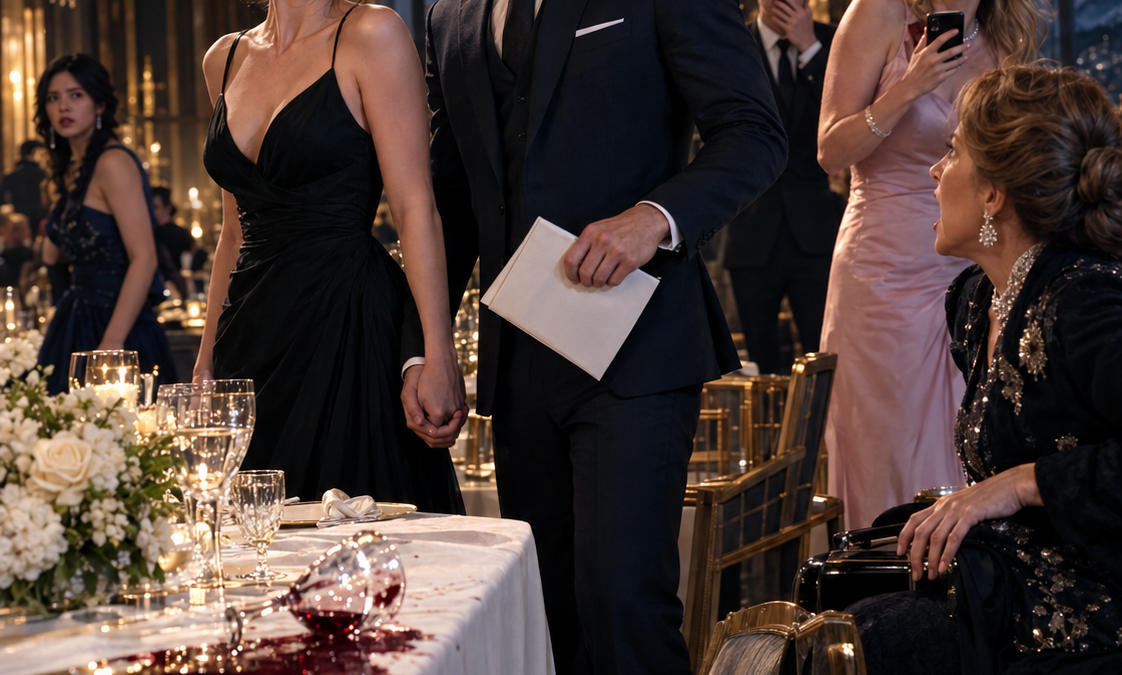
The dinner was at the Seo estate, a sprawling compound in Pyeongchang-dong that had been in the family for four generations. The ballroom was marble and crystal, the kind of room designed to make guests feel small.
Da-eun walked in on Seo-jun’s arm. She was wearing a black dress—borrowed from Seo-yeon, because she refused to spend money on a dress for a dinner that might end with her arrest—and no jewelry except her wedding ring.
His mother saw them from across the room. Her smile didn’t falter, but Da-eun saw the flicker in her eyes.
“You brought her,” his mother said, when they reached the head table.
“I brought my wife,” Seo-jun said. “Yes.”
“The seating chart—”
“Can be changed.” He pulled out the chair beside him—the seat usually reserved for the chairman’s consort—and gestured to Da-eun. “Sit.”
She sat.
Across the table, Chae-rin watched. She was dressed in pale pink, elegant, composed. She raised her glass to Da-eun with a smile that said: You won’t win this.
Da-eun smiled back.
The dinner progressed. Toasts were made. The partnership was praised. His mother stood—the chairman, the matriarch, the woman who had spent thirty years convincing the world she was untouchable—and raised her glass.
“I am proud to announce,” she said, “that Seoul Group and Daewon Construction have reached an agreement. The Haeundae resort will be developed as a joint venture, and my son, Seo-jun, will lead the project. I am also proud to announce that a marriage is being arranged between our families. My son will—”
“Mother.”
The room went silent.
Seo-jun stood. He was calm, composed, dressed in the same suit he’d worn to the office that morning. He looked like a CEO.
“I have an announcement of my own,” he said. He reached into his jacket and pulled out a folded piece of paper. “This is a copy of a report filed by the Ministry of Environment. It details eleven months of illegal wastewater dumping at the Haeundae site. The report includes the names of the executives who authorized it. It also includes audio evidence of the orders being given.”
The room erupted. His mother’s face went white.
“Seo-jun,” she said. “What are you doing?”
“I’m doing what my father would have done.” He turned to Da-eun. “The reporter who broke this story is my wife. The story will be published tomorrow morning. The audio will be released simultaneously. And I will resign as CEO, effective immediately.”
Chae-rin was on her feet. “You’re insane. You’re throwing away everything—”
“I’m throwing away the lies.” Seo-jun looked at his mother. “You taught me that power is control. You were wrong. Power is choosing what you’re willing to lose.”
He took Da-eun’s hand. She stood.
His mother looked at them—the son who had defied her, the wife who had ruined her—and for the first time in Da-eun’s memory, she said nothing.
Seo-jun led Da-eun to the door. They walked past the board members, past the shocked guests, past Chae-rin, who was already pulling out her phone. The doors closed behind them.
In the car, Da-eun let out a breath she’d been holding for two years.
“That was either the bravest thing I’ve ever seen,” she said, “or the stupidest.”
“Both,” Seo-jun said. “Definitely both.”
She laughed. He laughed. And then she kissed him—not a gentle kiss, not a reunion kiss, but a kiss that said: You waited too long, and I forgive you, and if you ever do this again, I will destroy you myself.
He kissed her back. The car pulled away from the estate. Behind them, the ballroom was in chaos. Ahead of them, everything was uncertain.
She didn’t care.
Chapter 17: The Story Breaks
The story published at 6 a.m. Da-eun watched it go live from the records room, her laptop propped on a stack of old tax filings, Seo-jun reading over her shoulder. The headline was simple: “Seoul Group Dumped Toxic Waste for Eleven Months. The Chairman Ordered It.”
Min-ho had outdone himself. He’d paired the documents with Ji-won’s audio, verified the signatures, and added a timeline that made the cover-up impossible to dismiss as a misunderstanding. The story hit the wire at 6:02. By 6:15, it was trending. By 7:00, three major broadcasters had picked it up.
Da-eun’s phone started ringing at 6:03 and didn’t stop.
She didn’t answer. She sat in the records room with Seo-jun and watched the notifications pile up like snow. His phone rang too—his mother, his sister, the board, the lawyers. He didn’t answer either.
At 8:00, Seo-yeon called Da-eun’s phone. Da-eun answered.
“Where are you?” Seo-yeon said. She sounded breathless, like she’d been running.
“Basement. Where else?”
“Stay there. Don’t leave the building. The board is convening an emergency session. Mother is trying to have you both arrested for corporate espionage.”
“On what grounds?”
“On the grounds that you stole documents. She’s claiming Seo-jun gave you classified company files.”
“That’s not espionage. That’s whistleblowing.”
“Tell that to the prosecutors she’s already called.” Seo-yeon paused. “Da-eun. There’s something else. Chae-rin is giving a press conference at noon. She’s going to claim that she was the one who discovered the violations and that Seo-jun tried to cover them up. She’s going to make herself the hero.”
Da-eun looked at Seo-jun. He was already on his feet, pulling on his jacket.
“She can try,” Da-eun said. “But we have the audio.”
Chapter 18: The Counter-Move
Chae-rin’s press conference was held in the lobby of Daewon Construction’s headquarters—a glass-and-steel monstrosity in Yeouido that made Seoul Group’s offices look almost modest. She stood at a podium, flanked by her father and three lawyers, and delivered her statement with the practiced sincerity of someone who had rehearsed it in the mirror.
“I am deeply saddened by the revelations about Seoul Group’s environmental practices,” she said. “I was made aware of these violations six months ago by a concerned employee. I brought the information to Mr. Seo-jun, who promised to investigate. Instead, he attempted to bury the evidence. I am cooperating fully with authorities and will do everything in my power to ensure the truth comes out.”
The room erupted with questions. Chae-rin answered three of them—all softballs from friendly outlets—and then her lawyer stepped in and ended the conference.
Da-eun watched it on her phone, sitting in the back of a taxi with Seo-jun beside her. They were on their way to the Ledger’s office, where Min-ho had set up a counter-press conference of their own.
“She’s good,” Da-eun said. “She’s very good.”
“She’s lying,” Seo-jun said. “And we have proof.”
“We have an audio file that mentions her name in the last thirty seconds. It’s damning, but it’s not airtight. Her lawyers will claim it’s edited, out of context, fabricated. They’ll demand a forensic analysis. It’ll take months.”
“Then what do we do?”
Da-eun looked at him. “We give them someone better than Chae-rin. We give them Ji-won.”
Chapter 19: The Woman in the Safe House
Ji-won was alive. She had been hiding in a motel in Incheon, paid for with cash, waiting for the storm to pass. Da-eun found her through a contact at the Ledger—a retired detective who owed her a favor—and called her at midnight.
“Ji-won. It’s Da-eun.”
Silence. Then: “How did you find me?”
“I’m a reporter. It’s my job.” Da-eun paused. “I’m not going to make you come forward. I’m not going to pressure you. But I need you to know what’s happening. Chae-rin is giving press conferences. She’s claiming she discovered the violations. She’s claiming Seo-jun covered them up. And she’s using your name to do it.”
“What do you mean?”
“She told the press that a ‘concerned employee’ brought her the information. She didn’t name you, but she described your position. Your tenure. It won’t take long for people to figure out who she means.”
Ji-won was quiet for a long moment. “She’s going to pin it on me.”
“She’s going to try.”
“I have the audio. I have the recording of the chairman giving the order.”
“And Chae-rin’s voice on the tape. Yes. But she’ll claim it’s fabricated. She’ll claim you’re a disgruntled employee. She’ll have her lawyers tear you apart.” Da-eun paused. “Unless you go on the record. Unless you tell your story in your own words, to the public, before she can destroy you.”
Ji-won laughed—bitter, exhausted. “You’re asking me to destroy my life.”
“I’m asking you to save it.” Da-eun leaned forward. “If you testify, you’ll be protected. Whistleblower laws, public sympathy, the truth. If you don’t, Chae-rin will make you the villain. She’ll ruin you, and she’ll walk away clean. You know that.”
“I know it.”
“Then come forward. Not for me. Not for Seo-jun. For yourself.”
The line was quiet for so long that Da-eun thought she’d hung up. Then Ji-won said: “Where do you need me?”
Chapter 20: The Second Press Conference
The Ledger’s office was two rooms and a coffee machine, but Min-ho had cleared the space and set up a backdrop with the publication’s logo. Ji-won sat at the table, pale but composed. Da-eun sat beside her. Seo-jun stood by the wall, arms crossed, watching.
Three journalists had shown up. It wasn’t Chae-rin’s crowd of fifty, but it was enough. A wire service. A broadcaster. A blogger with a large following.
Ji-won spoke for forty minutes. She explained the directive, the orders, the months of fear. She played the audio—the full audio, this time, not just the last thirty seconds. She named names. She answered questions. And when one reporter asked why she’d waited so long to come forward, she said: “Because I was afraid. I’m still afraid. But I’m more afraid of what happens if I stay silent.”
The story went viral by evening.
By nightfall, the Seoul Group board had voted to remove Seo-jun’s mother as chairman. By morning, prosecutors had opened a criminal investigation. By noon, Chae-rin had deleted her press conference from the internet and issued a statement claiming she had been “misled by a source.”
It didn’t work. The audio was too clear. Her voice was on the tape.
Seo-jun’s mother was arrested three days later. Chae-rin was questioned and released, but her reputation was in ruins. The Daewon partnership collapsed. The Haeundae resort project was suspended pending a full environmental review.
And Seo-jun—who had resigned as CEO the night of the dinner—was asked by the board to return.
Chapter 21: The Offer
They met in the records room. It had become their place—the place where they’d built the story, the place where they’d slept on the floor, the place where they’d started telling each other the truth. Da-eun was sitting on the desk, her legs dangling. Seo-jun was leaning against the filing cabinet.
“They want me to come back,” he said. “As CEO. Interim, at first, but they’ve made it clear it could be permanent.”
“Do you want it?”
“I don’t know.” He looked at her. “My mother is facing fifteen years in prison. My family’s name is destroyed. The company is in chaos. If I go back, I can rebuild it. I can make it into something my father would be proud of. But if I go back, I become the thing I’ve spent my whole life trying not to be.”
“The man in charge?”
“The man who compromises.” He crossed to her. “I don’t want to compromise anymore. I don’t want to be the person who lets things slide because it’s easier. I don’t want to be the person who watches while someone else gets hurt.”
Da-eun reached out and took his hand. “Then don’t be that person. Go back. But go back as yourself. Not as your mother’s son. Not as the family’s heir. As the man who leaked his own company’s secrets because it was the right thing to do.”
He looked at her. “You make it sound simple.”
“It’s not simple. It’s just clear.” She squeezed his hand. “You told me once that power is choosing what you’re willing to lose. You chose to lose everything for me. Now choose to keep something for yourself.”
Chapter 22: The New Chairman
Seo-jun returned to Seoul Group three weeks later. His first act as CEO was to appoint an independent environmental oversight committee with full auditing power. His second was to establish a whistleblower protection fund. His third was to fire every executive who had known about the dumping and done nothing.
The board was furious. The shareholders were nervous. The media was skeptical.
Da-eun covered it all. She had quit the Ledger—not because she wanted to, but because Min-ho had sold the story to a major outlet and taken a job there, leaving the Ledger without an editor. She was freelancing now, writing long-form investigative pieces for whoever would pay her. It wasn’t glamorous. It was honest.
She and Seo-jun moved out of the estate and into a small apartment in Seochon—two bedrooms, a kitchen that barely fit two people, a balcony that overlooked a courtyard where old men played baduk every afternoon. It was nothing like the life she’d married into. It was better.
They still fought. He was still controlling, still guarded, still prone to making decisions without consulting her. She was still stubborn, still sharp, still unwilling to let him get away with anything. But they fought differently now—not as adversaries, but as partners. They argued about the dishes. They argued about whose turn it was to buy groceries. They argued about whether to adopt a dog. They didn’t argue about the important things anymore, because they’d already said the important things.
On a Sunday in late autumn, they sat on the balcony and watched the sun set over the courtyard. Seo-jun was reading a report. Da-eun was working on her laptop.
“I found something,” she said. “In the old files. Something I missed the first time.”
He looked up. “What?”
“A memo from your father. Dated three months before he died. He was planning to shut down the Haeundae project. He’d commissioned an environmental impact study—a real one, not the fake one your mother used. He was going to cancel the whole thing.”
Seo-jun set down the report. “Why didn’t he?”
“He died before he could.” Da-eun closed her laptop. “Your mother buried the study. She let the project go forward. She knew, Seo-jun. She knew what it would do to the wetlands. She just didn’t care.”
He was quiet for a long time. Then he said: “I used to think I was protecting his legacy. But I was protecting hers. I was protecting the version of the company she built after he was gone.”
“You’re not protecting it anymore.”
“No.” He reached over and took her hand. “I’m building something new.”
Chapter 23: The Trial
Seo-jun’s mother’s trial lasted six weeks. Da-eun attended every day. She sat in the gallery and watched the woman who had made her life a misery sit in a defendant’s box and listen as witness after witness testified about the things she had done.
Ji-won testified. She was calm, precise, devastating. She described the directive, the cover-up, the fear. She described the moment she’d realized that the chairman would let her take the fall. She described the moment she’d decided to fight back.
Seo-jun testified. He described the moment he’d discovered the violations. The moment he’d decided to leak the documents. The moment he’d chosen his wife over his family. He didn’t look at his mother. He looked at Da-eun.
And Da-eun testified. She described the envelopes. The documents. The long nights in the records room. She described the moment she’d realized her husband was her source. She described the moment she’d decided to trust him.
The verdict came on a Friday. Guilty on all counts. Fifteen years. The courtroom was silent as the sentence was read. His mother didn’t react. She just sat there, her back straight, her face still, as if she were already somewhere else.
Afterward, in the hallway, Seo-yeon found Da-eun.
“She wants to see you,” Seo-yeon said.
“Who?”
“My mother. She wants to see you before they take her away.”
Da-eun looked at Seo-jun. He nodded.
 [Tap here for the Next Part ]