“I don’t let anyone destroy what’s mine.”
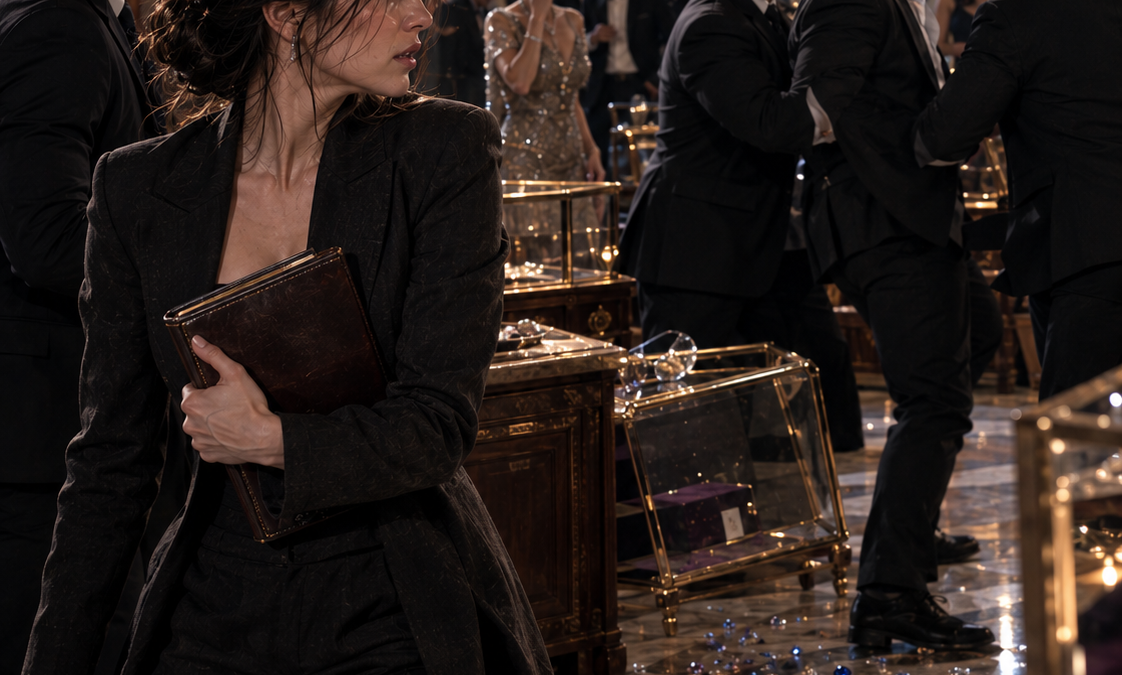
“I don’t let anyone destroy what’s mine.”
She came home to expose a fraud — she left with the family empire, the truth, and the man who’d once broken her heart.
The loupe was still pressed to Elena Voss’s eye when her brother’s voice cut through the workshop’s quiet hum.
“Put it down, Ellie. You don’t know what you’re looking at.”
She didn’t put it down. She turned the estate brooch—a Victorian mourning piece, jet and seed pearls surrounding a three-carat old-mine cut—under the light, and watched the stone’s interior fracture pattern tell her a story that made her stomach drop through the floor.
“Julian.” Her voice came out steady, which surprised her. “This is a lab-grown diamond. In a client’s estate piece. A piece we’re certifying as natural.”
Behind her, the workshop door clicked shut. She heard the bolt slide home.
“That’s a serious accusation.” Her brother’s footsteps crossed the worn oak floor. The workshop had been their grandfather’s, then their father’s, and now—technically—Julian’s, though he rarely set foot in it. He preferred the showroom floor, the clients, the champagne. “You’ve been back three weeks and you’re already trying to burn down the house?”
Elena finally lowered the loupe. Turned on her stool.
Julian stood with his arms crossed, leaning against the display case that held their grandfather’s original certification tools—antique brass instruments that hadn’t been used in decades. He was thirty-four, two years older than her, wearing a suit that cost more than her monthly rent, and he looked at her like she was a problem to be managed rather than a sister who’d come home.
“I’ve been back three weeks,” she repeated slowly, “and I’ve found eleven substituted stones in the Moreau estate alone. Eleven, Julian. In pieces valued at over two million dollars.”
“Valuations fluctuate.”
“These aren’t fluctuations. These are lab-grown stones—excellent ones, I’ll grant you, probably worth a few thousand each—sitting in settings certified as containing natural diamonds worth hundreds of thousands. That’s not a market shift. That’s fraud.”
The word landed like a slap.
Julian’s expression didn’t change. That was the thing about her brother—he’d learned to keep his face pleasant no matter what happened beneath it. Their father had taught him that, before the stroke took him, before the years of decline that had left the House of Voss teetering on the edge of irrelevance. Julian had absorbed the lesson well.
“You’re tired,” he said. “You flew in from Antwerp, you’ve been working sixteen-hour days, and you’re seeing ghosts. The Moreau pieces were authenticated before you got here. By me.”
“That’s what worries me.”
Something flickered in his eyes. Quick, there and gone.
“Careful, Ellie.”
“Or what? You’ll fire me? I’m the only certified gemologist in this family, Julian. I’m the only one who can sign off on the pieces that keep this house’s reputation intact.” She stood, the brooch still in her hand. “Without me, you can’t certify anything worth over fifty thousand dollars. Those are the terms of Grandfather’s will.”
There it was—the clause that had brought her back from Europe, from a career she’d built deliberately far from the family name, from the wreckage of a relationship she still didn’t talk about. The clause that said any piece valued above fifty thousand dollars required certification by a graduate gemologist of the Voss bloodline, and that if no such person was employed by the house, the piece could not be sold.
Their grandfather had written that clause forty years ago, when he’d still believed the family would produce a dynasty of gemologists. He hadn’t anticipated his son’s disinterest, his grandson’s ambition, or his granddaughter’s determination to escape.
He also hadn’t anticipated that the clause would become a weapon.
“You think I don’t know why you’re really here?” Julian moved closer. “You think I don’t know about the deal you’re negotiating with Ashford?”
Elena’s grip tightened on the brooch.
“Ashford Dynasty has been trying to acquire this house for three years,” Julian continued. “And suddenly, after a decade away, you show up, start poking around, finding ‘problems’ everywhere. It doesn’t take a genius to see the play.”
“There’s no play. I came back because Grandfather’s will required it if I wanted my inheritance.”
“You came back because Damian Ashford offered you something.”
The name hit her like a physical blow. She kept her face still—she’d learned that much, in Antwerp, in the years of rebuilding herself from the rubble of a life she’d walked away from.
“I haven’t spoken to Damian Ashford in eight years.”
“Then why is his company’s logo on the documents in your briefcase?”
Her briefcase. In her apartment. Which Julian had never visited. Which he had no key to.
The realization must have shown on her face, because Julian smiled—that pleasant, empty smile that made her want to throw something.
“I had someone check,” he said. “Call it due diligence. You’re my sister, Ellie. I need to know who I’m working with.”
“You broke into my apartment.”
“I had a key made from the original. The landlord was very helpful when I explained the family situation.”
Elena set the brooch down on the workbench with deliberate care. Her hands wanted to shake. She wouldn’t let them.
“What do you want, Julian?”
“I want you to certify the pieces and keep your mouth shut. I want the House of Voss to survive, which means I want you to stop looking for problems that don’t exist and start being the asset you’re supposed to be.” He spread his hands. “In return, I won’t tell the board that you’ve been conspiring with our biggest competitor to tank our reputation.”
“I’m not conspiring with anyone.”
“The documents in your briefcase say otherwise.”
The documents in her briefcase were a merger proposal from Ashford Dynasty—unsolicited, unopened, delivered by courier three days ago and shoved into her bag in a moment of exhaustion. She hadn’t even read them. She’d been too busy finding fraud in her family’s legacy.
But Julian didn’t know that. And the way he was looking at her—like he’d already won—told her that the truth wouldn’t matter.
“Get out,” she said.
“Excuse me?”
“Get out of my workshop. I have work to do.”
Julian studied her for a long moment. Then he laughed—a soft, almost affectionate sound that made her skin crawl—and headed for the door.
“You always were the stubborn one,” he said. “Grandfather loved that about you. Me, I’ve always found it tiresome.” He paused with his hand on the bolt. “Certify the pieces, Ellie. Or I’ll make sure you never work in this industry again. Not in this country, not anywhere. The Voss name still means something—and I’ll use every ounce of it to destroy you.”
The door closed behind him.
Elena stood alone in the workshop, surrounded by her grandfather’s tools, her grandfather’s legacy, her grandfather’s impossible standards. On the workbench, the brooch gleamed under the light—beautiful, expensive, and a lie.
She picked it up again. Turned it over. The laser inscription on the girdle of the stone was faint, almost invisible without magnification—but she’d seen it. A tiny mark, a serial number, a fingerprint that didn’t belong to any natural diamond.
Her grandfather had trained her to see things others missed. He’d spent hours with her in this workshop, a loupe pressed to her ten-year-old eye, teaching her the language of stones. He’d told her that a gemologist’s job wasn’t just to identify—it was to witness. To see the truth and speak it, no matter the cost.
The stone doesn’t lie, he used to say. People do. Your job is to know the difference.
She hadn’t spoken the truth in years. She’d run from it, buried it, built a new life on a foundation of carefully maintained silence. But now she was back in this workshop, holding a lie in her hands, and her brother was threatening to destroy her for telling the truth.
Her phone buzzed. She pulled it from her pocket, expecting Julian—some final threat, some last word.
Instead, the screen showed a name she hadn’t seen in eight years.
Damian Ashford.
The message was short. Three words.
I know everything.
Elena stared at the screen until it went dark. Then she set the brooch down, picked up her bag, and walked out of the workshop.
She had a decision to make.
CHAPTER TWO: The Man Who Owns Everything
The Ashford Dynasty headquarters occupied the top twelve floors of a glass tower that dominated the city’s financial district—a monument to three generations of ruthless ambition, built on a foundation of shipping, expanded through real estate, and now diversified into everything from hotels to high-end retail. The family name was carved into the lobby’s marble wall in letters tall enough to crush a man.
Elena had never been inside before. She’d spent years avoiding it, avoiding the name, avoiding the memories that clung to it like smoke.
Now she stood in the lobby, dripping rainwater onto the polished floor, and wondered if she’d lost her mind.
The security guard at the desk looked up as she approached. “Can I help you?”
“Elena Voss. I’m here to see Damian Ashford.”
The guard’s expression flickered—recognition, maybe, or surprise. “Do you have an appointment?”
“No. But he’ll see me.”
She wasn’t sure that was true. She wasn’t sure of anything except that she couldn’t go back to the workshop, couldn’t face Julian’s threats, couldn’t pretend she hadn’t seen what she’d seen. The House of Voss was rotten at its core, and the only person in the city with the power to help her expose it was the man she’d spent eight years trying to forget.
The guard made a phone call. Spoke in low tones. Hung up.
“Top floor. The elevator on the left. Someone will meet you.”
Elena walked to the elevator with her head high and her heart pounding. The doors closed. The car rose.
When they opened again, she was in a lobby that made the ground floor look modest—dark wood, abstract art, a receptionist who looked like she’d been hired for her bone structure rather than her typing speed. Beyond her, a hallway led to what Elena assumed was the CEO’s office.
“Ms. Voss.” The receptionist stood. “Mr. Ashford is in a meeting. He asks that you wait.”
“Of course.”
She sat in a leather chair that probably cost more than her rent. The rain had stopped outside, but the city looked grey and unwelcoming through the floor-to-ceiling windows. She could see the river from here, the bridges, the distant sprawl of neighborhoods where people lived lives that didn’t intersect with men like Damian Ashford.
She’d been one of those people, once. Before Antwerp. Before the scholarship, the degree, the years of building a career far from the family name. She’d been a girl who believed that hard work mattered, that merit counted, that the world rewarded people who told the truth.
Then she’d met Damian Ashford, and learned that none of it was true.
The door at the end of the hallway opened. A man emerged—tall, dark-haired, wearing a suit that fit him like it had been made for him, which it probably had. He was on his phone, speaking in low, rapid tones, and he didn’t look up as he approached.
“—no, I don’t care what the board thinks. Tell them the deal is off if they don’t meet the terms. I’ll handle the fallout.”
He ended the call. Looked up.
Their eyes met.
Eight years. It had been eight years since she’d seen him—since that night in Geneva, since the words she’d thrown at him like knives, since the look on his face when she’d walked away. Eight years, and he still had the same eyes: dark, assessing, seeing everything.
“Elena.” His voice was neutral. Giving nothing away. “You look well.”
“I look like I’ve been standing in the rain.”
“You always did prefer honesty to flattery.” He gestured toward the open door. “Come in.”
His office was enormous, corner-wrapped, with windows on two sides and a desk that looked like it had been carved from a single block of ebony. There were photographs on the credenza behind the desk—family pictures, Elena assumed, though she couldn’t make out the faces. A bar in the corner. Bookshelves that actually held books, not just decorative objects.
Damian closed the door behind her. The click of the latch sounded like a lock.
“Sit.”
“I’ll stand.”
He raised an eyebrow. “Still stubborn.”
“Still controlling.”
Something flickered in his eyes—amusement, maybe, or irritation. He moved to the bar, poured two fingers of whiskey into a crystal glass, and didn’t offer her one.
“Julian called me this morning,” he said. “Wanted to warn me off. Told me his sister was unstable, that she’d been spreading lies about the family business, that I should ignore any communication from her.”
“He works fast.”
“He’s scared. Which means you found something real.” Damian took a sip of his whiskey. “Tell me.”
“Why should I trust you?”
“You shouldn’t. But you’re here, which means you’re out of options.” He set the glass down. “Julian’s been cooking his books for at least two years. I’ve known about the substituted stones for six months—my people flagged them during due diligence on an acquisition we were considering. I didn’t move on it because I was waiting to see how deep the rot went.”
“You were waiting to use it as leverage.”
“I was waiting for the right moment.” He met her eyes. “Now you’re here, and the right moment has arrived.”
Elena’s hands were cold. She shoved them into her pockets.
“What do you want?”
“I want the House of Voss. I’ve wanted it for three years—not for the real estate, not for the inventory, but for the name. The Voss reputation for integrity is the only thing that’s kept that house afloat, and it’s the only thing Julian is destroying. If I acquire the company, I can rebuild it. If I don’t, it’ll collapse within eighteen months, and everyone who works there will lose their jobs.”
“That sounds like a threat.”
“It’s a prediction.” He moved closer. “I’m offering you a choice, Elena. Help me expose what Julian’s done, and I’ll make sure the House of Voss survives—under new management, but intact. Refuse, and I’ll go public with what I know anyway. Either way, your brother goes down.”
“And what do I get?”
“Your inheritance. Your career. Your name, cleared of the fraud your brother committed.” He paused. “And the truth. I know you want that more than anything.”
She did. God help her, she did.
But she also knew Damian Ashford. She knew what he was capable of. She knew the way he used people, the way he calculated, the way he’d looked at her eight years ago when she’d told him she loved him and he’d said nothing.
“You’re asking me to betray my family.”
“I’m asking you to tell the truth about your family. There’s a difference.”
“Is there?”
He studied her for a long moment. Then he did something unexpected—he reached into his desk drawer and pulled out a leather-bound book. Old, worn, the spine cracked and faded.
“This belonged to your grandfather,” he said. “He gave it to my father, forty years ago, when they were partners on a deal. It’s a ledger—a record of every stone he ever certified, with details that only he knew. Serial numbers. Laser inscriptions. Marks that can’t be replicated.”
Elena’s breath caught.
“The original ledger?”
“The original. Your grandfather was meticulous. Paranoid, even. He didn’t trust anyone to keep accurate records, so he kept his own—in a cataloguing system he invented. A system no one else could read.”
“I can read it.”
“I know.” Damian held the ledger out to her. “Your grandfather told me you were the only one he ever trained. The only one who could decipher his codes. He said you had the gift.”
She took the book. It was warm from being in the drawer, and it smelled like leather and dust and something older—memory, maybe, or time.
“Why do you have this?”
“My father kept it after the partnership dissolved. When he died, it came to me. I didn’t know what it was until I started looking into Voss’s fraud. Then I realized—this is the key. Every stone Julian substituted can be traced back to the original certification. The ledger proves it.”
Elena opened the book. Her grandfather’s handwriting—small, precise, almost illegible to anyone who didn’t know it—covered the pages in neat columns. Numbers. Symbols. A code she’d learned when she was nine years old, sitting on his lap in the workshop, tracing the letters with her finger.
The stone doesn’t lie, he’d said. But people do. Your job is to know the difference.
“I need to verify this,” she said. “Compare the entries against the current inventory. If Julian substituted stones, the ledger will show it.”
“Then do it. I’ll give you access to everything you need.”
“What’s the catch?”
Damian smiled—a real smile, this time, though it didn’t reach his eyes. “The catch is that you’ll have to work with me. Closely. For the next several weeks, you’ll be in my office, in my building, under my protection. Julian will know what you’re doing. He’ll try to stop you. And when this is over, you’ll have to decide whether you can live with the consequences.”
“Consequences for whom?”
“For everyone.” He moved to the window, looking out at the grey city. “This isn’t just about your brother, Elena. There are other players—rival families, rival executives, people who’ve been waiting for the House of Voss to fall. If we do this, we do it carefully. We do it together. And we don’t stop until the truth is out.”
She held the ledger against her chest. It felt like a heartbeat.
“And after?”
“After, you can go back to your life. Your career. Your carefully constructed distance from everything that reminds you of me.” He turned to face her. “Or you can stay. But that’s a decision for later.”
“I don’t want to stay.”
“Then don’t.” His voice was neutral again. Impossible to read. “But while you’re here, you’ll follow my rules. No contact with Julian. No solo meetings with anyone from Voss. No telling anyone what we’re doing—not your friends, not your colleagues, not your family.”
“And if I refuse?”
“Then Julian wins. The House of Voss falls. And you spend the rest of your life knowing you could have stopped it.”
Elena looked at the ledger in her hands. Her grandfather’s legacy. Her family’s shame. The truth, waiting to be told.
“I’ll do it,” she said. “But I have conditions of my own.”
Damian raised an eyebrow. “Name them.”
“I keep my workshop. I work from there—not from your office, not under your thumb. I’ll report to you, but I won’t be your prisoner.”
“Agreed. What else?”
“You don’t lie to me. Not about this, not about anything. If we’re doing this together, I need to know I can trust you.”
Something shifted in his expression. A crack in the mask, quickly sealed.
“And the third?”
“The third is that when this is over, you don’t stand in my way. Whatever I decide—to stay, to go, to rebuild the House of Voss myself—you don’t interfere.”
He was silent for a long moment. Then he nodded.
“Agreed.”
Elena tucked the ledger into her bag. It felt heavier than it should have—not just a book, but a weapon. A bomb, waiting to detonate.
“I’ll start tonight,” she said. “I’ll need access to the current inventory records. The certifications Julian filed.”
“I’ll send them to you within the hour.” Damian moved to his desk, sat down, and turned his attention to his computer—a dismissal, a return to his world of power and control. “One more thing.”
“What?”
“Julian isn’t the only one watching you. There’s a man—Marcus Chen. He’s my right hand, my most trusted advisor. He’ll be your contact if you need anything. If you see him, you’ll know he’s there on my behalf.”
“Marcus Chen. Is there anything else I should know about him?”
Damian’s fingers paused on the keyboard. “No. Nothing you need to worry about.”
But Elena saw it—the flicker in his eyes, the way his jaw tightened for just a moment. There was something about Marcus Chen that Damian wasn’t telling her.
She filed it away. Another piece of the puzzle. Another lie waiting to be uncovered.
“I’ll be in touch,” she said, and walked out of the office, down the hallway, into the elevator.
The doors closed. The city fell away.
She had a ledger, a mission, and a man who’d once broken her heart.
It was time to go to work.
CHAPTER THREE: The Language of Stones
The workshop was dark when she returned, but she didn’t turn on the overhead lights. Instead, she lit the old banker’s lamp on her grandfather’s desk—the one with the green glass shade and the brass base that had been repaired three times—and settled into the chair that still smelled faintly of his pipe tobacco.
The ledger lay open in front of her.
She’d spent the afternoon in a daze, canceling meetings, making excuses, preparing for a war she hadn’t chosen. Now, in the quiet of the workshop, she could finally focus on the task at hand.
Her grandfather’s code was deceptively simple. Each entry contained a date, a client name, a description of the stone, and a string of numbers and letters that looked like nonsense to anyone who didn’t know the system. But Elena had learned it when she was a child, tracing the characters with her finger while her grandfather explained each component.
The first three digits indicated the stone’s origin—mine, country, region. The next four were the carat weight, recorded to three decimal places. Then came the color grade, the clarity grade, and a series of letters that corresponded to the stone’s unique characteristics—inclusions, fluorescence, the exact pattern of flaws that made it identifiable.
And at the end of each entry, a final string of numbers: the laser inscription.
Modern diamonds were inscribed with serial numbers on their girdles—tiny marks, invisible to the naked eye, that could be read with magnification. Her grandfather had been one of the first gemologists to adopt the practice, decades before it became standard. He’d inscribed every stone he certified, creating a permanent record that couldn’t be altered or faked.
If Julian had substituted lab-grown stones for natural ones, the inscriptions wouldn’t match. The ledger would prove it.
Elena pulled out her laptop and opened the files Damian had sent. Current inventory. Certification records. Everything the House of Voss had sold or was preparing to sell in the last two years.
She started with the Moreau estate—the collection that had first caught her attention. Eleven pieces. Eleven stones she’d identified as lab-grown.
She cross-referenced each one against the ledger.
The first entry was a three-carat diamond, sold to a client in Geneva. The ledger showed a natural stone, inscribed with the number 1-4-7-2-9. The current certification listed the same number—but the stone in the piece was lab-grown, with an inscription that didn’t match.
Substitution, she wrote in her notebook. Confirmed.
She worked through the night, the way she’d worked through so many nights in Antwerp—coffee growing cold beside her, eyes burning, mind sharpening with each new discovery. By dawn, she’d confirmed eighteen substitutions. By noon, twenty-three.
The pattern was clear. Julian had been replacing natural stones with lab-grown ones for at least eighteen months, targeting high-value estate pieces that were unlikely to be re-inspected before sale. The clients were wealthy, trusting, and scattered across the globe—exactly the kind of people who wouldn’t question a certification from a house with the Voss reputation.
The fraud was systematic. Deliberate. And worth millions.
Elena sat back in her chair, staring at the evidence spread across her grandfather’s desk. She should feel triumphant—she’d proved what she suspected, found the truth she’d been searching for. Instead, she felt hollow.
Her brother had done this. Her brother, who’d taught her to ride a bike, who’d defended her from bullies, who’d stood beside her at their father’s funeral. Her brother, who’d looked at her with cold eyes and threatened to destroy her career.
How had it come to this?
Her phone buzzed. A text from an unknown number.
Ms. Voss. I’m outside. Mr. Ashford sent me. —Marcus Chen
She looked out the window. A black car idled at the curb, sleek and expensive. A man stood beside it—tall, broad-shouldered, wearing a dark suit. He was looking up at the workshop, his face unreadable.
Elena hesitated. Damian had warned her about Marcus, in his way—that flicker of something in his eyes when he’d said the name. But she needed to eat. Sleep. Think.
She grabbed her bag, tucked the ledger inside, and headed downstairs.
Marcus was waiting by the car. He was younger than she’d expected—mid-thirties, maybe, with sharp features and eyes that missed nothing. He didn’t smile as she approached.
“Ms. Voss. I’m Marcus Chen. Mr. Ashford asked me to check on you.”
“I’m fine.”
“You’ve been in that workshop for eighteen hours. That’s not fine.”
“I’ve been working.”
“Then you need to stop working and eat something.” He opened the car door. “There’s a restaurant around the corner. I’ll buy you breakfast.”
“I don’t need—”
“It’s not a request, Ms. Voss. Mr. Ashford was clear. Your safety and well-being are my responsibility.”
Elena wanted to argue. She wanted to tell him that she’d been taking care of herself for years, that she didn’t need a babysitter, that Damian Ashford had no claim on her time or her choices.
But she was tired. And hungry. And the truth was, she didn’t want to be alone.
“Fine,” she said. “Breakfast. But I’m paying.”
Marcus almost smiled. “Whatever you say.”
The restaurant was a small café three blocks from the workshop—the kind of place that served strong coffee and eggs that hadn’t been fried into submission. Marcus ordered for both of them without asking, and Elena was too exhausted to object.
“You found something,” he said, when the coffee arrived.
“Twenty-three substitutions. So far.”
“That’s more than Damian expected.”
“Damian expected eighteen.”
Marcus’s expression flickered. “You know him well.”
“I knew him. Eight years ago.”
“And now?”
Elena wrapped her hands around her coffee cup. “Now I’m trying to figure out who he’s become.”
“He’s the same man he always was. Just more dangerous.” Marcus leaned back in his chair. “He’s been planning this move for three years. Waiting for the right moment. Waiting for you.”
“I didn’t agree to be part of his plan.”
“You agreed to help expose your brother’s fraud. That’s all the agreement he needs.”
“You know him well.”
“I’ve worked for him for six years. I know him better than anyone.” Marcus paused. “Which is why I’m going to tell you something he won’t.”
Elena’s grip tightened on her cup. “What?”
“Julian isn’t working alone. He has partners—people who’ve been helping him launder the money from the substituted stones. One of them is inside Ashford Dynasty.”
The words landed like stones in still water.
“Inside Damian’s company?”
“Close to the top. I don’t know who, yet. But I know they exist. Damian doesn’t know I know.”
“Why are you telling me this?”
“Because you need to be careful. Damian is focused on your brother, but the real danger is closer than he realizes. If the mole finds out you’re investigating—if they figure out what you’re doing—they’ll come after you.”
Elena set down her cup. Her hands were steady, but her mind was racing.
“Does Damian know you’re telling me this?”
“No. And he can’t find out. Not yet.” Marcus met her eyes. “He trusts me. If he knew I’d gone behind his back—even for his own protection—he’d never forgive me.”
“You’re asking me to keep a secret from him.”
“I’m asking you to be smart. You want to take down your brother? Fine. But watch your back. And don’t assume that everyone in Damian’s inner circle is on your side.”
The waitress arrived with their food. Elena stared at her plate, her appetite gone.
She’d come back to this city expecting to fight her brother. Now she was caught between two men with secrets, two agendas, two sets of rules.
And somewhere in the middle of it all was the truth—waiting to be found, waiting to be told.
“I need to get back to work,” she said.
Marcus nodded. “I’ll drive you.”
CHAPTER FOUR: The Family Dinner
The invitation arrived at her apartment two days later, hand-delivered by a courier in a uniform so crisp it looked ironed onto his body.
Mrs. Helena Ashford requests the pleasure of your company at a family dinner. Saturday, 7 PM. Ashford Estate.
Elena read the card three times, trying to decipher its meaning. Helena Ashford was Damian’s mother—the matriarch of the dynasty, the woman who’d ruled the family with iron grace for four decades. She was legendary in the city’s business circles: brilliant, ruthless, and fiercely protective of her son.
Why would she invite Elena to dinner?
“I don’t know what she wants,” Elena said, when she called Damian. “But I don’t like it.”
“My mother doesn’t do anything without a reason. She’s been watching the Voss situation closely. She may see you as a threat—or an opportunity.”
“Which one?”
“That depends on the impression you make.” He paused. “I’ll be there. So will my sister. You won’t be alone.”
“I’m not afraid of your mother.”
“You should be. Everyone is.”
The Ashford Estate sat on twelve acres of manicured grounds thirty minutes outside the city—a sprawling Georgian mansion that had been in the family for five generations. Elena had seen it from the outside once, years ago, when she and Damian were—whatever they’d been. She’d never been invited inside.
Tonight, she arrived in a dress she’d borrowed from a friend, shoes that pinched, and the ledger hidden in her car’s locked glove compartment. She didn’t trust anyone in the Ashford family—not Helena, not the sister she’d never met, not Damian himself.
A butler opened the door before she could knock. “Ms. Voss. This way.”
The house was beautiful, in the way that old money is always beautiful—understated, expensive, filled with art that had been in the family for generations. The butler led her through a marble foyer, past a library that made her workshop look like a closet, into a dining room where a table had been set for six.
Helena Ashford sat at the head of the table.
She was in her seventies, silver-haired, dressed in a navy silk suit that probably cost more than Elena’s entire wardrobe. Her eyes were sharp—the same eyes as her son, calculating and cold—and she studied Elena with the focus of a jeweler examining a flawed stone.
“Ms. Voss.” Her voice was cultured, precise. “I’ve heard a great deal about you.”
“All of it terrible, I’m sure.”
Helena’s lips twitched—almost a smile. “Sit down. You’re letting the cold in.”
Elena sat. The chair was antique, uncomfortable, designed to discourage lingering.
“My son tells me you’ve been helping him with a delicate matter,” Helena said. “Something involving your family’s business.”
“He told you that?”
“He tells me everything.” Helena sipped her wine. “I’m aware of the fraud your brother has committed. I’m also aware that exposing it will damage the Voss reputation—which, in turn, could damage the Ashford reputation, since we’re about to be linked in the public eye.”
“Linked how?”
“That’s what tonight is about.” Helena set down her glass. “My son has decided to pursue a merger with your family’s company. He believes the House of Voss can be salvaged—rebuilt under Ashford management, repositioned as a luxury brand. But a merger requires trust. It requires the public to believe that both families are acting in good faith.”
“And Julian has destroyed that trust.”
“Precisely.” Helena leaned forward. “Which is why I’ve invited you here. I want to know if you’re willing to do what’s necessary to save your family’s name.”
Elena felt the trap closing around her. “What exactly are you asking me to do?”
“I’m asking you to publicly disavow your brother. To testify against him, if necessary. To stand beside my son and make it clear that the fraud was Julian’s doing—not the House of Voss’s, not your family’s.”
“You want me to destroy my brother.”
“I want you to tell the truth. The question is whether you have the courage to do it.”
The door opened. Elena turned, expecting the butler, expecting another course, expecting anything but the woman who walked in.
She was tall, elegant, wearing a red dress that seemed designed to draw every eye in the room. Dark hair, sharp cheekbones, a smile that didn’t reach her eyes.
“Sorry I’m late, Mother.” She kissed Helena’s cheek, then turned to Elena. “You must be Elena. I’ve heard so much about you.”
“Vivian,” Helena said, “this is Elena Voss. Elena, this is my daughter.”
Vivian Ashford. Damian’s sister. The woman who’d been living in Europe for the past decade—the woman Elena had never met, never spoken to, never even seen a photograph of.
Until now.
“Your brother talks about you constantly,” Vivian said, sliding into the chair across from Elena. “Elena this, Elena that. You’d think you were the second coming.”
“Vivian.” Helena’s voice was sharp. “Be polite.”
“I’m always polite.” Vivian smiled at Elena. “I’m just curious. What’s it like, being the woman who broke Damian’s heart?”
The room went very still.
“I don’t know what you’re talking about,” Elena said.
“Don’t you? He was different after you. Before you, he was—well, he was still Damian, but he was softer. Kinder. After you, he became…” Vivian waved a hand. “This. The man who owns everything, who trusts no one, who hasn’t had a real relationship in eight years.”
“Vivian.” A new voice, from the doorway. “That’s enough.”
Damian stood in the entrance, his expression unreadable. Behind him, a man Elena didn’t recognize—tall, dark-skinned, wearing a suit that fit him perfectly.
“Marcus told me you’d arrived,” Damian said, crossing to Elena’s side. “I see my sister has been making you feel welcome.”
“Your sister has been making me feel interrogated.”
“Same thing, in this family.” Damian pulled out the chair beside her and sat. The man who’d entered with him took a seat at the far end of the table. “Elena, this is David Okonkwo. He’s our family lawyer.”
“Ms. Voss.” David nodded. “I’ve heard good things.”
“From whom?”
“From everyone who’s ever worked with you. Your reputation in the gemological community is impeccable.”
Elena wasn’t sure whether that was a compliment or a warning.
“Now that we’re all here,” Helena said, “let’s discuss the merger.”
The dinner was a battlefield disguised as a meal. Helena controlled the conversation with the precision of a general, steering it toward the merger, toward the public relations strategy, toward the role Elena would play in the weeks ahead. Vivian interjected with barbed comments designed to unsettle. David took notes. Damian watched.
And Elena sat in the middle of it all, eating food she couldn’t taste, wondering how she’d ended up here.
“You’ll need to make a statement,” Helena said, as dessert was served. “Something that makes it clear you support the merger and condemn your brother’s actions.”
“I haven’t decided what I’m going to do yet.”
“You haven’t?” Helena’s eyebrows rose. “I assumed that’s why you came tonight.”
“I came tonight because I was invited. I’m still gathering evidence. I’m still deciding what’s right.”
“Right?” Vivian laughed. “There’s no right in business, Elena. There’s only what works.”
“That’s not true.”
“It’s adorable that you think so.” Vivian leaned back in her chair. “You’ve been away for a long time. You don’t understand how things work in this world—how power is built, how loyalty is bought. You think you can come back and play the hero, expose the villain, ride off into the sunset. But this isn’t a fairy tale. This is the Ashford family. And we don’t let people ride off into anything.”
“Vivian.” Damian’s voice was quiet, but it cut through the room like a blade. “Enough.”
“I’m just being honest.”
“You’re being cruel. There’s a difference.”
Vivian’s smile faltered. For a moment, Elena saw something else in her eyes—something raw, something wounded.
Then it was gone.
“Fine,” Vivian said. “I’ll be quiet. But don’t say I didn’t warn you.”
She stood, tossed her napkin onto the table, and walked out.
The silence she left behind was heavy.
“My daughter has her own reasons for disliking this situation,” Helena said, after a moment. “She was involved with the Voss family, once. Before your time.”
“What do you mean?”
“Vivian and your brother were engaged. Ten years ago. It ended badly.”
Elena stared at her. Julian had never mentioned—but then, Julian had never mentioned a lot of things. She’d been in Antwerp, building her career, deliberately distant from the family drama. She’d missed so much.
“I didn’t know,” she said.
“No. I imagine you didn’t.” Helena stood. “I’ll have the driver take you home. We’ll speak again soon.”
The dinner was over. Elena rose, her legs unsteady, her mind reeling.
Damian walked her to the door.
“I’m sorry about Vivian,” he said. “She shouldn’t have said those things.”
“She told the truth. I did break your heart.”
He was silent for a moment. Then: “You didn’t break it. You just—left. There’s a difference.”
“Is there?”
He didn’t answer. He opened the door, and the cold night air rushed in.
“Be careful, Elena. My mother likes you, which means she’s already planning how to use you. Don’t let her.”
“And Vivian?”
“Vivian is angry. She’s been angry for ten years, and she doesn’t know how to stop. Don’t take it personally.”
“How can I not?”
Damian looked at her—really looked, the way he had in his office, the way he’d looked at her eight years ago, when she’d told him she loved him and he’d said nothing.
“Because it’s not about you,” he said. “It never was.”
Elena walked to the car. Marcus was waiting, his expression neutral.
She got in. The car pulled away.
And in the darkness, she wondered if she’d just made a deal with the devil.
 [Tap here for the Next Part ]


