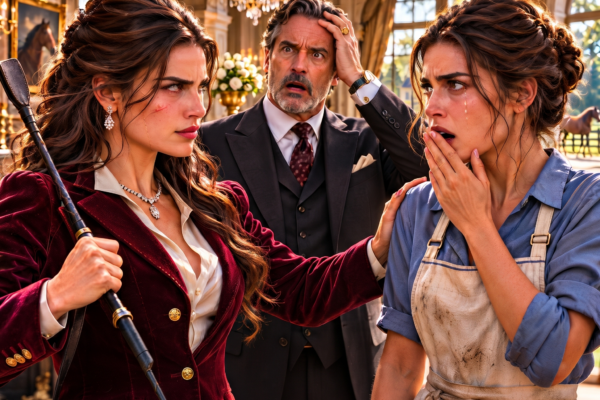
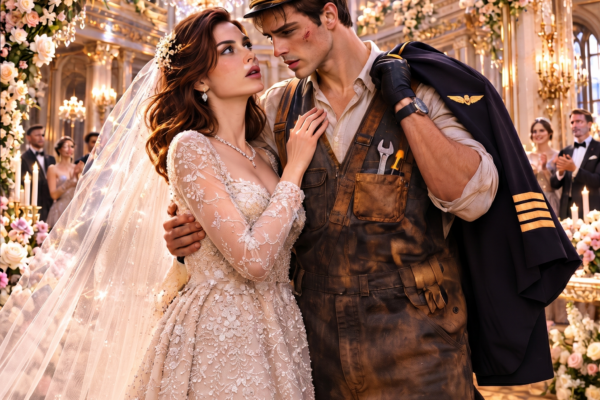
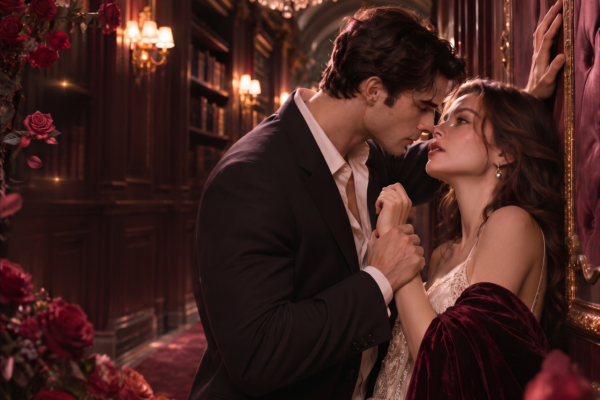
“You used me. You threatened me. You made me a criminal. I’m not going to let you do it to anyone else.”
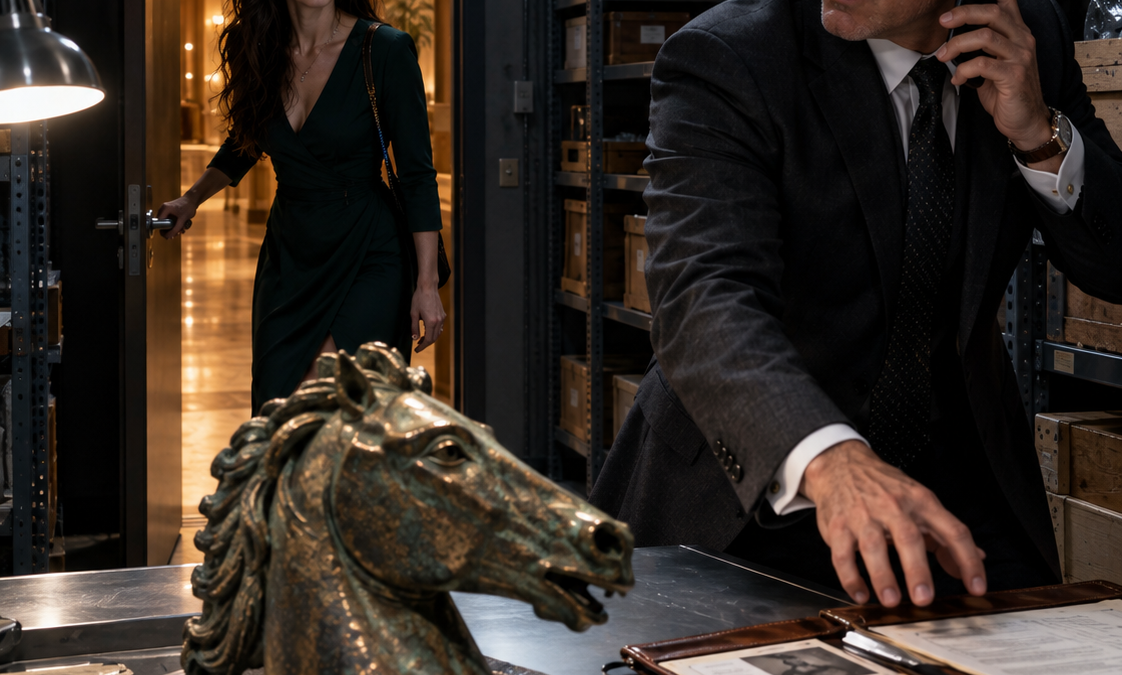
“You used me. You threatened me. You made me a criminal. I’m not going to let you do it to anyone else.”
She thought exposing her mentor would end her career. She never expected it to end with her name on her own gallery—and a key to every door the most dangerous man in the city owned.
“You signed the authentication papers, Elena. That makes you complicit.”
The words landed like a slap across a silent room. Elena Morozov stood frozen in the doorway of the Ashford Foundation’s private conservation wing, her hand still on the brass handle, the low hum of the gala drifting in from the marble corridor behind her. In front of her, under the flat, clinical glare of restoration lamps, sat three objects she had spent the last six weeks of her life treating as legitimate private commissions.
A Ming dynasty bronze ritual vessel. A Tang horse with a repair history she had documented down to the micro-fracture. A Song dynasty celadon bowl that she had personally stabilized after a hairline crack threatened its structural integrity.
And on the steel table beside them, fanned out like a losing hand of cards, were the shipping manifests. The customs declarations. The provenance documents. All of them forged. All of them bearing her signature as the authenticating restorer.
“Say it again,” Elena said, her voice quieter than she intended. “Say exactly what you just said.”
Her mentor, Marcus Vane, stood on the other side of the table. Sixty-three years old, silver-haired, wearing the same bespoke charcoal suit he’d worn to every opening night for the past decade. He had been her teacher. Her champion. The man who had pulled her out of a graduate program she couldn’t afford and given her a junior position at the most prestigious restoration house in the country. He looked at her now with something that wasn’t quite pity and wasn’t quite contempt. It was worse. It was patience.
“I said,” Marcus repeated, “that your name is on these documents. You authenticated these pieces. You wrote the condition reports. You signed off on their legitimacy. If the authorities come knocking, you are the first name they will find.”
Elena’s gaze dropped to the papers. Her own handwriting stared back at her. E. Morozov, Senior Restorer. She had signed them in good faith. She had signed them because Marcus had told her the pieces were part of a private collection being deaccessioned by a European estate. She had signed them because she trusted him.
“You lied to me,” she said.
“I protected you.”
“You used me.”
Marcus exhaled through his nose, a small, dismissive sound. “Don’t be dramatic. You’re a restorer, Elena. You restore things. You don’t ask where they came from. That’s the job.”
“That’s not the job. That’s the job you told me it was.”
From the corridor behind her, a burst of laughter erupted—the gala was in full swing. The Ashford Foundation’s annual patron dinner. Two hundred of the city’s wealthiest collectors, philanthropists, and old-money families, all of them here to celebrate the foundation’s newest acquisition: a collection of Chinese antiquities that had been “generously donated” by an anonymous benefactor.
Elena had seen the collection. She had restored half of it.
She turned back to Marcus. “Who is the benefactor?”
“That’s not your concern.”
“I’m making it my concern.”
“Elena.” His voice hardened. “Walk out of this room. Go home. Forget what you saw. I will handle the paperwork. I will make sure your name is removed from the worst of it. But if you make a scene, if you go to the board, if you do anything stupid, I will not be able to protect you. Do you understand?”
She understood perfectly. He wasn’t offering her a way out. He was offering her a gag order dressed as mercy.
The door behind her swung open. A man in a black suit—one of the foundation’s security team—stepped inside, his eyes moving from Elena to Marcus to the papers on the table.
“Mr. Vane,” he said. “Mr. Ashford is asking for you. He’s in the east gallery.”
Marcus nodded, already gathering the papers into a leather folio. “Tell him I’m on my way.”
Elena stepped forward. “No.”
Marcus paused.
“No,” she said again, louder. “You don’t get to walk out of this room and pretend this didn’t happen. Not this time.”
The security guard shifted his weight. “Miss, I’m going to have to ask you to—”
“Ask me to what? Leave? Go ahead. But I’m taking those papers with me.”
Marcus’s expression flickered—the first crack in his composure. “You don’t want to do that.”
“I don’t want to do any of this. But here we are.”
She reached for the folio. Marcus’s hand closed over hers, his grip cold and dry. For a moment, they were frozen, a grotesque tableau under the restoration lamps.
Then the door opened again.
This time, it was not a security guard.
Adrian Ashford stood in the doorway, and the room seemed to contract around him. He was tall, dark-haired, dressed in a black dinner jacket that fit him with the kind of precision that came from having clothes made for you since birth. His face was unreadable—sharp cheekbones, a mouth that looked like it had forgotten how to smile, eyes that swept the room in a single, efficient pass and catalogued everything: the papers, the folio, Marcus’s hand on Elena’s, the Ming vessel, the Tang horse, the celadon bowl.
“Marcus,” he said. His voice was low, calm, and carried the unmistakable weight of a man who owned the building they were standing in. “The board is asking about the provenance documentation for the new collection. I told them you had it.”
Marcus released Elena’s hand. “Adrian. I was just finishing up with Elena here. A minor discrepancy in the condition reports.”
“Is that what this is?”
“Yes.”
Adrian’s gaze moved to Elena. “And you are?”
She swallowed. “Elena Morozov. I’m a restorer.”
“I know who you are.” He stepped into the room, and the security guard immediately stepped back. “Your name is on every document in that folio.”
“Yes,” she said. “It is.”
“Did you authenticate these pieces?”
The room went very still. Marcus said, “Adrian, I can explain—”
“I wasn’t asking you.” Adrian’s eyes never left Elena’s. “Did you authenticate these pieces?”
Elena thought about lying. She thought about the career she had spent eight years building. She thought about the student loans she was still paying off, the apartment she could barely afford, the way Marcus had looked at her when she’d first walked into his studio with a portfolio and trembling hands.
Then she thought about the customs officer who had called her two days ago. The one she hadn’t called back.
“Yes,” she said. “I did. But I didn’t know what they were.”
“And what are they?”
“Stolen. Smuggled. Forged provenance. I don’t know the full extent, but I know enough.”
Marcus made a sound—a sharp, ugly exhale. “Elena, for God’s sake—”
“Shut up, Marcus.” Adrian’s voice didn’t rise. It didn’t need to. He turned to the security guard. “Close the door. No one comes in. Not the board, not the guests, not my mother.”
The guard nodded and pulled the door shut.
Adrian walked to the table and picked up one of the manifests. He read it in silence for a long moment. Then he set it down and looked at Elena.
“You’re going to tell me everything,” he said. “Right now. And then you and I are going to have a very long conversation about what happens next.”
Elena’s heart was pounding so hard she could feel it in her throat. She had just set fire to the only professional life she had ever known. And she had done it in front of the most powerful man in the city.
“Fine,” she said. “But I have conditions.”
Adrian’s eyebrows lifted a fraction of an inch. “Conditions.”
“Yes. I’m not going down for this alone. And I’m not going to be your scapegoat. If I tell you what I know, you protect me. Not Marcus. Me.”
For the first time, something flickered in Adrian Ashford’s eyes. It wasn’t warmth. It wasn’t respect. But it was something. Interest, maybe. Or surprise.
“You’re in no position to negotiate,” he said.
“I’m in the only position that matters,” she said. “I’m the one holding the papers.”
Across the city, in a cramped office on the fourth floor of the Customs and Border Protection building, a man named Daniel Okafor hung up his phone and stared at the file on his desk.
Her name was in the file. Elena Morozov. Witness of good faith.
He had been tracking the antiquities for eleven months. Three shipments. Two shell companies. One collector with ties to the triad networks that moved art through the port like water through a cracked pipe. He had enough evidence to move. He had enough evidence to make arrests.
But he needed her.
He picked up his phone again and dialed the number she had given him two days ago. The one she hadn’t answered.
This time, she picked up on the second ring.
“Ms. Morozov,” he said. “My name is Daniel Okafor. I’m with Customs. I think we need to talk.”
CHAPTER 2: The Man Who Owns Everything
The conversation lasted until two in the morning.
Elena sat in a conference room on the foundation’s third floor, a glass-walled box overlooking the dark city skyline. The gala had ended hours ago. The caterers had packed up. The board members had gone home. Only Adrian Ashford remained, and his presence filled the room like a second atmosphere.
He had asked her questions. Hundreds of them. When did she first suspect? Who introduced her to the pieces? What did Marcus tell her about the provenance? Did she ever meet the collector? Did she ever see the shipping records? Did she ever hear a name—any name—that didn’t belong?
She had answered all of them. She had given him everything. The timelines. The documents. The pattern of “private commissions” that had started six months ago, right after she had been promoted to senior restorer. The way Marcus had begun requesting her specifically for certain pieces, always Chinese antiquities, always with vague provenance, always with the same three-day turnaround.
And she had told him about the customs officer. Daniel Okafor. The call she hadn’t returned.
Adrian had listened without interrupting. He had taken notes on a yellow legal pad, his handwriting neat and sharp. And when she was finished, he had set down his pen and looked at her with an expression she couldn’t read.
“You understand,” he said, “that if you go to the authorities, you will be arrested.”
“I know.”
“You will lose your license. Your career. Possibly your freedom.”
“I know.”
“And yet you’re still here. Still talking. Why?”
She had thought about that. The honest answer was complicated. Part of it was fear—fear of being the fall guy, fear of Marcus’s threats. But there was something else, too. Something that had been gnawing at her for months, a quiet, persistent dread that she had been ignoring because facing it meant facing the truth about the man who had made her career.
“Because I didn’t spend eight years learning to restore art so I could help destroy it,” she said. “And because I’m tired of being used.”
Adrian had looked at her for a long moment. Then he had nodded, once, and stood up.
“Here’s what’s going to happen,” he said. “You’re going to work for me. Officially, you’ll be a consultant for the foundation, brought in to audit the new collection. Unofficially, you’re going to help me find out exactly how deep this goes. Who Marcus is working for. Who the collector is. Where the pieces are coming from. Everything.”
“And in exchange?”
“In exchange, I will make sure your name is cleared. I will provide you with legal representation. And I will protect you from whatever comes next.”
She stood up, too. Her legs were shaky, but she refused to sit back down.
“I want something else,” she said.
“Of course you do.”
“I want to be the one who exposes him. When the time comes. I want to be in the room. I want to say it to his face.”
Adrian’s mouth curved—not quite a smile, but close. “You’re not what I expected.”
“What did you expect?”
“Someone who would cry. Or beg. Or run.”
“I’m not a runner.”
“No,” he said, and his voice was softer now. “I’m starting to see that.”
He walked her to the elevator. The building was empty, the marble floors gleaming under the dimmed lights. When the doors opened, he stepped inside with her.
“One more thing,” he said.
“What?”
“You’re not going to like it.”
“I haven’t liked anything about tonight.”
“The foundation is hosting a private viewing tomorrow night. For the board. Marcus will be there. The collector will be there. And I need you to be there, too.”
She stared at him. “You want me to walk into a room with the man who threatened me twelve hours ago?”
“I want you to walk into a room with the man who threatened you and pretend you’re still his loyal protégée. I want you to smile. I want you to make small talk. I want you to watch and listen and remember everything. Can you do that?”
Her stomach turned. But she thought about the papers. The signatures. The way Marcus had looked at her when he’d said I protected you.
“Yes,” she said. “I can do that.”
The elevator doors opened onto the lobby. Adrian stepped out first, then turned to face her. In the low light, his face looked carved from stone—beautiful and brutal in equal measure.
“Ms. Morozov,” he said. “I don’t trust easily. And I don’t give second chances. You’ve just used up the only one you’re going to get.”
“I understand.”
“Good.” He reached into his pocket and pulled out a card. “Be at my office at nine tomorrow morning. We’ll go over the guest list.”
She took the card. His fingers brushed hers—just for a second, just enough to feel the warmth of his skin against hers.
Then he turned and walked out into the night, and Elena was left standing alone in the lobby of the Ashford Foundation, holding a business card and a secret that was going to get her killed.
CHAPTER 3: The Guest List
Adrian Ashford’s office was on the top floor of the Ashford Building, a sixty-story tower of black glass and steel that dominated the financial district like a raised fist. Elena arrived at 8:55, wearing the only decent suit she owned—a navy blazer and pencil skirt she’d bought on sale three years ago—and carrying a leather portfolio that contained every scrap of evidence she had managed to gather from her own files.
The assistant at the front desk looked her up and down with the practiced disdain of someone who had spent years guarding the gates of power. “Name?”
“Elena Morozov. I have an appointment.”
“Mr. Ashford is running behind. You can wait over there.”
Elena sat in a leather chair that cost more than her rent and tried not to fidget. The waiting room was all glass and white marble, with a view of the city that made her feel small and temporary. She had never been in a building like this. She had never met a man like Adrian Ashford.
At 9:15, the assistant waved her through.
Adrian’s office was the size of her entire apartment. Floor-to-ceiling windows. A desk made of reclaimed wood and steel. A wall of books—real books, not decorative—and a single painting behind his chair that she recognized immediately.
A Song dynasty landscape. Genuine. Priceless.
He was standing by the window when she walked in, his back to her, a phone pressed to his ear. He was wearing a dark gray suit today, no tie, and the sleeves of his white shirt were rolled up to his forearms. It was the most disarming thing she had seen him do.
“No,” he said into the phone. “Tell the board I’ll have the numbers by Friday. And tell my mother I’m not discussing the gala with her. Not now. Not ever.” He hung up without saying goodbye and turned to face Elena.
“You’re late.”
“Your assistant told me to wait.”
“She told you I was running behind. You should have ignored her.”
Elena set her portfolio on the table between them. “I’ll remember that.”
“See that you do.” He gestured to the chair across from his desk. “Sit.”
She sat. He didn’t. Instead, he walked to the window and stood with his back to her, looking out at the city.
“The guest list for tonight,” he said. “Twelve people. My mother. My sister. Four board members. Marcus. The collector—his name is Liu Wei. A businessman from Shanghai with a very clean public record and a very dirty private one. And three other guests who are, as far as I can tell, legitimate collectors.”
“Which one is the collector? Liu?”
“Yes. He’s the one we’re interested in.”
“What do you know about him?”
Adrian turned. “I know he’s been moving stolen antiquities through my family’s foundation for the past eighteen months. I know he has ties to triad networks in Hong Kong and Macau. I know he’s been using Marcus as his front. And I know that my mother invited him to the gala personally.”
Elena’s stomach dropped. “Your mother?”
“Yes.”
“Does she know?”
“That’s what I’m trying to find out.” He walked back to his desk and sat down across from her. “My mother, Eleanor Ashford, is the chair of the foundation’s board. She has been for twenty years. If Liu is using the foundation to launder stolen art, she either knows about it or she’s been willfully blind. Either way, she’s a problem.”
Elena thought about the gala. The way Eleanor Ashford had swept through the room in her emerald gown, holding court like a queen. She had barely looked at Elena. She had barely looked at anyone who wasn’t a donor or a board member or a potential acquisition.
“What does she know about me?”
“Nothing. As far as she’s concerned, you’re a junior restorer who works for Marcus. Nothing more.”
“And Marcus?”
“Marcus knows you’re a liability. But he also knows you’re smart enough to keep your mouth shut. He’ll be watching you tonight. He’ll be waiting for you to slip up.”
“Then I won’t slip up.”
Adrian leaned back in his chair. “You’re very confident for someone who’s in way over her head.”
“I’m not confident. I’m terrified. But I’m also angry. And right now, angry is more useful.”
He studied her for a moment. Then he nodded, and something in his expression shifted—a small crack in the armor.
“Good,” he said. “Angry is good. Just don’t let it make you stupid.”
“I won’t.”
“We’ll see.” He slid a folder across the desk. “The guest list. Memorize it. And tonight, when you walk into that room, you’re not Elena Morozov, the restorer who got played. You’re Elena Morozov, the loyal protégée who doesn’t suspect a thing. Can you do that?”
She picked up the folder. “I can do that.”
“Then we have a plan.”
He stood up, and she stood up, and for a moment they were standing very close to each other—close enough that she could smell his cologne, something clean and expensive and faintly dangerous.
“One more thing,” he said.
“What?”
“If Marcus threatens you again, you come to me. Not the police. Not the customs officer. Me. Do you understand?”
“Why?”
“Because I’m the only person in this city who can protect you. And because I don’t like people threatening what’s mine.”
The words hung in the air between them. What’s mine. She wasn’t his. She was a consultant. A witness. A liability. But the way he said it made her feel like something else entirely.
“I understand,” she said.
“Good.” He opened the door for her. “Nine o’clock. Don’t be late.”
CHAPTER 4: The Private Viewing
The private viewing was held in the foundation’s east gallery, a long, elegant room with white walls and soft lighting and a single, enormous chandelier that cast prisms of light across the polished floor. Elena arrived at eight o’clock, dressed in a black cocktail dress she had borrowed from her roommate, her hair pulled back, her portfolio replaced by a small clutch that contained nothing but her phone and a compact mirror.
She spotted Marcus immediately. He was standing near the Ming vessel, talking to a man she didn’t recognize—tall, thin, with silver-rimmed glasses and a smile that didn’t reach his eyes. Liu Wei. The collector.
She forced herself to walk toward them.
“Elena.” Marcus’s voice was warm, welcoming, as if nothing had happened. “There you are. I was just telling Mr. Liu about your work on the celadon bowl. He’s very impressed.”
Liu Wei turned to her, and his smile widened. “Ms. Morozov. I’ve heard wonderful things. Your restoration of the bowl was masterful. Truly masterful.”
“Thank you,” she said, and her voice didn’t shake. “It was a beautiful piece.”
“It was,” Liu agreed. “And now it is even more beautiful. You have a gift.”
She felt Marcus’s eyes on her, sharp and watchful. She smiled at Liu, and she made small talk, and she pretended she didn’t know that the bowl had been stolen from a temple in Gansu province three years ago.
Across the room, Adrian was talking to his mother. Eleanor Ashford was a tall, silver-haired woman with the kind of posture that came from decades of ballet and a face that had been lifted so many times it looked almost smooth. She was laughing at something Adrian had said, but her eyes were scanning the room—always scanning, always calculating.
Adrian caught Elena’s gaze for a fraction of a second. Then he looked away.
The evening wore on. Elena moved through the room like a ghost, listening, watching, cataloguing. She heard Liu mention a name—the Zhang collection—and saw Marcus’s jaw tighten. She heard Eleanor Ashford say something to one of the board members about “discretion” and “the foundation’s reputation.” She heard a waiter murmur to another waiter about a shipment that had arrived that morning, unmarked boxes, no paperwork.
And then, at ten o’clock, she saw Marcus slip out of the gallery.
She waited thirty seconds, then followed him.
He went down the corridor, past the conservation wing, past the storage rooms, and stopped at a door she had never noticed before—a narrow door at the end of the hall, marked with a sign that said Authorized Personnel Only.
He unlocked it and went inside.
Elena waited. Counted to ten. Then she tried the handle.
It was unlocked.
She pushed the door open and stepped into a room that was not on any of the foundation’s floor plans. It was small, windowless, lined with shelves. And on those shelves were boxes. Dozens of them. Unmarked. Unlabeled. And on the table in the center of the room, a single object: a bronze head of a horse, Han dynasty, with a patina that was unmistakably ancient.
Marcus was standing with his back to her, his phone pressed to his ear. He was speaking in a low, urgent voice.
“—I don’t care what he wants. Tell him the shipment was delayed. Tell him we need more time. The Morozov girl is a problem. She knows something. I can handle her, but I need—”
He turned.
He saw her.
And for the first time since she had known him, Marcus Vane looked afraid.
CHAPTER 5: The Witness
“Elena.”
She didn’t run. She didn’t scream. She stood in the doorway, her heart hammering against her ribs, and she looked at the boxes, the shelves, the bronze horse head, and she understood everything.
“This is where you keep them,” she said. “The pieces you don’t want anyone to see.”
Marcus lowered his phone. His hand was trembling, just slightly. “You shouldn’t be here.”
“Neither should you.”
“Elena, listen to me—”
“No.” She stepped into the room. “You listen to me. I know what you’re doing. I know who you’re working for. And I know that you’ve been using me to cover it up.”
Marcus’s face went pale. “You don’t know anything.”
“I know about Liu Wei. I know about the Zhang collection. I know about the shipment that arrived this morning. And I know that if I walk out of this room and go to the police, you will spend the rest of your life in prison.”
He took a step toward her. She took a step back.
“Elena,” he said, and his voice was softer now, almost pleading. “I have been your mentor for eight years. I have given you everything. Your career. Your reputation. Your future. Do you really want to throw all of that away?”
“You didn’t give me anything. You used me. You used my name. You used my hands. You made me complicit in your crimes.”
“I made you successful.”
“You made me a criminal.”
Something shifted in his face—the pleading fading, replaced by something colder. Harder.
“If you go to the police,” he said, “you will go down with me. Your name is on those documents. Your signature. Your authentication. You will be arrested. You will be tried. You will be convicted. And you will spend the rest of your life paying for a decision you made in good faith.”
“I know,” she said. “But at least I’ll be paying for the truth.”
She turned and walked out of the room.
She made it halfway down the corridor before her legs gave out. She leaned against the wall, her breath coming in short, sharp gasps, and she pressed her hand to her mouth to keep from screaming.
She had just declared war on the most powerful man in her industry. She had just set herself up to lose everything.
And she had never felt more alive.
Her phone buzzed. A text from an unknown number.
East gallery. Now. —A
She straightened up, wiped her eyes, and walked back to the gallery.
Adrian was waiting for her by the window, a glass of champagne in his hand. He looked calm, relaxed, as if he had spent the entire evening doing nothing more strenuous than making small talk.
“You look like you’ve seen a ghost,” he said.
“I found his stash. There’s a hidden room at the end of the east corridor. Full of boxes. And a Han dynasty horse head.”
Adrian’s expression didn’t change, but his hand tightened around the champagne glass. “Did he see you?”
“Yes.”
“Did he threaten you?”
“Yes.”
“Are you okay?”
The question caught her off guard. She looked at him, and for a moment, the mask slipped—just a fraction—and she saw something underneath. Something raw and human.
“No,” she said. “I’m not okay.”
He set down his glass. “Then we’re done for tonight. I’m taking you home.”
“I can take a cab.”
“I wasn’t asking.”
He put his hand on the small of her back and guided her toward the exit. She didn’t pull away. She didn’t want to.
Outside, the night air was cool and sharp, and the city was still alive with lights and noise. Adrian’s car was waiting at the curb—a black sedan, sleek and expensive. He opened the door for her and she slid inside, and he followed her in, and the driver pulled away without being told where to go.
“Where do you live?” Adrian asked.
She gave him the address. He repeated it to the driver.
They sat in silence for a long moment. Then Adrian said, “You did well tonight.”
“I almost threw up in the corridor.”
“That’s not what I mean.” He turned to look at her. “You stood your ground. You didn’t back down. You didn’t let him scare you.”
“He did scare me.”
“But you didn’t let it stop you. That’s what matters.”
She looked out the window at the passing city. The lights blurred together, red and gold and white. She thought about the hidden room. The boxes. The bronze horse head. She thought about Marcus’s face when he had seen her standing in the doorway.
“What happens now?” she asked.
“Now we build a case. We document everything. We find out who else is involved. And then we take him down.”
“And your mother?”
Adrian’s jaw tightened. “My mother is a complication. But I’ll handle her.”
“How?”
“That’s not your concern.”
“It is my concern. If she’s involved, she’ll try to protect him. She’ll try to discredit me. She’ll—”
“Elena.” His voice was sharp. “I said I’ll handle it.”
She fell silent. The car pulled up in front of her building—a modest six-story walk-up in a neighborhood that was slowly being gentrified, one coffee shop at a time.
Adrian got out and opened her door. She stepped out onto the sidewalk, and he walked her to the entrance.
“Thank you,” she said. “For the ride. And for… everything.”
“Don’t thank me yet.”
She looked up at him. In the dim light of the streetlamp, his face was all sharp angles and deep shadows, and she felt a sudden, terrifying urge to reach out and touch him.
“Why are you doing this?” she asked. “Why are you helping me?”
He was quiet for a moment. Then he said, “Because someone used you. And I don’t like people who use other people.”
“That’s not an answer.”
“It’s the only one you’re getting.” He stepped back. “Get some sleep. Tomorrow, we start building the case.”
She nodded. She turned to go inside.
“Elena.”
She looked back.
“If Marcus contacts you—if anyone contacts you—you call me. Immediately. Do you understand?”
“I understand.”
“Good.” He paused. “And Elena?”
“Yes?”
“You’re not alone in this. Whether you like it or not.”
He got back in the car and drove away, and Elena stood on the sidewalk for a long time, staring after him, wondering what she had just gotten herself into.
CHAPTER 6: The Consultant’s Contract
The contract arrived at seven the next morning, slid under her apartment door in a plain manila envelope with no return address. Elena found it when she stumbled out of bed, still in yesterday’s makeup, her head pounding from a night of broken sleep and adrenaline crash.
She unfolded the document on her kitchen counter, which was really just a cutting board balanced on top of her radiator, and read it twice.
Consulting Agreement. Ashford Foundation. Term: six months. Compensation: $8,500 per month. Scope: provenance audit of recent acquisitions, with particular focus on the Liu Wei collection. Confidentiality: absolute.
Eight thousand five hundred dollars a month. She made three thousand at her current position, and that was before taxes. She stared at the number until it blurred, then picked up her phone and called the number on Adrian’s card.
He answered on the first ring.
“You got the contract.”
“You could have warned me.”
“I could have. I chose not to.”
She could hear the smug satisfaction in his voice, and it made her want to throw the phone against the wall. Instead, she took a breath and said, “I have questions.”
“You always do.”
“One: why so much? Two: what happens if I say no? Three—” She hesitated. “What does ‘confidentiality: absolute’ actually mean?”
There was a pause on the other end. When Adrian spoke again, his voice had lost its teasing edge. “One: because you’re taking a risk that could end your career, and I pay people what they’re worth. Two: if you say no, I’ll find another way, but I’d rather not. Three: it means you don’t talk to anyone about what you’re doing. Not your roommate. Not your family. Not Daniel Okafor. No one.”
“Daniel Okafor is a customs officer. He’s already contacted me.”
“And you haven’t called him back. Good.”
“How do you know that?”
“Because I know everything that happens in this city, Elena. Especially when it involves someone I’ve hired.”
She closed her eyes. The kitchen was cold, the radiator clanking its usual morning complaint, and she could smell the burnt coffee she’d made an hour ago and forgotten. This was her life. This tiny apartment, this precarious career, this complete lack of leverage.
And now Adrian Ashford was offering her a way out. A way to fight back.
“I’ll sign it,” she said. “But I want one thing added.”
“What?”
“A clause that says if I’m arrested, you pay for my legal defense. A real lawyer. Not someone from your family’s firm.”
Another pause. Longer this time.
“That’s a smart ask,” he said finally. “I’ll have it added. Come to my office at noon. We’ll go over the audit plan.”
He hung up before she could say goodbye.
She signed the contract at 12:15 PM, in a conference room on the 58th floor, with two witnesses: Adrian’s personal assistant, a severe woman named Priya who looked like she could kill a man with a well-placed email, and a lawyer from an independent firm who spent the entire meeting staring at his phone.
Adrian wasn’t there. He was in a board meeting, Priya informed her, and would be tied up for the next two hours. In the meantime, Elena was to be given a tour of the foundation’s archive.
The archive was in the basement. Three floors below street level, temperature-controlled, humidity-controlled, and guarded by a keycard system that required both a fingerprint and a retinal scan. Priya walked her through the process with the patience of someone who had done it a hundred times before.
“The archive contains approximately forty thousand objects,” Priya said, as they descended in a stainless steel elevator. “Most of them are on long-term loan from private collectors. The foundation’s permanent collection is stored separately, on the fourth floor. You’ll have access to both, but your primary focus is the Liu Wei collection. Twelve pieces. All Chinese antiquities. All acquired in the past eighteen months.”
“Acquired how?”
“That’s what you’re here to find out.”
The elevator doors opened onto a long, narrow corridor lit by fluorescent tubes. Priya led her past a series of locked doors, each with a different classification label: Ceramics. Bronzes. Textiles. Works on Paper. At the end of the corridor was a room marked Restricted.
“This is where the Liu pieces are stored,” Priya said. “You’ll be working here. The keycard gives you access between 8 AM and 8 PM. Outside those hours, the system locks down automatically. No exceptions.”
She swiped her card, pressed her thumb to the scanner, and the door clicked open.
The room was small and cold, with a single worktable, a computer terminal, and twelve objects arranged on steel shelving. Elena walked slowly down the line, cataloguing each one. A bronze mirror. A jade bi disc. A ceramic pillow. A bronze horse head—not the one she had seen in Marcus’s hidden room, but similar. Han dynasty. Priceless.
And on the table, in a clear plastic sleeve, a single document.
She picked it up. It was a provenance certificate, issued by Marcus Vane’s restoration house, signed by Marcus Vane, and countersigned by—
Her breath caught.
E. Morozov.
Her own signature. Dated three months ago. On a piece she had never seen before in her life.
CHAPTER 7: The Forged Signature
She called Adrian from the archive. He answered on the first ring, which she was starting to realize was just what he did.
“Someone forged my signature,” she said.
“Where are you?”
“The archive. The Liu collection. There’s a provenance certificate down here with my name on it, but I never signed it. I’ve never even seen this piece before.”
“Don’t touch anything else. I’m coming down.”
He arrived in four minutes. She counted. He walked into the restricted room with the same controlled, predatory energy he brought everywhere, and for a moment the small space felt even smaller.
He took the document from her and studied it in silence. Then he set it down and looked at her.
“Is it your signature?”
“It looks like my signature. But it’s not. I mean—I didn’t sign this. I’ve never seen this piece. Look at the date. Three months ago. I was in the hospital three months ago. I had my appendix out. I was on medical leave for two weeks.”
Adrian’s eyes narrowed. “You’re sure?”
“I’m sure. You can check the hospital records. I was at St. Catherine’s. Dr. Amara Patel. You can call her.”
“I will.” He pulled out his phone and typed something. Then he looked at her again. “This changes things.”
“How?”
“It means Marcus isn’t just using your name on documents you signed. He’s fabricating your signatures on documents you didn’t sign. That’s a different level of criminal liability. And it means he’s been planning this for a long time.”
“Planning what?”
“Planning to make you the fall guy. If something goes wrong, if the authorities catch on, he needs someone to take the blame. Someone with a clean record and no connections. Someone no one would believe.”
“Me.”
“Yes.”
She sat down on the edge of the worktable. Her legs didn’t feel steady. “He’s been setting me up since the beginning. Since he hired me.”
“I don’t know about the beginning. But he’s been setting you up for at least the past year. Maybe longer.”
She thought about the past year. The promotions. The special assignments. The way Marcus had started requesting her specifically for certain pieces, always Chinese antiquities, always with vague provenance. She had thought he was grooming her for a senior position. She had thought he believed in her.
“He was my mentor,” she said, and her voice cracked on the last word. “I trusted him.”
Adrian looked at her for a long moment. Then he did something unexpected. He sat down next to her on the worktable, close enough that their shoulders almost touched.
“He was my mentor too,” he said quietly. “Not in restoration. In the business. He worked for my father for fifteen years. He was the one who taught me how to read a balance sheet. How to negotiate a deal. How to spot a liar.”
Elena turned to look at him. “And he betrayed you too?”
“He’s been skimming from the foundation for years. Small amounts at first. Then larger ones. I didn’t notice until last year, when the audit numbers stopped adding up. By then, he had already moved half a million dollars into offshore accounts. And he had already started using the foundation to move stolen art.”
“Why didn’t you go to the police?”
“Because I didn’t have proof. Not enough to convict. And because my mother blocked every attempt I made to investigate. She said I was being paranoid. She said Marcus was family.”
“Family.”
“She’s known him for thirty years. They were—” He stopped. “It doesn’t matter.”
Elena waited. When he didn’t continue, she said, “You were going to say something.”
“It doesn’t matter.”
“It does. If we’re going to work together, you can’t keep secrets from me. Not about this.”
Adrian was quiet for a long moment. Then he said, “They were lovers. Twenty years ago. Before my father died. It ended badly. My mother has never forgiven him for it, but she’s also never been able to cut him loose. He has something on her. I don’t know what. But it’s the reason she protects him.”
Elena absorbed this. The foundation’s elegant, untouchable chairwoman, with her ballet posture and her smooth face, having an affair with her husband’s restoration expert. Having an affair, and then covering for him for decades.
“What does he have on her?”
“I don’t know. Yet.”
They sat in silence for a moment. The archive hummed around them, the temperature controls clicking on and off, the fluorescent lights buzzing faintly. Elena could feel the warmth of Adrian’s shoulder against hers, a small point of heat in the cold room.
“I’m sorry,” she said. “About your father.”
Adrian didn’t respond. But he didn’t move away, either.
After a while, he stood up. “I need to make some calls. I need to find out who else signed off on this certificate. And I need to figure out what else Marcus has been forging.”
“What about the customs officer? Daniel Okafor. He’s been tracking the same shipments.”
“He’s a wild card. We don’t know how much he knows or what he’s planning. For now, we keep him out of the loop.”
“That feels wrong. He’s trying to stop the same thing we’re trying to stop.”
“It’s not wrong. It’s strategic.” He looked at her. “You’re a restorer, Elena. You fix things. But this isn’t something you can fix with a steady hand and a fine brush. This is a war. And in a war, you don’t show your cards to someone you don’t trust.”
“And you don’t trust him?”
“I don’t trust anyone. Except—” He stopped.
“Except what?”
He shook his head. “Nothing. I’ll have Priya set up a workstation for you upstairs. We need to document everything. Every piece. Every certificate. Every signature. I want a complete inventory by the end of the week.”
He walked out of the room without saying goodbye.
Elena sat alone in the archive for a long time, staring at the forged signature on the certificate. Her name. Her handwriting. A perfect imitation of something she had never written.
She thought about Marcus. She thought about the way he had looked at her when he’d said I protected you. She thought about the hidden room, the boxes, the bronze horse head.
And she thought about Adrian, sitting next to her in the cold, his shoulder warm against hers, his voice quiet when he said except.
 [Tap here for the Next Part ]