“You always get away with it. That’s not the same thing. And I’m not going to let you get away with it anymore.”
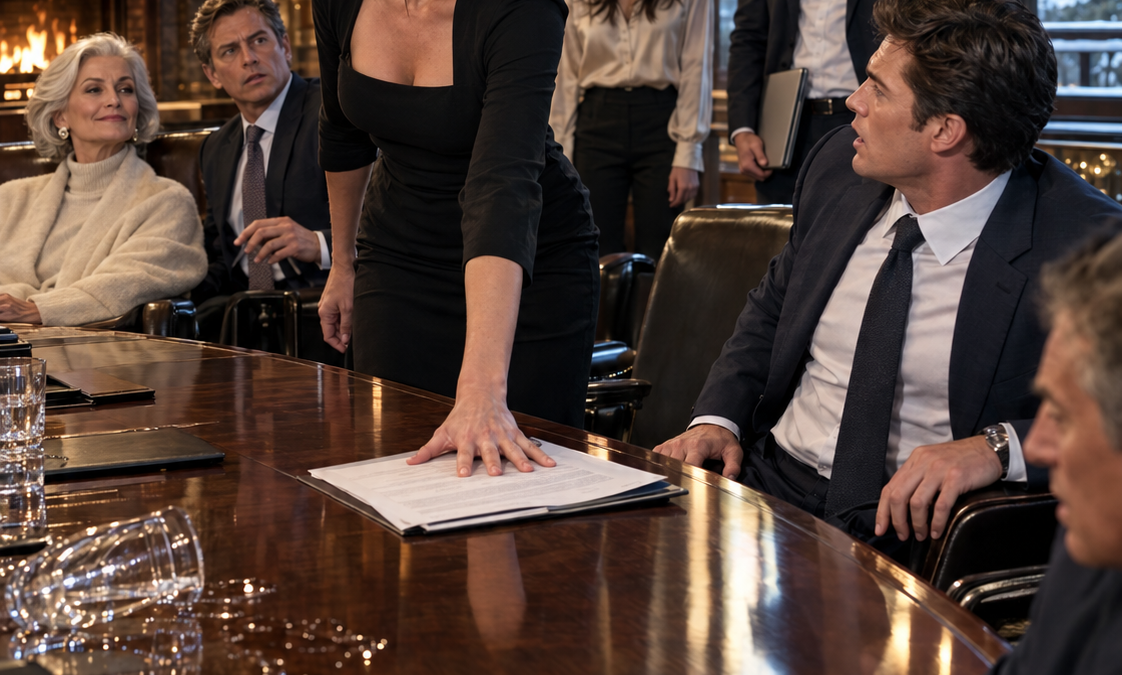
“You always get away with it. That’s not the same thing. And I’m not going to let you get away with it anymore.”
She thought she’d lost everything when her husband tried to sell her birthright. She ended up with more than she ever imagined—and a love she never saw coming.
The pen was already in Julian’s hand when Elena walked into the study.
She’d come down for the financial statements. The resort’s quarterly numbers were due to the bank by Friday, and she’d spent the last three hours reconciling the snowmaking equipment leases with the invoices from the compressor supplier—tedious work that Julian never touched, because Julian didn’t touch anything that didn’t glitter.
But the pen was in his hand, and the document beneath it wasn’t a lease.
“Emergency conservation easement,” she read, the words strange in her mouth. “Water rights transfer. Julian, what—”
He didn’t startle. That was the first thing that told her something was wrong. A man caught doing something innocent startles. Julian simply set the pen down with the precise, unhurried care of a man who’d rehearsed this moment, and looked up at her with the expression he wore for board meetings and charity galas—pleasant, empty, absolutely impenetrable.
“You’re supposed to be at the lodge.”
“The lodge closed at nine.” She stepped closer, and he didn’t move to cover the papers. He didn’t need to. That was the second thing. “What is this?”
“Exactly what it says.” He leaned back in the leather chair—her father’s chair, the one that still smelled faintly of pipe tobacco and cedar—and folded his hands. “The state’s been pressuring the resort corridor to demonstrate environmental stewardship. We’re ahead of the curve. It’s good press, and it protects us from the new watershed regulations coming down from the capital.”
“Protects us.” She picked up the document. The paper was heavy, expensive, the kind of stock used for contracts that were meant to impress. “By transferring our water rights to—” She flipped to the signature page. “Harrow Development Group?”
“Harrow is a respected firm. They’ve done conservation work all over the Rockies.”
“Harrow is our competitor.” Her voice came out steadier than she felt. “They’ve been trying to buy the resort for two years. You know that. You sat in the meetings when they made the offers.”
“I sat in the meetings when we declined the offers.” Julian stood, smoothing his tie. He was handsome in the way of expensive things—precision-cut, well-maintained, engineered to impress from a distance. She’d married him for reasons that had made sense at the time. Her father was dying. The resort was drowning in debt. Julian’s family had money and a reputation for fixing broken things. “This is a different arrangement entirely. Harrow gets the water rights, we get the tax incentives and the environmental credibility. It’s a win.”
“It’s a win for Harrow.” She held up the document. “This transfers our primary water source. The snowmaking, the irrigation, the—Julian, this is the resort’s lifeblood.”
“The state will still allocate us water. We’ll just be buying it back at market rate instead of owning it outright.”
“At market rate.” She heard herself repeating his words, a habit she’d developed over five years of marriage—echoing him while she caught up to what he was actually saying. “Market rate that Harrow controls. Market rate that they can raise whenever they want. You’re handing our competitor the power to shut us down.”
Julian’s expression didn’t change, but something behind his eyes shifted—a door closing, a lock turning. “You’re being dramatic.”
“I’m being accurate.”
“You’re being your father.” The words landed like a slap. “He was always convinced everyone was out to get him, too. And look where it got him. Dead at sixty-two, with a resort that was three months from bankruptcy, and a daughter who—” He stopped himself. Deliberately. The pause was its own kind of cruelty.
“Finish it,” Elena said quietly. “A daughter who what?”
Julian picked up the pen again. “A daughter who doesn’t need to worry about any of this. I’m handling it. Go back to the lodge. I’ll see you at dinner.”
She didn’t move. The document was still in her hand, and she was suddenly, viscerally aware of the date at the top of the page—three days from now. The transfer would be finalized in three days. She’d been married to this man for five years, and he’d been planning to gut her inheritance in three days, and she’d found out by accident, because she’d come down for financial statements he’d never intended to show her.
“Why the emergency framing?” she asked. “If this is such a good deal, why not take it to the board? Why not discuss it with me?”
“Because the board would take six months to deliberate, and by then the regulatory window would have closed. Sometimes you have to move fast.”
“Sometimes you have to move fast,” she repeated. “That’s what you said when you sold the east parcel. And when you restructured the debt. And when you brought in your mother’s investment group.” She set the document down on the desk, carefully, precisely, the way he’d set down the pen. “Every time you move fast, Julian, I lose something. I’m starting to think that’s the point.”
His jaw tightened—the first crack in the facade. “You’re being paranoid.”
“And you’re being generous with my inheritance.”
“It’s not your inheritance anymore.” He said it flatly, without heat, like a fact. Like weather. “It’s our marriage. Our partnership. And I’m making a decision for the good of the whole.”
“The good of the whole.” She looked at the document one more time. Emergency conservation easement. Water rights transfer. Harrow Development Group. Three days. “Whose whole, Julian?”
He didn’t answer.
She left the study without another word, but she took the document with her. He didn’t try to stop her. That was the third thing—the thing that would keep her awake for the rest of the night, staring at the ceiling of the bedroom she no longer felt safe in. He didn’t try to stop her, because he didn’t think she could do anything about it. He’d already won. In his mind, the game was over, and she was just a piece that hadn’t been cleared off the board yet.
She was halfway up the stairs when her phone buzzed.
The message was from an unknown number, and it contained a single line of text:
Your husband isn’t selling water rights. He’s selling you. Ask him about the divorce petition he filed last month.
Elena stood frozen on the staircase, the document clutched in one hand, the phone in the other, and the house—her father’s house, her house, the house she’d grown up in and married in and watched her father die in—settled around her with the quiet, patient creak of old wood.
Three days.
She had three days to figure out what Julian was really doing.
And she had a feeling the water rights were only the beginning.
CHAPTER TWO: The Consultant Who Didn’t Belong
The next morning, Elena didn’t go to the lodge. She drove into town instead, to the small office above the bakery where the resort’s original land deed was stored—along with every other legal document her father had accumulated in forty years of running the place.
She’d expected to be alone. She wasn’t.
The man in the office was tall, dark-haired, with the kind of sharply tailored appearance that screamed corporate money—but his shoes were wrong. Expensive leather, but scuffed at the toes, like he’d been walking through construction sites instead of boardrooms. He was bent over the filing cabinet, and when he heard her footsteps, he straightened with a start.
“Mrs. Ashford.”
“Who are you?”
He had a folder in his hands—her father’s folder, the one labeled Water Rights 1978–Present. “Marcus Chen. I’m the environmental consultant on the Harrow project.”
Elena’s hand tightened on the doorframe. “You’re the man who’s helping my husband sell my resort’s water rights.”
“I’m the man who was hired to validate the conservation claims.” He said it carefully, like a man choosing his words from a minefield. “There’s a difference.”
“Is there?”
Marcus looked at her for a long moment. He had the kind of face that gave nothing away—professional, pleasant, forgettable. But his eyes were tired. The kind of tired that came from not sleeping, from knowing something you shouldn’t know and not being able to un-know it.
“I read your father’s master plan,” he said finally. “The one he submitted to the state in 1992. He proposed a conservation easement himself—but he wanted it structured so the resort retained usage rights in perpetuity. He wanted to protect the water source and the business.”
“I know. I helped him write it.”
“I know you did.” Marcus set the folder down on the desk. “Your husband’s version does the opposite. Harrow gets the rights outright. The resort gets a five-year leaseback, after which they can renegotiate—at Harrow’s discretion.”
Elena felt the floor shift under her. “Five years.”
“Five years.” Marcus met her eyes. “And here’s the part that made me start asking questions. The environmental impact study that justified the emergency designation? It was commissioned by Harrow, written by a firm that Harrow owns, and based on data that I can’t find a source for. I’ve been in this business for fifteen years, and I’ve never seen a study that clean, that conclusive, that—” He stopped.
“That fabricated?”
“I didn’t say that.”
“You didn’t have to.” Elena stepped into the office and closed the door behind her. “Why are you telling me this?”
Marcus was quiet for a moment. Then he pulled a folded piece of paper from his jacket pocket and slid it across the desk. “Because I was hired to validate the deal, not to launder it. And because I found this in the company’s shared drive. Someone deleted it, but the server keeps backups.”
Elena unfolded the paper.
It was a memo. Harrow Development Group letterhead. Internal. Dated three months ago.
Subject: Ashford Resort Acquisition Strategy
Objective: Acquire the Ashford Resort property at below-market value by first securing control of its water rights through a conservation easement. This will render the property functionally unviable, forcing a distressed sale. The environmental framing provides legal cover and public goodwill. Proceed with consultant validation.
Projected acquisition cost: $4.2M
Projected resale value (post-development): $18.7M
She read it twice. Three times. The words didn’t change. The numbers didn’t change. The cool, clinical language—render the property functionally unviable—didn’t change.
“Where did you get this?” she whispered.
“I told you. The shared drive.”
“No—” She looked up at him. “Why are you giving it to me?”
Marcus Chen looked at her with those tired eyes, and for a moment, the professional mask slipped. “Because I’ve spent my whole career trying to do the right thing, and I’m tired of watching people do the wrong thing and call it conservation.” He nodded at the memo. “That’s your proof. If you want to fight this, you’ll need it.”
Elena folded the memo carefully and put it in her purse. Her hands were shaking. She didn’t let herself think about why.
“Thank you,” she said.
“Don’t thank me yet.” Marcus picked up the folder again, tucking it under his arm. “Your husband isn’t the only one involved in this. Harrow has partners. Investors. People who’ve been planning this for a long time. If you go after them, they’ll come after you.”
“Let them.”
Marcus almost smiled. “Your father would have liked you.”
“He would have hated this.” She turned toward the door. “He would have hated that I married the man who did this to us.”
“Maybe.” Marcus’s voice stopped her at the threshold. “But he would have been proud of what you do next.”
She didn’t answer. She walked out into the cold mountain morning, the memo burning in her purse like a coal, and she started to plan.
CHAPTER THREE: The Mother-in-Law’s Warning
Vivian Ashford arrived at the resort that afternoon, unannounced, in a black SUV with tinted windows and a driver who didn’t make eye contact. She swept into the lobby like a weather event—immaculate in cream cashmere, her silver hair swept back in a chignon that didn’t dare move, her eyes scanning the room for imperfections the way a general scans a battlefield.
Elena was at the front desk, reviewing the week’s bookings. She’d been doing that a lot lately—burying herself in the small, concrete tasks of running the resort, because the large, abstract tasks (saving it from her husband) required a kind of strategic thinking she wasn’t sure she was capable of yet.
“Elena.” Vivian didn’t kiss her cheek. She never did. “I need to speak with you. Privately.”
“Of course.” Elena led her to the small office behind the front desk—not the study, never the study again—and closed the door. “What’s this about?”
“Julian tells me you found the water rights document.” Vivian sat in the chair across from the desk, crossing her ankles with the precision of a woman who’d been trained to occupy space gracefully. “He’s concerned you misunderstood its purpose.”
“I understood it perfectly.”
“Did you?” Vivian’s eyes were pale blue, almost colorless, and they held Elena’s without blinking. “Because from what Julian tells me, you’ve been asking questions. Talking to people. Making accusations.”
“I haven’t accused anyone of anything.”
“Not yet.” Vivian smoothed an invisible wrinkle from her sleeve. “But you’re thinking about it. I can see it in your face. You have that look—the same look your father had when he was about to do something stubborn and self-destructive.”
Elena’s hands tightened on the edge of the desk. “My father built this resort. He loved it. He would never have—”
“Your father nearly lost everything.” Vivian’s voice was calm, almost kind, the way a doctor delivering bad news is kind. “Three times. Do you remember? The recession in ’08. The avalanche in ’15. The lawsuit in ’19. Each time, he refused help. Each time, he barely survived. And then he died, and left you with a property that was hemorrhaging money and a mortgage that was due in six months.” She paused. “And then Julian saved you.”
“Julian married me.”
“Julian married you and saved you. The two aren’t mutually exclusive.” Vivian leaned forward slightly. “I know you don’t like me, Elena. I know you think I’m cold, and controlling, and that I’ve never approved of you. And you’re right about all of it. But I’m also the only person in this family who will tell you the truth.”
“Which is?”
“That you are in over your head.” Vivian said it without malice—just a fact, laid on the table between them. “You grew up here, in this little mountain town, running a little resort that your father built with his own hands. You know how to manage a front desk and balance a budget and charm a guest who’s complaining about the thread count of the sheets. You do not know how to fight a corporation. You do not know how to fight Harrow. And you certainly do not know how to fight my son.”
“I’m not fighting Julian.”
“Aren’t you?” Vivian stood, smoothing her skirt. “He filed for divorce last month, Elena. Did he tell you that?”
The words hit Elena like a physical blow. She’d known—the text message had told her—but hearing it from Vivian, in that calm, measured voice, made it real in a way the anonymous message hadn’t.
“No,” she said. “He didn’t tell me.”
“He didn’t think he needed to. The petition is sealed, and he was planning to withdraw it once the water rights deal went through. It was leverage—a way to ensure your cooperation.” Vivian’s expression flickered, just for a moment, with something that might have been distaste. “I told him it was a mistake. I told him you’d find out. But Julian has never been good at listening to me. He gets that from his father.”
“Why are you telling me this?”
“Because I want you to understand the situation you’re in.” Vivian moved toward the door, then paused, her hand on the knob. “My son is going to take this resort from you. He’s going to take it, and he’s going to sell it to Harrow, and he’s going to walk away with a profit that will make him one of the wealthiest men in the state. And there is nothing you can do to stop him—unless you accept my help.”
Elena stared at her. “Your help.”
“I have my own reasons for wanting to keep this property in the family.” Vivian’s voice was cool, but there was something underneath it—something hard and bitter, like a stone at the bottom of a well. “Julian doesn’t know about them. If you want to know, be at my house tomorrow at six. Come alone. And bring the document you took from the study.”
She left without waiting for an answer.
Elena sat alone in the small office, the silence pressing in around her, and thought about her father. He’d died in this building. In the study, actually—the one Julian had claimed as his own. She’d found him there, slumped over his desk, the pen still in his hand. The doctors said it was a heart attack. She’d always believed them.
Now she wondered.
The phone buzzed again. The same unknown number.
Vivian knows more than she’s telling you. Ask her about the 1987 deed transfer. Ask her about her sister.
Elena stared at the message, and the pieces she’d been trying to assemble shifted, rearranged, formed a new and more complicated shape.
Her aunt. Her father’s sister, who’d died before Elena was born—the one no one talked about, the one whose name had been carefully removed from the family Bible, the one whose photograph Elena had found in a box in the attic when she was twelve, a beautiful woman with dark hair and a sad smile, standing in front of the lodge the year it opened.
She’d asked her father about it once. He’d closed the box, and told her some things were better left in the past, and never mentioned it again.
Elena stood up. She put on her coat. And she went to find out what her mother-in-law was really after.
CHAPTER FOUR: The Deed in the Attic
Vivian’s house was a mansion on the edge of town—new money pretending to be old, all stone and glass and heated driveways that melted the snow before it could accumulate. Elena parked her truck in the circular drive and sat for a moment, watching the house, trying to remember what she knew about the Ashford family.
Not much. Julian had always been vague about his family history—his father had died when he was young, his mother had raised him alone, they’d moved to the mountains when he was a teenager. It had seemed like a tragic story, the kind of thing that explained his ambition, his drive, his need to prove himself. She’d felt sorry for him.
Now she wondered if the vague history was deliberate.
Vivian met her at the door, wearing the same cream cashmere as before, as if she’d simply frozen in place since their conversation at the resort. “You came. I wasn’t sure you would.”
“I want answers.”
“Then come in. And close the door—this house has too many windows.”
She led Elena to a library—floor-to-ceiling bookshelves, a fire crackling in the grate, a single leather chair positioned before the desk. It was a room designed for intimidation, and it worked. Elena felt small, standing in the center of it, the memo from Marcus Chen burning in her purse like a secret she wasn’t ready to share.
“Sit down.”
“I’d rather stand.”
Vivian’s mouth twitched—annoyance, or maybe respect. “Suit yourself.” She sat in the chair, folding her hands in her lap, and looked up at Elena with that pale, unblinking gaze. “You found the messages on your phone. The ones telling you about the divorce. The ones telling you to ask about the 1987 deed transfer.”
Elena’s heart stopped. Then started again, faster. “How do you know about that?”
“Because I sent them.”
The silence stretched between them like a wire pulled tight.
“You,” Elena repeated. “You sent me anonymous messages about your own son’s divorce petition.”
“I sent you anonymous messages to keep you from walking into a trap.” Vivian’s voice didn’t change, but something behind her eyes shifted—something tired, and bitter, and old. “I’ve been watching Julian make mistakes for thirty years. I’ve cleaned up after him, covered for him, lied for him. And I am tired. I am tired of watching him destroy everything his father built.”
“His father.” Elena seized on the word. “Julian’s father died when he was young. That’s what he told me.”
“Julian’s father died when he was twenty-three.” Vivian’s voice was flat. “I lied to him about that, too. I told him his father abandoned us. I told him we were alone in the world, and we had to fight for everything we got. It wasn’t true. His father—my husband—was a good man who drowned trying to save a stranger on a river in Colorado. But that story didn’t fit the narrative I needed Julian to believe.”
“What narrative?”
“The narrative that made him ruthless.” Vivian stood and walked to the window, looking out at the snow-covered mountains. “I made him into what he is, Elena. I made him cold, and calculating, and willing to do whatever it took to win. And now he’s turned that ruthlessness against you, and I have to live with the fact that I created the weapon.”
Elena’s mind was racing, trying to fit the pieces together. “The 1987 deed transfer. What does it have to do with any of this?”
Vivian turned back to face her. “The resort was never your father’s. Not entirely. He had a partner. A silent partner. My sister.”
“Your sister.”
“Catherine Ashford. My husband’s sister.” Vivian’s voice was steady, but her hands were clasped tight in front of her. “She married your father in 1985. They built the lodge together. They were partners in every sense. And when the resort started to fail—when the debt piled up and the bank came calling—she took out a second mortgage on the property to save it. Without telling your father.”
Elena’s head was spinning. “I don’t—my father never mentioned a second mortgage. He never mentioned a wife before my mother. He never—”
“He never mentioned it because it ended badly.” Vivian’s voice dropped. “Catherine died in a car accident in 1989. Her will left her share of the resort to her husband—your father—but only if he never sold the property outside the family. If he did, the share reverted to her estate. Which means—”
“It reverted to you,” Elena finished. “Her sister. You own a share of the resort.”
“I own thirty percent.” Vivian met her eyes. “I’ve owned it for thirty-five years. And I’ve been waiting, all this time, for the right moment to claim it.”
“Then why haven’t you?”
“Because your father was a good man, and I couldn’t bring myself to destroy him.” Vivian’s voice cracked, just slightly. “And because I didn’t need the money. I had my own investments, my own properties. The resort share was a grudge, not a necessity. But now—” She stopped.
“Now Julian is trying to sell it,” Elena said slowly. “And if he sells it to Harrow, the share reverts to you. You get thirty percent of the sale price. And you become a partner with Harrow in developing the property.”
Vivian nodded. “That’s what Julian thinks will happen. But he’s wrong.”
“How?”
“Because I’m not going to let him sell it.” Vivian crossed the room and stopped in front of Elena, close enough that Elena could smell the lavender of her perfume. “I’m going to stop the deal. And I need your help to do it.”
Elena stared at her. “Why would you help me? You just told me you’ve been waiting for this moment for thirty-five years. You just told me you made Julian into what he is. Why should I trust you?”
“Because I’m not doing this for you.” Vivian’s eyes were hard, bright, and utterly unreadable. “I’m doing this for Catherine. My sister loved this resort. She loved your father. And when she died, he never recovered—he married your mother because he needed someone to take care of him, and he spent the rest of his life trying to keep the place alive because it was the last piece of her he had left. And Julian—” She stopped, her jaw tightening. “Julian is going to destroy it. He’s going to sell it to Harrow, and they’re going to turn it into a private club for billionaires, and everything Catherine and your father built will be gone. I can’t let that happen.”
“You can’t let it happen.” Elena’s voice was cold. “But you’ve been helping Julian for months. You’ve been at the meetings. You’ve been advising him. You could have stopped this at any point, and you didn’t.”
“I know.” Vivian’s voice was barely a whisper. “I know. And I’ll have to live with that.”
They stood in silence, the fire crackling in the grate, the snow falling softly outside the window. And then Elena made a decision—the first real decision she’d made since she’d found the document in the study. She reached into her purse and pulled out the memo.
“Then help me now,” she said. “Because I have proof that Harrow’s environmental study was fabricated. And I have a witness who’s willing to talk.”
Vivian took the memo, read it, and for the first time since Elena had known her, she smiled. It wasn’t a warm smile. It was a smile like a knife.
“Good,” she said. “Then we have work to do.”
CHAPTER FIVE: The Enemy of My Enemy
The next three days were a blur.
Elena didn’t sleep. She didn’t eat. She sat in the small office behind the front desk and made calls—to lawyers, to accountants, to every business contact her father had ever had, looking for someone who could help her fight the water rights transfer. Most of them didn’t answer. A few answered and said they couldn’t get involved. One—an old friend of her father’s, now retired in Arizona—listened to the whole story and then said, quietly, I always knew Julian was a snake. Your father knew it too. He told me, the week before he died.
That stopped her cold. “He told you what?”
He told me he was worried about you. He said Julian was pushing for control of the resort, and he didn’t trust him. He said— The old man paused. He said he was going to change his will. Cut Julian out. But then he died, and the will was never changed, and Julian got everything.
Elena sat with that for a long time after she hung up. Her father had been trying to protect her. He’d seen what Julian was, and he’d tried to do something about it. And then he’d died—in the study, with a pen in his hand, the same study where Julian now sat planning to sell the resort out from under her.
She didn’t let herself think the thought. Not yet. But she filed it away, in the back of her mind, and kept it close.
Marcus Chen called twice, offering to help, offering to testify, offering to do whatever was needed to stop the deal. She told him to be at the resort Friday morning—the day the transfer was scheduled to go through—and to bring everything he had. He agreed without hesitation.
Vivian spent the three days in her house, making calls of her own—calls to the state regulators, to the environmental board, to the lawyers who’d handled Catherine’s estate thirty-five years ago. She called Elena every few hours with updates, each one more urgent than the last.
The state is asking questions. The regulators are asking questions. Harrow is getting nervous.
Good. Let them.
On Thursday night, the night before the transfer, Julian found her in the lobby of the lodge. She was sitting by the fire, a cup of coffee going cold in her hands, watching the snow fall through the tall windows. He sat down across from her without asking permission.
“You’ve been avoiding me.”
“I’ve been busy.”
“Busy doing what?” His voice was carefully casual. “I’ve heard rumors. You’ve been making calls. Talking to people. Asking questions about the water rights.”
“People are talking to me too.” She looked at him—really looked, for the first time in years. She saw the handsome face, the expensive suit, the polished exterior. She saw the mask he’d been wearing since the day she met him. And underneath it, she saw something she hadn’t noticed before: fear. “They’re telling me things you should have told me yourself.”
Julian’s expression didn’t change. “What kind of things?”
“About the divorce petition.” She set her coffee down. “About the fact that you filed it a month ago, and didn’t bother to mention it to me. About the fact that you were planning to withdraw it once the deal went through—as a favor, if I cooperated.”
“Who told you that?”
“Does it matter?”
“It matters because whoever told you is lying.” His voice was flat, but his hands were fists on his knees. “I filed the petition as a precaution. The marriage has been struggling for years, and I needed to protect my assets. But I never intended to go through with it. I love you, Elena. I’ve always loved you.”
She looked at him, and felt nothing. That was the strangest part. A year ago—a month ago—those words would have broken her. Now they bounced off her like stones off a wall.
“You love me,” she repeated. “And that’s why you’re selling my resort to my competitor. That’s why you’re destroying everything my father built. That’s why you’ve been lying to me for months—maybe for years—about the deals you’ve been making behind my back.”
“Everything I’ve done has been for us.”
“There is no us.” The words came out flat, final. “There hasn’t been an us for a long time. I just didn’t want to see it.”
Julian stood. For a moment, he looked like he was going to say something else—to argue, to plead, to do something. Then his face closed, like a door slamming, and he was once again the man she’d married: cold, controlled, absolutely certain of his own rightness.
“The transfer goes through tomorrow at nine,” he said. “I expect you to be there. It’s a formality, but it’s an important one.”
“I’ll be there.”
“Good.” He turned toward the door, then paused. “Elena.”
“What?”
“You should know—whatever you’re planning, whatever you’re trying to do—it won’t work. I’ve been playing this game a long time. I’ve never lost.”
She watched him walk out into the snow, and she smiled. It was a small smile, and not a nice one.
“Neither have I,” she whispered to the empty room. “You just never noticed.”
CHAPTER SIX: The Nine O’Clock Meeting
The conference room at the resort was full.
Julian had invited everyone: the board of directors, the resort’s attorney, a representative from the bank, two members of the state environmental board, and—most importantly—three executives from Harrow Development Group, including the CEO, a man named Richard Harrow who looked like a retired football player and smiled like a shark.
Elena sat at the far end of the table, in the chair her father had always claimed as his own. Julian sat at the head, flanked by Harrow’s people, the document in front of him, the pen already in his hand.
“Thank you all for coming,” Julian said, and Elena thought, He’s nervous. He’s hiding it, but he’s nervous. “As you know, this transfer has been months in the making. It represents a significant step forward for the resort’s environmental sustainability goals, and—”
“Before we proceed,” Elena said, “I’d like to ask a question.”
Julian’s eyes flickered to her. “This isn’t the time for questions. We’re here to execute the transfer.”
“I understand. But I have a document I think everyone should see first.” She pulled the memo from her folder and slid it across the table. “This is an internal memo from Harrow Development Group, dated three months ago. It outlines the company’s strategy for acquiring this resort—not through a conservation easement, but through deliberate sabotage of our water rights. The environmental framing, according to this memo, is ‘legal cover.'”
Silence.
Richard Harrow picked up the memo. Read it. Set it down. His face was unreadable.
“This is a fabrication,” he said.
“It’s from your company’s shared drive,” Marcus Chen said from the doorway. He’d arrived five minutes ago, carrying a laptop and a folder full of documents. “I have the metadata to prove it. Date, time, author—all verifiable.”
Julian was very still. “Elena. What do you think you’re doing?”
“Exactly what you told me to do.” She stood, and the movement sent a ripple through the room—the lawyers shifting, the board members exchanging glances, the Harrow executives reaching for their phones. “I’m protecting the resort. I’m protecting my father’s legacy. And I’m protecting myself from a man who’s been lying to me for five years.”
“This is absurd.” Julian’s voice was steady, but his hands were shaking. “This memo is a forgery. Elena has been—she’s been unstable for months. She doesn’t know what she’s—”
“Where’s the divorce petition, Julian?” The question came from Vivian, sitting in the corner, her cream cashmere immaculate, her pale eyes fixed on her son. “The one you filed last month. The one you were planning to withdraw once the deal went through. Did you think no one would find out?”
Julian’s face went white.
“You told me,” he said slowly, looking at Vivian, “that you were on my side.”
“I was never on your side.” Vivian stood, smoothing her skirt. “I was waiting. Waiting for the right moment to stop you. And this—” She gestured at the room, at the assembled board and lawyers and Harrow executives—”this is the right moment.”
The next hour was chaos.
Richard Harrow tried to leave. One of the board members blocked the door. The lawyers started arguing—about the memo, about its provenance, about whether the transfer was legally binding. The state environmental board representatives, who had been silent until now, began asking pointed questions about the environmental study that had justified the emergency designation.
And through all of it, Elena stood at the far end of the table, watching her husband’s empire crumble.
“This isn’t over,” Julian said, low enough that only she could hear. “I don’t know what you think you’ve accomplished, but this isn’t over.”
“You’re right,” she said. “It isn’t.” She reached into her folder and pulled out a second document. “This is the original 1987 deed transfer. The one that gave my father full ownership of the resort—subject to a clause that says he can never sell it outside the family. That clause is still active. If you try to sell it to Harrow, the sale is void. And thirty percent of the property reverts to Catherine Ashford’s estate.”
Julian stared at the document. Then at Vivian. Then back at Elena.
“You—” He stopped. Started again. “You planned this. Both of you. You’ve been planning this.”
“We’ve been noticing,” Elena said. “You’ve been so busy covering your tracks that you forgot to check the foundation. My father’s will. The deed. The fact that your mother—your own mother—was watching every move you made.”
“Your mother has been watching you for thirty years,” Vivian said quietly. “And I have to say, Julian—I’m not impressed.”
He looked at her with something like hatred. “You’ll regret this.”
“I’ve regretted a lot of things in my life.” Vivian’s voice was calm, almost gentle. “But this isn’t one of them.”
The meeting broke up in disarray. Harrow’s people left first, followed by the board members, followed by the lawyers. The last to go was Julian, who stopped at the door and turned back to look at Elena.
“I’ll fight this,” he said.
“I know.”
“I’ll fight it, and I’ll win, because I always win.”
“No.” Elena shook her head. “You always get away with it. That’s not the same thing. And I’m not going to let you get away with it anymore.”
He stared at her for a long moment. Then he turned and walked out.
The door closed behind him, and Elena stood in the empty conference room, her heart pounding, her hands shaking, and for the first time in five years, she felt like she could breathe.
 [Tap here for the Next Part ]


