“If I wanted you gone, you’d be gone before you finished that sentence. The fact that you’re still here means I’m letting you stay.”
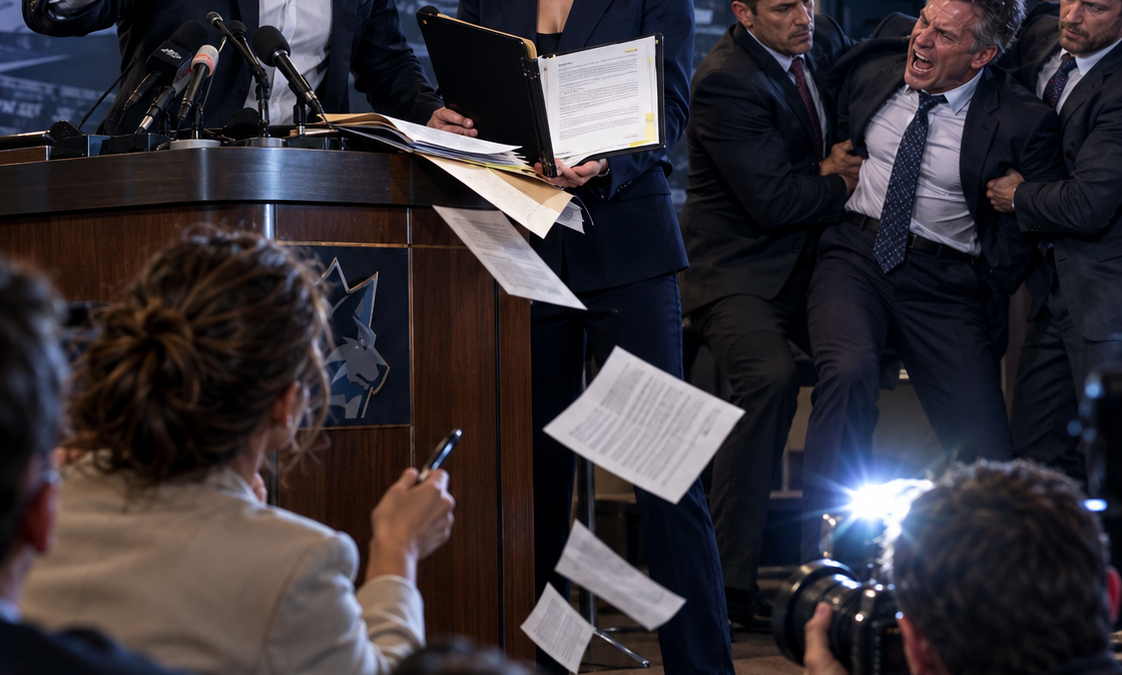
“If I wanted you gone, you’d be gone before you finished that sentence. The fact that you’re still here means I’m letting you stay.”
She was sent to destroy him. She stayed to save him — and built an empire of her own in the process.
Mikhail Volkov didn’t look up when the conference room door opened. He kept his eyes on the photographs fanned across the mahogany — eight glossy prints of him, taken from a distance, each one showing him in what any reasonable investigator would call a compromising position with men who had reputations the league preferred not to discuss in daylight.
“I assume you’ve seen these,” the woman said.
“Twice now.” He finally raised his gaze. She was younger than he’d expected from her file — early thirties, dark hair pulled back tight enough to look severe, wearing a navy suit that had been tailored for someone with broader shoulders. She held herself like a prosecutor, which she had been, once. “The first set arrived Tuesday. These are a better print quality.”
Her name was Elena Vasquez. The league had sent her. The league thought it was in charge.
“Then you know why I’m here.” She didn’t sit. She stood at the far end of the table, three chairs between them, one hand resting flat on a leather portfolio like she might need to grab it and run. Smart instinct, in this building.
“Tell me anyway.” He picked up one of the photographs — him, outside a restaurant in Brighton Beach, shaking hands with Dmitri Orlov, a man the FBI had been trying to put in a cage for eleven years. “I like hearing people say it out loud.”
Elena’s jaw shifted. Not much. A flicker of irritation that she smoothed over fast. “The league has flagged eleven Providence Falcons games over the past two seasons for irregular betting patterns. The same eleven games where your lineup decisions deviated most sharply from your own established coaching philosophy. The board wants to know why.”
“Vasquez.” He said her name slow, tasting it. “You’ve been on this assignment for six days. You’ve read the betting reports, you’ve watched the game footage, and you’ve built a theory that fits the shape of what you already believe about men like me. But you haven’t asked the only question that matters.”
“And what’s that?”
“Why would a man fix games in a league where he already owns the broadcast rights, the arena, and three of the eight teams’ debt?”
She was quiet for a moment. The air conditioning hummed. Somewhere down the hall, a phone rang and stopped.
“Because the money isn’t the point,” she said finally. “It never is with your family.”
Mikhail set the photograph down. He’d built the Falcons from a debt-ridden franchise into a three-billion-dollar asset. He’d done it while his father was dying and his brother was skimming from the shipping side and his mother was hosting charity galas for people who would have sold her out for a single favorable headline. He had not slept a full night in four years.
He did not tell Elena Vasquez any of this. He told her nothing.
“You have access to my office, my files, my staff,” he said. “You have a desk on the fourth floor that I’ve been told cost eleven thousand dollars to furnish. Use it. Interview everyone. Dig through everything. But if you’re going to accuse me of something, bring me better photographs than these.”
He pushed the stack toward her. One slid off the edge and fluttered to the floor. Neither of them moved to pick it up.
“That’s not how this works,” Elena said. “I don’t clear my findings with you. I report to the league.”
“Then report. Just don’t mistake patience for permission.” He stood. He was taller than her, broader, and he watched her register the fact without flinching — watched her file it away as a data point rather than a threat. Interesting. Most people flinched. “I own the building you’re standing in. I own the team you’re investigating. I sit on the board that signs your checks. If I wanted you gone, you’d be gone before you finished that sentence. The fact that you’re still here means I’m letting you stay.”
“For now,” she said.
“For now,” he agreed.
Elena Vasquez had spent nine years learning how to read men who thought they were unreadable. Three years in the Eastern District, two in the league’s integrity division, four before that working fraud cases no one remembered. She had seen billionaires cry on the stand and schoolteachers steal from their students and a hockey coach who fixed eleven games with a burner phone and a cousin in Atlantic City.
But she had never seen anyone like Mikhail Volkov.
He wasn’t lying. That was the problem. She had been in the room with him for six minutes and she already knew he wasn’t lying — about the photographs, about the games, about anything. His record was clean on paper, but his family’s record was written in a language that didn’t appear on paper at all. The Volkov name meant something in this city. It meant buildings that rose from nothing and deals that closed at midnight and men who walked into rooms and didn’t walk out. It meant his father’s funeral had been attended by two senators, three NHL owners, and a man the Bureau had been tracking since before Mikhail was born.
And it meant the photographs. The league had received them eight days ago, anonymous, with a typed note that said Ask Volkov about the second period. Elena had spent the last four days trying to figure out what the second period meant — which game, which night, which of the eleven flagged contests — and she had come up with nothing but questions.
She gathered the photographs, straightened them, and slid them into her portfolio. The one on the floor she left where it was, faceup, a small act of defiance she wasn’t sure he noticed.
He noticed everything.
“I’ll need access to your personal communications,” she said. “Phone records, email, calendar. Complete transparency.”
“You’ll have it.” He walked toward the door, then stopped with his hand on the frame. “One thing, Counselor.”
“I’m not a counselor anymore.”
“You are in this building.” He turned. The light from the hallway caught half his face and left the other half in shadow. “Whatever you find — and I suspect you’ll find something — bring it to me first. Not the league. Not the board. Me.”
“Why would I do that?”
“Because the people who sent you those photographs are the same people who’ve been bleeding this franchise dry for six years. And because if you go public with what you’re looking for before you understand what you’re looking at, you’ll destroy the only evidence that could convict them.”
“Who’s them?”
He held her gaze for a long moment. Long enough that she felt the quiet shift in the room — the air going heavy, the stakes recalibrating.
“That,” Mikhail Volkov said, “is what you’re here to find out.”
He left. The door closed behind him with a soft click that sounded louder than it should have.
Elena stood alone in the conference room with the photographs and the questions and the distinct, uncomfortable feeling that she had just been outmaneuvered by a man she couldn’t yet prove had done anything wrong. She pulled out her phone and typed a single note into her case file.
Subject is either innocent or the best liar I’ve ever met. Recommend proceeding with extreme caution.
Then she called her contact at the league office and told them she needed another week.
Chapter 2: The Girl in the Ninth Row
Three days later, Elena was in the bowels of the Providence Falcons’ arena, watching game footage in a room that smelled like stale coffee and industrial carpet cleaner. The team’s video coordinator, a nervous man named Pete who blinked too often, had set her up with a laptop and a playlist of the eleven flagged games, and she had been watching them in order of most suspicious to least.
The second period thing was bothering her.
She had watched the footage from every angle — broadcast, in-arena, two camera feeds the league didn’t know the team possessed — and she couldn’t see it. Every flagged game showed the same pattern: a lineup shift in the second period, a star player benched for reasons that weren’t in the official injury report, a rookie given ice time that made no sense given the score. On paper, it looked like incompetence or corruption. On paper, it looked like a man throwing games.
But on video, the players didn’t move like men who were losing on purpose.
Elena had covered game-fixing before. She knew the tells — the half-second hesitation before a check, the pass that went to the wrong stick, the shot that hit the post when the net was wide open. These Falcons didn’t have those tells. They played hard. They played angry. They lost anyway, and they lost in ways that looked like bad luck rather than bad faith.
Which meant either the fixing was more sophisticated than anything she’d ever seen, or she was looking at the wrong crime.
She rewound the tape again. Second period, game seven of the flagged stretch — a 4–2 loss to Toronto that had ended the Falcons’ playoff hopes. Mikhail Volkov was in his box, high above the ice, and the broadcast camera had caught him three times: once at the start of the period, arms crossed, expression unreadable; once midway through, leaning forward with his elbows on his knees; and once at the end, after the final goal, when he had stood and walked out before the horn sounded.
She paused on the third image. His face was angled away from the camera, but his shoulders were wrong — tight, rigid, like a man holding himself back from something.
She had seen that posture before. In courtrooms. In interrogation rooms. In the mirror.
It was the posture of someone who knew exactly what was happening and couldn’t do a damn thing to stop it.
Her phone buzzed. A text from an unknown number.
Game 7, second period, 8:42 remaining. Look at the ninth row.
She stared at the screen. Then she looked around the video room — Pete was gone, the door was closed, and she was alone with the footage and a message that had come from someone who knew she was watching.
She rewound the tape. Found the timestamp. Zoomed in on the ninth row.
A woman. Dark hair, red coat, sitting alone in a section that was otherwise empty. She was looking at her phone, not the ice, and she stayed that way for the entire two minutes of footage Elena could access. When the camera panned away and came back, the woman was gone.
Elena took a screenshot. Then she texted back.
Who is this?
The reply came fast.
Someone who wants the same thing you do. Check the coat. It’s the same one from the photographs.
She pulled up the images the league had received — the anonymous ones, the ones with Mikhail and Dmitri Orlov outside the Brighton Beach restaurant. In the background of the third photograph, barely visible through the window glass, a woman in a red coat was sitting at a table.
Elena’s heart rate kicked up. She saved both images side by side. The coat matched. The hair matched. The woman in the ninth row was the same woman who had been watching Mikhail Volkov three days before the league received the photographs that started this entire investigation.
She didn’t know who the woman was. She didn’t know what the red coat meant. But she knew one thing with the cold certainty of a prosecutor who had learned to trust her instincts:
Someone was playing her. And she was going to find out who.
Chapter 3: What the Owner Wants
Mikhail Volkov’s office occupied the entire top floor of the Falcons’ practice facility, a glass-and-steel box that overlooked the ice from behind a wall of tinted windows. Elena had been summoned there at seven in the morning, which she assumed was a power move until she arrived and found him already three hours into his day, sleeves rolled up, reading a stack of documents that looked like shipping manifests.
“Sit,” he said, without looking up.
She sat. She had decided on the drive over that she would not let him dictate the rhythm of this conversation, and she had already failed in the first ten seconds.
“You’ve been busy,” he said. “Pete tells me you’ve watched all eleven games. Twice.”
“Pete tells you a lot of things.”
“Pete is loyal. It’s one of his better qualities.” He set the manifests aside and fixed her with that flat, assessing look she was starting to recognize. “What did you find?”
“Nothing that clears you.”
“That’s not what I asked.”
Elena opened her portfolio and laid out the two screenshots — the red-coated woman in the ninth row, the same woman in the background of the photographs. She watched his face as he looked at them. Watched for the flicker of recognition, the tightening around the eyes, the micro-expression that would tell her whether he knew who she was.
He gave her nothing. But his hands, resting on the desk, went very still.
“Where did you get these?” he asked.
“Anonymous tip.”
“From who?”
“I don’t know. They texted me from a burner. But they knew I was watching the footage. They knew which game, which period, which row. That’s not a random source. That’s someone inside your organization.”
Mikhail leaned back in his chair. The leather creaked. Outside the window, a Zamboni was making slow, methodical passes across the ice, erasing the previous day’s practice like it had never happened.
“Her name is Irina Sokolova,” he said.
“You know her.”
“I know of her. She’s my brother’s wife.”
Elena felt the pieces shift. “Your brother. Alexei.”
“Alexei runs the shipping side of the family business. He’s been angling for control of the Falcons for three years. My father left the team to me in his will, but the will had a clause — if the league ever found evidence of misconduct, the team reverts to the next eligible heir. Which is Alexei.”
“Misconduct like match-fixing.”
“Misconduct like anything.” Mikhail’s voice was flat, but there was something underneath it, a current of cold anger that made the hairs on Elena’s arms stand up. “The photographs, the betting patterns, the anonymous tips — it’s all designed to trigger that clause. Someone is building a case that I’m dirty, so the team goes to Alexei, and Alexei sells it to a holding company in the Caymans that’s been trying to buy into the league for a decade.”
“And Irina is the one building the case.”
“Irina is the one who benefits if it succeeds. My brother’s been looking for a way to get rid of me since before our father was in the ground.” He picked up one of the screenshots, studied it. “The red coat was a gift. From Alexei. Anniversary present, two years ago. She wears it everywhere. She wants to be seen.”
“Then she’s not very good at being subtle.”
“She doesn’t need to be. She just needs to be believed.” He set the screenshot down. “You’re going to have to decide, Counselor, whether you’re investigating me or investigating whoever’s trying to destroy me. You can’t do both.”
Elena stood. She gathered her screenshots and slid them back into her portfolio, aware of his eyes on her the whole time — not predatory, not even particularly interested, just watchful in a way that made her feel like every move she made was being catalogued for future reference.
“I’m investigating the truth,” she said. “Wherever it leads.”
“That’s a nice answer. It’s also a dangerous one.” He stood as well, and for a moment they were both on their feet, facing each other across the desk, the morning light cutting between them. “The people who sent you those photographs don’t care about the truth. They care about winning. If you get in their way, they’ll destroy you too.”
“Is that a threat?”
“No.” He walked past her toward the door, close enough that she caught the faint scent of cedar and something sharper underneath. “It’s the only honest thing anyone in this building has said to you since you arrived.”
He opened the door. In the hallway beyond, a young woman in a Falcons hoodie was waiting with a tablet clutched to her chest, looking nervous.
“Mr. Volkov, the league called. They want to schedule a formal interview.”
“Tell them I’m available Thursday.”
“She said it was urgent.”
“Then tell them Thursday is urgent.” He glanced back at Elena, and something flickered in his expression — amusement, maybe, or warning. “Ms. Vasquez will be there. She can ask her questions then.”
The door closed. Elena stood alone in the office, surrounded by glass and ice and the quiet hum of a building that belonged to a man she couldn’t read, and she realized she had just been given something she hadn’t asked for.
An ally. Or a trap.
She wasn’t sure which one yet.
Chapter 4: The Second Period
The formal interview took place in a conference room at the league’s New York office, a sterile space with beige walls and a table that had been designed to make everyone sitting at it feel equally small. Elena sat on one side with her supervisor, a man named Gerald who had been in the integrity division for twenty years and had the weary patience of someone who had seen every kind of corruption and stopped being surprised by any of it.
Mikhail sat across from them with his lawyer, a silver-haired woman named Catherine who looked like she could gut a person with a single question.
For two hours, they went through the flagged games one by one. Gerald asked the questions. Elena took notes. Mikhail answered everything with the same flat calm, offering explanations that were technically plausible but emotionally empty — lineup decisions based on player fatigue, matchups, strategic rest before playoffs. Nothing that would hold up in a court of law, and nothing that would collapse under scrutiny either.
It was the perfect defense. It was also, Elena realized, a performance.
Because she had watched those games. She had seen the second-period shifts. And she had noticed something that Gerald hadn’t — something that had been nagging at her since her first day in the video room.
The suspicious lineup decisions always happened in the second period. Never the first, never the third. And in every game where the lineup shifted, the Falcons’ opponent scored within four minutes.
“You’re very prepared,” Gerald said, closing his folder. “Most people in your position would be sweating.”
“I’ve been investigated before,” Mikhail said. “It’s a cost of doing business.”
“Has the league ever found anything?”
“Not yet.”
“Not yet.” Gerald repeated the words like he was tasting them. “That’s an interesting way to put it.”
“It’s an honest way to put it.” Mikhail leaned forward, and Elena saw the shift in his posture — the slight loosening of his shoulders, the way his hands opened on the table. He was about to do something. She didn’t know what. “You’ve been asking me questions for two hours. Let me ask you one.”
Gerald’s eyebrows rose. “Go ahead.”
“Why did the league ignore the same betting patterns from three other teams last season?”
The room went very quiet. Catherine, the lawyer, put a hand on Mikhail’s arm, but he shook it off.
“The Carolina Hurricanes had a seventeen-game stretch with identical irregularities,” he said. “The Edmonton Oilers had fourteen. Both were flagged by your own monitoring system. Both investigations were closed within a week. No interviews. No formal review. Nothing.”
Gerald’s face had gone still. “Those investigations were closed for lack of evidence.”
“Those investigations were closed because the owners of those teams sit on the same broadcast committee that controls your division’s budget.” Mikhail’s voice was soft, but it carried. “I’ve been waiting six months for someone to ask me why my games were flagged and theirs weren’t. You never did. You came straight for me.”
Elena’s pen had stopped moving. She was watching Gerald now, watching the way his jaw tightened and his eyes flicked to the folder in front of him.
“The league takes all reports of irregularity seriously,” Gerald said.
“Then investigate the Hurricanes. Investigate the Oilers. And when you’re done, come back and tell me if you still think I’m the problem.”
He stood. Catherine stood with him. The interview was over, and they all knew it.
“I’ll show myself out,” Mikhail said.
He walked past Elena’s chair. She didn’t look up, but she felt him pause — just for a second, just long enough for her to catch the edge of his voice, pitched low enough that only she could hear.
“Thursday. My office. Bring the screenshots.”
Then he was gone, and Elena was left with a supervisor who wouldn’t meet her eyes, a folder full of questions, and the growing certainty that the case she had been sent to build was not the case she was actually going to solve.
Chapter 5: The Numbers Don’t Lie
The Falcons’ analytics department was housed in a windowless room on the second floor, staffed by three people who looked like they hadn’t seen sunlight in weeks. The lead analyst, a woman named Priya who spoke in the clipped shorthand of someone who had been explaining complicated things to skeptical men for her entire career, pulled up the data Elena had requested without asking why.
“Second-period goal differential,” Priya said, pointing at a line graph that showed a sharp decline across eleven specific games. “It’s the only statistical anomaly that correlates with the betting patterns. First period looks normal. Third period looks normal. But second period, right after the lineup shift — the Falcons give up goals at three times their season average.”
“And the lineup shift always happens after the first intermission.”
“Always. And it’s always the same players who get benched.”
Elena leaned closer to the screen. “Who?”
“Goalie, mostly. Our starter gets pulled in favor of the backup. And two of our top defensemen get reduced ice time. It’s subtle — they’re not sitting the whole period, just enough to disrupt the rhythm.”
“Who makes those decisions?”
“Technically, the head coach. But he’s not the one who signs off on them.” Priya hesitated, then clicked to another screen. “Every lineup change gets logged in the system with an approval code. The code belongs to whoever authorized it. For the eleven flagged games, the approval code was the same.”
She highlighted the line. Elena read it. Then she read it again.
Auth: A.V.
“Alexei Volkov,” she said.
“Alexei Volkov,” Priya confirmed. “The owner’s brother. He’s not on the coaching staff, he’s not in hockey ops, and he has no official role with the team. But his approval code was used to override the coach’s lineup decisions eleven times in two seasons.”
Elena’s mind was racing. Alexei had set up the lineup shifts. Alexei had authorized the decisions that led to the second-period collapses. And Alexei’s wife was the woman in the red coat, the woman who had been following Mikhail, the woman who had probably sent the photographs to the league.
But that didn’t make sense. If Alexei was behind the fixing, why would he send the league evidence that pointed to his own brother?
Unless the photographs weren’t evidence. Unless they were a trap.
“Can I get a printout of this?” Elena asked.
“I’ll do you one better.” Priya clicked a few more keys. “The system logs every approval code with a timestamp and an IP address. The IP for the Alexei approvals traces to a server in the Caymans. The same server that’s been trying to buy into the league for the past decade.”
Elena stared at the screen. The pieces were all there — the photographs, the lineup shifts, the betting patterns, the offshore money. It was a conspiracy, carefully constructed, designed to look like Mikhail was guilty while actually being orchestrated by the person who would benefit most from his downfall.
But there was still one thing she didn’t understand. If Alexei wanted to frame Mikhail, why had Mikhail been making the lineup decisions at all? Why hadn’t he stopped it?
She thought about the game footage. The third image, the one where he had stood and walked out before the final horn. The posture she had recognized — the posture of a man who knew exactly what was happening and couldn’t do a damn thing to stop it.
Or maybe — the posture of a man who was letting it happen.
On purpose.
She thanked Priya, took the printout, and walked back to her temporary office on the fourth floor. The building was quiet, most of the staff gone for the day. She sat at her desk and spread the pages out in front of her, and she started to build a new theory.
Mikhail Volkov had been making suspicious lineup decisions for two seasons. He had been documenting them, she suspected — the meticulous private notes he kept, the ones his assistant had mentioned in passing. He had been letting the fixing happen, letting the evidence accumulate, letting the league get suspicious. He had been building a case. Not against himself. Against whoever was pulling the strings.
And he had been sacrificing his own reputation to do it.
She picked up her phone and texted the burner number from before.
I know what you’re doing.
The reply came in seconds.
Then you know why I can’t stop.
She stared at the words. Then she typed one more question, the one that had been burning in her since the first day.
Who are you protecting?
The reply took longer this time. When it came, it was just four words.
My father’s legacy.
Elena set the phone down. Outside her window, the city lights were coming on, and somewhere in the building below her, Mikhail Volkov was probably still working — still making decisions that looked like corruption, still sacrificing himself for reasons she was only beginning to understand.
She had come here to investigate him. Now she was starting to think she had been sent here to help him instead.
And she didn’t know which possibility scared her more.
Chapter 6: The Quiet Part
The Thursday meeting wasn’t in his office. Mikhail texted her an address — a diner in Providence’s Federal Hill neighborhood, the kind of place that had been there for sixty years and would be there for sixty more, with cracked vinyl booths and a menu that hadn’t changed since Nixon. Elena arrived at nine in the morning to find him already in the back corner, a cup of black coffee in front of him, reading a newspaper that he folded and set aside the moment she walked in.
“You picked a diner,” she said, sliding into the booth across from him.
“I picked neutral ground. My office has cameras. So does yours.”
“Yours has cameras because you put them there.”
“Exactly.” He signaled the waitress, who brought a second cup and a pot of coffee without being asked. “You wanted to talk. Talk.”
Elena wrapped her hands around the mug. It was too hot, but she didn’t let go. “I talked to Priya. She showed me the approval codes. Alexei’s been authorizing the lineup changes for two seasons. His IP traces to a server in the Caymans that’s been trying to buy into the league for a decade.”
“I know.”
“You know.”
“I’ve known for eighteen months.” He said it the way another man might say he knew the weather forecast. “I’ve been documenting every instance. Lineup sheets, approval codes, betting line movements, bank transfers. I have a file in a safe deposit box that would put my brother in federal prison for the next twenty years.”
Elena set her mug down. “Then why haven’t you used it?”
“Because it doesn’t go high enough.” He leaned back, and the vinyl creaked under him. “Alexei is a middleman. He’s been taking orders from someone else — someone who sits on the league’s broadcast committee, someone who controls enough revenue that every owner in the Eastern Conference is afraid to cross him. If I go public with what I have on Alexei, the investigation stops there. My brother takes the fall, the real architect stays clean, and I lose the team anyway because the will’s misconduct clause doesn’t distinguish between the person who fixed the games and the person who let it happen.”
“Which is why you’ve been making the lineup decisions yourself.”
“Which is why I’ve been letting the fixes happen on my watch.” His voice was level, but there was something underneath it — something raw and tightly controlled. “Every game I could have stopped, I didn’t. Every player I could have protected, I benched. I’ve been making myself look guilty for eighteen months, because the league only investigates what it can see, and the only way to make them see was to give them a trail of breadcrumbs that led straight to me.”
Elena stared at him. The diner hummed around them — the sizzle of the grill, the clatter of plates, a couple at the counter arguing about something trivial. None of it touched the bubble of silence that had formed around their booth.
“You sacrificed your reputation,” she said slowly. “Your career. Your players’ trust. All to build a case that might not even work.”
“I sacrificed my reputation so that when the case breaks, it breaks wide enough to catch everyone. Including the man who’s been untouchable for thirty years.” He picked up his coffee, took a sip, set it down. “The photographs you saw — the ones with Dmitri Orlov — those were taken three days before the league received them. Orlov is the money man. He’s the link between the Caymans server and the broadcast committee. Alexei hired him to launder the buy-in. Irina hired a photographer to catch me with him, because they needed proof that I was connected to the people they were using to destroy me.”
“That’s circular.”
“It’s elegant. If I’m seen with Orlov, I look like the mastermind. If the league investigates and finds Alexei’s approval codes, they look like evidence of my complicity — my brother helping me fix games. Either way, I lose the team. Either way, the real buyers walk away clean.”
Elena pulled out her phone, opened her notes, and started typing. “We need to find out who sits on the broadcast committee and has ties to the Caymans server. We need to trace the money from the top down, not the bottom up.”
“You’ll need access to my father’s estate records. The committee member is an old friend of his. They’ve been doing business since before I was born.”
“Can you get me those records?”
“I can get you anything you need.” He said it simply, without bravado, like a man stating a fact about the weather. “But there’s a condition.”
“Of course there is.”
“When this breaks — and it will break — you don’t go to the league first. You come to me. You let me control the timing, the venue, the narrative. Because if this goes public before we have the top man in the frame, everyone who helped me — Priya, Pete, the players who trusted me enough to follow my orders without asking why — they all go down with me.”
Elena looked at him. At the tired lines around his eyes, the set of his jaw, the way his hands rested on the table like he was holding himself in place. He wasn’t asking her to protect him. He was asking her to protect his people.
She thought about Gerald, her supervisor, who had closed three identical investigations without a second glance. She thought about the league office, comfortable and compromised. She thought about the photographs in her portfolio and the red coat in the ninth row and the twenty years Alexei Volkov would spend in prison if she could prove even half of what Mikhail was describing.
“One condition,” she said.
“Name it.”
“I don’t work for you. I work with you. I report to the league, and I keep my own record of everything we find. If I think you’re lying to me, I walk. If I think you’re using me to protect someone who doesn’t deserve it, I walk. And when this is over, I decide what goes in the report and what doesn’t.”
Mikhail was quiet for a moment. Then he did something she hadn’t seen him do before. He smiled. It was small and brief and didn’t reach his eyes, but it was real.
“You know,” he said, “most people who try to negotiate with me don’t last this long.”
“Most people are afraid of you.”
“Are you?”
Elena took a sip of her coffee. It had cooled enough to drink properly. “I’m afraid of what happens if we lose. I’m not afraid of you.”
“Good.” He slid out of the booth, dropped some bills on the table, and stood. “Let’s go find out who your boss has been protecting.”
 [Tap here for the Next Part ]


