“Are They Mine”—Mafia Boss Saw His Ex Counting Coins With Twins and Froze
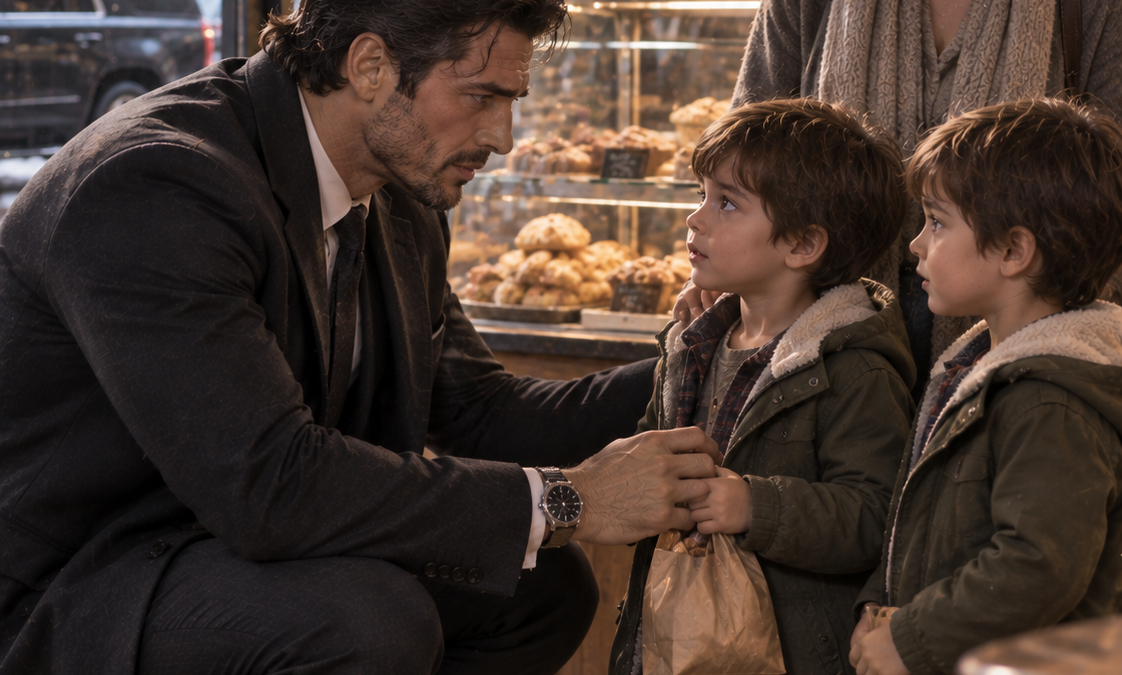
“Are They Mine”—Mafia Boss Saw His Ex Counting Coins With Twins and Froze
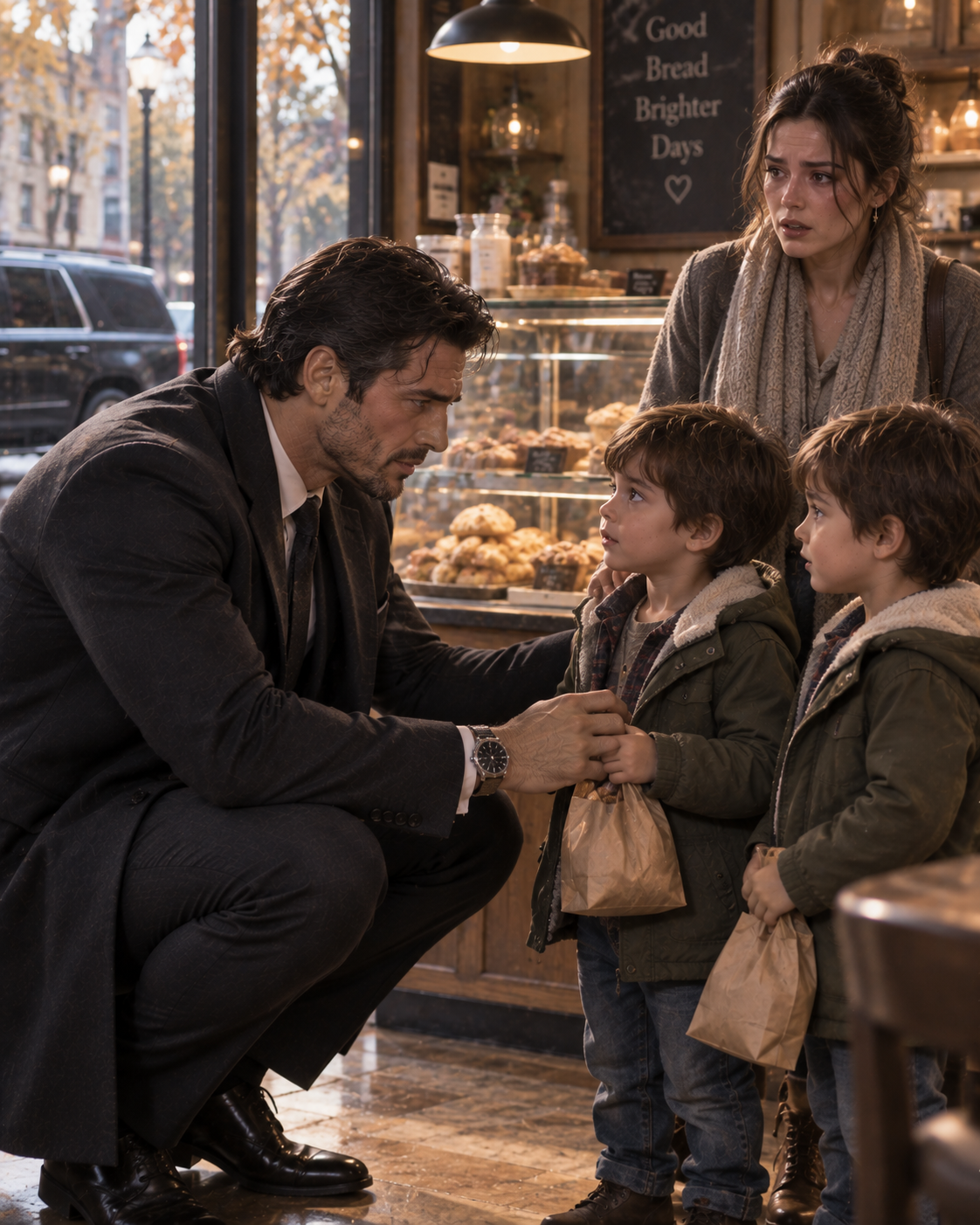
Darius Vain slammed the folder onto the table hard enough to make the coffee cups rattle.
She’s a liability, he said.
The woman, the kids, all of it. You want to hand everything we built to a man who leaves a war council to watch a school science fair? The other men around the table went quiet.
Roman Caldero didn’t move.
Didn’t blink.
Just looked at his oldest friend the way a man looks at something he’s already decided to bury.
Say her name again, Roman said softly. I dare you.
Darius leaned forward. You had an empire.
Part one, the morning Roman Caldero’s life changed.
He wasn’t doing anything dramatic.
He wasn’t signing a contract.
He wasn’t in a back room making the kind of decisions that don’t get written down.
He was standing on a sidewalk in a neighborhood he was about to tear down, wearing a coat that cost more than most people in that neighborhood made in a month, watching a window display in a bakery he had absolutely no reason to walk into.
He’d have been there for 11 minutes.
His driver, Marco, sat in the armored SUV, idling at the curb. His security detail stood at a respectful distance.
Nobody bothered Roman Caldero when he went still like that. They had all learned over the years that stillness in that man meant something was working inside him that none of them were equipped to understand.
They assumed it was business. It was not business.
It was a woman in a worn gray coat standing at a pastry counter counting coins. Roman had not seen Vivian Hail in 5 years.
And even from across the room, through the bakery glass, past the condensation and the morning crowd, he recognized her the way you recognize the particular ache of a scar you’ve stopped thinking about until it starts throbbing again without warning.
She was thinner than he remembered. Her hair was shorter.
She wore no jewelry, not even the simple pieces she used to favor, and her coat had a fraying hem she probably hadn’t had time to fix.
She was counting out coins and crumpled bills onto the bakery counter with the careful, unhurried concentration of someone who had become very practiced at making small amounts of money feel like enough. Roman watched her do this.
He did not move. Then he saw the children, two boys roughly the same height, standing side by side at the display case, with their noses nearly touching the glass, pointing at things inside with the total uncomplicated greed of small children in the presence of pastries. They were arguing about something.
He could see their mouths moving, but whatever they were saying was absorbed by the bakery wall between them and him.
They couldn’t have been older than four.
One of them turned to look up at Vienne and ask her something. She listened, counted again, shook her head once.
The boy’s shoulders dropped.
Then the other boy said something. The first one nodded slowly and they turned back to the display case together with the resigned but solemn look of small people negotiating a difficult reality they would share.
Roman watched this small moment happen and felt something he couldn’t immediately identify move through him.
He had watched negotiations worth millions of dollars. He had watched men attempt to conceal fear and fail. He had watched a dozen different versions of people trying to make the best out of a bad situation.
He had never in his life seen anything that hit him quite like this. Then the second boy turned completely around, scanning the bakery the way children sometimes do, looking for something interesting or just looking because everything is still interesting at that age.
And Roman saw his face. His chest stopped working.
The boy had gray green eyes, a specific gray green that Roman had only ever seen in two places. Old photographs of himself at 6 years old and his own bathroom mirror.
He had a particular set to his jaw, even at four years old, and the slight unconscious furrow between his brows, when he looked at something that didn’t immediately make sense to him.
Roman knew that furrow. He saw it every morning. He pressed one hand flat against the window glass without realizing he was doing it.
The first boy turned now, too, and looked in Roman’s direction without seeing him, because children that age are still learning, that the world extends past their immediate radius of interest.
But Roman saw him just as clearly. Identical structure, same jaw, same eyes, same everything.
He stood there on that sidewalk for what felt like a very long time with his hand against the glass and his chest refusing to remember how to function. Then he walked inside. The warmth of the bakery hit him first.
Then the smell of it bread and sugar and coffee, the kind of ordinary smell that costs nothing and means everything. He moved through the small crowd without registering any of them. Later, he would not be able to tell you who else was in that room.
He had the focused, narrowing attention of a man walking toward the only thing in the world that currently existed. Viven heard him before she saw him.
She had always been able to do that. It was one of the things about their marriage that neither of them had ever discussed, but that both of them had known.
She could always tell when Roman entered a room, even before she saw him. In the same way, you can feel a change in air pressure before weather comes. She had told him once that it was his footstep, something in the specific weight of how he moved.
He had laughed at that.
He didn’t laugh now.
She turned. Every color left her face.
The boys didn’t notice.
They were still negotiating their single pastry with the counter staff with the absolute cirius of small people engaging in important commerce. Viven, Roman said. His voice came out lower and quieter than he intended.
He wasn’t sure what he had planned to say when he walked in here.
He wasn’t sure he had planned anything.
He had walked in here on something that wasn’t exactly instinct and wasn’t exactly reason, more like the way the body sometimes moves before the mind is caught up.
Roman. Her voice was perfectly level, which meant it was costing her something significant to keep it that way.
Or he stopped started again. He looked at the boys. He looked back at her.
How old are they? You should leave. Quiet, firm.
the voice of someone who has rehearsed this in their head and planned for the possibility and is now discovering that planning Fern doesn’t actually make it easy.
Vivien, how old? She looked at him for a long moment.
Something moved behind her eyes, not softness, not anger. Something older than both of those. The look of a person who made a very hard decision once and has lived inside that decision for years and has never once stopped carrying it.
Four, she said. Roman turned and looked at his sons. four years old.
He had two four-year-old sons. He did the arithmetic in his head, and the arithmetic arrived at an answer that hit him somewhere below rational thought. Somewhere in whatever part of a person is responsible for understanding things that cannot be undone.
She had been pregnant when she left. Their names, he said, Rome, please.
He didn’t say please often.
When he did, it never came out quite right.
Always a little rusty, a little like a word he’d had to relearn after forgetting it.
But he said it now without thinking about it. their names.
Vivien looked at the boys. They had concluded their transaction and were now standing with a single pastry between them already in the process of dividing it with extraordinary fairness.
Silas, she said, and Theo. Silas and Theo Caldero.
Except they weren’t Caldero.
They were Hail because she had left and taken them and given them her name instead of his. and Roman stood in a bakery on a cold autumn morning in Chicago, understanding for the first time what it felt like to look at something that was yours and know that you had made it a stranger.
“You need to leave,” Vivienne said again.
There was nothing cruel in her voice.
“That almost made it worse.
“You cannot do this here.”
“Did you know?”
he asked.
“Did you already?”
“Roman, did you know?”
She turned to look at him fully and something in her face had shifted not to anger, not quite, but to something harder and more honest than anger. I found out 3 weeks later, she said.
3 weeks.
She had been 3 weeks pregnant when he told her he didn’t want children anymore.
He had told her he wanted his empire instead. 3 days after that conversation, she had packed two bags and driven away from their penthouse and out of his life. and he had let her go because he had believed at the time that letting her go was the rational choice for both of them.
That she would be better without the weight of his world on her. That he would be better without the distraction of wanting something that kept failing to happen.
He had told himself this story for 5 years now. The story had two other people in it who had never been consulted about any of his reasoning.
I need to know why, he said.
You found out and you didn’t.
I remembered what you said.
Her voice didn’t shake, but the steadiness of it cost her.
You could see the cost of it clearly now. You made yourself very clear.
You didn’t want children.
You wanted your empire. She glanced at the boys who were now sitting at a small table together, absorbed in their pastry and their argument and the complete business of being four.
So, I gave you what you wanted.
That’s not I was not going to call a man who had just told me he didn’t want children.
Say, “Surprise, I’m pregnant.”
I was not going to put that on them. her voice dropped.
They weren’t even born yet and I wasn’t going to let you reject them before they had the chance to take a breath.
Roman had nothing to say to this cuz there was nothing to say because she was right. Because the version of Roman Caldero who had stood in their penthouse 5 years ago and said those words had genuinely not understood what he was doing. He had understood it as a decision between two competing priorities.
He had not understood it as a rejection of two people who didn’t exist yet.
He had not understood it as the moment that determined what kind of person his sons would spend their childhood thinking.
They were the kind whose father didn’t want them or the kind whose father simply wasn’t there.
Vivienne had given them the second option because she believed it was kinder.
Roman wasn’t sure she was wrong.
I’m going to go, Vivien said.
She was already turning, already reaching for the boy’s things.
Don’t follow us, Vivien.
He stopped himself. Are they okay?
Healthy? She paused. Something shifted in the way she was holding herself.
A small thing, almost nothing.
But Roman had spent his adult life watching the way people’s bodies told the truth when their faces were trying to say something else.
“They’re fine now,” she said.
Now, he didn’t ask.
“Not then.”
She was already gathering the boys, already helping them with their coats, with the practiced efficiency of someone who has done this 10,000 times, already steersing them toward the door, with the brisk tenderness of a woman who has been the only parent in the room for 4 years, and knows exactly how to move through the world with small people attached to her. Silas looked back over his shoulder at Roman as they left. It was not a long look.
It was just a four-year-old’s brief, uncomplicated curiosity about a stranger.
But Roman held the eye contact for the half second it lasted, and then the door swung shut, and Vivienne and Cisass and Theo Hail walked out into the cold Chicago morning. Roman stood in the warmth of the bakery and breathed. Behind him, Marco appeared in the doorway.
He had the discreet, carefully neutral expression of a man who had seen enough of Roman Caldero’s life to understand when he was witnessing something private.
Mr.Caldero, we’re going to be late for cancel it.
Sir, this is the Meridian group.
they’ve been waiting 3 weeks for.
Cancel it, Marco. Roman turned from the door. All of it.
I’m not going in today.
Marco closed his mouth. Roman walked back to the SUV and sat in the back seat and did not speak for the entire drive. He looked out the window at Chicago, passing by the streets he controlled, the neighborhoods he owned, the city that had been his to command for 15 years, and saw none of it.
He was doing arithmetic. Four years old, born premature.
Something in the way she had said now told him, “Fine now.”
Not always fine. Fine now meaning there had been a time when they were not fine.
A time when they had been small and early and fragile and in the hands of doctors while Vivienne sat in a hospital somewhere in this city without a single person beside her cuz she had decided to face that alone rather than call a man who had already said he didn’t want them.
Roman pressed the side of his fist against the car window and held it there. He had been worth nine figures during those weeks.
He had been throwing money at an expansion that ultimately cost him three men and a disputed territory on the south side. He had been arguing about percentages and control over things that felt at this particular moment like they had the substance and significance of smoke.
And somewhere in this city his sons had been fighting to live. He sat with that for the entire drive.
Darius Vain took one look at him when Roman walked into the penthouse and said nothing.
This was one of Darius’s genuine gifts.
He knew when silence was more useful than conversation and he deployed it with the precision of someone who had been reading Roman Caldero for 20 years. He waited. He poured coffee.
He waited some more. Roman sat down. I found Viven today, he said.
Darius sat down his cup. His face did what it always did.
When Vivien’s name came up, went carefully, deliberately neutral, which was its own kind of tell.
Darius had never said it directly, but Roman had always known that Darius thought the divorce had been a mistake.
Not because of sentiment, Darius didn’t do sentiment as a primary mode, but because Roman had been noticeably worse at his job in the months after she left, less focused, more volatile, more prone to the kind of rage-based decision-making that cost organizations money and credibility.
Darius had chocked this up eventually to Roman’s need to prove he had made the right call.
Men who make the wrong decision often work very hard afterward to demonstrate that they didn’t.
How is she asked? I have sons, Roman said.
The room went very quiet. She was pregnant, Roman continued when she left.
She was pregnant and she didn’t tell me.
And I have two four-year-old sons named Silas and Theho, who I just met for the first time through a bakery window. He picked up the coffee cup and put it down again without drinking. I need you to find out everything.
where she lives, where she works, the boy’s schools, their medical records if you can get them, everything.
Darius was quiet for a moment. Roman, I know how it sounds. It sounds like surveillance of your ex-wife.
It is surveillance of my ex-wife.
The alternative is walking up to her again and asking questions she’s not going to answer yet.
And I’d like to know what I’m walking into before I before you what?
Darius leaned forward, not challenging, genuinely asking, “What are you planning to do here?”
Roman didn’t have an answer.
That was new. Roman Caldero almost always had an answer.
Or if he didn’t have one, he had the performance of having one, which served the same function in his world.
Uncertainty in a man his position was a luxury he had never been able to afford.
I don’t know yet, he said.
Darius studied him. Okay, he said finally.
I’ll put Reyes on it quietly.
Discreet. We<unkll know what we need to know in 48 hours.
Thank you. Darius picked up his cup again.
Roman watched him drink his coffee with the particular look of a man who was having one conversation out loud and a different, more important ones inside his own head. He knew what Darius was thinking. He was thinking about stability.
He was thinking about the organization’s position and the ongoing negotiations with the Meridian group and the three other active concerns that required Roman’s full attention.
He was thinking in the careful managerial way that Darius always thought about whether this development was a problem and how large a problem it was likely to become.
He wasn’t wrong to think this way.
That was his job. He was also not thinking and could not quite understand that Roman had walked into a bakery on an ordinary Tuesday morning and looked through the glass at two small boys sharing a single pastry and had become a different person in roughly 30 seconds.
Some things Darius’s precision didn’t account for.
The information arrived the following afternoon. Roman sat with it for a long time before he read it fully. Vivien Elena Hail, 38 years old.
Science teacher, Meridian Heights Public School, employed for the past 3 and 1/2 years. Annual salary not enough. Apartment: two bedrooms, third floor of a walkup building, two bus transfers from the school, no car.
The boys attended the school’s affiliated prek program, which meant she could walk them there in the morning and collect them in the afternoon without additional child care costs.
She had organized her entire life, he understood, as he read, around the specific geometry of keeping two children fed and housed and educated on a teacher’s salary.
She had been managing it, but only barely. Then he reached the medical file that Reyes had pulled.
Roman didn’t ask how.
Reyes had a particular talent for finding things that weren’t meant to be found.
And he stopped managing his reaction. The boys had been born at 31 weeks.
31 weeks when a full pregnancy was 40, 9 weeks early. Born weighing less than 3 12 lb each.
The report used language that was clinical and precise and that translated in Roman’s understanding into a very small window between his sons being alive and his sons not being alive.
emergency interventions, neonatal intensive care, weeks in incubators with tubes and monitors while their lungs and hearts learned to do what they needed to do. Viven had been alone for all of it. He found a single notation in the file about emergency contact information and saw that she had listed her mother, Evelyn Hail, in Michigan, which meant Evelyn had presumably been informed.
But whether she had come, whether Viven had let anyone come was not in the record. He found the billing file. He looked at the total.
He set the papers down and pressed both hands flat on his desk and breathed very carefully through his nose for about 60 seconds. He had been worth north of $30 million during those weeks.
He had been spending money on a restaurant that served as a front for a distribution network and on a security upgrade for three of his warehouses and on a piece of commercial real estate he’d subsequently flipped for a comfortable profit.
His sons had been three floors above street level in a niku somewhere in this city.
And Vivienne had since been sitting in a hospital corridor doing what she apparently did with everything, managing, counting what was available, finding a way to make it work, taking on debt that had followed her for 4 years because she had been too proud and too practical and too determined to call a man who had told her he didn’t want children and ask him for his money.
Roman picked up the papers again. He read everything twice.
Then he sat alone in his office for a very long time and thought about the particular silence of a man who has discovered that he was absent for something he can never get back. He picked up the phone.
Darius, he said, I want to talk to Hrix at the foundation tonight. Marcus Hrix ran the Caldero Family Foundation, a legitimately operated charitable organization that Roman had established years ago, primarily for tax purposes and secondarily for reputation management. Hrix was a careful, mildmannered man who genuinely believed in the work and who had learned over time not to ask too many questions about where the endowment money originated.
He ran the foundation with real competence and real care. And Roman respected this about him, even while understanding that their respective definitions of what the foundation was for were meaningfully different. Roman met him at 9 that evening.
He laid out what he wanted. Meridian Heights Public Schools science department full renovation.
New equipment, new lab space, computers, microscopes, whatever a school science and department needed that it currently didn’t have.
Anonymous donation through the foundation. No Caldero name on any of it.
Quiet and clean. Hrix asked no questions about motivation. He priced it quickly and conservatively in his head and named a number.
Roman approved it without negotiation. Hrix looked at him for a moment.
This is a good thing, he said. That school has been underfunded for years. I know, Roman said.
Is there any particular reason this school specifically? Roman looked at him.
Hendrickx straightened his papers. The foundation is in good shape, he said. The timing is good.
I’ll make some calls in the morning.
Thank you, Roman said. He drove home at midnight through streets he knew like his own hands.
Past the bar where he’d made his first real deal at 23.
past the warehouse district that his organization had controlled for 15 years, past the waterfront where the legitimate real estate empire had started growing. He had built all of it. He had built it carefully and deliberately and at significant personal cost.
And he had believed for a very long time that the building of it was its own justification, that the power and the wealth and the control were sufficient reason for everything they had required him to give up. He thought about Silas and Theo at 31 weeks, weighing 3 lb each, Viven alone in a hospital corridor. His empire had been doing exactly what empires do, growing and taking and requiring.
It had not paused to consider the cost. Roman parked outside his building and sat in the dark car for a while before going in.
He was not a man who permitted himself guilt as an ongoing condition. Guilt was expensive, and it made you slow, and in his world, slow got you killed.
He had always processed regret quickly and converted it into something more useful. Analysis, strategy, the cold-eyed assessment of what had happened and what the next move was. He tried to do that now.
He could not quite get there.
What kept stopping him was the image of Viven’s face when she turned and saw him.
The specific color that had drained out of it. Not fear. He knew what fear looked like on people.
And that wasn’t it.
It was something closer to the expression you might wear if you had organized your entire existence around a particular arrangement of reality. And then reality suddenly failed to cooperate. She had built a life that did not include him.
She had done this, he understood, not out of cruelty and not entirely out of hurt, though the hurt was certainly there. She had done it because he had told her who he was and what he wanted, and she had believed him, and she had acted accordingly.
The problem was that he had not been entirely right about who he was or what he wanted. He had not known that yet.
He was beginning to know it now. He got out of the car and went inside and somewhere across the city in a two-bedroom apartment on the third floor of a walkup building.
His sons slept in beds they had grown into from cribs that Viven had assembled alone and they did not know his name. The renovation of Meridian Heights science department took 3 weeks.
During those three weeks, Roman continued running his organization with the mechanical precision of a man doing his job by memory. He attended the meetings. He made the calls.
He reviewed the numbers and issued the instructions and handled the ongoing business of managing a criminal enterprise with sufficient competence that Darius stopped watching him quite so carefully. Inside, he was somewhere else entirely.
He found himself at odd moments doing things he couldn’t quite explain.
passing a children’s bookstore and stopping, looking in the window at books for four-year-olds, and thinking about Silas, pointing at dinosaurs in a pastry case, and about the quality of attention Theo had given the question of how to divide one pastry fairly.
These were small observations. They did not add up to anything coherent. They added up to the specific agony of a man learning to want something at the exact moment he has understood what it would cost to earn it.
He found the school on a street map and drove past it twice without stopping. He did not go inside. He did not have any right to go inside.
He drove past it and looked at the building ordinary, underfunded, painted the kind of beige that civic budgets produce and tried to imagine what it looked like to small boys every morning. He thought about what Vivien had said.
I was more afraid of hearing him reject them than I was of facing the hospital alone. He sat with this sentence the way you sit with a specific kind of pain.
Not because sitting with it helps, but because looking away from it feels dishonest. Then one morning, his phone rang.
He did not recognize the number.
He almost didn’t pick up.
He picked up Mr.Caldero, a woman’s voice, controlled and entirely furious in the specific way that only becomes possible once a person has moved past the first wave of fury into the cold, clear water on the other side of it.
This is Viven Hail. I think you and I need to speak. Roman sat very still.
Yes, he said. We do. The new microscopes arrived this morning and the computers and the new lab tables.
A pause. My department head cried.
She’s not the crying type.
Roman said nothing. Marcus Hrix has run that foundation for 6 years. Viven continued.
I had to look up exactly one thing to confirm what I already knew. You are the only person who gives to that foundation.
And you have never in six years donated to a school. You donate to housing, to veterans programs.
You have never, Viven, you had someone investigate me. Her voice tightened. You found out where I live and where I work, and you went through my life like it was a file on your desk, and then you spent money on my school like that was going to She stopped herself.
He could hear her regulating her breathing. That was not your right. I know.
You don’t get to buy your way into this.
I know. Another pause.
I’m going to give you 20 minutes, she said finally.
Wednesday afternoon.
I’ll text you the address of the coffee place across from the school.
You come alone.
You don’t bring anyone from your organization.
You don’t have people watching the building.
You come by yourself like an ordinary person and you sit across from me and we talk. Her voice shifted just slightly from fury to something harder to name.
And then we’ll see.
Wednesday, Roman said.
I’ll be there.
She hung up. Roman put the phone down.
He had negotiated with dangerous men across difficult tables his entire adult life. He had walked into rooms where the outcome was uncertain and the stakes were life and death and conducted himself with the steady unflapable composure of someone who had decided very young that composure was the most powerful thing he could offer a room. He was aware sitting in his office in the building he owned on the 22nd floor of the city he controlled that Wednesday afternoon across from a woman in a coffee shop was the most important meeting he had ever had in his life.
He was also aware that he had absolutely no strategy for it and that for once that was probably the right thing to bring into a room. Part two.
The coffee shop was called Denny’s Grind which was not a Denny’s and had nothing to do with any chain.
It was the kind of place that existed in every neighborhood that hadn’t yet been bought out and renovated mismatched chairs, a chalkboard menu with three items crossed off.
Permanent smell of dark roast that had been brewing since before anyone currently working there was born.
Roman arrived 7 minutes early and sat facing the door because some habits don’t have an off switch.
He had come alone. He had told Marco to drop him two blocks away.
He had walked the rest in the cold with his hands in his coat pockets and his head down, which was not how Roman Caldero normally moved through the world, but which was, he decided, the appropriate posture for a man trying to enter someone else’s life without making it look like an occupation.
He ordered an black coffee he didn’t want and waited.
Viven arrived 4 minutes late, not because she was disorganized. He understood this immediately. She arrived 4 minutes late because she had needed those four minutes to decide one final time whether she was actually going to do this.
He could see the residue of that decision in the way she walked through the door. Straight back, deliberate, the walk of someone who had made a choice and was going to live in it.
She sat down across from him without taking off her coat. That detail registered. She ordered tea from the server without looking at the menu because she had been here before cuz this was a neighborhood she lived and worked in.
and the coffee shop across from her school was a place she knew. Roman was the foreign element at this table.
“You look tired,” he said.
“It came out before he could stop it.
It was not what he had planned to say.
He hadn’t truthfully planned anything he had resolved on the walk over that he would not strategize this, would not approach it as a negotiation, s would sit across from her and be honest and see what happened.
” But honest and his experience had a tendency to arrive sideways.
Vivienne looked at him. I have four-year-old twins, she said. Alone, so yes, I know.
I’m sorry.
That wasn’t Don’t apologize for noticing things.
Just stop investigating me. He folded his hands on the table.
That’s done.
Is it? Yes.
She studied him the way she always had, not searching for weakness, not calculating, just looking at him with the particular cleareyed attention of a woman who had decided early in their relationship that she was going to see him as he actually was rather than
as he preferred to be seen. It had been one of the things he loved about her. It had also been, if he was being honest, one of the things that had made him uncomfortable enough that he had sometimes picked fights with her rather than sit under that gaze too long.
Why the school? She asked. because you needed it.
I needed a lot of things 5 years ago. The sentence sat between them like something solid.
Roman didn’t look away.
I know you weren’t there for those things.
No.
So, don’t walk back in now with a checkbook and think that covers the distance.
Her voice was level, controlled. The control was doing real work, and they both knew it.
It doesn’t work that way.
I’m not trying to cover anything.
He leaned forward slightly. I want to know them, Vivien.
That’s it.
That’s all I’m asking.
That’s not a small ask.
I know it isn’t.
They have a life, a routine, friends.
They know their teachers names and which kids to sit with at lunch and how many steps it is from the front door of our building to the bus stop because we’ve counted them.
They have a world that works. She wrapped her hands around her teacup.
You walking into it isn’t neutral.
You don’t get to be a stranger who shows up and then leaves again.
With kids that age, that’s not a visit.
That’s a wound.
Roman was quiet for a moment.
Then I won’t leave,” he said.
Vivienne looked at him.
“You don’t know what you’re saying.
I’m saying I won’t leave.
I’m saying I want to be there for whatever it requires.
School things, doctor things, the ordinary things, all of it.”
He held her eyes.
“I spent 15 years building something I thought was worth having.
I looked at it 3 days ago through a bakery window and understood for the first time that I was wrong.
” So, rested.
Tell me what it costs. Tell me what I have to do.
I’ll do it.
The server came by and refilled his coffee without being asked. Roman waited.
Viven looked at her tea.
“They don’t know who you are,” she said finally.
“They don’t know anything about you.”
“Not your name, not that you existed.”
She paused.
“I told them their father had to go away.
Something moved across Roman’s face.
He controlled it quickly, but not quickly enough.
I didn’t know what else to tell them,” she said.
“It was not an apology.
It was information.”
They were two, then three, then four.
At some point, I was going to have to explain more, but I wasn’t ready to explain more.
What did they say when you told them that? Vivien was quiet for a long moment.
Theo asked if you were coming back, she said.
I said, I didn’t know.
He said okay and went back to his trucks. She paused again.
Silus didn’t say anything.
He just he went very quiet for about a day. He does that.
He processes things slowly and then he’s fine, but the quiet day is real.
She looked down at her cup. He was four and he had a quiet day over it. Roman put his hands flat on the table.
He didn’t trust himself to speak for a moment.
If I do this wrong, Vivien said, “If you come in and they get attached and then something pulls you back to to whatever that life requires, you will break them in a way I cannot fix.
” “I have to be more afraid of that than I am of keeping you away from them and tell me how to do it right.”
She looked at him for a long time.
“You don’t come in as their father,” she said.
“Not at first.
You’re a friend.
Someone who knows their mother. We see how it goes.
How you handle the ordinary parts, the boring parts.
Her voice sharpens slightly because that’s what parenting is, Roman.
It is staggeringly, relentlessly ordinary. It is packed lunches and shoe arguments and someone crying because the wrong cartoon is on.
There is no part of it that will make you feel powerful or important.
So, if you’re looking for I’m not looking for anything, he said.
I just want to know my son’s.
She looked at him.
He didn’t look away.
“Okay,” she said finally.
“The word costs something.”
“Okay,” Roman said.
They sat there in Denny’s grind with their respective drinks and the mismatched chairs and the crossed off menu items, and it was not comfortable, and it was not warm, and it was not any version of a clean start, but it was a door barely cracked, which was more than Roman possessed 40 minutes ago.
He took what was available. Darius was waiting in the penthouse when Roman got back.
This was not unusual.
Darius had a key and a standing habit of using the penthouse office as a secondary workspace when he had things to discuss that he didn’t want overheard in the organization’s buildings.
Roman was accustomed to finding him there, usually with a spread of papers and a pot of coffee that had been going long enough to turn bitter. What was unusual was the look on his face.
Sit down, Darius said. I just got in.
Sit down, Roman. Roman looked at him.
Darius was 61 years old and he had the face of a man who had lived a life that didn’t simplify as it went on.
He had been Roman’s consilier for 12 years and his friend for 7 years before that.
Roman could read him well enough to know when he was performing concern versus actually feeling it. This was actual Roman sat down. Alderman Walsh called.
Darius said the Meridian Group found out about our renovation at the school. Hris runs a clean operation there. The donation went through the foundation under a holding company that Ray set up two years ago.
The Meridian Group’s lawyers found the connection.
Darius picked up his coffee and put it back down.
They’re saying it changes the landscape of our negotiation.
They’re saying a man who donates anonymously to a public school in a neighborhood he’s planning to redevelop might not be the kind of partner they want to do business with.
Roman stared at him.
They think it’s a play, he said.
They think it’s a play.
I gave money to a school. You gave money to a school in a neighborhood where you own four parcels of property and have pending demolition agreements.
From their perspective, I didn’t do it.
Roman stopped. He pressed two fingers against the bridge of his nose. It had nothing to do with the neighborhood.
I know that the school needed I know that, too. Darius leaned forward.
They don’t know it, and we can’t tell them why you actually did it without introducing a set of facts they definitely don’t need to have.
So, we have two choices. We tell them it was strategic and rebuild the negotiation from there or we walk away from Meridian entirely.
Roman looked at the table. The Meridian deal had been in the works for 8 months. It was not a small thing.
It represented a restructuring of two territories that would have given the Caldra organization control over the eastern corridor that three other operations had been fighting over for years. Walking away meant those 8 months dissolved. It meant the territory question remained live and expensive.
It meant that other organizations currently watching the negotiation would read the withdrawal as weakness.
“What do you want to do?”
Darius asked.
“I want to know why you’re asking me that like it’s a choice I haven’t made yet.
” Darius looked at him steadily.
Because 3 days ago, you wouldn’t have needed a second to think about it.
3 days ago, you would have had me on the phone with Meridian’s people before I finished the sentence.
He paused. What happened at that coffee shop? I told her I want to know my sons.
She said yes conditionally. Darius absorbed this. His expression did what?
It did the careful, precise calibration of a man running calculations.
Roman, he said, “Don’t.
I haven’t said anything.
You’re about to.”
Darius was quiet for a moment. The organization is watching you, not just me, the captains, the partners.
They watch everything you do, and they’re already asking questions about the Meridian delays.
If you start showing up differently, I’m already showing up differently.
Roman met his eyes. Call Meridian.
Tell them the school was a business decision.
If that’s what they need to hear, smooth it over.
Handle it. He stood up.
That’s why I have you.
Darius looked at him for a long moment. All right, he said quietly. Roman went to his room and sat on the edge of his bed in the dark and thought about Silas having a quiet day at 4 years old after being told his father had gone away.
He sat with that for a long time.
The first Saturday was a disaster, and it was Roman’s fault.
Viven had arranged it simply, a morning at the Children’s Science Museum downtown, the kind of place with interactive exhibits and things you could push and pull and look at under glass.
She had told the boys that a friend of hers was going to come along. She had told them his name was Roman.
She had told them nothing else. Roman had agreed to all of this and had spent the previous 4 days thinking about it more than he had spent thinking about the meridian situation which was he was dimly aware probably not an ideal allocation of his attention.
He arrived on time. He wore jeans and a plain coat because he had decided correctly that his usual wardrobe communicated the wrong things to a 4-year-old.
He did not bring gifts. He had thought about bringing something his instinct had been to bring something significant to make the first impression a strong one.
And then he had remembered Viven’s face when she said, “You can’t buy your way into this.
” And he had arrived with nothing but himself.
Viven opened the apartment door. Behind her, two small boys in mismatched socks stood in the hallway looking at him with the specific speculative attention of children evaluating an unfamiliar adult.
“Hi,” Roman said.
This was the most inadequate thing he had ever said in his life.
“Hi,” said Theo, who appeared to have decided that strangers were innocent until proven boring.
Silas said nothing. He looked at Roman with those gray green eyes.
Roman’s eyes in a 4-year-old’s face and tilted his head very slightly to one side, which was an expression Roman would later come to understand as the boy’s default posture when he was processing something he hadn’t categorized yet.
This is Roman, Vivien said with the studied casualenness of a woman carefully managing a small detonation.
He’s going to come to the museum with us.
Do you know about dinosaurs? Theo asked immediately. Roman looked at him.
Some, he said. Not as much as I probably should. Theo considered this.
I know everything about dinosaurs, he said.
I can tell you I’d like that, Roman said.
Theo appeared satisfied. He went to find his shoes. Silas continued looking at Roman.
You have the same eyes as me,” the boy said.
Roman’s heart did something architectural, some kind of internal collapse followed immediately by an attempt to rebuild.
He held the boy’s gaze and kept his face neutral, which cost him more than most things had ever cost him.
“I guess we do,” he said.
Silas looked at him for another moment. Then he went to find his shoes, too. Viven looked at Roman from across the hallway, just for a second.
Her face was doing the same controlled, careful work it always did, holding something in that she had decided it wasn’t time to put down.
She turned and went to help the boys with their coats.
The museum went reasonably well until it didn’t.
Theo attached to Roman with the easy mercenary affection of a child who has found a new audience for his knowledge of prehistoric creatures. Roman learned more about the dietary habits of the Spinosaurus in 45 minutes than most adults accumulate in a lifetime.
He listened seriously. asked questions that were not performative and was rewarded by a child who walked slightly closer to him as the morning went on. Silas kept a distance of roughly 3 ft, not hostile, observing.
The disaster came at the gift shop.
Roman’s instinct, deep automatic, built over 15 years of operating in a world where resources were how you demonstrated value, was to tell the boys they could have whatever they wanted.
He had his hand in his pocket before he even completed the thought.
He had already started walking toward the register when Viven’s hand came down lightly on his arm.
She steered him two steps away from the boys who were currently absorbed in a rack of plastic dinosaurs.
“No,” she said quietly.
“It’s a gift shop,” he said.
“I know what it is.
They’re kids.
It’s a museum gift shop.
It’s Roman.”
Her voice was a millimeter above a whisper. If you buy them whatever they want the first day you meet them, you are not being generous.
You are teaching them that the way to feel good about uncomfortable things is to get stuff. They already know that uncomfortable things pass. I taught them that.
She took her hand off his arm. Let them choose one thing each. Something reasonable.
And let them choose it themselves. He stood there for a moment.
Okay, he said, “And pay for it at the register like a normal person.
Not don’t make a thing of it.
I wasn’t going to make a thing of it.
” She gave him a look that communicated with great efficiency that she had seen him walk toward the register with the energy of a man about to make a thing of it.
He paid for one plastic Spinosaurus and one small illustrated book about space without making a thing of it. On the walk back to the car, Theo explained to Roman the correct way to hold a plastic Spinosaurus, which involved a specific grip that he had developed through research and experience. Roman listened.
He adjusted his grip accordingly. Theo approved.
He walked the rest of the way with his hand, intermittently bumping against Romans, which was not quite holding hands, but was in the general neighborhood of it.
Silas walked on Viven’s other side, holding the space book under his arm, still processing.
Roman watched him from the corner of his eye.
He thought, “I have time.
I’m not going anywhere.
Let him take his time.”
It was the most patient thought he’d had in years, and it arrived not as a strategy, but as a fact.
3 weeks in, Darius stopped coming to the penthouse. He started calling instead, which was new. Darius preferred face-toface.
He had always maintained that decisions made over the phone were decisions made incompletely because you lost 30% of the information when you couldn’t see the other person’s body.
The fact that he was calling now meant something. Roman picked up on the third ring.
There’s a problem with the east side collection, Dar said without preamble.
What kind of problem?
Reyes thinks someone’s skimming.
Three weeks of short numbers that don’t match up to the root reports.
A pause.
The discrepancy isn’t enormous, but it’s consistent enough to be intentional.
Reus has two names. He wants to bring them in for a conversation. Roman understood what a conversation meant.
When Thursday, which is the same night as Darius stopped the science fair, Roman said the silence was exactly as long as it needed to be to communicate everything Darius wasn’t saying out loud.
I know when it is, Roman said.
I’m not saying anything about your priorities.
You’re not saying it, but you’re timing the pause.
Roman, a long exhale. 3 weeks ago, you would have had this wrapped up by Tuesday. You would have called Reyes yourself before I got to you.
You are There’s distance in how you’re running things, and people notice distance.
The people who notice it are specifically the kind of people you don’t want noticing it.
Handle the Reyes situation. Thursday, whenever works for Reyes.
I’ll be available by phone.
You should be there, Darius. You should be there, he said again. And now his voice had shifted from the managerial register into something older and more direct.
I know what I’m asking.
I know what you’re building over there.
But these two things are on a collision course, and the longer you pretend they’re not, the worse it gets when they hit.
Roman was quiet. outside his window.
Chicago was doing what Chicago did in late autumn, pressing all that cold and gray against everything at once, indifferent and enormous.
“I’ll be on the phone,” Roman said.
“Tell Reyes to handle the conversation.
He doesn’t need me in the room.”

