“Are They Mine”—Mafia Boss Saw His Ex Counting Coins With Twins and Froze (part 3)
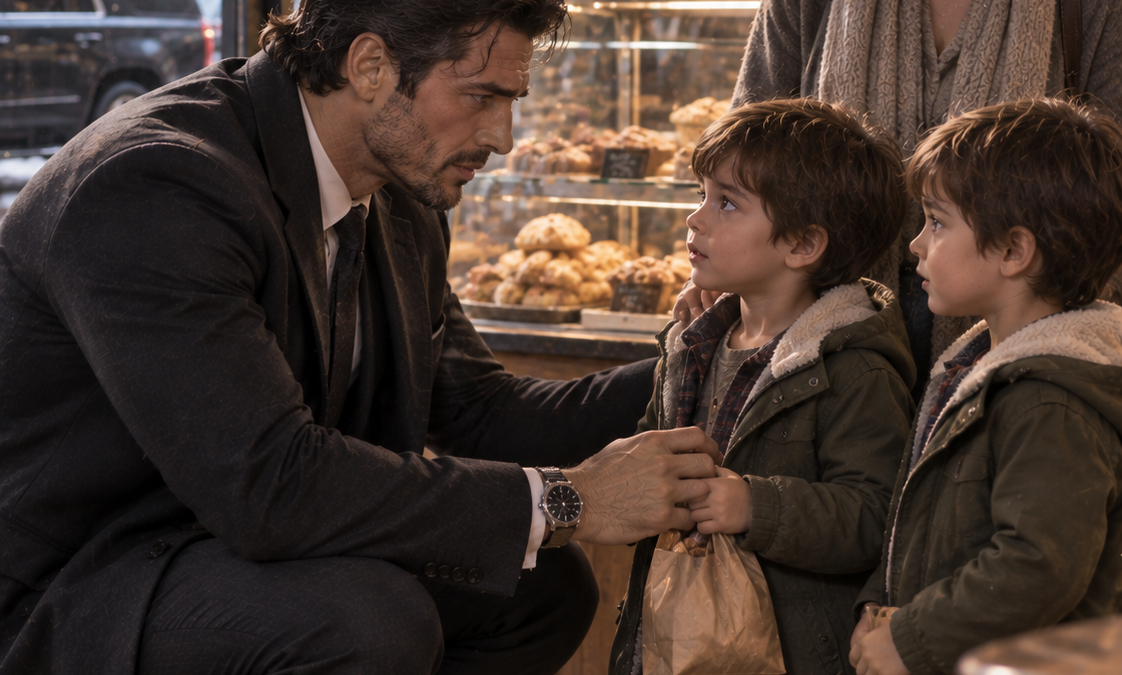
Part 3
He said yes without hesitation, which means he either wants to talk or he wants to read your face when you walk in. Both probably, Roman said.
That’s fine.
Do you want backup in the building? Roman thought about it for exactly 2 seconds.
No. If I walk in there with people, it changes what the meeting is. I go alone.
Rey has absorbed this.
Roman, if Cavalo has already decided that the preliminary conversation was a green light, then me walking in alone tells him something that me walking in with six men doesn’t.
Roman stood up from the chair.
He’s a businessman, Reyes.
He’s been a businessman his whole career.
Businessmen respond to clarity.
And if he’s moved past the business calculation, then I’ll deal with that when it happens.
He hung up.
He looked down the corridor toward Silas’s room.
The light under the door was still on. Viven was still in there.
You walked to the door and knocked once softly. She opened it. Her hair was loose now.
She had taken it down at some point in the last hour, and she was carrying the specific strippback look of a person who has stopped performing composure because there’s no one left to perform it for.
She looked at him.
Then she looked at something in his face that he hadn’t intended to show.
“What’s wrong?”
she said.
“Nothing.
I have to go.”
“I’m sorry.”
He looked past her at Silus in the beds and small under the hospital blanket. the monitoring equipment quiet and steady beside him, his chest moving with the easy rhythm of deep sleep.
I’ll be back tomorrow morning, Roman.
Her voice had changed.
What’s happening?
Business.
I’ll handle it.
Is it dangerous? He looked at her directly. He did not say no.
Vivien held his gaze for a long moment. Something moved through her face that was more complicated than fear and older than anger.
the expression of a woman who made peace with a dangerous man’s world once before and had the scars from that peace still.
“Come back,” she said.
“I will,” she nodded once.
Then she stepped back and closed the door, and Roman walked down the hospital corridor and out into the cold, and the city opened up around him like it always did, vast and indifferent, and completely his, for as long as he could hold it. He drove himself tonight. No Marco, no security detail.
He needed the drive and the silence and the specific feeling of his own hands on the wheel. While he finished working out what he was going to say to a man who had spent 8 years trying to take everything Roman had built. He drove for 90 minutes without direction through Chicago at midnight.
And by the time he parked outside his building, he had it. He knew exactly what he was going to offer Cavalo.
He went upstairs and slept for 4 hours. The restaurant on Wabash was called Elas.
It had been there for 30 years and served breakfast to the kind of men who conducted their real business over coffee and eggs because breakfast meetings implied legitimacy in a way that late night warehouse conversations didn’t.
Cavalo’s private room was at the back.
Roman had never been in it, but he knew it existed the way you know the layout of a competitor’s territory.
Through observation and inference and the occasional confirmed report, he arrived at 7:58.
The host knew his name without being told, which meant Cavalo had prepared the room for him specifically, which meant Cavalo had his own intelligence on Roman’s movements and had been tracking the approach of this morning with some care.
Good. That meant he was taking it seriously. The private room was small, four tables, only one of them set.
Cavalo was already there, sitting with coffee, and the particular relaxed posture of a man in a room he controls. He was shorter than Roman remembered from the two previous times. They had been in the same space, both large gatherings, never direct conversation.
He had gray hair cut close and the hands of someone who had worked physically before he had people to work for him. And he looked at Roman with the steady measuring attention of a man assessing something he has been thinking about for a long time.
Caldero, he said, “Cavalo.”
Roman sat without being invited to.
“Thank you for the early hour.
I’m an early riser.”
He signaled the server for another cup. Sit down.
You’re already sitting.
Good. The slight smile of a man who notices when protocol is adjusted.
You look tired. My son was in the hospital last night.
Cavalo’s expression shifted not dramatically, but genuinely.
He had grandchildren. Roman knew this. It was relevant information now.
Nothing serious. Cavalo asked.
He’s recovering.
Good. And he meant it.
That was the thing about men like Cavalo. The genuine moments were always there underneath the calculation.
They just weren’t always the thing in charge.
I was sorry to hear about the situation with the meeting. Were you?
I didn’t engineer it, Cavalo said.
I want that understood. Vain approached my people. Not the other way.
I know, Roman said. Cavalo looked at him. You came here anyway, Cavalo said.
Because you said yes to the meeting, Roman said. Which means you were interested in something.
And because whatever Darius told your people about the state of my organization, you’re smart enough to know that a man sitting across from you in a restaurant at 8:00 in the morning is a man who still controls something worth talking to.
Cavalo picked up his
coffee. He drank it.
He set it down. What do you want to talk about?
He asked. The Eastern Corridor, Roman said.
Something sharpened in Cavalo<unk’s eyes.
Go on.
You’ve wanted it for 8 years.
You’ve tried three different approaches.
direct conflict, economic pressure, and now political maneuvering through my own people. None of them worked.
Roman leaned forward slightly.
I’m going to offer you a fourth approach, which is, I give it to you.
The room was quiet for a moment. Cavalo looked at him with the careful, unreadable expression of a man who has heard many surprising things in many rooms, and has learned that the first response to a surprising thing is to say nothing until the full shape of it is visible.
“You give it to me,” he repeated.
the eastern corridor, the distribution routes, the agreements with the port authority contacts, the three warehouses. I walk away from all of it.
Clean transfer, no conflict, no ongoing obligation. Roman watched his face in exchange for one thing. What thing?
You call off whatever you have running with Petrov. Whatever understanding exists between your organization and anyone in mine who is operating on the assumption that my organization is in transition, you end it. You make clear through whatever channels you use to make things clear that Roman Caldero is not a man whose house is in disorder, that the conversation that happened in your warehouse was a miscommunication that has been corrected.
He paused. And you stay out of my remaining businesses, the legitimate ones permanently. Cavalo was very still.
You’re giving me the Eastern Corridor, he said slowly, in exchange for a reputation management favor.
I’m giving you the eastern corridor in exchange for stability for my family and for what’s left of what I’m keeping.
Roman held his eyes. You get eight years of work done in one breakfast.
I get the thing I’m actually trying to protect.
We both walk out of here with what we came for. Cavalo looked at him for a long time.
The corridor is worth considerably more than a reputation repair.
He said, “Yes,” Roman said.
“It is, which is why you should take the deal.”
before I changed my mind about the terms.
Cavalo<unk’s mouth moved in something that was not quite a smile.
You’re serious.
I’m always serious.
You know that. Why? He leaned forward.
Caldero, 20 years. That corridor is 20 years of work. Why give it up?
Roman looked at him. Because the men who will fight me for it are going to be fighting in a landscape that includes my sons, Roman said. And I am not willing to let them grow up inside that fight.
Cavalo sat sat back. He looked at Roman with an expression that had moved past the calculating register into something more direct, something that recognized a statement it had heard before in different words from different men at different stages of understanding what they were actually doing with their lives.
The hospital last night, Cavalo said, “Yes, how old?”
“Four.”
Cavalo was quiet for a moment. He looked at his coffee cup.
He looked at Roman.
“My oldest son,” he said.
“He’s 40 now.
He’s a contractor in Phoenix.
He has nothing to do with any of this. He gestured at the room, the breakfast, the specific geography of what the room represented.
When he was four, I missed his birthday for a meeting about a territory dispute that I lost 6 months later. Anyway, he paused.
I have thought about that birthday for 36 years. Roman said nothing.
The deal, Cavalo said. I need 48 hours to make certain calls. You have 24, Roman said.
After that, the offer recalculates. Cavalo looked at him steadily.
Then he nodded once the nod of a man who has made a decision and is done deliberating. 24 hours he said. Roman stood up.
He put on his coat with the unhurried movements of a man who has said he came to say and has no interest in adding anything to it. One more thing, Cavalo said. Roman looked at him.
Vain, Cavalo said. What are you going to do about Vain? Roman buttoned his coat.
That’s not part of our conversation, he said.
He walked out through the restaurant into the cold morning air. He drove to the hospital.
Silas was awake when he got there sitting up in the bed with considerably more energy than the previous night, engaged in a detailed conversation with a young nurse about whether the monitoring equipment beside his bed could theoretically be used to detect earthquakes. The nurse was handling this with impressive patience.
Vivien was sitting in the chair beside the bed with the careful, alert exhaustion of a parent who has been awake most of the night and is running on whatever comes after a second wind. She looked at Roman when he came in. He looked back.
She read something in his face, not what had happened, but the shape of it. The specific quality of a man who has done something irreversible and is still in the first hours of living with it.
She didn’t ask.
Not then, Dad. Silas said he had started using the word 3 weeks ago and had deployed it since with the casual proprietary ease of someone who has always known it and has simply been waiting for the right moment to use it.
Do you know if this machine can detect earthquakes?
Because the frequency range that seismic waves it can’t, Roman said, coming to sit on the edge of the bed.
But the principle you’re thinking of isn’t wrong.
Different instrument. Silas looked at him with those gray green eyes.
How do you know? I used to own a construction company.
Seismic surveys were part of the site assessment process. Silas considered this with the seriousness of a child who has learned to distinguish genuine expertise from adult bluffing.
He apparently decided Roman passed the test. Can you get me a book about it?
Silas asked. Yes, Roman said.
A real one.
Not a kid’s book.
I’ll see what I can do.
Silas nodded satisfied and returned to his conversation with the nurse who took this moment to make her exit with visible relief. Roman looked at Viven. She was watching him with that cleareyed seeing expression she had always had.
The one that looked at him as he actually was rather than as he preferred to be seen.
He’s being discharged this afternoon, she said quietly.
The doctor came at 6:30. Everything looks good. Good Roman said.
Roman. She leaned forward slightly. Whatever happened this morning, you look like a man who just burned something down.
He looked at her. He thought about the eastern corridor.
20 years, three warehouses, the Port Authority contacts, the distribution network that had taken the better part of a decade to build, and that he had offered across a breakfast table to arrival in exchange for the simple ability to walk out of his own life and
into a different one. I had a conversation, he said. With who?
Someone who had something I needed. And did you get it? He held her eyes.
I think so, he said.
I’ll know in 24 hours.
She looked at him for a moment longer. Then she leaned back in her chair and looked at Silas, who was now attempting to explain seismic wave theory to himself using the bedside table as a visual aid.
“He asked about you at 6:00 this morning,” Vivienne said quietly.
“He woke up and you weren’t here, and he asked where you were.”
Roman was still.
“I told him you’d be back,” she said.
He said, “Okay,” and went back to sleep, a pause.
“He trusts you.”
The sentence landed with the specific weight of something that has been held for a while before being set down. I know, Roman said.
Don’t.
She stopped.
Just don’t do anything that makes that a mistake.
I won’t.
He said he meant it the way he meant few things, not as a promise shaped for the moment, but as a statement of the actual organizing principle of his life going forward, the thing everything else had been reconfigured around. Silas was discharged at 2:15 in the afternoon.
Roman carried him to the car because Silas asked him to, and because Viven had both hands full of discharge paperwork, and the bag she had packed the night before.
Silas was lighter than Roman expected had always been lighter than the space he took up in Roman’s understanding of the world.
And he rode on Roman’s arm with his head against Roman’s shoulder and said conversationally that he thought hospitals would be more interesting if they had more science equipment available for patients to look at.
I’ll mention it to someone.
Roman said. You should write a letter.
Silas said letters are more official.
You’re right.
Roman said, I’ll write a letter.
They drove home through afternoon Chicago, the three of them, plus a bag of discharge papers and a prescription. And the particular tired, warm, quiet of people who have been through something together and come out the other side of it.
Roman drove. Viven sat in the passenger seat.
Silas fell asleep in the back before they hit the second traffic light. Vivian looked at him sideways once and then looked at the road. Thank you, she said.
Quiet, private, not the performance of gratitude, but the actual thing.
Don’t, Roman said.
Roman, there’s nowhere else I would have been.
She looked at the road. I know, she said. And this time when she said it, it arrived without the old weight of what had come before it.
It arrived as the simple presence truth of a woman acknowledging something she had watched happen and had finally decided to believe. Roman drove.
Darius was in the penthouse when Roman arrived back that evening. This surprised him.
He had left specific instructions through Reyes that Darius was to remain available, but was not to use the penthouse. The fact that he was there anyway communicated something that Roman processed in the 3 seconds between seeing him and crossing the room. Darius stood up.
He looked like a man who had not slept. His jacket was off, his tie was gone, and he had the particular dishevement of someone who has been sitting with a decision for hours and has finally arrived at it.
I know about the breakfast, Darius said. Roman stopped.
Cavalo called his people at 10 this morning, Darius said. Word moves fast.
He looked at Roman with an expression that was not quite what Roman expected, not defensive, not calculating, but something closer to stricken. You gave him the corridor.
Yes, Roman Darius’s voice was rough.
That’s 20 years.
I know what it is.
You can’t.
He stopped. Put one hand over his mouth briefly. You cannot give away 20 years of work because I He stopped again.
Because you what? Roman looked at him steadily.
Say it, Darius.
We’re past the careful version.
Darius looked at him. He looked at him the way men look at each other when everything around them has been cleared away and there is nothing left but the actual thing between them.
Because I went behind your back, Darius said.
because I made a call that wasn’t mine to make and set something in motion that cost you more than I intended it to cost you.
His voice dropped.
I didn’t.
He pressed two fingers against his forehead. I thought I was protecting the organization. I know what you thought.
I was wrong. Yes.
Darius lowered his hand. What are you going to do?
Roman looked at the man who had been beside him for 20 years. He looked at him with the full undefended attention of a person assessing something that cannot be put back the way it was.
You’re done as concigier, Roman said.
That’s not negotiable.
You sit in a decision-making role in my organization. You did what you did.
Those two things are not compatible. He paused.
But you’re not done.
Darius looked at him. The foundation needs an operations director, Roman said.
Hris is good at programming, but the organizational infrastructure is a mess.
The position is real, and the work is real, and it pays less than what you’re making now.
He held his eyes.
That’s what I’m offering.
Darius stared at him.
You’re not, he stopped after what I did.
You’re offering me a job.
I’m offering you a way to do something that doesn’t require you to be the kind of man you were in that warehouse, Roman said.
What you do with that is up to you. The room was quiet.
Darius looked at the floor, then at the window, then back at Roman. The corridor, he said quietly.
Roman, you didn’t have to.
I know I didn’t have to, Roman said.
That’s the point.
Darius was quiet for a long moment. Then something moved through his face.
Not relief, not absolution, but the particular expression of a man in his 60s who has just been shown a door he didn’t expect and is trying to decide whether he deserves to walk through it.
I’ll think about it, he said.
You have a week, Romans said. He walked past him to his office and closed the door. He sat in the dark for a while without turning on the lights.
He looked at the Chicago skyline, his city, his view, the geography of 20 years of decisions, and he thought about everything he had spent the last 12 hours setting in motion. The corridor was gone, the piece of his empire that Cavalo had wanted since before Roman was powerful enough to keep it, gone over eggs and coffee in a private room on Wabash Street.
The organization would shrink. It was already shrinking. The Cavalo deal would reshape the balance of the whole east side and other players would read the movement and adjust accordingly.
Some of the men who worked for him would leave. Some of the business that had depended on the corridor would evaporate.
There would be a period of significant instability during which Roman would need to manage the perception of what was happening very carefully indeed. He knew all of this. He sat with all of this.
And then his phone buzzed and the text was from Viven and it said, “Silus is asleep.
Theo wants to know if you’re coming Saturday.
The science museum has a new space exhibit.”
And underneath that, after a pause of several minutes, I told him probably, “Was I right?”
Roman looked at the message.
He thought about Cavalo’s son, 40 years old in Phoenix, a contractor with no connection to any of this.
He thought about a birthday 36 years ago, missed for a meeting about a territory that was lost 6 months later.
Anyway, he typed back, “Yes, tell him I’ll be there.”
He put the phone face down on the desk.
Outside, Chicago moved through its night with complete indifference to the specific reconfiguration happening in one man’s life.
The city didn’t care.
It had seen powerful men rise and fall and reform and dissolve. and it would continue sings this long after Roman Caldero was a name no one whispered anymore.
His phone buzzed one more time. He picked it up.
The message was from Reyes. Four words Cavallo confirmed.
Deal holds. Roman set the phone back down.
He leaned back in his chair in the dark office and closed his eyes and breathed. And somewhere outside moved through the city on whatever urgent business sirens moved through cities for and the sound of it passed and faded and was replaced by the ordinary indifferent silence of Chicago at night. A city that had never belonged to him as completely as he had believed and that he was for the first time in 20 years genuinely beginning to.
Part five. The week after the Cavalodils settled was the quietest week Roman had known in 20 years.
Not peaceful. Quiet is not the same thing as peaceful.
It was the specific quiet of aftermath, the stillness that follows, the moment when something large has finished falling and the dust is still in the air and you are standing in the wreckage trying to understand what shake shape the ground has taken. Now that everything that was on top of it is gone, he went to the space exhibit on Saturday.
He stood in a darkened room full of scaled planetary models with Theo on his shoulders because Theo had decided with the absolute authority of a small person who has made up his mind that the view from up there was superior. Silas walked beside him, pointing at things with the focused intensity of a child for whom the universe had just become personally relevant.
Vivien walked on Silas’s other side, and occasionally met Roman’s eyes over the boys’ heads with the careful, tentative expression of someone navigating new terrain without a map.
It was ordinary. It was the most ordinary Saturday Roman had spent in as long as he could remember, and he held it with the careful attention of a man who understands for the first time that ordinary things are what extraordinary things are made of. On Monday morning, he met with his attorney.
He spent 4 hours restructuring what remained of the Caldera operation, not dissolving it, not yet, but drawing clear lines between what was legitimate and what wasn’t, and beginning the process of extracting himself from the latter in a way that minimized exposure and managed the
transition without triggering the kind of instability that left people hurt.
his attorney, a careful woman named Josephine Park, who had worked for him for 11 years and who had never once asked him a question.
She didn’t already know the answer to, sat across from him and took notes with the precise efficiency of someone who had been waiting for this particular conversation for a long time and was not going to waste it by reacting visibly.
This is going to take time, she said. I know.
And during the transition period, there are players who are going to interpret the movement as opportunity. I know that too.
You’re going to need to manage the perception very carefully.
The story of what’s happening cannot be weakness.
It has to be deliberate.
Roman said it’s deliberate.
I’m moving resources toward legitimate enterprise.
The construction companies, the real estate holdings, the foundation.
That’s the story because that’s what’s actually happening.
Joseph looked at him over her reading glasses. And the rest of it, handle it the way we handle things, Roman said quietly. legally where possible, quickly where necessary.
She wrote something down.
“Roman,” she said without looking up.
“I’ve worked for a lot of men who said they were getting out.”
“I know most of them weren’t.”
“I know that, too.”
She looked up.
“Are you?”
He met her eyes.
“I have two four-year-old sons,” he said.
“And a woman who agreed to let me back into her life on the condition that I become someone she can trust.”
He paused.
“So, yes.”
Josephine Park looked at him for a long moment. Then, she went back to her notes.
I’ll need the full portfolio inventory by Thursday, she said.
And Roman, next time you decide to give away a major territorial asset over breakfast. Tell me in advance so I can prepare the documentation.
I’ll do that, he said.
Something close to a smile moved across her face. She covered it efficiently with professionalism and kept writing.
Darius called on Wednesday.
Roman was at Viven’s apartment, sitting at the kitchen table with a glass of water and a fourth grade science worksheet that Silas had decided required Roman’s immediate assistance.
The worksheet was about rock formation. Roman was discovering with some humility that Silas already knew more about sedimentary deposits than he did. He stepped into the hallway to take the call.
I’ll take the job, Darius said.
No preamble. The voice of a man who has made a decision and is presenting it as a fact rather than a request.
Roman leaned against the hallway wall.
“Okay,” he said.
“I want it understood that I’m not, this isn’t me asking for forgiveness.”
Darius’s voice was controlled, but underneath the control was something rougher.
Something that sounded like a man in his 60s confronting the specific weight of what he had done and choosing to carry it rather than set it down. I know what I did.
I know what it cost you.
That’s not something a job offer erases.
I know that, Roman said. Then why he stopped?
Why the foundation? Why not just cut me off entirely? You had every right.
Roman was quiet for a moment. Because you were right about one thing, he said. I was disappearing.
I was handling the transition badly and people were reading it as weakness and the organization was destabilizing.
You weren’t wrong about what was happening.
You were wrong about what to do about it. He paused.
You’ve spent 20 years being good at organizing things and managing people and making structures work.
Those skills don’t stop being useful because you used them badly once.
Darius was quiet for a long moment. The foundation does real work, Roman said. Medical assistance, educational programs.
Hrix cares about it genuinely. I need someone who can build the operational infrastructure without without it becoming another version of what we had before. Someone who understands how organizations work without turning it into a power structure.
You think I can do that?
I think you’re capable of it.
Roman said. Whether you actually do it is your choice.
Another silence. Monday. Darius said.
I’ll come in Monday.
Hendrickx will expect you at 9:00. Roman said.
He went back into the apartment and sat back down across from Silas who had continued the worksheet without him and had reached a section on metamorphic rock that he was now explaining to Roman with the patient slightly resigned
manner of someone who is accepted that adults are sometimes slow. You missed the part about heat and pressure.
Silas said.
Tell me again,” Roman said.
Silas told him again. Evelyn Hail came back from Michigan at the end of October. She came back not for a visit, but to stay, she had decided with the quiet unilateral certainty of a woman who has been making decisions on her own terms for 68 years, that her grandchildren were close enough to drive to, and that she was tired of being 4 hours away from them.
She found a small apartment 12
blocks from Vivian’s building and moved into it with four boxes in a set of cast iron pans that she had owned for 30 years and treated as irreplaceable, which they were.
Roman was at the apartment on the Sunday she came for dinner. He had cooked.
This was new. He had started learning to cook 6 weeks earlier, prompted by the realization that Viven had been feeding two small people three times a day for four years on a school teacher schedule and that the least he could offer was to occasionally take that particular weight
off her hands. He was not good at it.
He was functional at it. There was a meaningful difference between those two things, and his first three attempts had illustrated the gap with some vividness. The fourth attempt, a pot of something that began as a recipe and arrived as an improvisation, was what Evelyn walked into.
She came through the door with Silus and Theo attached to her like small enthusiastic satellites, both of them talking simultaneously, and she kissed Viven on the cheek and unwrapped her scarf and looked at Roman standing at the stove with a dish towel over his shoulder. She looked at him for a long moment. Then she pulled out a kitchen chair and sat down.
“Is it going to be edible?”
she asked. Probably, Roman said. Probably, she repeated.
She looked at Vivienne. He cooks probably.
He’s getting better, Vivienne said in the careful voice of someone managing multiple conversations simultaneously.
I made eggs last week, Roman offered. They were good.
He made very good eggs. Silas confirmed from the floor where he had already located a book and was settling in for the pre-dinner interval.
Evelyn looked at Silas, then at Theo, who had climbed onto the counter to see what was in the pot. Then at Roman. Get him off the counter, she said.
Roman lifted Theo off the counter and set him down without ceremony. Theo accepted this without complaint because Roman had learned early that the key to Theo was consistency rather than negotiation. Evelyn watched this happen.
She watched Roman move through the kitchen with the slightly careful movements of a man who is still learning the choreography of a domestic space, but who is trying with genuine attention. She watched him hand Vivien the dish towel when she needed it.
She watched him answer Silus’s question about whether the pot would boil faster with the lid on or off with the kind of direct accurate answer that told her someone in this room was taking the child’s questions seriously.
She watched all of this over the course of the half hour before dinner, and she said nothing, and her face revealed very little. They sat at the table.
The food was imperfect and warm and sufficient, which is what food needs to be when the table around it is full. The boys talked with the unfiltered urgency of children who have had things to say all day and have found the appropriate audience. Vivien ate and listened and occasionally redirected conversations that were veering into the kind of tangent that only four-year-olds can sustain for 40 minutes.
Roman ate and watched his family at the table, his family. The word sat in him quietly without fanfare, the way important things sometimes settle, not with drama, but with the specific weight of something that has become simply true.
After the boys had been put to bed and Viven was cleaning up in the kitchen and Roman was carrying plates from the table, Evelyn stopped him in the doorway. She put one hand on his arm.
He stopped. She looked at him the same cleareyed, reserving judgment look she had given him outside the hospital, except that something in it had shifted.
Not warmth exactly. Evelyn hail did not warm easily, and Roman suspected she was not going to make a habit of it with him, but the active temperature of what she was carrying toward him had changed. The cold judgment had moved to something cooler and less active, something that was willing to wait and see.
I’m not going to tell you you’ve earned anything, she said.
Her voice was quiet, but not gentle.
The voice of a woman who says what she means because she has found over a long life that the alternative wastess everyone’s time because you haven’t.
Not yet.
What you’ve done so far is the minimum.
I know, Roman said.
But I’ve been watching those boys for 4 years wonder about you without knowing they were wondering, she said every time they saw another child with a father.
Every time Silas went quiet for a day over something I couldn’t fix.
She held his eyes.
You don’t get credit for being here, but they do better when you are.
A pause.
That’s all I’m saying.
Roman looked at her.
That’s enough, he said.
She nodded once, released his arm, walked into the kitchen. Roman stood in the doorway for a moment.
Then he finished clearing the table. The Hail Family Foundation was incorporated in November.
Roman had Josephine draft the documents carefully, not under the Caldero name, because the Caldero name carried history that the foundation didn’t need to inherit, but under the Hail name, which was the name the people it existed to help might recognize without fear.
emergency medical assistance for single parent families facing catastrophic health costs, educational support programs for underfunded schools, both things that Roman had looked at from the outside for long enough to understand the shape of what was needed. Viven became director
of the educational programs in January. She had not wanted to initially.
She had made this clear with the particular directness she always brought to things she didn’t want, which involved no performance of reluctance, but simply a statement of her actual position.
I don’t want it to look like you created a job for me, she said.
I created a foundation for the work, Roman said. The job exists because the work requires it.
Whether you take it is separate.
You knew I’d want to do the work.
Yes, he said. So did you.
She had looked at him with the expression she wore when she was annoyed at him for being accurate. She took the job.
She was good at it in the specific methodical way. She was good at everything, not flashily, not visibly, but with the deep structural competence of someone who understands that real change is made in increments rather than gestures.
She built relationships with the school districts. She created a vetting process for emergency medical applications that was both rigorous and humane. She hired two people who were better at their specific functions than she was and managed them without ego.
Roman watched her do all of this from a careful distance present, available, not in the way, learning for the first time the difference between support and control. It was a harder lesson than most things he had learned, and he did not master it quickly. They did not rush toward each other.
This was Roman understood the right thing. Not because either of them had stopped feeling what they felt because that had become clear by December in the specific accumulating way that things become clear when two people are spending enough time in the same rooms. But because the trust that had broken between them had not been trust built in a week, and it could not be rebuilt in a week, and the attempt to rush it would have cheapened both what they had lost and what they were building.
What they
were building was slower and less certain and more honest than the marriage they had had before. Less romantic in the idealized sense, more romantic in the actual sense, the sense of two people seeing each other clearly, damage and all, and choosing to be in the same room anyway. There were hard conversations.
There were evenings when Roman said the wrong thing, and Viven went quiet in the way that meant she was deciding whether to address it or absorb it. and Roman had to learn to wait through that silence without trying to manage it. There were mornings when old frustrations surfaced habits of thought from the marriage.
Patterns they had both developed over years. The deeply grooved ways of responding to each other that do not dissolve just because circumstances change.
There was a Tuesday in February when they argued in Viven’s kitchen about something that started as a sigil disagreement and be came in the way that arguments between people with history always become a conversation about 5 years earlier about the things said about the things not said about the pregnancy and the hospital and the two years before the divorce when they had both been managing
the fertility treatments and the failure of them and the specific grief of wanting a thing very badly and not being able to have it.
Roman had not talked about those two years in any real way. He had compressed them in his memory into the category of things that had been difficult and were now passed.
He understood in Viven’s kitchen on a Tuesday in February that she had not been able to compress them at all.
that she had been carrying the full weight of that period. Not just the grief of the treatments, but the loneliness of going through them with a man who was increasingly unavailable, who was managing his own version of grief by throwing himself into the organization with a completeness that had left her more alone in their marriage than she had been before it. She said this, she said it clearly, and without cruelty, but without protection either.
and Roman sat with it and did not defend himself and did not explain himself because he had finally understood understood that the full presence she needed from him did not mean the absence of his past but the willingness to account for it honestly I know he said don’t just say no he said again I was absent not just that last year earlier too I was there and not there and I told myself I was managing the work so that we could have the life we wanted and I was actually
just choosing the work because the work was something I could control and the other thing wasn’t.
He looked at her. I know that.
I’ve known it for a while.
She was quiet.
I can’t fix those years, he said.
I can’t give you back the hospital or the apartment before this one that I know was harder than this one or Theo’s arm or Silus’s quiet days.
He held her eyes.
But I’m here now and I’m going to keep being here and I know that’s not a trade.
I’m not offering it as a trade.
I’m just stopped.
I just want you to know I understand what I missed. Not as a guilt exercise, as a fact.
Vivien looked at him for a long time. Then she turned and looked out the kitchen window at February in Chicago gray and cold and stubborn in the specific way of late winter when it has been lasting too long and something in her shoulders changed. Something released that had been held for a long time.
I know you’re here, she said quietly.
I do know that, Roman said. She turned back. Her eyes were wet briefly, and she did not perform their absence.
She let him see them. You burned down your empire for us, she said.
for them,” he said.
She held his gaze.
“For all of us,” he said.
She crossed the kitchen and sat down across from him at the small table where they had been arguing about the schedule. And she reached across and put her hand on his, and they sat there in the kitchen in February, with the coffee going cold between them and the city gray outside the window.
And it was not a resolution.
It was a turning, the kind that doesn’t announce itself, but changes the direction of everything that comes after it.
They remarried in Evelyn’s backyard on a Saturday in early June.
The yard was small. Evelyn had hung lights along the fence the night before with the assistance of Silas, who had opinions about the optimal spacing, and Theo, who had primarily assisted by handing her things and occasionally losing them.
There were no caldero captains, no armored convoy, no political figures whose attendance needed to be managed, no guest list of people whose presence was strategic rather than genuine. There was Evelyn who wore a blue dress and did not cry but stood with her arms crossed and her chin elevated in the specific posture of a woman who is feeling something significant and has decided that the feeling is hers to keep. There were Marcus Hrix and his wife who had driven from the north side and brought a plant.
There was Josephine Park who stood in the back with their hands in the pockets of her jacket and wore an expression of rye satisfied approval. There was Reyes who came alone and stood very quietly near the fence and left immediately after the ceremony without eating any of the food which was exactly what Roman had expected.
There were Silus and Theo who wore small jackets that Viven had pressed that morning with the focused attention of a woman who has two four-year-olds and knows that the pressed jacket is the battle you choose carefully. Silas carried the rings in a small wooden box that he held in both hands with the absolute seriousness of a child who has been given a responsible task and intends to meet the responsibility.
The walked beside him and was helpful in the way he was always helpful enthusiastically and with a slight tendency to introduce complications. He nearly dropped the box on the three steps up to the small raised area where the efficient stood. Silas caught it.
Theo’s eyes went wide.
Roman standing at the front watched this happen and something moved through his chest that was too large for the moment and exactly the right size for it. Viven came through the back door of the apartment and across the yard.
She was wearing something simple, not white, not ceremonial, just a dress in in the color of late autumn leaves that she had apparently owned for some time and had decided was the right thing for this particular afternoon. She carried nothing.
She walked toward him across a small backyard with string lights and a modest audience and the ordinary sounds of a June afternoon in Chicago traffic somewhere.
Birds, a neighbor’s air conditioning unit, and she looked at him the way she had always looked at him, which was the way he had always needed to be looked at, even during the years he had been too occupied with other things to acknowledge the need.
He held out his hand. She took it. Months later, 8 months, or close enough Romans, stood at the pastry counter of Bellweather Bakery.
The same bakery, the same counter, a different autumn, the leaves turning over the same streets, the Chicago River going dark steel, the same way it always did when the season shifted. Silas and Theo were five now. They were different and the same larger, louder, Silas still processing the world in the careful, sequential way that was entirely his own.
Theo still engaging it with the wideopen frontal enthusiasm that had been his from the first Saturday at the science museum. They were arguing about something at the pastry case with the focused energy of two people for whom the stakes of a pastry trrist decision are very real. Viven stood beside Roman.
They were not touching. They were simply sat standing next to each other in the particular close easy way of people who have been through enough together that proximity no longer requires a reason. Roman watched his sons at the counter.
He thought about the morning 5 years ago when he had stood on the other side of this glass and watched a woman count coins. He thought about what he had not understood then about what wealth was, what it meant, what it actually consisted of.
When you stripped away everything it was easy to mistake it for. He reached into his coat pocket.
Before he could pull out his wallet, Vivien’s hand came over his.
She reached into her own coat and took out a small handful of coins. She held them out to him, flat palmed, the way you offer something to a child.
He looked at her. Let them count, she said.
He looked at the coins in her hand, then at her face. Then he crouched down.
Silus, Theo. Both boys turned.
He held out the coins. Come count with me, he said.
They came. Theo took the coins with both hands. Silas immediately began organizing them by denomination with the systematic efficiency of a child who finds order satisfying.
They counted together Theo announcing numbers with great confidence. Silas correcting him twice with the patient firmness of an older by four minute sibling who has accepted this as his permanent responsibility. Roman crouched between them with his hands on his knees and watched them count.
He was aware of Vivienne behind him watching. He was aware of the bakery around them, warm, full of the smell of bread and coffee in ordinary morning.
He was aware of Chicago outside moving through itself with complete indifference to this particular moment which was happening in it regardless.
He was aware most of all of this, of his son’s hand sorting coins, of the weight of Silas leaning slightly against his arm because Silas had started doing this this small unconscious lean about 3 months ago and it had never been addressed and never needed to be of Theo’s voice announcing the total with the confidence of someone who is not entirely sure of the number but is fully committed to its delivery.
He was aware that he had spent 20 years building something that could be taken from him and that it had been and that what was in this bakery on this ordinary autumn morning could not be taken had never been the kind of thing that could be taken. Had simply been the kind of thing that had to be earned slowly in ordinary increments in the accumulated weight of school pickups and bedtime stories and burned breakfasts and moments like this one. Silas looked up from the coins.
It’s enough for two, he said, precise and satisfied.
Each? Theo asked hopefully. Each?
Silas confirmed. Theo turned to Roman with the expression of a child delivering excellent news.
Dad, it’s enough for two each.
Roman looked at his son.
Then let’s get two each, he said.
They turned back to the counter. Roman straightened up slowly. Vivien was beside him, and she did not say anything.
and and she did not need to because she was looking at him with the cleareyed seeing expression she had always had the one that looked at him as he actually was. What he actually was this morning was a man standing in a bakery with his family.
Nothing more, nothing less.
Outside, Chicago continued doing what Chicago does, moving and grinding and insisting on itself with the massive indifferent energy of a city that has never cared about any one person’s story.
Somewhere in that city, men still whispered Roman Caldero’s name in the context of the empire he had walked away from.
They told the story the way men in that world tell stories about loss with the particular reverence reserved for things that are gone and therefore safe to admire. They thought he had surrendered.
He knew the difference between surrendering and deciding. Surrendering was what happened when something was taken from you.
Deciding was what happened when you looked at everything you had and chose what was worth keeping. He had looked, he had chosen, and the coins his sons were counting at the pastry counter of a small bakery on a Tuesday morning in October were worth more than anything that had ever been on the other side of that decision. He knew this now.
He had finally learned to count the right things. Fade out.
—END—

