No One Would Dance with the Older CEO—Until a Single Dad Stepped Forward – PART 2
Part 2
She let out a short, humorless laugh. 5 years, Liam.
5 years I stayed home, stayed quiet, let them manage how visible I was allowed to be. And the one time I start showing up again, this is what it costs.
That’s not on you.
That’s on them.
On everyone who decided your scars are more interesting to talk about than your leadership.
It doesn’t matter whose fault it is when I’m the one who has to sit in board meetings and listen to grown men in $2,000 suits debate with a straight face whether my face is bad for business.
Her voice cracked slightly on the last word, the first real crack he’d heard in months.
And she pressed her lips together like she could physically hold the rest of it in.
Liam didn’t say anything for a moment.
He’d learned over the past 3 months that Evelyn Harrington didn’t respond well to reassurance offered too quickly.
It felt to her like being managed, like one more person deciding how she should feel about her own life. So instead, he just sat with her in the dim office while the storm outside the window matched something in the room.
For what it’s worth, he finally said, “I think you’re the bravest person I’ve ever met, and I don’t say that lightly.
I watched my wife fight a disease that was going to win no matter what she did every single day for 2 years without ever once feeling sorry for herself in front of me.
I thought that was the bravest thing I’d ever see in my life.
And then I watched you walk into a hospital wing full of cameras after 5 years of hiding, and I thought, “Okay, maybe there’s a second kind.”
Evelyn’s eyes were wet when she looked at him, though she didn’t let the tears fall, blinking them back with the same iron discipline she probably used in every boardroom she’d ever sat in.
“You always know exactly what to say.”
“No, I don’t,” Liam said honestly.
“I just say what’s true and hope it lands somewhere useful.”
It didn’t fix anything.
Not really. The comment stayed up. The finance blog ran a follow-up piece 2 days later that was somehow worse.
and the board scheduled an emergency session for the following week to discuss what one member reportedly called the optics situation. But Evelyn seemed steadier after that conversation, like something in her had been propped back up, even if the underlying structure was still cracked.
The board meeting, when it came, was the kind of ugly that didn’t show up in any minutes or official record.
Liam wasn’t in the room.
He had no reason to be. His job had nothing to do with corporate governance, but he was in the building finishing a grant proposal two floors below when Carol called him in a near panic and asked him to come up immediately.
He found Evelyn in her office afterward, the meeting clearly just ended, sitting at her desk with her composure stretched thin enough that he could see straight through it for the first time since he’d known her.
“They want me to step back,” she said before he’d even closed the door.
Not officially.
Nobody’s stupid enough to say it on the record, but three board members suggested very delicately that I should consider reducing my public-f facing role until the, and I’m quoting one of them directly, narrative settles.
Her hands were shaking now, not the controlled tremor from the ribbon cutting, but something raw. They want to put someone else in front of the cameras, someone more palatable.
That was the word they used, palatable. What did you tell them?
I told them I’d think about it.
Her voice broke on the last word, finally, completely, and she pressed both hands flat against the desk like she needed something solid to hold on to. Liam, I have run this company for 11 years.
I built half of what it is today with my own hands, my own decisions, my own sleepless nights. And in one meeting, five men decided my face was a liability they needed to manage.
like I’m a a a recall, a defective product.
Liam crossed the room and knelt by her chair close enough that she had to look at him instead of past him.
You’re not a defective product, he said low and fierce.
You’re the smartest, strongest person in that boardroom.
And every single one of those men knows it, which is exactly why they’re scared of you.
Scared people attack what makes them afraid.
That’s all this is.
It doesn’t feel like that, Evelyn whispered.
It feels like the accident all over again.
Like I’m back in that hospital bed looking in a mirror for the first time.
Except now it’s not just my face.
It’s everything.
My company, my voice, my place in the world I built. She finally let the tears fall. Quiet and exhausted.
The damn she’d been holding for days finally giving out.
I don’t know if I can do this again.
It would have been easy in that moment to offer comfort that didn’t mean anything.
the kind of soft, useless reassurance people offer when they want a painful moment to end quickly.
Liam didn’t do that.
He’d learned a long time ago sitting in hospital rooms with his wife that the worst thing you could give someone in real pain was a lie dressed up as kindness.
“Do you remember the gala?”
he asked instead. Evelyn looked up, startled by the shift.
“What?”
“The gala?
The night I crossed the floor?”
He held her gaze steady. You stood by that window for almost an hour while every coward in that room found a reason not to walk toward you.
And you didn’t leave.
You didn’t run to the bathroom and hide until the dancing was over.
Even though I bet some part of you wanted to. You stood there in front of everyone. And you let yourself be seen, even when it would have been so much easier not to.
His voice softened, but didn’t lose its edge.
That’s the same woman sitting in front of me right now.
The board didn’t take that away from you.
They’re just hoping you’ve forgotten you have it.
Evelyn was quiet for a long moment, looking at him, something working behind her eyes. You think I should fight this? I think you should do whatever is true to who you are, Liam said.
But I don’t think hiding again is going to feel any better the second time than it did the first.
She didn’t answer right away.
But 3 days later, an invitation crossed Liam’s desk for a national conference on burn recovery and trauma survivorship scheduled for the following month in Chicago with thousands of survivors, medical professionals, and advocates expected to attend.
Evelyn had been invited to give the keynote address months earlier before any of the recent ugliness started, and the foundation’s communications team had quietly begun drafting language to politely decline on her behalf, assuming correctly until that point, that she’d want to step back
from the spotlight rather than walk further into it.
Evelyn rejected the draft decline with a single line in the margin.
I’m going write something new.
The weeks leading up to the conference were tense in a way Liam hadn’t experienced at the foundation before.
The board hadn’t formally objected.
Evelyn had made it clear in a meeting Liam heard about secondhand that this particular decision wasn’t open for debate, but the undercurrent of disapproval followed her through every hallway conversation, every strange
smile from executives who’d rather she disappear quietly than make a scene.
The online attacks hadn’t stopped either.
If anything, word that she planned to appear publicly again, unflinching, seemed to provoke them further. Liam watched her prepare for the speech in the evenings, staying late at the office long after everyone else had gone home, drafting and discarding pages of remarks that all sounded to her own ear too careful, too managed, too much like the version of herself that had spent 5 years hiding.
“I don’t know how to write
this,” she admitted to him one night, nearly 11:00.
the two of them alone on the 40th floor with the city lights spread out below them like scattered stars.
“Every version sounds like I’m apologizing for existing or worse, like I’m performing courage instead of actually having it.”
“Then stop writing it,” Liam said.
“Just say what’s true.
That’s the only speech that’s ever worked for you.”
“That’s easy advice from someone who isn’t the one standing on a stage in front of 3,000 people.”
“You’re right,” Liam admitted.
It is easy advice.
Doesn’t make it wrong, though.
She looked at him for a long moment, something soft and unguarded passing over her face. Will you come with me to Chicago? The question landed heavier than its size, and they both seemed to feel it at the same time.
The way this had stopped somewhere in the last three months being purely about a job or a foundation or even gratitude for a single dance at a gala. It had become about something neither of them had said out loud yet. Something that lived in the careful way they made space for each other.
In the late nights at the office that had nothing to do with actual work in the way Maddie had started asking almost weekly now when Evelyn was coming over for dinner again.
Yeah, Liam said, “I’ll come with you.”
The conference hall in Chicago held just over 3,000 people, a sea of name badges and quiet conversation that hushed into anticipation as the morning’s keynote approached.
Liam sat in the third row, close enough to see Evelyn’s hands trembling slightly as she gathered her notes backstage, close enough that when she glanced out at the crowd just before walking on, her eyes found him first.
She walked onto the stage in a deep blue dress, her hair pinned back the way it had been the night of the gala. the scarring along her jaw fully visible under the bright stage lighting with no scarf, no careful angle, no attempt at concealment. A ripple of low murmurss moved through the crowd, not unkind, mostly just surprised, the reaction of an audience that had clearly expected a more cautious version of this moment.
She stood at the podium for a long moment before speaking, long enough that Liam felt his own chest tighten with worry. Then she set her prepared notes aside, untouched, and looked out at the crowd.
“I had a speech written,” Evelyn said, her voice steady despite everything.
“My communications team spent 2 weeks on it.
It talked about resilience and recovery and the foundation’s expanded programming, and it was probably very good.
I’m not going to give it on.
” A few uncertain laughs rose from the crowd.
The kind that come when an audience isn’t sure yet whether to relax.
5 years ago, I pulled a seven-year-old boy out of a burning car on Interstate 5.
Evelyn continued, “I don’t remember deciding to do it.
I just remember running. I remember the heat, and I remember not caring about the heat because there was a child trapped in that car, and nobody else was moving fast enough.
I got him out.
He’s 12 now.
He plays baseball.
I check in on his family every year, and every year I’m reminded that whatever this, she gestured to the right side of her own face without flinching.
Cost me it bought something worth infinitely more. The room had gone completely silent.
But here’s what nobody tells you about surviving something like that, she went on.
Surviving the fire is the easy part, relatively speaking.
What comes after is harder because the world doesn’t quite know what to do with you anymore.
People’s eyes do this thing.
You’ll all recognize it.
I imagine some of you better than I do. Where they look at you for half a second and then very deliberately look somewhere else.
Like making eye contact with you cost them something. And for 5 years, I let that look win. I disappeared.
I let other people manage how visible I was allowed to be because it was easier than fighting for a version of myself that the world seemed determined to make small. Her eyes moved across the crowd and Liam watched her find faces in the audience.
Survivors, some in wheelchairs, some with scarring of their own, some with prosthetics. All of them leaning forward now, listening in a way that had nothing to do with politeness.
“A few months ago, someone reminded me what it felt like to be seen without flinching,” Evelyn said, her voice catching slightly before steadying again.
“Not pied, not stared at, seen.
and it scared me more than the fire did, honestly, because being invisible was safe. Nobody could hurt what they had already stopped looking at. She paused.
But safe isn’t the same as alive, and I’d spent 5 years confusing the two.
She reached up with a steadiness that surprised even Liam, and unpinned the silk scarf she’d worn looped loosely around her neck for the entire conference, setting it on the podium beside her notes.
I’m 55 years old.
I run a company that employs 11,000 people. I have scars on the right side of my face and down my neck that I got pulling a child out of a burning car. And I am done apologizing for the way that fire left its signature on my skin.
If looking at me cost you something, I’d ask you to sit with that discomfort rather than asking me to disappear so you don’t have to feel it.
because I promise you, every single person in this room who survived something that changed how they look has already paid a far higher price than the cost of your glance.”
The applause started slowly. A few people standing first, scattered through the crowd, and then more, and within a few seconds, the entire hall was on its feet, the sound of it rolling through the room like something physical.
Liam stood with them, his throat tight, watching Evelyn Harrington stand at that podium with her scars fully visible and her shoulders square, looking for the first time since he’d met her, completely and entirely unafraid.
She found his eyes again in the crowd, and for just a moment before the next wave of applause swallowed everything, she smiled.
Not the careful practice smile of a CEO managing a room, but the real one, the one he’d first seen on a dance floor in Seattle, the one that belonged entirely to her.
By the time they landed back in Seattle that night, the speech had already gone viral. Clips of it were circulating across every platform. The moment she removed her scarf replayed thousands of times within hours.
News outlets that had spent the previous week speculating about her image problem now scrambling to run pieces about her courage instead. The same finance blog that had questioned whether she was bad for business published a hasty follow-up praising her as a new kind of corporate leadership.
The board predictably said nothing publicly about reversing their earlier concerns, but the emergency meeting they’d scheduled to discuss her visibility quietly never happened.
Evelyn didn’t gloat about any of it.
If anything, she seemed almost wary of the sudden reversal, as if she understood better than anyone how quickly public opinion could swing back the other way. But something in her had changed permanently in that conference hall in Chicago. Something Liam could see in the way she carried herself afterward.
Straighter, steadier, less braced for impact.
“Thank you,” she told him on the flight home, her hand finding his on the armrest between them.
neither of them quite acknowledging out loud what the gesture meant. For Chicago, for all of it.
You did that yourself, Liam said. I just reminded you that you already knew how.
That’s not nothing, Evelyn said quietly.
That’s actually everything.
Outside the small airplane window, the lights of Seattle were just beginning to appear in the distance, and neither of them spoke again for a long while, content simply to sit there together, her hands still resting in his, both of them aware that whatever this was between them had stopped being something either of them could pretend not to see.
The months that followed, Chicago moved differently than the months before it, the way a river moves differently once it’s broken through a dam.
Evelyn’s speech had been viewed by the foundation’s communications team’s last count somewhere north of 40 million times across every platform that mattered.
And the requests started pouring in almost immediately. Interviews, op-ed invitations, speaking engagements from hospitals and universities and survivor networks across the country.
All of them wanting a piece of the woman who’d stood on a stage and refused to apologize for her own face.
Evelyn turned down most of them.
the one she accepted she chose with a deliberateness that told Liam she was relearning slowly how to be visible on her own terms instead of anyone else’s.
“I’m not interested in being a symbol,” she told him one afternoon, going through a stack of requests Carol had printed and left on her desk.
“I watched what happens to people who get turned into symbols.
They stop being people.
They become a story other people tell about themselves.”
She set the stack down, rubbing her temple.
I want this to be about the work, the programs, the actual people we’re helping, not about a viral clip of me taking off a scarf.
Then make it about that, Liam said.
Nobody’s forcing you to take every interview.
Pick the ones that let you talk about the foundation instead of just your face. It became in practice exactly the kind of filter Evelyn needed.
She accepted a profile in a major business magazine, but only on the condition that half the piece focused on the foundation’s expanded burn treatment funding rather than her personal story.
She gave a single network interview, choosing a reporter who’d lost her own father to a houseire years earlier.
Someone who asked questions that came from understanding instead of curiosity.
She turned down three separate offers for a memoir, telling each publisher politely that her story wasn’t finished enough yet to be packaged and sold.
What she said yes to, almost without exception, was anything that put resources directly into the hands of survivors. Within four months of the Chicago speech, the Harrington Foundation had expanded its burn treatment partnerships to six new hospitals across the country, funded a scholarship program for the children of firefighters and emergency responders killed or permanently injured in the line of duty, and launched a peer mentorship network connecting newly injured survivors with people further along in their recovery. An idea Liam
had pitched almost a year earlier, back when he was still learning the difference between a grant proposal and a budget memo, and which Evelyn had quietly green lit without telling him until the funding was already approved.
You did this, Liam said, staring at the program outline she’d handed him.
His name listed as founding director of what the internal memo was calling the Brooks Mentorship Initiative. I funded an idea that was already good, Evelyn corrected. You did the actual work of having it.
You named it after me. I named it after the man who suggested that survivors needed someone further down the road showing them it gets easier instead of just doctors telling them it will.
She shrugged, a small private smile pulling at the corner of her mouth. It seemed fitting.
The program grew fast, faster than either of them expected because it turned out there was an enormous and previously unmet hunger among survivors for exactly this.
Not therapy, not pity, just connection with someone who’d walked the same road and come out the other side functional, even happy.
Liam spent his days now split between administrative work and something closer to what had drawn him into the field in the first place.
Sitting across from people in their worst moments and reminding them simply by being present and unflinching that worst moments don’t have to be permanent ones.
He still picked Maddie up from school every day at 3:15.
He still made her breakfast every morning, still argued with her about vegetables, still read to her every night before bed, the same battered picture books they’d been working through for 2 years.
The job had changed, the paycheck had changed. The entire shape of his professional life had changed almost beyond recognition. But the architecture of his actual life, the part that mattered most, stayed exactly as it had always been.
built around a six-year-old who was now closer to seven and increasingly opinionated about everything from her hairstyle to her father’s choice of friends.
“You should marry Evelyn,” Maddie announced one evening, completely without warning while Liam was cutting her chicken into smaller pieces.
“He nearly dropped the knife.”
“Where did that come from?”
“You smile different when she calls,” Mattie said.
Matter of fact, the way only a seven-year-old could deliver something so precisely observed.
and she came to my recital and she knows I don’t like the crust on my sandwiches without me even telling her.
She looked at him with the kind of patient seriousness kids reserve for explaining obvious things to slow adults.
That’s basically the same as marrying her already.
You’re just not doing the paperwork part.
Liam laughed surprised into it though something in his chest tightened around the truth buried inside his daughter’s logic.
Evelyn had come to Mattiey’s spring recital two months earlier, had sat in a folding chair in a school gymnasium that smelled like floor wax and nervous energy, surrounded by other parents who recognized her immediately, and tried
with varying degrees of success not to stare, and had clapped harder for Mattie’s slightly off rhythm tap routine than anyone else in the room.
Afterward, she’d brought Maddie a small bouquet of flowers, the kind of gesture that cost almost nothing and meant almost everything.
And Mattie had hugged her so hard Evelyn had laughed out loud, a real unguarded sound Liam hadn’t heard from her in the boardroom even once.
It had been happening gradually, the three of them becoming something that functioned like a unit without either adult formally deciding it should.
Sunday dinners at Liam’s small apartment.
Evelyn folding herself uncomfortably onto a secondhand couch that had seen better decades, insisting she preferred his cooking to the private chef who prepared her meals most nights.
Weekend trips to the aquarium, the zoo, a children’s museum downtown, where Evelyn had stood patiently for 40 minutes while Maddie explained in exhaustive detail the entire life cycle of a butterfly.
Evelyn teaching Maddie to play chess on a small travel set she kept in her office. Losing on purpose at first and then, as Maddie actually got good at it, losing for real and being genuinely delighted about it.
She’s better than half my board, Evelyn told Liam one evening, setting up the pieces again after Maddie had gone to bed.
The two of them sitting at his kitchen table with a bottle of wine between them that Evelyn had brought and Liam couldn’t have afforded.
She thinks three moves ahead. I respect that in a person regardless of their age. She gets that from her mother, Liam said quietly.
It still happens sometimes, those small unguarded mentions of his late wife. And Evelyn had learned over the months exactly how to receive them.
Not with the careful, anxious sympathy of someone afraid of saying the wrong thing, but with the easy attentiveness of someone who understood that grief and love could occupy the same space without canceling each other out.
Tell me about her,” Evelyn said.
“If you want to.”
He did sometimes.
Small stories, the kind that didn’t hurt as much in the telling as they used to.
How his wife Sarah used to sing terribly and on purpose just to make Maddie laugh.
How she’d planned to be a teacher before the diagnosis.
How she’d spent her last good months making Mattie’s preschool teacher promise to read her a specific list of books every year.
A promise the woman had apparently kept even after Sarah was gone.
Evelyn listened to all of it without flinching, without trying to fix the parts that couldn’t be fixed.
The same quality Liam had loved in her from the very beginning before he understood that he loved it.
Before he understood that what was growing between them had a name he hadn’t been ready to say out loud.
It was Evelyn who said it first eventually on a night in late autumn when the rain had finally stopped after a week straight, and the two of them sat on the small balcony of his apartment with blankets over their laps and Maddie asleep inside. I need to tell you something, Evelyn said.
And I need you to let me say all of it before you respond because if you interrupt me, I’ll lose my nerve and we’ll be back here in another 3 months having this exact same conversation.
And I don’t think either of us has the patience for that.
Liam, despite himself, smiled. Okay.
I am 55 years old. You are 32.
I am aware of every single thing that comparison implies.
And I’ve spent a fairly embarrassing amount of time lying awake calculating exactly how it looks to other people.
How it will look in the press if it ever becomes public. What my board will say.
What your daughter’s teachers will say when they find out.
What strangers on the internet will absolutely have something to say about because apparently I’ve become a person strangers on the internet have opinions about now.
She took a breath.
And I’ve decided I don’t care about any of it nearly as much as I care about the fact that for the first time in five years, longer than that, if I’m honest with myself, longer than the accident, I feel like a person worth knowing instead of a problem to be managed.
And you did that not because you pied me, not because you wanted something from me, because you looked at me and you kept looking every single day in a way nobody else in my entire adult life has bothered to. She turned to face him fully, the porch light catching the scarring along her jaw, and Liam thought, not for the first time, that it had stopped registering to him as anything other than simply part of her face, the same way a birthark or a laughline would.
I love you, Evelyn said.
I’ve known it for months and been too much of a coward to say it, which is somewhat embarrassing for a woman who stood on a stage in front of 3,000 strangers and took off her scarf.
Apparently, this is harder.
Liam didn’t say anything right away.
And for a moment, something flickered across Evelyn’s face.
Not quite panic, but close to it.
The particular fear of a person who’ just handed over something fragile and was waiting to see if it would be dropped.
I’ve been trying to figure out how to say this without sounding like I was just waiting for an opening.
Liam finally said, “I love you, too.
I think I have for a while.
Maybe since the gala if I’m being honest, which probably sounds insane because it was 3 minutes in a dance and I didn’t even know your last name yet at that point.
It doesn’t sound insane, Evelyn said, her voice unsteady in a way it almost never was.
I think I fell in love with you over the course of one song, too.
I’ve just had more practice hiding things than you have.
He reached over and took her hand the same way he had on that dance floor almost a year earlier. Except this time there was no audience, no orchestra, no 300 strangers holding their breath, just the two of them on a small balcony with the city lights spread out below.
The rain finally stopped, his daughter asleep inside in the small life he’d built out of nothing but stubbornness and love.
For what it’s worth, Liam said, I don’t care about the age thing either.
People can say whatever they want. I know exactly who you are. the board, the internet, all of it.
None of that’s ever once been the truth of you.
I am.
It wasn’t, of course, that simple once the relationship became public.
Nothing involving Evelyn Harrington’s life had stayed simple in over a year.
But the response, when a photographer caught the two of them having dinner at a quiet restaurant downtown, and the story broke a week later, was different than either of them had braced for. There was speculation, certainly the kind of tabloid attention that came with dating a billionaire CEO.
Questions about whether Liam was after her money. Snide comments about the age gap that Evelyn had predicted with uncomfortable accuracy. But underneath the noise, something else emerged, too.
A wave of genuine public affection.
People who’d watched her Chicago speech and felt invested in some strange parasocial way in seeing her happy.
The foundation’s social media accounts, normally dedicated to grant announcements and survivor stories, were flooded with comments wishing them well.
A burn survivor Liam had mentored through the program, wrote an open letter, published without either of their knowledge about what it meant to watch the woman who’d funded his recovery find love without hiding any part of herself to get there.
Even some of the same outlets that had run the Cruel Finance blog piece a year earlier published soft, almost apologetic pieces about Evelyn’s remarkable personal and professional renaissance.
The board, for the most part, kept quiet.
A few members made vague comments about personal matters not affecting the company’s performance, which given the foundation’s expanded reach and Harrington Global’s continued strong quarterly numbers, was difficult to argue with even for the people inclined to try.
The man who’d called her appearance an optics situation the year before requested awkwardly to be photographed shaking Liam’s hand at the company’s holiday party, which Evelyn found so darkly funny she nearly choked on her wine telling Liam about it later.
Maddie, for her part, took the news of her father’s relationship with the calm satisfaction of someone whose predictions had finally obviously come true.
I told you,” she said when Liam sat her down to explain carefully that he and Evelyn were officially together now, that Evelyn would probably be around even more than before, that this was a big change, and if Maddie had any feelings about it, good or complicated, she could say so.
“I told you at dinner with the chicken.”
“You did,” Liam admitted.
“You were right.
I’m always right, Mattie said with the breathtaking confidence of the very young and then immediately undercut the whole performance by asking in a smaller voice.
Does this mean she’s going to be around forever?
Like not just visiting? Liam knelt down to her level the way he always did for the questions that mattered most.
I don’t know about forever, baby.
Nobody knows that for sure about anything.
But I know she loves you, and I know she’s not going anywhere on purpose.
That’s about as close to a promise as I can honestly make you.
Maddie considered this with the gravity of a much older person weighing a contract.
Okay, she finally said, “But she has to come to my next recital, too.
Even the boring one in the spring where I’m just in the back row.”
I think, Liam said smiling that she’d want to come to that one most of all.
The mentorship program continued to grow through that winter, expanding into four additional cities by the following spring.
And Liam found himself almost without noticing the transition, becoming something the foundation’s annual report eventually called a leading voice in traumainformed survivor advocacy.
A phrase that made him laugh out loud the first time he read it because in his own head he was still just the guy who used to pour champagne at the Hawthorne Grand and couldn’t quite believe anyone had decided his opinion on anything mattered.
Evelyn, meanwhile, had become something the press had taken to calling.
With a mixture of admiration and slight disbelief, the most visible CEO in America, a complete reversal from the woman who’d avoided cameras for five straight years, she gave interviews now on her own terms, spoke at conferences
when the cause mattered to her, and had stopped entirely, wearing the silk scarves that used to be a permanent fixture of her wardrobe.
She still had hard days, moments, usually late at night, when old insecurities surfaced, and she needed Liam to simply sit with her without trying to talk her out of the feeling, the same way she’d once sat with him through stories about Sarah.
But the hard days came less often, and when they came, they didn’t last as long.
What struck Liam most watching the two of them build something neither had expected over the course of that year wasn’t the scale of it, the headlines, the foundation’s growth, the strange new visibility that had reshaped both their lives.
It was the small things. The way Evelyn had memorized without ever being told that Mattie liked her sandwiches without crust.
The way Liam had learned slowly which of Evelyn’s silences needed company and which needed space.
the way the two of them had built out of a single reckless dance at a gala neither of them had wanted to attend something that looked less like a fairy tale and more like the slow deliberate work of two imperfect people choosing each other over and over on ordinary days nobody was watching by the time the Hawthorne group sent out invitations for the
following year’s legacy charity gala the same ballroom the same chandeliers the same orchestra that had played the night everything started Liam Brooks and Evelyn Harrington had built a year’s worth of quiet, unglamorous, deeply earned love between them.
The kind that had nothing left to prove to anyone watching and everything left to celebrate with the people who mattered most.
The invitation arrived on heavy cream card stock, the Hawthorne group’s crest embossed in gold at the top, and Liam turned it over twice in his hands before setting it on the kitchen counter next to a stack of Mattie’s school worksheets.
struck by how strange it felt to receive something like that as an actual guest instead of finding it folded into a staff schedule with his shift times printed beneath it.
“You’re staring at that like it’s going to bite you,” Evelyn said, coming up behind him, still in her coat, having let herself in with the key he’d given her 3 months earlier.
An event that had felt at the time far more significant than either of them admitted out loud.
“Last time I was in that ballroom, I almost got fired for crossing the floor.
” Liam said, “Forgive me if the building gives me a little bit of a complex.”
You didn’t almost get fired.
Dale told me himself months later that he’d already decided not to fire you before you even sat down in his office.
He just wanted to make you sweat a little first.
Apparently, it’s some kind of management philosophy he’s very proud of.
Evelyn slid her arms around him from behind, resting her chin on his shoulder, looking down at the invitation.
Besides, this year you’re not staff.
This year you’re my date.
Your date? Liam repeated. That still sounds insane to say out loud, but get used to it, Evelyn said.
I intend to keep saying it for a very long time. The year since the last gala had reshaped both their lives in ways neither could have fully predicted, standing in that same ballroom 12 months earlier.
The mentorship program Liam had started with a handful of survivors in Seattle now operated in nine cities with a waiting list long enough that the foundation had begun training additional mentors just to keep pace with demand.
Evelyn’s visibility once a source of boardroom anxiety had become something closer to a competitive advantage.
Harrington Global’s stock had climbed steadily through the year, and more than one analyst had pointed somewhat sheepishly to the company’s reputation for authentic leadership as part of the reason why.
But the bigger changes were smaller than any of that. Maddie had lost her first tooth and insisted on showing it to Evelyn before she even told her teacher.
Liam had stopped flinching mostly when people recognized him in public now, stopped bracing for the assumption that he was only with Evelyn for her money. An assumption that still occasionally surfaced in comment sections and tabloid sidebars, but had largely been drowned out by a year of evidence to the contrary.
Evelyn had stopped wearing scarves entirely, had started, in fact, wearing necklaces that drew the eye toward her collarbone and jaw rather than away from it. a small private rebellion against 5 years of trying to disappear.
And quietly, in the months leading up to the gala, Liam had started carrying something in his coat pocket that he hadn’t told Evelyn about yet, a small velvet box he’d bought from a jeweler two streets down from the foundation’s offices.
After weeks of deliberation and one entirely unhelpful but enthusiastic consultation with his seven-year-old daughter, who had strong opinions about diamonds, despite having never owned anything more valuable than a friendship bracelet. It has to sparkle a lot, Mattie had instructed, examining photos on his phone with the seriousness of a jewel appraiser. Evelyn likes things that sparkle, but not like too sparkly.
She’s not extra like that.
She’s not extra like that, Liam had repeated, amused.
Got it. Noted. The night of the gala arrived cold and clear.
None of the rain that had soaked the city the year before, and Liam stood in front of his bedroom mirror, adjusting a bow tie that fit considerably better than the rented one he’d worn as staff 12 months earlier, while Mrs.Alvarez fussed over Maddie in the next room, getting her ready for the special sleepover she’d been promised as a reward for letting her father have a grown-up night out.
“You look nervous,” Mattie observed, appearing in his doorway in her pajamas, watching him struggle with the tie for the third time.
“I am nervous,” Liam admitted.
“Why?
You already danced with her once.
You’re good at it now.”
He laughed, kneeling down to her level, smoothing her hair the way he did when he needed a second to gather himself.
Tonight’s a little different, baby.
Are you going to ask her to marry you?
Mattiey’s eyes went enormous, and Liam realized too late that there was no version of this conversation where a seven-year-old kept that information to herself for the rest of the evening.
Maybe, he said carefully. Can you keep a secret?
Maddie nodded so hard her whole body moved with it.
I’m the best secret keeper in my whole class.
Ask anyone.
Then yeah, Liam said, “Maybe I am.”
She threw her arms around his neck with enough force to nearly knock him backward, and he held her there for a long moment, breathing in the smell of her shampoo, thinking about how far they’d both come from the apartment with the water stained ceiling and the bus rides home from shifts that paid just enough to keep the lights on.
He thought about Sarah the way he still did sometimes in quiet moments like this one, not with the raw grief of the early years, but with something gentler now, something closer to gratitude for the years they’d had, for the daughter she’d left him, for the fact that somewhere along the way he’d learned how to let love back in without it feeling like a betrayal of what he’d lost.
He thought she would have liked Evelyn.
He thought she would have liked, especially the way Evelyn never once tried to replace her, never performed a version of motherhood that wasn’t hers to perform.
Just showed up consistently and let Maddie decide in her own time how much room there was for someone new. The Hawthorne Grand Ballroom looked exactly as it had the year before. The same chandeliers throwing fractured light across the marble floor.
The same orchestra tuning quietly in the corner.
the same crowd of Seattle’s wealthiest gathering beneath gold leafed ceilings.
And yet everything about walking into it felt entirely different.
Leah moved through the room, not with a tray balanced on one hand, but with Evelyn’s arm linked through his, and the same guests who had averted their eyes from her a year earlier, now approached with genuine warmth, congratulating her on the foundation’s expanded reach, asking after the mentorship program, treating her finally fully like exactly what she’d always been, the most formidable woman in the room.
Dale found them near the bar within the first 20 minutes, looking almost unrecognizable out of his usual harried event coordinator mode, dressed in a tuxedo and holding a glass of champagne with the relaxed posture of someone who’d finally stopped sweating the seating chart.
“Brooks,” he said, shaking Liam’s hand with what looked like genuine pleasure.
“Last year, you nearly gave me a heart attack in this exact room.
I want that on the record.”
“Duly noted,” Liam said, smiling.
For what it’s worth, Dale added, lowering his voice slightly, glancing at Evelyn, who’d been pulled momentarily into conversation with one of the foundation’s major donors a few feet away.
I’ve worked a hundred of these events.
I’ve never seen anything like what happened on this floor last year.
I still don’t fully understand it, but whatever it is you two have, it’s the realest thing I’ve watched happen in this ballroom in 11 years of doing this job.
He raised his glass slightly.
Don’t waste it.
I don’t intend to, Liam said, and meant it more than Dale could have known.
The evening unfolded with a kind of warmth that the gala, in all its polished formality, didn’t usually accommodate.
Evelyn gave brief remarks before dinner about the foundation’s growth over the past year.
Her voice steady and unhurried, no notes in front of her, no scarf at her neck, the scarring along her jaw simply part of the room, the way the chandeliers and the gold leaf were part of the room.
present, unremarkable, no longer the thing anyone’s eyes snagged on first.
She spoke about the mentorship program by name, about the survivors who’d found their way back to themselves through it.
And at one point, without warning, she gestured toward Liam at his table and told the room simply that none of it would exist without a man who’d once crossed this exact floor when no one else would.
The applause that followed was warmer than anything Liam had ever experienced in his life. and he sat there slightly stunned while Evelyn returned to her seat beside him and squeezed his hand under the table like she understood exactly how much that moment had cost him to sit through gracefully.
“You didn’t warn me you were going to do that,” he murmured.
“I wanted to see your face,” Evelyn said entirely unrepentant.
It was worth it. But but dinner gave way eventually to dancing, and the orchestra began the same kind of slow walts that had opened the floor the year before. The deliberate choice, Liam suspected, of an events team that understood exactly what story this gala was now associated with, whether they admitted it publicly or not.
Couples began moving toward the center of the room, and Liam felt his pulse pick up. the small velvet box in his coat pocket suddenly feeling enormous, impossible to ignore.
“Walk with me,” Evelyn said before he could say anything himself, taking his hand and leading him toward the same stretch of floor by the tall windows where she’d once stood alone for nearly an hour while the whole room pretended not to notice her.
She turned to face him there in almost the exact spot, the city lights of Seattle glittering through the glass behind her.
And something in her expression told Liam she’d been planning this moment with as much care as he had, though neither of them had said a word about it to the other.
A year ago, Evelyn said, I stood right here and decided I was going to leave this party early, slip out a side door before anyone noticed I’d never danced at all.
I had the whole exit planned and then a waiter who had absolutely no business doing what he did crossed this entire floor and changed the rest of my life. Her voice wavered slightly, the careful CEO composure cracking just enough to let something roar through. I used to think the accident was the thing that defined me.
The fire, the scars, the 5 years I spent disappearing because I didn’t know how to exist in a world that kept flinching at me.
But I don’t think that’s true anymore.
I think the thing that actually defined me was the choice to keep standing in rooms even when it would have been easier not to.
And you’re the reason I remembered I was capable of that choice.
Liam reached into his coat pocket, and Evelyn went very still, watching his hand with an expression caught somewhere between disbelief and a hope she clearly hadn’t let herself fully feel until that exact second.
I’ve been carrying this around for 3 weeks, Liam admitted, opening the small box to reveal a ring that was exactly as Maddie had instructed.
Enough to sparkle without being too much.
I kept waiting for the right moment, and then I realized there isn’t going to be a more right moment than the place where this whole thing started.
He knelt right there on the marble floor, in front of the same windows, in front of a ballroom, slowly turning to watch. Evelyn Harrington, I am 33 years old. I have a 7-year-old daughter who already approved of you a year before I had the nerve to admit how I felt, and I would very much like to spend the rest of my life proving to you every single day that you never have to disappear again.
Will you marry me?”
The ballroom had gone fully silent now. The orchestra, faltering slightly before the conductor, understanding the moment unfolding in front of him, gestured for the musicians to keep playing softly, a quiet undercurrent rather than a stop.
Evelyn looked down at Liam.
Her eyes bright with tears, she didn’t bother trying to blink back this time.
No iron discipline left to hold them in. And for a moment, she simply stood there overwhelmed while 300 guests held their collective breath the same way they had a year earlier.
“Yes,” she finally said, her voice breaking on the single word, and then louder, laughing through the tears.
“Now, yes, obviously, yes.
Get up here and kiss me before I start crying in front of my entire board.
” He did, and the ballroom erupted.
Not the stunned scandalized silence of the year before, but genuine overwhelming applause. Glasses raised.
Several guests visibly wiping their own eyes.
Dale somewhere near the back actually whooping in a way that violated every professional standard he’d ever held Liam to.
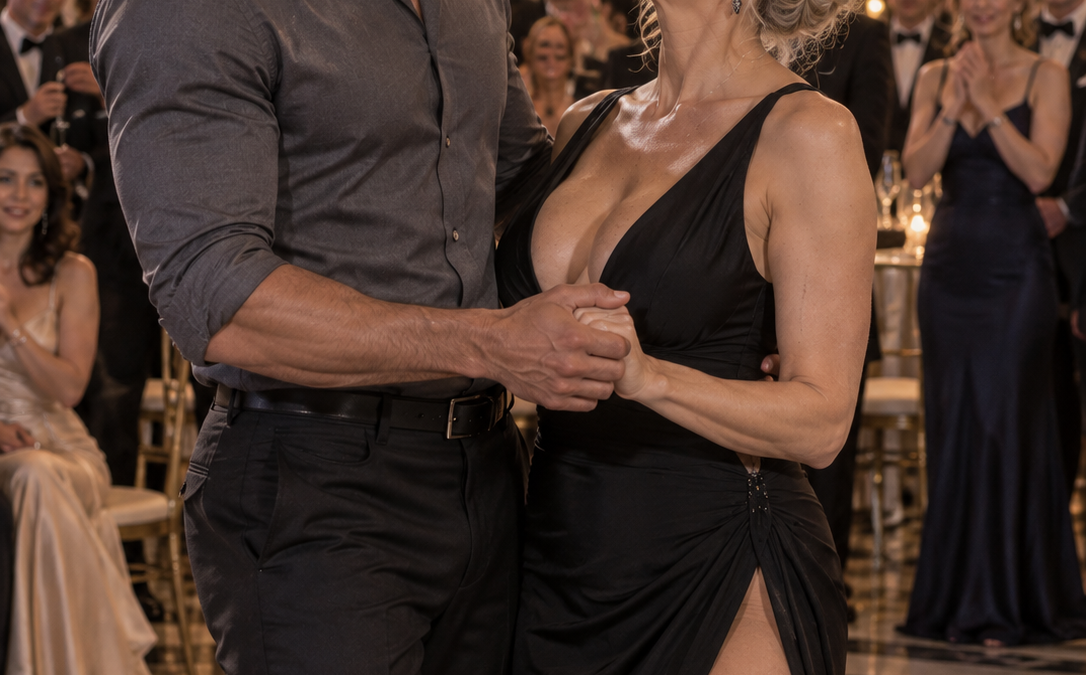
The orchestra swelled into the full walts and Liam pulled Evelyn into his arms right there. The two of them dancing in the exact spot where this entire impossible story had begun.
Except this time there was no hesitation in the room, no cowardice, no calculated distance, just 300 people watching two imperfect, ordinary, extraordinary people choose each other in front of everyone with nothing left to hide. They danced for the rest of the night through songs neither of them fully registered. Through congratulations from people Evelyn had known for decades and people Liam had only just met.
through champagne toasts and Dale’s genuinely emotional speech about having a front row seat to the only good thing that’s ever happened in this ballroom besides the open bar.
At some point, Evelyn pulled out her phone and video called misses.
Alvarez’s apartment and Mattie’s sleepy, delighted face filled the screen when she heard the news, immediately demanding to know if she got to be in the wedding and whether she could pick her own dress.
questions Evelyn answered with the patient seriousness of someone already deeply permanently invested in being this child’s family.
It would be easy telling a story like this one to end it there. The proposal, the applause, the happy ending wrapped up neatly in a ballroom under chandeliers, the kind of ending that closes a book and lets everyone go home satisfied.
But the truth of what Liam and Evelyn built together was never really about the gala or the proposal or even the love story itself. As remarkable as it was, it was about something quieter and harder to capture in a single dramatic moment. It was about the year that followed, the unglamorous day-to-day work of building a life together.
Evelyn learning to braid Mattiey’s hair badly and laughing at her own incompetence instead of being embarrassed by it.
Liam learning to navigate boardrooms and press events with the same steady presence he’d once brought to a dance floor.
Never quite losing the instinct that had gotten him there in the first place.
the simple refusal to look away from people the world had decided weren’t worth looking at.
It was about the wedding itself eight months later, small and unglamorous by Harrington Global standards.
Held not in some grand venue, but in the foundation’s community garden with survivors from the mentorship program seated alongside board members with Maddie as Flowergirl insisting on wearing sneakers under her dress because, in her own words, weddings are long and my feet matter too.
It was about the mentorship program continuing to grow long after the headlines about Evelyn’s engagement faded.
Quietly changing lives in cities neither Liam nor Evelyn would ever personally visit.
Run now by people Liam had trained who carried forward the same simple philosophy he’d built it on.
That dignity isn’t something you earn back after tragedy.
It’s something that was never actually lost, just temporarily obscured by other people’s discomfort.
It was about Evelyn years later sitting across from a young CEO at another company who’d reached out after her own public struggle with how the press covered a visible disability, asking Evelyn how she’d found the courage to stop hiding.
And Evelyn telling her honestly that courage wasn’t really the right word for it.
That what she’d actually found was a single person willing to walk toward her when an entire room walked away.
And that the real lesson wasn’t about her own bravery at all.
It was about how much it costs a society when its instinct faced with someone who looks different or has been marked by tragedy is to look away instead of forward. It was about how rare and how necessary it is to have even one person refused to do that and how that one refusal multiplied across enough rooms and enough years was the only thing that had ever actually changed anything.
Liam thought about this often in the years that followed, watching his daughter grow into a teenager who’d inherited both her late mother’s quick wit and her stepmother’s quiet steel.
Watching Evelyn continue to run one of the country’s most respected companies without a single scarf or careful camera angle.
watching the mentorship program he’d started in a cramped office with nothing but good intentions and his own hard-earned understanding of what it meant to be overlooked grow into something that had touched thousands of lives he’d never personally meet.
He thought about the version of himself who’d stood at the edge of that ballroom a year before any of it began.
Exhausted, underpaid, certain that crossing the floor was probably going to cost him a job he desperately needed.
He thought about how easy it would have been to stay where he was supposed to stay, to keep pouring water at table 9, to let the moment pass the way it had passed for every other man in that room who’d quietly decided Evelyn Harrington wasn’t worth the risk.
He never regretted, not for a single day afterward, choosing differently.
True courage, he’d come to understand, rarely announced itself with trumpets or grand gestures.
Most of the time it looked exactly like what it had looked like that night.
An ordinary, tired man putting down a tray he couldn’t really afford to set aside and walking towards someone the rest of the world had decided to walk away from.
It looked like choosing compassion in the one moment everyone else chose silence.
Not because it was easy, not because the outcome was guaranteed, but because the alternative, staying quiet, staying safe, staying invisible, had never once in the whole of human history made anyone’s life better.
Evelyn, for her part, came to understand something different, but equally important over those years. That the dance had never really been about romance. Not at its core.
Not in that very first moment when Liam’s hand found hers under the chandeliers.
It had been about dignity, about a woman who’d spent 5 years believing the world’s discomfort with her scars was a debt she owed.
A apology she had to keep paying, finally being shown that she’d never owed anyone anything at all.
That her worth had never actually diminished the day the fire changed her face.
It had only ever been other people’s fear that made it look that way.
and Maddie. Maddie who grew up watching her father and her stepmother build a life out of one impossibly brave choice.
Who grew up understanding in a way most children never get the chance to learn so directly.
That the people worth loving aren’t always the ones the world applauds first.
That sometimes the most important thing you can do in a crowded room is simply notice the person everyone else has decided not to.
Maddie carried that lesson with her long after she’d grown too old for bedtime stories and butterfly facts.
Long after the ring her father had shown her in secret became a wedding photograph on the living room wall. Long after the gala that started, everything had become simply the story of how her family began.
Years later, when she was old enough to understand the full shape of it, she asked her father once why he’d really crossed that floor, whether he’d known even a little that it would change everything.
“No,” Liam told her honestly.
“I had no idea what it would turn into.
I just knew that watching everyone walk away from her felt wrong, and I couldn’t make myself be one more person who did that.
He thought about it for a moment longer, looking out at the same Seattle skyline that had watched over the whole story from its beginning.
I think that’s usually how the important choices work.
Honestly, you rarely know in the moment that they’re going to matter.
You just know somewhere underneath all your fear and your tiredness and every reason you have to mind your own business that it’s the right thing to do and you do it anyway.
The rest of it, all of it, everything that came after, that was never really the plan. It was just what happens when you refuse to look away.
The Harrington Foundation continued its work for decades after that night, long after the headlines faded and the viral clips were forgotten, quietly funding burn treatment and survivor mentorship and emergency responder support in cities across the country. Carrying forward the same simple principle that had started it all in a Seattle ballroom.
that love, respect, and human dignity were never, despite what the world sometimes insisted, limited by scars or age or the cruel, careless calculations of people too afraid to walk across a room. And every year on the anniversary of that first gala, Evelyn and Liam returned to the same ballroom, stood in the same spot by the same tall windows, and danced to the same slow walts the orchestra had learned by then to simply expect.
Not because the moment needed repeating, but because some moments are worth returning to on purpose year after year as a reminder of exactly how much can change when one person decides that compassion is worth more than comfort and chooses against every easy instinct telling them not to to cross the floor anyway.
THE END.

