Part 3: “Put it down. It’s over.”
Chapter Ten: The Loose Floorboard
The apartment was dark when Elena let herself in. She didn’t turn on the lights. She moved by memory, her heart pounding, every creak of the old building making her flinch.
The bedroom was small, the bed unmade, her suitcase still sitting open on the floor. She knelt beside the desk and examined the bottom drawer. It was stuck fast, the wood warped, the lock rusted. But now that she looked closely, she saw what she’d missed before — the faint scratches around the lock. Recent. Someone had tried to open this drawer. Recently.
Giulia.
Elena grabbed the letter opener from the desk and wedged it into the gap. She worked it back and forth, her arms straining, until the wood splintered and the drawer popped open.
Inside was a single item: a small black notebook, its cover worn, its pages yellowed with age. Elena opened it.
The first page was a list of names. Matteo Falcone. Carlo Ricci. Vincenzo Moretti. Salvatore Greco. And beneath them, a name that made her blood run cold.
Don Alessandro Falcone.
The old man. The patriarch. The one who’d hired her. The one who’d given her his wife’s ring and told her she’d know what to do with it.
Elena turned the pages. They were filled with Giulia’s handwriting — cramped, hurried, the ink smudged in places. Dates. Times. Locations. Photographs slipped between the pages — grainy images of meetings, of handshakes, of money changing hands. And beneath each entry, a note in Giulia’s careful script.
Don knows. Don knows. Don knows.
The words repeated like a mantra, like a prayer, like a curse.
Don knows what? Elena thought. What does he know?
She turned to the last page. There, in larger handwriting, Giulia had written a single sentence.
If you’re reading this, I’m already dead. The Don is not what he seems. Trust no one. Except Dante. Always Dante.
Elena closed the notebook. Her hands were shaking.
She’d been played. By everyone. By the Don, who’d hired her, who’d given her the ring, who’d told her to trust him. By Sofia, who’d sent her here. By Dante, who’d asked her to trust him.
But Giulia’s last words had been clear. Trust no one. Except Dante. Always Dante.
She shoved the notebook into her jacket and ran for the door.
She was halfway down the stairs when the front door of the building burst open.
Carlo stood in the entrance, flanked by two men she didn’t recognize. His face was a mask of cold fury.
“You’re not very good at leaving,” he said. “Matteo is very disappointed.”
Elena backed up the stairs. “Matteo can be disappointed all he wants.”
“He wants to see you.” Carlo stepped forward. “Now.”
“I don’t want to see him.”
“I wasn’t asking.” Carlo nodded to the men. “Bring her.”
They climbed the stairs toward her. Elena turned and ran — up, not down, toward the roof. She burst through the door at the top of the stairs, into the cool night air, and found herself on a flat terrace overlooking the square. There was nowhere to go. The building was three stories tall. The drop was too far.
Carlo emerged behind her, breathing hard. “There’s nowhere left to run.”
Elena turned. The notebook was pressed to her chest. In the moonlight, Carlo’s face was hard, cruel, the face of a man who’d done terrible things and slept soundly afterward.
“You killed Giulia,” she said.
Carlo’s expression flickered. “She was a traitor.”
“She was a woman who loved her family.”
“She was a spy. She got what she deserved.” He stepped closer. “And so will you.”
He reached for her. Elena swung the notebook, catching him across the face. He staggered back, cursing. She lunged for the door, but one of the other men grabbed her arm, yanking her back.
“Enough,” Carlo growled. He wiped blood from his lip. “You’re coming with us. Matteo wants to talk to you before he decides what to do with his cousin.”
“Dante—”
“Dante is already dead.” Carlo’s smile was cruel. “Or he will be, by morning. Matteo has plans for him. Public plans. A lesson for anyone who thinks they can betray this family.”
Elena’s heart stopped.
No.
She’d promised him. She’d promised she’d come back. She’d promised they’d finish this together.
And now he was going to die because of her.
The man holding her arm yanked her toward the stairs. Elena stumbled, caught herself, and reached for the only thing she had left.
The ring.
The Don’s ring. Ruby and gold. Ancient and heavy. It was in her pocket, where she’d kept it since the night on the terrace. She closed her hand around it.
“Wait,” she said.
Carlo paused. “What?”
“The Don gave me something. A ring. He said I’d know what to do with it.” She held it up. The ruby caught the moonlight, glinting dark red. “Do you know what it means?”
Carlo’s face changed. For the first time, she saw uncertainty in his eyes. The ring meant something. Something important.
“That ring—” he started.
“It belonged to his wife. He told me it was special. He told me to keep it. He told me I’d know when to use it.” Elena’s voice was steady. “Do you know what happens to people who cross the Don?”
Carlo was silent.
“I do,” Elena continued. “I’ve been reading about this family. About its history. About what happens to men who think they can take what isn’t theirs.” She stepped closer to him, the ring held between them like a weapon. “The Don is still alive. He’s still the head of this family. And until he dies, you and Matteo are nothing but pretenders. You’ve already betrayed him. How do you think he’ll react when he finds out?”
“He’s dying—”
“He’s dying,” Elena agreed. “But he’s not dead yet. And I’ve been in his study. I’ve spoken to him privately. I’ve seen the real will — not the one Matteo’s been circulating, the forgery, but the one the Don signed three months ago.” She was bluffing. She had no idea what the will said. But Carlo didn’t know that. “Do you want to know who he named as his successor?”
Carlo’s face was pale. His men shifted uneasily behind him.
“Let me go,” Elena said quietly. “Let me walk out of here, and I’ll forget this happened. I’ll tell the Don you were just following orders. That you didn’t know what Matteo was planning.” She paused. “But if you stop me — if you take me to Matteo — then I’ll make sure the Don knows exactly who his real enemies are. And we both know what he does to traitors.”
For a long moment, Carlo didn’t move. His hand twitched toward his gun. His eyes flickered between Elena and the ring.
Then he stepped aside.
“Go,” he said. “But this isn’t over.”
Elena didn’t wait. She walked past him, down the stairs, out the door, into the square. She didn’t run. She didn’t look back. She walked with the calm of a woman who had nothing left to lose, and she didn’t stop until she reached Sofia’s safe house.
Sofia was waiting.
“You found it,” she said.
“I found it.” Elena held up the notebook. “And I know who the real enemy is.”
She opened the notebook to the first page and pointed to the name at the bottom of the list.
Don Alessandro Falcone.
Chapter Eleven: The Don’s Confession
Elena went to the main house alone.
Sofia had argued. She’d wanted to call in the commission, to raid the property, to take the Don into custody. But Elena had refused. The Don was the key. He was the only one who could end this — the only one with the power to stop Matteo before the family tore itself apart.
She knocked on the study door at exactly six in the morning.
“Entra.”
The Don was sitting behind his desk, a cup of espresso untouched at his elbow. He looked older than he had a week ago — smaller, frailer, the power that had once radiated from him now just a flicker. But his eyes were clear.
“You know,” he said.
“I know.” Elena placed the notebook on the desk between them. “I know you hired me. I know you knew about Giulia. I know you’ve been letting this happen.”
The Don looked at the notebook but didn’t touch it. “Giulia was a brave girl. Foolish, but brave. She thought she could save this family from itself.”
“She was right.”
“No. She was wrong.” The Don’s voice was soft. “This family can’t be saved. It can only be ended.”
Elena stared at him. “What?”
“Sit down, signorina. I have much to tell you, and not much time.”
She sat.
“I’ve been dying for two years,” the Don said. “The doctors told me six months ago that I had weeks, maybe days. But I’ve held on. I’ve held on because I needed to finish something.”
“The investigation.”
“The investigation. My grandson.” The Don smiled, a thin, sad expression. “Dante doesn’t know this, but I’ve been protecting him for years. From Matteo. From the syndicate. From himself. He thinks he’s been working alone. He thinks he’s been hiding his plans from me.” He paused. “But I’ve known about his investigation since the day he started it. Giulia told me. Before she disappeared, she came to me. She told me what she was doing. What Dante was doing. She asked me to protect him.”
“And you did?”
“I tried. I failed.” The Don’s eyes dropped to the desk. “When Giulia disappeared, I didn’t go after Matteo. I didn’t expose him. I was too afraid. Too afraid of what would happen to the family. Too afraid of losing what I’d built.” His voice cracked. “I let her die. And I’ve been paying for it ever since.”
“Why are you telling me this?”
“Because I need you to understand.” The Don looked up at her. “I’m not a good man. I’ve done terrible things. I’ve killed people. I’ve ordered people killed. I’ve built this family on blood and fear and greed.” He paused. “But I’m not Matteo. I don’t want to watch this family destroy itself. I don’t want to pass my legacy to a man who will turn it into something even worse than what I built.”
“So you hired me. You hired an auditor to expose your own family.”
“I hired a Falcone to save what was left of it.” The Don smiled again. “You’re the only one I could trust. An outsider, but one of us. Someone who understands the weight of this name.”
“I don’t understand anything.”
“You understand more than you know.” The Don reached into his desk drawer and pulled out a document. He slid it across the desk. “This is my will. The real one. Not the one Matteo’s been showing around, the forgery. This one was signed three months ago, witnessed by my lawyer and my doctor.”
Elena picked it up. She read it slowly, carefully, twice.
“This disinherits Matteo entirely,” she said.
“It does.”
“And leaves everything to Dante. The vineyard. The business. The estate.”
“The legitimate business. The illegitimate business goes to the authorities. I’ve arranged for the evidence to be released upon my death.” The Don leaned back. “Dante will have a chance to rebuild. To make this family something worth saving. But only if he survives the next twenty-four hours.”
Elena’s blood ran cold. “What happens in the next twenty-four hours?”
“Matteo has called a family meeting. Every Falcone, every associate, every ally. He’s going to announce that I’m no longer fit to lead. He’s going to claim I’ve lost my mind. And he’s going to name himself the new head of the family.” The Don’s eyes glittered. “He has the votes. Most of the family is either loyal to him or too afraid to oppose him. But he doesn’t have the will. And he doesn’t have you.”
“What do you want me to do?”
“I want you to come to the meeting. Bring the ledger. Bring Giulia’s notebook. Bring everything you have.” The Don’s voice was strong now, stronger than she’d ever heard it. “And when Matteo stands up to claim his prize, I want you to stand up and expose him. In front of everyone. Every Falcone. Every associate. Every witness.”
“He’ll kill me.”
“He’ll try. But I’ll be there. And I’ll protect you.” The Don met her eyes. “This is the last thing I’ll ever do, signorina. The last thing I’ll ever be. I’ve spent eighty years building a legacy of blood and fear. I want to spend my final hours tearing it down.”
Elena stared at him. The old man looked back, his eyes clear, his face calm.
“Where’s Dante?” she asked.
“Being held in the old church on the hill. Matteo’s men are guarding him. They’ll bring him to the meeting tonight.” The Don paused. “He’s alive. I made sure of that. But I can’t protect him much longer.”
“Then we need to move fast.”
“We do.” The Don stood up, slowly, painfully. “Go back to your apartment. Get the evidence. Be at the church at eight o’clock. And Elena—”
She stopped at the door.
“Thank you,” the Don said. “For being the one I could trust.”
Elena walked out of the study without answering.
Chapter Twelve: The Church on the Hill
The church was old. Sixteenth century. Its stone walls were thick, its windows dark, its doors heavy. It sat on a hill overlooking the vineyard, a reminder of the days when the Falcone family had been nothing more than farmers with delusions of grandeur.
Tonight, it was full.
Elena stood at the back, unnoticed, as the family filed in. Matteo sat in the front row, Bianca beside him, her face pale and tight. Carlo stood by the door, his eyes scanning the room. The other Falcone associates — cousins, uncles, men who’d built their lives on the family’s illicit fortune — filled the pews.
At the front, where the altar should have been, was a long table. And at the center of the table sat the Don.
He looked ancient. Frail. But his eyes were sharp, and when he spoke, his voice carried.
“My family,” he said. “My blood. My legacy. I’ve called you here tonight to settle a matter of succession.”
Matteo stood. “Uncle, you don’t have to—”
“Sit down.” The Don’s voice cracked like a whip. “You’ll speak when I tell you to speak.”
Matteo sat.
The Don looked at the assembled faces. “I’m dying,” he said. “The doctors say I have days. Weeks, at most. And before I go, I need to make sure this family is in good hands.”
“You’ve already made your wishes clear,” Matteo said. “You named me as your successor. The papers are filed. The lawyers have copies.”
“Did they?” The Don smiled. “That’s interesting. Because I have a different document here. Signed three months ago. Witnessed by my doctor and my lawyer. And it says something entirely different.”
He pulled the will from his jacket and held it up.
Matteo’s face went white. “That’s a forgery.”
“It’s the real one. The one you’ve been trying to suppress.” The Don placed it on the table. “I’m naming Dante Falcone as my sole heir. The vineyard, the estate, the legitimate business — everything. And I’m turning over the evidence of this family’s criminal activities to the authorities.”
Chaos erupted.
Men shouted. Matteo surged to his feet, his face twisted with rage. Carlo reached for his gun. Bianca grabbed Matteo’s arm, her face terrified.
And Elena stepped forward.
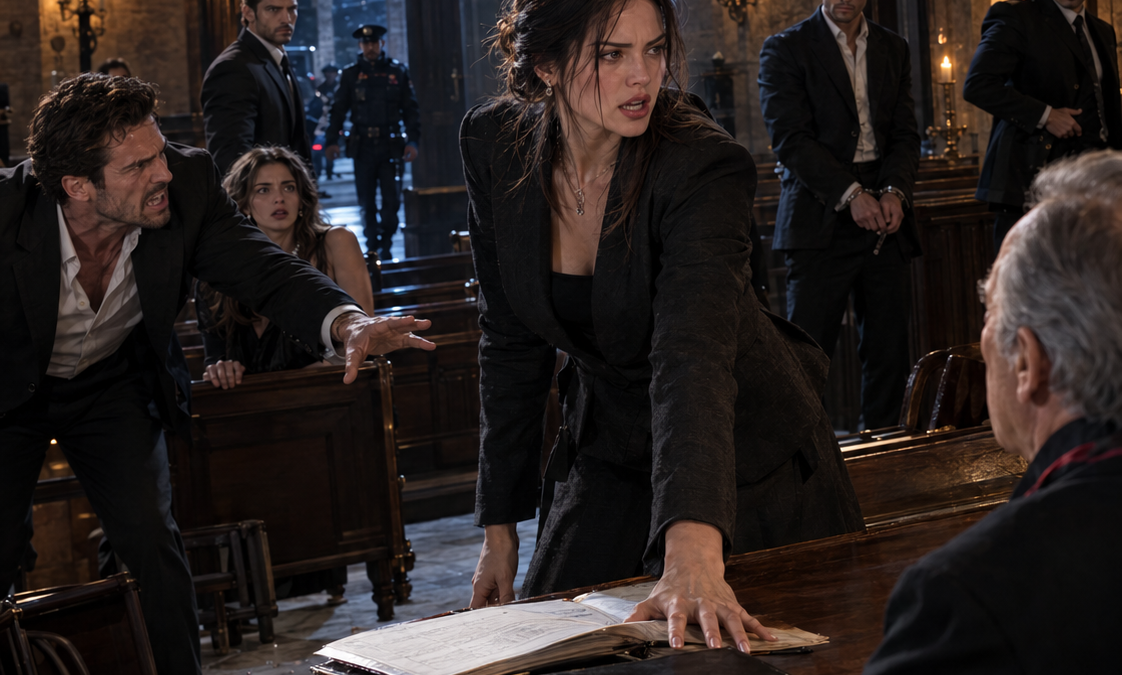
She walked down the aisle, the ledger in one hand, Giulia’s notebook in the other. She walked past the shouting men, past Carlo, past Bianca. She walked to the front of the church and placed the evidence on the table beside the will.
“I’m Elena Falcone,” she said. “I’m the auditor your Don hired. I’m here to tell you the truth.”
The room went silent.
For the next twenty minutes, she laid it out. The money laundering. The smuggling. The deals with the Moretti family. The wire transfers. The shell companies. The evidence that would send half the men in this room to prison for the rest of their lives.
“And there’s more,” she said. “Three years ago, a woman named Giulia Falcone was murdered. She was investigating this family’s crimes. She was gathering evidence. And when she got too close, someone killed her.”
She held up Giulia’s notebook.
“This is her failsafe. Her evidence. The names of everyone involved in her death.” She looked at Carlo. “Including the man who drove her to the airport and came back alone.”
Carlo drew his gun.
“No,” the Don said.
Carlo froze.
“Put it down,” the Don said quietly. “It’s over.”
“It’s not over.” Matteo’s voice was a snarl. “You think this changes anything? You think a piece of paper and a dead woman’s notebook will stop me? I have the votes. I have the men. I have the power.”
“You have nothing,” the Don said. “You’re a coward. A liar. A murderer. And you’re not my blood.”
Matteo’s face went white. “What?”
“I’ve known for years. Your mother was unfaithful. You’re not my brother’s son. You’re not a Falcone.” The Don stood up, his hands braced on the table. “And you’ll never be the head of this family. Not while I’m alive.”
Matteo screamed. He lunged for the table, reaching for the will, for the evidence, for anything he could destroy. But Carlo caught him, held him back.
“Let him go,” the Don said. “The police are already outside. Let them take him.”
The doors of the church burst open.
Sofia stood in the entrance, flanked by carabinieri in tactical gear. Behind her, Elena saw more men — agents, officers, people she didn’t recognize. The anti-mafia commission. The people who’d been waiting for this moment for years.
“Matteo Falcone,” Sofia said. “You’re under arrest for murder, money laundering, and organized crime.”
Matteo spat. “You’ll never prove it.”
“We already have.” Elena held up the ledger. “Your cousin gave us everything. Every deal. Every shipment. Every murder. Including his own father’s.”
Matteo’s eyes went wide. He turned to Dante — Dante, who was standing in the doorway of a side chapel, his face bruised, his hands cuffed but his eyes burning.
“You,” Matteo whispered. “You did this.”
“I did.” Dante’s voice was quiet. “I’ve been waiting for this moment for twenty-five years.”
Matteo lunged for him. Carlo grabbed him, pinned him down. The carabinieri moved in, their guns drawn, their voices shouting commands in rapid Italian. It was over in seconds.
Matteo was on the ground, his hands behind his back, cuffs clicking into place. Bianca was crying. The other men were frozen, their faces pale with shock. And the Don sat at the table, watching it all, a small, sad smile on his face.
Elena pushed through the chaos to Dante. She touched his face, her fingers brushing the bruise on his cheek.
“You’re alive,” she said.
“I’m alive.” He caught her hand, pressed it to his lips. “You came back.”
“I told you I would.”
“I know.” He smiled, a real smile, the first she’d ever seen from him. “I didn’t believe you.”
She laughed, a sound that was half sob.
“I told you to trust me.”
“I know.” He pulled her close. “I’m trying.”
Around them, the carabinieri moved through the church, taking statements, gathering evidence, leading the arrested away. Sofia was talking to the Don, her face serious. Bianca was being led out in cuffs, her mascara streaked, her composure shattered.
And through it all, Elena held onto Dante, and Dante held onto her.
Chapter Thirteen: The Don’s Last Gift
The Don died three days later.
He passed in his sleep, in the study where he’d spent eighty years building and dismantling his empire. The doctor said it was peaceful. Elena wasn’t sure she believed him. Men like Alessandro Falcone didn’t go peacefully. They fought until the last breath, clawing at the world that was trying to take them.
But when she found him, he was smiling.
She’d come to bring him tea — a habit she’d developed over the past three days, a small act of care in the chaos of arrests and interrogations and the endless paperwork that followed the raid on the church. She’d knocked on the study door and received no answer. She’d pushed it open and found him in his chair, his hands folded on the desk, his eyes closed, the morning light falling across his face like a blessing.
The ring was in his hand.
The same ring he’d given her on the terrace, the ruby ring that had saved her life on the rooftop. He must have taken it from her room, or perhaps he’d had another one made, a twin. It didn’t matter. What mattered was the note tucked beneath his hand, written in his cramped, old-fashioned script.
Give this to Dante. Tell him I’m sorry. Tell him I tried.
Elena took the ring. She folded the note and put it in her pocket. Then she sat with him for a long time, in the quiet of the study, and let herself grieve for a man she’d barely known and would never forget.
The funeral was small. The Don had specified that in his will — no pomp, no ceremony, no display of wealth or power. Just family. Just the people who mattered.
Elena stood at the edge of the grave, Dante beside her, his hand in hers. The vineyard stretched out behind them, rows of vines heavy with ripening grapes, the harvest only weeks away. The sun was warm. The sky was clear. It was the kind of day the Don would have loved.
“He asked me to give you this,” Elena said quietly, pressing the ring into Dante’s palm.
Dante looked down at it. His jaw tightened.
“He gave it to you first.”
“He gave it to me so I could give it to you.” She paused. “He wanted you to know he was sorry. For everything. For Giulia. For your father. For all the years he let Matteo run unchecked.”
Dante closed his hand around the ring. “He didn’t have to apologize.”
“He wanted to.”
“I know.” Dante’s voice was rough. “I just — I don’t know how to forgive him. I don’t know if I can.”
“You don’t have to forgive him. You just have to let him go.”
Dante was silent for a long moment. Then he knelt and placed the ring on the coffin, beside the single white rose someone had left there. He stayed there for a moment, his head bowed, and Elena watched the sun catch the silver threads in his hair and thought about all the things he’d never said to his grandfather. All the things he’d never have the chance to say now.
When he stood, his eyes were dry.
“I’m ready,” he said.
The will was read the following week.
Elena sat in the lawyer’s office in Palermo, Dante beside her, Sofia across the table, a notary recording everything on a small camera. The will was long, detailed, precise — the Don had spent months preparing it, anticipating every legal challenge Matteo might raise.
The vineyard went to Dante. The legitimate business, the estate, the land, the brand. Everything that could be salvaged from the wreckage of the Falcone empire. The illegitimate business — the shell companies, the offshore accounts, the deals with the syndicate — was already in the hands of the authorities, the assets frozen, the evidence catalogued.
But there was more.
“To Elena Falcone,” the lawyer read, “I leave the farmhouse on the eastern ridge. The original Falcone homestead. It was built by my grandfather in 1892 and has been in the family for four generations. It was taken from Marco Falcone when he was disowned. I return it to his daughter, in the hope that she will make of it something better than what we made of this family.”
Elena stared at the lawyer. “He left me the farmhouse?”
“He left you the farmhouse.”
She looked at Dante. He was smiling — a real smile, warm and open, the kind of smile she’d never thought she’d see on his face.
“He knew,” Dante said. “He knew who you were. He knew what your father lost. And he wanted to give it back.”
Elena didn’t know what to say. She’d spent her whole life running from the Falcone name, hiding from the legacy of a family that had cast her father out and forgotten he’d ever existed. And now — now she was being handed the keys to the ancestral home. The house her grandfather had built. The house her father had grown up in.
“I don’t know how to accept this,” she said.
“You don’t have to accept it,” Dante said. “You just have to decide what to do with it.”
Chapter Fourteen: The Terms
They walked through the vineyard that evening, the sun setting behind the hills, the rows of vines stretching out like rivers of green and gold. Elena was tired. Bone-tired. The kind of exhaustion that came from weeks of tension finally releasing, from fear finally fading into something like peace.
But her mind was still racing.
“You’re going to run the vineyard,” she said.
“I’m going to try.” Dante walked beside her, his hands in his pockets, his gaze fixed on the horizon. “The legitimate business, anyway. The winery, the exports, the brand. It’s going to take years to rebuild. To clean out the corruption. To make it something I’m not ashamed of.”
“You’ll do it.”
“I’ll try.” He glanced at her. “With help.”
“What kind of help?”
“Yours.” He stopped walking. They were standing at the edge of the vineyard, where the land sloped down toward the village. The lights were coming on in the houses below, pinpricks of gold in the gathering dark. “I want you to stay, Elena. Not just as a guest, or an auditor, or a witness. I want you to stay as my partner.”
She stared at him. “Partner in what sense?”
“In every sense.” He turned to face her. “I want you to help me run this vineyard. I want you to be the financial mind behind the operation — the one who makes sure we never go down the path my family went down. I want you to help me build something honest. Something worth leaving behind.”
“That’s a job offer.”
“It’s more than a job offer.” He stepped closer. “It’s a life offer. I’m asking you to stay. To build a life here. With me.”
Elena’s heart was pounding. She’d been expecting something like this — she’d seen it in his eyes, in the way he looked at her, in the way he touched her hand whenever he had the chance. But hearing it out loud was different. Hearing it out loud made it real.
“I don’t know if I can,” she said.
“Why not?”
“Because I don’t know who I am here. In London, I was an auditor. I had a career. A life. A sense of myself.” She paused. “Here, I’m a Falcone. A long-lost cousin. The illegitimate daughter of a disowned man. I don’t know what that means.”
“It means you belong.” Dante’s voice was soft. “You belong to this family. To this land. To me. If you want to.”
“What if I don’t want to?”
“Then I’ll let you go. I’ll thank you for everything you’ve done, and I’ll drive you to the airport, and I’ll never bother you again.” He paused. “But I don’t think that’s what you want.”
She looked at him — this man who’d been a stranger two months ago, who’d become her ally, her protector, her anchor. He was dangerous. He was complicated. He’d done terrible things. But he was trying. He was trying so hard, every day, to be better.
She thought about the Don’s ring. She thought about Giulia’s notebook. She thought about the farmhouse on the eastern ridge, waiting for her, the original Falcone homestead, the place where her father had grown up, before he’d been cast out.
You’ll know what to do with it.
“I want to stay,” she said finally. “But not on your terms. On mine.”
Dante’s expression didn’t change. “What are your terms?”
“I want a stake in the business. Not a salary. Not a favor. A real stake. I want my name on the paperwork. I want a vote on the board. I want to be a partner, not an employee.”
“Done.”
“I want the farmhouse. Not as a gift. As a restoration. I want to rebuild it. Live in it. Make it mine.”
“Done.”
“I want you to trust me. Not just with the business. With everything. No more secrets. No more half-truths. If we’re going to do this, we do it honestly.”
Dante was silent for a long moment. Then he smiled — that real smile, the one that made him look younger, lighter, almost happy.
“Done,” he said. “What else?”
“That’s it.” She stepped closer. “For now.”
“Then I accept your terms.” He reached out and took her hand. “And I have one of my own.”
“What?”
“Stay with me tonight.” His voice was quiet, almost hesitant. “Not for — not for that. Just stay. I don’t want to be alone in that house. Not anymore.”
Elena looked at him. The sun had set completely now, and the stars were coming out, and the vineyard was a dark ocean of vines stretching out beneath the sky. She’d spent so long being afraid. So long being careful. So long protecting herself from everyone who might hurt her.
But she wasn’t afraid of Dante. Not anymore.
“All right,” she said. “I’ll stay.”
Chapter Fifteen: The First Harvest
The harvest came three weeks later.
Elena stood on the terrace of the main house, a cup of coffee in her hand, and watched the workers move through the vines. They were picking the Nero d’Avola today — the grapes that would become the vineyard’s signature wine, the one the Falcone family had been making for generations. The sun was warm, the sky was clear, and for the first time in months, the valley felt peaceful.
Dante emerged from the house, his hair still wet from the shower, a clipboard in his hand. He’d been working since dawn — checking the vines, supervising the pickers, arguing with the winemaker about the fermentation schedule. He looked tired. He also looked happier than she’d ever seen him.
“You’re up early,” he said, kissing her cheek.
“I wanted to see the harvest.” She gestured at the workers. “It’s beautiful.”
“It’s hard work.” He leaned on the railing beside her. “My father used to say that the harvest was the only honest thing this family ever did. Everything else was lies and theft and murder. But the grapes — the grapes were real. The wine was real. It was the one thing we could be proud of.”
“He was right.”
“I know.” Dante smiled. “That’s why I’m going to spend the rest of my life making sure the wine stays real. No more fake export records. No more smuggling. Just good wine, made by honest people, sold to people who appreciate it.”
“That’s a lot to take on.”
“I’m not doing it alone.” He looked at her. “You’re the one who’s been rebuilding the financial records. You’re the one who’s been negotiating with the export partners. You’re the one who’s been making sure every transaction is clean and legal and documented.”
“I’m good at what I do.”
“You’re brilliant at what you do.” He took her hand. “I don’t know what I’d do without you.”
Elena squeezed his hand. “You’d manage.”
“No.” He shook his head. “I wouldn’t. I was drowning before you came. Drowning in secrets and lies and the weight of this family. You gave me something to hold onto.”
Elena was quiet for a moment. Then she said, “I used to think I was just an auditor. Just a woman with a clipboard. Someone who counted things and wrote reports and never made a difference.”
“And now?”
“Now I think I’m a Falcone.” She smiled. “The good kind.”
Dante laughed — a real laugh, warm and full. “There’s a good kind now?”
“There is. I’m starting it.” She gestured at the vineyard. “This is the good kind. This is what the Falcone name should mean. Not fear. Not violence. Just good wine and hard work and family.”
“You make it sound simple.”
“It’s not simple. But it’s worth it.” She paused. “I talked to Sofia yesterday.”
Dante’s expression flickered. “What did she want?”
“She wanted to know if I’d testify at Matteo’s trial. If I’d be a witness for the prosecution.”
“Are you going to?”
“I said yes.” Elena met his eyes. “I’m going to stand up in court and tell everyone what I saw. What I found. What your family did. And I’m going to do it with the Falcone name. Because I want people to know that this family doesn’t hide anymore.”
Dante was silent for a long moment. Then he nodded.
“I’ll be there,” he said. “Sitting in the front row. Watching you.”
“You don’t have to—”
“I want to.” He took her hand and pressed it to his lips. “I want to watch you bring them down. All of them. The ones who hurt Giulia. The ones who hurt my father. The ones who turned this family into something ugly.” He paused. “And I want to watch you rebuild it. Something better.”
Chapter Sixteen: The Ring on the Loose Floorboard
The farmhouse was old. Older than the main house, older than the vineyard, older than almost everything else on the estate. It had been abandoned for decades, its roof half-collapsed, its walls cracked, its floors warped by years of rain and neglect.
Elena loved it.
She stood in the doorway, a hammer in one hand, a crowbar in the other, and surveyed the wreckage. The living room was a mess of broken furniture and fallen plaster. The kitchen was a ruin of rusted pipes and cracked tile. The bedroom — her bedroom — had a hole in the ceiling that let in the sky.
But beneath the debris, she could see what it had once been. The beams were hand-hewn oak, solid and strong. The windows were tall and arched, designed to catch the morning light. The stone fireplace was a work of art, carved by someone who’d cared about what they were building.
Her father’s home, she thought. His childhood. His memories. His legacy.
She was going to bring it back.
Dante appeared in the doorway, his arms full of lumber. “Where do you want this?”
“In the bedroom. The floor needs to be replaced.” She paused. “There’s a loose board. By the window. I noticed it yesterday.”
Dante set the lumber down and walked to the bedroom. Elena followed, her heart beating a little faster than it should. She’d been thinking about the loose floorboard for days now — ever since she’d found Giulia’s notebook in the desk drawer, she’d been wondering if there were other hiding places. Other secrets.
Dante knelt beside the board and worked it loose. Beneath it, in the dark space between the joists, was a small metal box.
“What is it?” Elena asked.
Dante pulled it out. The box was old, its surface tarnished, its lock rusted shut. He pried it open with the crowbar.
Inside was a photograph. A young man — dark-haired, handsome, smiling at the camera. Beside him, a woman with Elena’s eyes, her hair loose, her face bright with laughter.
Elena’s breath caught.
“That’s my father,” she said. “And my mother.”
Dante looked at her. “How do you know?”
“I have the same photograph. My mother gave it to me when I was a child. Before she died.” She took the photograph from the box. “He must have left this here. When he was disowned. He must have hidden it, hoping someone would find it.”
“Or hoping you would find it.”
Elena stared at the photograph. Her father was young — younger than she’d ever seen him, younger than she remembered. He was holding her mother’s hand, and they were both laughing, and they looked so happy, so alive, so full of hope.
“He never talked about Sicily,” she said quietly. “He never told me about his family. I didn’t know he’d been disowned until I was an adult. I didn’t know he’d grown up in a vineyard.”
“Maybe he wanted to protect you.”
“Maybe.” She placed the photograph back in the box. “Or maybe he wanted to forget.”
Dante was quiet for a moment. Then he reached into his pocket and pulled out the ruby ring — the ring the Don had given her, the ring she’d given him at the funeral. He held it up, the ruby catching the light.
“I want you to have this,” he said.
“You gave it to your grandfather.”
“I gave it to his coffin. That’s different.” He took her hand and slid the ring onto her finger. “It belonged to my grandmother. My grandfather loved her more than anything. He told me once that she was the only person who ever made him want to be good.” He paused. “You make me want to be good, Elena. You make me want to be better than I am.”
“You’re already better than you think.”
“No. I’m not.” He met her eyes. “But I’m trying. Because of you.”
Elena looked down at the ring. It fit perfectly. The ruby glowed in the afternoon light.
“Dante—”
“I’m not asking you to marry me.” He smiled. “Not yet. I know you need time. I know you need to build your own life, your own name, your own power. I’m not going to take that from you.”
“Then what are you asking?”
“I’m asking you to keep the ring. As a promise.” He paused. “A promise that I’ll wait. As long as it takes. A year. Five years. Ten. Until you’re ready. Until you trust me enough.”
Elena stared at him. The man who’d been a stranger two months ago. The man who’d become her partner, her ally, her anchor. The man who’d done terrible things and was trying every day to be better.
“I already trust you,” she said.
“Then trust me a little longer.” He stepped closer. “Let me prove it. Let me earn it. Let me spend the rest of my life showing you that I’m worthy of you.”
Elena laughed. “You’re dramatic, you know that?”
“I know.” He smiled. “It’s the Sicilian in me.”
She reached up and touched his face, her fingers tracing the scar along his jaw. He closed his eyes at the touch, leaning into her hand like a man starved for tenderness.
“I’m staying,” she said. “I’m staying in the farmhouse. I’m staying in the vineyard. I’m staying with you. But I’m not going to be your wife. Not yet. Not until I’ve built something of my own.”
“I know.”
“I’m going to run the business with you. I’m going to testify at the trial. I’m going to make sure this family never hurts anyone again.” She paused. “And when I’m ready — when I’ve done everything I need to do — then I’ll think about the ring. About marriage. About forever.”
Dante nodded. “Then I’ll wait.”
“You’ll wait?”
“I’ll wait.” He took her hand and kissed it, a soft, gentle kiss that made her heart ache. “I’ve waited this long for someone like you. I can wait a little longer for forever.”
Elena pulled him close. She kissed him — not a gentle kiss, but a real one, a kiss that said everything she couldn’t put into words. And when she pulled back, she was smiling.
“Good,” she said. “Now help me fix this floorboard. We have a lot of work to do.”
Six months later
The farmhouse was finished.
Elena stood on the porch, a glass of wine in her hand, and watched the sun set over the vineyard. The harvest was over. The wine was aging in the cellars. The trial was finished — Matteo had been convicted of murder, money laundering, and organized crime. He’d been sentenced to life in prison. Carlo had taken a plea deal and was serving twenty years. Bianca had testified against both of them and had been given immunity.
The Falcone name was clean.
Dante emerged from the house, two plates in his hands. He’d been cooking — something with tomatoes and olives and fresh bread, the smell drifting through the open windows.
“You made dinner,” Elena said.
“I made dinner.” He set the plates on the table. “You’ve been working all day. You deserve a break.”
She smiled. “You’re getting good at this.”
“At what?”
“At being domestic.” She sat down at the table. “At being normal. At being happy.”
Dante sat across from her. “I’m learning.”
They ate in silence for a while, the sounds of the vineyard drifting up from the valley — the crickets, the distant bark of a dog, the soft rustle of wind through the vines. The stars were coming out, one by one, like someone was turning on lights in the sky.
“I got a call from Sofia today,” Elena said.
“What did she want?”
“She wants me to consult on another case. A family in Tuscany. Similar operation to yours — money laundering, smuggling, the whole thing.” She paused. “She wants me to go undercover. Do what I did here.”
Dante’s fork stopped halfway to his mouth. “What did you say?”
“I said I’d think about it.”
He set the fork down. “Are you going to do it?”
“I don’t know.” Elena looked at him. “Part of me wants to. Part of me wants to help other families the way I helped yours. Part of me wants to keep fighting.”
“And the other part?”
“The other part wants to stay here. Build this vineyard. Build this life.” She gestured at the farmhouse, the land, the man across from her. “Build something that’s mine.”
Dante reached across the table and took her hand.
“Whatever you decide,” he said, “I’ll support you. If you want to go to Tuscany, I’ll wait for you. If you want to stay, I’ll be here. If you want to do something else entirely — something I haven’t thought of — I’ll help you do it.”
Elena squeezed his hand. “You’re too good to me.”
“I’m not good enough for you.” He smiled. “But I’m trying.”
She looked at him — this man who’d been a stranger, an ally, a partner, a lover. This man who’d done terrible things and spent every day since trying to make up for them. This man who’d waited for her, who’d trusted her, who’d given her a home when she’d had nothing.
She thought about the ring. The ruby ring, still on her finger. The promise she’d made to wait. The life she was building, brick by brick, vine by vine.
“I’m going to stay,” she said. “For now. I’m going to help you run this vineyard. I’m going to make it the best damn winery in Sicily. And then — when it’s thriving, when it’s everything we dreamed it could be — I’ll think about Tuscany.”
Dante smiled. “That’s all I ask.”
He lifted her hand and kissed the ring. Then he stood and cleared the plates, and they walked together into the house, into the life they were building, into the future they’d earned.
Behind them, the vineyard stretched out under the stars — rows of vines heavy with promise, roots deep in the soil, waiting for the next harvest.

