The Maid’s 8-Month-Old Baby Held the Billionaire’s Watch to Her Ear—Then Pointed at Him and Whispered Something That Made Him Freeze, Revealing a Secret That Could Destroy His Entire Family…

The Maid’s 8-Month-Old Baby Held the Billionaire’s Watch to Her Ear—Then Pointed at Him and Whispered Something That Made Him Freeze, Revealing a Secret That Could Destroy His Entire Family…

Nobody in the Ashford family had said the word Emily out loud in almost four years.

It wasn’t a rule anyone had written down.

It was simply understood the way certain silences become law inside grieving families. Emily Ashford had been 31 years old, married to Richard Ashford for barely 6 months when a small plane carrying her home from a business trip in Colorado went down in the mountains outside Denver.

There had been no body to bury, no closure, just a folded flag of a memory and a wedding ring that came back in a small velvet box 8 months later once the investigation quietly closed. Richard Ashford was 39 now.

He ran Ashford Holdings, a private investment firm his grandfather had built from a single Chicago warehouse into a company managing over $4 billion in assets. He wore the same silver chronograph watch every single day. Emily had given it to him as a wedding gift engraved on the back with four words.

Time is only borrowed. He never took it off. Not in the shower, not at the gym, not once in four years.

Naomi Reyes had worked as a housekeeper for the Ashford family for just over a year.

She was 28, quiet, careful with her words, and she’d taken the job 3 months after her husband Miguel, a Navy pilot, had been killed in a training accident off the coast of San Diego.

She had an 8-month-old daughter named Sophia.

And on days when her usual babysitter fell through, she had no choice but to bring Sophia along, tucking her into a portable bouncer in the small laundry room off the penthouse’s east wing, praying Richard Ashford would stay in his office on the far side of the building, the way he almost always did.

That Thursday, everything went according to plan until Richard came looking for his watch.

He’d left it on the kitchen counter that morning after washing his hands.

An uncharacteristic slip for a man who normally guarded that watch like it was the only thing keeping him tethered to solid ground.

When he walked into the kitchen and didn’t find it, he began retracing his steps room by room and that search led him for the first time in over a year of Naomi working there straight into the laundry room.

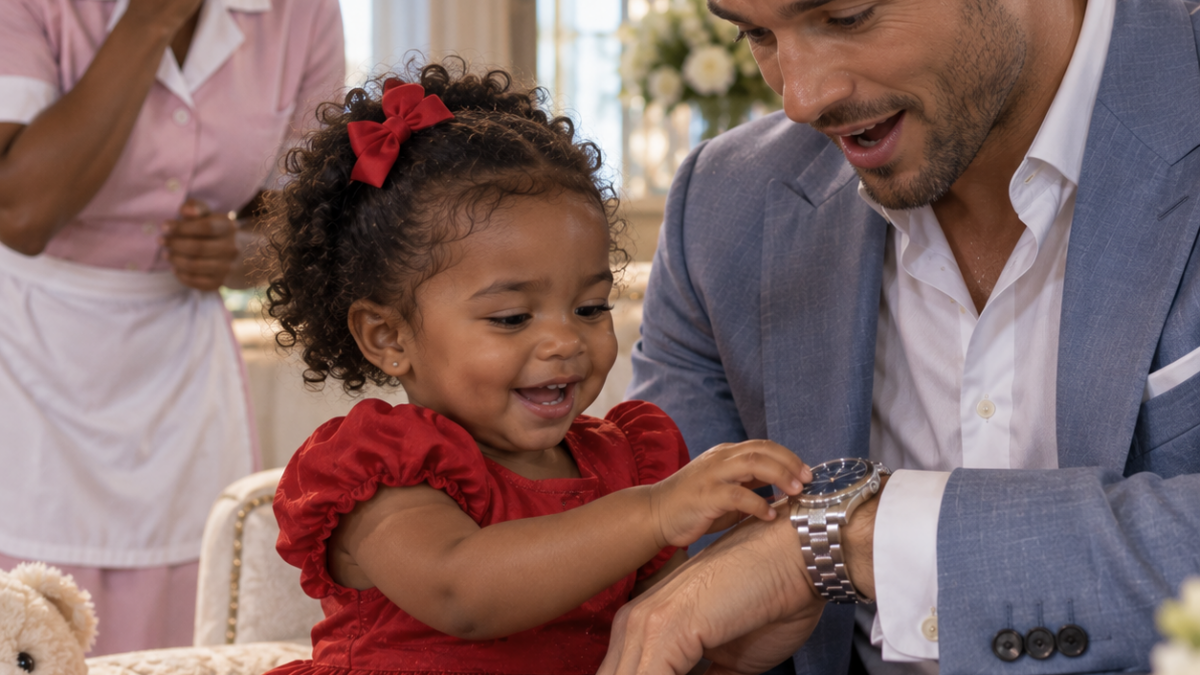
He found his watch sitting on top of the dryer and he found Sophia sitting in her bouncer nearby holding something small and silver in her tiny fist.

“Sophia, no honey, give that back,” Naomi said quickly, reaching for her daughter, mortified.

“Mr.Ashford, I am so sorry.

She must have grabbed it off the counter when I carried the laundry basket through.

I didn’t even notice.

” Richard didn’t answer right away.

He was watching his daughter, his godaughter, in every way but blood, though nobody in that room knew that title yet, hold his dead wife’s wedding gift up to her small ear like it was a sea shell, listening to it with a kind of total uncomplicated focus only a baby can manage.

Then Sophia did something that made both adults go completely still.

She pulled the watch away from her ear, pointed one small finger directly at Richard’s chest, and made a sound.

Not a cry, not a laugh, but a clear, deliberate two-cllable sound over and over.

Insistent the way babies repeat something they’re trying desperately to communicate.

Emmy. Emmy. Naomi froze.

Her hand halfway to her daughter’s fist.

I don’t.

She doesn’t know that word.

I’ve never taught her that word.

I don’t even know where she’d have heard it.

Richard Ashford, a man who had built his entire adult personality around never letting his face show what he was feeling in front of employees, felt the blood drain out of his own.

Because Emmy had been Emily’s childhood nickname, a nickname almost nobody outside his own family had ever used.

A nickname that had not been spoken in that penthouse by anyone in nearly 4 years.

What Richard didn’t know, standing frozen in that laundry room with his watch forgotten in his housekeeper’s daughter’s fist, was that this strange, impossible moment was only the first thread of something buried far deeper in his own family’s history, and that pulling on it was about to change both his life and Naomi’s forever.

He didn’t sleep that
night.

He sat in his study with the lights off, turning the watch over and over in his hands, running his thumb across the engraving he’d read a thousand times.

Time is only borrowed. He told himself it was a coincidence. Babies made sounds all the time.

Emmy could easily have come from anywhere. A nursery rhyme, a cartoon character, pure random babble that happened to land on two familiar syllables.

He was a rational man. He built his career on rational decisions.

He was not going to unravel over a baby’s babbling.

Yet the next morning, he found himself in the kitchen before Naomi arrived.

Something he had never once done in the year she’d worked for him.

When her car pulled into the private garage, he was standing by the elevator, hands jammed into his pockets, looking for the first time anyone on staff could remember, unsure of himself.

“Is Sophia with you today?”

he asked before she’d even stepped out.

Naomi’s stomach dropped.

She assumed she was about to be let go over yesterday’s laundry room incident.

No, sir.

My sister’s watching her today.

I promise yesterday won’t happen again.

I’ll make sure she’s never near anything of yours.

I’d like her to come back, Richard said.

If that’s all right.

Naomi stared at him, utterly confused.

But a wealthy man’s strange requests were not something she felt she had the standing to refuse.

So, it became an odd quiet routine.

Twice a week, Sophia came to the penthouse, and Richard Ashford, a man whose assistant scheduled his lunch breaks around board calls, began finding 20 minutes in the middle of his day to sit on the floor near his housekeeper’s daughter, simply watching her, waiting, half hoping and half dreading that she’d say that word again.

She did, twice more
over the following two weeks. Always unprompted, always while holding something silver or reflective.

once while looking at her own reflection in the toaster.

It reached Richard’s mother, Vivien Ashford, the way most things in that family eventually did through the staff grapevine, filtered and distorted, until it arrived at her as a vague rumor that Richard had grown unusually attached to the housekeeper’s baby.

Viven had spent four years quietly worried about her son’s inability to move past Emily’s death, and she’d hoped in some small way that this meant he was finally opening up to something new.

until she learned the housekeeper’s name.

Viven had been the one who handled most of Emily’s affairs after the accident, closing accounts, sorting through old boxes, working with a family attorney on the parts of grief nobody warns you about, the paperwork parts, and buried somewhere in her memory was a name she hadn’t thought about in years, because it had never mattered until now.

Viz.

It took one phone call to the family’s old attorney for Viven’s suspicion to solidify into something she could no longer ignore.

And when she hung up the phone, her hands were shaking badly enough that she had to sit down.

She drove to the penthouse that evening and found her son alone in the study, staring at his watch the way he’d been doing for two weeks straight.

Richard,” she said carefully, sitting across from him.

“I need to tell you something, and I don’t think you’re ready for it.”

He looked up, “Then tell me slowly.”

Viven took a breath.

“Do you remember right after you and Emily got engaged?

She volunteered at that Navy family support center in San Diego for almost a year before the wedding took over her whole life.

” “Vaguely,” Richard said.

She didn’t talk about it much, said it wasn’t about getting credit for it.

She mentored young military spouses there. Viven said helped a few of them through financial hardship when their husbands were deployed or when something happened to them.

She never told you the details because that’s who Emily was.

She helped people quietly and never brought it up again. She hesitated.

One of the young women she mentored had just lost her fiance in a training accident. Emily helped her get back on her feet financially for almost a year before the wedding.

Before your life together took over everything.

Richard’s jaw tightened.

What does that have to do with that young woman’s name?

Vivien said quietly. Was Elena Reyes.

The room went completely silent.

Naomi’s mother.

Vivien continued.

I found the connection in Emily’s old journal entries cross-referenced with the support cent’s old volunteer records.

Richard, I don’t think it’s a coincidence that Elena Reyes’s daughter-in-law and granddaughter ended up in this house.

I don’t know what it is, but I think you need to know.

Somewhere down the hallway, faintly, Richard could hear Sophia’s laughter drifting from the laundry room.

The same laughter that had said a word he hadn’t heard spoken aloud in nearly 4 years.

and he had no idea in that moment that the deepest part of the truth was still waiting to surface.

He didn’t confront Naomi right away.

For two days, Richard did the only thing he knew how to do when the ground shifted beneath him.

He buried himself in work, cancelled his afternoon time with Sophia and avoided the laundry room entirely, telling himself he needed time to think clearly before he said anything he couldn’t take back.

It was his mother who finally forced the issue, showing up unannounced with a worn cardboard box she’d pulled from storage.

“I found Emily’s old journal from that year,” Viven said, setting the box down.

“I think you need to read this before you talk to Naomi.”

“All of it?

Not just what I’ve already told you.”

Richard opened the journal that night, alone in the study, and read his late wife’s handwriting for the first time in years.

warm, funny, endlessly generous, exactly the woman he remembered. Entry after entry detailed her time at the support center, her frustration at how little help was offered to young military families after tragedy struck, and her growing bond with a 19-year-old widow named Ela Reyes, who had lost her fiance and was pregnant with her first child, utterly alone with no family support and barely any income. And then near the back of the journal, one entry stopped him cold.

I told Elena today that I probably can’t keep helping financially pass this year.

Richard and I are buying the new place and money’s tight in a different way now.

She cried, but she thanked me and told me something I don’t think I’ll ever forget.

She said, “Someday when my life is stable, I’m going to help somebody the exact same way, no matter how small it seems.

and I’ll never tell them why because that’s what you did for me.

I told her that’s not always how the world works.

Some small part of me hopes she’s right anyway.

Richard read it three times, his throat tightening with every pass. He remembered suddenly something Naomi had mentioned in passing months earlier, that her own mother-in-law, Elena, had raised her husband, Miguel, largely on her own after a difficult start, and that Elena had spent years quietly helping young mothers in her Navy community, covering emergency expenses,
never asking for anything back, always saying she was just paying something forward. The pieces settled into place with a weight that took his breath away.

Elena Reyes had raised her son Miguel on the strength of Emily’s quiet kindness all those years ago.

Miguel had grown up watching his mother pay that kindness forward to others.

And Miguel had married Naomi, who now impossibly worked in the house of the very family whose kindness had shaped her husband’s childhood without either woman ever knowing the connection existed.

She’s been saying his mother’s nickname, Richard said aloud to no one.

The realization landing like a physical blow. Elena must have talked about Emmy, talked about the woman who helped her for years to Miguel. And Miguel must have mentioned it to Naomi.

And somehow Sophia picked it up from hearing her own mother say the name in passing, maybe without even fully realizing what she was repeating.

It wasn’t supernatural.

It wasn’t fate reaching through a baby’s mouth.

It was something quieter and in its own way far more remarkable. A name that had traveled through three families over more than a decade. Finally landing back in the house where it had started, carried by a child too young to understand what she was saying.

The next morning, when Naomi’s car pulled into the garage, Richard was waiting outside with a manila folder in his hands.

And this time his hands were not steady at all.

“Can we talk?”

he asked.

Somewhere Sophia won’t hear this yet.

Naomi’s face went pale.

Certain this was finally the moment she was being let go. She followed him into the study anyway, sat stiffly across from his desk, and watched him slide the folder toward her.

“I need you to read something,” he said.

“I only pieced this together two days ago.

I would never have kept it from you.

Naomi opened the folder with trembling hands and found photocoped pages of Emily Ashford’s handwriting dated over a decade earlier describing a scared pregnant 19-year-old widow named Elena Reyes.

That’s my mother-in-law, Naomi whispered.

That’s Miguel’s mom.

She’s talked about a woman who helped her when she was pregnant with Miguel.

She called her the angel from the support center. said she never even got her last name because their sessions ended right before Elena moved away for a job.

She used to tell Miguel that story all the time growing up.

She said it’s the reason she spent her whole life trying to help other military families going through hard times.

Her name, Richard said quietly, was Emily. Emily Ashford, my wife.

Naomi’s hand flew to her mouth.

She died four years ago,” Richard continued.

His voice raw in a way that surprised even him. Small plane crash outside Denver.

“I’ve spent 4 years in this apartment, refusing to say her name out loud, wearing her watch every single day like it was the only piece of her I had left.

And 3 weeks ago, your daughter held that watch to her ear and said her nickname, a name I hadn’t heard spoken aloud since the funeral.

And I didn’t understand why until my mother showed me this journal two nights ago.

Naomi sat frozen, tears sliding down her face, holding pages that connected her husband’s late mother-in-law’s kindness to her employer’s dead wife in a way that felt too strange to be anything but real.

Elena talks about her constantly, Naomi said softly. She never knew her name was Emily.

She just called her the angel.

She said that woman helped her believe she could raise Miguel on her own, that she taught her kindness doesn’t require anything in return.

Elena spent her whole life quietly passing that same kindness forward to other young Navy families. She still does it now in her 60s on almost nothing.

I don’t know what this means, Richard admitted.

I don’t know if it means anything beyond the world being smaller and stranger than either of us realized, but I know I haven’t felt like a real person in 4 years.

And I know that feeling started to crack the day your daughter held my watch to her ear. Naomi wiped her eyes and looked up at the man across the desk, a man she had quietly cleaned around, cooked for, and mostly avoided for over a year, who now felt impossibly like family she never knew she had.

Neither of them could have guessed in that quiet study that the next challenge wouldn’t come from the past at all.

It would come from inside Richard’s own company, from people who would see this discovery not as a miracle, but as a threat to be managed.

Word travels fast in a company managing $4 billion. And it travels fastest when it curdles into suspicion.

Within days, someone on staff had mentioned in passing that Mr.Ashford had discovered some kind of family connection between his late wife and the housekeeper and that he’d started spending considerable time with the housekeeper’s baby.

By the time it reached the boardroom, the story had transformed into something far uglier.

A grieving billionaire for years deep in unresolved grief, forming an attachment to an employese’s child under strange, undocumented circumstances involving his late wife’s estate.

Gerald Finch, vice chairman of Ashford Holdings and a close associate of Richard’s late father, called an emergency meeting of the family trust committee that Richard wasn’t informed of until it had already begun.

I’ll say what everyone’s thinking, Gerald told the room because someone has to.

Richard hasn’t been himself in 4 years, and we’ve all made allowances for that.

But now there’s some story involving Emily’s old journals, a housekeeper’s family, and Richard doting on a baby who isn’t his.

Grieving men with this kind of wealth are exactly the kind of target people look to exploit, intentionally or not. We have a fiduciary duty to look into this before it goes further. By Monday, Naomi received a call from an unfamiliar number.

a private investigator, quietly retained by the trust committee, asking pointed questions about her late husband’s finances, her mother-in-law’s background, and whether she’d had any prior connection to the Ashford family before taking the job.

She hung up, shaking, and that evening, she didn’t bring Sophia to work.

She sat in her small apartment and cried because she recognized the shape of what was happening. a family with money deciding that warmth toward an employee looked less like a miracle and more like a liability.

Richard found out about the investigator by accident overhearing a tense phone call in the hallway. He confronted Gerald within the hour.

“You had a woman investigated,” Richard said, his voice low and dangerous in a way no one had heard from him in years.

You interrogated a grieving widow about her mother-in-law’s finances without my knowledge using company resources.

We’re protecting this family’s interests, Richard, the way we always have, Gerald said unshaken.

You haven’t been thinking clearly since Emily died.

And everyone in this room has respected that grief for 4 years. But a baby saying a name is not a miracle.

It’s a coincidence.

and you cannot let it cloud your judgment about people who could take advantage of that grief. Richard stood very still.

Then he said the words that would end up defining that meeting for years afterward. My wife spent a year of her own time and money helping a scared pregnant 19-year-old with nothing, expecting nothing in return.

That woman raised a son who grew up to marry the person now cleaning my kitchen.

And their daughter carried my wife’s name back into this house without any of us arranging it.

That is the family legacy you claim to protect and you had it investigated like a threat.

You’re removed from the trust committee effective today, but the damage was already done.

That evening, when Richard drove to Naomi’s apartment to apologize, he found her already packing boxes, telling him through a cracked door that she couldn’t put her daughter in the middle of a world that treated kindness as suspicious.

What Richard didn’t know, standing on that landing with his heart in his throat, was that convincing Naomi to stay wasn’t going to be the hardest conversation ahead, the hardest one was still coming.

Naomi, please,” Richard said through the gap in the door.

“5 minutes?

That’s all I’m asking.

I spent years giving people 5 minutes to explain themselves,” Naomi said, voice shaking.

Sophia balanced on her hip.

“5 minutes to prove I’m not after something.

I’m tired of it, Mr.Ashford.

Then don’t explain anything.

Just listen.”

She hesitated, then opened the door fully, arms crossed, standing on her own doorstep in a way she’d never allowed herself inside his penthouse.

Your mother-in-law’s kindness helped raise the man I loved.

Richard said, “Your daughter reminded me in one afternoon that I was still capable of feeling something.

That isn’t leverage.

It isn’t a debt.

And I’m ashamed that anyone connected to my family made you feel like you had to defend your own life to a man with a clipboard.

Your board thinks I’m after your money,” Naomi said quietly.

“My board was wrong, and the man behind it doesn’t work for me anymore.”

Sophia reached out one small hand toward Richard from her mother’s hip, and Naomi looked down at her daughter, then back up.

I’m scared,” she admitted, voice breaking.

“Not of you, of losing something else.

I’ve already lost so much stability.

I can’t let Sophia get close to a life she might lose.

I understand that fear better than almost anyone,” Richard said.

“I built a wall around myself for 4 years because I was terrified of losing something else, too.

Your daughter walked through that wall without even trying.

I’m not asking you to trust the world again overnight.

I’m asking for the chance to earn it, Michelle.

No, Naomi stood there a long moment, evening light fading gold behind her.

One condition, she finally said, “Sophia comes with me openly from now on.

Not hidden in a laundry room like she doesn’t belong there.”

Richard smiled.

The kind that hadn’t touched his face in years.

She was never a secret.

She’s the reason the lights came back on in that house.

Over the following months, Richard cleared his calendar every day at noon, set up a real space for Sophia in the penthouse instead of a laundry room bouncer, and began quietly funding a proper college trust for Naomi’s daughter, and separately and without ever making it public, formally endowed a support fund at the very Navy Family Center in San Diego, where Emily had once volunteered, naming it after no one, exactly the way Emily would have wanted it.

It was a rainy evening months after that laundry room afternoon that changed everything one final time.

Viven arrived unannounced, carrying a small box she’d never finished sorting through.

Inside was a second smaller journal, one Emily had kept privately, separate from the one Vivien had already shared, tucked away in a box of old keepsakes. Richard read late into the night and found near the final pages an entry that stopped his heart.

Elena told me today she’s going to name the baby Miguel after her late father.

She said she wants him to grow up kind. The way people were kind to her when she had nothing.

I told her that’s a beautiful goal.

Some tiny part of me hopes that someday, without either of us ever knowing it, that kindness finds its way back to me somehow.

I don’t know why I feel that so strongly.

Just do. Richard sat with that entry for a long time, understanding finally that Emily herself had somehow sensed years before her own death, years before Sophia was ever born, that the kindness she gave away quietly might someday circle back around to the people she loved. He called Naomi that night and read her the entry over the phone.

both of them crying quietly on opposite ends of the line, understanding together that what had happened in that laundry room wasn’t random chance dressed up as meaning.

It was simply what kindness does when you give it away without keeping score.

8 months later, standing on the same terrace where Sophia had first said that impossible word, Richard took both of Naomi’s hands in his.

I’m not a man who’s good with speeches, he began.

And Naomi laughed softly through tears already forming. For four years, I told myself the worst thing had already happened to me.

And the rest of my life was just about getting through the days.

Then your daughter held my watch to her ear and said a name I hadn’t heard in years, and every wall I’d built came down without her even trying.

He looked down at Sophia, asleep against his mother’s shoulder nearby.

I love you both, he said simply. I have for a while now.

I’ve loved you since you fired Gerald Finch over a phone call to a woman he’d never met, Naomi said, laughing through tears.

I just didn’t think it was my place to say it first.

Their wedding was small and quiet, held on that same terrace.

Sophia walking unsteadily down a short aisle, scattering flower petals with the same unguarded joy she’d once brought to a laundry room.

Emily’s photograph still hung in the front hallway, unchanged, and Naomi had insisted it stay exactly where it was.

“She’s the reason any of this happened,” Naomi said simply.

“She doesn’t get erased from this house.

She gets thanked in it every single day. The fund at the San Diego Support Center had, by the time of the wedding, quietly helped over 40 young military families through emergency hardship, exactly the way Emily once had. No press, no plaques, just help offered without conditions.

A year later, Richard sat on that same terrace, watching Sophia chase soap bubbles across the floor while Naomi, 7 months pregnant, rested nearby.

They hadn’t settled on a name yet.

But Naomi had gently suggested weeks earlier that if it was a girl, she’d like to consider Emily as a middle name.

Not to replace anything, she said, but to carry it forward. Richard cried when she suggested it.

He didn’t try to hide it anymore.

Sophia still reached for that silver watch sometimes, holding it to her ear the way she had that very first day.

Though she never said the word again after that first strange impossible month, she didn’t need to.

The name had already done what it came to do.

If you’d told Richard Ashford 4 years earlier, standing hollow and silent at his wife’s memorial that a housekeeper’s baby holding his watch to her ear would someday walk him back to life.

He wouldn’t have believed you.

But that’s the strange quiet truth about kindness.

Doesn’t disappear when someone dies.

It waits sometimes for years, sometimes traveling through people who will never know each other’s names until it finds its way home again.

THE END.

Disclaimer: This story is fictional and created for entertainment purposes only. Any names, characters, places, or events are fictitious or used fictitiously. No real person or organization is intended to be portrayed.
Recommended for You

View Archive arrow_forward
News

My Female Coworker Invited Me Over… Then Her Beautiful Roommate Said Something I Never Expected – YouTube Transcripts: The woman who opened my coworker’s apartment door took one look at me, glanced at the wine in my hand and said, Oh, you’re the one Mara warned me about. I froze. Warned you? She nodded, looking entirely too amused. Apparently, you’re very good at solving problems. I try. Perfect, because I have one she can’t help me with. Before I could ask what she meant, Mara shouted from the kitchen. Elise, whatever you’re telling him, stop. Elise smiled. See? She knows. I had come over for dinner, carrying wine and a perfectly normal set of expectations. Somehow, I’d been standing at that door for 30 seconds and already felt like I’d walked into the middle of a conversation nobody had bothered to explain. If you’ve ever walked into an ordinary evening and met someone who made it anything but ordinary, hit that like button, subscribe, and tell me in the comments. What’s the most unexpected thing someone has ever said to you when you first met? My name is Graham Ellis. I’m 32 and I work as a project coordinator at a marketing agency in Charlotte, North Carolina. Most days, my job consists of keeping deadlines from becoming disasters and politely reminding grown adults that Friday means Friday, not sometime next Tuesday. I’m reasonably good at it. Unfortunately, that skill has given my coworkers the impression that I enjoy solving everyone’s problems. Mara Bennett, who works two desks away from me, is the primary offender. On Thursday afternoon, she’d appeared beside my desk carrying two coffees and an expression that usually meant I was about to agree to something against my better judgment. Dinner tomorrow, my apartment, seven. I looked up from my laptop. Is that an invitation or a scheduling error? We survived the Brighton campaign. We’re We celebrated this morning. That was a meeting with donuts, Graham. There’s a difference. She explained that two other co-workers were coming. She’d ordered Italian food and her roommate would be there. I agreed, mostly because Mara had spent six weeks keeping our team sane. And occasionally, good people deserve to hear yes. What she hadn’t mentioned was that her roommate apparently considered opening a door an opportunity for psychological warfare. Back in the hallway, the woman finally stepped aside. I’m Elise, by the way. Graham. I know. Mara’s mentioned you. I’m beginning to worry about how often. Enough that I expected someone at least 60 years old. I looked down at my shirt. Is it the buttons? It’s the reputation. I was hoping to develop a mysterious one. You should start by not carrying tiramisu in a transparent box. I followed her inside, already laughing. Elise Rowan had dark chestnut hair twisted loosely behind her head, a white blouse with the sleeves rolled up, and the kind of confident smile that made it difficult to decide whether she was joking. The apartment was warm, bright, and full of things that clearly belonged to two different people. One side had neat shelves, matching pillows, and labeled storage baskets. The other had paintbrushes and coffee mugs, framed sketches leaning against furniture, and a ceramic giraffe wearing sunglasses. I glanced at the giraffe. Please tell me that’s yours. Obviously. Good. I’d hate to misjudge Mara. Elise looked delighted. You’re going to be entertaining. Mara appeared from the kitchen, carrying a salad bowl. Graham, thank God. Elise, why is he still standing in the entryway? We’re discussing your decorating choices. He means the giraffe, doesn’t he? Naturally. Mara sighed. That thing has been judging me for eight months. Elise took the wine from my hand. And yet you’ve made no effort to improve. I was beginning to understand why these two lived together. Dinner started with five people crowded around a table designed for four. Priya and Jonah from our office had arrived early, and Mara had apparently ordered enough pasta to support a small construction crew. Elise claimed the extra chair beside her was the only one that didn’t wobble. I sat in it. It wobbled. You lied. I whispered. I prefer the term creative seating arrangement. That’s concerning from someone I just met. You’ll adjust. Across the table, Mara narrowed her eyes. Why are you whispering? Your furniture has questionable structural integrity, I said. Don’t encourage him, Mara told Elise. Last month he reorganized our entire project tracking system because someone used the wrong shade of green. It was orange, I corrected, and it meant the deadline had passed. Elise raised her glass. To Graham, defender of civilization against unauthorized colors. Everyone laughed. I should have been embarrassed. Instead, I was having the best time I’d had at a coworker’s dinner in years. Elise wasn’t simply funny. She listened carefully, asked unexpected questions, and seemed genuinely interested in the answers. When Jonah described a disastrous client presentation, she asked what he’d learned instead of merely laughing at his embarrassment. When Priya mentioned her daughter’s school play, Elise offered to help paint the backdrop. Somewhere between the second serving of pasta and Mara’s disastrous attempt to explain a card game, I discovered Elise was a freelance illustrator preparing her first independent exhibition. So what kind of things do you draw? I asked. People, mostly. Not portraits exactly. Moments. That’s beautifully vague. Thank you. I charge extra for clarity. She smiled then tilted her head. Actually, I might need your opinion on something. Mara immediately pointed her fork at her. No. I looked between them. There it is again. What am I being recruited for? Elise leaned back. I have an illustration that needs a title. Every suggestion Mara makes sounds like a scented candle. My titles are excellent, Mara protested. Elise counted on her fingers. Quiet reflections, gentle beginnings, whispers of serenity. Those are perfectly respectable for a spa brochure. I laughed, earning an offended look from Mara. Fine, she said, but Graham is here to relax, not become your unpaid creative consultant. Elise turned to me with a triumphant expression. See, that’s the problem she can’t help me with. I was imagining something considerably more dangerous. Give me time. The words came so casually that I nearly swallowed an ice cube. Elise continued eating as though she’d said nothing unusual. Around 9:00, Priya and Jonah left. Mara disappeared into her bedroom to answer a call from her mother, leaving Elise and me with a mountain of dishes. I offered to help. You don’t have to, Elise said. I know. Mara was serious about your problem solving addiction. I’m putting plates in a dishwasher, not negotiating international peace. She handed me a towel. Fine, but if you start reorganizing the cabinets, I’m charging rent. 10 minutes later, she led me into a small room she’d converted into an art studio. The walls were covered with sketches, unfinished paintings, and photographs of ordinary city scenes. One illustration caught my attention. It showed a nearly empty bus stop at dusk with a single light glowing above the bench. There was no person in the picture, but something about it suggested someone had just left. That’s the one, Elise said. I’ve tried 12 titles. I studied it. What happened before this moment? She blinked. What? You said you draw moments. What happened right before this one? Elise considered the question. Maybe someone was waiting. Maybe they finally got on the bus. Or maybe they decided to walk home. Then I’d call it the last bus home. She went quiet. I glanced over. Terrible? No. She looked back at the drawing. Actually, that’s annoyingly good. I specialize in occasional usefulness. I’m writing it down before you become unbearable. She reached for a pencil, then paused. Do you write? The question surprised me. Sometimes. What? Short stories, nothing published. Why not? I shrugged. They’re mostly for me. She nodded without pressing. I get that. Sometimes making something is easier than letting someone see it. I looked at her. For the first time that evening, neither of us made a joke. Then she smiled. Although if your stories are as organized as Mara claims, I imagine your characters submit vacation requests before having adventures. Only the responsible ones. She laughed. A few minutes later, we found ourselves on the balcony overlooking the quiet street. The air was cool and the city lights shimmered beyond the rooftops. So, Elise said, resting her elbows on the railing, was dinner as terrifying as you expected? Worse. I was forced to defend my professional reputation against a ceramic giraffe. He’s a harsh critic. I noticed. She turned toward me. I’m glad you came, Graham. There was nothing teasing about her voice this time. Me too, I said, surprised by how much I meant it. My phone buzzed. It was nearly 11. I had planned to leave before 9. I should probably go. Probably, Elise agreed, making absolutely no move toward the door. Inside, Mara emerged from her room and spotted us through the glass. She opened the balcony door. Graham, you’re still here? Apparently. Mara looked at Elise, then at me. Interesting. Don’t start, Elise said. Mara raised both hands and retreated, smiling suspiciously. At the front door, I thanked Elise for dinner. She folded her arms. You’re welcome, although technically Mara paid for it. Then thank you for the unsolicited art consultation. Much better. She hesitated, then held out her phone. Actually, could I get your number? I might need to ask you something about that title. I took the phone. Does this position include dental insurance? Absolutely not. Paid holidays? Unlikely. Terrible benefits. You haven’t seen the retirement plan. I entered my number and handed it back. Elise glanced at the screen, looking pleased with herself. Good night, Graham. Good night, Elise. I made it halfway to my car before my phone vibrated. A message from an unfamiliar number appeared. For the record, I’ve already written your title beneath the painting. Don’t let it go to your head. I smiled and typed back. Too late. I’m updating my resume. Her reply arrived almost immediately. Then I have another question for you, but I’ll save it for tomorrow. I stood beside my car, staring at the screen. I had arrived expecting pasta, small talk, and an early night. Instead, I was suddenly looking forward to a conversation that hadn’t even started yet. And I had absolutely no idea what Elise Rowan was going to ask me next. At 8:17 Saturday morning, my phone buzzed while I was standing in my kitchen, trying to decide whether a banana and three crackers qualified as breakfast. The message was from Elise. Good morning, Graham. I’ve been thinking about something. I stared at the screen. That was a dangerous way for any conversation to begin, especially with a woman who had spent the previous evening making me forget how doors worked. Should I be concerned? I replied. Probably. Are you busy today? Define busy. Do you have actual plans or are you alphabetizing your refrigerator? I looked toward my refrigerator. There was a bottle of mustard, leftover Chinese food, and a lemon that had begun developing independent political opinions. My refrigerator is beyond administrative assistance. Her response arrived immediately. Perfect. Meet me at Ren and Ink at 11:00. I need a second opinion. On what? Books, possibly human judgment. Wear comfortable shoes. I glanced at my phone. Is this a kidnapping? Only if you make me carry all the books. And that was how, less than 14 hours after meeting Elise Rowan, I found myself driving across Charlotte on a Saturday morning. I told myself I was going because she needed help. My reflection in the rearview mirror looked unconvinced. Ren and Ink was an independent bookstore tucked between a bakery and a florist on a narrow street lined with old brick buildings. Elise was waiting outside, wearing jeans, white sneakers, and a green sweater that made her eyes look brighter than I remembered. She was holding two coffees. You’re 4 minutes early, she said. You’re already here. I wanted to see whether you’d actually come. You threatened me with manual labor, an effective recruitment strategy. She handed me a coffee, black, no sugar. I looked at her. How did you know? Mara mentioned it. Is there anything about me Mara hasn’t disclosed? Your social security number. I’m working on it. I laughed. Elise smiled, looking unreasonably pleased with herself. Inside, the bookstore smelled like old paper and cinnamon. Wooden shelves stretched toward the ceiling and handwritten recommendations hung beneath the displays. Elise explained that she was helping the owner prepare for an upcoming community arts event. She needed to select several books that inspired illustrations about ordinary moments. You’re asking me for literary advice? I said. I’m asking you to choose a book that tells me something about you. That sounds considerably more invasive. Relax, I won’t judge. I raised an eyebrow. Much. We separated for 15 minutes. My assignment was simple. Choose one book for Elise. Unfortunately, choosing a book for a woman I’d known less than 24 hours proved more stressful than negotiating a six-figure advertising contract. Eventually, I selected a collection of short stories about strangers whose lives briefly intersected. Elise returned carrying an old mystery novel. This is yours, she announced. Why? Because the detective spends the entire book believing he’s smarter than everyone else, then discovers he’s been asking the wrong question. I stared at her. That’s disturbingly specific. Thank you. I handed her my choice. She read the back cover. Then she looked at me. You think I like stories about strangers? I think you’re curious about people and you notice things most of us walk past. For once, Elise didn’t have an immediate comeback. She turned the book over in her hands. That’s actually a pretty good guess. I’ll add it to my resume. Please don’t ruin the moment. Near the back of the store, we passed a corkboard covered with handwritten messages. Some were funny, others were thoughtful. A small sign explained that customers could leave anonymous letters for strangers. I paused. I hadn’t thought about that board in a long time. Elise noticed me looking. Kind of wonderful, isn’t it? Depends what people write. Sometimes people say things more honestly when they don’t know who’s listening. I glanced at her. That sounds like something an artist would say. Or someone who’s terrible at small talk. You’re definitely not terrible at small talk. She smiled. Careful, Graham. That almost sounded like a compliment. Over the next three weeks, Elise and I developed a routine that neither of us officially acknowledged. She sent photographs of ridiculous things she found around the city. I replied with increasingly elaborate complaints. She photographed a parking sign that read three minute limit. Your dream relationship, she wrote. Brief, organized, and strictly enforced. I responded with a photograph of my empty refrigerator. Still accepting applications for someone who understands groceries. Rejected. Your kitchen needs professional intervention. Somewhere between those conversations, we began seeing each other regularly. A Sunday farmers market became lunch. Lunch became a walk through a neighborhood neither of us knew particularly well. One evening, she invited me to watch an outdoor jazz performance. The saxophonist played a solo that lasted approximately as long as my undergraduate education. Elise leaned toward me. Do you understand what’s happening? Absolutely not. Good. I was worried it was just me. By the end, we were laughing quietly enough to earn a disapproving look from a man wearing a beret. Elise whispered, we’ve offended the jazz authorities. I’ll prepare a formal apology. But beneath all the jokes, something else was happening. I was learning the difference between Elise being entertaining and Elise being happy. She became quieter when discussing her exhibition. She checked her email too often when waiting for a response from a gallery. And whenever someone praised her artwork, she smiled politely before immediately pointing out something that needed improvement. One Thursday evening, I arrived at her apartment carrying pizza. Mara was spending the weekend with her parents, and Elise had invited me over to see several finished illustrations. Unfortunately, 15 minutes after I arrived, a thunderstorm knocked out the electricity. The entire apartment went dark. Well, I said, that seems professionally inconvenient. From somewhere near the kitchen, Elise replied, don’t move. Why? Because there’s a ceramic giraffe behind you, and I refuse to explain its death to Mara. I froze. A flashlight clicked on. Elise stood in the doorway, laughing. Relax, it’s across the room. You’re enjoying this immensely. We ate pizza by battery-powered lantern light, sitting on the living room floor. Outside, rain tapped against the windows. Without music or television, conversation became surprisingly easy. Elise told me about growing up in a family where everyone had sensible careers. Her mother was a nurse, her father worked in insurance, her older brother was an engineer. And you became an artist, I said. Someone had to disappoint the retirement planning department. Do they support you? Absolutely. Dad just keeps asking whether watercolor has a pension. I laughed. Then she studied me. What about you? What about me? You’ve told me what you do, not much about why you’re so careful. I I back against the couch. My last relationship ended because we wanted different futures. Elise waited. She wanted to move overseas. I had just accepted a promotion. Neither of us was wrong, but we kept trying to convince the other person to change. That sounds exhausting. It was. Did you love her? Yes. Elise nodded. I appreciated that she didn’t turn the answer into a joke. For a while, I continued, I decided being comfortable alone was easier than being disappointed together. And now? I looked at her. Now I’m beginning to think comfortable isn’t always the same as happy. She lowered her eyes to her pizza, smiling faintly. That’s a good distinction. What about you? She considered her answer. I’ve spent so much time proving I can build a life on my own that sometimes I forget letting someone into it doesn’t mean giving up control. I nodded. That makes sense. She looked toward the dark windows. I’m not particularly good at needing people. Neither am I. Well, that’s encouraging. We could start a support group. Two members? Attendance optional. She laughed, and the moment became lighter without losing its meaning. Then the lights came back on. Elise glanced toward the ceiling. Well, there goes the atmosphere. I looked at the lantern. Should I turn the power off again? Please don’t. Mara already thinks you’re dangerous around appliances. By the following Friday, I had discovered something inconvenient. I was looking forward to seeing Elise more than almost anything else. That evening, I attended a small gallery opening where one of her friends was exhibiting. Elise arrived in a dark blue dress. For approximately 3 seconds, I forgot what I was saying. She noticed. Problem, Gram? No, just recalibrating. Should I call technical support? They’ve abandoned me. She laughed and slipped her arm through mine. Inside, a tall man with blonde hair spotted her. Elise. He walked over and hugged her enthusiastically. I stood there holding two drinks and experiencing an emotion I hadn’t authorized. The man introduced himself as Daniel, a photographer who had worked with Elise on several projects. He was friendly. Annoyingly friendly. After he left, Elise glanced at me. You’re quiet. I ‘m observing the artwork. You’re staring at an emergency exit. Interesting composition. She turned toward me, amusement spreading across her face. Graham. Elise. Are you jealous? I looked at her. Then I decided telling the truth was probably less embarrassing than attempting to defend an obvious lie. A little. Her expression softened. Daniel’s an old friend. He’s married, and his husband makes the best lemon cake in North Carolina. That’s reassuring on several levels. You could have just asked. I know. She slipped her hand into mine. For future reference, I like knowing what you’re thinking. Even when it’s ridiculous? Especially then. We stayed another hour. Afterward, I walked Elise back to her apartment. The rain had stopped, leaving the sidewalk shining beneath the street lights. At her door, she turned toward me. So, she said, you’ve survived three weeks of my company. Barely. Any complaints? Several. Your taste in jazz is questionable. You consistently underestimate walking distances, and you’ve somehow convinced me to own a decorative pillow. That pillow improved your apartment. It serves no measurable purpose. It makes your couch look less like a waiting room. I laughed. Then she stepped a little closer. Anything else? I looked at her. There were approximately 17 clever things I could have said. For once, I didn’t want any of them. Yeah, I said quietly. I’ve been wanting to kiss you. Elise’s teasing expression changed. Not into surprise exactly, something warmer. Then why haven’t you? I wasn’t sure you wanted me to. She smiled. Graham, I’ve been making excuses to spend time with you for 3 weeks. That explains the suspiciously frequent bookstore emergencies. Those were very serious emergencies. I moved closer. Can I kiss you? Yes. So, I did. Her hand rested against my chest, and for a few seconds, the entire city seemed wonderfully irrelevant. When we finally pulled apart, Elise looked up at me. Well, she whispered. Well? That was significantly better than discussing emergency exits. I ‘ve been expanding my skill set. She laughed softly. Then she kissed me again. When I finally walked to my car, my phone buzzed. You forgot something, Elise wrote. I turned around. She was standing in the doorway holding my jacket. I walked back toward her. You’re enjoying this, aren’t you? Maybe. She handed me the jacket, then caught my sleeve before I could leave. Oh, and Graham? Yeah? Next Saturday, I’m going to show you something I’ve been working on. Something I haven’t shown anyone yet. Should I be nervous? Elise smiled. A little. Then she disappeared inside. I stood there wondering what she could possibly be planning. I thought I was finally beginning to understand Elise Rowan. I had no idea that the thing she was about to show me would connect us to a moment from my past I had never told her about. The first thing I noticed when Elise opened her apartment door that Saturday was the paint on her cheek. The second was that she looked nervous. Not her usual playful let’s see how many times I can make Graham blush nervous. Actually nervous. Before you come in, she said, I need you to promise something. I stopped on the welcome mat. You said that before. It usually ends badly for me. I’m serious. That’s new. She gave me a look. Graham. I softened. Okay. What is it? She took a breath. Whatever you think about what I’m going to show you, I want you to be honest. I held up the bakery bag in my hand. I brought cinnamon rolls. Does that improve my chances of survival? She laughed, but only a little. Come inside, idiot. I followed her in, having absolutely no idea that within the next hour I would discover something about my past that made our entire relationship feel different. Mara was gone for the weekend, visiting her parents in Asheville, which meant the apartment was unusually quiet. Elise led me into her studio, where nearly every available surface was covered with artwork. There were illustrations of empty park benches, rainy windows, coffee cups abandoned on restaurant tables, and a woman sitting alone in a movie theater. The paintings were beautiful, but what caught my attention were the handwritten sentences attached beneath them. What am I looking at? I asked. Elise folded her arms. My exhibition, the actual one, not the polite little descriptions I’ve been giving everyone. I stepped closer. One painting showed a pair of shoes beneath an unfamiliar doorway. Underneath, someone had written, I finally left the house today. It doesn’t sound like much, but it was everything. Another depicted a kitchen table with two empty chairs. We don’t speak anymore, but I still remember how she takes her coffee. I swallowed. These are real? Elise nodded. Anonymous letters. Pen and ink started collecting them years ago. Some people wrote things they couldn’t tell their families. Others answered them. The store saved the old letters and the owner asked whether I’d be interested in building an exhibition around them. I looked at another painting. That’s incredible. She watched my expression carefully. You really think so? Elise, these aren’t just pictures. You’re giving people a way to recognize their own stories. Her shoulders relaxed. That’s exactly what I wanted. I smiled. Well, unfortunately, you’ve done something impressive. I’m going to have to be nice to you for at least 20 minutes. I’ll set a timer. She explained that the exhibition was called Things We Never Said. Each illustration interpreted a letter rather than simply reproducing its words. Some had received anonymous replies. Others hadn’t. The bookstore had allowed her to research its private archive, but anything displayed publicly would require permission or substantial changes to protect the writers. I don’t want to turn somebody’s worst day into decoration, she said. That sentence stayed with me. We spent the next 40 minutes walking through the paintings. Elise explained why she’d chosen certain colors, why one scene contained an empty chair, why another showed a street light burning against a pale morning sky. I teased her about a painting featuring a suspiciously judgmental cat. She informed me the cat represented emotional abandonment. Of course, I said. My mistake. I thought he just wanted dinner. She threw a pencil at me. I caught it. You invited a professional problem solver, I reminded her. You get professional observations. She shook her head laughing. Then I reached the last painting. It stood on an easel near the window covered with a thin white sheet. Elise stopped beside me. This one’s different. How? It’s the reason I started the whole collection. I looked at her. She hesitated then pulled the sheet away. The painting showed a nearly empty bookstore at closing time. A single person stood beside a doorway holding a folded piece of paper. Beyond the glass rain blurred the city lights. It wasn’t dramatic. There were no tears, no exaggerated expressions, no obvious tragedy. But something about it made my chest tighten. Beneath the painting was a printed letter. I read the first sentence. I thought being careful would keep me from getting hurt. My smile disappeared. I read the second. But somehow I spent two years making all the safe choices and I still couldn’t make the person I loved stay. The room went strangely quiet. I knew those words. I knew where I’d been sitting when I wrote them. I even remembered the cheap blue pen I’d borrowed from the woman behind the bookstore counter. My fingers went cold. Elise noticed immediately. Graham? I didn’t answer. I kept reading. I don’t think I’m afraid of being alone. I think I ‘m afraid of giving someone another chance to prove I wasn’t enough. Two years earlier after my relationship ended I’d spent a rainy Saturday wandering around Charlotte because I couldn’t stand being in my apartment. I’d ended up at Ren and Ink, bought a coffee and sat near the back of the store. There was an anonymous letter board. I’d written something I had never managed to say aloud, folded it and left it there. I hadn’t signed my name. I hadn’t expected anyone to read it. Apparently someone had. Graham? Elise said again. I looked at her. Where did you get this? Her expression changed. From the bookstore’s archive. Why? Who wrote it? I don’t know. That’s the point. Nobody signed it. I stared at the painting. For a moment, I was 29 again, sitting alone in a bookstore, convinced that my life had become smaller because I’d tried to love somebody. I wrote it, I said. Elise didn’t move. What? That letter. I pointed at the page. I wrote it. She looked from me to the painting and back again. Graham, are you serious? I remember every word. She took a step toward the easel. That’s impossible. Apparently not. No, I mean she stopped, pressing her hand over her mouth. Her eyes moved toward a small wooden box on the desk. Elise? She opened the box. Inside were several old photographs, folded notes, and a yellowed piece of paper protected inside a clear sleeve. When she turned around, her expression was unlike anything I’d seen before. All the teasing confidence was gone. She looked completely stunned. Did someone answer your letter? She asked quietly. My heart started beating harder. Yes. What did they say? I swallowed. That a closed door wasn’t proof every door would stay closed. Elise closed her eyes. For one extraordinary second, neither of us spoke. Then she whispered, Oh my god. She held out the paper. I recognized the handwriting immediately. You don’t have to believe in forever today. Just leave a little room for tomorrow to surprise you. At the bottom was a tiny crescent moon drawn in blue ink. And beneath it, two words. Paper moon. I stared at the signature, then at Elise. That was you? She nodded, looking almost frightened by the possibility. I wrote that. I reached into my wallet. Behind my driver’s license, tucked into a plastic compartment, was a piece of paper I’d carried so long that the folds had started to weaken. I unfolded it carefully and handed it to her. Elise looked down. Her own handwriting stared back at her. For a moment, she didn’t say anything. Then she sat on the edge of her desk. You kept it? Yeah. For two years? I nodded. I found it when I went back to the bookstore a few days later. Somebody had written an answer and left it with my letter. I looked at her. I didn’t know who it was, but I needed to hear it. Elise pressed her fingers against her lips. Her eyes were shining. I almost didn’t leave that reply, she admitted. Why? Because I thought it sounded stupid, like one of those inspirational quotes people put on coffee mugs. I laughed softly. It wasn’t stupid. I had just moved to Charlotte, she continued. Freelance work was barely paying my rent. My family thought I should find a stable job. I felt like I was pretending to be an artist. She looked down at the letter. Then I read what you wrote. I didn’t know anything about you, but I understood that feeling, like one disappointment could become the whole story of your life. I sat beside her. So you answered? I answered. And afterward, I kept wondering whether you ever saw it. I did. She looked at me. I read it so many times, I memorized parts of it. Her tears finally spilled over, and she laughed at herself while wiping them away. This is ridiculous. I was supposed to show you my artwork, not have an emotional breakdown. Your exhibition planning could use better risk management. She let out a watery laugh. Don’t you dare make me laugh right now. Sorry, occupational hazard. She turned toward me, still holding the little piece of paper. Graham, that letter was why I started drawing these stories. Not because yours was the saddest, because someone had written something painfully honest. And for the first time, I realized how many people were carrying things nobody around them knew about. I glanced at the painting. You made something beautiful out of a really bad afternoon. No, she said gently. You trusted strangers with something real. I just answered. I took her hand. We sat together for a while, listening to the soft traffic outside. Then Elise looked at me. There’s something I want to make clear. Okay. I didn’t know it was you when we met. I swear. I know. And I don’t want you thinking I was trying to recreate some connection from the past. Elise, she stopped. I know, I repeated. I met you because Mara invited me over for dinner. I kept seeing you because you’re funny, stubborn, talented, and somehow think decorative giraffes are a legitimate design choice. She laughed. And because you make ordinary days feel like something worth looking forward to, I added. Her smile softened. That’s a much better answer. What did you think I was going to say? Something about spreadsheets? I considered it. She leaned her head against my shoulder. After a moment, she asked, What about the painting? I looked toward the easel. It’s your work, but the words are yours. Then let’s keep them private unless we both decide otherwise. She nodded immediately. I was already planning to remove the actual wording if I couldn’t get permission. I never wanted anyone’s identity exposed. I squeezed her hand. Keep the painting though. It’s beautiful. Elise looked up at me. You realized I painted it before I knew who you were? I noticed. That doesn’t make you even a little uncomfortable? Only because you made me look suspiciously tall. She burst out laughing. There isn’t even a face in the painting. Artistic exaggeration. She shook her head and kissed my cheek. Later that afternoon, we returned to Ren and Ink. The owner remembered the letter exchange, though she had never known either writer’s identity. When Elise told her we discovered the connection, she smiled and said, Well, that’s a first. We didn’t ask for special treatment or dig through anyone else’s letters. Elise simply confirmed the permissions process for the exhibition while I stood beside her holding two coffees. On our way out, we passed the anonymous letter board again. Elise stopped. Do you ever wonder what would have happened if you hadn’t written that letter? Occasionally. Or if I’d never answered? I thought about the lonely man I’d been two years earlier. The woman standing beside me now. The first time she’d opened Mara’s door and made me lose my train of thought. Then I shook my head. I don’t think those letters made this happen. Elise looked at me. No? They helped us through things before we met. But everything after that I smiled. That was us. She considered that, then nodded. I like that better. Outside, the afternoon sunlight fell across the sidewalk. Elise slipped her hand into mine as we walked toward my car. So, she said, if we’d never written those letters, do you think you still would have noticed me? I looked at her. You opened the door, called me a problem, and spent an entire dinner insulting my professional reputation. That’s not an answer. I stepped closer. Elise, I forgot half the English language within 30 seconds of meeting you. She smiled. Only half? I’m being conservative. She laughed, leaning into me as I wrapped an arm around her waist. Then she looked up, suddenly thoughtful. You know what’s strange? What? Two years ago, I told a stranger to leave room for tomorrow to surprise him. I brushed a loose strand of hair away from her face. And? Her smile grew softer. I never imagined I’d get to be one of those surprises. I kissed her forehead. Neither did I. And standing there outside the same bookstore where I’d once written the loneliest letter of my life, I realized something that made my chest feel strangely full. Back then, I’d been afraid nobody would ever choose me again. Now, the woman beside me was choosing to spend an ordinary Saturday afternoon holding my hand. And I was choosing her right back. Not because of an anonymous letter, not because of some grand coincidence, but because after all the jokes, the awkward conversations, and the unexpected moments, being with Elise Rowan had become the easiest decision I’d made in years. Unfortunately, I still had one problem. I hadn’t figured out how to tell her just how much she meant to me. And with her exhibition opening only two weeks away, I was beginning to suspect that keeping those feelings to myself was becoming considerably harder than saying them out loud. 38 minutes before Elise Rowan’s first independent art exhibition, she was standing in the middle of a gallery, holding a broken picture frame and looking like she was considering a career in competitive arson. Graham, she said very calmly, I need you to tell me something. I stopped adjusting a crooked display card. How much trouble are we in? On a scale of 1 to 10? Yes. She looked at the shattered glass scattered across the floor. How do you feel about 11? I considered the situation. 11 seems emotionally excessive. I’d give it an eight. She stared at me. Then, despite everything, she laughed. And that was the moment I knew the evening might actually survive. The gallery was a renovated brick warehouse in downtown Charlotte with white walls, polished concrete floors, and windows tall enough to make every mistake visible from three different angles. Elise had worked toward this night for nearly a year. 24 original illustrations, 12 anonymous stories, six months of negotiating with the gallery, securing permissions, and convincing herself that her work deserved to be seen. And now, one of her largest frames had slipped from a volunteer’s hands. I’m going to call the framer, I said. Elise caught my arm. No. I turned. No? She took a slow breath. I appreciate the instinct, but I have a backup print, a spare frame, and 38 minutes. I can handle this. I looked at the broken glass. Fair enough. What do you need? Her expression softened. Could you get everyone away from the floor before someone steps on something? That sounds suspiciously like a job I’m qualified for. Congratulations. You’ve been promoted to director of not bleeding. Does it come with dental? Don’t push it. Within 15 minutes, the damaged artwork was replaced, the glass was cleaned up, and Elise was standing in front of the finished display. She looked at it for a long moment. Then she turned toward me. How does it look? I studied the painting. Like it belongs here. Her eyes flickered. For once, she didn’t make a joke. Thank you. At 6:30, the doors opened, and people came. Not hundreds, not some ridiculous Hollywood crowd with reporters and champagne fountains. Real people. A retired teacher who had submitted a letter about her first classroom. A young couple who stood holding hands in front of a painting of two empty coffee cups. An older gentleman who spent nearly 10 minutes looking at an illustration of a rain-soaked train station. I watched Elise move through the room. She wasn’t the teasing woman who had opened Mara’s apartment door and nearly talked me into a medical emergency. Well, she was, but she was also something else. An artist explaining her work with confidence. A professional answering difficult questions. A woman who had spent years wondering whether anyone would take her seriously. Finally standing in a room full of people who did. I was so busy watching her that I didn’t notice Mara approaching. You’re doing it again, she said. I turned. Doing what? Looking at Elise like someone just invented electricity. She’s giving an explanation about watercolor techniques. Uh-huh. It’s educational. Graham. What? You’re hopeless. I took a sip of water. That’s a serious accusation. Then stop smiling every time she laughs. I immediately stopped. Mara looked delighted. Oh, this is going to be fun. Before I could defend myself, Elise appeared beside us. What’s going to be fun? Nothing, I said. Everything, Mara said. Elise looked between us. Should I be concerned? Only about your roommate’s complete lack of discretion. Mara lifted her glass. You’re welcome, by the way. Elise frowned. For what? For inviting him to dinner. I nearly choked. Elise folded her arms. Mara Bennett, did you set us up? Mara looked offended. I invited my co-worker to celebrate a successful campaign. What happened afterward was entirely outside my jurisdiction. You made me answer the door. You were standing closer. You were literally beside the door. Mara considered this. Details. Elise slowly turned toward me. I raised both hands. I was promised pasta. I had no knowledge of any conspiracy. Mara grinned. And yet, here we are. Elise shook her head, laughing. Then she reached for my hand. Well, conspiracy or not, I’m glad he came. Something in my chest shifted. Mara looked between us, rolled her eyes dramatically, and walked away. Disgusting, she announced. I’m getting more cheese. Half an hour later, I found Elise standing beside the painting that had started everything. The bookstore, the doorway, the folded letter. She had removed the original words, replacing them with a simple title. Room for Tomorrow. No names, no private details, just a painting about hope. A woman approached us and studied it. This one’s my favorite, she said. Elise smiled. Thank you. What’s the story behind it? Elise considered the question. It’s about someone who thought disappointment meant they had reached the end of their story. The woman looked at the painting again. And? Elise glanced at me. And discovering that sometimes the next chapter is still worth turning to. The woman smiled thoughtfully. That’s lovely. After she walked away, I looked at Elise. You didn’t have to change the title. I wanted to. Why? Because the letter was yours. The painting is mine. But what it means now? She looked up at me. That’s something we understand together. I took her hand. For a moment, the gallery noise faded into the background. Then Then, in a gray blazer approached. Elise? I’m Thomas Avery. We exchanged emails last month. Her posture changed immediately. Of course, from the Eastbrook Art Center. He nodded. I wanted to see your work in person. I stepped aside while they talked. Thomas explained that his organization was planning a spring exhibition featuring local artists. He was interested in discussing a smaller traveling version of Things We Never Said. Elise didn’t immediately agree. She asked about budgets, venue specifications, insurance, artist fees, and whether participating writers’ permissions would cover additional displays. I stood nearby, pretending not to listen and failing spectacularly. 20 minutes later, Thomas handed her his card. Send me your portfolio Monday. I’d love to continue the conversation. After he left, Elise stared at the card. Then she looked at me. Did that just happen? I believe you were offered a professional opportunity. I know that, Graham. Then yes. She let out a breathless laugh. Oh my god. I smiled. You did this. She shook her head. People helped. Absolutely, but you made the work. Her expression softened. And you came tonight. Well, you hired me as director of Not Bleeding. I take my responsibilities seriously. She laughed and leaned into me. For the first time, I understood that loving someone didn’t mean standing in front of every obstacle they faced. Sometimes it meant standing close enough for them to find you when they turned around. By 9:30, the gallery was nearly empty. Mara had taken the leftover appetizers home after announcing that she deserved compensation for her contributions to Modern Romance. Elise and I were sitting on a low bench, surrounded by paintings and exhausted volunteers packing equipment. How do you feel? I asked. She thought about it. Tired, proud, slightly terrified, excellent emotional range, and hungry. That one I can solve. We stopped at a 24-hour diner on the way home. Elise ordered pancakes at 10:15 at night. I watched the waitress set down a plate roughly the size of a bicycle wheel. That’s dinner? I asked. That’s victory. Your doctor would disagree. My doctor wasn’t there when the frame broke. Fair point. She cut into the pancakes, then looked at me. Can I ask you something? Of course. Have you written anything lately? I paused. Actually, yes. Her fork stopped halfway to her mouth. Graham. What? You’ve been holding out on me. It’s nothing finished. I didn’t ask whether it was finished. I looked down at my coffee. The truth was I’d started writing again because of her. Not a story about a mysterious woman, not some grand romantic fantasy, just a short piece about a man who had become so obsessed with avoiding the stakes that he’d stopped allowing anything unexpected into his life. Elise listened without interrupting. When I finished explaining, she set down her fork. I want to read it. I hesitated. She noticed immediately. But only if you’re comfortable, she added. I know how strange it feels to show someone something personal. I thought about the gallery, about the courage it had taken for her to fill an entire room with things she’d created, and about the letter I’d once left in a bookstore because I couldn’t say those words to anyone I knew. I’ll send it tomorrow, I said. Elise smiled. Good. You’re not allowed to laugh at the dialogue. Absolutely no promises. Three days later, she called me after reading it. I answered, expecting a joke. Instead, she said, Graham, why have you been hiding this? My stomach tightened. That bad? That good, idiot. I sat down. She told me which scenes worked, where the pacing slowed, and why one of my supporting characters deserved more than two lines. It was the most specific feedback anyone had ever given me. Then she said something I wasn’t expecting. I’d love to illustrate this someday, if you’d want that. I looked at the manuscript open on my laptop. You really mean that? Of course, but we’re keeping separate creative control. I don’t want you agreeing with every artistic decision just because you like kissing me. That’s going to require considerable discipline. Good. You’ll survive. I laughed. And for the first time, I seriously considered letting someone else read my work. Two weeks after the exhibition, I stood outside Mara and Elise’s apartment, carrying takeout from our favorite Italian restaurant. I pressed the doorbell. Footsteps approached. The door opened. Elise stood there, wearing a loose sweater, her hair tied up, a pencil tucked behind one ear. She looked at the food, then at me. Well, well, Graham Ellis. Elise Rowan. Let me guess. You came to solve another problem. Several, actually. She leaned against the doorframe. Such as? Your refrigerator contains four olives, some questionable yogurt, and half a cucumber. That’s a perfectly respectable vegetable collection. Your kitchen is one grocery trip away from becoming a documentary. She grinned. Anything else? I looked at her, and suddenly I remembered that first Friday evening, the bottle of wine, the unexpected greeting, the way she’d leaned against this exact doorway and told me Mara had warned her about me. I’d spent the entire night wondering what kind of trouble I’d walked into. Now I knew. The best kind. Actually, I said, there’s one more thing. Elise tilted her head. That sounds serious. It is. Her teasing expression softened. I stepped closer. I love you. She went still. I continued before my courage could reconsider. I love how you see things. I walk straight past. I love that you argue with me when you think I’m wrong. I love that you don’t need me to fix your problems, but you still let me be there when things get difficult. Her eyes grew bright. And I love that every time something good happens, you’re the first person I want to tell. For once, Elise Rowan didn’t have a clever response ready. Then she whispered, Graham. Yeah? You brought Italian food and an emotional confession? Efficient scheduling. She laughed, wiping at one eye. You’re unbelievable. I’m getting that impression. She reached for my hand. I love you too. My heart did exactly what it had done the first night we’d met. Only this time, I didn’t have to guess what it meant. Elise pulled me closer and kissed me. When we separated, she rested her forehead against mine. You know something? What? Mara was right. I frowned. About what? You are good at solving problems. Occasionally. She smiled. But I think I like you better when you stop trying to solve everything. I considered that. That’s going to be a challenging performance review. Don’t worry. Your overall rating is excellent. I kissed her again. From somewhere inside the apartment, Mara shouted, If you two are finished having a romantic moment in my doorway, could somebody please bring in the food? Elise burst out laughing. I looked toward the kitchen. How long has she been listening? Long enough. Mara yelled. Elise covered her face. Oh my god. I picked up the takeout bag. Well, at least somebody remembered why I came. Elise caught my hand before I stepped inside. Wait. I turned. She smiled with that same mischievous expression I’d fallen for on the very first night. One last question. Should I be worried? Probably. Go ahead. If Mara hadn’t invited you over that Friday, do you think we would have met? I looked at her. At the apartment. At the woman who had somehow turned ordinary weekends into adventures, helped me find my courage, and made me believe that an uncertain future wasn’t necessarily something to fear. I don’t know. I admitted. Elise nodded. Fair answer. But I’m really glad she did. Her smile softened. Me too. She pulled me through the doorway. And this time, when she closed the door behind us, I didn’t feel like I was stepping into something I couldn’t understand. I knew exactly where I wanted to be. Not because life had suddenly become predictable, not because every risk had disappeared, but because the woman standing beside me made the unknown feel worth exploring. Two years earlier, I’d written a letter to a stranger because I was afraid nobody would ever choose me again. That stranger had written back, telling me to leave a little room for tomorrow. I had no idea that tomorrow would eventually look like a beautiful woman opening an apartment door, making an outrageous joke, and changing everything I thought I knew about love. Funny how life works. I went to my coworker’s apartment expecting dinner. I met her roommate. And somewhere between a sarcastic remark, an old letter, and a painting called Room for Tomorrow, I found something I hadn’ even known I was looking for. A person who didn’t need me to be perfect, a person I didn’t need to rescue. Just someone who wanted to build a life alongside me. One ordinary, unpredictable, wonderful day at a time. And if you asked me whether I’d do it all again, knowing how completely that first conversation would change my life, I’d bring the same bottle of wine, the same box of tiramisu. I’d knock on the same door. And when Elise opened it and said something that made my heart race, I’d probably forget what I was going to say all over again.