The Crime Lord Realized His Quiet Waitress Was the Deadliest Person in Chicago—After She Didn’t Flinch During a Bomb Blast

The Crime Lord Realized His Quiet Waitress Was the Deadliest Person in Chicago—After She Didn’t Flinch During a Bomb Blast
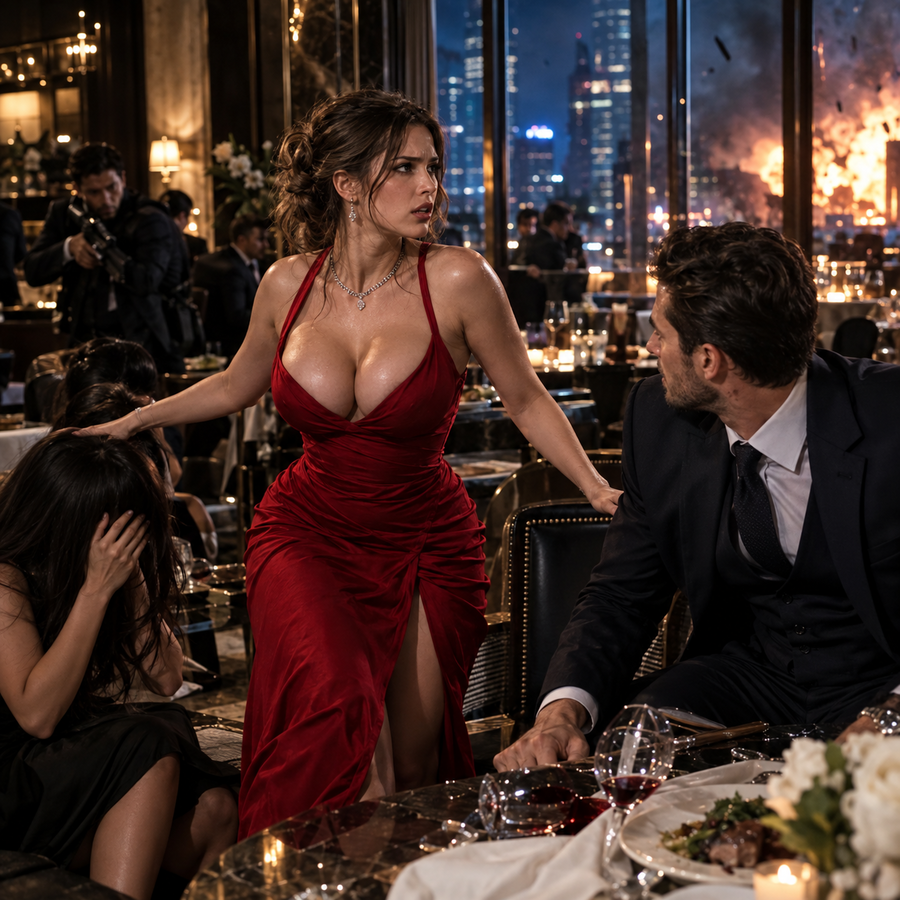
In a world where violence moves at the speed of sound, the most terrifying thing isn’t the explosion. It’s the silence that follows it.
When a car bomb detonated outside the Gilded Cage, Chicago’s most exclusive mafia front disguised as a Michelin-star restaurant, the shockwave turned a $400 lunch service into a war zone. The blast shattered the floor-to-ceiling windows.
Shrapnel tore through velvet curtains. Politicians dove under tables. Hedge fund managers screamed for their mothers. Even the battle-hardened soldiers of the Milani crime family hit the deck.
But the security footage that went viral, the footage that made international news, sparked a federal investigation and sent shockwaves through the underworld, didn’t show the explosion. It showed a 26-year-old waitress in a red apron who never stopped pouring.
This is the story of Daphne Angelo, the woman who didn’t flinch when glass turned to daggers. The woman who finished serving a $3,000 bottle of Cabernet Sauvignon while the city’s most dangerous crime lord stared at her like she was a ghost.
And this is the story of Valentino Milani, who realized too late that the quiet girl refilling his wine glass was the deadliest person in the room.
The Gilded Cage didn’t advertise. It didn’t need to.
Tucked into the ground floor of the Obelisk, a historic limestone tower in the heart of Chicago’s financial district, the restaurant was invitation only. The kind of place where congressmen sat three tables away from cartel lawyers, where CEOs closed billion-dollar mergers over truffle risotto, and where everyone pretended not to notice the man in the corner booth who owned half the city.
Valentino Milani. At 34, he was what the newspapers called a controversial real estate mogul and what the streets called Il Martello, the Hammer.
He didn’t break kneecaps anymore. He bought buildings, foreclosed mortgages, crushed unions. But everyone knew the truth.
Beneath the Tom Ford suits and the art collection was a man who’d earned his seat at the table with blood. Today he sat at his usual spot, table 12, corner position, back to the wall, sightlines to both entrances and the kitchen, a tactical position disguised as a lunch reservation.
He was meeting with the Volkov brothers, Russian arms dealers pretending to be tech investors. They were late. Valentino hated that.
He lifted his glass of sparkling water, scanning the room with eyes the color of cold steel. His consigliere, Rico, sat two tables away, pretending to read the Wall Street Journal.
Three more of his men were scattered throughout the restaurant, one by the bar, two near the valet entrance. And then there was the waitress.
He didn’t know her name yet. She was new, hired within the last month.
Dark blonde hair pulled into a sleek bun, pale skin, delicate features that would have been forgettable if not for the way she moved. Economically, precisely, like a surgeon, like a soldier.
She was approaching his table now, carrying a bottle of 2005 Château Margaux that he’d ordered 30 minutes ago. Her posture was perfect. Her expression was neutral, professional.
But Valentino noticed things other people missed. The way her eyes swept the room in a calculated pattern—entrances, exits, windows. The way her grip on the bottle was firm but relaxed, fingers positioned for control, not service.
She arrived at his table without a word, presenting the label for his inspection. “Your Margaux, Mr. Milani.”
Her voice was quiet, unremarkable, but there was something underneath it, a flatness, an absence of the nervous energy most people carried in his presence. “Go ahead,” Valentino said, leaning back.
She broke the seal. Removed the cork with a soft pop. Poured a taste into his glass with the exact tilt, the exact pour speed that sommeliers trained years to perfect.
He didn’t taste it. He watched her. That’s when the world exploded.
The blast came from the street, a parked sedan rigged with enough C4 to turn steel into confetti. The shockwave hit the restaurant like a freight train. The windows didn’t shatter, they vaporized.
Glass became a thousand flying knives. The chandeliers swung violently, raining crystal onto the screaming patrons. A congressman’s wife was thrown from her chair.
A waiter near the window was lifted off his feet and slammed into the bar. Smoke and dust filled the air, turning the elegant dining room into a battlefield.
Valentino’s instincts kicked in immediately. He dropped low, his hand going to the Sig Sauer P320 holstered at his ankle.
Rico was already moving, weapon drawn, shouting into his radio. The other soldiers were up, scanning for threats, expecting a follow-up assault.
But in the chaos, in the screaming, the smoke, the ringing silence that follows violence, Valentino saw something that made his blood run cold. The waitress hadn’t moved.
She was still standing exactly where she’d been. The wine bottle was still in her hand, tilted at the same precise angle.
A jagged piece of window glass the size of a playing card spun through the air toward her face. She adjusted barely. A micro-movement of her head, 2 inches to the left.
The glass missed her cheekbone by a millimeter and embedded itself in the wall behind her. She didn’t blink.
She finished pouring the wine into Valentino’s glass. The dark red liquid filled to exactly three-quarters. Not a drop spilled.
Then, and only then, did she set the bottle down on the table with a soft clink. She brushed a piece of glass off her red apron.
She made eye contact with Valentino, her expression utterly calm. “Compliments of the house, sir.”
And then she walked back toward the kitchen, stepping over debris and hysterical patrons with the same unhurried efficiency as before. Valentino sat frozen.
The gun still in his hand, staring after her. Rico appeared at his side, breathless.
“Boss, we need to move.” “Who is she?” Valentino’s voice was barely above a whisper. “What?”
“The waitress,” he pointed. “The one in the red apron. Who the hell is she?”
Rico glanced toward the kitchen, confused. “I—I don’t know. I can check.”
“Check now.” Rico hesitated, clearly wanting to prioritize the explosion, the potential attackers, the senator currently crying under a table. But he knew better than to question Valentino twice.
“On it.” Valentino stood slowly, holstering his weapon.
Around him, chaos continued—sirens in the distance, people sobbing, his men securing the perimeter. But Valentino wasn’t thinking about the Volkov brothers or the bomb or the rival families that might have just declared war.
He was thinking about a woman who didn’t scream when the world shattered. A woman whose pulse, he’d seen the vein in her neck, hadn’t risen once.
A woman who’d angled her serving tray, he now realized, in a way that would have shielded him from the worst of the blast. Fear is a reflex, Valentino thought, watching the kitchen door where she’d disappeared.
Survival is a choice. But silence in the face of death? That is a warning.
He smiled. A slow, dangerous thing. “Daphne Angelo,” he murmured to himself, as if testing the name he didn’t yet know.
“Who the hell are you?”
Valentino didn’t go home that night. He went to the security office three floors below the Gilded Cage, a windowless room that smelled like burned coffee and electronic equipment.
His head of security, a former NSA analyst named Chen, was already pulling footage when Valentino walked in. “Start at 12:47,” Valentino said, dropping into the chair. “Table 12, the waitress.”
Chen didn’t ask questions. He queued up the feed. Four camera angles, synced to the same timestamp.
The high-definition footage showed the dining room in perfect clarity. Valentino could see himself sitting with his water glass, could see the exact moment Daphne Angelo approached with the wine.
“Slow it down. Half speed.” The footage crawled.
Daphne presented the bottle, broke the seal. Her movements were textbook. Every sommelier in the city would have approved.
But Valentino wasn’t watching her hands anymore. He was watching her neck. “Zoom in right there.”
Her carotid. Chen enhanced the image.
The pulse point on Daphne’s throat became visible. A subtle rhythm beneath pale skin. Valentino leaned closer.
Counting. 62 beats per minute. Calm. Resting heart rate.
“Now jump to the explosion. Same zoom.” The screen flashed white.
The shockwave hit. Windows disintegrated. People screamed and dove.
Chen had already synced the audio. The sound was deafening even through speakers. But on Daphne’s neck, that steady pulse didn’t change.
62 beats per minute. Valentino watched it three times.
A normal person’s heart rate would have spiked to 120, 140, maybe higher. Fight or flight. Adrenaline.
Basic human biology. But Daphne Angelo’s cardiovascular system had responded to a bomb blast the same way it responded to pouring wine.
“What the hell?” Chen muttered. “Combat conditioning,” Valentino said quietly.
“Military, maybe private security. The kind of training where you run drills until your nervous system stops registering threats as threats.” “Or she’s on beta blockers.”
Valentino shook his head. “Her pupils responded to the light change from the blast. She’s not medicated. She’s trained.”
He pointed at the screen. “Run it again. Different angle. I want to see the glass trajectory.”
Chen switched to the camera covering the window side. He isolated the explosion frame by frame, the precise moment the window shattered.
Thousands of fragments, each one a potential projectile. Chen overlaid trajectory lines using software that calculated velocity and angle.
Three large shards were headed directly for table 12. Two would have missed Valentino entirely, embedding in the wall behind him.
But the third, a jagged piece roughly the size of a cell phone, was on course to hit him center mass. Throat or upper chest.
Potentially fatal if it severed the carotid or subclavian artery. “Pause it there,” Valentino said.
“Now advance frame by frame.” The footage crept forward.
The glass moved through the air, and Daphne, still holding the wine bottle, still in the act of pouring, shifted. It was such a small movement that Valentino had missed it in real time.
She rotated the bottle 15 degrees. The silver serving tray in her other hand, lifted maybe 2 inches.
The angle changed just enough that the tray caught the shard of glass, deflecting it harmlessly to the side. The motion looked accidental, natural, like she was simply completing the pour.
But Valentino could see it now. She’d calculated the trajectory, adjusted her position, and used her equipment as a shield without breaking the rhythm of service. “She protected you,” Chen said, his voice carrying a note of disbelief.
“She saw the glass coming and put herself between—” “No.” Valentino stood up, his jaw tight.
“She put the tray between me and the glass. She never put herself in danger. Look at her body position. She’s behind the tray, behind the bottle. She used them as tools.”
He paced the small room, his mind racing. A waitress didn’t move like that. A waitress didn’t have the spatial awareness to calculate ballistic trajectories in a fraction of a second.
A waitress didn’t maintain operational calm during an explosion. “Pull her employment file,” Valentino said.
Chen typed rapidly. A document appeared on screen. Standard restaurant application.
Name: Daphne Angelo. Age: 26. Previous employment: various service positions in Seattle, Portland, Denver.
References checked out. Background check clean. “Social media?” Valentino asked.
Chen pulled up her profiles. Facebook, Instagram, both sparse, generic photos, no geo-tagging, no personal information.
The kind of carefully curated digital presence that people built when they were hiding something. “Birth certificate, tax records. Go back further.”
Chen worked in silence for 3 minutes. Then four, then five. “Boss,” he finally said, “there’s nothing.”
“She exists on paper starting 3 years ago. Before that, it’s like she didn’t exist.” Valentino stared at the frozen image on the screen.
Daphne Angelo, captured mid-pour, her face serene, her eyes focused. A woman made of secrets and sharp edges disguised as something soft. “Find her,” Valentino said.
“I don’t care what it takes. Find out where she lives, where she goes, who she talks to. And I want her at my office tomorrow night. Tell her it’s about the incident. Tell her she’s getting a bonus. I don’t care. Just get her there.”
Chen nodded, already typing. Valentino walked out, but he couldn’t shake the image from his mind.
That steady pulse, that calculated movement, that voice calm as death. “Compliments of the house, sir.”
He’d spent 15 years learning to read people, to see through lies, to spot threats. And Daphne Angelo was the most dangerous person he’d ever met.
He just didn’t know why yet.
The Gilded Cage was closed on Tuesdays for private events. That’s what the website said.
What it really meant was that Valentino Milani wanted the building empty, and when Valentino wanted something, the world rearranged itself accordingly. Daphne received the summons at 4 p.m. via her manager, a nervous man named Gerald, who could barely make eye contact.
“Mr. Milani has requested your presence for a private dinner tonight. 8:00. He said to tell you it’s about the incident and that you’ll be compensated for your time.”
She’d known this was coming. From the moment she’d seen him watching her in the security office footage reflection on the polished silver, she’d known.
Men like Valentino Milani didn’t let mysteries walk away. She arrived at 7:58 p.m. wearing the same uniform, black slacks, white shirt, red apron, her hair pulled back, no makeup.
She looked exactly like what she was supposed to be. Unremarkable. The restaurant was empty except for two men at the entrance.
Valentino’s soldiers, both armed, both watching her with the suspicious intensity of trained dogs. One of them patted her down. Professional, thorough, impersonal.
He found nothing because there was nothing to find. “He’s at table 12,” the soldier said, stepping aside.
The dining room was lit by candles, hundreds of them, casting shadows that danced across the restored mahogany and repaired windows. The blast damage had been erased completely, as if violence had never touched this place.
Valentino sat in his usual corner wearing a charcoal suit that probably cost more than her annual salary. No tie, top button undone.
He looked relaxed, but Daphne could see the tension in his shoulders, the way his right hand rested near the edge of the table, within reach of something. “Miss Angelo,” he said, his voice carrying easily across the empty room.
“Thank you for coming.” “I was told it wasn’t optional.” She approached with measured steps, stopping at a professional distance from the table.
Smart girl. He gestured to the chair across from him. “Sit.”
She sat, kept her hands visible on the table, her posture upright but not rigid. The position of someone who had nothing to hide and nothing to fear.
Valentino studied her for a long moment. Then he reached beneath the table and placed something in the center of the white tablecloth.
A gun. Glock 19, 9mm.
Standard issue for half the law enforcement agencies in America. The metal gleamed in the candlelight. “Who are you?” Valentino asked.
Daphne looked at the gun, then at him. Her expression remained perfectly neutral. “I’m sorry, Mr. Milani. I don’t understand the question.”
“Three days ago, a bomb went off 20 feet from where you were standing. You didn’t scream. You didn’t run. Your heart rate didn’t change.” He leaned forward. “So, I’ll ask again. Who are you?”
“I’m a waitress.” “Waitresses scream when things explode.” “I was in shock.” Her voice carried just the right tremor of uncertainty.
“I didn’t really process what was happening until later. I think I was just running on autopilot.” “Autopilot?”
Valentino smiled, but it didn’t reach his eyes. “That’s an interesting choice of words. The kind of thing soldiers say after firefights or cops after shootings. Not waitresses after bombs.”
“I don’t know what you want me to say.” “I want you to stop lying.” His hand moved to his jacket pocket.
Daphne tracked the movement but didn’t react. He pulled out a phone, tapped the screen, and set it on the table.
Audio filled the restaurant. Kitchen sounds, the clatter of dishes, the hiss of a grill, voices calling out orders. And then another sound, distinct and unmistakable.
The mechanical clicks and slides of a firearm being field-stripped. Daphne felt her stomach drop, but her face remained impassive.
“That was recorded yesterday,” Valentino said. “In the kitchen of this restaurant. One of my men left his Glock in the staff room while he used the bathroom. 45 seconds later, you walked in. 90 seconds after that, you walked out.”
The audio continued. Seven seconds of mechanical precision. Slide release, barrel, recoil spring, frame.
The components being separated and reassembled with the efficiency of someone who’d done it a thousand times in the dark. “Total time, 14 seconds. You want to tell me how a waitress from Denver knows how to detail-strip a Glock faster than most Marines?”
Daphne met his eyes. She could keep playing the part, keep pretending. But men like Valentino didn’t bluff, and they didn’t ask questions they didn’t already know the answers to.
The silence stretched between them like a blade. Finally, she reached for the gun on the table.
Valentino’s hand twitched toward his jacket, but he stopped himself, watching. Daphne picked up the Glock, checked the chamber.
Empty. Removed the magazine. Empty.
Then she set it back down and slid it across the table toward him. “You brought an unloaded gun to intimidate me,” she said quietly. “Which means you’re either testing me or you’re afraid of me. Maybe both.”
Valentino’s smile turned genuine. Dangerous. “And which is it?”
“Both.” She folded her hands on the table. “You want to know who I am, Mr. Milani? I’m someone who was very good at a very bad job. Someone who walked away from that job 3 years ago. Someone who wanted to disappear.”
“People don’t just disappear from bad jobs. Not unless those jobs involved the kind of people who make sure you stay disappeared permanently.” “No,” Daphne agreed.
“They don’t.” “So, what are you doing pouring wine in my restaurant? Hiding from who?”
She looked at him for a long moment. “From people who make you look like a saint.”
Valentino leaned back in his chair, his expression unreadable. Then he laughed, a low, genuine sound that seemed to surprise even him.
“Well, Miss Angelo, or whatever your real name is. You just became the most interesting person in Chicago.” “That’s exactly what I was trying not to be.”
“Too late.” He stood up, buttoning his jacket. “You start working for me tomorrow. Personal security detail. I’ll triple whatever they’re paying you here.”
“I’m not interested.” “I’m not asking.” He picked up the gun, chambered a round with practiced ease, and holstered it.
“People who can do what you do don’t waste their time serving Cabernet. And people who hide in my city, they hide under my protection, or they don’t hide at all.” He walked past her toward the exit, then paused.
“8:00 a.m. My office. Don’t be late.” Daphne sat alone in the candlelit restaurant, surrounded by ghosts and choices.
She’d spent 3 years building a wall between who she was and who she’d been. Valentino Milani had just torn it down in under 10 minutes.
The architect received the notification at 3:47 a.m. Berlin time. A single line of text on an encrypted server.
Viper located. Chicago. Facial recognition match 94.1%. He stared at the attached photograph.
Grainy security footage from a Chicago PD database, uploaded during the restaurant bombing investigation. A woman in a red apron, her face partially obscured by smoke and debris.
But the facial recognition algorithm didn’t need a perfect image. Bone structure, eye spacing. The geometry of a face was as unique as a fingerprint.
The architect smiled. He’d been looking for Viper for 3 years, and now she’d gotten careless.
He opened his contact list and selected a name. Cleaner Team 7. The message was simple.
Neutralize. No witnesses. 6,000 miles away, Daphne felt the ghost of a target settling between her shoulder blades.
She’d felt it before, the invisible weight of being hunted. It was a sensation you never forgot, like muscle memory encoded in nerve endings.
She stood in Valentino’s penthouse office, watching him review contracts with the casual efficiency of a man who treated murder and mergers with equal professionalism. It was 9:00 a.m.
She’d been here for an hour, mostly listening to him make phone calls in Italian, while his consigliere Rico glared at her from across the room. “We have a meeting tonight,” Valentino said without looking up.
“South docks, warehouse 7. The Knitzoff brothers are bringing in a shipment I need to inspect personally.” “That’s not security work,” Daphne said.
“That’s you testing me.” “Smart and perceptive.” He signed a document.
Closed the folder. “The Russians are paranoid. They’ll have counter-surveillance. Probably snipers on the surrounding buildings. My men will handle close protection. You’ll handle everything else.”
“Why would I do that?” Valentino finally looked at her. “Because you’re working for me now, and because if you’re as good as I think you are, you’ll see threats my men miss. If you’re not—” he shrugged.
“Then I overpaid for a waitress.” Rico stepped forward.
“Boss, this is insane. We don’t know anything about her. She could be setting us up.” “Then tonight, we’ll find out.”
Valentino stood, buttoning his suit jacket. “Get her a comms. She comes with us.”
The warehouse district was exactly what Daphne expected. Rusted industrial buildings, broken street lights, the kind of place where gunshots echoed and nobody called the police.
Valentino’s convoy arrived at 11 p.m. sharp. Three black SUVs, eight armed men, and one crime boss who walked into danger like he owned it because he did.
Daphne stayed two steps behind Valentino’s left shoulder, her hands empty, her eyes scanning. She’d been given an earpiece that connected her to Rico’s security channel.
The chatter was professional, but predictable. Standard sweep patterns, basic counter-surveillance. Good enough for street thugs, nowhere near good enough for professionals.
The Knitzoff brothers waited inside the warehouse with their own security detail. 12 men with Kalashnikovs and attitude. The kind of Russians who still thought the Cold War mentality was charming.
“Valentino,” the older brother Dmitri called out. “You bring army to business meeting? This is insult.” “I bring insurance,” Valentino replied smoothly.
“Open the containers. Let’s see what I’m buying.” While the men postured and negotiated, Daphne’s eyes traced the warehouse geometry.
Catwalks above, loading doors on three sides, windows at 40 feet, most broken or covered. She counted 17 potential firing positions for a sniper.
Her gaze stopped on the north window, third floor of the adjacent building. There, a reflection, barely visible.
The faint glint of glass catching ambient light. Not a window. Windows didn’t move.
This had moved. A scope adjusting. She keyed her comm.
“Sniper. North building. Third floor. Center window.” Rico’s voice crackled back.
“Negative. We swept that building. It’s clear.” “It’s not clear.” Daphne moved closer to Valentino, her voice low.
“Someone’s lining up a shot right now.” Valentino didn’t turn. Didn’t break his conversation with Dmitri.
But his hand moved to his jacket. “You’re certain?” “Yes.” “Rico,” Valentino said into his comm, “pull two men. North building, third floor. Now.”
Two of Valentino’s soldiers peeled off, moving toward the exit. Daphne watched the window.
The reflection shifted again. Whoever was up there had seen the movement. They were repositioning or preparing to fire before they lost the shot.
“Get down,” Daphne said. She didn’t wait for Valentino to respond.
She grabbed his shoulder and pulled him sideways just as the window exploded. The crack of the rifle shot came a fraction of a second later.
Suppressed. Professional. The round passed through the space where Valentino’s head had been and punched through a steel container behind him.
Chaos erupted. The Russians scattered, weapons drawn, shouting in their native language.
Valentino’s men formed a perimeter, returning fire at shadows. Daphne was already moving.
She grabbed a pistol from the nearest soldier’s holster, a Sig Sauer, and sprinted toward the warehouse’s side exit. She could hear Rico shouting for her to stand down, but she was done taking orders from amateurs.
She crossed the alley in 4 seconds, hit the adjacent building’s fire escape, and climbed. Her muscles remembered this—the burn, the rhythm, the tunnel vision of pursuit.
By the time she reached the third floor, the sniper was gone. But he’d left evidence.
Brass casing, still warm. 7.62, professional grade.
And on the window sill, barely visible in the darkness, a small black marking. A symbol she recognized immediately.
A viper coiled around a dagger. The syndicate’s calling card.
Her blood ran cold. They’d found her. And they just tried to kill Valentino to send her a message.
Everyone around you dies. She descended the fire escape and found Valentino waiting in the alley.
Rico and four soldiers flanking him. His expression was unreadable, but his eyes were locked on hers. “There was a sniper,” she said quietly.
“I know. My men found the position.” Valentino stepped closer.
“They also found this.” He held up a phone. On the screen was a photograph taken from the sniper’s nest.
Telescopic view, high resolution, and in the center of the frame, perfectly focused, Daphne’s face. “So,” Valentino said, his voice deadly calm.
“Want to tell me why a professional hitman just tried to kill me but took the time to photograph you first?” Daphne looked at the image, at her own face captured through crosshairs.
The wall she’d built between her past and present hadn’t just cracked. It had shattered completely.
“Because,” she said, “I’m not hiding anymore. They found me. And now everyone near me is a target.”
Valentino smiled, not with warmth, with recognition. “Good,” he said.
“I was getting bored anyway.”
The second attempt came 3 days later during dinner at Valentino’s penthouse, 16 floors above Chicago. Floor-to-ceiling windows overlooking the city.
The kind of view that made you forget there were people below who wanted you dead. Valentino had insisted on the meeting.
“If someone’s trying to kill me because of you,” he’d said, “then you’re going to sit across from me and explain exactly who we’re dealing with.” Now, they sat at opposite ends of a marble table, untouched plates of ossobuco between them.
Rico and two guards stood by the elevator. The atmosphere was tense, but contained, like a storm system waiting for the right pressure drop.
“The syndicate,” Daphne said, her voice flat. “International. No headquarters, no official leadership. They broker contracts for the kind of work governments deny exists.”
“Assassinations, extractions, political destabilization. I worked for them for 6 years.” “Worked,” Valentino repeated.
“Past tense.” “I completed a contract in Vienna. High-value target, heavy security. It went perfectly. Too perfectly.”
She paused, her jaw tight. “I realized they’d given me a no-exit job. The kind where you finish the contract and then become a loose end. So, I disappeared instead.”
“And they’ve been looking for you since.” “Yes.”
Valentino lifted his wine glass, a 2009 Barolo that cost more than most people’s monthly rent. “So why surface now? Why take a job in my restaurant where surveillance is constant?”
“Because hiding isn’t living. And because I thought 3 years was long enough that they’d—”
The wine glass exploded. Not shattered. Exploded.
The bullet passed through it and continued toward Valentino’s chest in the same microsecond that Daphne registered the suppressed crack from the building across the street. She moved.
Time didn’t slow down. That was a myth. Something civilians believed, but training compressed perception, turned chaos into sequence.
Her hand shot across the table, grabbed the steak knife from Valentino’s plate, and in one continuous motion, she threw it. Not at the window.
At Valentino. The knife tumbled through the air, handle over blade, and struck him square in the chest with the blunt end.
The impact knocked him backward out of his chair, just as the second bullet passed through the space his head had occupied and embedded itself in the wall behind him. Rico was shouting.
The guards were drawing weapons. Daphne was already moving around the table, her body low, using the marble surface as cover.
She reached Valentino, who was sprawled on the floor. The wind knocked out of him, but alive.
“Stay down,” she hissed. “What the hell?”
She pressed her palm against his chest, holding him flat. “Two shooters, diagonal positioning. They’ve got overlapping fields of fire on the table. You stand up, you die.”
Another shot punched through the window. Then another. The glass was rated for bird strikes, not sustained sniper fire.
Spiderweb cracks spread across the surface. “Rico,” Daphne called, “kill the lights now.”
Rico hesitated for exactly one second, long enough for Daphne to understand he was debating whether to take orders from her or let his boss bleed, then flipped the switch. The penthouse went dark, except for the ambient glow of the city below.
Daphne pulled Valentino behind the overturned chair, her hand still pressed against his chest. She could feel his heartbeat through the expensive fabric of his shirt.
Elevated but controlled. Not panicking. Good.
“They’ll reposition,” she whispered. “Thermal scopes. We have maybe 90 seconds before they acquire us again.” “Then what?”
“Then I go out there and remove the problem.” Valentino grabbed her wrist.
His grip was strong. His eyes sharp even in the darkness. “You’re not bulletproof.”
“Neither are you. But I’m faster.” She started to pull away, but his grip tightened.
“How fast?” “Fast enough.” She yanked free and moved in a crouch toward the shattered window.
Rico tried to intercept her, but she sidestepped him like he was standing still. At the window, she assessed angles.
The shooters were in the building 300 meters east. Probably two teams. Professionals.
Syndicate standard operating procedure. Going out there was suicide.
She went anyway. The fire escape was accessed through the kitchen. She hit it at a dead run, took the stairs down four at a time, her mind calculating trajectories and timing.
By the time she reached street level, she’d mapped 12 different approaches to the shooter’s position. She chose the one that kept her in shadow.
7 minutes later, she returned through Valentino’s front door. Her hands were empty, but there was blood on her sleeve.
Not hers. Rico raised his weapon, but Valentino, now standing behind the overturned furniture, raised his hand.
“Stand down.” Daphne walked past the guards, past Rico’s suspicious glare, and stopped in front of Valentino.
“It’s done.” “Both of them?” “Both of them.”
“With what? You left unarmed.” She smiled. Barely, just a ghost of expression.
“I improvised.” Valentino stared at her, really looked at her for the first time since she’d knocked him to the ground with a dinner knife.
Her hair had come loose from its bun. There was a cut on her cheekbone, probably from broken glass. She was breathing hard, but not winded.
And in her eyes was something he recognized, because he saw it in his own mirror every morning. Control.
Absolute, terrifying control. “You threw a knife at me,” he said.
“I saved your life.” “You could have warned me.” “No time.” She reached up, touched her cheekbone, came away with blood on her fingertips.
“If I’d hesitated, you’d be dead.” Valentino stepped closer, closer than professional distance, closer than tactical necessity.
“You know what I think?” “What?”
“I think you’re the most dangerous person I’ve ever met.” His voice dropped, intimate and sharp. “And I think I just figured out how to win every war I’m about to start.”
Daphne held his gaze. “I’m not your weapon.” “No.” He smiled.
Slow, genuine, deadly. “You’re something better. You’re my apocalypse.”
The air between them crackled with something that wasn’t quite trust and wasn’t quite danger, but lived somewhere in the intersection of both. “They’re going to keep coming,” Daphne said quietly.
“The syndicate doesn’t stop. Not until the contract is fulfilled.” “Good.” Valentino gestured to Rico.
“Clear the building. I want every entrance locked down, and get me a line to the Morettis, the Russos, and every family that owes me a favor. If someone’s declared war, we’re going to make sure they regret it.”
He turned back to Daphne. “You wanted to hide. I’m offering you something better. Stand with me. Fight with me. And when this is over, we’ll burn their entire organization to the ground.”
She should have said no. Should have run. But standing there in the wreckage of his penthouse, blood on her hands and death at her back, Daphne realized something.
She was tired of hiding. “Okay,” she said.
Valentino extended his hand. She shook it. And the war began.
The Maronei Foundation Charity Gala was Chicago’s annual performance of legitimacy, where the city’s criminal elite dressed in tuxedos and evening gowns and pretended their donations to children’s hospitals erased the blood on their hands. It was held at the Blackstone Hotel.
Marble columns, crystal chandeliers, a string quartet playing Vivaldi, while men who’d ordered murders that morning discussed stock portfolios over champagne. Valentino attended every year.
It was expected. This year, he brought a date.
Daphne descended the grand staircase in a dress that Valentino’s personal shopper had selected. Midnight blue silk that moved like water, a neckline that suggested elegance without vulnerability, and a slit up the right thigh that would have been impractical for anyone who didn’t know how to move in it.
She hated it. The exposure, the attention. Every eye in the ballroom tracked her descent, and she felt each gaze like a targeting laser.
“Breathe,” Valentino murmured as she reached his side. He was devastating in a Tom Ford tuxedo, his dark hair swept back, a diamond pin in his lapel that probably cost more than a car.
“You look like you’re walking to your execution.” “I might be.” “Then we’ll die beautiful.”
He offered his arm. She took it, and they entered the ballroom as cameras flashed and whispers spread like wildfire.
“Who is she?” “Where did she come from?” “When did Valentino Milani start bringing women to public events?”
Rico appeared at Valentino’s elbow, his expression tight. “Security’s in place. Eight men inside, four on the perimeter. But boss, this is a bad idea. Too many civilians, too much exposure.”
“Relax,” Valentino said, accepting a glass of champagne from a passing waiter. “If they wanted to hit us in a crowd, they would have done it already. The syndicate prefers surgical strikes, not spectacles.”
Daphne said nothing. She’d learned long ago that the syndicate preferred whatever method achieved the objective, and sometimes the objective was sending a message.
They made it through 90 minutes of polite conversation, strategic handshakes, and passive-aggressive exchanges with rival families. Valentino played his role perfectly.
The charming mogul, the generous philanthropist, the man who definitely didn’t order executions between business meetings. Daphne played hers, too.
The mysterious companion, the quiet presence, the woman who smiled at the right moments and said very little. But her eyes never stopped moving.
Exit routes. Security positions. Anyone who lingered too long, watched too carefully, or carried themselves with the particular tension of someone concealing a weapon.
At 10:47 p.m., she saw him. Black tuxedo, perfect posture, standing near the service entrance with a champagne flute he hadn’t touched in 15 minutes.
His eyes weren’t on Valentino. They were on her. She knew that look.
She’d worn it herself hundreds of times. “We need to leave,” she said quietly.
Valentino was mid-conversation with a judge whose re-election campaign he’d funded. “What? Now?”
“We need to leave now.” The lights went out.
Not a power failure. The emergency systems would have activated immediately. This was deliberate.
Tactical. And in the 3 seconds of darkness before screaming started, Daphne heard the unmistakable sound of suppressed gunfire.
Bodies hit the floor. Not from bullets, from panic. The ballroom erupted into chaos as hundreds of Chicago’s elite trampled each other in the dark.
Their expensive shoes and jewelry forgotten in the primal scramble for survival. Daphne grabbed Valentino’s wrist.
“Stay with Rico. Get to the kitchen exit. Go.” “Where are you—”
“Handling this.” She vanished into the darkness before he could stop her, moving through the crowd with the fluid efficiency of someone who’d trained in close-quarters combat since she was 16.
Her hands found the slit in her dress, and she ripped hard. The silk tore cleanly up to her hip, giving her legs freedom of movement.
The hallway outside the ballroom was lit by emergency lighting, red and stark. She counted four men dressed as waiters, all carrying suppressed MP7 submachine guns.
Professional kit. Syndicate issue. They saw her at the same moment she saw them.
“Viper,” the lead man said. Not a question, a confirmation. “Hello, Marcus.”
She recognized him now. Used to work Budapest operations. Good with explosives, mediocre with small arms.
“You’re out of your depth.” “You’re out of time.” He raised the MP7.
Daphne moved first. She closed the distance in three steps, faster than his nervous system could process the threat.
Her hand deflected the weapon’s barrel toward the ceiling as it fired, the suppressed rounds punching harmless holes in the plaster. Her other hand struck his throat, not hard enough to kill, but hard enough to collapse his trachea and send him gasping to the floor.
The second man fired. She was already moving, using the first man’s body as a shield. Bullets meant for her spine hit her former colleague instead.
She let him drop and launched herself at the shooter, her heel connecting with his kneecap, the joint bending backward with a wet crack. Two down, two remaining.
They’d adjusted their tactics now, splitting up, creating crossfire. Smart, but not smart enough.
Daphne grabbed a decorative vase from the hall table and threw it at the overhead light. Glass shattered, plunging the corridor into near darkness.
In the confusion, she moved left, low and fast, closing with the third man before he could track her movement. She took his weapon, a simple disarm, wrist control, leverage, and used the stock to break his jaw.
The fourth man was already running. She let him go. One survivor to report back to tell the syndicate that Viper wasn’t hiding anymore.
She was hunting.
Back in the ballroom, Valentino had made his stand near the stage. Rico and his men formed a perimeter, weapons drawn, flashlights cutting through the darkness.
Several bodies lay on the floor, syndicate operatives who’d attempted to breach the protective circle. Valentino stood in the center, his tuxedo jacket discarded, a pistol in his hand, looking every inch the warlord he was.
He saw Daphne emerge from the hallway, torn dress, blood spatter on her skin that wasn’t hers, moving like death in evening wear. The remaining guests saw her, too.
Those who hadn’t fled, those who’d stayed to witness what happened when you brought war to a charity gala. Someone took a photo.
The flash lit up the ballroom like lightning. By morning, that photo would be on every criminal network from Moscow to Mexico City.
Daphne Angelo, the Viper, alive and operational. Standing beside Valentino Milani in the wreckage of Chicago’s most prestigious social event.
The secret wasn’t a secret anymore. “Well,” Valentino said, lowering his weapon as police sirens wailed in the distance.
“I guess we’re not hiding your identity anymore.” Daphne looked at him, then at the carnage surrounding them, then back at him.
“No,” she agreed. “I guess we’re not.” He smiled.
“Good. I prefer honesty.” She almost smiled back.
Almost. “Get your people out,” she said. “The syndicate just declared open war, and they don’t take prisoners.”
“Neither,” Valentino said, holstering his weapon and offering her his arm again as if they were still at a party, “do I.”
They walked out together through the main entrance, past the shocked valet and arriving police, into the Chicago night. Behind them, the ballroom looked like a battlefield.
Ahead of them, an actual war was waiting.
The vineyard was 2 hours northwest of Chicago, hidden in the hills of Wisconsin, where cell service was a suggestion, and the nearest neighbor was 5 miles away. Valentino owned 300 acres of Pinot Noir vines that produced wine he never sold, kept for himself for moments when the city became too loud and the bodies piled too high.
They arrived at dawn. No convoy this time, just Valentino driving a blacked-out Range Rover with Daphne in the passenger seat and Rico following in a second vehicle with two soldiers.
Minimal footprint. Tactical retreat. The estate house was stone and timber, built like a fortress disguised as a villa.
Solar panels, independent water supply, an armory in the basement that could outfit a small militia. Valentino had built it 5 years ago with exactly this scenario in mind.
A place to disappear when Chicago became untenable. He just never imagined he’d be hiding from international assassins instead of federal investigations. “Get some sleep,” he told Daphne as they entered through the reinforced steel door.
“We’ll regroup in a few hours. Figure out our next move.” She nodded but didn’t move toward the bedrooms.
She stood in the main living area, staring out the floor-to-ceiling windows at the vineyard rows stretching toward the horizon, her silhouette sharp against the morning light. Valentino watched her for a moment, then headed upstairs.
He needed to make calls, consolidate his forces, prepare for the war that was no longer theoretical. He made it 3 hours before he heard the sound of an engine starting.
By the time he reached the driveway, Daphne was loading a backpack into one of the vehicles. Not the Range Rover, but Rico’s sedan.
She’d found the keys. Of course she had. “Going somewhere?”
Valentino’s voice was controlled, but there was an edge underneath. She turned.
She’d changed out of the ruined gala dress into tactical pants and a dark shirt she’d found somewhere in the house. Her hair was pulled back.
Her face was set. She looked like what she was. A weapon preparing for deployment.
“I’m leaving.” “The hell you are.” “They’re not coming for you, Valentino. They’re coming for me. Every minute I stay, I put you and your people at risk. The smart play is for me to disappear. Lead them away.”
“The smart play,” Valentino said, walking closer, “is for you to stop pretending you’re protecting me and admit you’re running.”
Her jaw tightened. “I’ve been running for 3 years. I’m good at it.” “And how’s that working out? Because from where I’m standing, they found you anyway. And the only reason you’re still breathing is because I gave you an army to hide behind.”
“I never asked for your army.” “No, you asked for a quiet life pouring wine. How’d that work out?”
He was close now. Close enough to see the exhaustion in her eyes, the weight she carried.
“You want to leave? Fine. Tell me the truth first. Tell me why you really want to run.” Daphne’s hands clenched into fists.
“Because everyone I get close to dies. Everyone. My first handler, dead three months after I completed training. My spotter in Johannesburg, dead. My logistics coordinator in Prague, dead. The syndicate doesn’t just eliminate liabilities. They eliminate connections. They burn everything you touch until you’re isolated, controllable.”
Her voice cracked. “You think I’m dangerous? You have no idea what follows me.”
“Show me.” “What?” “Your scars. The ones you’re hiding. Show me.”
For a long moment, she didn’t move. Then slowly, she pulled off her shirt.
Valentino had seen violence. He’d inflicted it. But the map of damage across Daphne’s torso made his chest tighten.
Bullet wounds, knife scars, burns, a particularly vicious one across her ribs that looked surgical. Removal of a tracking device, probably.
Her body was a testament to survival, measured in millimeters and luck. “That’s what happens when you stay close to me,” she said quietly.
“That’s what the syndicate does.” Valentino didn’t respond with words.
He unbuttoned his shirt and let it fall. His torso told its own story.
The puckered scar from a Louisville Slugger with nails when he was 19. The bullet wound from a Russian Bratva hit when he was 24. The knife slash across his ribs from his own uncle during a succession dispute.
And covering his left shoulder and chest, a tattoo of a phoenix rising from flames, incorporating the scars into the design. “I got this,” he said, pointing to the phoenix, “after I killed the man who gave me these.”
He traced the oldest scars. “I was 25. I’d just taken over the family. Half my own people wanted me dead. The feds wanted me in prison. I had a target on my back the size of Illinois.”
He stepped closer. “You think you’re the only one who knows what it’s like to have death follow you? I’ve been living with it since I was 16. The difference is I stopped running. I turned around and made death work for me.”
“That’s different.” “How?” “Because you chose this life. I was drafted into mine.”
“And now you’re choosing to leave. To run again. To spend the rest of your life looking over your shoulder, waiting for the day they finally catch up.” He reached out, not touching her, but close enough that she could feel the heat.
“Or you could stay. Fight. And when we win, because we will win, you’ll never have to run again.”
“You don’t know that.” “I know that two days ago you killed four trained assassins with your bare hands. I know that you’re the best operator I’ve ever seen. And I know that together we’re more dangerous than anything the syndicate can send.”
His voice dropped. “Demons don’t run alone, Daphne. They run together, and they burn everything in their path.”
She looked at him. Really looked at him, at the scars, at the man who’d built an empire on violence and somehow still had the audacity to offer her sanctuary.
“This is insane,” she whispered. “Probably. We’ll both die.” “Maybe. But at least we’ll die fighting instead of hiding.”
The morning sun cut through the windows, painting them both in gold and shadow. Two people carved by violence, standing in the wreckage of their choices.
Daphne reached up and touched the phoenix tattoo on his shoulder. Her fingers traced the flames.
“Demons run together,” she repeated. “Demons run together.”
She dropped her hand, picked up her backpack, and instead of walking to the car, she walked back toward the house. Valentino followed behind them.
The vineyard stretched silent and still. But underneath that silence, something new was growing.
Not peace. War.
The architect made his move 72 hours after the gala massacre. He didn’t use bombs or bullets. He used something far more devastating in the modern world.
Financial warfare. At 9:00 a.m. Eastern, every bank account tied to Valentino Milani froze simultaneously.
Offshore holdings in the Caymans, shell corporations in Delaware, real estate trusts in Miami. 13 years of carefully laundered wealth, gone. Not seized. Frozen.
Inaccessible. By 10:00 a.m., the bounty went live on the dark web.
$5 million for Valentino Milani. 10 million for the woman known as Viper. Dead or alive.
Payment guaranteed by the syndicate’s escrow system, which had never failed to pay out in 20 years of operation. By noon, every mercenary, bounty hunter, desperate criminal, and ambitious street thug with a gun and a dream was looking at satellite images of a vineyard in Wisconsin.
Valentino got the news via an encrypted call from his accountant, a man who sounded like he was about to have a heart attack. “They didn’t just freeze your accounts. They’ve locked down your entire financial network. I don’t know how they got this kind of access, but—”
“How long until I can move money?” Valentino interrupted. “Days, maybe weeks, maybe never if they’ve backdoored the entire system.”
Valentino hung up, walked to the living room where Daphne was cleaning a disassembled rifle, one of 30 weapons they’d pulled from the basement armory. She looked up, read his expression.
“How bad?” “We’re broke. And there’s a bounty. 15 million combined.”
She didn’t flinch. Just went back to reassembling the rifle with mechanical precision.
“How long until they come?” “They’re probably already on their way.” “Good.” She chambered a round.
“I was getting bored.” Rico burst through the door 20 minutes later, his face pale.
“Boss, we’ve got movement. Drone spotted three vehicles approaching from the east. Two more from the south. They’re staging at the property line.”
Valentino and Daphne moved to the window. In the distance, visible through the vineyard rows, vehicles were parking along the access roads.
Men with rifles were climbing out, checking equipment, coordinating over radios. “Not professionals,” Daphne observed.
“Look at their positioning. No tactical discipline. They’re bunched up, silhouetting themselves against the treeline.” “Professionals don’t come for bounties,” Valentino said.
“They negotiate contracts. These are opportunists, criminals, the kind of people who think $15 million is worth dying for.” “It’s not.” “No, but they don’t know that yet.”
Over the next 6 hours, they turned the vineyard into a graveyard. Daphne designed the kill zones with the cold efficiency of someone who’d done this before.
The vineyard itself was perfect terrain, rows of trellised vines that created natural corridors, forcing attackers into predictable lanes. She marked firing positions on a hand-drawn map, calculated crossfire angles, and set up improvised explosive devices using fertilizer from the groundskeeper’s shed and blasting caps from Valentino’s armory.
“The first wave will be amateurs,” she explained to Rico and the two soldiers. “They’ll come fast, thinking numbers are an advantage. Let them get close. Wait for my signal, then cut them down in the channels between rows four and seven.”
“And the second wave?” Rico asked. “The second wave will be smarter. They’ll see the bodies and adjust. That’s when we switch to mobile defense. Hit and run. Never stay in one position longer than 30 seconds.”
Valentino watched her work. Watched her transform from a woman trying to escape her past into a tactician orchestrating death with the precision of a chess master.
This was who she really was. Not the waitress. Not the woman trying to disappear.
This. The Viper.
The first assault came at dusk. 17 men spread across the eastern approach, moving through the vineyard with the overconfidence of people who’d never faced real resistance.
They made it 40 meters before Daphne detonated the first IED. The explosion was deafening.
Fire and shrapnel tore through the vine rows, shredding bodies and turning the peaceful agricultural landscape into an abattoir. The survivors scattered, running directly into the firing lanes Daphne had predicted.
Valentino fired from the second-floor window. Controlled bursts, three-round groupings, the muscle memory from his youth when he’d earned his bones doing collections on the South Side.
Rico and the soldiers fired from flanking positions. In 90 seconds, it was over.
17 came. Three left. “Next wave in 20 minutes,” Daphne said, reloading.
“They’ll come from multiple angles this time. Be ready to move.” She was right.
The second assault was better coordinated. 23 attackers approaching from three sides simultaneously, using smoke grenades and suppressing fire.
Professional tactics executed by semi-professional criminals. Daphne moved through the chaos like a ghost.
She’d abandoned the house, taking the fight into the vineyard itself. Valentino watched from his position as she eliminated targets with ruthless efficiency.
A sniper shot from behind a stone wall. A close-quarters kill between vine rows. An ambush from a drainage ditch that left three men dead before they knew she was there.
She wasn’t fighting defensively. She was hunting.
The third wave arrived after midnight. Smaller, smarter.
Only eight men, all carrying military-grade equipment. These were the professionals, the ones who’d waited for the amateurs to die first.
They made it to the house perimeter before Daphne appeared behind their rear guard like a nightmare made flesh. By the time Valentino reached her position, five were dead, and the remaining three were running for their vehicles.
Dawn broke over a vineyard painted red. Bodies lay scattered among the vines like grotesque scarecrows.
Abandoned weapons, spent brass casings glinting in the early light. Daphne stood in the center of it all, covered in blood and dirt, her rifle slung across her back.
She looked like a battlefield angel. Beautiful and terrible.
Valentino walked to her, stepping over corpses. “How many?”
“48 confirmed. Maybe more in the outer perimeter.” “And us?”
“Rico took shrapnel. Minor. Everyone else is operational.” He looked at the carnage, at the vineyard he’d built as a sanctuary, now transformed into a killing field.
“They’ll keep coming.” “I know.” She met his eyes.
“So, we stop playing defense. We take the fight to them. The architect.” “The architect.”
Valentino smiled, sharp and predatory. “You know where to find him.” “I know where to start looking.” She chambered a fresh round.
“And I know he won’t be expecting us to come for him. He thinks we’re pinned down, defensive, waiting to die. Instead—” “Instead we’re going hunting.”
She started walking toward the house. “Get your people ready. We leave in 2 hours.”
Valentino followed, stepping over the bodies of men who died chasing money. The hunt was over.
Now came the war.
The syndicate’s temporary operational headquarters was a bank. Not metaphorically. An actual bank.
The old Chicago Mercantile Trust building on West Adams, shuttered since 2019, purchased through shell corporations, and renovated into a fortress masquerading as abandoned real estate. Daphne had suspected its location for 2 days, confirmed it in 4 hours using nothing but traffic camera footage and pattern recognition.
“The architect is arrogant,” she explained to Valentino and the assembled soldiers in the vineyard’s basement. “He thinks in symbols. A bank, where money flows, where power consolidates. It’s exactly the kind of statement he’d make.”
Valentino studied the building schematics she’d pulled from the city archives. “Six floors, reinforced concrete, one main entrance, two service exits, and probably a tunnel to the subway system. How many hostiles?”
“30, maybe 40. All syndicate-trained. These won’t be bounty hunters. These will be Tier 1 operators.”
Rico shook his head. “Boss, this is suicide. We’ve got eight men. They’ve got 40 in a fortified position.”
“Which is why we’re not walking through the front door.” Daphne spread a series of photographs across the table.
Surveillance images she’d taken that morning from a rooftop two blocks away. “The architect rotates his security shifts every 6 hours. Changeover happens at 6:00, 12:00, 18:00, and midnight. During changeover, there’s a 90-second window when both shifts overlap at the loading dock. Confusion, communication gaps. That’s our entry point.”
She looked at Valentino’s soldiers, hard men with criminal records and combat experience, but none of them had trained for this kind of operation. “You’re going to learn tactical breach methods. You have 6 hours. By midnight, you’ll either know how to move as a unit or we’ll all die trying.”
They trained in the vineyard’s barn. Daphne ran them through close-quarters battle drills with the relentless efficiency of a special operations instructor.
Room clearing, fatal funnels, slice the pie. Concepts most of them had never heard of, executed with live ammunition and countdown timers.
“Move faster,” she barked as two soldiers fumbled a doorway breach. “Hesitation kills. You enter a room in pairs. First man takes left, second takes right. 3-second rule. If you’re in a room longer than 3 seconds without eliminating threats, you’re dead.”
Again. Valentino watched from the doorway, occasionally stepping in to reinforce her commands with his own authority.
By hour 4, the soldiers were moving like a functional unit. By hour 6, they were dangerous.
At 11:47 p.m., they loaded into two unmarked vans. Valentino, Daphne, Rico, and seven soldiers.
10 people preparing to assault a fortified position, defended by four times their number. The odds were terrible.
Daphne smiled as she checked her rifle. “I’ve had worse.”
They parked three blocks away and moved on foot through the Chicago night. The financial district was empty at midnight, just shadows and street lights and the distant sound of traffic.
The bank loomed ahead, dark except for minimal security lighting. At 11:58, they reached the loading dock.
Daphne hand-signaled positions. The soldiers spread out, taking cover behind dumpsters and concrete pillars.
Valentino crouched beside her, his Sig Sauer drawn, his breathing controlled. At precisely midnight, the loading dock door opened.
The night shift exited. Six men in tactical gear, laughing about something, carrying coffee.
The day shift entered from inside. Six more men, tired, ready to go home.
12 men in one location. 90 seconds of overlap.
Daphne raised her fist, then dropped it. The soldiers moved as one.
Suppressed weapons coughed 12 times in 4 seconds. Bodies dropped without screams, without alarms, without anyone inside knowing the perimeter had just been breached.
“Go,” Daphne whispered. They entered through the loading dock, stepping over corpses, moving in the tactical formation she’d drilled into them.
The interior was exactly as the schematics showed. A central corridor leading to the main vault area, now converted into an operations center.
They encountered the first resistance at the stairwell. Three guards caught mid-conversation.
Daphne eliminated two with a sidearm before they could react. The third managed to key his radio before Valentino put two rounds through his chest.
“Contact!” A voice crackled through the building’s intercom system. “Ground floor! Breaching team!”
The element of surprise was gone. “Switch to assault speed,” Daphne ordered.
“We go loud.” They hit the second floor in formation.
The syndicate operatives were scrambling to respond, grabbing weapons, establishing defensive positions, but they’d been caught unprepared, comfortable in their fortress. And comfort was a luxury that got people killed.
The firefight was brutal and fast. Valentino’s soldiers moved through the corridors with the precision Daphne had beaten into them, clearing rooms, eliminating targets.
Rico took a bullet to the shoulder but kept moving. One of the younger soldiers went down with a leg wound but crawled to cover and kept firing.
Daphne moved like death itself, flowing from position to position. Each shot deliberate, each movement calculated.
She wasn’t fighting. She was executing a tactical problem, and the solution was written in bodies.
They reached the fourth floor at 12:19. 21 minutes since breach.
Half the syndicate force was eliminated. The survivors had fallen back to the old executive suite, the architect’s command center.
Valentino and Daphne stacked outside the reinforced door. Inside, they could hear movement, shouted orders, the mechanical sound of weapons being readied.
“Breaching charges,” Daphne said. Rico handed her the explosive package.
She placed it on the hinges, set the timer for 5 seconds, and signaled everyone back. The explosion blew the door off its frame.
Smoke and dust filled the corridor. Daphne went in first.
The executive suite was chaos. Overturned desks, scattered papers, the glow of computer screens showing surveillance feeds.
Eight syndicate operatives, all armed, all firing. Daphne moved through them like a scalpel, precise and unstoppable.
Valentino followed, his weapon barking in controlled bursts, covering her angles. In 30 seconds, it was over.
Eight bodies. Silence.
And in the corner, behind an overturned desk, a laptop still displaying an active video feed. The architect’s face filled the screen, older than Daphne remembered.
Gray hair, wire-rimmed glasses. He looked like a university professor, not a man who brokered assassinations for governments. “Viper,” he said, his voice calm.
“Impressive. But you’re standing in an empty command post. Did you really think I’d be here personally?” Daphne walked to the laptop, blood on her hands, death in her eyes.
“Where are you?” “Somewhere you’ll never find me. But don’t worry. We’ll find you. We always do.”
She smiled, cold and sharp. “No, you won’t. Because after tonight, there is no syndicate. We just cut off your head, and now we’re coming for the body.”
She closed the laptop, pulled her sidearm, and put three rounds through it. Valentino appeared at her side.
“He’s running.” “Let him run.” She surveyed the carnage, the destroyed command center, the shattered infrastructure of an organization that had operated in shadows for decades.
“He just lost his army, his assets, and his mystique. He’s not dangerous anymore. He’s just an old man with a bounty on his head and nowhere to hide.”
“So what now?” Daphne looked at him. “Now we go home, rebuild, and wait for him to make his move. And when he does—when he does—” she said, “we finish this.”
They walked out of the bank as sirens wailed in the distance, leaving behind the ruins of an empire built on murder. The counter-strike was complete.
Now came the reckoning.
The architect made his final mistake 3 weeks after the bank raid. He tried to hire local muscle to finish what the syndicate couldn’t.
Valentino’s network picked up the chatter within hours. A man matching the architect’s description, meeting with the Sinaloa cartel’s Chicago representatives at a warehouse in Pilsen, offering intelligence on Milani operations in exchange for protection.
Daphne listened to the intercepted phone call with the detached interest of a surgeon reviewing an X-ray. “He’s desperate. Making alliances with people who will sell him out the moment it’s convenient.”
“How long until we move?” Valentino asked. “Tonight. Before the cartel realizes he’s worthless and kills him themselves.”
They found him at a motel off I-94, the kind of place that rented rooms by the hour and didn’t ask for identification. Third floor, corner room, one exit.
The architect had traded his tailored suits for jeans and a fleece jacket, had shaved his distinctive beard, looked 20 years older without the veneer of power. He was alone.
No security, no contingency. Just a man who’d spent 30 years orchestrating death from behind computer screens, now reduced to hiding in a $60-a-night room with peeling wallpaper and the smell of cigarette smoke embedded in every surface.
Daphne kicked in the door at 2:00 a.m. The architect was awake, sitting on the bed with a laptop and a pistol.
He raised the weapon, but Daphne had already crossed the distance. She deflected the barrel, stripped the gun from his hand, and put him on the floor in three efficient movements.
“Hello, Marcus,” she said, using his real name for the first time in years. He looked up at her, blood trickling from where his head had hit the nightstand.
“Viper. I trained you well.” “You trained me to kill. Valentino taught me to live. There’s a difference.”
She pulled him to his feet and zip-tied his hands behind his back. He didn’t resist.
Men like the architect understood when the game was over. “You’re going to follow the code,” he said as she pushed him into the room’s single chair.
“Quick, clean, professional. That’s who you are. That’s who I was.” Daphne drew her sidearm.
“But I’m not that person anymore.” She shot him.
Not in the head. Not in the heart.
Both kneecaps. Precise shots that shattered bone and destroyed cartilage, that left him screaming and bleeding, but very much alive.
The architect’s scream turned into ragged sobbing. “You—you can’t—the code—”
“There is no code.” Daphne holstered her weapon and walked to the door.
“Not anymore.” She opened it.
Valentino walked in carrying a Louisville Slugger. Ash wood, 34 inches, the same model that had given him the scar across his ribs 15 years ago.
He’d told Daphne the story during one of their long nights at the vineyard, how his uncle had tried to beat him to death, how Valentino had taken the bat and beaten him back. Poetic justice, he’d called it.
The architect looked at Valentino, then at Daphne, understanding finally dawning through the pain. “You’re giving me to him.”
“I’m giving you what you gave everyone else,” Daphne said. “Consequences.”
She stepped into the hallway and closed the door. The sound of the first impact was muffled but unmistakable.
She didn’t flinch. Just leaned against the wall and waited.
It took 7 minutes. When Valentino emerged, his shirt was spotted with blood, his knuckles raw, his expression neutral.
He handed her the bat without a word. “It’s done?” she asked.
“It’s done.” They burned the motel room.
Valentino had people who specialized in making crime scenes disappear. By dawn, there would be no evidence that Marcus Renfield, the architect, had ever existed in that room or anywhere else.
6 weeks later, the Gilded Cage reopened. The restaurant had been renovated.
New windows, reinforced this time. New furniture, new chandeliers to replace the ones shattered by the blast.
The kitchen staff was the same. The menu was the same. But everything else had changed.
Valentino sat at table 12, his usual corner position, wearing a charcoal suit and reading the Tribune’s business section. The headline read, “Milani Enterprises expands holdings.”
The article detailed his recent acquisition of three properties previously owned by dissolved international interests. The reporter didn’t mention the syndicate by name.
They never did. Across from him sat Daphne Angelo.
Not in a server’s uniform. In a black dress that cost more than she used to make in 6 months.
Her hair styled, a diamond bracelet on her wrist that Valentino had given her the week before. She looked every inch the woman she’d become.
Elegant, dangerous, untouchable. The queen to his king.
A waiter approached, young, nervous, new hire. “Mr. Milani, Miss Angelo, can I get you started with something to drink?”
Valentino looked at Daphne. She smiled.
Genuine this time, not the careful performance she used to wear. “Bring us the 2005 Château Margaux,” she said.
“And make sure you don’t spill it. Mr. Milani is particular about his wine.” The waiter nodded and hurried away.
Valentino raised an eyebrow. “Particular?” “I’ve seen you work. You’re particular about everything.”
He leaned back, studying her. “Any regrets?”
She considered the question. Thought about the waitress she’d pretended to be, the assassin she’d tried to leave behind, the woman she’d become somewhere in the middle of blood and bullets, and a man who looked at her scars and saw beauty instead of damage.
“No,” she said finally. “No regrets.”
The waiter returned with the wine, poured it with shaking hands, not from fear of them, just the natural nervousness of youth. He presented the bottle for Valentino’s approval.
Valentino gestured to Daphne. “Ask her. She’s the expert.”
The waiter turned, confused. Daphne lifted the glass, swirled it, inhaled the bouquet.
“Perfect,” she said. As the waiter left, Valentino raised his glass.
“To new beginnings.” Daphne clinked hers against his.
“To demons running together.” They drank, and through the window behind them, Chicago glittered in the night like a kingdom laid at their feet.
The Viper had stopped hiding. The Hammer had found his equal.
And together they ruled an empire built on the understanding that some monsters didn’t need to be slain. Some just needed to find each other.
In the kitchen, a new waitress was training, learning the rhythm of service, the weight of trays, the precise angle required to pour wine without spilling. She had no idea that the woman sitting at table 12 had once stood exactly where she was standing.
Had no idea that empires could be built or destroyed by the steadiness of a hand holding a bottle. Had no idea that sometimes the most dangerous person in the room was the one who never stopped pouring.
But she would learn. They always did.

