Single Dad Ex-SEAL Was About to Leave—Then a Billionaire Arrived With Her Daughter – Part 1
Single Dad Ex-SEAL Was About to Leave—Then a Billionaire Arrived With Her Daughter
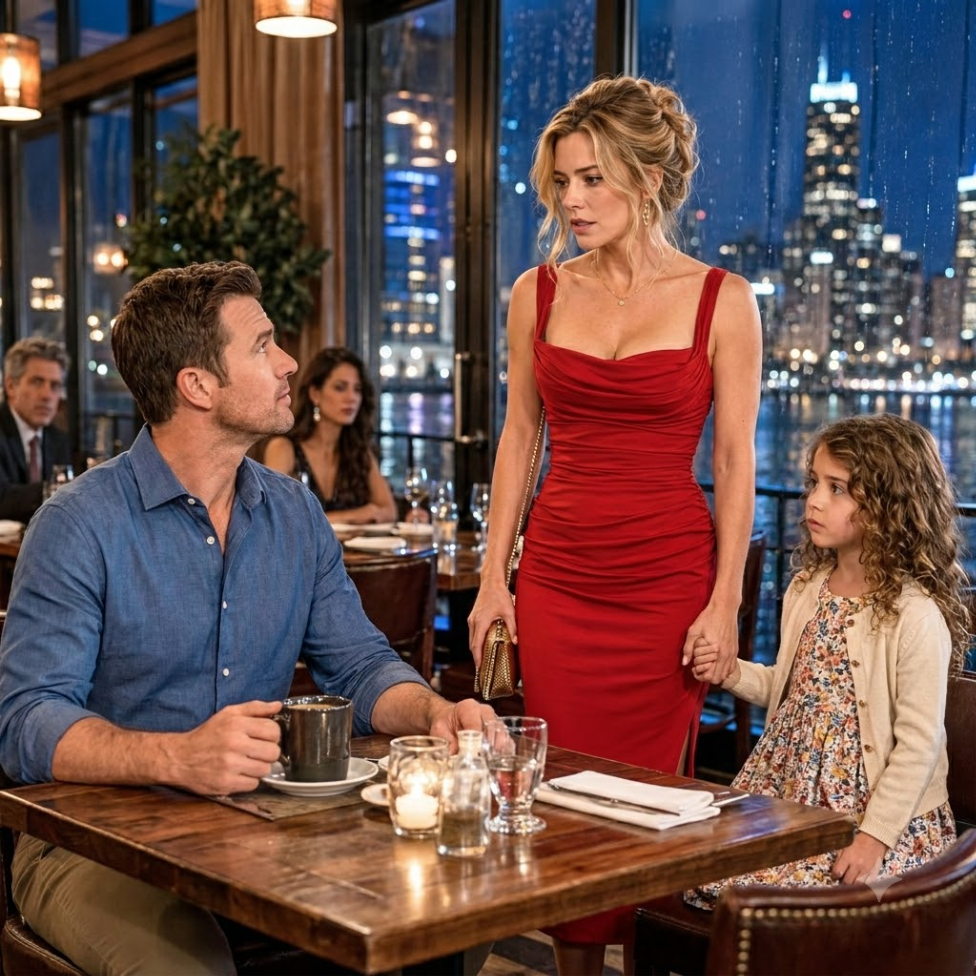
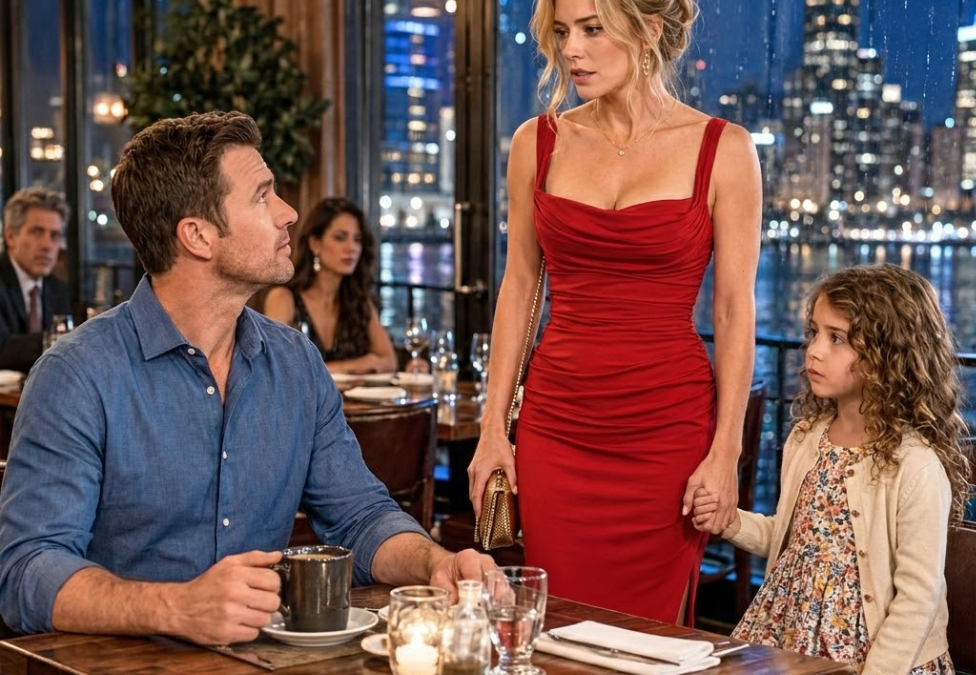
He was 30 seconds from walking out. The coffee had gone cold. The chair across from him was still empty.
Damon Kesler had given her 40 minutes, more than most men would, and now he was done. He reached for his wallet, laid two bills on the table, and stood. Then the front doors opened.
She walked in soaking wet, breathless, holding the hand of a terrified little girl, and Damon’s entire night collapsed into something he wasn’t prepared for.
Because the woman who just burst through the door wasn’t just late.
She was the most powerful woman in American tech and someone outside had followed her here.
The reservation had been made for 7:00 and by 7:32 Damon Kesler was the only person still sitting at a table for 2.
He wasn’t angry exactly.
Anger would have required more energy than he was willing to spend on a Tuesday night.
What he felt was more like the slow settled confirmation of something he’d already suspected the moment his sister had called him 3 weeks ago with that particular brightness in her voice.
The brightness that meant she had an idea he wasn’t going to like.
Just one dinner, Damon.
She’s smart.
She’s kind.
She understands complicated situations.
You’ll like her.
Complicated situations.
His sister’s careful way of saying a woman who would be okay with a man who came with an 8-year-old son.
A ghost story of a former life. An approximately zero interest in performing emotional availability on a first date. Damon had said no twice.
Then Owen had overheard the phone call and appeared in the kitchen doorway in his pajamas. 8 years old. serious eyes, always watching, and asked in that quiet way he had whether Damon was going on a date.
Damon had said no. Owen had stared at him for a moment, then turned and gone back to bed without another word.
That silence was the reason Damon was sitting in this restaurant at all. He looked at the window. The November Lake was invisible beyond the glass, just darkness and the shifting reflection of the dining room.
The restaurant was the kind of place where the lighting was warm but not fussy, where the menu was presented without prices on the copy they handed to guests, and where the weight staff had the practice skill of noticing everything while appearing to notice nothing. Damon had been in combat zones that felt less surveyed.
He didn’t eat at places like this.
He’d looked it up before coming and felt a brief, involuntary grimace when he saw what they charged for a plate of pasta.
His own kitchen table had seen better meals.
Owen’s opinion aside, Damon had slowly learned to cook over the last four years out of pure necessity, and at this point he could do a credible chicken soup and a passible stir fry, and that was enough.
Coffee in front of him had stopped steaming about 15 minutes ago. He wrapped both hands around the cup anyway. Force of habit.
Cold coffee was still coffee. Anything else I can bring you, sir?
The server had the good grace not to phrase it, as are you sure she’s still coming?
No thanks. He reached inside his jacket.
Actually, go ahead and bring me the check.
He’d give the money to his sister.
She could frame it the cost of her worst idea. He was pulling bills from his wallet when the front doors opened. The first thing he noticed was the sound, a sharp rush of cold air, and then the muffled thud of the heavy door swingsing shut.
And then he noticed the woman. She was somewhere around 30, he guessed. Though she had the specific kind of presence that made age feel beside the point.
Dark coat, dark hair. both of them rained damp.
She wasn’t exactly beautiful the way fashion magazines engineered beautiful.
She was more uneven than that, more actual.
High cheekbones and tired eyes and a jaw set with the expression of someone who had been sprinting in heels through a parking lot and wasn’t going to apologize for it.
She was also holding the hand of a small girl who looked deeply unhappy about every single thing that was happening. Damon recognized Serena Vale 2 seconds after the door closed behind her. Not because he followed tech news.
He didn’t particularly.
But Serena Vale was the kind of name that crossed even his deliberately limited media consumption, the founder of Valick Systems, which had become, depending on who was writing the headline, either the most disruptive enterprise software company in America or the most dangerous one.
She’d built it from two rooms and a borrowed server rack when she was 23.
She was on the cover of things. Senators called her to testify.
Her face appeared on the side of a building in Chicago’s River North neighborhood in a mural that had caused an argument on the city council.
She was also his blind date. For about 3 seconds, Damon sat very still and ran through a rapid internal calculation that involved the word absolutely not appearing several times.
Then he looked at the little girl.
The child, six, maybe 7 years old, had her mother’s dark hair and her mother’s jaw set expression of determination.
But the eyes were different. The eyes were wide and scanning the restaurant with the cautious assessment of someone who had learned not to trust new places too fast.
She was clutching her mother’s hand with both of hers.
Her coat was slightly too large, probably grabbed in a hurry. She was also unmistakably trying not to look scared, which meant she absolutely was. Damon knew that look.
He saw it every morning for about a year after Sarah died in Owen’s face across the breakfast table.
Serena had found him by then, or found the table for two with the single occupant who was clearly not a waiter. She crossed the dining room with an efficiency that suggested she was used to crossing rooms while people watched her, which they were.
Several of the other diners had gone quiet in the particular way that meant they recognized her, too. She stopped at the edge of the table.
Damon Kesler.
It wasn’t really a question.
That’s me.
I am so sorry, she said it plainly without the performative guilt he might have expected. just a flat genuine statement.
My child care arrangement fell through at 6:45.
Maisy’s regular sitter had a family emergency, legitimate emergency.
I’m not minimizing it, and the backup I called is someone Maisie has only met once, and she Serena paused, glanced down at the girl, recalibrated.
She didn’t want to stay.
The small girl Maisie was now examining the tablecloth with great focus. Completely understand if this is too much, Serena said.
She wasn’t performing humility.
She was doing something harder than that.
She was leaving the exit genuinely open, which told him she’d used it herself before.
“We can leave right now.
I’ll Do you like hot chocolate?”
Damon asked. Maisie looked up. He was looking directly at her, not her mother.
They have it on the menu, he said.
“I noticed it earlier because it seemed like the most reasonable item they offer.”
Maisie studied him with the frank evaluation that small children perform better than any intelligent service. Does it have marshmallows? I have no idea, but we can ask and make it a condition.
Something shifted in the girl’s face.
Not a smile yet, but the preconditions for one. She looked at her mother. Damon pulled out two chairs.
The hot chocolate came with marshmallows. This was established as a victory. Maisie sat between them rather than beside her mother, which Damon suspected was either a tactical choice by the child or the universe having a sense of humor.
She held the mug with both hands the way he was holding his coffee, and this made him feel a strange quiet fondness that he hadn’t expected.
Serena had removed her coat. Under it, she was wearing something simple and dark, the kind of clothes that were expensive without announcing themselves.
She had the habit of watching Maisie while she talked to him, a peripheral kind of attention, constant and automatic, and he recognized that, too, because he did the same thing with Owen anywhere that wasn’t home.
Your sister told me you work with marine engines, Serena said. Repair and restoration, mostly private boats, some commercial.
I’ve got a shop out in Skoi.
Do you like it? The question surprised him.
Most people asked how business was or where he’d trained or whether it was profitable.
Yeah, he said. I like it.
It’s he thought about it.
You’re solving a real problem.
Something was broken. Now it works.
The thing itself tells you when you’ve gotten it right.
Serena tilted her head slightly.
That’s a very specific kind of satisfaction.
Is it different from software? Software is never really done, she said. And there was something in her voice that was either affection or exhaustion.
He couldn’t tell.
You ship it and then you find out what you got wrong.
But you keep going because it’s still interesting.
She wrapped her hands around her water glass.
I’ve been asked whether I’d trade at the company the whole thing about 14 times in interviews and the honest answer is no, which apparently makes me seem cold-blooded, but the reason is that I’m still curious about what it becomes.
I want to see how it ends. Is that cold-blooded? Apparently preferring your work to a clean exit is suspicious.
People who want you to exit are usually the ones who benefit from it. She looked at him for a moment.
Your sister didn’t tell me you were going to say things like that.
She doesn’t know I think things like that.
She thinks I watch too many Marine engines and not enough television.
This time Maisie laughed a quick unself-conscious sound and then looked down at her hot chocolate as if she hadn’t meant to.
Damon kept his expression steady so she didn’t feel observed.
Dinner arrived and the formality of the evening dissolved in the way that sometimes happened when a child was present and nobody was pretending otherwise. Maisie had opinions about the bread, strong ones.
She informed Damon that the bread at her school lunch was better, which he chose to interpret as a culinary review of significant integrity. He told her that Owen, his son, had recently declared that the sandwiches Damon made were worse than the ones from the gas station, which was both devastating and possibly true.
Serena’s expression shifted when he said his son.
“How old?”
she asked.
“8 Owen.”
He turned his phone briefly so she could see the lock screen, which was Owen at a Cubs game last summer, wearing a hat three sizes too large. Expression completely serious.
He’s with my neighbor tonight, Mrs.Patton.
She’s 73 and she beats him at checkers every time and he cannot figure out how.
Does he know about Serena? Gestured vaguely at the restaurant.
He knows I’m having dinner with someone.
I didn’t give him details.
Wise, he’d have questions.
Maisy had questions. Serena confirmed.
She lowered her voice slightly, even though Maisie was currently absorbed in architectural experiments with the bread rolls. She asked whether I was going to fall in love and move away.
The words landed quietly on the table between them.
“What did you tell her?”
𝑵𝑬𝑿𝑻 𝑷𝑨𝑹𝑻
Damon asked. I told her that grown-up dinners were about finding out whether you liked someone before anything else happened.
Serena was looking at Maisie while she spoke. She said that was a non-answer.
Smart kid, terrifyingly, yes. A pause.
Her father isn’t in the picture.
He wasn’t suited for it, his words, actually, which I’ve always thought took a specific kind of honesty to say out loud.
She said it without bitterness, which suggested she’d had years to sort through it.
Maisie doesn’t remember him.
She was 14 months old.
What she remembers is that there was never a second person at breakfast, and she’s started to notice that other families have one.
Damon was quiet for a moment.
Outside, a car’s headlight swept briefly across the restaurant window.
He tracked it without meaning to old reflex. Owen remembers his mother. He said she died four years ago.
Andurism very fast.
He’d said those words enough times that they came out level, but they still had a specific weight he could feel.
He was four.
He doesn’t have a lot of clear memories, but he knows the shape of what’s missing.
Serena didn’t say she was sorry in the immediate automatic way people usually did.
She just held the information for a moment, which was more respectful than most things anyone had said to him about it. The mornings were the hardest part, she said finally.
Not I can only imagine. Not that must have been so difficult. Just a recognition from someone who also knew which part of the day showed you what was absent.
Yeah, he said the mornings.
Later, when Maisie was coloring on the back of the paper placemat with a pen she’d produced from her coat pocket, she brought her own pen, which Damon, deeply impressive Serena told him about the last 2 years of trying to date.
She didn’t dress it up.
There was a fund manager in New York who’d taken her out six times and then when she declined a particular business introduction he’d been working toward, simply stopped calling.
There was a venture capitalist in San Francisco who was wonderful in every visible way and who 3 months in had referred to Maisie in conversation as your situation once and hadn’t understood why that was the last dinner.
There was a man who was charming and patient and funny and had with what he clearly thought was reasonable practicality suggested that Maisie might benefit from a structured boarding school environment.
give you both some breathing room,” he’d said.
And Serena had smiled politely and ended the evening and cried in the car on the way home, not because she’d expected better from him specifically, but because it was exhausting to keep being surprised by people.
“They see a child as a complication,” Damon said, “Or something to be managed.”
She shrugged, and the shrug had years in it. I stopped explaining.
“Now I bring her.
If someone can’t handle a six-year-old at dinner, then we’ve learned something efficient.
and if they can. She looked at him across the table.
Then we have dinner. Damon glanced at Maisie, who had graduated from the placemat to drawing what appeared to be a very detailed horse on a napkin. Then he looked back at Serena.
A parent and a child aren’t two separate things, he said.
They’re the same thing.
Anyone who doesn’t get that, he paused.
They don’t get either of you.
Serena looked at him for a long moment.
She didn’t say anything right away, and he didn’t feel the silence.
Your sister, she said finally, didn’t tell me that part either.
It was close to 9:30 when Damon first noticed the SUV. It was a black Suburban or something similar.
He’d only caught the shape through the rainfilmed window.
The restaurant’s entrance faced the parking lot directly, and the vehicle had passed the turn-in once slowly and continued.
He noted it without reacting. 15 minutes later, it came back. Same direction, same slow roll, then gone again around the corner.
His attention didn’t leave the conversation.
Exactly. He was still present, still asking Maisie about the horse she was drawing, which she informed him was named Capernacus and had a complicated backstory.
But part of his processing had shifted quietly into a different register, the same way a circuit breaker flips. No drama, just function.
A vehicle doesn’t circle a restaurant parking lot twice by accident.
Delivery trucks don’t drive like that.
Someone looking for parking finds it or moves on. He said nothing to Serena.
She didn’t need the weight of it right now, sitting here across from him, with her coat finally relaxed off one shoulder and the first real ease he’d seen in her face all evening.
Maisie was explaining Capernicus’ difficult childhood with the complete narrative investment of someone who had clearly been developing this story for months.
He watched the window. The SUV made a third pass.
This time it slowed further at the entrance before continuing. And in the brief amber wash of the parking lot lights, Damon clocked two occupants. Front seats, no visible activity, no one getting out.
He set down his coffee cup. Okay.
He didn’t know yet what this was.
Could be nothing.
Someone scoping the lot for a valet that wasn’t there.
Some corporate protection team waiting to escort a client. Any number of ordinary explanations.
He wasn’t in the business of reading threats into shadows anymore.
Pattern was wrong, and wrong patterns were something his body recognized.
Before his brain finished the argument, Serena was checking on Maisy’s water glass.
Her head was turned. Damon looked at the door, looked at the window, looked at the layout of the restaurant behind him, exit at the back, secondary entrance through the bar, kitchen likely had its own service door. He was doing this automatically, and the automatic part was what bothered him.
He thought he’d stopped doing this.
When the check came, he paid it before Serena could reach for anything, which made her raise an eyebrow.
“Thank you,” she said carefully.
“Don’t read into it,” he said, and offered something that was mostly a smile.
“I just want to be moving before the parking lot empties out.”
She looked at him with the particular attention of someone who had built a company by noticing when something wasn’t adding up.
But she was already helping Maisie back into her coat, and for the moment she let it go. The three of them walked out into the cold together, Maisie between them as if this were entirely natural. Her paper napkin horse folded carefully in her coat pocket.
Parking lot was half empty at this hour. The rain had thinned to a drizzle.
The light was uneven bright near the entrance, graying off toward the far end where the trees started. At the far end, idling without headlights, was the black Suburban.
Damon saw it immediately. He also saw 3 seconds later the front doors opening.
He didn’t say anything.
He put one hand very gently at Serena’s elbow just redirecting, not grabbing and said, “Low and calm.
I need you to take Maisie back inside right now.”
Serena looked at him. Then she looked toward the far end of the lot.
Damon inside.
He said it the way he’d learned to say things when the saying mattered.
No alarm in it. No room for negotiation either.
Two men were walking toward them across the wet asphalt, and whatever answer tonight had seemed to be moving toward whatever slow and careful thing had been building across 3 hours, and one order of marshmallow hot chocolate it was going to have to wait.
Serena didn’t argue.
That was the first thing that registered. Not the men crossing the parking lot, not the rain, not the sound of her own heels on the wet asphalt reversing direction.
What registered was that she didn’t argue.
She took one look at Damon’s face, one look at the far end of the lot, and she pulled Maisie tight against her side and moved.
Maisie made a small sound, not quite a question, not quite a complaint.
And Serena said, “We’re going back inside, baby.
We forgot something, which was a lie so practiced it came out smooth.”
And Damon filed that away, too.
She’d done this before, some version of it.
The quick pivot, the calm voice for the child, the careful management of alarm. He held the restaurant door open without turning his back to the lot. The two men had stopped walking.
They were standing about 60 ft out, hands visible, not moving. One of them said something raised his chin in what might have been a greeting, but the distance and the rain made the words indistinct.
They were dressed in dark clothing, not suits, nothing that announced private security. And that was one of the things wrong with this picture.
Serena Veil’s security, from what little Damon had read in passing over the years, ran to the formal end.
Earpieces, tailored jackets, the kind of visible deterrence that corporate protection favored because visibility was part of the point.
These two looked like they’d gotten dressed in a parking garage.
The door swung shut behind him.
Inside, the restaurant had the quality of a room that doesn’t know it’s supposed to be tense.
The warm lighting, the soft ambient noise, the server who appeared at his elbow almost immediately with the professional reflex of someone trained to respond to re-entry. Sir, did you forget something?
Is there a manager on duty? Damon asked. Of course.
Is there a problem? There might be.
Can you get him quietly? And I need to know where your rear exit is.
Server young male, professionally composed, though his composure flickered slightly, said, “Get the manager.”
and pointed toward the back of the restaurant past the bar. Damon thanked him and turned to Serena.
She was crouched in front of Maisie, both hands on the girl’s arms, speaking in a low voice.
Maisie was listening with that serious, still expression that children adopt when they sense their parents are managing something real.
She wasn’t crying.
She looked like she was deciding whether to Hey.
Damon touched Serena’s shoulder lightly.
I need a minute with you. Can she sit with the hostess station for a second?
Serena looked up at him. Her eyes were doing something complex, assessing him. She was definitely assessing him.
And then she looked at Maisie and said, “Sweetheart, I need to talk to Damon for 2 minutes.
Can you sit right there at that little desk and show her your horse drawing?”
Maisie considered this. 2 minutes, she said, as if establishing contract terms. 2 minutes, Serena confirmed.
Maisie took her napkin horse from her pocket and went to the hostess stand with the resigned professionalism of a child who had been managed many times and had made peace with it. Serena straightened and looked at Damon.
Tell me what you saw. That vehicle made three passes before we came out.
No lights on the last one. Two men, both front seats.
When we walked out, they got out of the car and started moving toward us. They could be my security detail. Do your people drive without lights in a lit parking lot?
She didn’t answer immediately.
Does your security team use a check-in protocol with you when they make contact? Yes.
She said it quietly. A code freight specific. They were 60 ft out, and neither one of them said anything identifiable.
Serena was quiet for a moment.
She had her arms crossed, not defensively, but the way people do when they’re cold and thinking hard.
How do you know about security protocols? He looked at her steadily.
I’ll explain that part later.
Right now, I need to know. or is there anyone who would want to follow you specifically tonight?
Specifically here. Something moved across her face.
It wasn’t surprise exactly.
It was more like a door opening onto a room she’d been hoping wasn’t there.
There have been some issues, she said with the company.
I didn’t think they’d escalated to, she stopped, started again.
There was a board dispute. Two executives were removed in August. One of them filed a grievance and then the grievance went quiet, which my legal team said was a good sign.
She looked toward the window. My legal team is occasionally optimistic.
The manager appeared a man in his mid-50s with the bearing of someone who’d handled dining emergencies, but not necessarily this kind.
Damon spoke to him briefly and directly. Two men in the parking lot who may have been watching a guest.
Possible need to keep the front entrance clear. Could they alert staff without causing a scene?
The manager’s expression went through several stages and landed on careful cooperation.
He said he’d call the police non-emergency line.
Damon said that was fine, but to make it the emergency line. The manager looked at Serena Vale standing in his restaurant lobby, reassessed, and made a different call. The police were on their way.
They moved to a table near the back, away from the windows, and Maisie came with them this time.
The 2-minute arrangement had expired, and she arrived at Serena’s side with her horse drawing and a look that said she was not going back to the hostess stand.
Nobody argued with her. Damon sat facing the front of the restaurant.
“Old habit.”
He couldn’t fully break it and he’d stopped trying.
“You’re going to explain the protocol thing,” Serena said.
“It wasn’t a question.
I will.
Are you actually a Marine engine mechanic?”
He let a beat pass. Also, for 11 years before that, I was a Navy Seal. Serena received this information without visible shock, which he found interesting.
She just looked at him with that recalibrating attention like she was updating a spreadsheet in real time.
Your sister didn’t mention that.
My sister thinks of it as something that happened a long time ago. She wrong.
He thought about the way his body had shifted the moment he’d seen the SUV’s third past the quiet click of something that never fully powered down.
She’s not entirely wrong, he said carefully.
Maisie was drawing something new on a second napkin, apparently expanding the Capernacus universe. She was tracking the adult conversation with one ear the way children did when they were pretending not to.
When did you leave? Serena asked. Four years ago.
Sarah died. He said it plainly. Owen needed a parent who came home.
The math wasn’t complicated.
Serena nodded once.
She didn’t call it a sacrifice.
He appreciated that more than he would have been able to explain. What I saw tonight, he said, is consistent with surveillance.
Not a random tale, a planned one. Someone knew where you were going to be. Very few people knew about this dinner.
How few? She thought about it. My assistant, the reservation was made through a service she uses.
She paused. And whoever she spoke to at the restaurant.
What about on your security team’s end?
My head of security knows my general schedule, not specifics usually. Something shifted in her expression.
He would have known I had a personal engagement tonight. Not the location.
Could he find it? Serena was quiet.
I’m not accusing anyone, Damon said.
I’m asking what’s possible.
He could find it, she said finally. If he wanted to, he could find it. She looked down at the table.
I’ve known Marcus for 3 years.
He came with strong recommendations. Most people who do things like this come with strong recommendations, Damon said.
Otherwise, they don’t get close enough.
The front door of the restaurant opened, and two uniformed officers came in. And the dining room shifted in the way rooms do when police arrive.
a particular stillness. Several people lowering their conversations, the ambient noise thinning out. The manager led them to the back.
Damon stood and introduced himself without drama.
He explained what he’d observed the vehicle’s pattern, the timing, the men’s approach in the clear, specific language of someone accustomed to giving situation reports.
One of the officers was taking notes. The other was already radioing the lot.
The vehicle’s gone.
The radio crackled back. Of course it was.
The officers took statements and were professional and thorough and did not find the men who had departed sometime during the 12 minutes between the group re-entering the restaurant and the squad car pulling into the lot.
Black Suburban had turned onto the main road heading north and hadn’t been picked up on any camera yet, which in November darkness on a suburban street was not surprising.
What they did find in the far corner of the parking lot was a cigarette butt still faintly warm and more usefully a small adhesive GPS unit attached to the undercarriage of Serena’s car.
One of the officers showed it to her in a sealed evidence bag and asked if she’d authorized any tracking device on her personal vehicle.
Serena looked at it for a long moment. No, she said. I have not.
Maisie was sitting beside Damon at the back table, close enough that their elbows were touching, eating a complimentary slice of chocolate cake that the kitchen had sent out because the restaurant manager was beneath the professional composure, a decent man who’d looked at a six-year-old who’d had a frightening evening and made a decision.
Maisie was
eating it with the focused appreciation it deserved.
And she hadn’t asked more questions than the one, which was whether they were safe, and Serena had said yes.
and Damon had said yes, and Maisie had evaluated both answers and apparently found them satisfactory. Damon was watching her eat cake and thinking about the GPS tracker.
It was a commercial-grade device, not cheap, but not military spec either. The kind available to private investigators, corporate security firms, anyone with several hundred and a legitimate sounding reason to order it online. Placement on the undercarriage was competent.
Someone had done this before or been trained to.
someone who had access to Serena’s vehicle, the parking garage or building or the lot at her office or her home.
The circle of people who could have done this was small. That was the uncomfortable math. One of the officers came back and took down contact information and said a detective would follow up in the morning.
He was polite and appropriately grave and suggested that Miss Vale might want to notify her security team. Serena said she would handle that and thanked him in a tone that ended the conversation without closing it off entirely.
The tone of someone who’ dealt with official processes many times and understood exactly how much to give them.
When the officers were gone, the restaurant had mostly emptied. It was past 10:30. The kitchen was closing down.
Damon could hear the distant sound of the industrial equipment shutting off. The manager came by once more and said they were welcome to stay as long as they needed, which was genuinely kind and probably also a polite way of noting that the weight staff needed to go home. Serena was on her phone, speaking quietly.
A call she clearly didn’t want to make from the way her shoulders sat.
Damon looked at Maisie, who had finished the cake and was now drawing what appeared to be a detective badge on her third napkin, having apparently processed the evening through art.
“Is the horse a detective now?”
Damon asked. Capernacus is the detective, Maisy said without looking up.
Badge is mine.
You’re the detective.
Someone has to be.
That’s fair.
She glanced up at him sideways. Are you a soldier? He considered the question the way she deserved.
Seriously, I was. Not anymore. Why not anymore?
Because my son needed me home more than the work needed me gone. Maisie processed this with a small nod, the way she processed most information fully, without rushing.
My mom works a lot, she said. I know. She comes home though.
She said it carefully, like she was aware it was important and also aware it wasn’t always a given.
She always comes home. That says something, Damon said.
Maisie looked at him.
She had her mother’s eyes after all.
He realized not in color, but in quality, the particular attention in them. She cried in the car once, Maisie said when she thought I was asleep. After a man said something, she paused.
I don’t know what he says.
Damon didn’t say anything.
“Some things didn’t need a response.
They just needed to be heard.
” “She doesn’t cry a lot,” Maisie said, returning to her drawing.
“Just that once that I know about.”
Serena ended her call and came back to the table.
She looked tired in a way that the evening’s events had deepened rather than created like something that had been there underneath and was now closer to the surface.
She sat down and looked at the napkin drawing in front of Maisie.
“What is that?”
my detective badge, of course. Serena pushed her hair back from her face with one hand. She looked at Damon.
I called my head of security, Marcus.
He’s on his way to the building to review the garage footage from the past 72 hours to see when the tracker was placed.
She paused. He sounded surprised.
Did he sound genuinely surprised or surprised like someone who knew a call was coming?
Serena’s jaw tightened.
I don’t know, she said.
I couldn’t tell.
And the fact that I couldn’t tell is she stopped.
Unsettling, Damon said. Yes. Maisy looked up between them, read the room, and went back to her drawing.
Damon drove them home.
This wasn’t a plan so much.
As a practical conclusion, Serena’s car was now evidence adjacent and she was shaken in a specific way that she was managing very effectively, but that Damon had spent years learning to recognize in people after something frightening, which was that they got very competent and very controlled and absolutely should not be driving alone on a highway at 11:00.
She didn’t argue.
She gave him the address and he drove. Maisie fell asleep within 8 minutes of the car moving, which was the particular gift that children had the ability to decide they were done with an evening and simply leave it.
She was in the backet seat with her coat folded under her head. Capernacus, the horse drawing, tucked into her pocket, and she made a small sound once when Damon took a turn and then went quiet again.
“Serena watched the highway for a while.”
“You could have just told me you were Seal,” she said finally.
My sister specifically told me not to lead with it. She said it made me sound like I was trying to impress someone. Are you not?
I spent 11 years trying not to get killed.
He said it’s mostly embarrassing in retrospect.
That’s not true.
Parts of it are true. She turned to look at him.
The highway lights were intermittent, and in the spaces between them, her face was mostly in shadow. Were you good at it?
At not getting killed at the work? He thought about the honest answer to that. Yeah, he said.
I was good at it.
I didn’t love being good at it.
Those aren’t always the same thing.
She was quiet for a moment. I understand that.
He believed her. The company, she said, when I was 23 and I was building it, I was not afraid exactly, but running.
I was working 20 hours a day because every time if I’d slowed down, I could feel how wrong it might go.
She looked at the road. Then it stopped being about fear and started being actually interesting. And I thought this is what people mean when they talk about finding the right work.
When the thing itself is the reason, not the running from something else. A pause.
The board dispute Marcus mentioned it’s about patents, a licensing structure we put in place 18 months ago on a series of enterprise encryption protocols.
They’re worth conservatively about $4 billion in licensing revenue over 10 years.
Damon absorbed this and someone wants control of them. Someone wants me to restructure them in a way that effectively transfers majority revenue to a holding company that they have significant interest in.
She said it flatly, the way she’d probably said it to lawyers.
When I declined, there was litigation. When litigation failed, there were leaks to industry press.
When that didn’t move me, she gestured slightly toward the road behind them, toward the restaurant, the parking lot, the GPS on her car.
Apparently, we’ve arrived here.
Do you know who? I have a strong suspicion.
She turned to look at him again. A former executive named Harlon Briggs removed from the board in August for cause. He has connections to the holding company in question through two intermediary entities that our attorneys have been mapping for 3 months.
She said the name like she’d said it many times in rooms full of lawyers.
He’s clever.
None of it’s direct.
People who do this are usually clever. Yes.
She looked at Maisy’s sleeping reflection in the window.
They’re counting on me being too visible to make a scene.
Too many eyes on the company. If I go aggressive publicly, it looks like instability.
And instability affects our stock price and my partners get nervous and the pressure builds from multiple directions at once. She said it without self-pity, just analysis. The kind of mind that turned problems into structures.
It’s actually a very elegant trap.
Elegant traps are still traps. I know. She turned back to the road.
I’ve just been trying to stay inside the legal process, believing that would be enough.
And tonight, a long beat of silence. Tonight suggested it might not be. They were in the city now.
Proper Chicago, the lakefront moving past on the right, dark water beyond the lit drive. Damon took the turn she gave him, and let the quiet sit between them, the good kind of quiet, the kind that came after honesty rather than before it. Her building was a high-rise near Lincoln Park, not ostentatiously tall, but the kind of address that communicated something through understatement, the lobby visible through glass.
A doorman who spotted Serena’s face and straightened without being asked.
Damon pulled to the curb and put it in park. Serena turned to look at him.
“I want to say something,” she said.