She Needed One Safe Hug… But the Stranger She Chose Was the City’s Most Feared Mafia Boss – Part 1
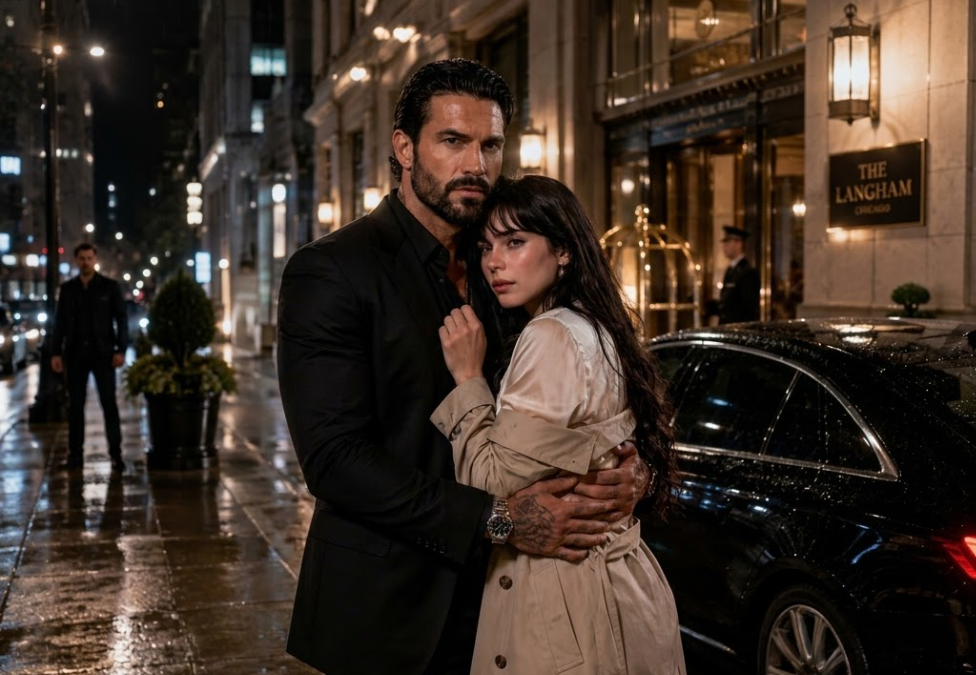
She Needed One Safe Hug… But the Stranger She Chose Was the City’s Most Feared Mafia Boss
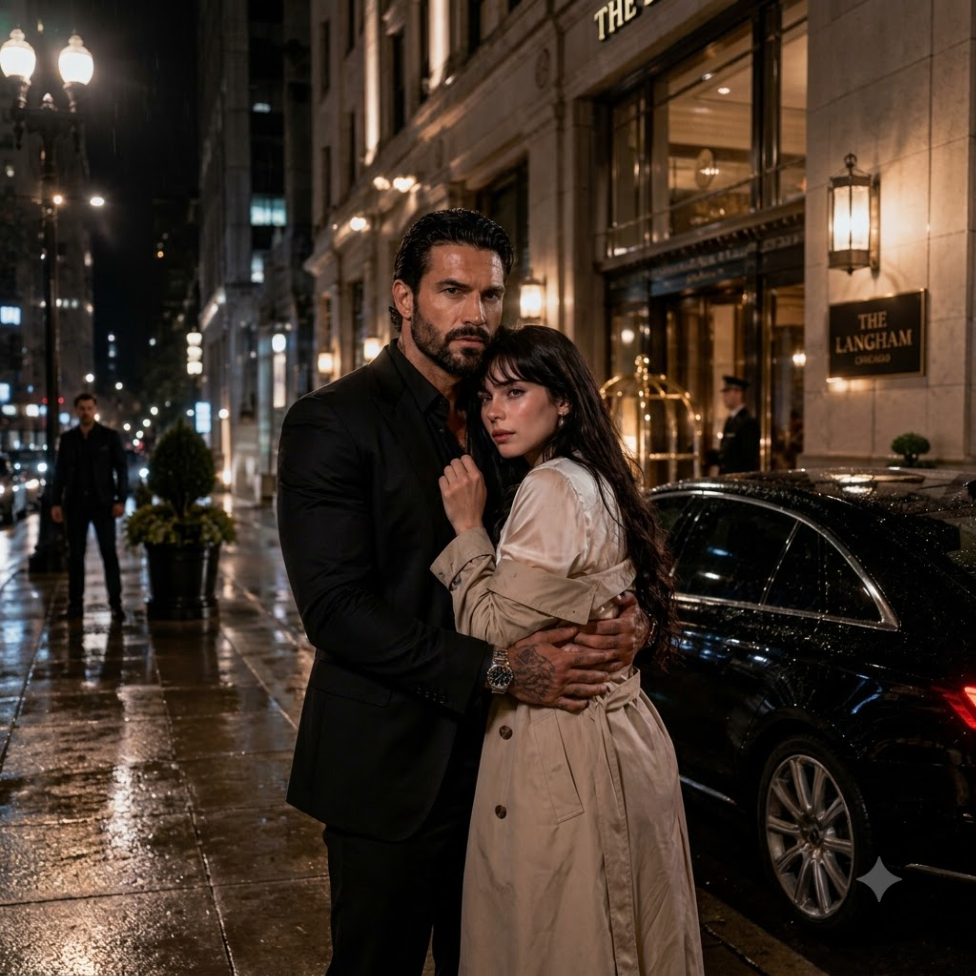
I ran barefoot.
No plan, no direction. Blood on my lips and my heart slamming against my ribs.
When I spotted him leaning against the black car, tall, inked, the kind of face no sane person would test, I didn’t think.
I crossed the street, fisted his shirt, and said the only words I had: Hold me. Just one second, please.
He never held anyone, not once. But something in my eyes moved his body before his mind could stop it.
He held me and over my head he saw the man waiting on the corner, fists clenched, eyes like someone who kills without hurry. The man stepped back, dissolved into the dark.
I didn’t know whose shirt I was gripping.
He didn’t know who he’d just pulled from the edge.
And that single second rewrote both our lives in ways neither of us could have begun to imagine. Chapter 1. The dark street.
I was running barefoot with no destination in mind. The metallic flavor of blood coating my tongue and the frozen pavement tearing at my souls with every stride.
March in Chicago carried a cold that burrowed into the marrow and refused to leave, but I hardly registered it.
Adrenaline was standing in for the coat I’d never had the chance to grab.
One thought ruled everything.
Don’t stop.
Stopping meant collapsing, and collapsing meant he would find me.
Gregor Eastvan, the name I’d been taught to call father, was a man whose hands did the talking.
That was ancient history.
At 6, I’d learned never to knock over a glass.
At 10, I’d learned to swallow my replies.
At 17, I’d learned to bolt my bedroom door and shove the dresser against it every night before I slept.
I should have walked out long ago. I understood that. But walking out demanded money I never managed to keep.
An address that didn’t exist on any map of my life.
And each time I scraped together enough for a deposit on some rented room, life intervened. An unexpected bill.
cash lifted from my drawer that Gregor rebranded as my share of the household. A week when the restaurant cut my shifts, staying was unbearable, but staying was familiar.
Leaving was the great unknown. That night, though, the pattern broke.
The first blow landed without the usual prologue, without the escalating pitch of his voice that I’d learned to read as a countdown.
His closed fist caught me in the face, and the force of it flung me against the kitchen table hard enough that the dinner plate slid off and exploded on the tile.
I didn’t hang around for round two.
I bolted through the back door while he was still finding his footing among the shards. And the last sound I caught was him hurling my name through the apartment as if the name alone could wound.
Maybe it could. In his mouth, every syllable turned into a weapon. Even words that were supposed to be gentle, like daughter, like come back.
I descended the fire escape with trembling hands, nearly losing my grip on the corroded rail more than once. And when my bare feet met the asphalt of the alley, I ran without a single glance over my shoulder. Three blocks, four.
The neighborhood I could have walked blindfolded looked like someone else’s territory in the dark, as though the streets had shuffled themselves around to throw me off.
My phone had stayed behind, left on the table when the first punch came. No wallet, no documents, nothing but the thin pajama set and a thread of blood trailing from the corner of my lip to my chin.
I rounded onto a broader street, one of those secondary avenues that separated my part of the city from everywhere else.
And that’s when I spotted him.
A black car sat at the curb, the kind of vehicle that had no business being parked in that neighborhood. Too immaculate, too still, too expensive for any corner on this side of Chicago.
and propped against it, arms folded, with the stance of someone who had all the time in the world, stood a man, tall, wide through the shoulders beneath a dark overcoat, dark hair combed back, a jaw that seemed engineered for intimidation, tattoos snaking up the side of his neck and stopping just below
his ear. He was murmuring into a phone, but the words died on his lips when I rounded the corner, barefoot, bloody, gasping, with the wild stare of something hunted.
I didn’t deliberate.
I crossed the street, fisted my hand in his shirt, and said, “Hold me just for a second, please.”
He went still. The phone was still raised near his ear, and every muscle under my grip locked at once, as if his entire frame had turned to stone in the same heartbeat.
The look he gave me was unreadable.
It wasn’t pity.
It wasn’t revulsion.
It wasn’t annoyance.
It was something that ran deeper than simple surprise, as though I’d spoken words he hadn’t heard addressed to him in years, maybe ever.
Then, without saying anything, he lowered the phone and he held me.
His arms folded around my shoulders with a pause that lasted less than a second, as if his body were performing an action his mind hadn’t yet signed off on.
He was solid, all muscle and heat, and costly wool, a wall that swallowed me whole. I pressed my cheek against his chest and heard his pulse there, steady and even, a rhythm so calm compared to mine that it felt like it belonged to a different kind of creature.
The shaking hit me then.
Everything I’d been clamping down on since the first punch, since the table, since the smashed porcelain on the floor, it all broke loose at once, and his arms drew tighter around me, a reflex to something he hadn’t intended to feel.
His scent
wrapped around me. Something dark and woody, expensive, threaded through with the chill of the night.
And for a moment, a single suspended moment, I felt safe, not saved, not rescued, just safe, as though the world had paused its rotation long enough to let me breathe.
He didn’t say a word.
He simply held on with the composure of someone who had no idea what he was doing, but had already decided he wasn’t going to stop.
I couldn’t say how long we stood there.
10 seconds, a full minute. But at some point, I felt the quality of his tension shift.
A sharper alertness, something that had nothing to do with me anymore. His chin lifted above my head, and the embrace, which had been firm, turned protective in a way that dropped a cold weight into my stomach.
He was watching someone.
I didn’t look.
I didn’t have to.
I knew who was there before my ears even picked up the footsteps on the opposite sidewalk because my body had always recognized Greor the way it recognized approaching storms. by some older instinct, by the fear that arrived before the sound. The footsteps paused.
The man holding me didn’t flinch, didn’t speak, didn’t look anywhere else.
I felt the faintest rumble in his chest against my cheek. Not words, but something closer to a warning.
The low note a large predator makes when it hasn’t yet decided whether something is worth the bother.
The footsteps retreated, hesitant at first, then quick, and then nothing. Gregor was gone.
I let out a breath I hadn’t known I was holding and unclenched my fingers from his shirt, noticing only then that my knuckles had gone white.
I stepped back and the cold rushed in again so viciously that I crossed my arms against my chest.
“I’m sorry,” I said, unable to meet his eyes.
“I didn’t mean I’m sorry.
Who was that man?”
His voice caught me off balance. Not the tone, but the question itself.
He didn’t ask whether I was all right.
He asked who the man was as if the rest was already obvious to him.
“My father,” I said, and the word scraped its way out of my throat like it hated being spoken.
He stayed quiet.
His eyes moved over me with a patience I hadn’t earned.
“He did that,” he said.
It wasn’t a question.
𝑵𝑬𝑿𝑻 𝑷𝑨𝑹𝑻
His gaze had settled on my split lip. I swept the back of my hand across my mouth and saw the blood already drying there.
I didn’t respond.
There was nothing to respond to.
“Do you have somewhere to go?”
he asked. I almost laughed.
Almost. Because the answer was so ridiculous that laughter seemed like the only sensible response for a barefoot, bleeding girl on a dark Chicago street whose entire inventory of possessions had been reduced to the clothes on her body.
“No,” I said.
He nodded as though he’d expected that exact word and slipped the phone into his overcoat pocket with a slow, measured motion.
That’s when it registered that he’d cut the call somewhere in the middle of holding me.
not finished it, cut it. As though whoever had been speaking had simply stopped being relevant. A movement behind him made me go rigid, and my eyes snapped to the figure that seemed to have condensed out of the air beside the black car.
Another man, younger than I’d anticipated, hair cropped short and pale, eyes that seemed to take in everything without fixing on any one thing.
He studied me, then the man in the overcoat, and his face gave away nothing, but something in the set of his shoulders adjusted almost imperceptibly, as though he were logging a piece of data that didn’t fit the framework he usually worked with.
He didn’t speak.
“Get in the car,” the man in the overcoat said, and it didn’t quite sound like a command, even though I was certain he wasn’t accustomed to being refused.
“I don’t know you,” I shot back, and the sarcasm slipped out before I could catch it.
Sarcasm being my standard armor when fear got too big to stay contained. I already hugged a stranger in the middle of the street tonight.
Climbing into his car feels like a lot for one evening. The edge of his mouth twitched.
It didn’t amount to a smile, more like the shadow of one.
The outline of something he probably didn’t hand out very often.
Ronin, he said, “My name is Ronin.”
as though that closed the matter.
As though a first name delivered without a surname and without context amounted to credentials sufficient for getting into a tinted window sedan with two men I’d never laid eyes on.
But I was barefoot. I was bleeding. I was trembling from something deeper than the cold.
And the man who had struck me was somewhere in that darkness, likely weighing whether or not to circle back. Iris, I said, and I got in.
The fair-haired man settled into the front seat without turning his head, and Ronin slid in beside me, holding a distance that felt measured to the millimeter, close enough that I could feel the heat coming off his body, far enough that nothing of us touched, as though the embrace from a few minutes ago had been an aberration he was already working on reclassifying as an error. I watched through the window as the car pulled away, the streets of my neighborhood falling behind us block by block, like a life being switched off one section at a time. No one spoke.
The silence wasn’t awkward.
It was dense, freighted with the kinds of questions people who don’t know each other haven’t yet figured out how to ask.
The car came to a stop in front of a building downtown that I’d only ever registered from the window of a bus, never once imagining its interior.
Ronin got out first, waited for me to climb out, and walked ahead, not out of courtesy, I realized, but out of some instinct to sweep the path first. The apartment was on the seventh floor, clean, neutral, functional, the sort of space that existed expressly to leave no impression. A window opened onto a slice of the city that glittered below as if nothing bad ever happened on those streets.
“You’re staying here tonight,” Ronan said from the doorway, as if stepping over that threshold alongside me was something he needed to think twice about.
“Everything you need is inside.
We<unkll talk tomorrow.
” I wanted to ask about what?
wanted to ask who he was, why he’d been standing on that street, why he’d held me, why he’d brought me here, why my father had retreated the instant he saw him.
But exhaustion was already a wave breaking over me, and I didn’t have the strength left to fight it.
“Thank you,” I said.
“It wasn’t enough, and I knew it wasn’t enough.
But it was everything I had.”
He nodded. He left. The door closed behind him with a soft click.
I went into the bathroom, rinsed my face, looked at the split on my lip in the mirror. Then I made my way to the bedroom.
Sleep took me faster than I’d expected, as though my body had decided this was a safe enough place to power down, at least for a few hours.
Inside an apartment that belonged to a man whose last name I didn’t even know.
On the other side of that door, in the hushed corridor of a floor that seemed to exist at a remove from the rest of the building, Ronan Morgan stood with his hands sunk in his pockets, his eyes fixed on the closed door as though it contained something he hadn’t yet worked out how to label.
Silian Hail, the pale-haired man who hadn’t uttered a syllable since the street, came up beside him.
“You don’t hold people,” Psyian said, and his voice had that arid, level quality that turned every sentence into a verdict.
Ronin didn’t look over.
I know, he said, and he walked off down the corridor without a backward glance, leaving behind a silence that Silly considered with the expression of a man who had just seen something that wasn’t supposed to exist, and which, for precisely that reason, deserved to be watched very carefully.
Chapter 2. The monster who cares. I woke up without knowing where I was.
The mattress was too plush, the silence too clean, and the air didn’t carry the mildew and stale cigarettes I was used to.
Then memory returned and remembering hurt. I pushed myself upright and my body filed its complaints one by one.
My feet stung, my face pulsed, and there was still dried blood trapped beneath my fingernails from where I’d fisted his shirt.
The apartment was quiet, an orderly kind of quiet, stripped of the layered noise I’d grown up inside.
No television cranked to the last notch. No heavy stomping down the hall. No clink of bottle against glass announcing that Greor had begun drinking before lunch.
I got up, went into the bathroom, and faced the mirror with the reluctant courage of someone who already knows the verdict won’t be kind.
The cut on my lip had puffed up and hardened into a dark scab. My left cheekbone bloomed purple, the eyes slightly swollen, the kind of damage you could disguise if nobody paid attention, and the kind that confessed everything the moment someone did. I rinsed my face carefully, letting the warm water run across it like something extravagant.
And here with this steady pressure and this exact temperature, maybe it was. Then I returned to the bedroom, sat at the edge of the bed, and stared at the door. Nothing was stopping me.
No lock had been turned.
Ronin had said, “We’ll talk tomorrow.”
Which was a statement, and not a sentence. I stood up and turned the handle.
It gave without resistance, and there was Silly. The fair-haired man was braced against the opposite wall with the ease of someone who had apparently been born in that posture, arms folded, face arranged in the same perfectly vacant expression as the night before. He looked at me like I was an appointment already penciled onto his day.
No surprise, no haste, nothing I could read. Morning, he said with the same dryness as before, as if each word got weighed before it was spoken. Ronin asked you to wait.
He’ll be back within the hour.
And if I don’t feel like waiting, I shot back, leaning my shoulder against the frame with a nonchalance I didn’t actually possess.
Selian held my gaze a beat longer than necessary, and the corner of his mouth did something so small it might have been a twitch, or it might have been, in another person, the opening stroke of a smile. The doors open, he said.
Though I’d recommend shoes, I glanced down at my bare, torn up feet, and had to concede the point.
Sarcasm is a significantly less effective weapon when you couldn’t physically walk to the end of the block.
I stepped back into the apartment and shut the door behind me with whatever dignity is still available to a woman in borrowed pajamas, a busted lip, and no money to her name.
The next hour stretched like no hour I’d ever known.
I opened the fridge and found water, fruit, and tidy containers of prepared food that looked like the work of someone who knew exactly what they were doing. I ate an entire apple standing at the kitchen counter watching the city come awake below the window and tried to assemble a plan from the materials at my disposal which amounted in practical terms to absolutely nothing.
When the front door finally opened, I was already parked on the couch with my legs folded beneath me, mentally rehearsing three different versions of thanks for everything.
But I’m leaving now.
Ronin walked in and the room seemed to contract. In daylight, his face was sharper than I remembered, and his eyes went straight to the bruise, then to the split in my lip.
His jaw tightened. A minimal movement, one I caught because I tracked every man who entered a room I was in. A survival habit.
Greor had taught me that without intending to. Greor has disappeared, he said, without preface and without sitting.
Same night. No one knows where.
My father’s name in his mouth sounded surgical, like a data point being delivered in a conference room.
My stomach nodded, not with fear, but with something less clean, some unstable mix of relief and dread that refused to settle into a single shape.
“And how is it that you know that?”
I asked, because the question was right there, plain, “And I wasn’t in the habit of pretending not to see obvious things just because looking away was easier.
” Ronin regarded me with that controlled stillness I was starting to identify as his default register, not an absence of feeling, but a tight leash on it.
because I know who he is, he said. And given what he did to you, you need protection until this is sorted.
Protection, I echoed, and the word felt wrong in my mouth, like a garment that didn’t fit.
And what’s the cost?
None. Nobody offers protection for free, I said.
I was raised by a man who charged a punch for every plate of food. Forgive me for not believing in spontaneous kindness.
He didn’t push back.
He didn’t argue, didn’t look offended, didn’t reach for any smooth line about good intentions.
He only looked at me a second longer than necessary and said, “You don’t have to believe.
You just have to be safe.
” Then he turned away to take a call that had started vibrating in his pocket, leaving me alone with the sentence and no idea what to do with it.
I called Sariah from the landline in the apartment, a device I hadn’t realized still existed anywhere on Earth, and asked her to bring me clothes because all I had were the pajamas I’d run out of the house in.
I gave her the abbreviated version, a fight with Gregor, the escape, a man who’d helped me, a temporary apartment.
Sariah heard me out in complete silence, which in itself was a rare phenomenon, and then said, “Send me the address.”
When Sariah Nasri arrived 40 minutes later, hauling a suitcase that looked like it had been packed in a hurry with whatever items her hands had closed on first. She stopped dead in the middle of the living room, let her mouth fall slightly open as she surveyed the place, and then turned her eyes on Silly, who was standing near the door with the same expression he always wore.
“Iris,” she said, rounding on me with her eyes very wide.
“Were you abducted or did you win the lottery?
I need to know whether to call the cops or ask if I can move in.
” Silly, without a single facial muscle shifting, said, “Both of those options are bad.”
He speaks,” she announced, pointing at him like she was reporting a phenomenon to the scientific community.
“Iris, the statue speaks.”
“I hear things, too,” Selian added, then slipped out of the room with the same discretion he’d come in with, leaving Sariah with a half smile she tried without much success to rearrange into indifference.
Sariah hugged me the moment we were alone. And it was the kind of hug she always gave. Tight, long, one hand at the back of my neck, the other flat between my shoulder blades.
No questions, no rush to release me. When she finally stepped back, her face hardened in a way I rarely saw on her.
“Greor,” she asked, though it wasn’t really a question.
I nodded.
“I’m going to kill that man,” she said as casually as if she were talking about swapping shifts at the restaurant.
I think someone may already be handling that, I answered, and the weight of my own words surprised me because I genuinely didn’t know whether I was joking or describing something I actually believed.
Sariah stayed another hour.
She helped me change out of the pajamas, cleaned the cuts on my feet with the first aid kit she’d unearthed under the bathroom sink, and only left after I promised I’d call if I needed anything, a promise we both understood I’d drag my feet on keeping, because asking for help was the thing I did worst in the world.
Late in the afternoon, Ronin came back. He walked into the apartment with the same economy of motion as before, as if every step had been pre-calculated to save energy. I was in the kitchen drinking water, and he stopped on the far side of the counter as if the distance were a protocol he observed without thinking about it.
“Thank you,” I said.
The words getting out before I could rehearse them.
“For last night, for holding me.
I know it sounds like a small thing, but I trailed off because his face did something I hadn’t anticipated.
Something unguarded, as if gratitude were a language he didn’t speak, and he was decoding it in real time.
His eyes slid away for a fraction of a second, and his right hand made a small, involuntary movement at his side, as if reaching for a pocket, a wall, anything solid to steady himself against.
“You don’t need to thank me,” he said, and his voice came out lower than he’d probably meant it to.
I know I don’t need to.
I said I wanted to.
The silence that settled between us wasn’t empty.
I held his eyes because it was the only thing I had to give in that moment.
Proof that I wasn’t afraid of him, even though I probably should have been.
His phone rang and the moment shattered like dropped glass. Ronin took the call without apology, without asking leave, and I watched his face shift as he listened to whatever was being said on the other end. The change was subtle and violent at once.
His eyes narrowed, his jaw went rigid, and something in that deep green hardened in a way that finally explained for me why Greor had retreated on the street the moment he’d seen him.
When he ended the call, he looked at me with an expression I didn’t yet know how to read.
It wasn’t the controlled calm, and it wasn’t the calculated chill.
It was the face of a man who had just received information that redrew the whole map, the look that comes right before a decision.
“What is it?”
I asked because his silence no longer felt like procedure. It felt like something he was holding back.
Tomorrow, he said, “We<unkll talk tomorrow.”
And he walked out, leaving me alone with the certainty that he knew something about Gregor.
I didn’t.
Something that had made this man, the one the world at large seemed to be afraid of, look at me as though I were a piece on a board that had just become considerably more dangerous. Chapter 3.
The father’s name.
Sleep didn’t come that night.
I lay in the dark trying to stitch together what little I actually knew, and none of the pieces fit. No phone, no money, no home.
Leaning on a man who stirred something in me I couldn’t file as fear or label as anything else.
The next morning, Ronin didn’t come alone.
Beside him, stepping into the apartment with the restrained elegance of someone who treats every footfall as a statement, was a man I’d never laid eyes on before.
Early 50s, charcoal suit, pale blue eyes set to the temperature of an interrogation room. He carried a leather briefcase and took me in with a quick clinical onceover.
Iris,” Ronan said, stopping in the center of the living room with that bearing that turned any space into his own.
This is Declan Burn.
He’s a lawyer and an adviser to my family.
Family?
The word hung in the air, and I turned it over silently as I shook the hand Declan extended, firm, dry, lasting exactly as long as someone who’d learned to meter out even his courtesies.
“Miss Eastfan,” Declan said.
Ronan briefed me on your situation.
“I’m sorry for the circumstances.”
I nodded and looked at Ronin, who stood near the window with Chicago’s light behind him, waiting for the explanation I’d been owed since yesterday.
“Sit down,” he said.
“Not quite an order.
Not quite an invitation.”
I took the couch. Ronin stayed on his feet. Declan lowered himself into the armchair opposite mine, with the ease of a man accustomed to delivering bad news in pleasant settings.
“What I’m about to tell you,” Ronin began, his eyes pinned to mine with an attention that made the air between us heavier.
isn’t easy to hear, but you need to know it.
I survived 24 years of Gregor Istvan, I said, folding my arms. A shield more than a posture.
Go on, he nodded once, as if I’d confirmed something he’d already predicted.
Your father is a soldier for the Zacharov family, he said.
The Russian bratva that runs Chicago’s east side.
Low-ranking muscle, but active.
He’s attached to operations involving territory control, collections, intimidation.
The words entered me slowly, like ice water filling a space I hadn’t realized was empty.
I heard each one individually, grasped their individual meanings, but the whole refused to coalesce into anything coherent, because the picture of Gregor Thirst carried, violent, yes, cowardly, yes, cruel in ways I wore on my body like signatures, had never included the word mafia.
In my head, he’d always been pathetic and dangerous at the same time, but the radius of his danger had been bounded by the walls of the apartment I grew up in.
And now Ronin was telling me the radius was much bigger than I’d ever guessed.
“Bratva,” I repeated, and the word had a strange flavor in my mouth, as though it belonged to a language I could understand, but had never spoken.
“My father works for the Russian mob.”
“Works,” Ronin confirmed.
And something in his tone told me this wasn’t the hard part yet.
His disappearance wasn’t coincidence, Iris.
He saw who I am that night and decided vanishing was safer than sticking around.
“And who are you?”
I asked because the question had been sitting there since the first second, and I was tired of circling it like it was a trap. Ronin looked at me for a full beat without speaking.
And in that beat, I saw something I hadn’t expected to find in his face.
Not hesitation, but something closer to care, as if he were choosing the angle at which the answer would reach me.
“I’m the head of the Morgan family,” he said.
“We control Chicago’s west side.
” The Zakarovs are our rivals.
The room didn’t change.
The light kept streaming through the window. The wall clock kept ticking out seconds. Declan remained seated with his briefcase across his lap.
And the expression of a man watching a conversation whose ending he’d already worked out, but something inside me moved.


