They Fired This Nurse for Defying a Doctor—Then a General Arrived and Exposed the Truth
They Fired This Nurse for Defying a Doctor—Then a General Arrived and Exposed the Truth
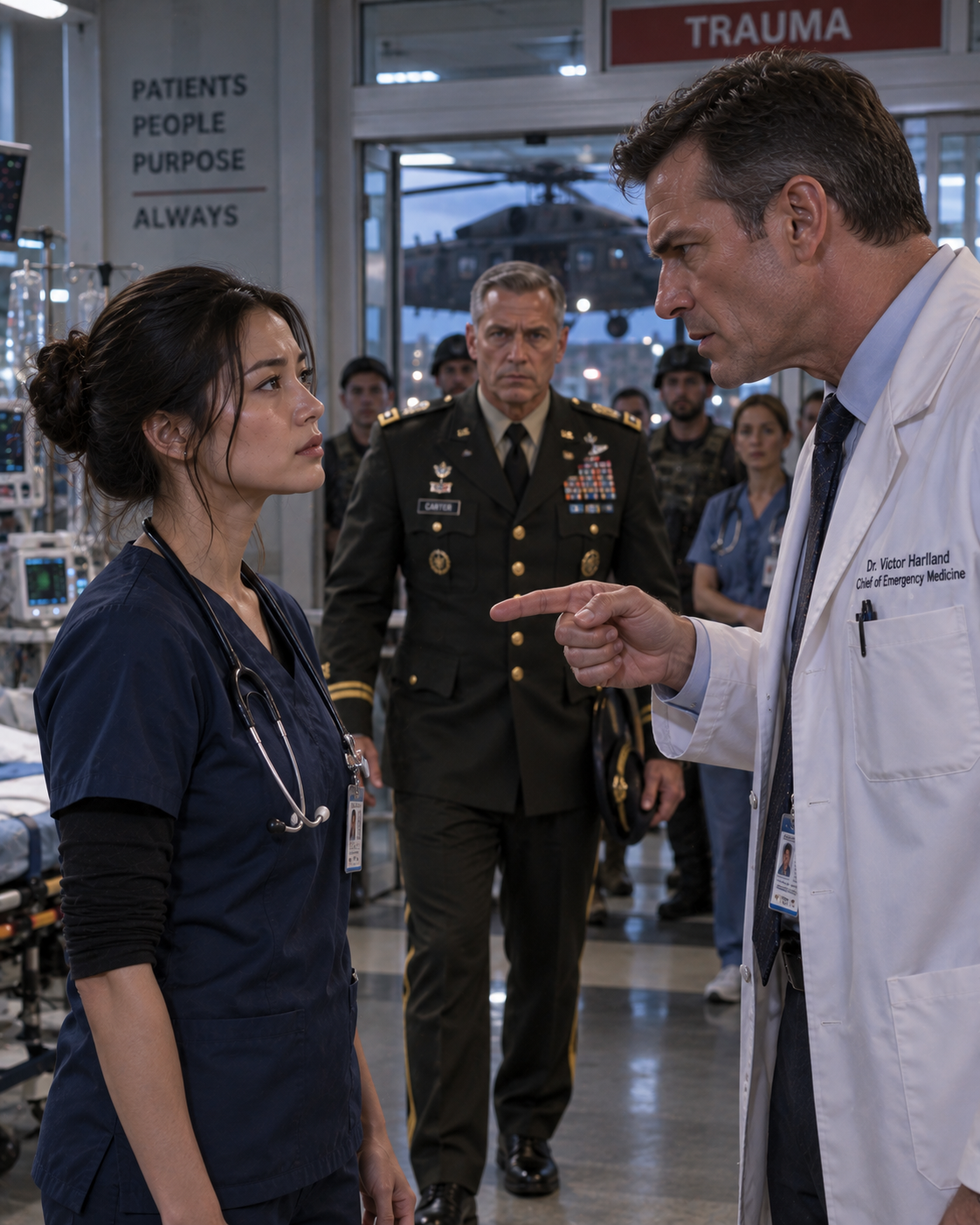
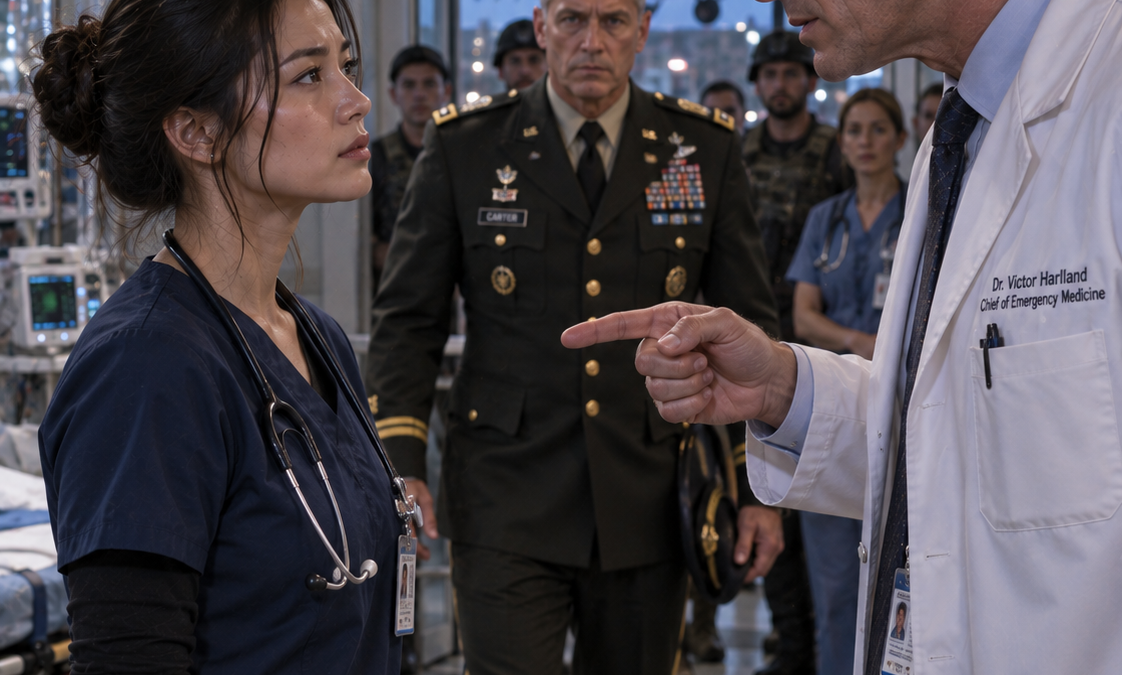
The order came before the helicopter did. Fire her tonight.
I want her badge on my desk before morning rounds.
Dr.Victor Harlland’s voice cut through the emergency department like a scalpel clean, deliberate, designed to end things without discussion.
38 nurses, techs, and residents heard it. The department absorbed the words and went still in the way that institutions go still when authority speaks without expecting a response.
Nobody moved. Nobody breathed loud enough to be noticed.
Emily Shen stood at the trauma bay entrance, gloves still on, a faint smear of blood across her left forearm from a patient she had spent the last 40 minutes keeping alive.
And she didn’t flinch.
She had heard worse.
She had survived worse in places where the air tasted like cordite and diesel smoke and the only light came from a headlamp held between someone’s teeth, where the ground shook in a way that had nothing to do with weather and everything to do with what human beings do to each other when diplomacy runs out.
Emily Shen had knelt in the dirt beside men who had about 4 minutes left in them and made decisions that no nursing protocol on earth had ever anticipated. She knew what worse looked like.
She knew exactly what it smelled like.
Victor Harlland’s voice was not worse, but it was coming and she knew it.
Then the windows rattled. Not thunder, not an equipment problem.
The specific low-frequency concussion of military rotor blades at close range of sound that lives in a different register than civilian aircraft. Heavier and more deliberate.
the kind of sound that doesn’t so much arrive as it announces itself from a distance and then closes the gap.
The fluorescent lights in the ER hummed in sympathy with the vibration.
A supply cart near the nurse’s station rattled against its break.
And then a Blackhawk helicopter dropped below the cloud line above Ridgemont Trauma Center in Salt Lake City, Utah. its belly lights cutting white arcs across the rooftop pad.
And 60 seconds later, a man in a general’s uniform walked through the emergency department’s main entrance and asked if for Emily Shen by name.
Emily Shen arrived at Ridgemont Trauma Center on a Tuesday morning in early November and was assigned to bay 4 before she had finished her first cup of coffee. Every emergency department had a bay 4.
The number didn’t matter.
It was always the same bay regardless of what it was called. The monitors were a generation behind the rest of the floor.
The overhead light flickered on a 12minut cycle with the reliability of a failing metronome.
The supply cart was missing its crash kit drawer handle, replaced years ago by a strip of blue surgical tape on which someone had written in thick black marker, “Pull hard, curse freely.
” Bay 4 was where hospitals put nurses.
They hadn’t decided what to do with yet transferins without enough institutional history to earn a better assignment.
nurses who came with paperwork that said excellent in every evaluation box, but carried something in their bearing that made the senior staff vaguely uncomfortable in ways they couldn’t uh uh articulate.
Emily carried that something. She was 34 years old with dark hair pulled back tight enough that it never drifted.
precise in her movements, in the way that people are precise when they’ve have spent years operating in environments where imprecision had consequences that extended far beyond paperwork.
She was not cold. The patients figured that out within the first 5 minutes of being in her care, but she was contained. And to someone meeting her for the first time, a cross, a busy emergency department, that containment looked like a wall.
Dr.Victor Harlon had looked at it and decided it was arrogance. He was chief of emergency medicine at Ridgemont, 49 years old, two decades into a career built on genuine clinical skill that had slowly over time become insulated from any serious challenge. He was not a bad doctor.
That was the part that made everything complicated. He was sharp and decisive and had trained attending physicians who now ran departments at hospitals across the region. His outcomes were good.
His instincts were usually right. But 20 years in a position where being right had never once required him to reconsider.
His process had done something to the architecture of his thinking that no amount of continuing medical education could address.
He had reviewed Emily’s transfer file.
He saw the nursing credentials, the trauma certification, the critical care hours, solid, nothing spectacular. He saw the gap in her employment history, 3 years, listed as federal service, non-clinical.
He had read that as filler language, some administrative role, maybe a desk somewhere. He assigned her to Bay 4 and moved on.
That was his first mistake. It would not be his last.
Emily didn’t complain about bay 4.
She arrived 20 minutes before her shift began, sourced a replacement drawer handle from the equipment room down the hall, installed it herself, recalibrated all three monitor leads, and submitted to a detailed maintenance request for the overhead light that specified the flicker interval, the probable cause, a
failing ballast rather than a bulb issue, and the patient safety implications of a compromised lighting environment in a trauma bay. By the time her first patient rolled in, Bay 4 was a functional workspace.
Her charge nurse that evening was Donna Reyes, 42 years old, 15 years in trauma nursing, the kind of person who had survived long enough in emergency medicine to stop being surprised by anything and start being surprised by people. She watched Emily move through the first 2 hours of the shift and said nothing.
But she started appearing near Bay 4 more frequently than her other responsibilities required. The ER was busy.
November in Salt Lake City meant black ice, which meant collisions, which meant the department ran at near capacity from 8p onward. With the grim efficiency of a machine that had been designed for exactly this kind of sustained pre pressure, Emily worked her patience with a rhythm that looked almost mechanical until you watched closely enough to recognize it as something entirely economy, not automation.
Every movement had a destination.
She talked to her patients in a low, steady register that didn’t perform calm so much as actually produce it in the room around her.
She documented with the same precision she applied to everything else. Twice during those first two hours, she flagged medication discrepancies on adjacent charts, not her patients. patients she had simply passed in the course of moving through the department and reported them to the appropriate residents without drama or commentary.
Dr.Harland saw this.
He didn’t say anything about it.
He filed it in a category he wasn’t fully aware he maintained things that don’t fit where I’ve put her.
He filed it and moved on. At 11:40 p.m., Marcus Webb arrived by ambulance. He was 26 years old, the product of a rear-end collision on I-15 at highway speed airbag deployment, mild laceration on his chin from the steering wheel, GCS, of 15, alert and answering questions clearly.
The paramedics had run a solid field assessment. His vitals on arrival were acceptable in the way that vitals in the early stages of internal hemorrhage are often acceptable.
Blood pressure 108 over 72. Heart rate 101.
Oxygen saturation at 97% on room air. He was talking. He was coherent.
He was rating his pain at a six and telling the paramedic he thought he was probably fine. He came to bay four. Emily began her assessment while the paramedics were still completing the transfer.
She listened to his chest breath sounds equal bilaterally. no abnormality. She moved her hands across his abdomen, systematic, watching his face as much as feeling for findings.
His abdomen was soft, no obvious rigidity, no guarding until she pressed the left upper quadrant. There, a small involuntary tightening, a flinch controlled fast enough that a less attentive examiner would have attributed it to general tenderness, and moved on.
She pressed again. Same response. Tell me about what you feel right there, she said.
When I press it’s Marcus paused, organizing the sensation.
A dull ache. Kind of spreading out when you do that. Has it changed since the crash?
Better, worse, the same. He thought about it. Maybe a little worse.
I figured it was bruising. Emily looked at his hands. She had a habit of looking at hands.
His nail beds were pale in a way that was subtle enough to be dismissed as baseline variation. And his capillary refill came back at 2 and 1/2 seconds.
Not alarming. Not individually alarming, but there was a pattern assembling itself from a series of individually non-alarming data points. And the pattern had a shape she recognized.
She flagged the chart for Dr.Harlland and stayed with Marcus until the attending arrived. Harlon came in three and a half minutes later, reviewed the vitals board, performed a quick physical assessment with the confident speed of someone who has run this particular sequence thousands of times. He asked Marcus two questions and listened to the answers and made a decision.
CT of chest, abdomen, and pelvis with contrast. Standard protocol. Emily stepped closer.
I’d like to add a fast exam alongside the CT.
his left upper quadrant response and the capillary refill trend. CT with contrast is the diagnostic standard for blunt abdominal trauma.
Harland didn’t look at her.
He was already typing the order.
I’m aware of fast protocol.
Nurse Shen, I understand that.
I’m not suggesting replacing the CT.
I’m suggesting we run both concurrently.
The scanner is backed up and if there’s the CT order is placed.
He looked at her then briefly.
The expression of a man exercising patience he hasn’t been asked to exercise in quite some time.
Unnecessary duplication of diet creates confusion in the workup. Let the CT do its job. He moved to the next bay.
Emily stood at Marcus Webb’s bedside and said nothing for a moment.
Then she pulled the blanket up to his chest, checked his IV line, and checked the clock. 11:47 PM. The CT scanner had a 40minute backup.
40 minutes was not unusual. Ridgemont ran two operational scanners for a level two trauma center serving the broader Salt Lake metro area. And on a busy November night with black with black ice on the roads, 40 minutes was a Tuesday.
Emily documented the scanner delay in Marcus’ chart, timestamped, and adjusted her vital sign check frequency to every 8 minutes instead of the standard 15.
At 12:22, his blood pressure read 104 over 68. At 12:30, 101 over 65. Small drops, the kind of drops that could be positional artifact, could be anxiety response, could be the natural variability of a young body managing moderate pain, could be half a dozen things that were not dangerous and would resolve on their own without intervention, or they could be something else entirely.
Emily went to the storage al cove and retrieved the portable ultrasound unit.
She brought it to bay 4, applied gel to the probe, and positioned it over over Marcus’ right flank, Morrison’s pouch, the anatomical space between the liver and the right kidney.
One of the first places fluid collects in abdominal hemorrhage. She looked at the screen.
The image took a moment to resolve through the artifact from his subcutaneous tissue. Then it was clear. a thin crescent of anacoic fluid, free fluid, blood, most likely, not a massive volume.
But there, Emily photographed the image with the department’s clinical camera, uploaded it directly to Marcus’ chart with a timestamped note, and walked to the physician workstation, where Dr.Harlland was completing documentation on a separate case.
She placed the uploaded image on the screen in front of him and said, “Free fluid in Morrison’s pouch.
He needs a surgery consult now.”
Harlon looked at the image. He looked at it for a full 4 seconds longer than a dismissal would have required.
Then he said, “That’s artifact.
The portable unit in bay 4 has a degraded transducer head. The CT will give us the definitive picture.
His pressure has dropped 9 points in 22 minutes. within acceptable variance for his presentation.
Dr.Harlon, nine points in 22 minutes on a trauma patient with LUQ tenderness and suboptimal capillary refill is not variance.
I’m comfortable with then I suggest you adjust your comfort level.
He turned back to his documentation. The CT order stands. Return to your patient and monitor his vitals per protocol.
I am monitoring his vitals.
That’s why I’m here.
He set his pen down. He turned to face her fully, and his voice dropped into a register that was quieter and therefore considerably more pointed than it had been. Nurse Shen, you have been on staff in this department for 72 hours.
You do not countermand attending physician orders on the basis of a portable ultrasound in a compromised bay environment.
That’s not how this works here.
Return to your patient. Two seconds of silence. Emily turned and walked back to bay 4.
She checked the monitor the moment she arrived. 100 over 62.
She pulled the stool close to Marcus’s bedside and sat down.
He was watching her. Eyes eyes had gone slightly glassy.
Not altered, not confused, but tired in a way that was moving faster than than a young man’s normal fatigue should move.
“Is something wrong?”
he asked. She looked at him directly.
I’m watching your numbers carefully.
That doesn’t sound like nothing’s wrong.
It means I’m paying attention, she said.
That’s what I’m supposed to do.
He was quiet for a moment.
That doctor and you, you don’t agree about something.
We have a difference of clinical opinion. Marcus looked at the ceiling.
He’s the doctor.
He is.
But you think I think you’re in good hands, Emily said.
And I am going to be standing right here. She meant it both ways. Donna Reyes found her 3 minutes later.
Emily gave her the full report without editorializing the LUQ finding on palpation, the fast image and what it showed, the vital sign trend, the physician’s response.
Donna listened without interrupting. Her face stayed professionally neutral through most of it.
And only when Emily described the 9point pressure drop.
In 22 minutes did something move behind Donna’s eyes.
A small controlled acknowledgement. Everything documented. Timestamped entries.
Image uploaded. All of it.
Donna looked across the department toward the physician workstation.
I’ll go talk to him.
He won’t hear it.
Probably not, but I’ll document that I tried.
She met Emily’s eyes.
You see the systolic break 100. You come find me immediately. Not in 2 minutes.
Immediately. Emily nodded.
Donna crossed the department. The conversation with Haron lasted 40 seconds. Emily watched it from the bay entrance.
Donna speaking with the measured precision of someone who has learned to make institutional arguments in the shortest possible form. Harlon listening with the patience of a man who has already made up his mind.
Haron responding in three words that made Donna’s shoulders lower by a fraction before she turned and walked back.
She passed Emily and said quietly without stopping.
He’s calling CT to bump the scan up.
18 minutes. Emily looked at the monitor 97 over 60. She did not say anything.
She pulled on a fresh pair of gloves.
At 12:49 a.m., Emily placed two large bore peripheral IV lines in Marcus Webb’s arms, a 16 gauge in the right anti-cubital, and an 18 gauge in the left forearm, and hung a bag of normal saline running wide open.
She had not been ordered to do either of these things. She had done them because the math had run to its conclusion, and the conclusion pointed in one direction. She was adjusting the IV tubing when Dr.Harland walked into Bay 4.
Behind him were two residents, both of them young, both of them doing the specific kind of watching that junior physicians do when they’re not sure which senior person in the room to learn from.
Behind them at the bay entrance was a hospital security officer. Harlland looked at the IV lines, his jaw tightened the way a closed door tightens when someone on the other side is pushing against it. Nurse Shen, step away from the patient.
His pressure is 97 over 60 and trending. I can read the monitor. His voice had dropped into something flat and very precise.
Step away from the patient now. I have large bore access established and fluids running. If he decompensates in the next, you placed IV lines without a physician order.
He said it the way a judge reads you finding factual, conclusive, designed to be heard by everyone in the room. That is a protocol violation.
You are removed from this case effective immediately. He looked at the security officer. Please escort nurse Shen to the hallway.
The security officer stepped into the bay. Emily looked at Marcus. His eyes were halfopen.
His skin had taken on a waxy quality that it hadn’t had 40 minutes ago.
Subtle.
the kind of thing you only caught if you’d been watching the whole progression.
She looked at the two residents. Neither of them met her eyes. She looked at Dr.Victor Harlon and she understood in that moment with complete clarity exactly what kind of wall she was standing in front of.
She took one step back.
Then she did the thing she hadn’t planned to do.
She reached over and picked up the ultrasound probe.
She had kept the machine running at the bedside throughout the shift and she pressed it to Marcus Webb’s abdomen one final time.
She angled the screen so that both residents could see it. The image was unmistakable.
What had been a thin crescent of free fluid 40 minutes ago had expanded into a visible pool. The hemorrhage was accelerating.
She held the screen in place for 4 seconds. The bleeding has increased significantly in the last 40 minutes, she said, addressing the residents. Not Harlon.
He does not have 18 minutes. One of the residents, the taller one, a young woman who had been watching the proceedings with the expression of someone doing rapid internal calculations, looked at the screen, looked at the monitor, and looked at Dr.Harlon. Harland stepped directly in front of the ultrasound screen, blocking it.
“Remove her,” he said to the security officer.
Emily set the probe down carefully on the machine’s armrest.
She pulled off her gloves. She walked out of bay 4 without looking back and the security officer followed her into the hallway and the door behind her swung shut and she stood in the corridor of the emergency department with 12 ft between her and the patient she had spent the last 72 minutes trying to keep alive.
She did not move. She stood in the hallway and she breathed and she counted the seconds.
She had reached 11 when the blood pressure monitor alarmed. She heard it from the hallway, the sharp triple tone of a monitor hitting its lower threshold.
Then she heard a second alarm join it. Then she heard the quality of doctor.
Harlland’s voice changed from behind the bay door.
Not the words, just the register, the specific compression of authority into something faster and more reactive. the sound of a man shifting from administrative mode into clinical emergency.
She heard one of the residents call out a number. She heard the word surgery.
Donna appeared beside her.
She had come from the nursing station without being called because 15 years of working in trauma had given her the ability to read a department’s atmosphere the way some people read weather by feel before the instruments confirmed it.
surgical resident is already on his way down,” Donna said quietly.
Martinez called him without authorization. Martinez, the taller resident, the one who had looked at the ultrasound screen.
Emily nodded. The bay doors opened and the surgical resident, a thirdyear named Garza, who had the compact intensity of someone who slept in 4-hour increments and had made his piece with it, came through at a near run.
He stopped at the bay entrance, looked at the monitor, looked at the ultrasound, the ultrasound image still displayed on the screen at the bedside, and was on the phone in under 10 seconds. Emily stood in the hallway and listened to the department reorganize itself around the crisis. The IV IV lines she had placed were now the IV lines the surgical team was using to push fluids into Marcus Webb while they moved him toward the elevator.
The access points she had established without an order.
The access points she had established without an order were the access points that currently represented systems between Marcus Webb’s circulatory system having a viable pathway and not having one.
The bay door opened. The gurnie came out.
Marcus’s face was pale and his eyes were only partially open.
And his blood pressure was reading 88 over 54 on the transport monitor.
and the surgical resident was walking alongside the gurnie with his hand on Marx’s arm talking to him in a low steady voice and the O team met them at the elevator.
Emily watched the elevator doors close. She stood in the hallway for a moment after they they closed and the department resumed its ambient noise around her.
And she was alone in the particular way that people are alone in the aftermath of a crisis.
They prevented partially but not completely where the outcome is still unknown and there’s nothing left to do but wait and document and hold the shape of what happened without letting it collapse into something shapeless.
She walked to an open workstation. She sat down.
She started typing. At 1:14 a.m., Dr.Victor Harlland came to the nursing station.
He stood at the edge of it for a moment without speaking.
And his posture had the specific quality of a man who has just experienced something that doesn’t fit the model he’s been operating from and hasn’t yet found a way to reclassify it.
His jaw was set. His eyes were moving across the department with the slight unfocused quality of someone running an internal conversation.
“Where is nurse Shen?”
he asked Donna documenting.
“He was quiet for 3 seconds.
She violated protocol tonight,” he said.
“The unauthorized ultrasound, the IV placement without an order, the direct disregard of a physician directive to step away from the patient.
” He paused as if organizing these into a formal structure.
I want her written up. Suspension pending formal investigation. Possible termination recommendation.
Donna kept her face exactly as composed as she always kept it.
I’ll need that in writing before I can process it, she said.
You’ll have it.
He turned and walked back toward his office. Donna waited until the office door was closed.
Then she walked to the back workstation where Emily was still typing and said, “At a volume calibrated precisely for one person, he’s pushing for suspension and possibly termination.
He’s putting it in writing tonight.”
Emily continued typing for another 4 seconds. Then she stopped.
“Okay,” she said.
“That’s your response?”
“Okay, what would you like me to say?”
Donna pulled a chair close and sat down.
She looked at Emily’s face.
Whatever she found there, that containment, that particular quality of stillness, she studied it for a moment.
The way you study something you’ve seen before, but understood.
You’re not scared, Donna said.
I’m concerned about Marcus Webb’s surgical outcome.
That’s not what I asked.
Emily looked at her hands on the keyboard.
I’ve been in situations that were harder than this, she said.
Significantly harder. The three-year gap in your file, Donna said.
It wasn’t quite a question.
Emily didn’t answer.
Federal service non-clinical. Donna tilted her head.
I’ve been working trauma long enough to know what nonclinical usually means in a file like yours.
Then you probably don’t need me to explain it.
Donna sat back in her chair and was quiet for a moment.
He’s going to try to fire you, she said, tonight with paperwork.
before you have a chance to build a response. I know. Do you want union representation?
Not yet. Emily. Donna.
Emily turned to face her. I need a little more time.
I need you to trust that I understand what’s happening and that I’m not handling it carelessly.
She held the older woman’s gaze.
Can you do that? Donna looked at her for a long assessing moment.
For somebody who’s been here 72 hours, she said finally.
You are the most annoyingly calm person I’ve ever worked with.
I’ve been told that.
Is it a compliment where you come from? Emily turned back to the keyboard.
Usually, she said.
At 1:57 a.m., Dr.Victor Harlland returned to the floor with Patricia Voss, the chief nursing officer, who had been called from home and carried in her posture the displeasure of someone who has been interrupted from sleep for institutional reasons that could have waited until uh until morning, but
apparently couldn’t.
He had the suspension paperwork. It was formal, typed, and signed. Emily was brought to the nursing station and informed of the action.
She read the document. Harlon stood on the opposite side of the counter and waited with the patience of a man who expected the situation to proceed in a single uncomplicated direction.
You’ll need to acknowledge receipt and surrendered your badge to security.
He said the formal investigation will begin at the start of business tomorrow. Patricia Voss stood slightly behind and to the left in the administrative position of someone officially present but not yet fully committed to a side. Emily picked up a pen.
She was positioning it over the acknowledgement line when the building shook. Not structurally, not seismically, rotor wash.
The deep mechanical resonance of a military helicopter at close descent. A sound that operates below the threshold of normal hearing and is felt more than heard.
A vibration that moves through floors and walls and the soles of your feet. Every light fixture in the ER hummed.
The supply cart near the station rocked against its break. Two nurses near the central desk like looked up at the ceiling simultaneously.
The way animals was orient toward a sound before they’ve consciously processed what it means.
The rotor noise built until it was impossible to speak over and then it stopped. The department went quiet. The entrance doors opened.
They came in four across two in army combat uniform, two in dress greens, and then behind them, moving with the particular unhurried gravity of a man for whom rooms rearranged themselves as a matter of course, came a brigadier general in full dress uniform. single star, rows of service ribbons, a face that had spent 30 years in environments that left their mark on a person and had left all of those marks on his.
He stopped inside the entrance. His eyes moved across the emergency department, not cataloging equipment, not assessing the layout, but reading the people the way people who have spent careers in highstakes environments read rooms. He was looking for one specific person and he found her in under 5 seconds.
He walked directly toward the nursing station. Doctor.
Harlon stepped forward. General, this is a restricted clinical area.
You cannot simply The general walked past him as if he hadn’t spoken.
He stopped 2 feet from Emily Shen. He looked at the suspension paperwork on the count on the counter in front of her.
He looked at her face. His expression was not soft and it was not dramatic. It was the expression of a man who has arrived somewhere and found exactly what he expected to find, which made him neither relieved nor surprised, only confirmed.
He raised his right hand. He rendered a full formal military salute.
in the center of Ridgemont’s emergency department at 1:59 in the morning with Patricia Voss’s hand frozen halfway to her notepad and Victor Haron standing with his mouth partially open and 24R staff watching from every angle the room permitted.
Brigadier General Daniel Marsh saluted Emily Shen. The department was so quiet that you could hear fluorescent lights.
Emily looked at him for the first time that entire night through the dismissals and the orders and the security escort and the suspension paperwork. Something moved through the stillness in her face.
Not triumph, not relief. Something quieter and older than either. Sir, she said.
Marsh lowered his salute.
I’ve been trying to reach you for 6 hours.
I’ve been on shift.
I know that now. His eyes dropped to the paperwork on the counter, then came back up.
I can see what kind of shift it’s been.
He turned. He looked at Victor Harland with the specific quality of attention. That very powerful people reserve for moments when they need someone to understand something without the option of misunderstanding it.
Who are you? Marsh asked. Harlland straightened.
Doctor Victor Harland, chief of emergency medicine at this facility. And I need to understand the authority under which a military minus the nurse you ordered removed from her patient tonight.
Marsh said served 31 months as a special operations combat medic attached to the 75th Ranger Regiment. She treated penetrating trauma and hemorrhagic shock in active combat conditions without imaging equipment, without surgical backup, without the option of waiting for a better answer. He paused.
She has more documented trauma hours than every physician in this department combined. And based on what I was briefed on the drive-in, she identified and flagged a hemorrhagic injury tonight that your protocols were running out of time to catch.
The silence in the department had weight.
Harlon’s face had gone through several transitions in the past 30 seconds.
It had not yet settled on a final one. Marsh turned back to Emily.
The patient, she said, “Web, what’s his status?”
One of the uniformed personnel had a device in hand. Surgery is ongoing, stable at last update.
Emily nodded once. She reached across the counter and picked up the suspension paperwork.
She looked at it for a moment. Really looked at it. Not performing the moment, but simply acknowledging what it represented, what the night had been, what it had cost in the specific currency of being the person in the room who is right before everyone else is ready to believe it.
Then she held it out to Victor Haron.
He didn’t take it.
He was looking at her and she recognized the expression. Not because she had seen it on his face before, but because she had seen it on enough faces over enough years to know what it looked like when a person is doing the very particular work of revising something they have held as fixed. It was not a comfortable expression.
It was not supposed to be. Nobody in the department spoke.
and three floors above them in an operating room and that smelled like antiseptic and controlled urgency. The surgical team working on Marcus Web was using the IV access Emily had placed without authorization, working in the time window her unauthorized ultrasound had created, racing to stop the bleeding that her dismissed clinical instincts had been the first to identify. and whether that was going to be enough was still at 1:59 in the morning.
A question that only the next hour would answer.
He didn’t take it.
The paperwork stayed in Emily’s outstretched hand for four full seconds before for she set it back on the counter without ceremony, without making a production of it, without doing anything that could be read as theater.
She simply placed it down and stepped back. And this gesture was more devastating than anything she could have said because it communicated without ambiguity that she had already moved past this moment even while everyone else in the department was still processing it.
General Marsh turned to the two uniformed personnel behind him and said something in a voice too low to carry across the station. One of them nodded and moved toward the corner of the department with a phone pressed to his ear.
The other positioned himself near the entrance with the relaxed watchfulness of someone doing a job he had done many times in many different rooms. Patricia Voss, the chief nursing officer, was the first administrator to find her footing.
General Marsh,” she said, stepping forward with her notepad in hand and the careful precision of someone who has spent a career navigating situations where multiple institutional authorities are in the same room.
I want to make sure I understand what’s happening here.
You’re here in an official capacity.
I’m here because one of my people needed me here, Marsh said.
He said it simply, the way people state facts, they don’t feel the need to defend.
Your people, boss repeated Sergeant First Class Emily Shen retired. He glanced at Emily, something brief and private in it. She went quiet about 2 years ago when she transitioned out.
Took some time. We respected that.
He paused. When I got word of what was happening here tonight, I stopped respecting it. Voss made a note or pretended to.
Emily could see that her pen wasn’t moving.
Harlon had not spoken since Marsh’s initial statement.
He was standing slightly apart from the group now, not retreating exactly, but creating distance in the incremental way that people create distance when the ground has shifted beneath them, and they haven’t yet worked out where the new solid ground is.
his face psychologically, professionally.
His face had completed its transition through the various expressions it had been attempting and settled on something that wasn’t quite stonewalled and wasn’t quite chasened.
Something in between some something that looked like a man running calculations.
He wasn’t sure he had all the inputs for Emily watched him from the corner of her vision.
She had worked alongside enough people like Harlon to know that this moment, the public moment, the exposure, the arrival of an authority that operated outside his institutional structure, was not the moment that would actually change anything. These moments could wound pride without touching the underlying architecture.
She had seen men absorb moments like this and then spend the following weeks quietly, systematically reinstating everything that had been challenged using the tools available to people who still held institutional power after the cameras metaphorical or otherwise had stopped running. The general standing in this er was significant.
The system that had produced Doctor Victor Harlon and reinforced him for 20 years was significantly larger than one general. She knew that she had learned it in contexts that made this one look simple.
But the next hour had its own requirements and she turned her attention back to them.
“What’s the O’s contact number for surgical updates?”
she asked Donna. Donna blinked, re-calibrating from witness mode to operational mode with the speeds of someone who had been doing this job long enough to switch between the two in under a second. She recited the extension.
Emily pulled out her phone, noted it, and moved to a sidewall where the lighting was steadier and the ambient noise was manageable. Marsh watched her make the call. He said nothing.
He understood operational focus when he saw it. The surgical resident who answered the O phone was not Garza Gardza was scrubbed in, but a second year named Holloway who had been positioned at the circulators and had the crisp information dense communication style of someone who had been taught to give surgical updates to to updates to anxious people in the minimum possible words.
Web Marcus, he’s stable on the table.
Dr.Okapor is managing the bleed. liver laceration, grade three, and a small tear in the messenteric hallway paused as if checking something.
It’s contained.
They’re about 90 minutes from close, maybe less if the field stays clean.
His pressure when he came in, 82 over 48. They had him back to 96 over 60 within about 8 minutes of getting product running.
Emily did the math on that in her head. the distance between 82 over 48 in viable. The distance between where Marcus had been when the monitor alarmed and where he was now.
The margin was not comfortable.
It was the kind of margin that sometimes held and sometimes didn’t and the difference between those two outcomes often came down to how much time had been lost before the right decision was made.
“Thank you,” she said and ended the call.
She stood at the wall for a moment with the phone in her hand and let herself feel the particular physical sensation of a situation that is not yet resolved but has moved far enough from the edge that breathing is possible again.
It wasn’t relief.
Not yet. Relief required a conclusion.
This was something smaller. The momentary loosening of a fist that had been clenched for 2 hours. You sp she put the phone away and walked back to the nursing station.
Marsh was talking to Patricia Voss in a low, measured voice. He was not aggressive.
He didn’t need to be.
There was a quality to his communication that Emily recognized from the field.
The absolute absence of performative urgency because the confidence behind it didn’t require performance.
He was explaining something. Voss was listening with the full attention of someone who has just understood that the situation she walked into is considerably more complicated than it was described to her on the phone. Harlon was standing near his office door.
He wasn’t quite inside and he wasn’t quite in the department.
He was in the threshold which struck Emily as appropriate in a way she didn’t spend time on.
She picked up a new pair of gloves from the dispenser at the station and snapped them on. She had patience in other bays. She still had a job to do, whatever the paperwork on the counter says about its status.
She started toward the board to assess what had accumulated during the Marcus Webb crisis. Nurse Shen, she stopped.
It was Harlon’s voice from the threshold.
She turned.
He was looking at her with an expression she hadn’t seen from him yet.
Not defensive, not coldly institutional. Something stripped back from all of that.
It wasn’t comfortable to look at.
She suspected it wasn’t comfortable to wear.
The surgical resident, he said. Martinez, she called surgery without my authorization.
Emily waited.
You didn’t ask her to do that.
He said it wasn’t quite a question.
No, she made that decision herself.
She’s a good doctor, Emily said.
She reads of room. He absorbed that for a moment. What she did was also a protocol violation, he said.
Technically. Technically, Emily agreed.
His jaw worked.
I haven’t decided what to do with that yet.
I understand. Emily held his gaze.
While you’re deciding, the bed in bay 7 needs attending.
The patient came in about 20 minutes before all of this started.
She’s been waiting.
She turned and walked toward bay 7. Behind her, she heard Haron move, not following her. Moving back into his office, the door closing with the particular controlled click of someone being very careful not to slam it.
The next two hours had the specific texture of a difficult shift in the middle stages.
Not the raw crisis of the opening hours and not the exhausted decompression of the close, but the sustained midsection where the work is still heavy and the department’s atmosphere carries the residue of what happened earlier like humidity after a storm.
People moved with the slightly elevated awareness that comes after a significant event. After significant event, conversations at the nursing station were quieter than normal, and more than one staff member found a reason to pass near the area where Emily was working.
They weren’t checking on her.
Or they were, but they were doing it in the way that ER staff do most things obliquely, practically, without making anything of it. Ryan, the tech who had lent her the portable ultrasound, came by bay 7 at 2:30 with a cup of coffee he set on the edge of the counter without comment and then left.
One of the other nurses, a woman named Polly, who had been in the ER for nine years and had the nononsense effect of someone who had seen enough drama to develop a permanent immunity to it stopped at the bay entrance during a chart review and said without looking up
from her tablet, for what it’s worth.
We all saw from the beginning. Emily looked at her.
Polly moved on without elaborating. General Marsh and his personnel had relocated to the family consultation room near the ER entrance.
A small beige room with chairs that were designed to look comfortable without actually achieving it. Patricia Voss had joined them.
Through the small window in the consultation room door, Emily could see the quality of the conversation, heads forward, voices low, the occasional pause where someone took a note. Whatever was being discussed in that room was operating at a level above the department floor and its outcomes would take longer to materialize than the next few hours. Emily knew that, too.
She had learned patience from environments where patience was not a virtue so much as a survival strategy. At 2:58 a.m., Dr.Harlland came out of his office. He walked to the nursing station.
He looked at the board. He made two clinical decisions about patients in bays 2 and six with the brisk efficiency of a man trying to reassert the rhythm of his authority by doing the work it was based on.
He did not look toward where Emily was working. He did not speak to Donna except in clinical terms. Donna watched him the way she watched most things with the complete attention she had learned to make invisible.
At 3:20, the orc called down. Donna took the call.
Emily watched her face from across the department.
Donna’s face stayed composed through the first 15 seconds of the call and then something loosened in it.
Not dramatically, just the release of a specific tension that had been present since midnight. She hung up. She looked across the department at Emily and gave one slow nod.
Marcus Webb was out of surgery, stable. The liver laceration had been repaired.
The mesenteric tear was managed. Barring the unexpected, he would recover. Emily stood in the middle of the department for a moment and did nothing except let that information settle through her.
Then she went back to work. The formal meeting happened at 4:15.
Patricia Voss called it not in the sense of scheduling it across a calendar, but in the sense of walking out of the consultation room and saying to Harlon and to Donna and to the charge supervisor who had come in for the overnight that they were going to sit down now. General Marsh accompanied her.
His two uniformed personnel waited outside. Emily was included.
The room was small enough that everyone was aware of everyone else’s physical presence in a way that made social posturing harder than usual.
Voss sat at the head of the table. Marsh sat to her left.
Harland sat across from Marsh, and his posture was the most controlled thing in the room. The rigid, deliberate composure of a man who had decided that whatever was about to happen, he was going to receive it as upright as possible. Emily sat at the far end.
Donna had been asked to sit in as nursing representation. She sat beside Emily with a legal pad in front of her and wrote nothing on it. Voss began.
I want to start by making clear that this conversation is not a formal disciplinary proceeding. Formal proceedings will follow their own process and their own timeline. This is a conversation to establish what happened tonight and what the immediate administrative response needs to be.
She paused.
Dr.Harlland, I’d like to hear your account.
Harlland gave it. He was a precise speaker.
He organized his account chronologically and clinically, presenting each pet he had made with the diagnostic reasoning that had supported it at the time. He did not minimize.
He did not frame his choices as obviously correct in retrospect. He was too smart for that and too experienced with formal institutional processes to give anyone the the material to accuse him of revisionism. He presented his actions as defensible based on available information which was accurate.
He acknowledged the protocol violence Emily had committed the unauthorized ultrasound to the IV placement the failure to comply with the directive to leave the patient. He did not raise his voice. He did not personalize any of it.
It was Emily recognized a very good institutional defense. When he finished, Voss looked at Emily, nurse Shen.
Emily gave her account.
It was shorter than Harlland’s and more granular specific numbers, specific timestamps, specific observations.
She described what she had seen in Marcus Webb’s presentation from the first assessment.
She described what the ultrasound had shown and when. She described the vital sign trend and at what intervals she had recorded it. She described the decisions she had made and the clinical reasoning behind each one.
She did not describe them as correct. She described them as the decisions she had made and why she had made them and left the evaluation to the room.
When she finished, there was a brief silence.
Then Marsh said without preamble, “The patient is alive because of the decisions she made.”
Two of those decisions violated protocols that were designed for normal operating conditions and not for situations where the physician of record met is declining to act on presented clinical evidence. He let that sit for a moment.
I’m not here to adjudicate hospital policy, but I want that context in whatever documentation comes out of this conversation.
Haron looked at him. The protocol violations created liability for this institution.
The protocol violations kept that young man’s circulatory system functioning until surgery could repair the source of the bleed.
Marsha’s voice was not raised.
It didn’t need to be.
We can discuss liability frameworks. Or we can discuss what actually happened.
I’d suggest the latter is more useful at 4 in the morning.
Harlon was quiet. Voss made a note.
This time her pen was moving. This is suspension action, she said, looking at the paperwork that had been placed on the tables at some point during the proceedings.
I’m pausing that effective right now pending review.
That’s not a finding.
It’s an administrative hold while the situation is assessed properly.
She looked at Emily.
You’re not suspended.
You’re not cleared.
You’re in review, which means you continue your duties under standard oversight until we have a formal recommendation.
Emily nodded. Dr.Haron Voss turned.
I’m going to ask you to recuse from any cases involving nurse Shen during the review period.
Effective immediately, Harlon absorbed that for a moment.
That’s He stopped, recalibrated.
That’s reasonable, he said.
The words came out with the weight of something much larger being held in check behind them. The meeting concluded at 4:42 a.m.People filed out of the small room in the particular way that people file out of tense meetings, not all at once, with small staggered gaps that provide everyone a moment to reset their face before re-entering a larger environment. Emily was the last one out.
Marsh was waiting in the hallway just outside the door.
“Walk with me for a minute,” he said.
They walked to the end of the corridor where a large window looked out over the parking structure and beyond it the earliest beginning of gray at the eastern edge of the sky sky.
“Not dawn yet, not even close, but the first suggestion that the night wasn’t permanent.”
Marsh looked at it for a moment.
“You could have called me,” she said.
when you took this job when you transferred in.
I didn’t take this job to bring the army with me.
I know that I needed to do it on its own terms, she said. Figure out if I could actually, she stopped, started again. Transition is not what people tell you it is.
It’s not a door you walk through.
It’s It’s a long hallway where none of the lights work, and you have to find the wall with your hand.
It was quiet for a moment.
How’s the hallway getting wider?
She said he nodded.
He didn’t push it further than that.
He was a person who had spent 30 years knowing when things had been said completely. The review, he said. Voss is going to try to run it cleanly.
But Harlon has 20 years of institutional capital in this building. Allies on the board, people who owe him professional favors. He paused.
That capital doesn’t evaporate because of one bad night.
I know. I want to file a formal statement on your behalf.
What I observed tonight, what your service record reflects. It goes into the review file.
That’s your call, sir.
It’s a courtesy, Shen.
I’m asking.
She looked at the gray beginning at the horizon’s edge.
In a few hours, the dayshift would arrive. The department would turn over. The nurses from the night shift would give their reports and go home.
And the fluorescent lights would keep doing what fluorescent lights do. And bay 4 would still have a slightly compromised monitor lead that needed recalibrating every 36 hours.
And none of what had happened tonight would be visible in the rooms itself. It would only be visible in the documentation in the chart in the timestamps that showed what was noticed when and what was done with that information and by whom.
Yes, she said file it at 510A. M Emily returned to the nursing station to check the board for the remainder of her shift.
She had 4 hours left. The department had settled into the specific quieter rhythm of very early morning.
the postria where the black ice collisions had mostly resolved and the next wave of the day’s emergencies hadn’t yet materialized.

