She Couldn’t Afford Baby Milk And Was Mocked — Until A Mafia Boss Stepped In And Silenced Everyone – Part 1
She Couldn’t Afford Baby Milk And Was Mocked — Until A Mafia Boss Stepped In And Silenced Everyone
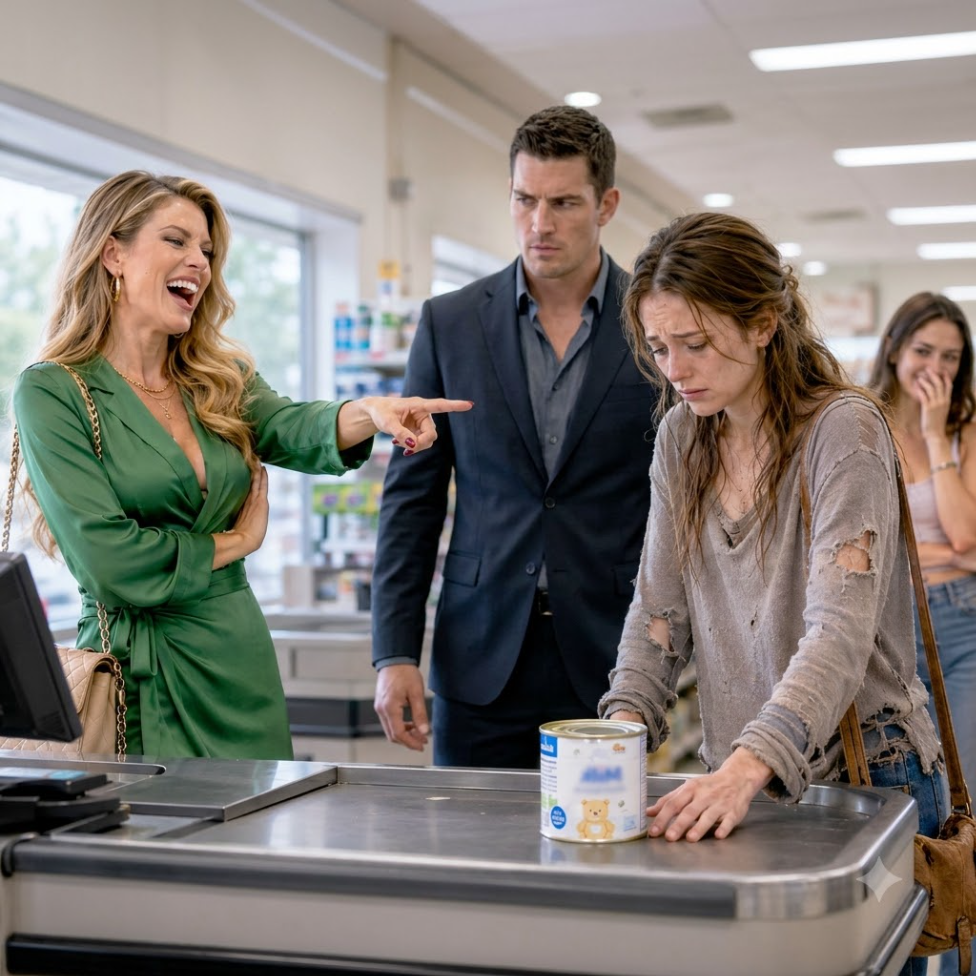
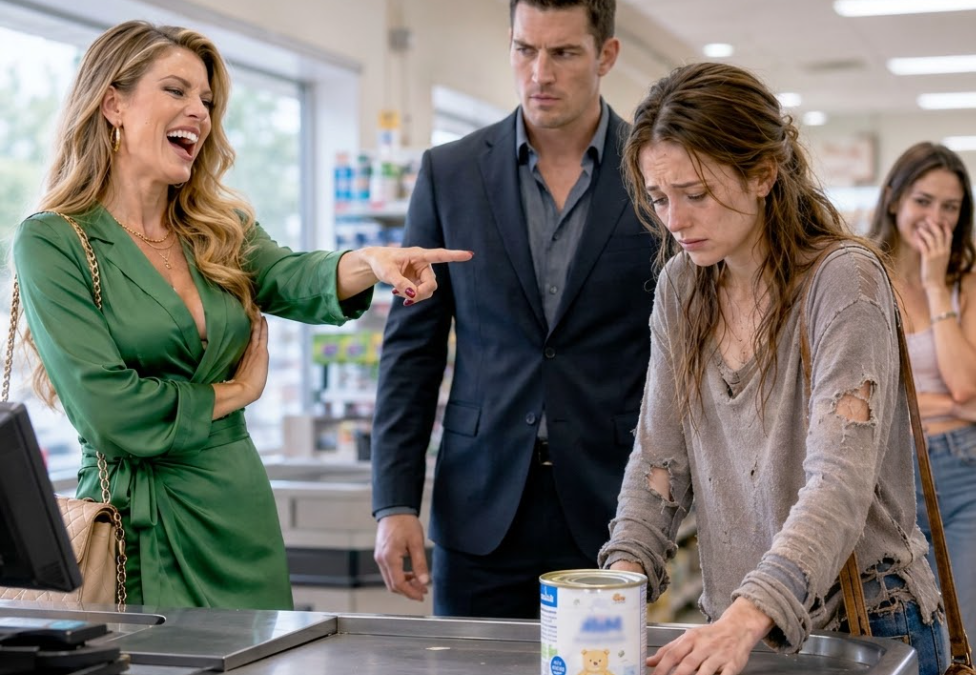
6:40 in the morning, a grocery store in Providence, Rhode Island, and the checkout line had gone quiet.
The kind of quiet that means everybody’s decided to watch.
Hannah Sullivan was 27 years old, and she had $41. 20 counted out in her palm.
She’d counted it three times in the parking lot before she came in.
The can of formula on the belt cost $52. 99.
It was the only kind her daughter could keep down, and the last can at home had run out the night before. Her card had already been declined once.
The cashier read the price out loud a second time, louder than she needed to sighed. The woman waiting behind her in a camel coat worth more than Hannah made in a month.
Didn’t bother lowering her voice.
If you can’t feed them, don’t have them, she said.
Can’t even cover one can of milk.
What kind of mother are you? Somebody laughed.
Hannah didn’t argue.
She didn’t explain.
She just pushed the can back across the counter, closed her hand around her money, and walked out with her head down and nothing in her arms. What nobody in that line noticed was the man standing at the coffee counter at the back of the store.
Dark coat, no hurry, no expression at all. Everybody on Federal Hill knew exactly who Nikico Ferrante was.
Everybody except the woman who just walked past him.
He didn’t raise his voice.
He didn’t say a word to anyone.
But what he did in the next 90 seconds shut that whole store up. and not one person standing in that line ever forgot it.
The glass door closed behind Hannah with a faint hiss, and in the silence that lingered, the man standing at the coffee counter at the far end of the store set down his paper cup.
He hadn’t taken a single sip.
He simply put it down, folded the newspaper in his hands, and stepped out of the shadows cast by the rows of shelves.
He didn’t walk quickly.
The supermarket floor was old, and each step of his shoes struck it with a slow, steady sound that made several people in line turn their heads without understanding why they had done so. He passed the woman in the camel colored coat. She moved back half a step on instinct, the way people stepped back when a truck came too close to the curb.
He didn’t look at her.
He stopped at the checkout counter where the young woman in the apron was still holding the can of milk, not yet having placed it in the basket for returned items. She looked up. The name tag on her chest read Kayla.
She was 23 years old.
And for the next 3 seconds, she realized she wasn’t breathing.
The man pointed to the can in her hand. His voice was deep, just loud enough for everyone in line to hear, and not one degree louder than it needed to be. How many more cans of that are on the shelf?
Kayla stammered that there were nine. Perhaps nine. And in the stock room, he asked.
She turned her head, searching for the manager as though she were searching for something that could keep her afloat. The morning shift manager, a heavy set middle-aged man standing about 13 ft away, hurried over with an inventory clipboard still in his hand.
He said there were probably three cases left in the stock room. Sir, six cans to a case, but he would check again to make certain. The man gave a single nod.
I’ll take everything.
Those three words fell into the middle of the store like a stone dropping onto still water.
The woman in the camel-colored coat stepped forward, her voice sharp as she complained that she had been standing there first, and that he couldn’t simply clear out an entire item that way.
She spat out her name, Crane, a name half the Providence waterfront read on its signs every day. The man turned his head and looked at her for the first time with an icy silence that cut her short.
“You were too busy mocking a mother to open your wallet,” he said calmly.
Someone in the line drew in a breath. The woman in the camel-colored coat opened her mouth, then closed it again. Blood rushed into her cheeks, leaving two uneven patches of red.
She dropped her shopping basket onto the floor and walked straight toward the door, her heels striking the tiles in quick, angry beats, and no one in the store watched her leave. The man turned back toward the counter. The manager was signaling for two stock clerks to run into the back.
Kayla remained where she was, both hands gripping the edge of the counter, and she understood what was about to happen to her. She had worked there for 11 months. She knew exactly what the manager would say the moment this man walked out the door.
She had seen it happen to two other people.
But the man didn’t look at her with blame in his eyes.
He spoke to the manager, and this time his voice was lower, just loud enough for the three people nearest the counter to hear.
Don’t fire her.
The manager blinked, unsure whether he had heard correctly. The man placed a black card on the counter and spoke his final words in that store. Every month, she will personally deliver that amount of milk to the doorstep of the mother who just walked out.
Set up a recurring order.
I’ll pay for 12 months in advance.
The manager nodded rapidly and said, “Yes, sir.
They would take care of it, sir.”
And asked whether the receipt should be made out to a company or to him personally.
The man didn’t answer.
He picked up the card, turned, and walked toward the door. Near the exit, a broad-shouldered man in a dark coat was already waiting, his hands in his pockets and his eyes fixed on the parking lot.
His name was Vinfalco, and he had been standing there from the very beginning without anyone noticing him. As he passed, the man said only one thing to him without turning his head or slowing his stride.
Find out where she lives. Vin nodded, took out his phone, and followed three paces behind. The glass door opened, then closed again, and the entire store remained still, as though someone had just turned off the sound of the morning.
The manager was the first to move. He turned and urged the two stock clerks to bring the cases out faster.
The line began to stir again. Someone coughed. The barcode scanner gave a sharp beep, but Kayla stayed exactly where she was, the can of milk still in her hand, cold and heavy, with the picture of a smiling toddler printed on its paper label.
She stared through the glass doors and out across the empty parking lot toward the place where the 27-year-old woman had long since disappeared. She stood that way for a very long time. Then she set the can of milk down very gently as though she were afraid of breaking something inside it.
Hannah walked 20 minutes home because the bus fair was $1. 50 each way and $3 was more than onetenth of all the money she had left.
The attic apartment was above a laundromat on Atwells Avenue with a low ceiling and wooden floors that warmed whenever the dryers downstairs were running, and that was the only reason she could endure the winters there.
She didn’t go straight upstairs.
She stopped at the door of the ground floor apartment and knocked three times, just as she did every morning. Pearl Donnelly, 74 years old, opened the door with a wooden spoon still in her hand. and behind her, sitting on the playmat, was a 14-month-old girl with brown hair tied crookedly to one side.
The little girl looked up, babbled, “Mommy!”
then toddled over and wrapped her arms around Hannah’s leg.
Pearl looked at Hannah’s empty hands.
She didn’t ask.
She only said the little girl had been very good, had eaten all her mashed banana, and if Hannah needed her to, she could leave the child downstairs again that evening. Hannah thanked her in an ordinary voice, then picked Lily up and carried her back upstairs.
In the attic, she set Lily on the bed, opened the kitchen cupboard, and took out the old can. She had known since the night before how much was left inside, but she still tilted it toward the light to look again.
Enough for about three level scoops.
According to the instructions printed on the label, each of Lily’s feedings required one full scoop mixed with two flu ounces of warm water, and she needed four feedings a day.
Hannah measured out half a scoop. She leveled it with the back of a knife slowly and carefully, then poured it into the bottle and shook it.
The liquid inside was paler than usual, a cloudy white with the faintest bluish cast. She handed it to Lily and sat on the edge of the bed, watching her drink.
Lily finished it, handed back the empty bottle, then asked, “Is there any more, Mommy?”
Hannah told her there would be later and that she should play for now. She opened a drawer, took out a hardcover notebook, found the line for that day, and wrote in blue ink. 7:15, half a scoop, finished it all, no vomiting.
The next column was for weight, 24. 7 lb. 3 weeks earlier, it had also been 24.
7 lb.
The pediatrician at the community clinic had told her to record everything because for a child who couldn’t tolerate cow’s milk protein, every 3 1/2 o was evidence of something.
She closed the notebook and placed it on the table. There were three things on that table.
The first was a stack of customers clothes awaiting alterations. 11 pieces she had taken from the laundromat downstairs for $4 a piece. All of them due before Friday morning.
The second was an opened envelope containing a letter from the insurance company. The third such letter in 10 months bearing the same sentence she had now memorized. The nutritional product made from amino acids was not classified as a covered prescription medication.
The appeal had been denied and the customer had the right to file a further appeal within 60 days. The third was a long sheet of paper covered in dense print sent by a lending company on Elmwood Avenue and it was the thing she had avoided looking at for 3 days. Notice of foreclosure collateral the workshop and Pier 9 Allens Avenue District Providence owner of record Daniel Sullivan and beneath that heir Hannah Sullivan.
The original loan had been $19,000, signed by Dany four years earlier so he could buy a used industrial pipe welding machine and replace the workshop’s entire electrical system.
She had once known that exact amount by heart, but the figure on the final line of the notice was $34,600.
And above it ran a long column of abbreviated charges she didn’t fully understand.
𝑵𝑬𝑿𝑻 𝑷𝑨𝑹𝑻
property reassessment fee, service fee, late payment processing fee, interest on penalties. She read it a second time, then a third. She took out a calculator and tried to work out the interest.
Arrived at one number, then subtracted it from the total, and what remained unexplained was nearly $9,000. Pier 9 was the only legacy Dany had left for their daughter.
a promise of a future he had poured his life into, and selling it was the one line she refused to cross, no matter how desperate things became. She sat motionless for a long while with the calculator in her hand. Outside the window, traffic moved along Atwells Avenue, and beneath the floor, the dryers turned with a low, steady hum, Lily sat on the blanket, playing with small, soft blocks, and every time they tumbled over, she giggled.
Hannah folded the notice, slipped it between the pages of the feeding log, then pulled the stack of clothes toward her.
She switched on the desk lamp, threaded her needle, and began with the first pair of dress pants, hemming them by hand because her sewing machine was loud and the little girl couldn’t sleep when it was running.
11 pieces at $4 a piece came to $44. Added to the $41.
20 in her pocket, it still wasn’t enough.
She did the arithmetic in her head without looking at the paper and she knew the answer wasn’t enough and still she kept sewing close to 10 that night.
She carried Lily downstairs to Pearl’s apartment, then went back up and continued working until 3:00 in the morning before turning off the light.
She opened the can of formula once more, tilted it toward the light, and measured out the portion for the following morning. Exactly one and a half scoops remained.
She put the lid back on, set the can on the shelf, and turned out the light. 3 hours after the incident at the supermarket that morning, Vinfalco placed a sheet of paper on the desk in front of Nico Ferrante.
It listed an address on Atwells Avenue, the landlord’s name, the name of the laundromat on the ground floor, and three final lines Vin had underlined in pencil.
Hannah Sullivan, 27 years old, widowed. husband Daniel Sullivan, a welder, died 14 months earlier at Pier 9 in the Allens Avenue District and alone currently in foreclosure proceedings with a lending company on Elmwood Avenue. Nico read the entire page without saying a word, then stood and reached for his coat.
The lending company’s office occupied the second floor of an old brick building with gold lettering pasted across the glass door.
Inside were only three desks and a water cooler. The man seated at the desk farthest back was Roger Pel, the branch manager, and he recognized Nico the moment he walked through the door. He rose more quickly than necessary.
Nico pulled out a chair and sat down without waiting to be invited. He said he wanted to see the Sullivan file.
Roger Pel smiled and said customer records were private information, that the company had rules, and that he would very much like to help, but he truly couldn’t.
Nico didn’t answer with a single word.
He simply sat still, both hands resting on his knees, and looked at him. 15 seconds passed. Roger Pel turned to his computer, tapped several keys, then stood, walked to the filing cabinet, and pulled out a thick folder.
Nico went through it one page at a time.
He read slowly, his finger tracing the column of figures on the right, and he didn’t skip a single line.
The original loan had been $19,000 signed in March 4 years earlier with a 7-year term and an interest rate of 11. 4%. 31 payments had been made on time.
Then, in the 32nd month, the ink changed color and new charges began to appear. His finger stopped halfway down the page. She was 11 days late on a payment of $312.
He said, “You charged her a penalty of $850.”
Roger Pel cleared his throat and said it was a late payment processing fee under the schedule of charges included in the signed contract, that the customer had signed the addendum, and that everything was legal. Nico turned to the next page.
He continued reading, his voice unchanged. Property reassessment fee, $1,200, September 22nd. Then another $1,200 on November 19th.
The same property 8 weeks apart. Roger Pel said waterfront real estate changed rapidly and had to be reassessed frequently. Nico asked who had performed the assessments.
Roger Pel searched through the paperwork, then gave the name of an appraisal company in Warwick. Nico nodded once slowly like a man who had just heard exactly what he had been waiting for. He closed the file, drew a thick envelope from inside his coat, and placed it on the desk, $34,600.
Roger Pel looked at the envelope, then at Nico, and said he wasn’t certain their procedures permitted a cash payment of that size, that a transaction report would have to be filed, and that perhaps a bank transfer would be more appropriate.
Nico told him to file the
report. Then he said he wanted three things before he left that room.
A receipt stating that the loan had been paid in full, a written cancellation of the foreclosure proceedings, and a lean release filed with the city records office that day, not the next. Roger Pel called in his secretary.
During the next 20 minutes, the printer ran three times. Stamps came down four times, and Nico read every page before folding it and slipping it into the inside pocket of his coat. When everything was finished, Roger Pel exhaled, loosened his tie, and said in a much more agreeable voice that he had actually felt sorry for the woman, but his job had forced him to do what he had done.
Nico stood. He fastened the button of his coat again, then spoke his final words in that room without raising his voice or leaning forward.
“If I ever hear that you’ve added one more fraudulent dollar to the account of someone working to support a child, you won’t have any accounts left to add it to.”
Roger Pel didn’t answer.
Nico turned and walked away, but when he reached the door, he stopped. On the wall to the left behind the water cooler hung a large map, the kind of multicolored harbor planning map that showed the parcels of land along the Providence River in different shades.
Nico stepped closer. He studied it for a long while.
Most of the western waterfront from the Point Street Bridge down to the old power plant had been shaded the same gray blue one unbroken block running along the water’s edge with a handwritten note in the margin.
In the middle of that colored block, almost precisely where the river was deepest, one small parcel had been left white, unshaded, unmarked. On that white space, someone had written two words in pencil.
Pier 9. Nico stared at that blank parcel longer than he had looked at the entire file.
Then he turned to Roger Pel, who was still standing beside his desk, and asked where the map had come from. Roger Pel said someone had sent it over about a year earlier and told them to hang it there for easy reference. Nico asked who had sent it.
Roger Pel said he couldn’t remember.
Nico nodded, then walked out the door and down the stairs. When he reached the sidewalk, he stood for a moment in the cold, looking toward the end of the street where a strip of gray water could be seen between two rows of warehouses. Then he opened the car door and got in.
The following afternoon, Hannah was finishing the last alteration when she heard a knock at the door. She opened it and found two people standing at the top of the narrow staircase.
The person in front was a young woman wearing a supermarket uniform jacket. Both arms wrapped around a cardboard box so large that she had to tilt her head to one side just to see where she was going. Her face flushed from carrying the heavy load up three flights of stairs.
Hannah recognized her at once. Kayla recognized Hannah, too, and her eyes immediately dropped to the floor. Three more boxes were stacked at the foot of the stairs.
The second person stood behind her carrying nothing, dressed in a dark coat, and Hannah had never seen him before in her life. He gave his name, Niko Ferrante.
Hannah didn’t invite either of them inside.
She stood blocking the doorway, one hand still gripping the door knob, and looked down at the four boxes. The name of the formula was printed on their sides, the same lettering, the same shade of blue she had been looking at on those paper labels for over a year.
She understood immediately what was happening, and she felt hot blood rush into her face.
If you’ve brought pity with you, take it back.
Kayla drew in her shoulders and retreated half a step down the stairs.
Nico didn’t move.
I don’t give charity, Miss Sullivan.
I invest.
Then he drew a folded packet of papers from inside his coat, reached it over Kayla’s head, and kept his hand there until Hannah took it.
She opened it.
It was a printed contract, three pages long, bearing the letterhead of a transportation company, and the name of the Providence Dock Workers Union, 200 uniform jackets, fleece lined canvas, handfinish at the collar and cuffs, with each worker’s identification number embroidered over the left breast, delivery in five installments of 40 jackets each.
She ran her eyes down to the unit price and stopped.
The figure written there wasn’t the figure of a man offering charity, nor was it a figure intended to humiliate her.
It was exactly the market rate she had once quoted to a garment workshop in Cranston 2 years earlier, only to be told that her price was too high. Beneath it was another line written by hand.
Payment every Friday, no percentage withheld. Hannah read all three pages.
She read them more carefully than necessary because she was searching for the trap.
Then she looked up and said she didn’t have an industrial sewing machine.
Hers was a household machine, and sewing 200 canvas jackets would destroy it within a month. Nico told her to write down the model she needed and give it to Vin.
It would be included as an equipment expense under the contract, he said, and it would belong to her when the contract ended. Hannah fell silent.
She knew she should ask more questions. She should ask why. She should ask why a stranger was standing at the top of her staircase with four boxes of formula and a contract that would provide enough work to support her for three months.
But she didn’t ask because she had known the answer from the moment she saw those boxes and because asking would mean having to hear someone speak about what had happened that morning and she didn’t want to hear it.
She was opening her mouth to say something when she felt a small movement behind her legs. Lily had crawled down from the bed and toddled over.
She clung to her mother’s pant leg, leaned to one side, and peered up at the two strangers outside the door with wide, unblinking eyes.
Kayla smiled at her instinctively.
The little girl didn’t smile back.
She retreated completely behind Hannah’s leg until only half her face remained visible.
Nico looked down. Then he did something neither Hannah nor Kayla expected. He set the remaining papers on the stair.
He pulled off his right glove and slipped it into his coat pocket.
Then he rested one hand on his knee and slowly lowered himself into a crouch, sinking farther and farther until his eyes were level with the child’s.
He didn’t hold out his hand.
He didn’t say anything.
He simply stayed there on the wooden stair, silent, and waited. The staircase was dark and narrow, and the dryers downstairs continued their steady turning.
Lily looked at him.
She studied him for a long time with the kind of gaze that only a child could hold directly on another person’s face.
Then she edged half a step out from behind her mother’s leg.
She pointed at the nearest box, then at the picture of the baby printed on its side and said one word, “Milk.”
Nico nodded once, only once, and Lily smiled. She smiled at a stranger standing outside her own front door.
For the first time in 14 months, Hannah went completely still. She could hear every breath leaving her own body. Something inside her chest gave way with barely a sound, and she had to turn her face aside for a moment so no one would see.
When she looked back, Nico had already risen, pulled on his glove, and began retreating down the stairs. The first installment is 40 jackets. They are due in 3 weeks.
He told her Kayla would deliver the formula on the 15th of every month. That the order had already been arranged for 12 months, and that it had nothing to do with the contract. Whether Hannah accepted the work or not, the formula would still come.
Then he turned and walked downstairs. Kayla carried the remaining three boxes up, set them against the wall, murmured a quiet goodbye, and hurried after him. Hannah stood in the doorway until the sound of their footsteps had completely faded into the street below.
Then she bent down, lifted her daughter into her arms, and carried the contract inside. She signed the contract the following morning.
She signed it at the corner of the table beside the feeding log, and she wrote the date with the same blue ballpoint pen she used to record her daughter’s weight.
4 days later, two men from the transportation company carried an industrial sewing machine up to the attic, the kind mounted on its own table and powerful enough to handle heavy canvas and placed it where she directed, beside the window. Hannah threaded it, pressed the pedal to test it, and the machine burst into a long, crisp clatter before falling silent. She remained still for several seconds after the sound ended.
It had been 14 months since she had heard that sound in her home. From that day forward, the attic above the laundromat moved to a different rhythm.
She cut fabric in the morning while Lily was still asleep, sewed from 9:00 until noon, went downstairs to Pearl’s apartment to collect her daughter, fed her, recorded everything in the notebook, then returned to the machine, and kept sewing until evening.
She still measured out only half a scoop for the first 3 days out of habit until Pearl saw her and asked what she was still trying to save it for. On the first Friday morning, an envelope was pushed beneath the door. Inside was her payment, exactly as the contract specified, not a dollar short, not a dollar over, and with no note enclosed.
She picked it up and sat on the edge of the bed for a very long time. She finished the first shipment four days ahead of schedule. Nico came to collect it.
He didn’t go up to the attic.
He stood at the foot of the stairs while Vin carried the boxes of jackets out to the car, and he held one jacket beneath the hallway light to inspect the stitching around the cuff.
“This will do,” he said.
Then he asked a question that had nothing to do with the jackets.
He asked whether anyone had recently approached her about buying her husband’s workshop.
Hannah was slightly startled because she had never mentioned the workshop to anyone. She said yes. About 3 weeks earlier, two men had come to Pier 9 wearing reflective vests and plastic identification cards around their necks.
They had introduced themselves as city inspectors. They said the structure beneath the workshop pier showed signs of decay and that unless it was repaired, the city might issue an order prohibiting its use.
Then, in very courteous voices, they had told her that if she was considering selling it to another party, she would be better off doing so before the inspection report was issued, because the property’s value would fall afterward.
Nico asked what time they had come. Hannah had to think for a moment. She said it had already been dark, probably around 7:00, because she remembered having to switch on the flashlight on her phone to read the identification cards around their necks.
She added that the cards had looked perfectly ordinary with photographs and official seals, but she couldn’t remember the names.
Nico set the jacket back on the box.
City inspectors don’t work at night, Miss Sullivan.
Hannah looked at him.
I don’t understand.
He didn’t explain further.
He only told her to lock both doors, the one downstairs and the one upstairs, and not to go to the pier alone after dark. Then he handed her a slip of paper with a telephone number written on it.
He said that if anyone came at any hour, she was to call that number before calling anyone else. Hannah took the paper. She was about to tell him that she could take care of herself, that she had been taking care of herself for 14 months, but she saw the expression on his face and swallowed the words.
She folded the paper and slipped it into her coat pocket. After he was gone, she went upstairs, locked the door, and checked the latch on the window. She felt foolish for doing it, but she did it anyway.
Down on the street, Nico climbed into the back seat. Vin closed the trunk, got into the front, and asked no questions. Nico switched on the reading light overhead, opened his briefcase, and took out the file Vin had assembled over the past 3 days on everything connected to Pier 9.
He turned to the final section containing permit applications and public records from the city government, and began reading from the bottom upward, as he always did. He stopped at a page where two entries appeared close together.
The first was a copy of a death certificate.
Daniel Sullivan, workplace accident at Pier 9 in the Allens Avenue District, fell from scaffolding at the W’s Edge, pronounced dead at the scene at 7:40 in the evening.
The date listed was a Thursday. The second entry appeared nine pages away in the records of the Rhode Island Department of Environmental Management.
Under application intake, a waterfront development company had submitted an application for a permit to dredge a deep water channel along the entire western shoreline from the Point Street Bridge southward. The application had been stamped as received at 8:41 on the following Monday morning.
Nico read both entries a second time. Then he raised one finger and calculated. From the night those photos were taken to Monday morning was less than a week.
Preparing a dredging application usually took between four and six weeks with depth charts, sediment surveys, and supporting technical opinions.
That application had already been sitting on someone’s desk.
It had only been waiting to be filed. Nico switched off the reading light.
He sat in the darkness of the back seat as the car traveled along Atwells Avenue, and he didn’t say a word for the entire drive home.
On the 15th, Kayla came.
She stood at the top of the stairs with the box of formula in her arms and stared at the stretch of wall to Hannah’s left throughout the entire exchange.
She said this was the delivery for the month and asked Hannah to sign for it. Hannah signed. Kayla set the box down, hesitated for half a second as though she meant to say something, then said she would be back next month and hurried downstairs faster than necessary.
Hannah stood there listening to her footsteps to send all three flights.
That afternoon, she asked Pearl to watch Lily, then took a bus down to the Allen’s Avenue District.
She had put this off for 14 months, but the debt had now been paid in full.
The lean release was lying in a drawer, and the workshop belonged to her, truly belonged to her, and she couldn’t leave it locked forever.
Pier 9 stood at the end of a row of warehouses, clad in blue corrugated metal that had faded with age, with a manually operated rolling door. The padlock was so badly rusted that she had to turn the key three times before it caught.
She pulled the door open and the smell inside rushed out at her. The smell of cold iron, machine oil, and dust. The daylight from the doorway reached only partway in.
Everything beyond it remained dark. She flipped the circuit breaker. The high bay lamps flickered several times, then came on.
Everything was exactly as it had been that Thursday afternoon.
No one had ever come inside to clean because she was the only person authorized to enter, and she hadn’t had the strength.
She walked slowly down the center aisle. Then she stopped.
Dany<unky’s welding gloves were still hanging from the nail driven into the iron column beside the workbench, one tucked inside the other.
The leather hardened with time, the right thumb rubbed pale because he had always used it to brush away slag. She stood looking at them for a very long time without going closer, without touching them. Then she turned away and continued toward the back of the workshop.
She was opening a drawer in the workbench when she heard a car stop outside. Two men walked in. The older one wore a wool coat and no gloves, and he introduced himself as a project development representative for Crane Harbor Group.
The other man was younger and stood one step behind him.
He didn’t speak from beginning to end, and his eyes traveled once around the workshop before settling on her.
The older man said he was very sorry about what had happened to her husband. Then he got down to business.
The company was assembling waterfront parcels for a marina development and Pier 9 fell within the project boundary. He offered $90,000 in cash with closing in 30 days and all transfer costs paid by the buyer. Hannah asked how much waterfront property in the area was worth per square foot.
The older man smiled and said, “The market always offered many ways to value a property, but for a building in this condition, one that could be declared unsafe for use by the city at any moment, $90,000 was a generous figure.
” Hannah said she wasn’t selling.
The older man nodded thoughtfully, showing no surprise, and told her to take some time to think about it. He would contact her again in 2 weeks.
Then he looked around the workshop, up at the high bay lamps and out toward the rolling door, and he spoke his final sentence in the voice of a man expressing genuine concern.
“This isn’t a safe place for a woman alone, Miss Sullivan.”
Hannah didn’t answer.
She remained where she was until both men had reached their car, until the engine started, and the sound of tires grinding across the gravel had faded completely at the end of the road. Only then did she realize her hands were trembling. She sat for a while on the chair beside the workbench.
When she stood again, she was about to switch off the lights and leave when she remembered she still hadn’t collected what she had come there to retrieve.
The old safe stood in the farthest corner behind a sheet of plywood, a waist high upright safe Dany had bought from a bankrupt shipyard. She pulled the plywood aside and stopped short. The safe door was slightly a jar.
It wasn’t locked.
She stood motionless for several seconds before reaching out and pulling it all the way open. The papers inside had been ransacked. The files Dany had once fastened and arranged upright in careful order now lay scattered everywhere.
Some had been torn open, and loose pages had fallen to the bottom of the safe, but the emergency cash envelope he had always kept on the top shelf was still there. All $900 of it.
She counted the bills with her fingers, and the full 900 remained.
His mother’s old wedding ring was still in the velvet box in the corner.
The watch was still there. Nothing was missing.
Someone had opened this safe, searched through every document inside, and hadn’t taken a single scent.
Hannah stood before the open safe in the middle of the empty workshop. And for the first time since that morning at the supermarket, she felt afraid in an entirely different way. She reached into her coat pocket for the slip of paper with the telephone number and realized she had left it at home.
That evening, Lily stayed downstairs with Pearl because Pearl had promised to let her watch the entire animated movie about the school of fish, and because Hannah needed one quiet evening to finish cutting 40 jacket panels for the second shipment.
But after cutting 20 of them, she remembered that her measuring tools and the large shears for cutting canvas were still in the toolbox at the workshop, and she didn’t want to lose another half day traveling back and forth tomorrow.
She looked at the clock, 9:20. She slipped the piece of paper with the telephone number into her coat pocket, remembering it this time, went downstairs, and caught a cab.
The cab dropped her at the beginning of Allen’s Avenue, she walked the rest of the way along the row of warehouses, and the moment she rounded the final corner, she stopped.
The rolling door at Pier 9 had been raised about 3 ft. Inside, a flashlight beam swept from side to side. She stood motionless.
Then she continued forward slowly, staying close to the corrugated metal wall, until she could hear voices. Two men, one voice said to hurry.
The other asked which cabinet, the metal one or the wooden one, and the first said both. Take out all the large drawings, especially the ones with red seals. The original survey was in there.
Then came the sound of metal scraping across concrete. A drawer was yanked out and thrown to the floor.
And then there was another sound, steady and continuous, like water being poured.
Except it wasn’t water, because at that same moment, the smell reached her, the sharp, sweet smell of oil.
Hannah took one step backward. She heard a plastic bottle being squeezed. The impatient voice told the other man to pour it only around the bases of the columns, evenly around all four, and not to spill it across the middle.
She turned and began moving back along the wall. She had taken four steps when her foot struck an iron bar lying on the ground. The clang rang out with terrible clarity in the night.
Everything inside went silent. Then she heard footsteps running toward the door.
Hannah ran. She raced around the back of the warehouse toward the small steel door Dany had always used to reach the pier, the only door with a bolt on the inside.
She pulled it open, rushed through, slammed it shut, and dropped the horizontal bolt into place. She heard footsteps following her around the building. She backed away until her shoulders struck the cold concrete wall, then pulled out her phone.
Her hands were trembling so badly that she entered the number incorrectly twice. Someone outside grabbed the handle and jerked it.
Then came a kick. The steel door shuttered in its frame, and dust fell onto her shoulders. She entered the number a third time correctly and pressed the phone to her ear.
It rang once, then again. Outside, someone kicked the door a second time, harder. Then the call was answered.
No one said hello.
A man’s voice only asked where she was.
Hannah said pier 9 that there were people inside the workshop and they were pouring oil. The voice asked where she was inside the building.
She said she was at the back door and had bolted it from within. The voice told her not to open it, not to say anything else and not to end the call. She sank to the floor with her back still against the wall, holding the phone tightly to her ear, listening to the sound of her own breathing echo from the concrete.
Outside, the kicking stopped. She heard footsteps circling away and someone murmuring something too quietly for her to understand. Then silence.
Hannah didn’t know whether that silence was good or bad.
Time passed in a way she couldn’t measure.
It might have been 3 minutes. It might have been 10.
Then the sound of engines came from the far end of the road. Not one car, but two, followed by the hard crunch of brakes on gravel.
Car doors slammed. Two, three. Then came the sound of footsteps.
Several men running toward the rolling door. Someone shouted a single short word. The footsteps changed direction and scattered.
Shoes pounding across concrete, followed by the deafening crash of something metal striking the ground. A dull impact. then another.
Someone fell and a man said, “That’s enough.”
in a perfectly calm voice. After that came silence, a long silence. Hannah remained exactly where she was.
The phone still pressed to her ear, and no one on the line said a word. Then someone knocked on the steel door behind her three times, slowly and distinctly.
A man’s voice outside said, “It’s over, Miss Sullivan.
You can open the door now.”
She recognized Vinfalo<unk’s voice.
She rose, pulled back the bolt, and stepped out into the night. The headlights of the cars shone across the yard, cutting through the mist rising from the river.
Nico’s car was parked farthest out.
He walked toward her from the rolling door with an empty plastic bottle in his hand, then passed it to Vin without looking at it. He stopped in front of her.
Hannah meant to thank him, but something else came out instead, and her voice trembled so badly that she had to repeat herself before the words could be heard. I thought you only bought formula.
Nico looked at her.
I didn’t buy anything, he said.
I gave back what someone took from you.
At 9:00 the next morning, Nico arrived at the coffee shop on the corner of Atwells Avenue where Hannah had asked him to meet because she didn’t want to discuss this at home.
Pearl was upstairs looking after Lily. He spread a large zoning map across the table and turned it toward her. Hannah looked down and immediately recognized the western shoreline because she had walked its length a hundred times.
Nico placed one finger on the gray blue strip that ran along the W’s edge.
He asked if she knew who owned this land now.
Hannah said she didn’t.
She only knew that the old warehouses had gradually closed one after another. Nico told her that every one of these parcels had been acquired by a single company over the past four years, piece by piece, through several different legal entities, so no one would recognize the shape of the hole.
He told her the company’s name, Crane Harbor Group, and saw her shoulders stiffen.
She said the man who had come to the workshop yesterday had used that name, too. Nico nodded. Then he placed his finger on the white square in the middle of the colored block.
This is yours. Hannah stared at the white square for quite a while.
It’s so small.
Yes, it is.
And that’s exactly why it’s so valuable, he explained it briefly and without evasion.
The project they intended to build was a deep water marina with a publicly announced investment of $400 million along with a hotel and a commercial district.
What gave a marina its value wasn’t the land, but the depth of the water.
Large yachts needed a channel deep enough to enter and leave, even at low tide.
Along that entire stretch of shoreline, there was only one place where the riverbed was naturally deep enough that extensive dredging wouldn’t be necessary, and that place lay directly in front of Pier 9.
Hannah asked why they couldn’t dredge somewhere else.