They Fired This Nurse for Defying a Doctor—Then a General Arrived and Exposed the Truth (PART 3)
PART 3
Emily stood at the nursing station for a moment after the elevator closed. Then she picked up the remainder of the protein bar and finished it and went back to work.
At 7:15 p.m., Victor Haron returned to the building, not to the ER.
He came in through the administrative entrance on the building’s east side.
Emily only knew this because Terrence’s phone received a text from someone in administration.
And Terrence’s face did the thing it did when information arrived that required.
Rapid processing and he showed her the text without being asked.
Harlland’s in the building.
Admin wing third floor. His attorney and two board members.
Emily read it. She handed the phone back. What do you want to do?
Terrence asked. My job, she said, and moved to Bay 3 where a patient had been waiting 12 minutes for a wound assessment.
The next 40 minutes had the specific quality of the period before a decision arrives. Not the crisis itself, not the aftermath, but the narrow suspended interval between them where where everything continues as normal because the alternative is stopping Maddox and stopping is not a functional option in emergency department. She assessed the wound in bay 3, coordinated an orthopedic consult for a patient in bay 7, managed a pain protocol adjustment in bay 1, and documented all of it in the precise timestamped language that had become not just habit but a a kind of discipline, a practice she understood now was more important than she had originally framed it.
At 7:58, Patricia Voss appeared at the ER entrance. She had changed clothes since the morning. She had gone home at some point and come back, which meant whatever was happening on the third floor had pulled her back in, which meant it was significant enough to require the CNO present in person after hours.
She looked across the department until she found Emily. She walked over.
I need 5 minutes, she said.
They stood in the family consultation room, the same small beige room where Marsh and his personnel had been the previous night, which gave it, in Emily’s perception, a slightly layered quality, as if the room itself had absorbed the residue of consequential conversations and held it in the walls.
Voss closed the door.
“The board meeting is happening upstairs,” she said.
Two board members, legal counsel, the compliance lead and doctor Harlon. She paused and his attorney who has spent the last 4 hours preparing what amounts to a counteroffensive Emily waited.
Harlland’s attorney is arguing four things.
boss said with the compressed efficiency of someone delivering a briefing. One, that the compliance investigation was triggered by a biased complaint from a former disgruntled employee.
Two, that the web case, while unfortunate in its outcome from a process standpoint, reflects a defensible clinical judgment call rather than a pattern of reckless disregard. three, that your protocol violations last night were serious enough to constitute independent misconduct and should not be treated as mitigated by their outcome. And she paused slightly longer before the fourth.
Four, that the Army General’s presence last night constitutes improper external pressure on an internal hospital matter and that the compliance investigation has been compromised by that pressure.
Emily processed the four arguments in sequence. The first three were predictable.
She had anticipated versions of them from the moment Reyes Carver had described the motion filed by Harlland’s attorney that afternoon.
The fourth was not predictable. The fourth was not predictable.
The fourth was a move she hadn’t seen coming.
And the fact that she hadn’t seen it coming bothered her in the specific way that gaps in situational awareness always bothered her.
He’s arguing the whole process is tainted.
She said, “He’s arguing it strategically.”
Voss said, “If he can get the board to accept that the investigation was initiated under conditions of external pressure and internal conflict of interest, it creates grounds to delay or restructure the process, which buys time, which gives his legal team room to work.
Is it working?”
Voss looked at her steadily.
“One of the two board members in that room was appointed to the board 12 years ago,” she said.
on Harlland’s recommendation.
The room was quiet. What does the other board member think?
Emily asked.
The other board member, Voss said, has been reading Mo’s documentation for the past 2 hours and has not said much, but what she has said has not been favorable to the argument that this is a biased complaint from a disgruntled former employee.
Emily understood the shape of what was happening.
a room divided by two different orientations with Harlland’s attorney working the seam between them and the outcome not yet determined.
Why are you telling me this? Emily asked.
Because Harlland’s attorney has requested that you be available for questioning.
Voss kept her voice neutral. Not in a formal legal proceeding.
The board meeting is internal, but he wants to put questions to you in front of the board, about last night, about your prior relationship with General Marsh, about whether the general’s presence was coordinated in advance.
Emily looked at her.
It wasn’t coordinated, she said.
I know that Marsh came because someone at the Army liaison office heard what was happening through the notification chain and passed it up.
That’s not coordination.
That’s an That’s an institution looking after one of its people.
I know that, too. Voss paused.
Harlland’s attorney is going to try to make it look like something else.
He’s going to ask you questions that are designed to make the relationship between you and Marsh look strategic, premeditated.
She met Emily’s eyes.
I want you to be prepared for that.
Emily thought about Sandra Moe’s note.
find her.
The channel that had been opened through the army liaison contact, the way the position at Ridgemont had reached her through a sequence of connections that’s that she had not known were connected.
She thought about this for a moment with the uncomfortable clarity of someone who is doing accurate accounting and not enjoying all the numbers. If he asks me directly about how I ended up at Ridgemont, she said slowly.
And I tell the truth and the truth includes the liaison connection to Mo. It changes the picture.
Voss said, “Yes, it doesn’t change what happened last night.”
What Haron did the web case, Mo’s documentation.
No, it doesn’t.
Voss was careful, but it changes the narrative around your presence here. And narrative is what his attorney is working with right now because the evidence is not working in his favor.
Emily was quiet. The fluorescent light in the consultation room buzzed faintly.
The sound of the ER came through the wall monitors. Movement, the ambient ongoing work of the department.
Bayour’s light was probably flickering on its 12minute cycle.
Bayour’s patient was probably being seen by someone capable and careful who had no idea what that bay had seen last night.
“He’s going to ask me,” Emily said.
“He’s going to ask you,” Voss confirmed.
And if I answer truthfully, he uses the answer to argue that the whole thing was orchestrated.
That Mo engineered a situation, planted a witness, and used a general’s intervention to apply external pressure to a legitimate institutional structure.
That’s his argument.
Yes.
And if I don’t answer fully, you’re under no legal obligation in an internal board meeting.
Fenwick had said something like this that morning. she remembered no legal obligation, but there were other kinds of obligation, and the people in this room understood that she knew the difference.
Voss looked at her for a moment with an expression that was not quite sympathy and not quite solidarity, but lived in the territory between them.
“I can’t tell you what to say,” she said.
“I’m telling you what to expect.”
Emily stood up.
“What time does the board meeting reconvene?”
she asked. 8:30. She looked at the clock on the wall.
22 minutes. I need to make a phone call, she said.
She made it in the stairwell because the stairwell had the specific acoustic quality of institutional concrete that absorbed sound rather than reflecting it. And because she needed 10 minutes of privacy and the stairwell was the closest reliable version of she had access to. Marsh picked up on the second ring.
They’re going to ask me about the liaison contact, she said.
About how I got to Ridgmont.
Harlland’s attorney wants to argue it was orchestrated.
A brief silence. Was it? Marsh asked.
Not by me.
No, he said, “Not by you.
If I tell the truth, he uses it.
If I don’t tell the truth, then you’re not telling the truth.
” His voice was even, which is not something I’ve known you to do.
and I’ve known you in environments where it’s the temptation to manage the truth was considerably more acute than a board meeting.
She was quiet. Tell the truth, he said.
The complete truth, including Mo’s note, including the liaison channel, including everything you know about how you ended up in that department.
He paused because the truth does not undermine the case. The truth is that a former nurse kept records for 2 years and spent 6 months looking for a way to get them in front of a process that would use them.
That’s not a conspiracy.
That’s someone who cared enough to be patient.
Another pause.
And if Harlland’s attorney wants to stand in front of a board of directors and argue that careful, documented, patient persistence is a form of fraud, he’s welcome to make that argument.
I’d like to see it.
Emily looked at the concrete wall of the stairwell.
“You knew,” she said about Moe’s note.
The silence that followed lasted long enough to be its own kind of answer. The liaison contact who passed the information about the Ridgemont position, he said carefully did so through appropriate channels.
“Nobody compelled you to apply.
Nobody compelled Rididgemont to hire you. Nobody compelled Harland to do what he did last night.
His voice was steady. The truth is that a nurse who had been failed by every process available to her found a way to try one more time.
The truth is that it worked because the people involved were competent and honest and didn’t stop when it got hard.
He paused. Tell that truth. She exhaled.
8:30.
She said, I’ll be there, he said.
You’re still in Salt Lake City.
I’ve been in this city for 18 hours waiting to find out if you needed backup.
A pause that had something almost dry in it. Turns out you might. She looked at the clock on the stairwell wall.
18 minutes. She put the phone in her pocket. She stood in the concrete stairwell and she thought about Sandra Mo sitting alone in an adjacent room on the third floor.
63 pages on the table. 16 months of patience behind her, waiting to find out what whether the thing she had built so carefully was going to hold, or whether the man who had dismantled it once before was going to find the right lever and do it again.
She thought about Marcus Webb waking up that morning and asking for water and asking about his car. She thought about the construction worker from 14 months ago, a man she had never met whose name she did not know, who had lost permanent lung function on his left side on a night when the right call had been available and had not been made.
And she thought about the 11 other cases in Mo’s folders.
Each one a patient who had moved through this building and been failed not by medicine but but by the specific failure of a system that had protected one man’s authority at the cost of clinical truth.
She thought about Bayour, the flickering light, the blue tape, pull hard, curse freely. She thought about what Sandra Mo had written on a piece of paper 3 weeks ago and placed in a folder and waited for the right moment.
Find her. Emily straightened.
She opened the stairwell door. She went upstairs and she was three step on from the conference room when the door opened from the inside.
And Harland’s attorney, the man in the suit she had seen earlier, who had the polished, unhurried quality of someone who had won enough of these to believe.
Winning was his default stepped into the hallway with a document in his hand and looked at her with the specific expression of a man who has just been handed by someone inside the room a piece of information that has changed the shape of his strategy. He looked at the document.
He looked at Emily.
Nurse Shen, he said there’s there’s something you need to see.
He held out the document. She took it.
It was a transfer request dated 6 weeks ago submitted to the Rididgemont administrative office through the hospital’s standard interfacility transfer system.
The requesting physician was listed in the standard field. The requesting physician was Victor Harlon. The requested transfer was not of a patient.
It was a staff transfer request, a formal request to block the hire of a specific nursing candidate whose application was then pending review.
The candidate’s name in the transfer request was Emily Shen.
Harlon had known she was applying. He had tried to block her hire. The request had been processed by an administrative coordinator who had filed it incorrectly in the outgoing transfer queue rather than the incoming hire review queue.
and it had sat in the wrong folder for six weeks without being actioned. And Emily had been hired in the interim by a hiring committee that had never seen the request because it had been misfiled before it reached them. Harlon had tried to keep her out of the building.
She had gotten in anyway.
And everything that had followed, the web case, Moe’s documentation, the compliance investigation, the board meeting happening right now on the other side of that door had followed from the administrative error that had led her through a door that had been quietly, deliberately closed against her before she ever arrived.
Emily held the document.
She looked at Harlland’s attorney.
His expression had shifted from the controlled confidence of someone deploying a strategic reveal to something considerably more complicated. The expression of a man who has just the just realized that the document he was handed as a weapon has a se second edge he did not examine before he handed it over because the document did not show orchestration.
The document showed that Victor Harlon had known Emily Shen was coming and had been afraid of it. And the question that document raised, the question that was going to be in that conference room in approximately 90 seconds was not why Emily Shen had ended up at Ridgemont Trauma Center.
It was why Victor Harland had tried to make sure she didn’t.
The attorney’s hand was still extended in the space between them, suspended in the specific stillness of a man who has just watched his strategy invert itself in real time.
Emily read the document a second time, not because she had missed anything the first time, because she needed the second reading to confirm that the document said exactly what she it said, that she was not assembling meaning out of exhaustion and the accumulated pressure of the past 36 hours. It said exactly what she thought it said.
Victor Harlland had submitted a formal request to block her hire 6 weeks ago. He had known her name before she walked through the door. He had seen her application, her credentials, her military background, her three-year gap listed as federal service nonclinical, and something in that file had alarmed him enough to try to close the door before she reached it.
The question was not complicated once you held the document in your hand and let it mean what it meant. He had been afraid of what she represented before he had ever met her. not of her specifically of the category.
She belonged to people who documented carefully, who didn’t stop when told to stop, who didn’t stop when told to stop, who came from environments where the cost of ignoring clinical truth was measured in rather than institutional inconvenience.
He had seen enough of that profile over 20 years to know what it did to systems like the one he had built. and he had tried quietly and through proper bureaucratic channels to keep that profile out of his department. The administrative error that had misfiled his request had not been large.
A coordinator entering a code incorrectly. A document landing in the wrong queue. The kind of small operational failure that happens in every large institution every day.
The accumulation of minor human imperfection that most of the time produces nothing consequential.
And this this time had produced this everything that had followed from Emily’s first shift in bay four everything that was now sitting in four Manila folders on a table one room away.
She lowered the document. She looked at the attorney.
He had recovered his composure in the interval. He was too practice to let it stay gone for long, but the recovery was visible if you knew what to look for. the slight overcorrection in his posture, the way his hands had moved from relaxed to deliberately still.
Who gave you this? She asked.
It was in the compliance file, he said. Pulled with the administrative records this afternoon. And you were planning to use it as what exactly?
He chose his words with the care of someone who has just realized the footing is uncertain.
as context, he said for the board’s understanding of how this situation developed.
Emily looked at him for a moment. That document shows that doctor Harlon identified my application and tried to prevent my hire, she said.
What context does that provide that helps your client? He had no answer to that, not a usable one.
She could see him working through of all the architecture of the argument he had been building and finding that this particular stone placed where he had intended to place it did not fit the structure anymore. She walked past him and opened the conference room door.
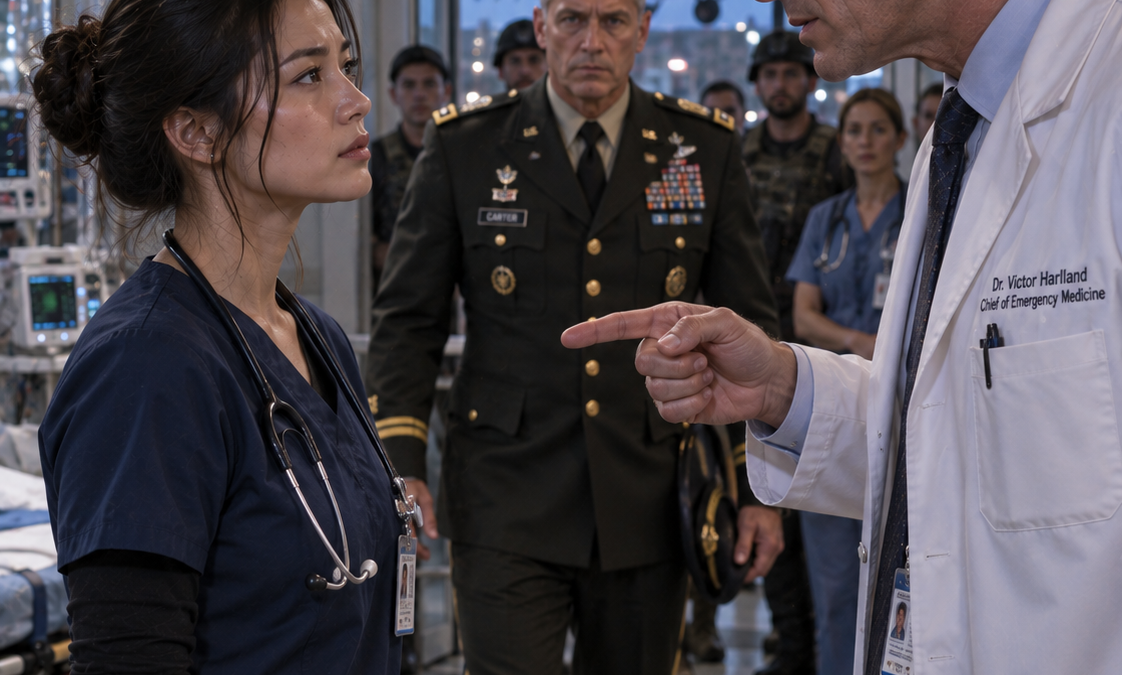
The room held six people around a rectangular table. Reyes Carver from compliance, Robert Fenwick representing hospital legal. two board members, a man in his 60s named Aldridge, who had the settled authority of someone who had occupied institutional power long enough to be shaped by it, and a woman in her 50s named Doctor.
Prianire, who had the specific alertness of someone who has been reading for 2 hours and has found the reading disturbing, and Victor Harlland, who was seated at the far end of the table with the contained posture. Emily had cataloged over the preceding night and day the posture of a man who had decided that whatever came at him he would receive upright.
Sandra Mo was not in the room. She was still in the adjacent space waiting.
General Marsh was not in the room. He was somewhere in the building.
He had said he would be there, but he was not here yet. Emily placed the transfer request document on the table in front of board member Aldridge.
This was in the compliance file, she said. I was just shown it in the hallway.
Aldridge looked at it.
His expression moved in a direction Emily couldn’t fully read.
Nare leaned forward, read it from across the table, and sat back. The room was quiet for a moment, then Harland spoke.
“I submitted that request,” he said.
His voice was level.
“I won’t pretend otherwise.”
Aldridge looked up from the document. Victor, why?
The word sat in the room without embellishment, not a formal question, not a procedural prompt, the voice of a man who had known another man for a long time and was asking something that was partly institutional and partly personal and entirely serious. Harlland was quiet for a moment. Her file had the military background, he said.
The trauma certification, the gap in employment that read as field service. He paused.
I’ve hired nurses like that before.
They come in and they’re good.
They’re often very good and they have a way of operating that doesn’t doesn’t account for the realities of how a civilian department runs.
They push against protocols.
They don’t accept established hierarchies.
He paused again. I thought it would create friction.
You thought I’d be a problem, Emily said.
He looked at her directly. Yes, he said. It was the most honest thing he had said in her presence.
And you were right, Emily said. I was.
He absorbed that.
But the friction wasn’t the problem, she continued.
The problem was what the friction found. She kept her voice even and clinical and entirely without performance.
If the department had been running cleanly, I would have created friction and either adapted or left. The friction found something because there was something to find.
The room was quiet. Nare spoke.
Dr.Haron, the document in front of Mr.Aldridge, combined with the compliance file, combined with Moe’s documentation and Puit’s account and the two current staff statements.
She paused. What is your response to the pattern finding? Harlland looked at his hands on the table for a moment.
His attorney, who had followed Emily into the room and taken a position near the wall, made a small movement, a slight lean forward, a preparatory shift, the beginning of an intervention. Haron raised one hand slightly.
The attorney stopped.
“I need to speak without counsel for a moment,” Harlon said.
The attorney’s lean reversed itself.
Harlon looked at the table. Then he looked at Nare.
Then finally, he looked at Emily. The pattern finding is accurate.
He said the room did not explode. It did the opposite.
It’s compressed the way rooms compressed when something that has been held under under pressure for a long time is finally released and the air has to recalibrate.
Aldridge set the document down.
Harlon continued, “It’s accurate in the sense that I consistently prioritized my own clinical judgment over nursing input in ways that were not always warranted by the evidence.”
He spoke slowly, not as performance, but as someone doing the actual work of saying true things about himself that he has not previously said out loud. I believed that I had more relevant experience than the nursing staff in most situations.
I was right about that in aggregate and wrong about it in the specific cases where it mattered most. He paused. The web case the construction worker 14 months ago Mo documented incidents.
I made decisions that placed institutional hierarchy above clinical accuracy and patients were harmed by some of those decisions. The attorney near the wall had gone very still. I also, Harlon said, attempted to prevent the of a nurse whose profile I found threatening to my operational authority.
That was not a clinical decision. That was a self-protective one. He looked at Emily, and it was wrong.
Emily said nothing. She had waited a long time in her professional life for a version of this moment, not from Harland specifically, but from the structure he represented.
the long institutional hallway where the lights didn’t work and you found the wall with your hand.
She had not expected the moment when it came to feel like this. Not triumphant, not vindicated in the uncomplicated way that vindication looks in simpler stories.
Just real, heavy and real and marked by the specific texture of things that have cost something to reach. The board meeting concluded at 10:14p M.
The formal findings would take weeks to document and process through the appropriate channels, but the shape of what had been decided was visible in the room before anyone left it. Haron would resign as chief of emergency medicine, not terminated. The distinction mattered legally, and he had earned it by the honesty of the past 20 minutes, which N had noted explicitly, and Aldridge had not contradicted.
He would resign effective at the end of the administrative review period and the resignation would be accompanied by a form a formal acknowledgement of the compliance findings that would become part of the permanent institutional record.
His medical license review would proceed through the state board as a separate process with Moe’s full documentation and um the new items submitted to the board that week.
That process would not be controlled by Ridgemont, would not be managed by his attorney in a small conference room, and would move at the board’s pace regardless of what anyone in this building preferred.
The three cases from Moe’s file with the strongest evidentiary chains, including the construction worker from 14 months ago, would be formally reviewed for patient notification and potential remediation.
The hospital’s legal exposure from from those cases was significant and would be managed by Fenwick’s team over the following months.
Emily’s protocol violations from the web case would be reviewed and formally closed as justified under emergency clinical discretion provisions with a notation that the outcome supported the clinical necessity of the actions taken.
She was cleared, not celebrated. cleared, which was the accurate word for what an institution does when it acknowledges in the spec language of formal process that a person acted correctly in circumstances where the structures around them had failed.
She walked out of the conference room at 10:17 P M and stood in the hallway. Sandra Mo came out of the adjacent room.
They stood in the hallway together for a moment. The institutional corridor was empty except for them. the cleaning staff had been through earlier and left the floor with the specific scrubbed quiet of institutional spaces after hours.
Fluorescent lights running at full brightness over nothing in particular. It held, Sandra said.
It held, Emily said. Sandra looked at the closed conference room door.
Something moved through her face. Not relief. Exactly.
Because relief implies that the danger is past and she understood better than anyone that the processes now in motion would run for months and produce outcomes she couldn’t fully predict.
But something that was the emotional equivalent of setting down a weight that had been carried for a very long time and and letting your arms hang at your sides and feeling what that was like. 16 months, Emily said. 16 months and 4 days, Sandra said.
I counted. Emily looked at her at the plain gray sweater and the steady hands and the 63 pages that had waited in a file for the right moment, assembled by a woman who had been failed by every available process and had chosen instead of leaving quietly to stay in the fight from the
outside with the only tools she had left.
“You should have been protected the first time,” Emily said.
Yes, Sandra said simply, I should have. There was no apology Emily could make for the institution that had failed her.
There was no language that covered the 16 months or the career interrupted or the weight of being the person in the room who was right and could not make anyone hear it. Emily knew this.
She didn’t try to fill the space with words that wouldn’t fit.
“What happens now?”
she asked instead.
“For you.”
Sandra was quiet for a moment. I offered my position back, she said. Voss called me this afternoon.
She paused.
I haven’t decided.
That’s fair.
I don’t know if I can work in that department again, Sandra said.
I want to. I think I want to.
But wanting something and being able to do it are different things, and I’m I’m being honest with myself about that.
She looked at Emily. Is that terrible? No.
Emily said, “It’s accurate.”
Sandra made a sound that was almost a laugh.
You sound like you’ve had practice with honesty.
Specific kind of environments, Emily said. It becomes a habit.
Sandra nodded. She picked up her bag from the chair just inside the adjacent room. She looked at Emily one more time with the expression of someone completing a transaction that has taken a very long time and a great deal of cost and is now finally finished.
Thank you, she said, for not backing down. Emily watched her walk to the elevator.
She stood in the hallway alone for a moment. Then she took the stairs back down to the ER.
Marsh was in the parking lot. He was leaning against the side of a dark SUV with his hands in the pockets of his civilian coat like and the particular patience of someone who has learned to wait in difficult conditions and has found that parking lots in November are considerably less difficult than most. He looked up when Emily came through the exterior door.
It’s done, she said.
I heard. He paused. How are you?
She thought about this honestly. Tired, she said.
And something else.
I don’t have a word for it yet.
You will, he said. Give it a few days.
She stood in the cold air and let it work on her the way cold air works when you’ve been in institutional interiors for too many consecutive hours cutting and clarifying.
using everything to its actual temperature. He tried to block my hire.
She said, “I know.
And you knew he might.”
That’s why Mo wanted someone with my profile specifically because a military trained trauma nurse with strong documentation habits was the kind of person that someone like Haron would react to.
Marsh was quiet, the liaison contact.
Emily said they didn’t just pass along the job posting.
They were looking for a reason to pass it along. They were looking for the right posting to match to the right person. You applied of your own choice, Marsh said.
You were hired on your credentials.
That’s not what I asked.
He looked at her. No, he said.
It isn’t.
The parking lot was quiet.
A car moved through the far entrance and found a space near the building, and a person got out and walked quickly through the cold toward the hospital’s main entrance.
the ordinary movement of a place that processes emergencies continuously without pause regardless of what happens in in its conference rooms after hours.
You could have told me, she said, you wouldn’t have gone in the same way.
He said, you would have been managing it from the beginning, secondguessing every decision against the context of knowing why you were there. Maybe I would have been more effective. Maybe, he said, maybe not.
What happened in that department happened because you were doing your job without an agenda. Because you saw a patient who needed something and you fought for it without reference to anything except the clinical picture in front of you. He paused.
That’s why it worked.
Emily looked at the hospital building. The lights in the CR wing burned steadily at the at the ground white and unwavering.
The specific brightness of a place that does not get to turn off.
I’m not angry, she said, testing the statement as she said it.
No, I’m I don’t know what I am.
She looked at the building. The patient survived.
The documentation is in front of the right people. The process is running, she paused.
That’s what it was supposed to accomplish.
Yes, Marsh said. I just would have liked to know, she said.
That’s all.
He nodded.
He didn’t defend it further.
He was a person who understood the difference between explaining and justifying. And he had explained.
They stood in the parking lot for another minute, not because there was more to say, but because some moments and require a little time before they can be classified and filed and moved past. What are you going to do?
He asked. Go home, she said.
Sleep, she paused. Come back tomorrow.
And after that, she thought about Bay 4.
the monitor that needed recalibrating every 36 hours, the supply cart and its new drawer handle, the 12minute flicker in the overhead light that she had reported on her first shift, and that maintenance had finally replaced 2 days later, so that the bay was now lit consistently and evenly in a way it apparently hadn’t been for several months before she arrived.
small things, functional things, the kind of things that that didn’t register as significant until you understood that every small functional thing in a trauma bay was a component of the system that either worked or didn’t when it mattered.
I want to change the escalation protocol, she said.
The process for nurses to raise urgent clinical concerns when the attending isn’t acting on them.
right now it takes too long and has too many points where it can be blocked by the physician of record. She paused. I want a direct escalation path.
Nursing to charge to senior attending, bypassing the physician who’s the subject of the concern with documentation requirements that trigger automatically.
Marsh looked at her. That a policy change, he said. That requires board approval.
I know. She looked at him.
I’ll be at the next board meeting.
Something moved through his expression. Not quite a smile because it was too complicated for that, but something in the vicinity.
You’ll want that in writing before you go in, he said.
I know how to document things, she said. He pushed off the SUV.
Get some sleep, Shen. he said. He got in the vehicle and drove out of the parking lot and the tail lights disappeared around the corner of the parking structure and Emily stood in the cold for another moment by herself.
She went home. She slept 8 hours, not well, not in the smooth uninterrupted way that sleep is supposed to work, but in the fragmented and occasionally turbulent way that sleep works after the body has been through something significant and needs to process it before it can rest.
She she woke it’s 6:43 a.m.with the specific someone who has come through to the other side of something and can now see the full shape of it from a different position.
She made coffee. She sat at her kitchen table in the particular quiet of a morning that had not yet become a day. And she thought about Marcus Webb asking for water and asking about his car.
She thought about the construction worker she had never met.
She thought about Sandra Moe’s hands on the conference table steady and the 63 pages and 16 months and 4 days.
She thought about bay four before she arrived. The flickering light, the broken drawer leads, the compromised monitor leads.
And she thought about how long it had been like that before someone decided it was worth fixing. Not because it was unfixable, because it had become normal. because the people working in it had adjusted to the dysfunction and stopped in and stopped registering it as something that could be different.
That was the part that stayed with her, not Harlon. Haron was a specific person with a specific history and a specific set of choices, and those choices were now being processed by the systems that existed to process them.
He would face consequences that were real and proportionate and that she had not manufactured. She had only documented what was already true.
That was all she had ever done. The part that stayed with her was the light, the 12-minute flicker that everyone had adjusted to. The drawer handle replaced by tape because nobody had gotten around to fixing it.
The monitor leads that ran slightly slow and gave slightly unreliable readings that everyone had learned to mentally correct for. the thousand small compromises that accumulate in systems that lack people willing to say this is not acceptable and I can fix it and I am going to fix it now. She had been in environments where those compromises cost lives directly where the stakes of ignoring the flickering light were measured in the most absolute possible terms.
She had carried that knowledge into a civilian emergency department and she had applied it and people who had the authority to stop her had tried to stop her and she had not stopped. That was the thing she had done. Not heroic.
She was honest enough not to use that word for it. Just she had not stopped.
She finished her coffee. She went back to work.
3 weeks later, the state medical board formally reopened the complaint against Victor Harland.
The notification arrived in the hospital’s administrative office on a Tuesday morning.
By Tuesday afternoon, it had moved through the institutional channels that such notifications moved through. And by Tuesday evening, most of the clinical staff at Ridgemont knew that the board was taking the case seriously in a way that the original review had not. Haron had been on administrative leave since the night of the board meeting.
vac. His office had been cleaned out by a colleague under the direction of administration.
Personal items boxed and held for collection.
His name had been removed from the department’s attending schedule.
The residency program director, who was Harlland’s institutional ally and had been named in Puit’s complaint as having been aware of the retaliation pattern, was also under review.
The position of chief of emergency medicine at Ridgemont Trauma Center was posted internally pressed two weeks after the board meeting. Emily did not apply for it. She was asked by Patricia Voss directly whether she had considered it.
She said she had and had decided against it. She was a nurse.
She wanted to remain a nurse. The things she wanted to change in the department did not require her to stop being a nurse.
They required her to stay on the floor doing the work and use the standing she had earned to advocate for the changes in the rooms where those decisions were made. Voss listened to this the escalation protocol proposal.
She said, “I want it on the board agenda for next month.
I want it from you in writing with clinical justification.
You’ll have it by end of week.”
Emily said the protocol proposal took her 4 days to write, not because the content was complicated, but because she wanted it to be precise, cuz precision was the only version of anything she knew how to do. Because she had learned in conditions where imprecision had a cost that she was never willing to pay again.
She submitted it on a Friday afternoon.
Reyes Carver from compliance who had stayed involved with Ridgemont’s process beyond her initial investigation mandate read it over the weekend and sent back two notes.
One suggesting a modification to the documentation trigger language and one that simply said this is good work. The board approved it at the next meeting. It became policy effective the 1st of December.
The escalation protocol, formally titled the clinical concern escalation standard, which was the kind of institutional language that made the thing sound bureaucratic when what it actually was, was a door that had previously been locked and was now open applied to every nurse in every department at Ridgemont. It meant that when a nurse raised a clinical concern and the attending physician failed to act on it, there was a clear, documented, protected path to escalate that concern to a senior physician without fear of retaliation. It meant that the escalation itself was logged automatically, creating a record that could not be retroactively removed or reccharacterized.
It meant that the next Sandra Mo whoever she was, whatever department she worked in, whatever attending she was trying to move, had a process that would hear her before she had to leave the building. It was not a perfect system. Emily had not designed it to be perfect because she did not believe in perfect systems.
He believed in systems that were better than the ones they replaced and that had built-in mechanisms to identify and address their own failures. The protocol had review provisions at 6 and 12 months.
It had a modification process.
It would be imperfect in ways she couldn’t predict, and she would deal with those imperfections when they materialized.
That was the work. On a Thursday afternoon in December, Marcus Webb came back to the hospital, not as a patient.
He walked in through the main entrance in street clothes 6 weeks post surgery. with the slightly careful movement of someone whose body is still negotiating its recovery but is mostly back to functional. He found the ER nursing station by asking at the information desk and he found in and he found Emily at the nursing station by the same method he had apparently been using since he regained enough coherence to think about it.
She was at the board when she heard someone say her name from behind the station and she turned around and he was standing there looking somewhat better and somewhat younger than the last time she had seen him which had been on a gurnie with a blood pressure reading that she preferred not to think about. I wanted to come in
person he said my mom came a while ago I know but I wanted to he stopped.
He had the expression of someone who has rehearsed something and is now discovering that the rehearsed version doesn’t fit the actual room.
I wanted to say it myself. Emily looked at him.
You’re recovering well.
She said it was clinical and genuine and both of those things at once.
The surgeon says another month and I’m back to normal.
Mostly, he paused. The left side is going to be a little.
They said there might be some residual. He stopped again.
That’s not He took a breath and abandoned the medical framing entirely.
I know what you did. I know what it cost you to do it.
I know you got ordered out of that room and you found a way to do it anyway. Emily said nothing.
I’m not good at this.
He said, “You’re doing fine.”
She said, “I just” He looked at her with the direct, slightly unpolished quality of someone saying something true without the benefit of knowing how to make it sound better than it is.
I’m 26.
I have a lot of time left.
And the reason I have it is because you wouldn’t stop.
He paused.
I don’t know how to say that in a way that’s big enough.
You don’t have to make it big, Emily said.
You just have to go live it. He looked at her for a moment.
He nodded. He turned and walked back out through the entrance into the December afternoon into the rest of the life he had almost not had.
Emily stood at the nursing station and watched him go. Donna appeared beside her.
She had developed over the weeks since November the specific habit of materializing in Emily’s peripheral vision at moments of significance as if she had calibrated herself to the frequency.
He looks good, Donna said. He does, Emily said.
They stood together at the nursing station for a moment looking at the entrance door that had swung closed to coints. The protocol goes live next week. Donna said Monday.
I’ve already had two nurses ask me about it.
Donna paused. Good questions, specific ones, about their actual cases. She paused again.
That’s the thing about opening a door.
People were already standing behind it. Emily looked at the board. Three patients waiting.
Two in active treatment. The work ongoing as it always was, as it always would be.
Bayour’s monitor is running slow again.
Donna said, “I’ll recalibrate it before the next shift,” Emily said.
She pulled on a fresh pair of gloves. She went to bay 4. The overhead light was steady fixed weeks ago and holding.
The supply cart had its handle. The monitor leads needed recalibrating, which she did in four minutes with the focused efficiency of someone who had done it enough times to understand and exactly where the drift originated and how to correct it without the workaround that everyone before her had accepted as the permanent condition of the thing.
She checked the calibration accurate. She looked at the bay at the functional, ordinary, unglamorous workspace that had been the beginning of all of it.
The patient who had come through the door and the warnings that hadn’t been heard, and the orders that had been given, and the room that she had been removed from and returned to, in the end, on her own terms.
There was no clean lesson in it.
Real things don’t produce clean lessons.
They produce complicated ones, partial ones, ones that require ongoing revision as new information arrives. What she knew was this.
The system that had failed Sandra Mo and the construction worker and the six people named in Puit’s complaint had not failed because it was uniquely corrupt or uniquely broken.
It had failed because it had never been forced to account for itself. And it had been forced finally, not by a hero or a crusade or a dramatic singular act, but by a nurse who had walked into Bay 4 on a Tuesday morning and fixed the drawer handle and recalibrated the monitor leads. And then when a patient arrived who needed someone to keep paying attention, had paid attention without stopping.
That was the whole of it. That was enough. She stepped out of bay 4.
She went to work and the emergency department moved around her with the continuous unscentimental necessary rhythm of a place that did not stop for anyone that processed its crises and its recoveries and its small daily victories and its failures and its beginning of gains with the same unwavering operational pulse.
Shift after shift, year after year, the rhythm of a system that worked better than it had last month and would be asked to work better still next month by the inside it who had decided that better was not a destination but a direction and that the direction was worth holding even when the hallway was dark and the walls were the only thing you had to find your mway.
—END—

