“It’s what he does when nobody’s watching
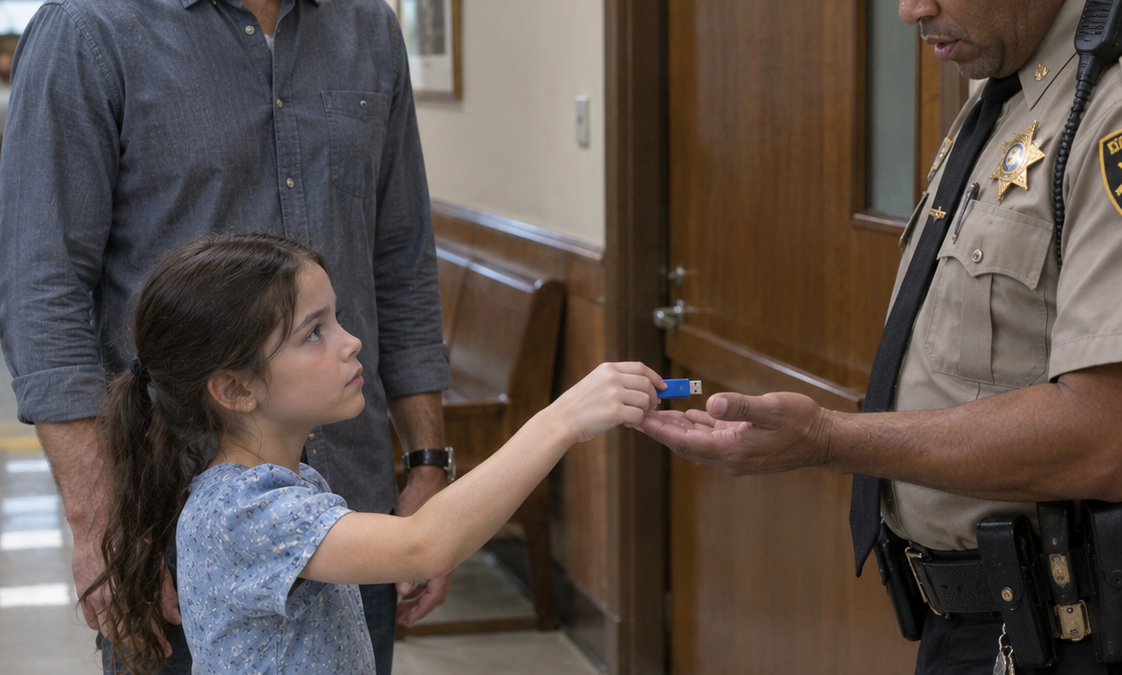
“The bailiff took the USB drive from my daughter’s hand like it was a loaded weapon. He held it between two fingers. A small blue rectangle. The kind you buy at an office supply store for nine dollars.”
Everyone thought a ten-year-old girl couldn’t possibly understand what was happening in her own home. They didn’t know she was watching. They didn’t know she was recording. And they didn’t know she was about to bring it all down.
The bailiff took the USB drive from my daughter’s hand like it was a loaded weapon.
He held it between two fingers. A small blue rectangle. The kind you buy at an office supply store for nine dollars.
“Ma’am,” he said. “You can’t just—”
“Judge Ellison said we could submit evidence,” Lily said. She was ten years old. She barely reached the bailiff’s chest. “This is evidence. I want it played.”
I stood six feet behind her in the hallway outside Courtroom 4B. I had not known she had it. I had not known she had been recording anything. I had spent three months telling myself she was adjusting fine, that kids were resilient, that the system would do what the system was designed to do.
What I didn’t know was that my daughter had been keeping a secret for ninety-four days.
My name is Caleb Rourke. I was forty-seven years old when my daughter handed a federal evidence bag to a county bailiff in a family court hallway in Sandpoint, Idaho. I was a retired senior investigator with the Bureau of Alcohol, Tobacco, Firearms and Explosives. Twenty-two years on the job. Undercover work in the Pacific Northwest. Weapons trafficking, primarily. I had put people in prison who would have killed me if they’d known my real name.
None of that mattered in this hallway.
What mattered was that my ex-wife’s new husband had petitioned for full custody of my daughter, and the court had been listening to him for two days.
Dane Kessler. Thirty-nine years old. Owner of Kessler Logistics, a regional trucking outfit based out of Spokane. He had a smile that made strangers want to trust him. He wore boots that cost more than my first car. He had a handshake that lingered a half-second too long.
He had also, according to the petition, been the primary male figure in Lily’s life for the past fourteen months. He coached her soccer team. He helped her with homework. He attended every parent-teacher conference while I was still living in Seattle, still working cold cases as a contractor, still driving four hours each way every other weekend to see her.
The petition said I was absent. Unstable. Unable to provide a consistent home environment.
It wasn’t wrong on paper.
It was wrong in fact.
Lily sat beside me on a wooden bench outside the courtroom. Her feet didn’t touch the floor. She swung them slowly. Back and forth. Back and forth.
“You’re not mad,” she said.
“No.”
“You’re not scared.”
I looked at her. She had her mother’s eyes. Green, almost gray in certain light. She had my patience. That was what her kindergarten teacher had told me once. “Lily Rourke has the patience of someone who has been around for a hundred years,” she’d said. “She watches everything.”
“I’m a little scared,” I said.
“Me too.”
We sat in silence for a moment. The courthouse smelled like floor wax and old paper. Somewhere down the hall, a woman was crying. I had heard that sound many times before, in many different buildings.
“You recorded him,” I said.
“I recorded everything.”
“For how long?”
She looked at the ceiling. Counting. “Since the middle of May.”
That was ninety-four days.
I met Dane Kessler for the first time at Lily’s spring soccer tournament. He showed up in a black SUV with tinted windows. He shook my hand. He called me “Caleb” like we’d known each other for years. He put his arm around Vanessa — my ex-wife — and told me how great Lily was doing.
“She’s a natural athlete,” he said. “Really talented.”
I said thank you.
“You still living in Seattle?”
“Yes.”
“Long drive.”
“Yes.”
He nodded. Smiled. Moved on.
That night, Vanessa called me. She said Dane wanted to be more involved. She said he was willing to step up where I couldn’t. She said the words carefully, like she had practiced them.
“Step up where I couldn’t,” I repeated.
“You know what I mean.”
“I don’t think I do.”
She sighed. “Caleb, you’re four hours away. You’re still working. You can’t be at her games. You can’t be at her doctor’s appointments. Dane can.”
I said nothing.
“I’m not saying you’re a bad father.”
“You don’t have to say it.”
The thing about being an investigator is that you learn to hear what people don’t say. You learn to watch their hands. You learn to notice when someone is performing rather than speaking.
Dane Kessler was performing.
I couldn’t have told you what he was hiding. Not then. I just knew that something was off. The way he positioned himself between Vanessa and me. The way he redirected questions about his business. The way he watched Lily when he thought no one was looking.
Not predatory. Not that. It was something else. Something colder.
He watched her like she was an asset.
I started pulling records on Kessler Logistics three months before the custody hearing. Not officially. I didn’t have a badge anymore. But I had friends. I had favors owed. I had twenty-two years of relationships with people in the federal system who trusted my judgment.
The records showed a company that had grown too fast. Revenue had quadrupled in three years. The trucking routes didn’t make sense. Empty runs to the Canadian border and back. Late-night deliveries to warehouses that didn’t exist on any commercial registry.
I called a friend at the DEA.
“Kessler Logistics,” I said. “Spokane. Anything?”
“Give me a day.”
He called back two days later.
“Stay away from that name,” he said.
“Why?”
“Because people who ask about it stop asking about things.”
I didn’t tell Vanessa. I didn’t tell Lily. I kept showing up for my weekends. I kept taking Lily to dinner. I kept pretending everything was normal.
But I started watching. In between everything else — the cold cases, the drive, the empty apartment in Seattle — I started watching.
I noticed that Dane had a security system at the house that was overkill for a residential property. I noticed that he had a detached garage that was always locked. I noticed that he took phone calls in the backyard and lowered his voice.
I noticed that Lily watched him too.
She was ten years old. She should have been worrying about soccer and math homework and whether her best friend would invite her to her birthday party.
Instead, she was watching.
The custody hearing began on a Monday. I drove down Sunday night and stayed in a motel. Lily was already with Vanessa and Dane. The court had ordered that she remain in their household until the hearing concluded.
I didn’t sleep much.
On Monday morning, I sat in the courtroom and listened to Dane Kessler describe me as a “ghost” — a man who was physically present but emotionally absent. A man who put his career ahead of his child. A man who couldn’t be relied upon.
I listened to Vanessa describe our marriage as “a slow unraveling.” She said I was distant. She said I was always working. She said she had tried to reach me, but I had been unreachable.
I listened to a court-appointed evaluator describe me as “engaged but geographically limited.”
I listened to Dane describe his plan to adopt Lily and provide her with a “stable, secure, two-parent home.”
I listened.
I took notes.
I said nothing.
On Tuesday, the second day of the hearing, I was called to the stand. My attorney — a woman named Carol Pham who I had hired with the last of my savings — asked me about my career. I told the court about my years in federal law enforcement. I told them about my undercover work. I told them about the cases I had worked, the people I had helped put away.
Opposing counsel asked me how many nights I had missed with my daughter.
I said I didn’t keep a count.
He asked me if I had ever been shot in the line of duty.
I said yes.
He asked me if I had ever been hospitalized for injuries sustained during undercover work.
I said yes.
He asked me if I thought that was the behavior of a man who prioritized his family.
I said nothing.
Judge Ellison looked at me over her glasses. She was in her sixties. Gray hair. Calm voice. She had been on the bench for twenty years and had seen everything.
“Mr. Rourke,” she said. “You’ve had a distinguished career. But this hearing isn’t about your career. It’s about your daughter. Can you tell me what you’ve done to be present in her life?”
I took a breath.
“I call her every night,” I said. “I’ve never missed a night. Not once. Even when I was overseas. Even when I was in the hospital. I call her at 8:15. We talk for fifteen minutes. She tells me about her day. I tell her about mine. Then she says goodnight and I say goodnight and we hang up.”
“You don’t see her very often.”
“I see her every other weekend.”
“There are only fifty-two weekends in a year. That means you see her twenty-six times.”
“At least.”
“Do you think that’s enough?”
I looked at Lily. She was sitting in the front row of the gallery, next to a social worker. She was watching me.
“I think it’s what I can do,” I said. “I think it’s what I’ve done.”
On Tuesday night, after the hearing recessed for the day, Lily walked up to me in the parking lot.
She was holding something in her hand.
“Dad,” she said.
“What’s up, sweetheart?”
She opened her hand. A small blue USB drive.
“I need you to give this to the judge tomorrow,” she said.
I looked at her.
“What is it?”
“It’s what he does when nobody’s watching.”
I didn’t sleep that night either. I plugged the USB drive into my laptop in the motel room.
There were forty-seven video files.
The first one was dated May 14. Lily had set up a small camera — I later learned it was a nanny cam she had found in the garage, something Dane had bought and never installed — on the bookshelf in the living room. The angle was low. The audio was tinny. But the picture was clear.
Dane was sitting at the kitchen table with two men I didn’t recognize. They were talking about a shipment. The words were coded, but they weren’t coded well. I had heard those codes before, in a different context. In a different investigation.
A truck. A border crossing. A schedule.
The second file showed Dane in the garage, counting cash. The camera was positioned in a way that showed his face. He looked different in this video. Harder. Angrier. He was talking to someone on the phone.
“You tell him if he doesn’t have the payment by Friday, I’ll take it out of his family. He knows what I mean.”
The third file. The fourth. The fifth.
I watched all forty-seven. It took me five hours.
By the end, I knew three things:
First, Dane Kessler was involved in organized crime. Specifically, he was running guns across the Canadian border under the cover of his trucking company. This was not speculation. This was documented.
Second, he had connections I couldn’t fully trace. People who had been mentioned but not identified. Names I recognized from old investigations. Names that had never been charged. Names that were dangerous.
Third, my daughter had been recording him for ninety-four days. She had watched him. She had documented him. She had waited.
She was ten years old.
On Wednesday morning, I sat in the hallway with Lily. I had the USB drive in my pocket. Carol Pham was inside the courtroom, arguing with opposing counsel about procedural matters. We had a few minutes.
“How did you know?” I said.
She shrugged. “I heard him on the phone. One night. He didn’t know I was awake.”
“What did he say?”
“He said he was going to hurt someone. A man who owed him money. He said he was going to ‘make it look like an accident.'”
I stared at my daughter. She was so small. Her shoes didn’t touch the ground. She was swinging her feet.
“Did he ever hurt you?”
“No.”
“Did he threaten you?”
“No.”
“Did he threaten your mom?”
She hesitated.
“Once,” she said. “He didn’t know I heard. He told her that if she ever tried to leave, he would find her. He said he had people.”
I closed my eyes.
“I didn’t know what to do,” Lily said. “I wanted to tell you. But I didn’t know if you would believe me. And I didn’t know if he would find out.”
“I believe you.”
“I know. That’s why I recorded it.”
The bailiff returned. He was holding the USB drive in a plastic evidence bag.
“Judge Ellison will see you in chambers,” he said.
I stood up. Lily stood up.
“You should come,” I told her.
She shook her head. “It’s for you. I already did my part.”
I looked at her.
“I love you,” I said.
“I love you too.”
Judge Ellison’s chambers were small and quiet. She sat behind a large desk. A clerk was beside her. A court reporter was setting up in the corner.
“This is highly irregular,” she said.
“I understand.”
“Your daughter approached the bailiff with a USB drive. She said it contained evidence. She said it should be played in open court.”
“Yes.”
“Do you know what’s on it?”
I looked at her.
“I do now.”
I’m going to tell you the truth about what happened next. But first, I need to tell you about the ninety-four days that came before. I need to tell you about Lily’s courage. I need to tell you about what I did and didn’t do.
Because the story isn’t just about the video.
It’s about a little girl who watched.
And it’s about what happened when the watching was finally over.
PART 2 — THE CHAMBERS
Judge Ellison had a clock on her desk. It was an old-fashioned analog clock with a white face and black hands. It ticked. Loudly. In the silence of her chambers, it sounded like a metronome.
“Mr. Rourke,” she said. “You’re telling me your ten-year-old daughter has been recording her stepfather for three months.”
“I’m telling you she recorded forty-seven video files over ninety-four days.”
“And you’ve watched them.”
“All of them.”
She leaned back in her chair. The leather creaked. Her clerk — a young man with thick glasses — was watching me like I was a defendant instead of a father.
“What’s on them?”
I put my hand on the USB drive. It was still in the evidence bag. The plastic was cold.
“The first twelve files show Mr. Kessler conducting what appears to be illegal firearms transactions from his home. The next fifteen show him counting large amounts of cash and discussing delivery schedules with unidentified individuals. The final twenty show him making threats against people who owe him money.”
“Threats.”
“Specific threats. He describes methods. He describes locations. He describes what he’ll do to their families.”
Judge Ellison was quiet for a moment. The clock ticked.
“Play the first one,” she said.
The video was grainy. Low resolution. The audio was worse. But it was clear enough.
Dane Kessler sat at his kitchen table. Two men sat across from him. One was large — bald, with a thick neck. The other was smaller — wiry, nervous, with a tattoo on his forearm that I couldn’t make out.
“The shipment comes in Thursday,” Dane said. “Twenty units. No serials. You pick up at the usual place.”
“We got a problem,” the large man said.
“What problem?”
“Border patrol’s been running extra patrols. New guys. Young. Eager.”
Dane smiled. It was not a warm smile. “Then we use the other route.”
“The other route takes an extra six hours.”
“Then it takes an extra six hours.”
The nervous man spoke. “What about the payment?”
“You’ll get your payment when the product is delivered.”
“That’s not what we agreed.”
Dane leaned forward. “I don’t care what we agreed. I care about the product. You bring me the product, you get paid. You don’t bring me the product, you don’t get paid. And then we have a different conversation.”
The video ended.
Judge Ellison looked at me. Her expression hadn’t changed, but something behind her eyes had shifted.
“Play the next one.”
We watched five more videos. Each one was worse than the last. Dane counting cash. Dane on the phone, arranging deliveries. Dane in his detached garage, opening a crate that contained what looked like rifles wrapped in blankets.
The clerk had stopped taking notes. He was just staring at the screen.
Judge Ellison held up her hand.
“Enough,” she said.
I paused the video.
“How long have you known about this?”
“I found out last night.”
“Your daughter gave you the drive last night.”
“Yes.”
“And you watched all forty-seven files.”
“Yes.”
“Why didn’t you call the police?”
I looked at her.
“I wanted to,” I said. “But I needed to be careful.”
“Careful.”
“Dane Kessler has connections. I don’t know how deep they go. I don’t know who he knows. If I called the wrong person, the evidence would disappear. And so would my daughter.”
Judge Ellison stared at me.
“You’re former law enforcement.”
“Twenty-two years with ATF. Senior investigator. Undercover work in the Pacific Northwest.”
“Then you know how this works.”
“I know that if I walk into the Sandpoint police department and say my ex-wife’s husband is running guns, I’ll get a report filed. And then someone will call someone. And then the evidence will be gone.”
She nodded slowly.
“What do you want me to do?”
“I want you to play the video in open court. I want it on the record. I want every person in that room to see what he is.”
“And then?”
“And then I want you to call the FBI.”
The hearing reconvened at 2:15 that afternoon.
Dane Kessler was already seated at the petitioner’s table. He was wearing a navy suit and a white shirt. His hair was perfectly combed. He looked like a man who had never done anything wrong in his life.
Vanessa sat beside him. She was wearing a gray dress. Her hands were folded on the table. She looked tired.
Lily was in the front row of the gallery. The social worker was beside her. Lily was watching me.
I sat at the respondent’s table. Carol Pham was beside me. She had asked me three times what was on the USB drive. I had told her she would find out.
Judge Ellison entered. Everyone stood.
“Be seated,” she said.
She looked at the bailiff.
“Bring in the television.”
The courtroom had an old television on a rolling cart. It was the kind you used to see in schools in the 1990s. The bailiff wheeled it to the center of the room. He connected the USB drive.
Dane Kessler watched. His expression didn’t change. But his hands did. They were resting on the table, and his fingers curled slightly. Just a little.
“Mr. Kessler,” Judge Ellison said. “Do you recognize this device?”
He looked at the USB drive. Then at me. Then at the judge.
“No.”
“Your stepdaughter says she found it in your garage.”
He smiled. “Lily is a creative child. She has a very active imagination.”
“Play the first video.”
The screen flickered. The courtroom was silent.
Dane’s face appeared on the screen. His voice filled the room.
“The shipment comes in Thursday. Twenty units. No serials.”
Someone in the gallery gasped.
Dane’s smile didn’t falter. But his eyes did. They went flat. Cold. The way they looked when he thought no one was watching.
The video played for three minutes. When it ended, Judge Ellison called for the next one.
“You tell him if he doesn’t have the payment by Friday, I’ll take it out of his family.”
Vanessa turned to look at Dane. Her face was pale. Her mouth was open.
Dane didn’t look at her. He was looking at me.
“He said he had people.”
That was Lily’s voice. Not on the video. She had said it to me in the hallway. I hadn’t recorded it. But I heard it in my head.
The third video played. The fourth. The fifth.
By the seventh, Dane’s attorney was on his feet.
“Your Honor, this is a violation of my client’s privacy. These recordings were made without his knowledge or consent.”
Judge Ellison looked at him.
“Are you suggesting that a ten-year-old girl violated her stepfather’s privacy by recording him discussing illegal firearms transactions in her own home?”
The attorney opened his mouth. Closed it. Sat down.
The videos kept playing.
I watched the people in the gallery. There were about twenty of them. Some were reporters. Some were spectators. Some were family members of other cases, waiting for their own hearings.
I watched Vanessa. She had stopped looking at Dane. She was looking at the floor. Her hands were trembling.
I watched Lily. She was watching Dane. Her face was calm. She looked like she was taking notes.
I watched Dane. He was watching the screen. His expression was blank. But I had seen men like him before. I had seen them in interrogation rooms. I had seen them in courtrooms. I had seen them in the moments before they realized they were caught.
They always had the same look.
It was the look of a man who was recalculating.
After the twelfth video, Judge Ellison called for a recess.
The bailiff turned off the television. The room was silent.
“We’ll reconvene in thirty minutes,” Judge Ellison said.
She stood and left the courtroom.
I stayed in my seat. Carol Pham was looking at me.
“You could have told me,” she said.
“I know.”
“You could have told me you had evidence.”
“I know.”
She shook her head. “You’re going to explain this to me. All of it. Right now.”
We went into a small conference room down the hall. Carol closed the door.
“Start talking.”
I told her about the USB drive. I told her about the ninety-four days. I told her about the videos I had watched in my motel room. I told her about the connections I had suspected and the ones I had confirmed.
Carol listened. She didn’t interrupt.
When I finished, she was quiet for a long moment.
“Dane Kessler is connected,” she said.
“Yes.”
“How connected?”
“I don’t know yet. But I’m going to find out.”
“How?”
I looked at her.
“I called a friend. Before the hearing. He’s with the FBI field office in Coeur d’Alene. He’s on his way.”
Carol stared at me.
“You called the FBI.”
“I called the FBI.”
“And you didn’t tell me.”
“I didn’t tell anyone.”
She took a breath. Let it out.
“Okay,” she said. “Okay. This is what we’re going to do.”
The hearing reconvened at 3:00 PM.
Judge Ellison had a different expression now. She looked like a judge who had seen something she couldn’t unsee.
“I’ve reviewed the evidence presented,” she said. “Given the nature of the recordings, I’m ordering a temporary suspension of these proceedings pending a federal investigation.”
Dane’s attorney was on his feet again.
“Your Honor, this is outrageous. My client is a respected businessman—”
“Your client is the subject of a federal investigation,” Judge Ellison said. “Sit down.”
He sat down.
Judge Ellison looked at the bailiff.
“Escort Mr. Kessler to the marshal’s office. He’ll be detained pending further review.”
Dane stood up. He was still smiling. But it wasn’t a real smile. It was the smile of a man who was trying to look like he wasn’t afraid.
“This is a mistake,” he said. “You’re making a mistake.”
Judge Ellison didn’t look at him.
“Take him.”
The bailiff moved toward Dane. Dane’s hand went to his jacket.
I was already standing. I had been in this situation before. I knew what it looked like when a man reached for something.
“Hands where I can see them,” I said.
Dane looked at me. His eyes were cold.
“You,” he said.
“Hands.”
He raised his hands. The bailiff grabbed his arms. He was cuffed and led out of the courtroom.
Vanessa was crying. She was still sitting at the petitioner’s table. Her shoulders were shaking.
Lily was watching her mother. Her face was calm.
I walked over to her.
“You okay?” I said.
She nodded.
“You did good.”
She looked up at me.
“Did I?”
“Yeah. You did.”
The hallway outside the courtroom was chaos. Reporters were shouting. People were on their phones. Vanessa was sitting on a bench, her head in her hands.
I sat down beside her.
“I didn’t know,” she said.
“I know.”
“I didn’t know what he was doing. I swear.”
“I believe you.”
She looked at me. Her eyes were red.
“How did you know?”
“Lily.”
She stared at me.
“Lily?”
“She recorded him. Ninety-four days. She gave me the drive last night.”
Vanessa’s face crumpled. She started sobbing.
“She’s ten years old,” she said. “She’s ten years old and she—”
“She’s brave,” I said. “Braver than either of us.”
Vanessa kept crying. I didn’t touch her. I didn’t know if I should.
Lily came out of the courtroom. She was holding the social worker’s hand. She walked over to us.
“Mom,” she said.
Vanessa looked up.
“I’m sorry,” Lily said.
Vanessa grabbed her and hugged her. She was still crying.
“It’s okay,” Lily said. “It’s okay.”
A man in a gray suit walked up to me. He was tall. Bald. He had the kind of face that had seen too much and wasn’t impressed by any of it.
“Caleb Rourke?”
“Yes.”
“Special Agent Mark Dunne. FBI. I got your message.”
We shook hands.
“You’re fast,” I said.
“I was already in the area. We’ve been looking at Kessler Logistics for six months.”
I looked at him.
“You’ve been looking at him?”
“We had a source. Nothing solid. Nothing we could take to a judge.”
“And now?”
He smiled. It was a tired smile.
“Now we have forty-seven video files and a federal judge who’s about to sign a warrant.”
I looked back at Lily. She was still hugging her mother. She was small. She was ten years old. She had done something that most adults wouldn’t have the courage to do.
What she didn’t know was that it was only the beginning.
What none of us knew was that Dane Kessler wasn’t the top of the chain. He was just a link. And the people above him were already making calls.
PART 3 — THE SOURCE
Special Agent Dunne and I sat in a diner two blocks from the courthouse. It was the kind of place that served breakfast all day and had vinyl booths that stuck to your legs in the summer.
He ordered coffee. I ordered water.
“Start from the beginning,” he said.
I told him about the ninety-four days. I told him about the USB drive. I told him about the videos. I told him about the codes I had recognized — the phrases, the schedules, the routes.
Dunne listened. He took notes. He didn’t interrupt.
When I finished, he leaned back.
“You were ATF.”
“Twenty-two years.”
“Undercover?”
“Mostly.”
“In the Northwest?”
“Washington, Oregon, Idaho. Some work in Canada.”
He nodded. “You know Mickey Vasquez?”
I looked at him.
“Everyone knows Mickey Vasquez.”
“Not everyone. Just people who were paying attention.”
Mickey Vasquez had been a legend in the Pacific Northwest arms trade. He had run guns from Alaska to Mexico for twenty years. He had never been caught. He had never been charged. He had retired to a ranch in Montana and died of a heart attack in 2019.
I had spent three years of my life trying to build a case against him. I had never succeeded.
“Why are you asking about Vasquez?”
“Because Dane Kessler worked for him.”
I stared at him.
“For how long?”
“Five years. Vasquez used Kessler Logistics to move product. When Vasquez died, Kessler took over the operation.”
“He took over?”
“He inherited the contacts. The routes. The clients. He was Vasquez’s protégé.”
I thought about the videos. The confidence in Dane’s voice. The way he talked about shipments and payments. The way he threatened people.
“He learned from the best,” I said.
“He learned from the worst. And now he’s in custody. And his people are nervous.”
Dunne pulled out his phone. He showed me a photograph.
“This is Raymond Cross. He was Vasquez’s number two. When Vasquez died, everyone assumed Cross would take over. But Kessler beat him to it.”
The man in the photograph was in his fifties. Gray hair. Thick mustache. Cold eyes.
“Cross is still in the organization?”
“Cross is the organization. He’s the one who connects Kessler to the buyers. He’s the one who handles the money. He’s the one who makes problems go away.”
“And where is he now?”
“No one knows. He disappeared three days ago.”
“Three days ago?”
“Right around the time your daughter started recording.”
I went back to the motel that night. Lily was staying with Vanessa at a shelter in Sandpoint. The court had ordered it. Vanessa had agreed. She was cooperating.
I sat on the bed and stared at the wall.
Raymond Cross. I knew the name. I had heard it in briefing rooms. I had seen it in files. He had been a ghost for twenty years. Never charged. Never indicted. Never even questioned.
And now he was out there. Somewhere. And he knew about Lily.
My phone rang at 11:47 PM.
I didn’t recognize the number.
“Hello?”
“This is Caleb Rourke?”
“Who is this?”
“My name is Angela Cross. Raymond is my husband.”
I sat up.
“Mrs. Cross—”
“I know what my husband does. I’ve known for years. I don’t approve. But I don’t know how to stop it.”
“Why are you calling me?”
There was a long pause.
“Because I’m scared. Raymond has been different lately. Angrier. More paranoid. He said someone was watching him. He said he was going to ‘clean house.'”
“Clean house?”
“He meant witnesses. People who could testify against him.”
I closed my eyes.
“Mrs. Cross, I need you to listen to me. Do you have somewhere safe you can go?”
“I have a sister in Portland.”
“Go there. Tonight. Don’t tell anyone where you’re going. Don’t use your phone. Don’t use your credit cards. Take cash.”
“Why are you helping me?”
“Because you called me. That means you want to do the right thing.”
She was quiet.
“Your daughter,” she said. “The one who recorded Dane. Is she safe?”
“She’s with her mother.”
“Keep her close. Raymond knows about her. He knows what she did.”
I called Dunne at midnight.
“Raymond Cross knows about Lily.”
“I know.”
“You know?”
“We intercepted a call. Cross was talking to someone in Spokane. He mentioned the girl. He mentioned you.”
“What did he say?”
“He said he wanted to ‘handle it personally.'”
I was already getting dressed.
“Where is he?”
“We don’t know. He’s been off the grid for three days. We have people looking. But he’s good at disappearing.”
“Not good enough.”
“What are you going to do?”
“I’m going to find him.”
“Caleb—”
“He threatened my daughter. I’m going to find him.”
I called an old friend. His name was Jerry Tufts. He had been my partner for eight years. He had retired two years before me and moved to a cabin in northern Idaho.
He answered on the second ring.
“Caleb. It’s midnight.”
“I know.”
“What’s wrong?”
“Raymond Cross.”
There was a long pause.
“What about him?”
“He’s in the wind. He threatened my daughter.”
Another pause.
“Where are you?”
“Sandpoint.”
“I’ll be there in three hours.”
Jerry arrived at 3:15 AM. He was sixty-two years old. Gray beard. Bad knee. He had been shot twice in the line of duty and had the scars to prove it.
He walked into my motel room and looked at me.
“You look like hell.”
“Thanks.”
“What do we know?”
I told him everything. The videos. The hearing. The FBI. Angela Cross’s phone call.
When I finished, he sat down on the edge of the bed.
“Raymond Cross is a ghost,” he said.
“I know.”
“He doesn’t leave tracks.”
“I know.”
“He’s been doing this for thirty years.”
“I know.”
“So how do we find him?”
I looked at him.
“We don’t. We make him come to us.”
The plan was simple. Dangerous. But simple.
We would leak information. Not to the press. Not to the public. To the right people. We would let it be known that Lily had more evidence. That she had recorded Cross too. That she had videos of him that hadn’t been played in court.
It wasn’t true. But Cross wouldn’t know that.
If Cross believed Lily had evidence against him, he would come for her. And when he came for her, we would be waiting.
“You’re using your daughter as bait,” Jerry said.
“No. I’m protecting her.”
“That’s the same thing.”
“It’s not. She’s already a target. Cross already knows about her. This way, we control the timing. We control the location. We control the outcome.”
Jerry stared at me.
“You’re sure about this?”
“No.”
“Then why are you doing it?”
I looked at the wall.
“Because I don’t have a choice.”
I called Dunne at 6:00 AM.
“I need your help.”
“What kind of help?”
“I need you to put out a rumor. Quietly. Through channels that Cross’s people monitor.”
“What kind of rumor?”
“Lily has more evidence. Videos of Cross. Recordings of phone calls. Proof that he was involved in Vasquez’s operation.”
Dunne was quiet for a moment.
“You’re trying to flush him out.”
“Yes.”
“That’s risky.”
“I know.”
“If it goes wrong—”
“It won’t.”
“You don’t know that.”
“I know that I’ve been doing this for twenty-two years. I know that Cross is a coward. He doesn’t take risks. He only acts when he thinks he has the advantage.”
“And you think he’ll think he has the advantage?”
“I think he’ll think a ten-year-old girl is easy to handle.”
The next morning, I went to see Lily.
She was at the shelter with Vanessa. They had a small room with two beds and a window that looked out at a parking lot. It wasn’t much. But it was safe.
Lily was sitting on the bed, reading a book.
“Dad,” she said.
“Hey, sweetheart.”
She put the book down.
“Are you here to tell me something?”
“Why do you say that?”
“Because you have your serious face.”
I sat down on the bed beside her.
“I need to tell you something. And I need you to listen carefully.”
She nodded.
“There’s a man named Raymond Cross. He worked with Dane. He’s dangerous. And he knows about the videos you made.”
Her face didn’t change.
“Is he going to hurt me?”
“I’m not going to let him.”
“How?”
“I have a plan.”
She looked at me. Her eyes were the same as they had been in the courthouse hallway. Calm. Patient.
“What kind of plan?”
“The kind where we set a trap.”
She nodded slowly.
“Okay.”
“You’re not scared?”
“I’m scared. But I trust you.”
That trust was going to cost me. I knew it then. I knew it when I made the plan. I knew it when I called Dunne. I knew it when I looked at my daughter’s face and told her I was going to protect her.
What I didn’t know was how close I would come to failing.
What I didn’t know was that Raymond Cross wasn’t just dangerous.
He was desperate.
And desperate men don’t follow plans.
They make their own.
 [Tap here for the Next Part ]


