Part 2: “It’s what he does when nobody’s watching
PART 4 — THE TRAP
The rumor worked faster than I expected.
Dunne called me at 2:00 PM. His voice was tight.
“Cross surfaced.”
“Where?”
“Spokane. He’s been making calls. He’s trying to find out where the girl is staying.”
“Does he know?”
“Not yet. But he’s asking the right questions. He’ll figure it out soon.”
“How soon?”
“Twelve hours. Maybe less.”
I looked at the clock. It was 2:07 PM.
“Then we need to move.”
The plan was this: We would move Lily and Vanessa to a safe house in Coeur d’Alene. A place the FBI used for witness protection. It was a small house on a dead-end street with security cameras and a panic room.
We would let it leak — through the right channels — that Lily was being moved at 8:00 PM. We would make it look like a routine transfer. Two cars. A decoy.
Cross would come for the decoy.
And we would be waiting.
“What if he doesn’t take the bait?” Jerry asked.
“He will.”
“How do you know?”
“Because he’s desperate. And desperate men are predictable.”
At 5:00 PM, I went to the shelter to see Lily one more time.
She was sitting on the bed, drawing in a notebook. She looked up when I came in.
“Dad.”
“Hey, sweetheart.”
She put the notebook down.
“Is it time?”
“Almost.”
She nodded. She didn’t look scared. She looked like she was thinking.
“I want to help,” she said.
“You’ve already helped. More than anyone.”
“I want to help with the trap.”
I sat down beside her.
“Lily, this isn’t something you can help with. This is—”
“I know what it is. I know he’s dangerous. I know he might hurt people.”
“Then you understand why you need to stay safe.”
She looked at me. Her eyes were steady.
“I understand that you’re trying to protect me. But I also understand that I’m the only one who knows what he looks like. The real him. Not the one he shows everyone else.”
I stared at her.
“What do you mean?”
She opened her notebook. There were drawings. Detailed drawings. A man with gray hair and a thick mustache. A man with cold eyes. A man standing in a doorway, watching.
“I saw him,” she said. “Three times. He came to the house when Dane thought I was asleep. He never came inside. He just stood in the driveway and watched.”
“Why didn’t you tell me?”
“I didn’t know who he was. I just knew he was scary.”
I looked at the drawings. They were good. Too good for a ten-year-old. She had captured something in his face. Something cold. Something patient.
“Lily, these are—”
“Accurate,” she said. “I’m good at remembering faces. I always have been.”
I called Dunne.
“I need you to look at some drawings.”
“Drawings?”
“My daughter drew Raymond Cross. Three times. From memory.”
Dunne was quiet.
“Send them to me.”
I took photos of the notebook pages and texted them to Dunne. He called back ten minutes later.
“These are good.”
“I know.”
“These are really good. We’ve been trying to get a current photo of Cross for six months. The only ones we have are from 2015.”
“So now you have three.”
“Caleb, this changes things. If she can identify him in a lineup—”
“She’s ten years old.”
“She’s a witness. A credible one.”
I closed my eyes.
“I’m not putting my daughter in a courtroom again.”
“You might not have a choice.”
At 7:00 PM, we moved.
Lily and Vanessa went in the first car. Two FBI agents. Tinted windows. The car left the shelter and headed east on Highway 2.
The decoy car left fifteen minutes later. Same make. Same model. Same color. Two agents in the front seat. A mannequin in the back, covered with a blanket.
I was in the third car. Jerry was driving. We were parked two blocks from the shelter, watching.
“Nothing yet,” Jerry said.
“Give it time.”
We waited. The street was quiet. A few cars passed. A dog barked in the distance.
At 7:43 PM, a black SUV turned onto the street.
Jerry sat up.
“That’s him.”
“How do you know?”
“Because he’s driving like a man who doesn’t want to be seen.”
The SUV pulled to the curb. The engine stayed on. The windows were tinted.
“Call it in,” I said.
Jerry picked up his phone.
“Target acquired. Black SUV. Washington plates. Parked on Fifth Street.”
“Copy,” Dunne said. “We’re moving.”
The SUV sat there for three minutes. Then the driver’s door opened.
A man stepped out. Gray hair. Thick mustache. He was wearing a dark jacket and jeans. He looked like a man who was going to the store.
He wasn’t.
He walked toward the decoy car. He was slow. Careful. He looked around. He didn’t see us.
He reached the decoy car. He looked inside. He saw the mannequin.
He froze.
Then he turned and ran.
“Go,” I said.
Jerry started the car. We pulled out of the parking spot and accelerated.
The SUV was already moving. Tires squealing. It turned left onto a side street.
Jerry followed.
“Call it in,” I said.
“Already did.”
We chased the SUV for six blocks. It was fast. But Jerry was faster. He had been a pursuit driver for twelve years. He knew these streets.
The SUV turned into an alley. Dead end.
Jerry blocked the entrance.
The SUV stopped. The doors opened. Cross got out. He was holding a gun.
“Stay in the car,” Jerry said.
I was already opening the door.
“Caleb—”
“He’s not going to shoot me.”
“How do you know?”
I stepped out of the car.
Cross was standing twenty feet away. He was breathing hard. His gun was pointed at the ground.
“Raymond Cross,” I said.
He looked at me. His eyes were cold. The same eyes from Lily’s drawings.
“Who are you?”
“Caleb Rourke.”
“The father.”
“Yes.”
He laughed. It was a dry, humorless sound.
“You’re the one who set this up.”
“Yes.”
“You’re a fool.”
“Maybe.”
He raised the gun. Not at me. At the air. He was thinking. I could see it in his face. He was calculating.
“You don’t want to do this,” I said.
“I don’t want to go to prison.”
“You don’t have a choice.”
“I always have a choice.”
He looked at me. His hand was steady. His eyes were flat.
“You’re not a cop anymore,” he said. “You can’t arrest me.”
“No. But I can hold you here until the people who can arrive.”
He smiled. It was a thin smile. A snake’s smile.
“You think I’m afraid of the FBI?”
“I think you’re afraid of what happens if you go back to prison. I think you’re afraid of the people you’ve been working with. I think you’re afraid of what they’ll do if you talk.”
His smile faded.
“You don’t know anything about me.”
“I know you worked for Mickey Vasquez. I know you ran his operation for fifteen years. I know that when he died, you expected to take over. I know that Dane Kessler beat you to it. And I know that you’ve been nursing that grudge ever since.”
Cross stared at me.
“You’ve been watching me.”
“I’ve been paying attention.”
He raised the gun. This time, he pointed it at me.
“You should have stayed out of this.”
“I couldn’t.”
“Why?”
“Because you threatened my daughter.”
He laughed again. The same dry sound.
“Your daughter. The little girl with the camera. You know what she did? She cost me everything. She cost me my operation. My business. My life.”
“She cost you your freedom. That’s different.”
“It’s the same thing.”
He took a step forward. The gun was still pointed at me.
“I’m going to walk away from here,” he said. “And you’re going to let me.”
“No.”
“Yes. Because if you don’t, I’ll shoot you. And then I’ll find your daughter. And I’ll shoot her too.”
The words hung in the air.
Jerry was still in the car. I could see him out of the corner of my eye. He had his phone out. He was calling for backup.
Cross didn’t notice. He was focused on me.
“You don’t want to do this,” I said.
“I don’t have a choice.”
“You do. You can put the gun down. You can surrender. You can tell the FBI what you know. You can give them Kessler. You can give them everyone.”
“And what do I get?”
“A chance.”
“A chance at what?”
“A chance to live. A chance to see your wife again. A chance to be something other than a man who runs guns and threatens children.”
His hand wavered.
“You don’t know what you’re talking about.”
“I know you’re tired. I can see it. I can hear it in your voice. You’ve been running for thirty years. You’ve been looking over your shoulder for thirty years. You’ve been afraid for thirty years.”
“You don’t know that.”
“I know it because I’ve been there. I spent twenty-two years chasing men like you. And every single one of them was tired. Every single one of them wanted to stop. They just didn’t know how.”
Cross stared at me.
“What are you saying?”
“I’m saying you can stop. Right now. Right here. Put the gun down and tell the FBI everything. Give them the operation. Give them the names. Give them the evidence. And maybe—just maybe—you get to walk away with something.”
“And if I don’t?”
“Then you spend the rest of your life in a federal prison. And you never see your wife again. And you never see the sun again. And you die alone, wondering what would have happened if you had just put the gun down.”
The silence stretched.
Five seconds. Ten. The gun was still pointed at me. Cross’s hand was shaking now. Just a little.
Then, slowly, he lowered the gun.
“You’re good,” he said.
“I know.”
“You should have been a therapist.”
“I get that a lot.”
He put the gun on the ground. He kicked it away.
“I want a lawyer,” he said.
“You’ll get one.”
“And I want immunity.”
“That’s not up to me.”
“Then get me someone who can make that decision.”
The FBI arrived four minutes later. Dunne was in the lead. He looked at Cross, then at me, then at the gun on the ground.
“You okay?” he asked.
“Yeah.”
“Cross?”
“He wants to talk.”
Dunne looked at Cross. Cross was standing with his hands on his head. He looked smaller now. Older. Tired.
“Take him in,” Dunne said.
Two agents stepped forward and cuffed Cross. They read him his rights. He didn’t say anything. He just stood there, looking at the ground.
Dunne walked over to me.
“How did you do that?”
“Do what?”
“He was ready to shoot you. I heard it on the phone.”
“I talked to him.”
“You talked to him.”
“Sometimes that’s all it takes.”
Dunne stared at me.
“You’re something else.”
“I’m a father.”
I drove back to the safe house in Coeur d’Alene. It was 9:30 PM. The house was quiet. Vanessa was in the living room, watching TV. She looked up when I came in.
“Is it over?”
“For now.”
She nodded. She looked exhausted.
“Lily’s in the bedroom.”
I walked down the hall. The door was open. Lily was sitting on the bed, drawing in her notebook.
“Dad.”
“Hey.”
I sat down beside her.
“Did you catch him?”
“Yeah.”
“Did you hurt him?”
“No.”
“Good.”
She went back to drawing. I looked at the page. It was a picture of a man in a suit. A judge. Judge Ellison.
“Why are you drawing her?”
“She’s the one who listened,” Lily said. “I wanted to remember her.”
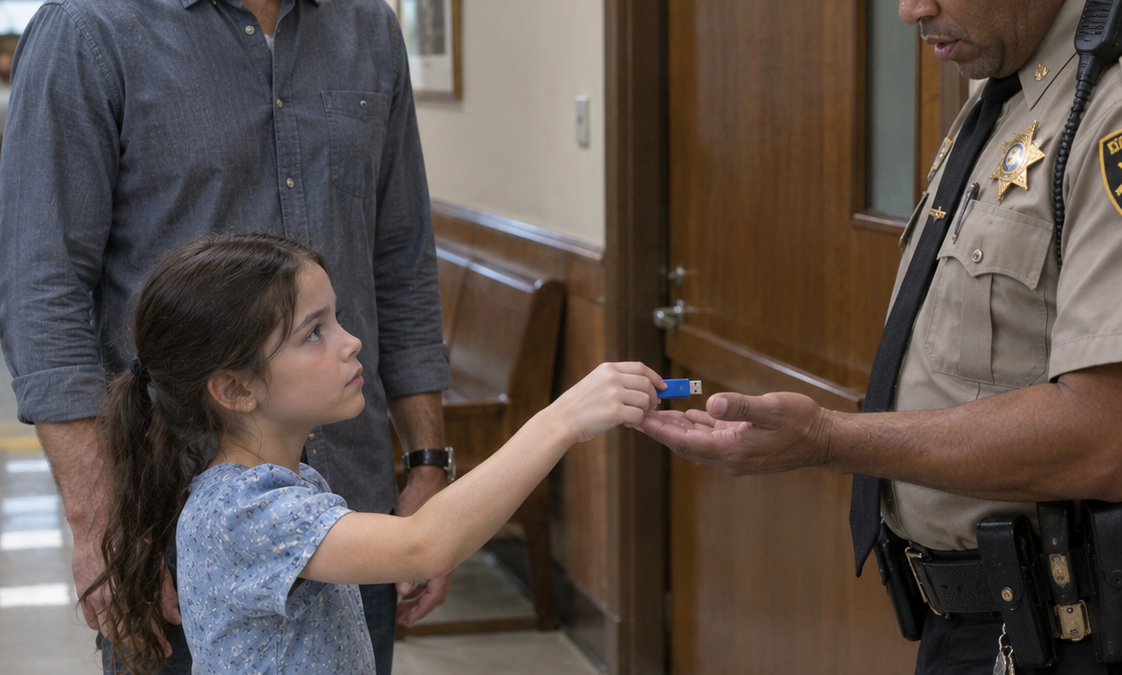
I sat there for a long time. Just watching my daughter draw. She was ten years old. She had done something that would have terrified most adults. She had recorded her stepfather for ninety-four days. She had kept a secret that could have gotten her killed. She had handed a USB drive to a bailiff and asked a judge to play a video.
She was ten years old.
And she was the bravest person I had ever met.
PART 5 — THE INTERROGATION
Raymond Cross talked for six hours.
Dunne called me at 4:00 AM. He sounded like a man who had just run a marathon.
“You need to hear this.”
“Now?”
“Now.”
I drove to the FBI field office in Coeur d’Alene. It was a plain building on a side street. Nothing about it said “federal.” That was the point.
Dunne met me in the lobby. He looked tired. His tie was loose. His coffee cup was empty.
“Cross gave us everything.”
“Everything?”
“Names. Routes. Buyers. Sellers. He kept records. Detailed records. He’s been documenting his own operation for years. Insurance policy, he said. In case someone tried to screw him over.”
“Where are the records?”
“Safe deposit box in Spokane. We’re getting a warrant now.”
We sat in a conference room. Dunne spread photographs across the table.
“These are the players. Cross identified all of them.”
I looked at the faces. Some I recognized. Some I didn’t.
“This one,” I said. Pointing to a man in his fifties. Gray suit. Confident smile.
“That’s Victor Han. He’s a city councilman in Spokane. Cross says he’s been on the payroll for eight years.”
“On the payroll?”
“Kessler Logistics paid him fifty thousand a year to make sure certain permits went through. Zoning. Inspections. Things like that.”
“And he knew what he was facilitating?”
“He knew.”
I looked at another photograph. A woman. Forties. Blonde.
“Who’s this?”
“Patricia Weller. She’s a prosecutor in the Spokane County District Attorney’s office.”
I looked at Dunne.
“A prosecutor.”
“Cross says she’s been leaking information about investigations. Tips about warrants. She’s been protecting the operation for three years.”
“How much does she know?”
“Everything. She knows about the guns. She knows about the shipments. She knows about the threats.”
I sat back.
“This is bigger than I thought.”
“It’s bigger than any of us thought. Cross has been running this operation for fifteen years. Kessler took it over three years ago, but he kept all of Cross’s contacts. All of Cross’s arrangements.”
“So when we arrested Kessler—”
“We cut off the head. But the body is still moving. Han is still on the council. Weller is still in the prosecutor’s office. And there are others. Cross gave us twelve names.”
I called Jerry.
“Twelve names,” I said.
“I heard.”
“We need to move fast. Before they find out Cross talked.”
“They’ll find out. They always find out.”
“Not if we’re careful.”
“Caleb, you’ve been doing this for twenty-two years. You know how this works. There’s always a leak. There’s always someone who talks.”
“Then we don’t give them time to talk. We take them all at once.”
The FBI coordinated with the Washington State Patrol and the Spokane Police Department. They executed search warrants at 6:00 AM. Twelve locations. Twelve arrests.
Victor Han was arrested at his home in Spokane. He was in his bathrobe. He didn’t say anything.
Patricia Weller was arrested at her office. She was in the middle of a meeting. She cried.
The others were arrested without incident. Most of them didn’t resist. They knew it was over.
By 10:00 AM, all twelve were in custody.
I watched the news coverage that night. The local station led with the story. “Major Organized Crime Ring Busted in Spokane.” They showed footage of Han being led out of his house. They showed a map of the routes. They showed a photograph of Dane Kessler from his business website.
They didn’t mention Lily. They didn’t mention the USB drive. They didn’t mention a ten-year-old girl who had recorded everything.
That was fine. That was how it should be.
But it didn’t stay quiet.
Two days later, a reporter from the Spokane Spokesman-Review called my cell phone.
“Mr. Rourke?”
“Who is this?”
“My name is Dana Reyes. I’m a reporter with the Spokesman-Review. I’m working on a story about the Kessler investigation.”
“I don’t have any comment.”
“I understand. But I wanted to ask you about your daughter.”
I froze.
“What about my daughter?”
“There’s a rumor that she was the one who provided the evidence. The USB drive. The videos.”
“Where did you hear that?”
“I can’t reveal my sources. But I wanted to give you a chance to comment.”
“No comment.”
“Mr. Rourke, this is a big story. A ten-year-old girl taking down a major crime ring? That’s incredible. People will want to know.”
“People don’t need to know anything. She’s a child.”
“I understand. But—”
“No comment.”
I hung up.
I called Dunne.
“A reporter called me. She knows about Lily.”
“I know. We’ve been getting calls.”
“How did they find out?”
“I don’t know. Someone in the courthouse talked. Or someone in the FBI. Or someone in the marshal’s office. It could be anyone.”
“I want it stopped.”
“Caleb, I can’t stop the press. I can ask them to be sensitive. I can ask them not to name her. But I can’t stop them from writing the story.”
“Then I’ll stop them.”
“How?”
“I’ll give them a different story.”
I called Dana Reyes back.
“Ms. Reyes. This is Caleb Rourke.”
“I’m glad you called back.”
“I’ll give you an interview. But not about my daughter. About me.”
“What about you?”
“Everything. My career. My work. The investigation. I’ll tell you whatever you want to know. But my daughter’s name doesn’t appear in the story. She’s not mentioned. She’s not identified. She’s not a source. She’s a child who did something brave, and she deserves to be protected.”
There was a pause.
“That’s a deal,” she said.
The story ran three days later. “The Investigator Who Took Down a Crime Ring — And the Daughter He Protected.” It was a good story. Fair. Accurate. It mentioned me. It mentioned my career. It mentioned the investigation. It didn’t mention Lily.
Dana Reyes kept her word.
But the story had an unintended consequence. It made me famous.
My phone started ringing. Old colleagues. Old friends. People I hadn’t talked to in years.
Some of them wanted to congratulate me. Some wanted to ask about the investigation. Some wanted to know if I was available for consulting work.
One call was different.
“Mr. Rourke? My name is Harold Brennan. I’m a partner at Brennan, Foster & Associates in Seattle.”
“What can I do for you?”
“We represent a group of families whose children were affected by the Kessler operation. We’re filing a civil suit. We’d like you to consult.”
“Consult on what?”
“On the investigation. On the evidence. On the timeline. We want to make sure the civil case is as strong as the criminal case.”
“I’m not sure I can help.”
“You can. You know the case better than anyone. And we’re willing to pay.”
“How much?”
He told me. It was more than I had made in the last three years combined.
“I’ll think about it.”
I went to see Lily the next day. She was still at the safe house with Vanessa. The FBI had said it would be a few more weeks before it was safe to go back to normal life.
We sat on the porch. The sun was setting. The sky was orange and pink.
“Dad,” Lily said.
“Yeah?”
“Are you going to work again?”
I looked at her.
“What do you mean?”
“The lawyer who called. Are you going to work with him?”
“How do you know about that?”
“I heard you talking to Mom.”
I smiled.
“I might.”
“Is it a good job?”
“It’s a good job. It pays well. It helps people.”
She nodded.
“Then you should do it.”
“You think so?”
“Yeah.”
She was quiet for a moment. Then she said something that surprised me.
“I want to be an investigator. Like you.”
I looked at her.
“You do?”
“Yeah. I want to help people. I want to catch bad guys.”
“Lily, you’re ten years old.”
“I know. But I can start now. I can learn. I can practice.”
“Practice what?”
“Watching. Listening. Remembering.”
I thought about the videos. The ninety-four days. The drawings of Raymond Cross.
“You already know how to do that.”
She smiled.
“I know. But I can get better.”
I didn’t know what to say. So I just sat there with her. Watching the sunset. Thinking about the future.
What I didn’t know was that the future was about to get complicated again.
What I didn’t know was that Vanessa had been keeping a secret of her own.
And what I didn’t know was that the custody battle wasn’t over.
It was just beginning.
PART 6 — THE DEPOSITION
The secret came out on a Tuesday.
Vanessa was sitting in the kitchen of the safe house. She had a cup of coffee in front of her. She hadn’t touched it. She had been staring at it for twenty minutes.
I was in the living room, reading through the civil case files Harold Brennan had sent over. Lily was in the bedroom, drawing.
“Dad.”
I looked up. Lily was standing in the doorway.
“Mom wants to talk to you.”
I walked into the kitchen. Vanessa looked up. Her eyes were red.
“What’s going on?”
She took a breath.
“I signed something.”
“What do you mean?”
“When Dane and I got married. He asked me to sign a prenuptial agreement. I didn’t think anything of it. I just signed it.”
“What was in it?”
“It said that if we ever divorced, I wouldn’t get anything. No alimony. No property. Nothing.”
“That’s not unusual.”
“There’s more.”
She looked down at the table.
“It also said that if I ever tried to leave him, he would get full custody of Lily.”
I stared at her.
“What?”
“He said it was just a formality. He said it was to protect his business. He said he would never use it.”
“But he did.”
“He filed the custody petition before I even knew he was going to. I found out when the papers were served.”
I sat down across from her.
“Vanessa, why didn’t you tell me this before?”
“Because I was scared. He said if I told anyone, he would make sure I never saw Lily again. He said he had lawyers. He said he had connections.”
“He did have connections.”
“I know that now.”
She started crying. I didn’t move.
“I’m sorry,” she said. “I’m so sorry.”
I called Carol Pham that night.
“We have a problem.”
“What kind of problem?”
“Vanessa signed a prenuptial agreement. It says if she tries to leave Dane, he gets full custody of Lily.”
Carol was quiet for a moment.
“That’s not enforceable.”
“What?”
“Prenuptial agreements can’t determine custody. Family law doesn’t work that way. Custody is always decided based on the best interests of the child. You can’t contract away a child’s rights.”
“Then why did he put it in there?”
“Intimidation. Control. He wanted her to think she was trapped.”
“But she believed it.”
“She believed it because she was scared. Abusers do that. They make you think you have no options.”
I closed my eyes.
“So what do we do now?”
“We go back to court. We file a motion to dismiss the custody petition. And we introduce evidence of domestic abuse.”
“Domestic abuse?”
“Vanessa was coerced. Controlled. Threatened. That’s abuse. And it’s relevant to the custody determination.”
The hearing was scheduled for the following Monday. Judge Ellison was still presiding.
Carol and I met in her office on Friday afternoon. She had a stack of documents.
“Here’s what we have,” she said. “First, the prenuptial agreement. It’s invalid as to custody. Second, Vanessa’s testimony about the threats. Third, the videos. Fourth, the FBI investigation.”
“That’s a lot.”
“It’s more than enough. But we need Vanessa to testify. She needs to say in open court that she was coerced.”
“Will she do it?”
“She has to.”
I talked to Vanessa that night.
“You have to testify.”
“I know.”
“You have to tell the judge what he did to you.”
“I know.”
“Can you do it?”
She looked at me. Her eyes were red. Her hands were shaking.
“I don’t know.”
“Vanessa—”
“I don’t know if I can stand up in front of a room full of people and say that I was a victim. I don’t know if I can admit that I let this happen.”
“You didn’t let it happen. He did it to you.”
“It feels the same.”
I sat down beside her.
“Let me tell you something. I’ve been doing this for twenty-two years. I’ve interviewed hundreds of victims. Do you know what they all have in common?”
“What?”
“They all think it’s their fault. Every single one. They all think they should have seen it coming. They all think they should have left sooner. They all think they were weak.”
“And were they?”
“No. They were human. They were manipulated. They were scared. And they survived.”
Vanessa looked at me.
“I don’t feel like I survived.”
“You’re here. You’re alive. Lily is safe. You survived.”
She started crying again. I let her.
On Monday morning, we walked into the courtroom together.
Dane Kessler was there. He was wearing an orange jumpsuit. His hands were cuffed. He looked smaller than I remembered. The suit and the smile were gone.
Vanessa sat in the witness box. She swore the oath. She looked at Judge Ellison.
“Ms. Kessler,” Carol said. “Can you tell the court about your marriage to Dane Kessler?”
Vanessa took a breath.
“It was good at first. He was charming. He was generous. He made me feel special.”
“When did it change?”
“After we got married. He started controlling things. Where I went. Who I talked to. He checked my phone. He checked my email. He didn’t want me to see my friends.”
“Did he ever threaten you?”
“Yes.”
“What did he say?”
“He said that if I ever tried to leave, he would take Lily. He said he had a prenuptial agreement that gave him full custody. He said I would never see her again.”
“Did you believe him?”
“Yes.”
“Why?”
“Because he had lawyers. He had money. He had connections. I didn’t have any of those things.”
Dane’s attorney cross-examined Vanessa for twenty minutes. He tried to poke holes in her story. He tried to suggest she was exaggerating. He tried to imply she was lying to protect me.
Vanessa didn’t waver.
“He told me he would take my daughter,” she said. “He told me I would never see her again. I believed him.”
After Vanessa’s testimony, Carol called me to the stand.
“Mr. Rourke, can you tell the court about your daughter’s recordings?”
“Yes.”
“How did you first learn about them?”
“Lily gave me a USB drive on the second day of the original hearing.”
“Did you watch the videos?”
“All forty-seven.”
“What did they show?”
“They showed Dane Kessler conducting illegal firearms transactions. They showed him counting cash. They showed him making threats against people who owed him money.”
“Did they show anything else?”
“They showed him threatening my daughter.”
The courtroom went silent.
“Can you describe what you saw?”
“There was a video from June 3. Lily was in the living room. Dane didn’t know she was there. He was on the phone. He said, ‘If the kid becomes a problem, I’ll handle it.'”
“Did he say what he meant by ‘handle it’?”
“No. But I knew what he meant.”
Dane’s attorney objected. Judge Ellison overruled.
“Continue,” she said.
I continued.
“I spent twenty-two years in federal law enforcement. I know what ‘handle it’ means. It means making someone disappear. It means making sure they never talk again.”
The hearing lasted three days. Vanessa testified. I testified. Carol presented the videos, the prenuptial agreement, the FBI reports.
Dane’s attorney called three witnesses. None of them helped.
On the third day, Judge Ellison made her ruling.
“Mr. Kessler,” she said. “I have reviewed the evidence presented in this hearing. I have listened to the testimony. I have watched the videos.”
Dane stared at the table.
“You are currently facing federal charges for illegal firearms trafficking, conspiracy, and making threats against a minor. Those charges are being handled by the U.S. Attorney’s office.”
She paused.
“This court’s concern is not your criminal liability. This court’s concern is the welfare of a ten-year-old girl.”
She looked at Lily. Lily was sitting in the front row. She was watching the judge.
“Lily Rourke has demonstrated extraordinary courage. She recorded evidence of criminal activity. She provided that evidence to the court. She did so at great personal risk.”
Dane’s attorney started to speak. Judge Ellison held up her hand.
“I’m not finished.”
She looked at Dane.
“The custody petition filed by Mr. Kessler is denied. The prenuptial agreement, insofar as it attempts to determine custody, is void. Sole physical and legal custody of Lily Rourke is awarded to her father, Caleb Rourke.”
Vanessa let out a sob. Lily didn’t move.
“Ms. Kessler is granted supervised visitation, to be arranged through a court-approved mediator.”
Judge Ellison looked at me.
“Mr. Rourke, you have demonstrated that you are a fit and capable parent. You have also demonstrated that you will protect your daughter at all costs. This court has no concerns about your ability to care for her.”
She closed her folder.
“This hearing is adjourned.”
The hallway outside the courtroom was chaos again. Reporters. Cameras. People shouting questions.
I didn’t answer any of them. I just held Lily’s hand and walked.
Vanessa caught up with us at the elevator.
“Caleb.”
I turned.
“Thank you.”
“For what?”
“For not giving up. For fighting for her. For—”
She stopped. She couldn’t finish.
“You’re her mother,” I said. “You always will be.”
She nodded. She was crying.
“I’m going to get better,” she said. “I’m going to get help.”
“I hope you do.”
We drove back to Seattle that night. Lily fell asleep in the passenger seat. Her head was against the window. Her mouth was open. She looked like a normal ten-year-old.
I thought about everything that had happened. The videos. The trial. The fear. The relief.
I thought about what came next.
The civil case was still pending. The FBI investigation was ongoing. The reporters were still calling.
But for the first time in a long time, I felt like I could breathe.
The next morning, I made breakfast. Pancakes. Lily’s favorite.
She came into the kitchen, rubbing her eyes.
“Dad.”
“Morning.”
“Are we staying here?”
“This is our home. If you want it to be.”
She looked around. The apartment was small. Two bedrooms. A living room. A kitchen. It wasn’t much.
But it was ours.
“I want it to be,” she said.
“Then it is.”
She sat down at the table. I put a plate of pancakes in front of her.
“Dad.”
“Yeah?”
“What happens to Dane?”
“He goes to prison.”
“For how long?”
“A long time.”
She nodded.
“Good.”
I didn’t know how to feel about that. She was ten years old. She should have been worried about soccer and school and her friends.
Instead, she was thinking about prison.
But I also knew that she had earned the right to think about it. She had been through something that would have broken most adults. She had come out the other side.
I sat down across from her.
“Lily.”
“Yeah?”
“I’m proud of you.”
She looked up.
“You are?”
“Yeah.”
“Why?”
“Because you did something brave. You did something that most people wouldn’t have the courage to do. You stood up for what was right.”
She thought about that.
“I was scared,” she said.
“I know.”
“But I did it anyway.”
“That’s what courage is.”
She smiled. Just a little.
“Can I have more pancakes?”
“Sure.”
 [Tap here for the Next Part ]


