Part 2: “Don’t trust Victor. Don’t trust Catherine. And whatever you do — don’t trust anyone in this building who tells you they’re on your side.”
CHAPTER 5: The Gala
The Ashford Foundation Gala was the social event of the season. Every year, the family gathered at the Grand Meridian Hotel — owned by Ashford Capital, of course — to drink champagne, show off their jewelry, and pretend to care about whatever charity they’d chosen to support this time.
This year, the charity was the Ashford Cultural Center.
I’d known about the gala for weeks. I’d known I’d have to attend, that Ronan would need me there, that the whole point was to watch Victor and Catherine in their natural habitat. But I hadn’t expected to feel so exposed.
The dress was Ronan’s idea. A deep green silk gown, floor-length, with a neckline that was elegant without being scandalous. It had appeared in my room two days before the event, along with a note in Ronan’s handwriting: Wear this. You’ll need armor.
I’d stared at the note for a long time. Then I’d put on the dress.
Now I was standing at the entrance to the ballroom, watching the city’s elite mingle and drink and laugh, and I felt like a spy in enemy territory.
“You look like you’re about to throw up.”
I turned. Ronan was behind me, in a black tuxedo that made him look like a villain from a very expensive movie. His hair was slightly disheveled, as if he’d been running his hands through it, and his eyes were tired.
“I’m fine,” I said.
“You’re not fine. You’re terrified.” He stepped closer, so close that I could feel the warmth of his body. “That’s good. Fear keeps you sharp.”
“I thought you said I shouldn’t be afraid.”
“I said you shouldn’t let them see it.” He offered his arm. “Ready?”
I took it. “Ready.”
We walked into the ballroom together.
The room was a sea of black and white and gold: men in tuxedos, women in gowns, champagne flutes catching the light from a massive crystal chandelier. A string quartet played something classical and inoffensive. The air smelled like perfume and money.
I saw Catherine first. She was holding court near the bar, surrounded by a group of women in designer dresses. She was tall and elegant, with silver hair and a smile that didn’t reach her eyes. When she saw me, the smile flickered — just for a second — then widened.
“Ronan, darling.” She glided toward us, arms outstretched. “You brought a guest.”
“Ms. Voss is my compliance auditor,” Ronan said smoothly. “She’s been invaluable.”
“Ah, yes. The auditor.” Catherine’s eyes swept over me, assessing. “I’ve heard wonderful things. Victor speaks very highly of you.”
“I’m sure he does.”
Catherine’s smile sharpened. “You have your father’s eyes. Did you know that?”
The room seemed to tilt. I gripped Ronan’s arm.
“No,” I said. “I didn’t.”
“He was a wonderful man. Such a tragedy, what happened to him.” Catherine’s voice was silk over steel. “But I’m sure Ronan has told you all about it.”
“Ronan has told me enough.”
“Has he?” Catherine’s gaze flicked to Ronan, then back to me. “Well. I’m sure you’ll find out the rest soon enough. These things always come out, don’t they?”
She smiled and drifted away, leaving a wake of perfume and threat.
I let out a breath I hadn’t realized I’d been holding.
“That was a warning,” I said.
“That was a test.” Ronan’s voice was low. “She wanted to see how you’d react. You passed.”
“How do you know?”
“Because she’s worried. And when Catherine Ashford is worried, she makes mistakes.” He looked down at me, and there was something fierce in his expression. “Stay close. The real fun hasn’t started yet.”
The real fun started an hour later.
I was standing near the bar, trying to avoid a conversation with a man who kept calling me “the little auditor,” when Victor appeared at my elbow.
“Alexandra.” His voice was warm, almost paternal. “You look beautiful.”
I turned to face him. My uncle — my father’s brother — was a handsome man in his sixties, with silver hair and a charming smile and eyes that missed nothing. He’d been my legal guardian after my father died, though he’d never actually acted like a guardian. He’d managed my trust, my finances, my life, from a distance, always with that same warm smile and that same cold calculation.
“Uncle Gerald,” I said. “I didn’t expect to see you here.”
“I’m on the board of the foundation. Of course I’m here.” He took a sip of his champagne. “I hear you’ve been digging into the family finances.”
“I’ve been doing my job.”
“Yes. Your job.” He smiled. “You always were a diligent girl. Just like your father.”
The words hit me like a slap.
“Don’t,” I said quietly. “Don’t talk about my father.”
“Why not? He was my brother. I loved him.” Victor’s smile didn’t waver. “I loved him enough to take care of his daughter after he died. I loved him enough to manage her trust, to make sure she had everything she needed. And this is how you repay me? By digging through my accounts? By accusing me of — what, exactly? Fraud? Theft?”
“I haven’t accused you of anything.”
“Not yet. But you will.” He stepped closer, and his voice dropped. “Let me give you some advice, Alexandra. Some things are better left alone. Some questions shouldn’t be asked. And some people —” he paused, and his eyes flicked toward Ronan, who was across the room, talking to a group of investors “— some people will use you for their own ends and then discard you when you’re no longer useful.”
“Is that what you’re doing?” I asked. “Discarding me?”
Victor’s smile faded. “I’m warning you. There’s a difference.”
He walked away.
I stood there, heart pounding, and realized that my hands were shaking.
Ronan found me five minutes later, in a quiet corner near the terrace.
“What happened?”
“Victor.” I told him what my uncle had said. Ronan’s expression darkened with every word.
“He’s threatening you.”
“He’s warning me. There’s a difference.” I tried to smile. It didn’t work. “He knows I’m onto him. He knows about the trust. He knows —” I stopped, swallowed. “He knows I know about my father.”
“What did he say about your father?”
“That he loved him. That he took care of me after he died.” I laughed, and it came out bitter. “He took care of me by stealing my money and putting it into a vanity project. He took care of me by making sure I never asked the right questions. He took care of me by —” I stopped.
Ronan took my hand. His grip was warm and steady, and it anchored me in a way I hadn’t expected.
“We’re going to get him,” he said quietly. “We’re going to get all of them. But we have to be smart. We have to be patient. And we have to be careful.”
“I know.”
“Do you?” He turned me to face him, and his eyes were intense, searching. “Because this isn’t just about money anymore. It’s about your father. It’s about what they did. And if we go after them, they’re going to fight back. Harder than you can imagine.”
“Let them.” I met his gaze. “I’m not afraid of them.”
“You should be.”
“I know.” I pulled my hand away. “But I’m more afraid of letting them get away with it.”
Ronan was quiet for a moment. Then he nodded.
“Okay,” he said. “Then we do this together.”
“Together.”
We stood there on the terrace, the city lights spread out below us like a promise, and I realized that something had changed between us. Something I couldn’t name, something I wasn’t ready to face.
But it was there. And it wasn’t going away.
CHAPTER 6: The File
The breakthrough came three weeks later.
I was in the archive room — with Ronan this time, and two security guards outside the door — when I found it. A file, buried in the back of a cabinet, labeled Voss, J. — Confidential.
Inside was everything.
The investigation into my father’s death. The coroner’s report. The witness statements. The evidence that had been suppressed, buried, forgotten.
And a letter. Handwritten. From my father to Ronan’s grandfather, dated three weeks before he died.
I have proof that Victor Ashford is embezzling from the family trust. I have documents, bank records, and testimony from two former employees. I am prepared to bring this to the board and to the authorities. But I am afraid. Victor has threatened my family. He has told me that if I speak, my daughter will pay the price.
I am writing this letter as insurance. If something happens to me, please make sure my daughter is safe. Please make sure the truth comes out. Please —
The letter ended there. It was never finished.
I read it three times. Then I handed it to Ronan.
He read it in silence. When he looked up, his eyes were wet.
“I’m sorry,” he said. “I’m so sorry.”
“He knew.” My voice was steady, which surprised me. “He knew he was going to die. He knew what they were doing. And he tried to protect me.”
“He did protect you. He kept you out of it. He kept you safe.” Ronan reached for my hand. “And now we’re going to finish what he started.”
I looked at the letter. At my father’s handwriting. At the words he’d written for me, knowing he might never see me again.
“Okay,” I said. “Let’s finish it.”
CHAPTER 7: The Betrayal
We planned for two weeks. Every detail, every contingency, every possible outcome. We had the documents. We had the witnesses. We had the letter.
What we didn’t have was time.
On a Tuesday morning, I woke up to a phone call from my lawyer.
The trust had been frozen.
“What do you mean, frozen?”
“The bank flagged it. Irregular activity. They’re conducting a review.” She paused. “Your uncle is contesting it. He’s claiming the freeze is illegal, that the trust’s discretionary reallocation clause allows him to move funds as he sees fit.”
“Discretionary reallocation.”
“It’s in the amendment he added five years ago. He wrote it himself, apparently. Very vague language. Very easy to exploit.”
I sat up in bed. “But the bank flagged it. On their own?”
“On their own. They said the pattern of transfers triggered their internal fraud detection system. They’re not releasing any funds until the review is complete.”
I should have been relieved. The money was safe — temporarily, at least. But something felt wrong.
“Why now?” I asked. “Why would the bank suddenly notice after all this time?”
“I don’t know. But there’s something else.” My lawyer’s voice dropped. “Your uncle is suing for control of the trust. He’s claiming you’re mentally unfit to manage your own affairs.”
The room spun.
“What?”
“He filed the petition this morning. He has a doctor — someone who’s never met you — who’s willing to testify that you’re suffering from ‘delusional paranoia’ and ‘financial instability.’ He’s asking the court to appoint him as permanent administrator.”
I couldn’t breathe.
“Alex? Are you there?”
“I’m here.” My voice came out as a whisper. “I’ll call you back.”
I hung up. Then I sat there, in my bed, in Ronan’s house, and tried to figure out how my life had fallen apart so completely.
Ronan found me an hour later, still in my pajamas, staring at the wall.
“What happened?”
I told him.
When I finished, he was very quiet. Then he said: “He’s not going to win.”
“You don’t know that.”
“I know the judge. I know the system. And I know that a man who’s been stealing from his niece for years is not going to convince anyone that she’s the unstable one.” He knelt in front of me, taking my hands. “We have the evidence. We have the letter. We have everything we need to destroy him.”
“Then why do I feel like I’m losing?”
“Because you’re scared. Because he’s your family. Because this isn’t just about money — it’s about your father, your childhood, everything you thought you knew.” He squeezed my hands. “But you’re not losing. You’re fighting. And I’m going to fight with you.”
I looked at him — really looked at him — and saw something I hadn’t seen before. Not just determination. Not just anger. But something softer. Something that looked almost like love.
“Why?” I asked. “Why are you doing this? Why are you helping me?”
Ronan was quiet for a long moment. Then he said: “Because you’re the first person in years who’s looked at me and seen something worth saving.”
The words hung in the air between us.
“Ronan —”
“Don’t.” He stood up, pulling away. “Don’t say anything. Not yet. We have a lawsuit to win.”
He walked out.
I sat there, alone, and wondered when everything had gotten so complicated.
CHAPTER 8: The Hearing
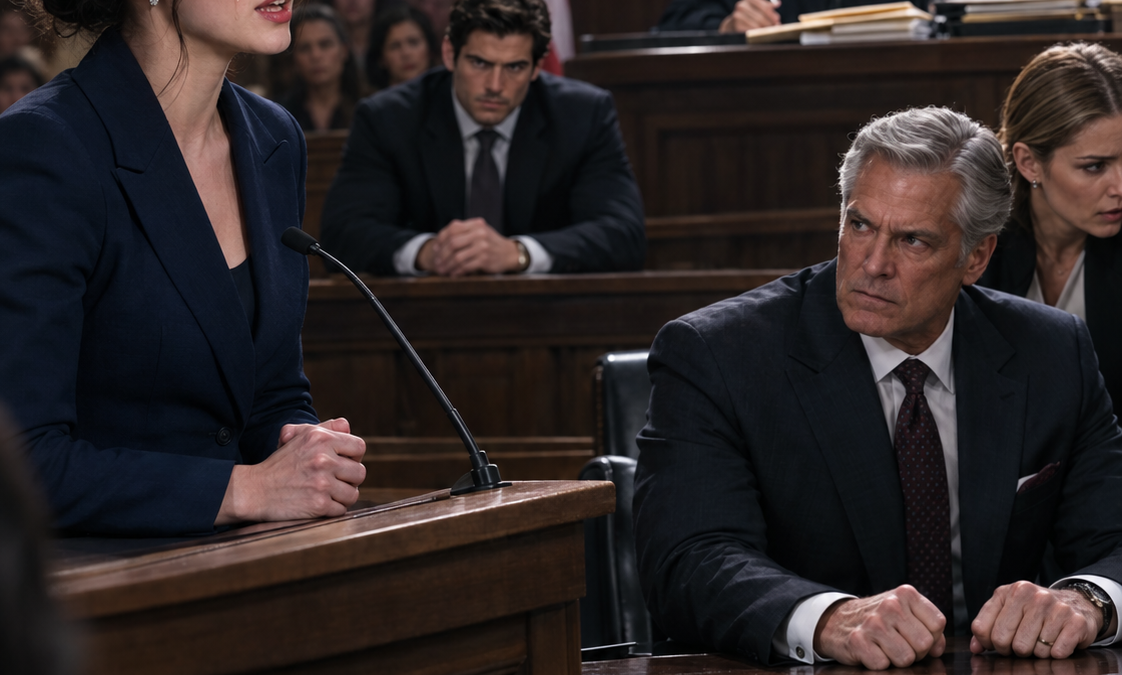
The courtroom was smaller than I’d expected. Just a judge, a clerk, two lawyers, and the parties involved. No jury. No audience. Just the quiet, brutal machinery of the law.
I sat at the plaintiff’s table with my lawyer, a sharp-eyed woman named Diane who’d been recommended by Ronan. Across the room, Victor sat with his own attorney, looking calm and confident and utterly unbothered.
Catherine was in the gallery, watching. Ronan was next to her, his expression unreadable.
The judge, a woman in her fifties with gray hair and a no-nonsense expression, called the hearing to order.
“Mr. Voss,” she said. “You’re petitioning for control of the Voss Educational Trust. On what grounds?”
Victor’s lawyer stood up. “Your Honor, my client believes that his niece, Alexandra Voss, is mentally unfit to manage her own financial affairs. She has exhibited signs of paranoia, delusional thinking, and financial irresponsibility. My client is deeply concerned for her well-being and wishes to protect her interests.”
“Protect my interests,” I muttered.
Diane put a hand on my arm. “Wait.”
The judge turned to us. “Ms. Voss. How do you respond?”
Diane stood up. “Your Honor, my client categorically denies these allegations. Furthermore, we have evidence that Mr. Voss has been systematically redirecting trust funds into accounts he controls — accounts that have nothing to do with Ms. Voss’s education or well-being. We have bank records, financial statements, and testimony from a forensic accountant who has reviewed the trust’s activity.”
The judge’s eyebrow lifted. “Is that so?”
“It is.” Diane handed a folder to the clerk. “We also have a letter, written by Ms. Voss’s father — Mr. Voss’s brother — three weeks before his death. In it, he states that he had proof that Mr. Voss was embezzling from the family trust and that Mr. Voss had threatened his family if he spoke out.”
The courtroom went very quiet.
Victor’s lawyer stood up. “Your Honor, this is a blatant attempt to smear my client with unsubstantiated allegations. The letter is unverified, and —”
“The letter is verified.” Diane’s voice was calm. “We had it authenticated by a handwriting expert. It’s genuine.”
The judge looked at Victor. “Mr. Voss. Do you have a response?”
Victor stood up. He looked at me, and for a moment, I saw something in his eyes — not guilt, not remorse, but something colder. Something calculating.
“This is a family matter,” he said. “A private disagreement between an uncle and his niece. I have always acted in Alexandra’s best interests. I have managed her trust with care and diligence. And I have never —” he paused, and his voice cracked, just slightly “— I have never done anything to harm her.”
“Liar,” I whispered.
Diane squeezed my arm.
The judge looked at the folder, then at Victor, then at me.
“I’m going to take this under advisement,” she said. “In the meantime, the freeze on the trust remains in place. No funds are to be disbursed until I’ve reviewed all the evidence.”
She banged her gavel.
The hearing was over.
We won.
Not completely — not yet. The judge ordered a full investigation into the trust’s finances, which would take months. But she denied Victor’s petition for control. She appointed an independent administrator to oversee the trust until the investigation was complete. And she referred the evidence of embezzlement to the district attorney’s office.
Victor was furious. Catherine was stone-faced. And Ronan — Ronan looked at me across the courtroom, and for the first time since I’d met him, he smiled. A real smile. Warm and proud and full of something that made my heart stutter.
We walked out of the courthouse together.
“You did it,” he said.
“We did it.” I looked up at him. “Thank you.”
“You don’t have to thank me.”
“I do.” I stopped walking, and he stopped with me. “You didn’t have to help me. You didn’t have to risk anything. But you did. And I —” I took a breath. “I don’t know how to repay you.”
Ronan looked at me for a long moment. Then he said: “You don’t repay me. You trust me. That’s all I want.”
The words hung in the air between us.
“Okay,” I said. “I trust you.”
He smiled again — that same warm, real smile — and offered me his hand.
“Then let’s go home.”
I took it.
CHAPTER 9: The Truth
The investigation took three months. In that time, everything changed.
Victor was indicted on charges of embezzlement, fraud, and — after a second investigation — second-degree murder. The evidence against him was overwhelming: the letter, the financial records, the testimony of two former employees who’d been paid off years ago but were now willing to talk.
Catherine was indicted as an accomplice. She’d known about the embezzlement. She’d helped cover it up. She’d been complicit in my father’s death.
The Ashford family imploded.
Ronan handled it with the same cold efficiency he brought to everything. He hired lawyers, managed the press, protected the company. But I saw the toll it took on him — the late nights, the hollow look in his eyes, the way he flinched every time his mother’s name came up in the news.
I tried to be there for him. I made him coffee. I sat with him in the kitchen at 2 a.m. when he couldn’t sleep. I listened when he talked about his childhood, his father, the things he’d seen and the things he’d done.
And slowly, something grew between us.
It wasn’t loud or dramatic. It wasn’t the kind of love you see in movies, all passion and fireworks. It was quieter than that. It was the way he looked at me when he thought I wasn’t watching. The way he saved the last piece of pie for me. The way he said my name — Alex — like it was something precious.
It was the way I felt when I was with him. Safe. Seen. Home.
One night, we were sitting on the terrace, looking out at the city. The investigation was winding down. Victor and Catherine were going to trial in the spring. The trust had been unfrozen, and the court had appointed a new administrator — someone I’d chosen myself.
“I’m going to move out,” I said.
Ronan looked at me. “What?”
“I’ve been here for six months. The case is almost over. I should — I should find my own place.”
“Why?”
“Because I can’t stay here forever. Because I need to figure out what my life looks like without —” I stopped.
“Without what?”
“Without you.”
The words hung in the air between us.
Ronan was quiet for a long time. Then he said: “What if I don’t want you to go?”
I stared at him. “What?”
“I know I’m not — I know I’m not easy. I know I’m controlling, and guarded, and sometimes I don’t say what I mean. But you —” He turned to face me, and his eyes were intense, almost desperate. “You’re the first person who’s ever seen me. Really seen me. Not the CEO, not the heir, not the Ashford name. Just me. And I —”
He stopped. Swallowed.
“I don’t want to lose that,” he said. “I don’t want to lose you.”
I felt tears in my eyes. “Ronan —”
“I know this isn’t the right time. I know we have a trial coming up, and the company is in chaos, and everything is complicated. But I need you to know —” He took my hand. “I need you to know that I love you. I’ve loved you since the moment you refused to sit down in my office. And if you need to leave, if you need space, I’ll understand. But I had to tell you. I had to —”
I kissed him.
It was the first time. The first real kiss, the first real touch, the first real admission of everything we’d been dancing around for months. His lips were warm and soft, and his hands came up to cup my face, and for a moment, the world disappeared.
When we finally pulled apart, we were both breathing hard.
“I love you too,” I said.
Ronan’s smile — that rare, real smile — lit up his entire face.
“Thank God,” he said. “I was starting to think I’d imagined it.”
I laughed. “You didn’t imagine it.”
“Good.” He kissed me again, softer this time. “Because I have plans for us.”
“What kind of plans?”
“The kind that involve you staying. Not as a guest. Not as an auditor. As —” He paused. “As my partner. In every sense of the word.”
I looked at him — at this man who’d started as my adversary, become my ally, and somehow, impossibly, turned into the love of my life.
“Okay,” I said. “I’ll stay.”
“Forever?”
“Forever.”
He kissed me again, and the city lights glittered below us, and for the first time in years, I felt like I was exactly where I was supposed to be.
CHAPTER 10: The Trial
The trial was a circus.
Victor and Catherine had hired the best lawyers money could buy — which, given that their assets had been frozen, wasn’t saying much. The prosecution had the letter, the financial records, and three witnesses who’d agreed to testify against them. The defense had a lot of bluster and not much else.
I testified on the third day.
I’d been dreading it. I’d practiced with Diane, prepared for the cross-examination, steeled myself for the moment when I’d have to look my uncle in the eye and tell the world what he’d done.
But when I got on the stand, something changed. I looked at Victor — really looked at him — and I didn’t feel afraid. I felt angry. I felt sad. But mostly, I felt free.
“Ms. Voss,” the prosecutor said. “Can you tell us about your relationship with the defendant?”
“He’s my uncle,” I said. “He was my guardian after my father died. He was the administrator of my trust.”
“And did you trust him?”
“I did. Until I found out he’d been stealing from me.”
The courtroom stirred.
“Can you explain what you found?”
I explained. The Meridian Holdings account. The redirected disbursements. The years of money that had been meant for my education, my security, my future — all of it funneled into a project that had nothing to do with me.
And then I explained the rest. My father’s letter. The investigation that had been buried. The slow, deliberate poisoning that had ended his life.
When I finished, the courtroom was silent.
The prosecutor turned to the defense. “Your witness.”
Victor’s lawyer stood up. He looked nervous.
“Ms. Voss,” he said. “Isn’t it true that you’ve been working for Ronan Ashford, the CEO of Ashford Capital, throughout this investigation?”
“Yes.”
“And isn’t it true that Mr. Ashford has a vested interest in seeing my client convicted?”
“Objection.” Diane was on her feet. “Relevance.”
“Sustained.”
The lawyer tried a different angle. “Ms. Voss, isn’t it possible that you’re mistaken about your uncle’s involvement? That the financial irregularities you found were simply —”
“No,” I said.
“No?”
“No.” I looked at Victor. “I know what he did. I have the documents. I have the evidence. And I have the letter my father wrote before he died — the letter that proves Victor threatened to kill me if my father spoke out.” I paused. “I’m not mistaken.”
The lawyer sat down.
Victor looked at me, and for the first time, I saw something in his eyes that looked almost like fear.
The verdict came in three weeks later.
Guilty. On all counts.
Victor was sentenced to twenty-five years to life. Catherine got fifteen. The judge called their crimes “a betrayal of the highest order” — the murder of a man who’d tried to do the right thing, the theft of a child’s inheritance, the corruption of a family’s legacy.
I watched them get led away. Catherine didn’t look at me. Victor did. He looked at me for a long time, and I couldn’t read his expression. Regret? Anger? Something else entirely?
I didn’t care.
It was over.
CHAPTER 11: The Inheritance
The trust was restored.
Every penny Victor had stolen, plus interest, plus damages. The court appointed a new administrator — a woman I’d chosen myself, a lawyer with a reputation for integrity. The money would go to my education, my security, my future. And when I had children, it would go to them.
I sat in Ronan’s kitchen — our kitchen, now — and looked at the paperwork.
“I don’t know what to do with it,” I said.
“With what?”
“The money. I’ve spent so long fighting for it, and now that I have it —” I shook my head. “It feels strange.”
Ronan sat down across from me. “What do you want to do with it?”
I thought about it. I thought about my father, who’d died trying to protect me. I thought about the years I’d spent struggling, working, fighting. I thought about all the people who didn’t have a trust fund, didn’t have a safety net, didn’t have anyone in their corner.
“I want to help people,” I said. “People like me. People who’ve been taken advantage of. People who don’t have anyone to fight for them.”
Ronan smiled. “Then do that.”
“I don’t know how.”
“I do.” He reached across the table and took my hand. “I know lawyers, accountants, investigators. I know how to build a foundation. If you want to help people, I’ll help you.”
I looked at him — at this man who’d given me everything, who’d stood by me through the worst months of my life, who’d loved me when I didn’t think I deserved to be loved.
“Why?” I asked. “Why do you do so much for me?”
Ronan was quiet for a moment. Then he said: “Because you’re worth it. Because you’re the best thing that’s ever happened to me. Because —” He paused. “Because I spent my whole life surrounded by people who wanted something from me. And you’re the first person who ever wanted me for me.”
I leaned across the table and kissed him.
“I love you,” I said.
“I love you too.”
We sat there, in the kitchen, holding hands, and I realized that this was what I’d been fighting for all along. Not the money. Not the revenge. This. A life. A future. Someone to share it with.
CHAPTER 12: The Wedding
We got married in the garden at Bellworth House.
It was a small ceremony — just family and close friends. Mrs. Pemberton catered. Marisol was there, and she actually smiled this time. Diane came, and my lawyer, and a few people from the office who’d become friends over the past year.
I wore a simple white dress. Ronan wore a gray suit. The peonies were in bloom.
As I walked down the aisle — such as it was, a path through the garden — I thought about my father. I thought about how much he would have loved this. How proud he would have been.
And I thought about the journey that had brought me here. The betrayal. The fight. The victory.
I thought about the woman I’d been when I first walked into Ronan’s office — scared, angry, alone. And I thought about the woman I was now — still scared sometimes, still angry sometimes, but no longer alone.
Ronan took my hand.
“Ready?” he asked.
“Ready.”
We said our vows. We exchanged rings. We kissed.
And when the judge pronounced us married, I felt something click into place. Something that had been missing for a long time.
I was home.
EPILOGUE: The Trust
Five years later.
The Voss Foundation had helped over three hundred people. Kids whose parents had died. Elderly people whose families had stolen from them. Women whose husbands had hidden assets, men whose business partners had embezzled funds.
We’d won every case we’d taken on.
I was in my office — a small space in a building we’d bought with some of the trust money — when Ronan walked in.
He was holding a folder.
“What’s that?”
“Something I found.” He sat down across from me. “In the archive room. In the back of a cabinet.”
I felt a chill. “What is it?”
He handed me the folder. I opened it.
Inside was a single piece of paper. A letter. My father’s handwriting.
My dearest Alexandra,
If you’re reading this, I’m gone. I’m sorry I couldn’t stay. I’m sorry I couldn’t protect you. But I need you to know — I tried. I tried to do the right thing. I tried to expose the truth.
I don’t know if I succeeded. I don’t know if anyone will believe me. But I need you to know that I loved you. I loved you more than anything. And I would have done anything — anything — to keep you safe.
Be brave. Be strong. And don’t let anyone take what’s yours.
I love you.
Dad
I read the letter three times. Then I looked up at Ronan.
“Where did you find this?”
“In a box. In the back of the archive room. It must have been there for years.”
I held the letter to my chest and cried.
Ronan came around the desk and held me. He didn’t say anything. He just held me, and let me cry, and when I finally stopped, he kissed my forehead.
“He would be proud of you,” he said. “I know he would.”
I nodded. I couldn’t speak.
We sat there for a long time, holding each other, and I thought about my father. About the letter he’d written, the sacrifice he’d made, the love he’d given.
And I thought about the life I’d built. The woman I’d become. The future I was fighting for.
I wasn’t a victim anymore. I wasn’t a pawn. I was a woman who’d fought for what was hers — and won.
And I had the rest of my life to keep fighting.

