Hostage-Takers Chose a Single Dad—The CEO Had No Idea He Was a Former Navy SEAL (Part 1)
Hostage-Takers Chose a Single Dad—The CEO Had No Idea He Was a Former Navy SEAL (Part 1)
PART 1
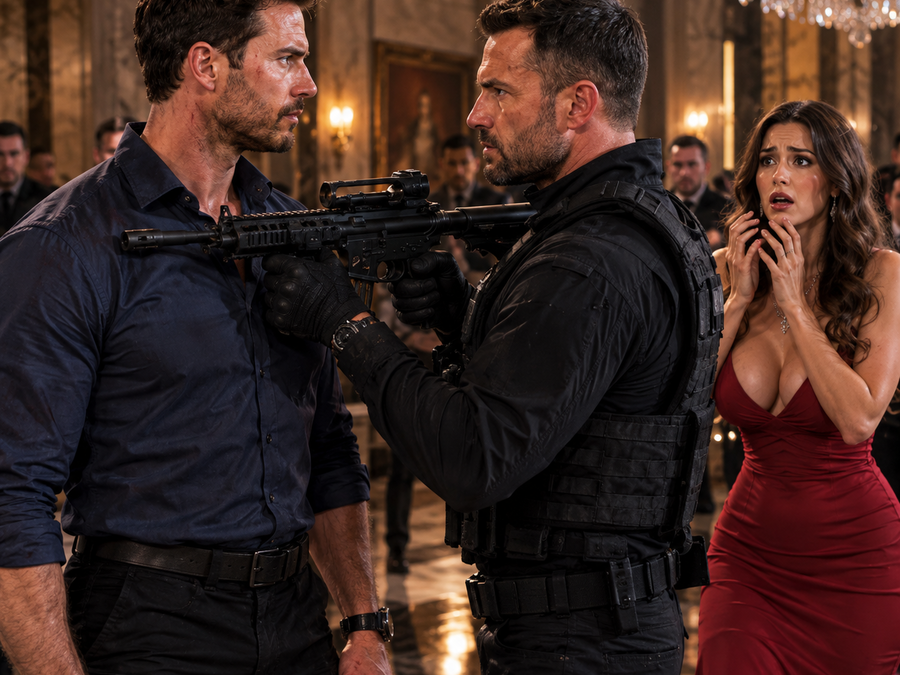
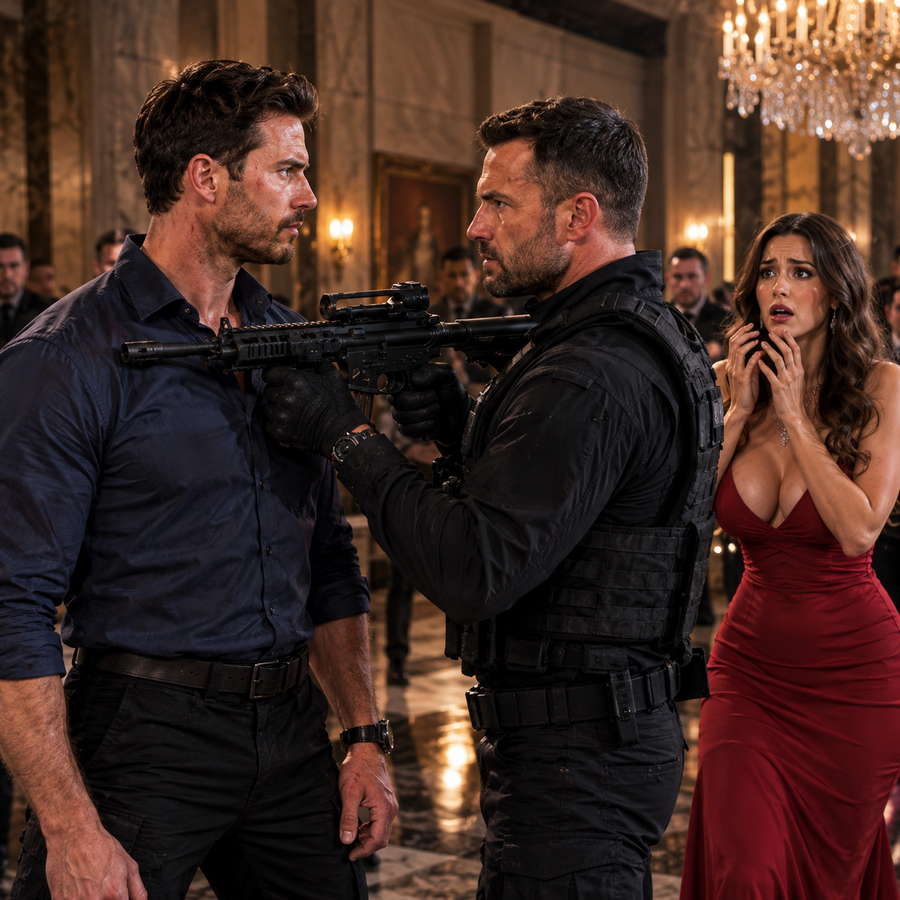
He was on his knees in the center of the ballroom, hands behind his head, a gun pressed against his skull, and he was the calmest person in the room. Six armed men had just sealed every exit. Three hundred guests were screaming, crying, crawling under tables.
The man in the worn charcoal blazer and scuffed work boots didn’t flinch. He didn’t beg. He simply looked across the marble floor to a marble pillar twenty feet away where his nine-year-old daughter was hiding and gave her one small, steady nod. Stay put. I’ve got this.
The hostage takers had chosen him because he looked like nobody. They had no idea they had just made the last mistake of their careers.
The invitation had arrived in a manila envelope with the Crown Mir Foundation letterhead embossed in navy blue, addressed to the families of the East Side Community Learning Center. Bennett Strad had set it on the kitchen counter and walked past it for three days before Tessa found it.
“Dad.” She’d been sitting at the kitchen table doing geometry homework, and she held up the envelope the way she held up interesting rocks she found at job sites, with the focused intensity of someone who had already made up her mind. “We’re going.”
“We’re not going.” “It says formal attire welcome, but not required.” She turned the card over. “And it says there’ll be engineers from Witcom Tech on the guest list. Real ones. Dad, I want to talk to a real engineer.”
Bennett had poured his coffee and looked at her over the rim of his mug. She was nine years old, with her mother’s dark eyes and his stubborn jaw, and she had already decided they were going to that gala. The same way she’d already decided everything else in their lives for the past four years. Firmly, quietly, and without much room for argument.
“It’s a fundraiser in Manhattan,” he said. “Tuxedos and speeches.” “You have a blazer.” “I have a work blazer.” “It’s a blazer.” She went back to her geometry. “We’re going.” They went.
The Crown Grand Hotel occupied an entire city block on Park Avenue. And on the third Saturday of November, it was dressed up the way old money always dressed. Expensively and without appearing to try. Two valets stood at the entrance, looking at Bennett’s twelve-year-old truck the way people look at something they aren’t sure is allowed to be there.
Bennett parked it himself in a public garage two blocks away because he wasn’t going to tip someone twenty dollars to move his truck forty feet. Tessa wore a navy blue dress her grandmother had sent for her birthday and her good sneakers because she’d flatly refused the dress shoes that hurt her feet. Bennett wore the charcoal blazer, a clean white button-down, and his least scuffed pair of work boots because he hadn’t owned dress shoes in five years. And he wasn’t buying a pair for a party he hadn’t wanted to attend.
They walked through the entrance together, and the doorman, to his credit, said nothing about the boots. The ballroom on the fourth floor was exactly what Bennett had expected, and everything he’d hoped to avoid.
Crystal chandeliers, round tables covered in ivory linen, a string quartet in the corner playing something that required a music degree to appreciate. Three hundred people in gowns and tailored suits moving through the space with the practiced ease of people who attended things like this regularly, and knew where to stand to be seen by the right other people.
Tessa looked at it all with wide, fascinated eyes. Bennett looked at the exits. Old habit. It wasn’t something he decided to do. It happened the way breathing happened, the way checking mirrors happened when you drove.
Four exits visible from the entrance. Two service doors on the east wall, the main entrance behind them, and a corridor leading toward the hotel’s upper floors at the northwest corner. Security consisted of two uniformed hotel guards near the main entrance and one plainclothes man circling the perimeter who kept touching his ear. An earpiece, probably connected to someone monitoring the lobby feeds.
Good coverage near the doors. Significant blind spots along the north wall and behind the bar setup on the west side. Bennett had cataloged all of it in the time it took Tessa to spot the shrimp cocktail station. “Can I get some?” she asked. “Two pieces,” he said. “Then we find the engineers.” She took four and didn’t look remotely apologetic about it.
They found the engineers, a pair of women from Witcom Tech’s infrastructure division, who were delighted, then genuinely impressed by the nine-year-old asking them detailed questions about load-bearing calculations in modular construction. Bennett stood slightly to one side and let Tessa run the conversation, which she did with the focused confidence of someone who had spent her entire life on job sites listening to adults talk about structural problems.
He was watching the room. Not the way he used to watch rooms, not with the cold professional distance of a man calculating threat assessments and extraction routes. He was watching the way he always watched now. Quietly. Out of habit. The way you carry an old injury that no longer hurts, but still changes how you walk.
He noticed the catering staff moving efficiently through the west side. He noticed the plainclothes security guard had stopped circling and was now standing near the bar talking to someone. He noticed a cluster of men near the service corridor on the east wall who had arrived together and hadn’t touched the food or the drinks.
He noticed her. Not because she was the most striking person in the room, though she was, but because she was looking at him. Lenora Witcom was thirty years old and had been on the cover of three business magazines in the past eighteen months. Bennett knew her name because Tessa had made him watch a documentary about Witcom Tech’s rural infrastructure programs, and because her face had been in the news enough that it was simply there in the background of modern life whether you paid attention to it or not.
She was standing near the center of the room with a small group of men in expensive suits, nodding at something one of them was saying, and she was looking at Bennett with an expression that was openly curious and not particularly concerned with hiding it. He looked away.
“Your dad is kind of intense,” one of the engineers said to Tessa, not unkindly. “He was in the Navy,” Tessa said simply, as if that explained everything, and then asked a follow-up question about tensile strength in carbon fiber composites.
Lenora excused herself from the conversation with Marcus Ellery, Crown Mir’s board chair and a man who had a gift for turning two-minute pleasantries into twenty-minute monologues, and moved toward the appetizer table because she needed a moment to think, and also because she hadn’t eaten since noon.
She was aware that she’d been staring. It wasn’t something she made a habit of, but the man was strange. Not strange in a threatening way. Strange in the way that certain things in a room were strange when they didn’t belong to the same category as everything else around them.
Everyone at this event was performing something. Performing generosity, performing influence, performing the kind of casual wealth that required significant effort to look effortless. The man near the engineering cluster wasn’t performing anything. He was standing in a four-hundred-dollar ballroom in work boots, watching the room with the quiet attention of someone who had assessed it and found it manageable.
His daughter was interrogating two of Lenora’s senior engineers about carbon fiber, and they were both leaning forward like she was the most interesting person they’d talked to all evening. Lenora almost smiled. She picked up a glass of water. She’d stopped drinking at events years ago when she realized that alcohol at functions like this was an attack on your decision-making, and turned back toward Marcus Ellery, who had found another victim and was already at the seven-minute mark of what appeared to be a story about golf.
She was fifteen feet from the appetizer table when the first service door opened. She thought it was catering staff. It was the kind of entrance you didn’t question at a large event. Doors opening, people moving through with purpose. Nobody looking twice because purposeful movement at a gala always looks like it belongs.
Then the second door opened, then the third. And the men who came through them were not carrying trays. The first sound was a woman’s scream from somewhere near the south wall, high and sharp, and immediately silenced by a second sound. A single hard crack that might have been a gunshot or might have been something struck hard against the floor. And then the screaming spread through the room.
The way fire spreads through dry grass. Fast, consuming, and suddenly everywhere at once. Six of them. Black clothing, dark masks covering everything above the jaw. The two who came through the east service doors moved immediately to flank the main entrance, cutting off the only obvious exit.
The two from the north corridor fanned outward, driving guests away from the walls toward the center of the room. The final pair, including the one who appeared to be the leader, heavier built, moving with the unhurried deliberateness of someone who had rehearsed this, came through the west service door and positioned themselves at the room’s center axis.
Three hundred people collapsed inward like a wave meeting a wall. Bennett moved in the opposite direction. Not toward an exit. The exits were already covered. He’d clocked that in the first three seconds. He moved laterally toward the marble pillar on the north side of the room, and he moved low and fast and against the direction of the crowd, which meant nobody noticed him because nobody was watching anything except the men with guns and their own terror.
He reached Tessa in four seconds. She had pressed herself behind the pillar the moment the screaming started. Not frozen, not panicking. Already moving. He got his hand on her shoulder and put his mouth close to her ear.
“You stay exactly here,” he said. “Pillar between you and the room at all times. You do not move unless I tell you or unless someone is physically taking you. And if that happens, you drop your weight and you scream. Understand?”
She was white-faced and shaking, but her eyes were steady. “Understand?” she whispered. “I’m going to be right there.” He nodded toward the center of the room. “I need you to watch me, not them. Okay?” “Okay.” “Watch me.” She nodded.
He straightened up and turned around, and he made himself look like what he was supposed to look like. A frightened parent. Shoulders up, hands slightly raised, eyes wide. He moved back into the crowd and let himself be swept toward the center of the room with everyone else.
The leader was good. Not military. Bennett had been around enough military men to read the difference in body language, in positioning, in how they handled space. But trained. Disciplined. He moved through the crowd with controlled authority, and when he spoke, his voice was calm, which was more frightening than if he’d shouted.
“Everyone sit down,” he said. “Sit down and be quiet, and no one gets hurt tonight.” The crowd sat. Some of them slowly, some of them immediately, some of them collapsing as much as sitting.
Bennett sat and watched. The youngest of the six was nervous. Bennett had identified him inside the first ninety seconds. His hands weren’t quite steady, and he kept glancing at the leader instead of maintaining his sector of the room. Bad training or bad nerves, or both.
The man on the east wall near the secondary service door was covering an area too wide for one person. There was a blind spot behind the bar cart, about eight feet of coverage that nobody owned. Two of the six had positioned themselves too close together near the main entrance, which meant they were covering the same ground twice.
Three hundred guests, six attackers, and a formation with real holes in it. The leader was searching faces. Bennett had understood this within the first minute. The man wasn’t here for money. There had been no demand, no announcement, no instructions for phones or jewelry. He was looking for someone.
He moved through the seated crowd methodically, scanning, checking, moving on. His attention passed over Bennett the way it passed over most of the men in the room. Briefly. Without interest. Then it stopped.
Across the room near the center tables, Lenora Witcom was sitting upright with the contained stillness of someone who was terrified and refusing to show it. She was wearing a deep burgundy dress that wasn’t designed to make her invisible, and she was exactly who she was, which was something that couldn’t be hidden in a room full of people who knew exactly who she was.
The leader found her, and Bennett understood what the evening actually was. This wasn’t a robbery. It wasn’t random. This was an extraction. Professionally organized, and the target was the woman who’d been looking at him from across the room forty minutes ago with open curiosity in her dark eyes.
The leader moved toward Lenora. One of his men fell in behind him, and the crowd parted ahead of them the way crowds always parted in front of men with guns. Involuntarily. Desperately. Then the leader stopped.
His gaze had shifted. It was moving across the crowd again, slowly, with a different quality of attention. The way a person looks when they’re looking for something to use. It landed on Bennett. Not because of anything Bennett had done. Because of what Bennett was wearing. Because of what Bennett looked like.
The blazer that wasn’t expensive, the boots that weren’t dress shoes, the build that was solid but not remarkable, the face that was unremarkable in a room full of carefully maintained faces. The leader said something to the man beside him. The man beside him looked at Bennett and nodded.
And Bennett understood with a cold clarity that had nothing to do with fear exactly what was about to happen. They needed a demonstration. Something to establish control. To break whatever resistance might be forming in the crowd before it had a chance to organize.
They needed someone expendable. Someone whose removal from the equation would frighten everyone else into compliance and signal to Lenora Witcom that resistance was a worse option than cooperation. They had chosen the working-class father in the cheap blazer because he looked like the person whose death would cost the least.
Two men reached down and grabbed Bennett by the arms. He let them drag him to the center of the room. He let them force him to his knees. He put his hands behind his head without being told, which surprised the man holding him. The hesitation was small, barely a second, but Bennett felt it and filed it away.
He was on his knees in the center of this ballroom now. The gun was cold against the back of his skull. Three hundred people were watching him. The string quartet had stopped. The chandeliers were still blazing overhead, which struck him as absurd. All that light, all that crystal, and everything underneath it reduced to this. One man on his knees and a room full of people who had stopped breathing.
He looked toward the marble pillar on the north wall. Tessa’s face was a pale oval in the shadows. Her eyes were locked on him. He gave her the nod. Small, steady. I’ve got this.
Across the room, Lenora Witcom was already rising to her feet. “Wait.” Her voice was controlled in a way that cost her something. Bennett could hear the effort underneath it. The way you can hear the strain in a cable that’s bearing weight. “Wait. Let him go.”
She stepped forward past the people sitting around her. “I’m the one you want. Everyone in this room knows that, so let him go.” The leader looked at her without expression. “Sit down,” he said.
“He has a daughter here.” She didn’t sit. “She’s nine years old. Let him go and I’ll cooperate. I won’t resist. I won’t delay. I’ll walk out of this building with you right now. But let him go.”
The leader was quiet for a moment. Then he said, “Sit down,” again, with exactly the same inflection. And one of his men stepped toward Lenora, and she sat down because she had run out of options.
The leader turned back to Bennett. “Your daughter,” he said. “Where is she?” And something in Bennett’s chest, some carefully maintained quiet that had held for five years through the renovation work and the school mornings and the parent-teacher conferences and the thousand ordinary days he had built deliberately on top of everything that came before, went very still.
“She left before this started,” Bennett said. His voice was level. “She wasn’t feeling well.” The leader studied him for a long moment. “No,” he said finally. “She didn’t.” He nodded to the man on the east wall. “Find the child,” he said.
And Bennett stopped waiting. The man on the east wall started moving. Bennett watched him from his knees, peripheral vision, not direct attention, because direct attention telegraphed awareness, and he needed them to keep thinking he was what he appeared to be. Scared, confused, a working man way out of his depth in a ballroom he never should have entered.
The gunman on the east wall was the nervous one. The youngest of the six. The one whose hands hadn’t been fully steady since they’d come through the door. He was moving along the north wall now, scanning the crowd, looking for a nine-year-old girl in a navy dress and sneakers.
The marble pillar was twenty feet away. Twenty feet was nothing. Twenty feet was also everything. Bennett did the calculation the way he’d been trained to do it. Fast, without emotion, stripping the problem down to its components.
One man moving toward Tessa’s position. The leader standing four feet behind Bennett with a gun at the base of his skull. Two men flanking the main entrance. One man on the west wall. One man covering the south side of the crowd.
If he moved now, the leader shot him before he covered three feet. If he waited until the nervous one reached Tessa, he lost the initiative and she lost her cover. He needed a window. Something that fractured their attention even for two seconds. He didn’t have one yet, so he did the only thing available to him. He bought time.
“She has asthma,” Bennett said. The leader looked down at him. “My daughter.” Bennett kept his voice flat, stripped of anything that might read as manipulation. “She has asthma attacks when she gets scared. If your man startles her in the dark, she’s going to start wheezing loud enough for everyone in this room to hear. That’s going to panic the crowd.” He paused. “I’m guessing that’s not what you want right now.”
The leader was quiet for a moment. The kind of quiet that meant he was thinking, which was both better and worse than the alternative. A man who didn’t think at all was dangerous in a different way. “Where is she?” he asked again.
“I told you she left.” “You told me she wasn’t feeling well.” The leader crouched down so his face was level with Bennett’s. He had pale eyes, gray or light blue, hard to tell in the chandelier light, and the particular blankness of someone who had trained themselves not to broadcast what they were thinking. “You didn’t say she left.”
Bennett said nothing. The leader studied him for another moment, then straightened up and said something in a low voice to the man standing to his left. The man nodded and moved toward the nervous one on the east wall, intercepting him before he reached the north corridor.
They exchanged a few words. The nervous one’s posture shifted. He pulled back from the north wall and repositioned himself near the bar setup, covering the area he’d been neglecting. The blind spot behind the bar cart closed. Bennett noted it and recalculated.
Lenora was sitting six feet from the couple she’d been introduced to forty minutes ago at the appetizer table. A retired cardiologist named Gerald and his wife Patricia, who had been describing their recent trip to Portugal right up until the moment the doors opened.
Gerald was now sitting with both hands pressed flat on the floor in front of him, as if trying to hold the earth still. Patricia had her face turned into his shoulder, and her shoulders were shaking in the small, controlled way of someone who was crying and furiously trying not to make any sound.
Lenora wanted to reach across and put her hand on Patricia’s arm. She didn’t. Because she didn’t want to draw any attention to the people near her, and because the man with the gun on the south side of the room was watching the crowd with the systematic patience of someone who’d been trained to notice exactly that kind of movement.
She was thinking very clearly. She’d always thought clearly in crisis. It was something she’d discovered about herself at twenty-three during a product recall that should have ended the company before it started, and something she’d come to depend on in the years since.
Emotion didn’t disappear in those moments. It just went somewhere below the surface. Compressed. Available, but not in charge. What she was thinking clearly about was the man on his knees in the center of the room.
He was not behaving like someone who was terrified. He was behaving like someone who was managing a situation. The posture was right. The compliance was right. The surface presentation was entirely correct. But underneath it, something was very, very wrong with the picture.
She’d watched him walk into this ballroom two hours ago. She’d watched him catalog the room the way you catalog a space you’re responsible for. She’d watched the way he’d positioned himself slightly to the outside of the cluster around his daughter, at an angle that kept the room in his sightline.
She’d dismissed it as hypervigilance. A lot of single parents had it. She knew that constant, low-level alertness that came from being the only backup. Now she was revising.
He told them his daughter had left. She’d seen the girl go behind the pillar. She’d watched it happen. A small figure in a navy dress moving low and fast in the wrong direction while everyone else moved toward the center. Smart kid. Trained reaction, or close enough to it that the difference didn’t matter.
And the man on his knees had given her a signal. Small, deliberate, completely controlled. I’ve got this. Lenora did not know what that meant. She knew what it looked like.
She looked at the leader, the heavyset man with the pale eyes, who was running this operation with the calm of someone who had run similar operations before. And she tried to remember everything she’d been taught in the security briefings her chief of staff had been pushing on her for three years, the ones she’d sat through impatiently because she’d always found the threat assessments overwrought. She was revising that opinion, too.
The leader was looking for her. He’d found her. He hadn’t moved toward her yet, which meant this wasn’t a simple abduction. There was a sequence to what he was doing. A setup he needed to complete before he moved to the next stage. The man on his knees was part of the setup. A demonstration.
She tried to interrupt it by offering herself, and it hadn’t worked because the demonstration wasn’t optional. It was necessary. It was the thing that broke the crowd’s resistance before it could form.
She looked at Patricia’s shaking shoulders, at Gerald’s white-knuckled hands, at the three hundred people sitting on an expensive ballroom floor because six men with guns had decided their fear was a tool. Lenora’s jaw tightened. She looked back at the man on his knees.
He was watching the room. Not panicking, not praying, not staring at the gun behind him. Watching.
“I want everyone’s phones,” the leader said, loud enough to carry across the room. “Screens down on the floor in front of you. Do it slowly. If I see anyone attempting to make a call, the man in the center of the room stops being useful.”
The implication was plain enough that no one needed it explained. Phones came out of pockets and clutches across the ballroom. Slowly, carefully, placed face down on the marble floor with the tentative movements of people trying very hard not to make a mistake.
One of the leader’s men moved through the crowd, systematically collecting them in a canvas bag, moving row by row with the efficiency of someone doing a job he’d practiced. Bennett had no phone to surrender. He left it in the truck.
The man collecting phones reached him and stopped, looking down. Bennett opened his jacket with two fingers, slow, obvious, showing the empty inside pocket. The man moved on.
The leader watched all of this with the same unhurried attention. He had a quality that Bennett had encountered before in a certain kind of operator. The ability to appear to be doing nothing while actually managing fifteen things simultaneously. He wasn’t standing still. He was holding the room. Maintaining the temperature of it.
Keeping the fear at exactly the level he needed. High enough to ensure compliance. Not so high that someone panicked and did something unpredictable. He was good at this. Bennett cataloged that, too.
The phone collection finished. The canvas bag was heavy. The man carried it to the west service door and handed it through to someone on the other side. There was a seventh person at minimum running support outside the ballroom. Bennett had suspected it from the beginning, from the precision of the entry timing, and now he’d confirmed it. Seven, not six.
The formation in the room had five active positions now, not six. The man who’d collected the phones had repositioned himself near the entrance corridor. The recalculation adjusted Bennett’s window from impossible to something several categories short of ideal. Still not enough, but closer.
“There’s a little girl hiding somewhere in this room,” the leader said conversationally, as if commenting on the weather. He was addressing the crowd now, not Bennett. His voice carried the particular flatness of a man who had learned that calm was more frightening than loud.
“Navy blue dress, about this tall.” He held his hand at roughly Tessa’s height. “If someone brings her forward in the next sixty seconds, tonight gets considerably simpler for everyone.” No one moved.
The silence was different from before. Less the silence of shock and more the silence of three hundred people collectively deciding something without discussing it. Bennett felt it and was surprised by it and then wasn’t. People were frightened, but the instruction was to produce a child. And even the most frightened people in a room will hesitate before they hand someone a child.
Forty seconds passed. Fifty. The leader’s expression didn’t change. “All right,” he said. He looked down at Bennett. “Stand up.” Bennett stood. “What’s your name?” “Bennett.” “What do you do, Bennett?” “Home renovation. I own a small contracting business.”
The leader nodded slowly, as if this confirmed something. “You brought your daughter to a black-tie fundraiser in work boots,” he said. “She wanted to come. I didn’t have much choice.” Something moved at the edge of the leader’s expression. Not quite amusement, not quite respect. Something between them that came and went too fast to classify.
“She’s behind the pillar on the north wall,” he said. “I know because I watched her go there. I let her go there because I wanted to see what you would do.” Bennett said nothing.
“I have a question for you,” the leader said. “And I want you to think about it honestly, because the answer matters.” He took a step closer, closing the space between them to less than two feet. “Are you going to be a problem?”
The ballroom was very quiet. Bennett looked at the man directly for the first time. Not the peripheral cataloging attention he’d been maintaining, but straight at him. The pale eyes were watchful and patient and completely without malice, which was somehow worse than if they’d shown something uglier.
“I’m a contractor,” Bennett said. “I build things and fix them. That’s all I am.” The leader held his gaze for a long moment. Then he nodded once, stepped back, and said to the man on his right, “Bring the girl.”
Bennett had known it was coming. He’d been tracking the possibility from the moment the leader first asked for Tessa’s location, calculating, adjusting, looking for the thing that would change the math enough to move. He’d been trained in situations that were objectively worse than this. Situations where the variables were more numerous and the consequences of failure were measured in dozens of lives rather than one.
He knew how to hold still when holding still was the right call. He knew the difference between patience and passivity. What he hadn’t known, what twelve years of training and four years of civilian life had not fully prepared him for, was what happened in his chest when the man on the east wall started walking toward his daughter.
It wasn’t fear. Fear was something he understood, something he could manage, a physiological response with a known set of symptoms and a known set of countermeasures. This was different. This was the thing that lived underneath fear. The thing that fear was built on top of. The specific and absolute unacceptability of a particular outcome.
He had no word for it. He’d never needed one before because before Tessa, he’d never had anything that activated it. He had it now. He breathed through it. Slow, deliberate. Four counts in, four counts out. His hands were still behind his head. His posture was still what they expected. His face was still the face of a frightened parent.
The man was ten feet from the pillar. Eight. Bennett looked at the ceiling, specifically at the chandelier directly above the center of the room, a massive arrangement of crystal and iron that caught the ballroom light and scattered it in every direction. He looked at the chain that suspended it, running up twelve feet to a bracket on the ceiling.
He looked at the power cable running along the crown molding on the north wall and the junction box it connected to, and the switch panel behind the bar setup on the west side. Six feet. He looked at the nervous one, repositioned near the bar, covering the west approach, standing with his back partially to the bar setup, and his weight shifted to his left foot. An amateur stance. His right side was exposed. Four feet.
He looked at the leader, standing two feet behind Bennett’s right shoulder. His attention split between Bennett and the operation of extracting Tessa from behind the pillar. Two feet.
The man reached the pillar. There was a pause. Bennett heard the man say something low and presumably intended to be non-threatening. The kind of voice adults use when they’re trying to get children to comply.
And then there was a sound from behind the pillar that was not crying, not screaming, but something sharper. The specific sound of a nine-year-old who has been told to drop her weight and scream and is following instructions exactly.
Tessa’s voice cracked across the ballroom like a crack across ice. High and raw and carrying every particle of terror that she’d been holding since the first service door opened. And the man who’d reached the pillar recoiled by instinct, because a screaming child is one of those sounds the human body responds to before the brain processes it.
And his retreat was only half a step and only for a second, but it rippled. It rippled through the room. The nervous one at the bar turned toward the sound. The leader’s attention snapped left. The two men at the main entrance exchanged a look. The man on the south side of the crowd shifted his weight.
A half second of fractured attention. Bennett moved.
He didn’t think about it the way people imagine trained operatives think about things. In clean steps, in tactical sequences, in deliberate decisions made at speed. The training had burned the thought out of it years ago. What happened was more like the training thinking through him. His body doing what it had done thousands of times in controlled environments and a handful of times in situations that were not controlled at all. Moving before the conscious mind caught up.
He dropped his right shoulder, letting gravity help, and pivoted into the leader’s gun arm. Not away from the gun. Into it. Closing the distance so fast that the weapon became a liability rather than an advantage.
His left hand came up and took control of the wrist. His right elbow connected with the leader’s jaw with the compact violence of something that had been building for the past forty minutes. And the leader went down.
But he was not out. He was good enough to tuck his chin and take most of it on the cheekbone, and he hit the marble floor already trying to recover. Bennett had already moved on.
The man nearest the east wall was three steps away and coming forward, drawn by the commotion. Bennett took the gun from the leader’s hand. It had come free in the fall. The wrist control had made sure of that. And he threw it sideways, not toward the crowd, but away from it, toward the base of the south wall, where it skittered across the marble and came to rest under a table.
Then he hit the man from the east wall. This one was simpler. The man had been moving toward Bennett rather than into a defensive position, which meant his momentum was working against him, and Bennett used it. One hand on the gun arm, one step to the outside, the man’s own forward movement completing most of the work.
He went down hard on his left side, and Bennett put a knee across the back of his shoulder and stripped the weapon before the man had fully processed that he was on the floor. Two seconds, maybe three.
The remaining four, five if counting the leader, who was already getting back up, recalibrated. The leader was faster than Bennett had hoped. The man who’d been near Tessa’s pillar had turned back toward the center of the room. The nervous one at the bar had finally unfrozen and was moving, which was dangerous because nervous men with guns were the least predictable element in any equation.
Bennett straightened up. He had one weapon. The leader had lost his. That left four guns still operational in the room, plus at minimum one outside in support. The crowd was beginning to fracture at the edges. People at the outer ring of the seated group had realized something was happening, and some of them were moving slowly toward the walls.
That was going to complicate things. Moving bodies changed coverage, created new angles, gave the gunmen unpredictable targets to manage. It was a problem. It was also potentially an asset.
The leader touched his cheekbone, already swelling, coloring under the skin, and looked at Bennett with the pale eyes that had lost none of their flatness but had gained something new in them. Something that might have been recalibration. “Okay,” the leader said. His voice was still level. He was bleeding slightly from the corner of his mouth. “Okay.”
He reached into his jacket. He produced a second weapon. Bennett had known there would be one. There was always one. “Here’s the problem you have,” the leader said, and he sounded like a man explaining a math problem to someone who’d gotten the wrong answer.
“You took out two of my men in about three seconds, which is impressive, genuinely. But you’re not going to take out all of us. So now I have to decide whether you’re more useful to me as an example or as a liability.” He leveled the gun at Bennett’s chest. “I’m leaning toward liability.”
“Then you’re thinking about it wrong,” Bennett said. The leader waited. “You came here for her.” Bennett didn’t move toward Lenora. Didn’t gesture. Didn’t draw any additional attention toward her position. “Everything else tonight is overhead. I’m overhead. My daughter is overhead. If I’m dead on this floor, you’ve got three hundred witnesses to a homicide, which makes your exit considerably more complicated than it was forty minutes ago. And the woman you actually came for has a reason to do something unpredictable.”
He held the leader’s gaze. “Live hostages cooperate. People who’ve watched someone get shot don’t.” The calculation was visible if you knew how to read it. The slight pause. The fraction of the leader’s attention that went sideways. Weighing variables.
“Restrain him,” the leader said. Two of his men moved in. They were rougher about it this time, which Bennett had expected. He’d embarrassed them, and men who’ve been embarrassed get physical about it when they have the numbers.
His arms were yanked behind him and zip-tied at the wrists, tight enough to cut, and he was pushed back down to his knees on the marble floor with a hand pressed hard between his shoulder blades. His cheek was bleeding from somewhere. He didn’t remember that happening, which meant it had happened fast. Probably when the floor came up during the brief window when he’d been outnumbered and they’d gotten a hand in.
He could feel it drying on his jaw, tacky and itching in the cold air of the ballroom. His wrists hurt. His knee, the left one, the one that had been bad since an op in a country whose name he no longer used at home, had taken the marble hard and was talking to him about it. None of it mattered.
He was back where he’d started. On his knees, hands behind him, gun at his head. But the formation in the room had changed. Two men were down. The crowd had shifted. The nervous one at the bar was in a different position. And the leader, touching his jaw carefully with two fingers, had looked at Bennett for the last forty seconds with a quality of attention he hadn’t had before.
Bennett had done what he needed to do. He’d shown them what they were managing. He’d let the room see that the man in the work boots was not what he appeared to be. Not because he wanted credit for it, but because three hundred frightened people sitting on a marble floor in a sealed ballroom were going to need to find the nerve to move when the moment came. And people found nerve from evidence. He’d given them evidence.
Across the marble floor, past the seated crowd, past the scattered phones and overturned glasses and one cream-colored evening wrap that someone had dropped in the first seconds of the panic, he could see a small oval face behind the marble pillar. Tessa was watching him.
She hadn’t moved. She was pressed against the back of the pillar with her knees drawn up and her sneakers flat on the marble and her eyes fixed on him with the concentrated stillness of a child who has been told to hold a position and is holding it with everything she has.
He looked at her for two seconds. He let her see that he was upright, that he was aware, that the blood on his jaw and the zip ties at his wrists were information but not the conclusion. Then he looked away from her, because he didn’t want her location in his sightline when things moved again.
He needed to be able to act without looking toward her first, and she needed to stay invisible, and the only way to maintain both was to stop letting his eyes track to the pillar. It was the hardest thing he’d done all evening.
The leader crouched in front of him for the second time, and this time the pale eyes had something new in them. Not anger, not exactly. Something more like a decision being finalized. “I’m going to ask you something,” the leader said quietly, so only Bennett could hear it. “And I want you to understand that the answer changes what happens to your daughter.”
Bennett waited. “Who are you?” the leader asked. Not what are you, not where did you serve. Who are you? The specific question of a man who had just watched something that didn’t fit the category of contractor and was trying to find the category that did.
“I told you,” Bennett said. “Home renovation.” The leader was quiet for his moment. Then he said, just as quietly, “The way you took apart my guy on the east wall. That’s not home renovation.”
“I grew up with three brothers,” Bennett said. “You learn to handle yourself.” The leader almost smiled. It was a thin expression, barely there, and it went away immediately. “Sure,” he said. He stood back up. He spoke at normal volume again. “You want to tell me where your daughter is, or do you want to watch my man find her himself?”
The man he’d sent to retrieve Tessa had returned to the pillar. He was approaching it more carefully this time, from an angle, and Tessa’s scream had bought her maybe another thirty seconds before he worked around to the back of it. Thirty seconds.
The chandelier was directly overhead. The junction box was on the west wall behind the bar. The nervous one was standing five feet from it. Bennett looked at the crowd. The outer ring of people who had begun to migrate toward the walls. He looked at Lenora Witcom, who was watching him with the focused attention of someone who had been watching him all evening and had arrived at a different understanding of what she was looking at.
He looked at the man approaching the pillar. Twenty seconds. He looked at the nervous one standing near the junction box. Weight still on his left foot. Right side still exposed. Gun hand slightly low. He needed ten feet and two seconds. He needed the nervous one to give him a reason.
Then from somewhere in the crowd, a man’s voice. Older, rough at the edges. The voice of someone who had made a decision that frightened him less than the alternative. “Hey, over here.”
The nervous one turned. So did everyone else. And Bennett moved.
The voice came from the left side of the crowd. A man in his sixties, heavyset, in a dinner jacket that had fit him better a decade ago, sitting in the third row back from the center. He’d raised his hand like someone in a classroom, which under any other circumstances would have been almost comic, and his voice had the particular quality of someone who was more afraid of his own silence than of what speaking might cost him.
“Hey, over here.” The nervous one turned toward him. So did the man near the east wall, who’d been recircling after Bennett took down his partner. So did the leader. For exactly the fraction of a second that a sudden voice in a controlled crowd demanded. The involuntary rotation of attention toward an unexpected input.
Bennett was already moving. The zip tie at his wrist was tight, but it was plastic, and plastic had a specific tolerance, and he’d spent the last four minutes working his wrists against each other in small, systematic rotations that the men watching him had interpreted as discomfort rather than preparation.
His hands weren’t free. They didn’t need to be. He came up off his knees in a single motion. Not the kind of move that looked athletic, because it wasn’t. Because his left knee screamed at the marble on the way up and he felt it as a white-hot line from his kneecap to his hip. And he covered the five feet to the nervous one before the man had fully processed that something behind him had changed.
The nervous one’s name, though Bennett would never know it, was Danny Rice. Twenty-six years old. And he had taken this job because the money was better than anything else he’d been offered and because he’d convinced himself it was a professional operation, run by professionals, and that nothing would go wrong. He had been wrong about both things.
He had also, critically, allowed himself to stand for the past several minutes with his weight on his left foot and his right side exposed, because he was watching the crowd and not his own positioning. Which was the kind of mistake that experienced operators did not make and which was the specific mistake Bennett had been waiting for.
Bennett hit him from the right side and slightly behind, driving his shoulder into the junction of Danny’s neck and shoulder. And the impact was hard enough that Danny’s gun left his hand before his brain sent the instruction to hold it.
The weapon hit the bar cart, a sharp metallic clang that cut through the ballroom, and skittered left. And Bennett was already driving Danny into the bar setup, using his weight and forward momentum to pin the man against the polished wood long enough to do what came next.
His hands were still tied. His elbows weren’t. The right one connected with the back of Danny’s skull in the compact, efficient way of something that had been practiced until it required no thought. And Danny Rice went down face-first against the base of the bar cart and stayed there. Three seconds.
Bennett grabbed Danny’s fallen weapon off the floor with both bound hands. Awkward. Functional. Not elegant. And turned. The leader was already moving toward him. Not running. Walking. Fast and deliberate, with the second weapon leveled. And Bennett had a fraction of a second to make a decision about whether to use Danny’s gun and what the consequences of that were.
Three hundred people in a sealed ballroom. Four active gunmen, including the leader. One support position outside. And he made the decision the way he made all decisions in situations like this, which was to choose the option that kept the most variables alive.
He threw the gun. Not at the leader. Sideways and upward, high enough that the arc carried it past the leader’s right shoulder and into the open space behind him, landing with a clatter somewhere in the vicinity of the east wall.
The leader’s attention tracked it. One second. Less. Because a thrown weapon was information. It told you where the threat was going. And information demanded processing, even in people who were trained to manage it.
Bennett had already changed direction. He went left instead of forward, toward the south side of the room, cutting behind a cluster of seated guests who scrambled backward as he came through. He registered a woman’s sharp cry and an overturned glass, someone’s elbow catching his shin.
And he came around the outside of the group and put three people between himself and the leader’s line of fire. Not a shield. He was not using them as a shield. He was using them as cover, which was a different thing. Cover meant the distance and the confusion and the angle made a clean shot impossible without risk. Which meant a man with the leader’s level of control would hold rather than fire.
A shield meant you were putting a body in the path of a bullet you knew was coming. He was not doing that. He was buying distance. He needed distance because the other thing he’d done in the four minutes on his knees, besides working the zip tie, besides cataloging positions and blind spots and the nervous one’s stance, was watch the crowd.
Specifically, the outer ring of the crowd. The people at the edges who’d been slowly, unconsciously migrating toward the walls as the situation deteriorated. The way water finds low ground without deciding to. He’d watched them and he’d seen the thing that crowds always did in situations like this. They sorted themselves.
The ones who were going to freeze had frozen. The ones who were going to panic had already done their panicking and come out the other side of it into a flat, exhausted stillness. And the ones who were going to act when they had a reason to act. They were identifiable if you knew what to look for. The posture. The way the eyes tracked the room instead of the floor. The hands flat rather than gripped.
He’d counted seven, maybe eight. He’d given them evidence back when he’d taken down the two men the first time. He needed to give them something more now. He needed to give them a gap.
The man who’d been approaching Tessa’s pillar had abandoned that mission the moment Bennett came off his knees. He’d repositioned toward the center of the room, which was tactically correct, and also meant Tessa’s position was momentarily unmonitored. Bennett knew this the way he knew where his left knee was. Not by looking, but by tracking.
She was still behind the pillar. She had stayed exactly where he’d put her. He knew this because he knew his daughter. He put it out of his mind and focused on the geometry of the room.
The leader was circling left to get a clear angle. The man from the pillar was moving to cut Bennett off from the south wall. The man at the main entrance, the one who’d been there since the beginning, older, steadier than the others, was staying at his post, which told Bennett something useful. This man had good discipline and a specific assignment, and he was not going to break off from it unless directly ordered to or directly threatened. One fewer variable on the south side.
The fifth active gunman, the one who’d been covering the crowd on the west side, had moved to the center of the room during the confusion and now stood between Bennett and the north wall. Between Bennett and Tessa.
Four active positions. One outside. His hands bound. One weapon somewhere on the east side of the room. The chandelier overhead. The junction box on the west wall behind him, currently unguarded because Danny Rice was face down at the base of the bar cart.
Bennett stopped moving. He let himself be seen standing still. Let the leader get the angle he was working toward. Let the man from the pillar close to within ten feet. “Stop,” the leader said. Bennett stopped. “Get on your knees.”
Bennett looked at the leader. He looked at the gun. He looked at the distance between them, which was eighteen feet, and at the man coming from the pillar on his left, which was nine feet. He looked at the crowd. The outer ring. The ones who’d been watching him. The ones who’d shown him what he needed to see in their posture and their hands.
He looked at Gerald, the retired cardiologist, who was no longer pressing his hands flat against the floor, who was sitting up slightly, weight shifted forward. He looked at the man in his sixties who had said, “Hey, over here.” And who was still sitting exactly where he’d been, watching Bennett with the focused, deliberate attention of someone who had already made his decision and was waiting for a cue.
Bennett did not get on his knees. “I need you to understand something,” he said. Speaking to the room more than to the leader. Loud enough to carry. “There are six of them. Two are down. There are four left, plus one outside. They have specific positions, and if any of those positions moves, there are gaps.”
He spoke fast, but not rushed. The way you brief a team. Clear and sequential. “The one on your right near the entrance is not going to leave his post. That’s his training. Which means the south exit corridor is currently—”
“Shut up,” the leader said. “—the south exit corridor is currently the softest point in this room.” The leader fired. Not at Bennett. A foot to Bennett’s left, into the marble floor. The crack of it enormous in the closed space, and the crowd convulsed backward, and someone screamed, and three people near the south wall stood up.
Stood fully upright. Which was not what the shot was designed to produce. The man in his sixties stood up. Gerald stood up. He was sixty-eight years old and his knees were bad and he’d had a stent put in four years ago. And he stood up in the middle of a ballroom with four armed men in it, because he’d been a cardiologist for thirty-five years and he understood, fundamentally, that there were situations where not acting was its own form of action. And he had stopped being willing to be still.
“Move to the south wall,” Bennett said. “Go now. Move together. Don’t run.” Four people moved. Then six. Then twelve. And the twelve became a flowing edge of the crowd, pressing toward the south wall and the corridor beyond it.
And the man at the entrance, the disciplined one, the one with the specific assignment, held his position exactly as Bennett had predicted. Which meant he was watching the movement and not committing. Which meant the corridor was momentarily unmanned.
The leader was screaming now. The first time his voice had lost its flatness. Ordering his men to contain the movement. And they moved to contain it. And when they moved, they left gaps. Bennett went through a gap. Not toward the exit. Toward the man from the pillar, who had lost his focus on Bennett in the chaos of the crowd movement and was half-turned toward the south wall.
And Bennett covered the nine feet in the time it took the man to process that the target he’d been approaching was no longer in front of him. And what happened in the next four seconds was not clean or impressive or anything that would look good if someone had filmed it.
Bennett had his hands tied and a bad knee, and he’d taken a hit to the face at some point in the preceding minutes, and he was operating on adrenaline and training and the specific, focused ferocity of a man who had one thing he would not allow to happen tonight.
The man from the pillar was larger than Danny Rice and better trained. And he got a hand up in time to deflect the first strike and managed to drive his elbow into Bennett’s ribs, hard enough that something in there shifted. Not broke, but shifted. The kind of impact that was going to make breathing interesting for the next several weeks.
Bennett’s vision went gray at the edges for one second. He hit the man again, harder, with the tied hands functioning as a single blunt object rather than two separate ones. And this time it landed where it needed to land, and the man’s legs went out from under him. He was down.
Bennett straightened up slowly, the gray at the edges not fully gone, the rib making its opinion about deep breaths extremely clear. And he found the gun the man had dropped, and this time he didn’t throw it. He held it with both tied hands, and he turned to face the remaining three.
The room had changed. Not in a dramatic, cinematic way. It wasn’t that the tide had turned, or that the balance of power had shifted cleanly from one side to the other. The room had changed the way a room changes when the temperature in it drops. Gradually, undeniably, and in a way that affected everything in it simultaneously.
Twenty, maybe twenty-five people had reached the south corridor and were moving through it. Another fifty were on their feet, pressing toward the walls, their paralysis broken by the sound of other people moving. The man at the main entrance was still at his post, but he was watching the crowd movement with the expression of someone whose plan was no longer tracking with what was actually happening.
The leader stood in the center of the room. Three of his six men were down. Danny Rice at the bar cart, the first man Bennett had taken out near the east wall, and the man from the pillar, who was currently face down on the marble trying to remember how his legs worked.
The leader had his weapon. The man on the west side had his. The entrance man had his. Three guns, two of them operational and aimed at Bennett, one of them trained on the crowd at the entrance. Bennett had one gun, two tied hands, a bad knee, a compromised rib, and blood that had dried on his jaw and was starting to crack when he moved his face.
The math was not in his favor. It had not been in his favor since the moment he came off his knees the first time. He had never expected it to be.
“Put it down,” the leader said. His voice was flat again. The screaming was gone, which meant he’d recovered, which meant he was dangerous in the specific and focused way again rather than the reactive way. And the reactive way was actually easier to work with.
“You’ve done something tonight that very few people could have done. I’m acknowledging that. But you’re not walking out of here with a gun in your tied hands while I have two men with clean sight lines.” He took one step forward. “So put it down and we end this without anyone else getting hurt.”
“You came here to take her,” Bennett said. Not accusing. Just naming it. “That’s not ending without someone getting hurt.” “That’s not your problem.” “She’s in my sightline. She’s been in my sightline all night. That makes it my problem.”
Across the room, Lenora Witcom had not moved with the crowd toward the south wall. Bennett had registered this in his peripheral vision and filed it away. She was still in the center section. Not standing, but no longer sitting. Crouching slightly, which kept her below the eyeline of the man on the west side.
She’d been watching the crowd move the same way Bennett had watched it, and she’d reached the same conclusion he had about what created a gap and what didn’t. And she’d made the choice not to run for it. He didn’t know why. He didn’t have time to figure it out.
“Here’s what’s going to happen,” the leader said. He seemed to have decided something. “You’re going to lower that weapon, and I’m going to walk out of this building with what I came for, and you’re going to take your daughter home.” He paused. “Or you’re going to keep holding it, and I’m going to shoot you, and then I’m going to find your daughter myself, and at that point I’m going to be irritated, which is bad for everyone.” Another pause. “Those are the options.”
“You’re missing one,” Bennett said. He lowered the gun. Not dropped it. Lowered it. The barrel angling down, both hands visible. The posture of someone complying. The leader’s shoulders released a fraction. Not fully, not completely, but enough. The man on the west side shifted his weight.
Bennett had been watching the chandelier all evening. The chain ran twelve feet up to a ceiling bracket. The power cable ran along the crown molding to the junction box behind the bar, which was currently unattended because Danny Rice was on the floor in front of it.
The junction box had a breaker panel. He’d seen it when he was dragged past the bar setup. A gray metal box with a red switch at the top. The kind of thing that controlled the lighting circuit for that section of the room. The gun he was holding was not pointing at the leader. It was pointing at the junction box on the west wall. He pulled the trigger.
The sound of the shot was enormous. The junction box cracked and sparked and blew, and the chandelier section directly overhead went dark. Not the whole room. Not all the lights. But the central cluster, the main source of the bright, flat illumination that had been filling the ballroom all evening.
What remained were the wall sconces on the perimeter, warm and low, and the ambient light coming from the corridor doors, and the sharp, cold dark of the center of the room where the chandelier had been the primary source. It was not complete darkness. It was the darkness of a room at dusk. Enough to see shapes and movement. Not enough to read faces or take precise aim at a target twelve feet away.
The leader fired. He fired where Bennett had been standing, which was not where Bennett was standing when the bullet arrived, because Bennett had moved left the instant he pulled the trigger. Not far. Three feet. But three feet in reduced light against a changed background was enough to take him out of the exact position and send the shot past his right shoulder into the wall behind him.
He felt the displaced air of it against his ear. Then he was moving again. Not toward the leader. Not toward the exit. Toward the west side of the room. Toward the man on the west side, who had been slightly blinded by the flash of the blown junction box. The same way anyone is temporarily blinded by a sudden bright flash followed by sudden darkness. The eyes taking a second to adjust. And a second was what Bennett had.
This one was fast and ugly and nothing like the clean takedowns that the training scenarios suggested were possible. The man got his weapon up and managed to rake it across Bennett’s forearm before Bennett got inside his reach. And there was a moment, two seconds, three, where they were simply fighting in the low light. Grappling. Neither of them with a clean advantage.
The man strong and experienced and not going down from the first or second impact. Bennett’s rib was talking very loudly now. He ignored it and drove his forehead into the bridge of the man’s nose. The man’s grip broke. Bennett stepped on the dropped weapon and kept moving.
The leader was circling. The entrance man was still at his post, still the discipline of him. But he was watching the west side of the room rather than the crowd at the entrance, which was the gap. And the crowd near the entrance felt it the way crowds feel things collectively without coordinating. And the people nearest the main door began pushing through it.
The noise in the room was enormous now. Screaming and shouting and the sounds of people moving in a space that had been kept violently still for forty minutes, suddenly finding its own momentum.
The leader was shouting into a radio or a phone, something compact that he’d produced from inside his jacket. And Bennett couldn’t hear the words, but he understood what the call was. Extraction request. Plan B. Something had gone wrong.
Something had gone wrong. Three men down and one neutralized. The crowd moving. Two exits opened. And one man in a charcoal blazer and work boots standing in the low center of the room with his hands still tied and a rib that needed medical attention and blood on his jaw, between the leader and the woman the leader had come to take.
The leader looked at Bennett. Bennett looked back at him. “She’s not leaving with you tonight,” Bennett said. His breathing was not right. The rib made sure of that. And he was aware that he sounded less composed than he’d sounded twenty minutes ago, which was fine because he was less composed than he’d been twenty minutes ago.
He was human, and he’d been fighting for forty minutes with his hands bound, and he hurt in specific and detailed ways that he was going to have a lot of time to think about later. “She was never leaving with you tonight.”
“You can barely stand up,” the leader said. “Yeah,” Bennett said. “I know.” Outside, finally, distant, but getting louder the way sirens always got louder in a city, arriving from everywhere at once, the sound of police.
The leader’s jaw tightened. He looked at his radio. He looked at the two remaining men, one at the entrance beginning to back away from the pressing crowd, one on the west side recalibrating from the floor. He looked at the exits, the doors pushing open with the weight of people streaming through them.
He did the math the same way Bennett had been doing math all evening. He came up with a different answer. He ran. Not toward Lenora. Toward the north corridor. The one Bennett had cataloged at the beginning as the route to the hotel’s upper floors. He went through the door at a dead sprint, and the man from the entrance was four seconds behind him, and the man from the west side pulled himself off the floor and followed, and then they were gone.
The ballroom suddenly was a different room. The screaming didn’t stop immediately. It never does. The sound has its own momentum, and it runs for a while after the reason for it has ended. But it changed. It became less sharp, less controlled terror, and more the release sound of people who had been holding something for a very long time and could finally let it go.
Bennett stood in the center of the room and breathed carefully. Short breaths, because the rib required short breaths, and he was aware of every single one of them in a way that he normally was not. The zip tie at his wrists had cut into his skin, and both hands were slightly numb, and the cut on his jaw had reopened at some point in the last ten minutes and was doing something new and warm down the side of his neck.
He looked at the north wall. The marble pillar was twenty feet away. He was walking toward it before he made the conscious decision to walk, his legs doing it the way his body had been doing things all evening, ahead of the thought, driven by something below decision-making.
He walked past overturned chairs and dropped phones and a woman sitting against the east wall who was crying with her face in her hands. He stepped over Danny Rice, who was conscious and blinking at the ceiling and not in any condition to be a problem. He walked the twenty feet that had been everything and nothing all evening. That had been the constant background calculation. The fixed point he was always measuring from.
He reached the pillar. Tessa was pressed against the back of it with her knees pulled up and her sneakers flat on the marble. The same position she’d been in for most of the last forty-five minutes. Her face was white and streaked from crying she hadn’t made any sound about. Her dress was dusty from the floor.
Her eyes, when they found his face, were doing something complicated. Relief and terror and something very young trying very hard to look older than it was. She looked at the blood on his jaw, at the zip tie on his wrists, at the way he was holding his left side slightly. Not enough for most people to notice. Enough for her to notice, because she’d been watching him her whole life.
“Dad,” she said. Her voice was rough and very small. Just the one word. “Hey.” He crouched down in front of her, which cost him something in the rib department that he didn’t show on his face. “I told you to watch me, not them.” “I watched you,” she said. “The whole time.”
He didn’t say anything to that. He pulled her forward carefully, mindful of his wrists, adjusting the angle, and she pressed her face into his shoulder, and he held on. And neither of them said anything for a moment because there wasn’t anything that needed to be said.
She was shaking. He could feel it. Small, continuous tremors running through her shoulders and arms. The body doing what bodies do after sustained terror. The adrenaline finding its way out. He was shaking too, slightly, though he wouldn’t have admitted it if asked. Different cause. Same release.
“Are they gone?” she asked, muffled, her face still against his shoulder. “The police are coming,” he said. “Yeah, they’re gone.” She pulled back and looked at him directly. Her mother’s dark eyes, serious and assessing, checking him the way she always checked him when he said he was fine.
“The zip ties cutting into your wrists,” she said. “I know.” “The cut on your face is still bleeding.” “I know that too.” “Your rib,” she started. “Tessa—” “You’re holding your left side.” “Tessa, I’m okay.”
She looked at him for another long moment with the expression of someone who was nine years old and not remotely convinced, but had decided to accept the answer for now. “Okay,” she said. She reached up with one hand and pressed her palm flat against the uninjured side of his jaw. A gesture so specific and so familiar that it knocked the air out of him more effectively than the rib had, because it was the gesture she’d been making since she was four years old.
The one she’d developed on her own as a way of holding his face still so she could look at him properly. And he had never told her what it meant to him, because there wasn’t language for it that didn’t sound like too much. “Okay,” he said.
From somewhere behind them, across the ballroom, past the overturned chairs and the scattered phones and the places where things had happened tonight that were going to take a while to settle into memory, a voice. “Is she all right?”
Bennett looked up. Lenora Witcom was standing eight feet away. She was not entirely composed. Her dress was creased from sitting on the floor. Her hair had come partially down from whatever arrangement it had started the evening in. And there was a small cut on her palm that she either hadn’t noticed or had decided wasn’t the priority.
She was looking at Tessa with an expression that was trying to be professional concern and was something more personal than that. Tessa looked at her, then looked at her father. “She’s the one they were here for,” Tessa said. It wasn’t an accusation. Just the observation of a nine-year-old who had been paying attention.
“Yeah,” Bennett said. Tessa considered this for a moment. Then she looked back at Lenora and said, with the direct simplicity that was entirely her own, “Did you get hurt?” Lenora blinked. “No,” she said. “No, I’m—I’m fine. Are you?”
“I’m okay.” Tessa thought about it. “My dress is dirty.” Lenora looked down at the navy blue dress, dusty from forty-five minutes against a marble floor, and something moved across her face that was not entirely controlled. “I’m sorry about that,” she said. “It was already kind of old,” Tessa said generously.
Outside, the sirens arrived. No longer distant. Loud, and immediate. The red and blue light beginning to stutter through the tall windows on the east side of the ballroom, painting the marble floor in irregular flashes that made the whole room look briefly like something from a different world, and then gradually like itself again.
Bennett looked at his daughter’s face, lit red, then blue, then red again in the strobing light. Dirty dress and steady eyes and the palm still pressed against the side of his jaw. He breathed carefully. The rib complained. He ignored it.
“Come on,” he said. “Let’s go find somewhere to sit that’s not the floor.” She stood up, brushing marble dust off the back of her dress in the practical, no-nonsense way she did everything, and took his arm, threading her hand through his tied ones, and they walked back across the ballroom together while the sirens filled the street outside.
And the lights came, and the long, complicated business of the aftermath began. Lenora Witcom watched them go. Her hand, the one with the small cut, was pressed against her side, and she was very still in the way of someone who has just processed something that does not yet have a category in their experience and is waiting for the category to form.

