“Check That Desk, Sir!” —The Maid’s Daughter Warned the Mafia Boss. Seconds Later, He Turned Pale (part 2)
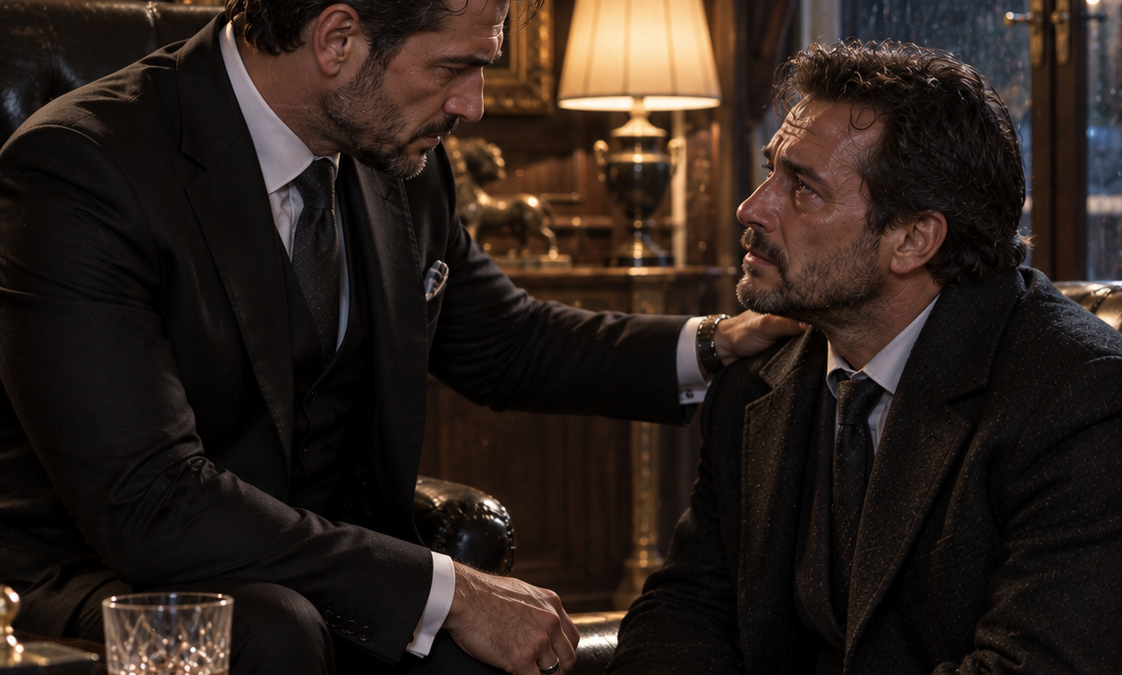
Part 2
Luca is 8 years old. She likes to draw. She drew a picture of you and me and your father standing next to each other.
She has never even met your father. She only knows him from the way I have talked about him, and she put it on the refrigerator with a magnet shaped like a strawberry.
If I die tonight, I need you to keep that drawing. Do not let Elena throw it away when she is going through my things.
It took her 3 weeks to finish.
She kept starting over because she could not remember what color your father’s eyes were, and I would not tell her because I wanted her to decide.
Alessandro nodded. I will keep it.
Victor’s eyes had not yet touched Aleandro<unks.
He was looking at some point between them, at the wooden floor, at the middle distance where a man sees the faces of the people he loves when he is far from them. Elena is afraid of the dark. From the time she was six, her father used to lock her in a store room behind their apartment when she did anything wrong.
Once he left her there two nights because she had lost a nickel. She has never told anyone, only me. Even now, she keeps the hallway light on when she sleeps.
After tonight, do not let her sleep alone in a dark house. If I do not come back, send her to my mother in Queens.
My mother will leave every light in the apartment on all night for her. My mother has done it before when Elena has stayed there.
She will not ask questions. Aleandro listened.
He did not interrupt, but his fingers out of Victor’s sight closed around the arm of the borrowed chair until the knuckles went white and none of it reached his face.
This was not a man bargaining. This was not a man pleading.
This was a man giving his last will and testament in fragments from memory without paper, item by item. Each item small enough that a lesser listener would have thought it trivial. Each item was in fact unbearable because each item was proof that Victor Romano had lived for three days with the certainty of his own death.
And inside those three days he had thought through every small thing he would leave behind in the order of the people who would miss it. Victor breathed in again. His voice did not shake yet, but it was thinning.
The cross your father gave me. Give it back to Lucia. Tell her that the godfather she never met wore it before her father did.
Tell her that her father tried to live worthy of it for 15 years and failed once. At the end, do not defend me. Do not soften it.
Just tell her the truth. When she is old enough to understand, she will understand. My daughter is smart.
She will not need it dressed up. Aleandro cut in.
You will hang it around her neck yourself. On the day of her wedding, Victor lifted his eyes for the first time and looked directly at him.
There was something in his gaze that flickered, not hope. He did not permit himself hope.
He had spent three days making himself unable to hope, but something adjacent to it. Something that had lived just underneath hope for those three days without a name.
“If you are kind enough to let me live until that day,” he said quietly.
Alesandro did not answer that. He did not want to answer it yet.
He had made his decision hours ago in this room alone, watching a screen. But the decision needed a floor of truth beneath it before it could be spoken aloud.
And the floor was still being laid, sentence by sentence in Victor’s own voice.
Go on, Allesandre said. Tuesday afternoon, Victor nodded.
He drew in one more breath deeper this time. The breath of a man preparing to walk into a room he had walked out of 3 days ago and had been walking out of over and over every hour since.
And he began at the beginning. He began with the phone call at 3:00 and the ordinary voice of his wife telling him she would be home before 5. And the last thing she had said to him before she had hung up, which had been the same thing she always said before she hung up five words that he had heard thousands of times in nine years of marriage, and had never, until this week, understood were the kind of words a man could hear for the last time on any given afternoon without knowing.
He told it plainly without dressing. As he spoke, Allesandro did not move, not once.
He did not shift in the borrowed chair. He did not glance at the walnut desk. He did not look at the tall French windows where the rain kept its patient rhythm.
He kept his eyes on Victor’s face, and he kept his hand where it had been for the last several minutes, resting lightly on the shoulder of a man who was giving him a widow’s testimony from inside a still living body.
The silver crucifix beneath Victor’s collar caught the lamplight every time his chest rose to breathe.
It rose. It fell. It rose again, and Alessandro knew with the same private certainty he had carried since the hidden footage had ended three hours before that the decision had already been made.
It had been made in the 4 seconds of Victor’s bowed head on that recording.
It had been made in the moment Victor had knelt a second time in this room without being asked. It had been made in the sentence about the hallway light in Queens. He only needed Victor to finish speaking, so that the justice he was going to deliver would rest on ground made entirely of truth, and not one inch of it on assumption.
He let his hand stay where it was. He let Victor keep talking.
He began at 3:00 on Tuesday. His voice was flat now, the voice of a man reading from a report he had been forced to memorize, one that no longer sounded to him like it belonged to his own life. Elena had called from the sidewalk on Malbury Street.
It had been an ordinary Tuesday. She and Lucia had gone to Little Italy the way they always went to Little Italy on Tuesdays, to the small grocery three doors down from the bakery to buy the ingredients for the lasagna she made every Sunday.
It was Victor’s favorite meal.
She had been making it for him for 9 years. She had told him she was picking up ricotta and San Marzano tomatoes and Lucia had asked to stop at the toy shop on the corner and Elena had promised her 10 minutes and no more.
She had said she would be home before 5. She had ended the call the way she always ended calls with him. I love you.
Come home early. He had never counted in 9 years of marriage how many times he had heard those five words.
If she had asked him at the beginning of that week, he would have said several thousand. He would not have said they were the kind of words a man could hear for the last time on any ordinary Tuesday afternoon without knowing. At 4:25 in the afternoon, he had been sitting in a small conference room above a shipping office on Court Street, listening to five cappos discuss the price structure of the Brooklyn docks.
His phone had lit up on the table, an unknown number, not a call, a message, a single photograph attached. Elena was tied to a wooden chair.
Her eyes were bound with a black cloth. She was sitting in a room he did not recognize. Bare walls, a single overhead bulb, the floor of a place that had once been an industrial store room and had not been swept in years.
Beside her sat Lucia. His daughter was wearing the pink cardigan Aleandro had given her the previous Christmas, the one with the small pearl buttons that Elena had had to sew back on twice because Luchia refused to take it off even to sleep.
Lucia’s face was the color of paper.
Her mouth was covered with tape. Her small wrists were tied to the arms of a chair too large for her.
Beneath the photograph was one line of text. Wait for the call.
Tell no one. If this phone is switched off or if you contact anyone, both of them are dead in 10 minutes.
Victor described the moment to Alisandre without decoration. He had sat in that room for another 20 minutes, surrounded by five men of the Moretti family who were arguing about the tariff on olive oil shipments and laughing over an anecdote from a warehouse in Red Hook.
He had kept his face still. He had nodded at the right places. He had answered when he was addressed, and later he would not be able to remember a single word he had said.
He had used the 20 years he had spent in this life, and the 15 years he had spent at Alessandro<unk’s shoulder, and every lesson Alessandro<unkre’s father had ever taught him about how to keep his face empty.
And he had used all of it in one long, silent expenditure to survive that 20 minutes.
When the meeting had ended, he had walked to the men’s room on the second floor of the shipping office.
He had locked the stall. He had sat on the closed lid of the toilet for 4 minutes with the burner photograph phone in his hand.
And he had thought very carefully about who he could call Aleandro, Tony, the capo across the table who had loved him as an uncle, the priest at St.Anony’s, his own mother in Queens.
And he had understood one name at a time that any single call would kill both of them in 10 minutes. He had understood also that whoever was watching him was watching him well enough to know when a phone was off, which meant he was being watched.
Now, at that moment, in the second floor men’s room of a Court Street shipping office, he had stood up.
He had walked out. He had bought a burner phone in cash at a bodega on Atlantic Avenue because the message had told him to.
The call came at 6:08 in the evening. The voice on the other end did not introduce itself.
It did not need to. Victor recognized it inside the first two syllables.
He had sat across a table from it twice in the last year at two of the periodic sitdowns between the eastern families. He had watched it smile behind a tumbler of imported grapa.
Leonardo Russo, the head of the Russo family, the Moretti’s principal rival for two years running.
A man who had wanted the eastern seabboard for a decade and had made no secret of it. Leonardo had made three demands.
One, a block of military grade C4 was to be placed in Aleandro Moretti’s private study beneath the walnut desk before 8:00 on Friday night.
The device would be delivered to Victor by disguised courier on Thursday evening. He would receive detonation instructions with it. Two, Victor was to speak to no one, not a phrase at his own dinner table about feeling unwell, not a note written and torn up, not a single behavior that would allow Aleandro to sense at even 1% that something was wrong.
15 years of a face Allesandre could read in his sleep, and Victor was to hold that face perfectly still for three days. Three, Victor was to report twice a day at 6:08 in the evening and 11 at night by calling back on the burner. Each call was to consist of a single coded phrase memorized.
If a report was missed, if the timing was off by more than 4 minutes, the punishment would be visible in the next video. In exchange, after the bomb detonated and Allesandre was confirmed dead, Elena and Lucia would be released unharmed within two hours at an address in Queens. Victor had not believed it.
He had known in the same 3 seconds it took Leonardo to finish the third condition that the release would never happen. Leonardo Russo did not leave witnesses. He did not leave loose ends.
Two women who had spent 72 hours inside his safe house would not be returned to walk the streets of New York and speak about what they had seen. But he had also known in the same 3 seconds that a small chance was a chance and that no chance at all was no chance at all.
And he had chosen the small chance. He told Alessandro next about the videos. Every 2 hours for 3 days, a new video had arrived on the burner phone, 37 in total.
He had watched each one. He had to because Leonardo had built the instructions into the videos themselves.
Small operational details buried in the last 30 seconds of each recording. adjustments to timing to courier drop points to the shape of the report he was to give at the next call.
Missing one video meant missing one instruction.
Missing one instruction meant one of Lucia’s fingers.
That had been the rule. Leonardo had said it once. At the end of the first call, in the same tone a man might use to describe the terms of a business lease.
Allesandro listened. He did not interrupt. His fingers resting on the arm of the borrowed chair had gone completely white around the wood.
His face did not move. Victor reached inside the breast pocket of his black wool coat.
He took out the burner phone, small, cheap, its plastic casing scratched in one corner from being dropped on a Brooklyn kitchen floor at some point in the last three nights. He set it down on the walnut desk between them. On the same wood beneath which, 9 hours earlier, he had knelt to press a block of gray C4 into the inside corner.
He looked at Aleandro. His voice was steady, but it was the steadiness of a man who had emptied himself of everything except one final sentence.
You do not have to watch all of them. But if you need to see, they are there.
All 37. I did not delete a single one. I did not dare.
Aleandro reached out and picked up the burner phone from the walnut. It was light, cheap, the kind that was purchased in cash and thrown away in a river.
A cracked corner, fingerprints on the screen that would tell nothing. He tapped the display awake.
There was no password. Leonardo had forbidden Victor to set one so that at any moment without warning, he could demand a screenshot of any folder, any conversation, any file, and receive it within 30 seconds. Privacy had been the first thing taken.
The video folder opened at his touch. 37 files arranged in chronological order, timestamped down to the minute.
Each icon showed a tiny frozen frame, no larger than a thumbnail. He did not need to enlarge them to know what they contained.
He did not open all 37, but he opened enough. The first Tuesday afternoon, 4:20 in the afternoon, Elena was tied to the same wooden chair he had seen in the still photograph.
Her face was still whole. There were no bruises yet. Her jaw was set.
Her breath was coming through her nose in short, furious pulls, and even with the black cloth over her eyes. Aleandro could see the shape of the woman she was, the woman he had known for nine years, the woman who had stood at the top of a church staircase in a white dress and had reached out to grip his sleeve for balance a moment before she had walked down the aisle to Victor.
The woman in that first video was awake. She was angry. She was still fighting.
The 10th, Wednesday morning, something had changed. There was a purple swelling closing her left eye.
Her lower lip was split. The angle of her shoulders was different. A woman who has stopped bracing against what is coming and has begun instead to conserve.
She was no longer fighting. Her head was down. Her fingers still bound to the arms of the chair were no longer moving.
The 27th Thursday afternoon, she was whispering to someone off camera. The words came out through the swelling of her mouth, thick and uneven.
My love, do not do it. Do not do it for me.
Do not do it for our daughter. Aleandro is your brother. Do not.
The sound of the slap cut her off. Her body pitched sideways in the chair.
The camera stopped. The 34th Friday at noon.
Today, 9 hours ago, Lucia alone. The 8-year-old girl in the pink cardigan sat in a chair too large for her.
The tape gone from her mouth this time. Her small hands were still bound. Her hair was tangled.
The man off camera held a knife with a black handle. He did not cut her.
He only rested the flat of the blade against her cheek slowly, carefully letting the cold of the metal reach her skin, letting her feel exactly what it was and exactly what it could do. She was crying so hard her whole small body was shaking.
Baba, please, I want to go home. Baba. Aleandro set the burner phone down on the walnut desk.
He did not watch the remaining three videos. He did not speak.
He could not speak. His fingers had closed around the edge of the borrowed chair with the strength of a man who did not know he was tightening them, and the knuckles beneath the skin had gone white, but his face did not move. He had been trained not to let it move at 12 years old.
In this same room by his father, and the training held now, the training held under fire in the way it had been designed to hold, because if the face went, the man went with it, and the man was needed for what came next.
But his eyes, for half a second before he pulled the boss’s control back down over them half a second, no more his eyes gave Victor something no man in this house had ever seen in 20 years.
They gave him the sight of the man beneath. They gave him the rupture. Victor lowered his head.
He did not wait for a verdict. He spoke quietly. And now his voice was neither steady nor performative.
It was the voice of a man releasing what he had been carrying alone for 3 days. 3 days.
37 videos. I have not slept.
I have not eaten. On the second night, I stood in our bedroom with a pistol in my hand and thought about putting it under my chin.
I did not do it. I could not do it.
Leonardo told me on the first call, “If I die before the job is done, Elena and Lucia die within the hour.”
He stopped. He drew a breath that did not fill his chest. Then his voice broke completely.
He kept going anyway. This afternoon, when the house closed the study for 30 minutes for the cleaning rotation, I came up the stairs. The device had arrived by parcel last night.
I put it under the desk. This desk, the one right next to my knee now.
I armed the detonator. I set the timer for 20 minutes. Keyed to 8:00.
Then I walked out. I went down the back stairs.
I sat in my own car in the garage. I waited. Loyalty is not a promise made once and framed on a wall.
It is a debt that either party can be forced to renegotiate at any hour of any night. The question is never whether the loyal will stay loyal.
The question is what the enemy is willing to hold hostage and how long the loyal can endure before something inside them finally breaks. Aleandro rose from the borrowed chair. He walked to the tall French window.
He did not speak. He stood with his back to Victor and his hand flat against the cold glass.
And outside the March rain kept striking the pain in the same patient rhythm it had kept for hours.
Behind him in the visitor’s chair, Victor sat with his head bowed.
The silver crucifix beneath his collar caught the lamplight each time his chest rose to breathe. It rose.
It fell. It rose again.
Aleandro stood there for a long moment. Then he turned.
He crossed the polished floor back to Victor. He did not sit down again.
He stopped in front of the chair and looked down at the man sitting in it, and in his eyes there was no longer a boss. There was only the older brother he had once been, and had almost let himself forget how to be.
There was no verdict on his face. There was no forgiveness spoken.
There was no sentence handed down. He simply reached out his hand. He took Victor by the upper arm and lifted him out of the chair, firm, steady, the way a man lifted a brother who had fallen.
And he said the three words Victor had not permitted himself in 3 days to dream of hearing. We are going.
Aleandro did not remove his hand from Victor’s arm.
He kept it there a firm, steady grip on the upper shoulder for a full 10 seconds. He held on the way.
A brother holds a brother who has just been pulled out of deep water and has not yet remembered how to stand on his own weight. Victor did not speak. He did not need to.
The tremor had begun to go out of his legs. The silver crucifix beneath his collar rose and fell in a slower rhythm now.
Then Alessandro turned, crossed the room, and pulled open the study door. Tony was standing exactly where he had been placed, three paces down the hall, out of sight of the doorway, close enough to be summoned by a raised voice, far enough to hear nothing that had passed inside. The four escorts stood at the far end of the corridor, hands folded, eyes forward, none of them turned their heads as the door opened.
“Tony!”
inside. Tony crossed the threshold. He closed the door behind him with the same care he had used every time he had entered this room in 18 years.
Then he saw them. Victor was standing beside the walnut desk, not kneeling, not restrained.
The silver crucifix was still around his neck. His shoulders were still lowered, but no longer collapsed.
Aleandro<unk’s hand was no longer on him.
It was resting on the surface of the desk. But the space between the two men had rearranged itself in the last 20 minutes into something Tony did not need to be told. The meaning of Tony did not ask.
He waited.
Alessandro<unk’s voice when it came was low and even.
Victor is not a traitor. Elena and Lucia are being held by Leonardo Russo in the Bronx. We have 6 hours before sunrise to bring them home.
Prepare a full strike team tonight. Tony did not blink.
He had learned in 18 years that a boss’s order arrived in one of two forms.
The form that permitted questions and the form that did not.
Tonight’s order was the second.
He nodded once. How many men?
16. No one from outside the family. There is no time to screen for a second betrayal.
Full ordinance. Bronx maps.
Thermal optics. Body armor. Breach grade C4 for a steel door.
A medevac helicopter staged 2 km off the objective. Running hot. Direct to Mount Si.
Dr.Rossi meets it there. Have him told inside the next 10 minutes.
Tony committed each item to memory in the order Aleandro had spoken them. He did not ask about Leonardo.
He did not ask about the rules of engagement.
Both had been made clear by the sentence, “Bring them home.”
Understood. He crossed the room, opened the door, and left.
Aleandro turned back to the walnut, rolled across its surface now was a wide folded map of the Bronx, one of the tactical maps kept in the basement of the estate, laminated, marked with the old boundaries and utility lines of a burrow Aleandro had not personally walked in 12 years.
One of the three loyal capos had carried it up during the last stretch of Victor’s testimony and had laid it there without speaking a word, and Alessandro had not looked up to acknowledge him.
The map had waited beside the burner phone until now. Allesandro spread it flat with the heel of his hand. Victor stepped forward.
There was a hesitation in him at first, the last remnant of the man who, 5 minutes earlier, had been kneeling beside this same desk, waiting to be executed against it. Then the hesitation passed and the operator returned. He put one finger on the map on a stretch of industrial waterfront in the South Bronx and began to speak.
He described the safe house. He described how he had come to know it piece by piece. In 3 days of listening for anything Leonardo did not mean to give away a remark about the smell of iron in the walls, a stray reference to the eastern basement in one of the later videos.
The sound of water dripping through pipes in the background of a call. The rhythm of a subway line audible only in one narrow slice of the Bronx.
An old munitions warehouse from the Second World War converted decades later into a Russo staging facility. Three floors, six ways in two subterranean egress tunnels through the storm sewer system at least 20 armed men, probably more tonight given how close Leonardo believed himself to be to victory. The holding cell for Elena and Lucia was in the eastern basement near the shell of an old water storage tank.
Leonardo in one of the middle calls had said it near the old water tank eastern side. Keep them dry without thinking.
Victor had held that sentence in his head for two days. There was a sewer service tunnel that ran into that basement from the east. Aleandro listened.
He asked short questions and received short answers. He committed each detail to the same silent library of the mind where he had 20 years ago learned to store the words of dying men and the layouts of buildings he might one day have to burn.
But while Victor’s finger traveled the paper, Aleandro<unk’s mind was traveling something else.
It was traveling 15 years. The Brooklyn warehouse in the summer of 2009, Victor at 25, stepping between Aleandro and three shooters from the Falcone crew around taking him high in the shoulder. He had not made a sound.
He had turned his own body into a corner and had returned fire until Aleandro had cleared the wall.
The Queen’s explosion in the autumn of 2013.
Victor, one leg broken from a falling beam, carrying Aleandro two kilometers across railway ground with his own weight on the wrong side of gravity, refusing to set him down until they reached the pickup point.
The Manhattan funeral in the winter of 2018, Aleandro<unk’s mother’s reququum at St.Patrick’s victor standing at Aleandro<unk’s left through the entire ceremony, saying nothing, doing nothing but being there for 4 hours without breath or drink, so that Alessandro would not have to receive the condolences of 200 men alone.
The Long
Island funeral 3 years ago, Alessandro<unk’s father, Victor, sitting beside him in the dark cathedral, long after every other mourner had gone, not speaking, not moving, waiting silently until at last.
At some hour past midnight, Alessandro had permitted himself the tears he had refused to shed in front of the family. There was no betrayal inside those 15 years.
Not one moment, not one gesture, not one small drift of loyalty in the direction of another house. There had been only one night 3 days ago when a man had been placed in front of a choice that was not a choice. 15 years of the family that had raised him from the street, or the wife he had loved for 30 years, and the daughter he had held on the day of her baptism with his hands still trembling from the water.
There was no right answer to that question. Aleandro understood.
He looked down at the map, then at Victor. He folded the paper along its center creases with the slow precision of a man who did not want to tear it, and he set it aside.
“You go through the door first,” he said quietly.
“I follow.
No argument.
” Victor lifted his head.
He did not argue.
He only nodded once, and beneath his collar, the silver crucifix, the one Alessandro<unk’s father had lifted from his own neck 15 years ago in this same room, caught the lamplight and held it.
9:30 in the morning by the clock, but outside the tall French windows, the world was still black, held under by the rain that had refused to lift since the previous afternoon. In the 4 hours since Tony had first walked out of the study, the Long Island estate had ceased to be a house.
It had become a command post. Tony had assembled the inner circle in the study. Three capos, the three whose loyalty Alessandro had chosen to stake his life on tonight without a second thought.
12 soldiers personally vetted by Tony inside the hour. Each one drawn from the small pool of men who had served the family long enough that a betrayal on their part would have already come to the surface, 16 in total, with Aleandro and Victor 18.
The Bronx map was open on the Walnut desk, the same map Victor had traced with a fingertip 4 hours earlier. The corners were held down now by two glass tumblers, an empty ashtray, and a fountain pen.
Aleandro stood at the head of the desk, both palms flat on the wood. Victor stood beside him, not behind, not at his shoulder, beside at equal height, at equal distance from the map, close enough that any man in the room who understood the geometry of authority in this house understood also that a decision had been made, and that whatever Victor Romano had done or not done in the last 72 hours, he was standing tonight in the position he had
always stood in.
Aleandro spoke without preamble. His finger moved on the paper as he assigned. Team A, Tony leads.
Four men. You take the front.
You make noise. You draw fire toward the main entrance and you hold it there.
Automatic weapons. Thermal optics. You do not push past the first two rooms.
I want you loud. I do not want you dead.
Tony inclined his head. Team B.
Marco leads. Five men. You circle east.
Cut the main power feed to the building. Kill the camera system and hold the rear service door open for our exit. When the lights go dark, you have three minutes to blind every eye in that facility.
Marco, 38 years old, a former marine, the man who had lifted Aleandro out of the wreckage of the Queen’s explosion beside Victor 12 years ago, gave a single hard nod.
Team C, myself, Victor, two men. Aleandro<unks finger left the front of the map and traced a thin line along the storm sewer that ran east into the industrial parcel.
We enter through the eastern drainage tunnel, straight to the basement, straight to the holding room where Elena and Lucia are being kept. We do not stop to engage. We take them.
We come out through the same tunnel. And we do not fire around.
We do not absolutely have to fire until they are behind us. He raised his eyes to the room. Tonight is not ordinary work.
This is war. If any man here is not ready to die for it, say it now. There is no judgment in it.
Say it and step out. You will not be marked. No one spoke.
The three cappos stood still. The 12 soldiers stood still.
Tony’s face did not move.
Marco<unk’s face did not move.
Alisandro nodded once. Prepare. Vehicles depart at 10:30.
The men filed out of the study without a word. Boots on marble.
Then boots down the great staircase.
Then the muffled activity of the lower floors as the estate’s armory began to be opened for the second time in its history.
The door closed behind the last of them. Aleandro and Victor were alone. For a moment, neither of them moved.
Then Alessandro reached down to the leather sheath at his right hip, the sheath that had written on his belt inside his jacket every day for 20 years. Unseen by anyone who did not know to look for it, he drew the knife.
6 in of Damascus steel. The pattern in the metal caught the desk lamp and threw it back in shifting bands of dark and light.
The handle was carved horn worn smooth at the grip by two generations of use. On the underside of the pommel, cut so deeply that no polish had ever softened it, was a single letter M. His father had given it to him on the morning of his 18th birthday.
He had never given it to another man. He held it out to Victor. Victor looked at the blade.
He did not understand at first.
His eyes went from the steel to Aleandro<unk’s face and back again, and something in his throat closed.
Aleandro said quietly, “Three days ago, Leonardo tied you with a rope I could not see.
Tonight you cut it yourself with this knife in your own hand. Victor took it.
His fingers closed around the horn grip. His hand shook not the tremor of fear which he had learned to master years ago in this house, but a different tremor, deeper, the tremor of a man holding something he had not believed he would ever be given.
Alisandre<unk’s voice went lower.
It was steady, but there was iron in it now. After tonight, whatever happens if you live, you keep this knife.
If you die, this knife goes to Lucia with one message. Her father cut his own rope. No one cut it for him.
She will understand it when she is old enough. Victor could not speak.
His hand tightened on the horn grip. Then his other hand rose and he took hold of Aleandro<unks hand. Not the way a soldier grips the hand of his boss.
Not the way a subordinate touches his dawn’s ring, but the way a brother took the hand of a brother in a doorway before one of them walked into a room he might not walk out of.
He did not let go for 10 seconds. Alessandro did not pull his hand away.
He allowed the grip. He returned it quiet, level without ceremony.
At last, Victor spoke. His voice was again, horser than it had been in the confession, because now it was carrying a different weight.
Alessandro, if I do not come back, you tell Luchia that her father loved her enough to have been ready to betray the man he had loved as blood in order to save her. That is not a defense. That is only so she will know.
Alessandro nodded slowly. I will tell her, but you will tell her first.
He squeezed Victor’s hand one last time.
Then he let go. Go.
Draw armor. Vehicles at 10:30. Do not be late.
Victor nodded. He turned. The Damascus blade held loosely at his side in the hand that had not stopped trembling.
And he walked to the study door. He paused at the threshold. He did not step through immediately.
For one moment, he turned his head back and looked at Alessandro across the length of the room. looked at the man he had almost killed three days ago in the ordinary weakness of an ordinary weak, the man who had just placed into his hand the knife with which to cut his own bonds.
There were no words for that look. There was no word in either of their vocabularies that had ever needed to hold what passed between them in that half second.
Then he stepped through the doorway, and the door closed behind him with a small, careful sound. Aleandro stood alone in the study.
He walked back to the walnut desk. He placed both hands on the wood, one on either side of the folded Bronx map, and he lowered his head for the first time all night. Outside in the Bronx, the rain was already waiting for him.
The convoy left the estate at 10:32. Four black SUVs, engines low, headlights killed the moment the last vehicle cleared the gate.
No emblems, no plates that would show under a street light, no radios open on any channel a Bronx patrol car might scan. Aleandro rode in the lead vehicle with Victor. Tony sat in the front passenger seat.
Marco held the wheel. Two of the 12 soldiers filled the second row behind them. Weapons cradled in their laps, faces already gone into the flat stillness.
Men wear before they walk into rooms they may not walk out of. No one spoke.
The rain came harder when the convoy climbed onto the Long Island Expressway. It struck the roofs of the four vehicles in a steady percussion, the last rain of a New York march, the rain that always fell hardest in the final week before the city surrendered to spring.
and to a man sitting in the back seat with a Damascus knife against his hip. It sounded exactly like a countdown. The convoy crossed the trib.
The lights of Manhattan glittered wet and distant on the left. The lights of the Bronx were waiting to the front.
45 minutes. The vehicles rolled to a halt 300 m short of the old munitions warehouse.
On the wrong side of a broken chainlink fence in the shadow of an abandoned coal storage silo that had not been used in 30 years, the men stepped out into the rain. Doors were closed with practiced hands without slamming.