“You stopped being my brother when you forged Dad’s signature.”
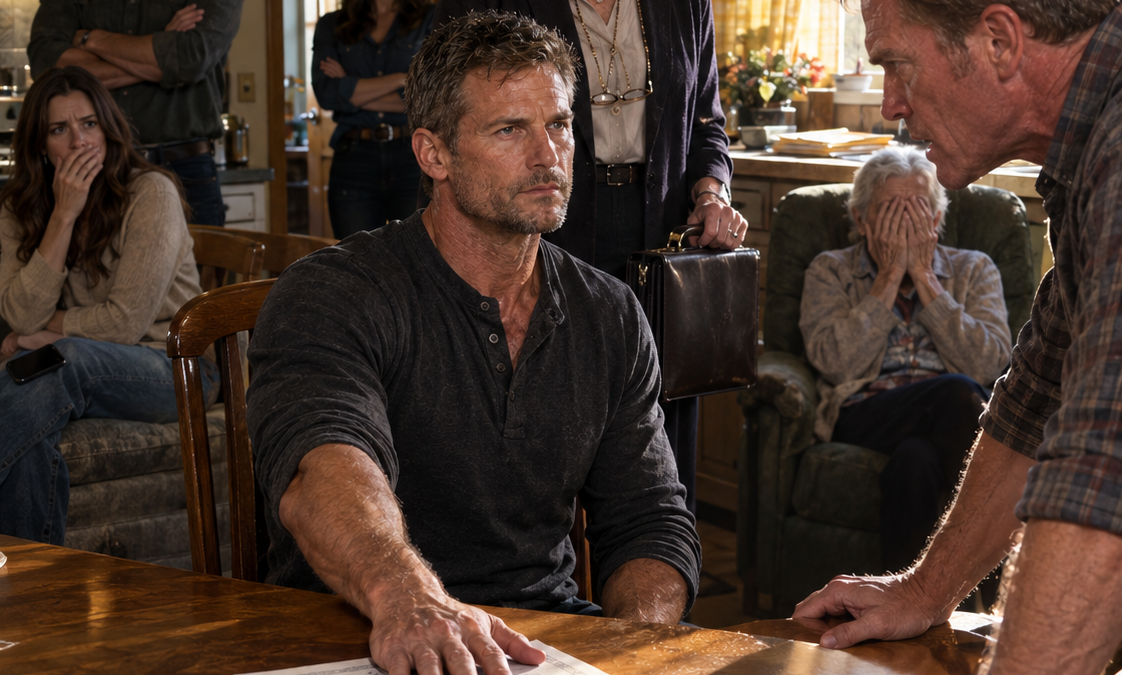
“You stopped being my brother when you forged Dad’s signature.”
My brother read the will before the rest of us had finished our coffee.
We were in the front room of the ranch house. The one with the big stone fireplace and the elk mount above it. Dad’s chair was empty. Still smelled like his pipe tobacco. Mom sat in the recliner by the window with her hands folded, looking at nothing.
I stood by the door. Old habit. I like to know where the exits are.
My brother Clay stood in the center of the room like he owned it. He probably already thought he did.
“There are a few things that need to be said,” Clay announced.
He was holding papers. Actual papers, printed out, with a cover sheet. He’d gone to the effort of making a cover sheet. That told me everything about how long he’d been planning this.
“The reading of the will is scheduled for next Tuesday with the lawyer,” I said. “That’s what Dad wanted.”
Clay waved the papers. “Dad wanted a lot of things. This is what’s actually happening.”
My sister Beth was on the couch. She had her phone out, filming. Filming. Like this was content. Her husband Rick sat next to her, picking at his fingernails and not looking at anyone.
“Clay,” Beth said, “just read it.”
He read it.
“To my son Clayton, I leave the family ranch. All four hundred and eighty acres. The house, the barns, the equipment, and the water rights. This is my wish and my final word on the matter.”
Clay lowered the paper. “The rest is just small stuff. Some money for Beth. Nothing for Jack.”
My mother finally looked up. She looked at me like she was sorry. But not sorry enough to say anything.
I stood there. I didn’t move. That’s the thing about me that has always confused my family. When something big happens, I get quiet. I don’t yell. I don’t argue. I go still.
Clay noticed. He always noticed. That’s because Clay spent most of his life watching me, measuring himself against me, and never once saying it out loud.
“You know how it is,” Clay said. “Dad always said the ranch goes to the one who stays.”
“And I didn’t stay,” I said.
“You chose the Army.” He said it with a little smile. “You made your choice, Jack. You walked away. You went and played soldier while I did the work here. Thirty years of work. I deserve this.”
I said nothing.
What he didn’t know was that Dad had signed a different will three years after the one Clay was holding. And that will was sitting in a fireproof safe in the office of a lawyer named Margaret Kessler, in a town Clay had never heard of, and it named me the sole heir to the ranch.
I didn’t know that yet.
Not in that room.
But I would know it by the end of the week.
My name is Jack Wheeler. I was forty-six years old when my brother read a fake will to my family and told me I had no claim to the only home I’d ever loved. I spent twelve years in the United States Army. Eight of them in the 75th Ranger Regiment. Three combat deployments. I was a Sergeant First Class when I left. My knees still ache. My hearing in my left ear is gone. I don’t sleep through the night. And none of that mattered in that room.
None of that ever mattered to them.
What mattered was that Clay had stayed. Clay had worked the ranch with Dad. Clay had married his high school girlfriend, bought a house near town, and had two kids who called my father Grandpa every single Sunday.
I had chosen a different life.
And that, in my family’s eyes, made me a stranger.
I should go back. I need to explain how we got here. How a family that once rode horses together every Sunday ended up standing in a room like strangers, watching a brother try to steal something that wasn’t his.
It started with our father.
Harold Wheeler was a quiet man. He ran cattle, and he ran the land, and he ran his family the same way—slowly, deliberately, and without much talking. He believed in work. He believed in staying. He believed that a man’s word was a contract.
He didn’t believe in the Army.
When I told him I’d enlisted, the summer after I turned eighteen, he stood on the porch of the ranch house and looked at me for a long time. Then he said, “You sure about this?”
“Yes, sir.”
“You know what you’re leaving.”
“I do.”
“You know the ranch needs you.”
“Clay’s here.”
The look on his face when I said that is still in my head. He wasn’t angry. He was disappointed. Deeply, quietly disappointed. Like I’d broken something he couldn’t fix.
Clay was standing behind him in the doorway. I remember that. He didn’t say anything, but he didn’t have to. The look on his face said it for him. It said finally.
Clay and I were never close. There’s a reason for that. Clay was the older one by three years, and he spent his whole childhood trying to be the one Dad was proudest of. He wasn’t a bad kid. He was just hungry. Hungry for approval. Hungry for validation. Hungry for the thing he thought he could only get if I failed.
I was the son who didn’t need to be told he was good enough. That made Clay crazy.
I didn’t figure that out until years later. In the Army. When I was sitting on a footlocker in a forward operating base in Afghanistan, thinking about home, and it finally clicked.
Clay didn’t hate me. He envied me. And envy, held long enough, turns into something that looks exactly like hate.
I shipped out in August. Basic at Fort Benning. Then Airborne. Then the Ranger Assessment and Selection Program. I was twenty years old and weighed one hundred and sixty pounds and could run twelve miles without stopping.
The Army built me. I don’t know how else to say it. I was a shy, quiet kid from a cattle ranch in eastern Oregon, and the Army took everything I was and made it into something useful.
Ranger School is not a thing you describe. People ask sometimes. They want to know what it was like. I tell them it was cold, and it was long, and I learned what I was willing to do to finish something I’d started.
That answer always disappoints them. They want a story.
The truth doesn’t make for a good story. It’s just a list. Cold, wet, hungry, tired, push forward. Cold, wet, hungry, tired, push forward. Cold, wet, hungry, tired. Push forward.
I did that for eight weeks. Then I came back and did it again for another three years of active duty with the 1st Ranger Battalion.
I deployed three times. Twice to Afghanistan. Once to Iraq.
I did things I don’t talk about.
I lost friends.
I came home different.
That’s the part my family never understood. They never asked. Not one time, in eighteen years, did Clay or Beth or my mother or my father ever ask me what it was like over there. Not what I did. Not what I saw. Not whether I was okay.
They were afraid of the answer. I know that now. They preferred me as the brother who “chose the Army.” A vague phrase. A way to file me away. If they’d asked, I might have told them something they couldn’t file.
So they didn’t ask.
They just let me become a stranger.
After my third deployment, I came back to Oregon for a leave. Dad was sick by then—COPD, emphysema, years of smoking and dust. He was still working the ranch, but slower. Clay was doing most of it.
I sat with Dad on the porch one night. The sun was going down over the far pasture. The cattle were moving slow. It was quiet.
“Son,” Dad said. “I’ve been thinking.”
“About what?”
“About this place. About who it goes to.”
I didn’t say anything. I could feel where it was going.
“Clay’s been here. He’s done the work. He knows the land.”
“He does.”
“But you’re still my son.”
“I know, Dad.”
He was quiet for a long time. The stars were coming out. I remember there was a coyote calling somewhere off past the fence line.
“I don’t know how to split this,” he said. “I don’t know how to make it fair.”
“Dad, I don’t need—”
“Let me finish.” He coughed. It took him a minute to catch his breath. “You chose a different road. I don’t understand it. I never did. But I don’t hold it against you either.”
I nodded.
“I’m going to make this right,” he said. “Before I go. I’m going to make this right.”
I didn’t know what he meant. I forgot about it. I had another deployment coming, and I had a life, and I had things to do.
Two months later, Dad called me.
“Jack. I saw Margaret.”
“Who?”
“Margaret Kessler. The lawyer. From Burns.”
“Oh.”
“I signed something today. A new will. You should know it exists.”
I was standing in a parking lot outside a hardware store in North Carolina. It was hot. I was holding a bag of bolts I didn’t need.
“Okay,” I said.
“Clay doesn’t know.”
“Dad—”
“Just so you know,” he said. “That’s all. Just so you know.”
He hung up.
I didn’t think about it again. I had a Ranger mission cycle coming up. I had a team to lead. I had a marriage that was already starting to fall apart.
I forgot about the call.
I forgot about Margaret Kessler.
I forgot about the will.
Until eight years later, when I was standing in my father’s living room, watching my brother read a document that I now know was not the last thing my father signed.
But I’m getting ahead of myself.
Let me go back to that day.
The day Clay read the fake will.
It was a Sunday. Two weeks after Dad’s funeral.
The whole family was there. Mom. Beth and Rick. Clay and his wife Donna. Their kids, Tyler and Grace, were outside on the porch, trying not to hear.
I’d driven down from Portland. Four hours in my truck. I’d been living in the city since I got out of the Army. Working security consulting for a private firm. Decent money. Steady life. No drama.
I came for the reading of the will.
I got something else.
“Sit down, Jack,” Clay said. “You look like you’re about to leave.”
I wasn’t about to leave. I was just standing where I always stand. By the door.
“I’m fine here.”
“Suit yourself.”
He had the papers in his hand. That cover sheet was so obvious. He’d printed it at home. I could see the inkjet smudge.
“This is what Dad wanted,” Clay said. “This is his final word.”
He read it.
And then he looked at me with that smile. The smile he’d been practicing for thirty years. The one that said I finally won.
“You know how it is,” he said.
I said nothing.
What he didn’t know was that Dad had called me eight years ago and told me there was another will. A better one. One that was sitting in a safe in Burns, Oregon, in the office of a lawyer named Margaret Kessler, who I had never met but who was about to become the most important person in my life.
But that’s not how I found out.
That came later.
That came because of something small. Something Clay did wrong.
He left the papers on the coffee table.
That was his mistake.
He was so proud of himself. He was so sure he’d won. He stood up, went to the kitchen to pour himself a drink, and left the papers sitting there.
I didn’t grab them. I didn’t need to. I just looked. And I saw what any Ranger would see.
The document had a signature. My father’s signature. But it wasn’t in the right place. There was a witness line, and the witness line was blank. And the date on the notary stamp—I knew that date. I knew it because it was the day I’d been home on leave, eight years ago, and I’d gone to see Dad, and he’d told me he was going to town to see Margaret.
The date on the notary stamp was three days after Dad had called me about the new will.
That was the first crack.
I didn’t say anything. Not that day. I just filed it away. That’s what Rangers do. We observe. We collect. We wait.
You don’t charge into a room until you know what’s in it.
Clay came back with a whiskey. He raised his glass to the room.
“To Dad,” he said. “To the ranch.”
Everyone drank. Everyone but me.
I just stood by the door and thought about Margaret Kessler.
The next morning, I drove to Burns.
It’s a small town. One main street. A diner. A gas station. A law office with a green awning that said KESSLER & ASSOCIATES on the window.
I walked in at 9:15.
A woman was at the front desk. Older. Gray hair. Reading glasses on a chain.
“Can I help you?”
“I’m looking for Margaret Kessler.”
“That’s me.”
I told her my name. I watched her face. It didn’t change. She’d been expecting me for eight years.
“You’re Harold’s son,” she said.
“I am.”
“Jack.”
“Yes, ma’am.”
She stood up. Slow. Her knees were bad. She walked around the desk and looked at me like she was trying to see something specific.
“You look like him,” she said. “Same eyes.”
“I’ve been told.”
She nodded. “Come back to my office. We have some things to talk about.”
I followed her down a hallway. The office was small but neat. Bookshelves. A window looking out at the street. A fireproof safe in the corner.
She sat down and gestured to the chair across from her desk.
“I was wondering when you’d come,” she said.
“I didn’t know about you until yesterday.”
“Your father told me he’d called you. He told me he’d made sure you knew.”
“He did. But that was eight years ago. I was deployed. I forgot.”
She looked at me for a long moment.
“You forgot.”
“Yes, ma’am.”
“You forgot that your father made a new will.”
“I was busy, ma’am. I had a life. And I didn’t think—” I stopped.
“You didn’t think you’d need it.”
“No, ma’am.”
She nodded. “That’s fair. Your father was the same way. He trusted people. He thought if he just said the words out loud, they’d stick.”
“They didn’t.”
“No. They didn’t.”
She opened a drawer and took out a manila envelope. It was thick. She set it on the desk between us.
“This is your father’s final will,” she said. “Signed three years after the one your brother has. Notarized. Witnessed. I have the original.”
I stared at the envelope.
“Why didn’t you come forward sooner?”
“Because you didn’t ask me to.”
That stopped me.
“What do you mean?”
She folded her hands. “Your father gave me very specific instructions. He said if something happened to him, I was to wait. I was to see what the family did. If they honored the first will, and if everyone was satisfied, I was to destroy this one. He didn’t want to cause trouble.”
I sat there, quiet.
“But if there was a dispute,” she went on, “or if you came to me, or if anything looked wrong, I was to give you this. And only you. Not your brother. Not your mother. Not your sister.”
“Why me?”
She looked at me like I’d just asked something obvious.
“Because you’re the one who was written out, Jack. This will cuts Clay out entirely. The ranch goes to you. All of it. The house, the land, the water rights, the equipment. You are your father’s sole heir.”
I didn’t say anything.
I couldn’t.
I just sat in that chair and stared at the envelope on the desk, and I felt something I hadn’t felt in a long time.
Not anger. Not relief.
Just a quiet, heavy weight.
Like a door closing somewhere far away.
“What else?” I asked.
She raised an eyebrow.
“There’s more. I can see it on your face.”
She almost smiled. Almost.
“Your father was worried about the deed,” she said.
“The deed to the ranch?”
“The land deed. The original. He kept it at the house. But he told me a few months before he died that he couldn’t find it. He thought someone had moved it.”
“Who would move it?”
She didn’t answer that.
She didn’t have to.
Clay had moved it.
That’s when I knew.
This wasn’t just about inheritance. This wasn’t just about who got the ranch.
This was about fraud.
And the question was: how far had Clay gone to make sure he won?
I drove home that night with the envelope on the passenger seat.
Four hours. Dark highway. Nothing but headlights and the radio and the weight of everything I’d just learned.
I didn’t open the envelope. Not yet. I wanted to be somewhere safe. Somewhere I could think.
I pulled into my driveway in Portland at ten o’clock. I sat in the truck for a minute. Then I took the envelope inside and locked the door behind me.
The will was everything Margaret said it was. Signed by my father. Witnessed. Notarized. Dated three years after the version Clay had read to the family.
I read it three times.
Then I sat on my couch and stared at the wall.
My father had done the right thing. He’d made it right. He’d tried to protect me.
And my brother had stolen it from both of us.
The next morning, I started digging.
I’m a Ranger. That’s what I do. I gather intelligence. I assess the situation. I make a plan.
First, I called a friend. A guy I served with, Mike Delgado, who had gone into law enforcement after he got out. He worked white-collar crimes for the state of Texas now. He knew paper trails better than anyone.
“Jack,” he said. “This is a hell of a thing to wake up to.”
“I need to know how to handle it.”
“Tell me what you’ve got.”
I told him. The will. The forged signature on Clay’s copy. The missing deed. The fact that Clay had been handling all the family business for the last four years while Dad was sick.
Mike was quiet for a minute.
“Okay,” he said. “First thing, don’t tell anyone. Not your mom, not your sister, nobody. You don’t know who’s in on it.”
“Beth was filming.”
“Filming what?”
“The reading. She was recording it on her phone.”
“Then she knows something’s off. Why would you film a will reading if there wasn’t going to be a fight?”
That landed. I hadn’t thought about it that way.
“Second thing,” Mike said. “Get a forensic document examiner. Someone who can look at the signatures and tell you if Clay’s version is fake.”
“How do I find one?”
“I’ll send you a name. Third thing, get a real estate attorney. If the deed was moved or altered, that’s a separate crime. And if Clay already filed paperwork to transfer ownership, you’ve got fraud on the record.”
“Can he do that?”
“Not legally. But if he had a notary friend and a fake signature, he could do it for a while. It would hold up until someone challenged it.”
I thought about that.
Then I asked the question I’d been avoiding.
“What about my mother?”
Mike didn’t answer right away.
“Your dad signed the new will three years after the first one,” he said. “Your mother had to know. She was in the house.”
I closed my eyes.
“She knew,” I said. “She knew, and she said nothing.”
“She might have been scared. Your brother could have pressured her.”
“She could have called me.”
“Would you have answered?”
That hurt.
I didn’t answer.
“Look,” Mike said. “I’m not defending her. I’m just saying, in these cases, the spouse often feels trapped. They’ve got the kid who stayed, and the kid who left, and they don’t want to lose the one who’s still around.”
“She had me too.”
“Jack, I’m going to say something you’re not going to like.”
“Go ahead.”
“Your family made a choice a long time ago. Not about the ranch. About you. They decided you were the one who left, and once they decided that, everything else made sense. Clay didn’t have to do anything. He just had to be there. You made it easy for them.”
I sat with that for a long time.
He was right.
I’d made it easy.
I left. I stayed gone. I showed up every three or four years, said hello, said goodbye, and then disappeared back into a life they couldn’t understand.
I never asked them for anything. I never told them what I needed. I never gave them a chance to see me.
That didn’t excuse what Clay had done.
But it explained why nobody had stopped him.
The next day, I called a forensic document examiner in Seattle. Her name was Dr. Anh Nguyen. She’d worked with the FBI for twelve years before going private.
“How soon can you look at a document?” I asked.
“How soon can you get it to me?”
“Tomorrow.”
“Bring it in the morning. And bring a sample of the same person’s signature from a different document. I need a comparison.”
I had one. My father’s signature was on the original will. That was enough.
But I also had something else. Something I hadn’t told anyone.
When I was a kid, my father kept a journal. He wrote in it every night. Small entries. Just the weather and what he’d done that day. But he wrote them in longhand, and he signed the bottom of every page. I knew because I’d found it once, when I was fifteen, snooping in his office.
It was still there. In the desk drawer. I’d seen it when I’d gone through the house after the funeral.
I didn’t tell Clay. I didn’t tell Beth. I didn’t tell Mom.
I just took it.
And now I had a reference. A hundred signatures. All in my father’s hand.
For the first time in weeks, I felt something other than tired.
I felt ready.
PART 2 — THE JOURNAL
Dr. Nguyen’s office was on the fourth floor of a building downtown. Glass windows. Clean carpet. A receptionist who offered me coffee I didn’t drink.
I sat in the waiting room with the journal in my lap.
I hadn’t slept much the night before. I kept thinking about my father. The journal was the first thing I’d taken from the house that wasn’t mine. I’d told myself it was for evidence. That was true. But it was also the only thing I had left of him that hadn’t been filtered through my brother.
Dr. Nguyen came out herself. Small woman. Sharp eyes. She didn’t waste time.
“You have the documents?”
I handed her the envelope. She opened it on the spot, scanning the pages with the practiced speed of someone who’d done this a thousand times.
“This is the contested will,” she said, holding up Clay’s copy.
“Yes.”
“And this is the original.”
“The one from Margaret Kessler.”
She held both pages side by side under a lamp. Then she looked at me.
“Your father’s signature on the contested document is good,” she said. “At a glance. Whoever did it knew his hand.”
“But?”
“But the pen pressure is wrong.” She pointed. “Here. And here. The original has a natural variation. Your father had a tremor in his last years. You can see it in the downstrokes. The contested version is too smooth.”
I leaned in. I couldn’t see it. Not yet. But she could.
“Whoever forged this practiced,” she said. “A lot. But they practiced from an older signature. Not from the last year of his life.”
“How long do you need?”
“A few days. I want to run it through the electrostatic detection apparatus. Check for indented writing on the pages underneath. Sometimes people sign a will in a stack, and the pressure leaves marks.”
“Will that hold up in court?”
She looked at me.
“If I’m called to testify, yes. I’ve done it before.”
I nodded.
“The journal,” I said. “Does it help?”
She took it. Flipped through a few pages. Stopped on one. Read it.
“Your father wrote every day?”
“Every night. For forty years.”
She looked at me. Something changed in her face.
“Then this is the best evidence you have,” she said. “Not the will. The journal. It proves your father was competent and consistent right up until the end. If someone tries to argue he was confused or pressured, this destroys them.”
I let that sink in.
“Can I take it back with me?”
“Not yet. I need to photograph each page. But I’ll have it to you by Thursday.”
I left her office and walked to my truck. I sat behind the wheel for a long time.
Thursday was four days away.
I needed to use them.
The first thing I did was drive to the county records office.
It was a low building on the edge of town. Fluorescent lights. A woman at the counter named Doris who’d worked there for twenty-two years and knew everyone’s business.
“I need to look at a land deed,” I said. “The Wheeler ranch. Four hundred and eighty acres.”
She looked up at me. “You’re Harold’s boy.”
“Yes, ma’am.”
“Sorry for your loss.”
“Thank you.”
She typed something into her computer.
“The deed was transferred six weeks ago,” she said.
I froze.
“Transferred?”
“To Clayton Wheeler. Sole ownership. Filed on the fourteenth.”
Six weeks ago. My father had been dead for three weeks at that point.
“Can I see the paperwork?”
She hesitated. I could see her weighing it. Doris knew my family. She knew Clay. She probably knew more about us than I did.
“Technically, it’s a public record,” she said. “But I’d need a reason to pull the physical file.”
“I’m challenging the transfer.”
Her eyes widened. Just a little.
“Give me a minute.”
She disappeared into the back. I stood at the counter and waited.
I counted the tiles on the floor. Twenty-seven across. Sixteen down. A pattern I didn’t need to notice, but I noticed anyway. That’s what the Army does to you. It makes you see everything, even when you don’t want to.
Doris came back with a folder.
“Here,” she said. “You can look at it here. Not take it.”
“Thank you.”
I opened the folder.
The transfer document was there. Signed by my father. Dated two weeks before his death.
Except.
I looked at the signature.
Then I looked at the date.
The date was a Tuesday.
My father had been in the hospital that Tuesday. I knew because I’d called him. I’d called him from a hotel room in Virginia, where I was doing a consulting job for a defense contractor, and we’d talked for twenty minutes. He’d told me he was tired. He’d told me he loved me.
He’d told me he was going to make it right.
And now here was a document that said he’d signed over the ranch to Clay two days later.
While he was in a hospital bed with an IV in his arm.
While he could barely hold a pen.
I looked at Doris.
“Can I get a copy of this?”
“You can request one at the front desk. It’ll be certified.”
“How long?”
“Twenty-four hours.”
“Can I pay extra to get it today?”
She looked at me for a long moment.
“I’ll see what I can do.”
I drove to the hospital after that. St. Charles Medical Center. The place where my father had spent his last three weeks.
I walked up to the records desk and asked for his admission records. They told me they couldn’t release them without a court order. I asked for a supervisor. I got one. A man named Paul who was patient and polite and completely unmovable.
“You’d need to be the executor of the estate,” he said.
“I’m not.”
“Then I can’t help you.”
I stood there for a minute.
Then I asked a different question.
“Is there a nurse who worked on the third floor the last week of September? Someone who might remember a patient named Harold Wheeler?”
Paul hesitated.
“That’s a privacy issue.”
“I’m not asking for medical records. I’m asking if a specific nurse is on shift.”
He looked at me. I could see him trying to figure out whether I was a problem or just a grieving son.
“Third floor. Ask for Karen. She’s been here fifteen years.”
I found Karen in a break room. She was in her fifties. Gray hair pulled back. Tired eyes that had seen too much.
“My father was here,” I said. “Harold Wheeler. September.”
She nodded slowly.
“I remember him.”
“Can I ask you a question?”
She didn’t say no.
“Was he able to sign documents that week? The last week?”
She looked at me. Really looked at me.
“There was a man who came in with papers,” she said. “His son. He wanted your dad to sign something.”
“Did he?”
“I don’t know. I was told to leave the room.”
“By who?”
“By the son. He said it was a family matter.”
I stood there. My hands were steady. I made sure they were steady.
“Thank you,” I said.
I left.
Outside, in the parking lot, I called Mike Delgado.
“I’ve got it,” I said.
“Got what?”
“Proof. The deed transfer was signed while my father was in the hospital. He could barely hold a pen. And the nurse remembers Clay asking to be alone with him.”
Mike was quiet for a second.
“That’s good, Jack. That’s really good. But it’s not enough.”
“What do you mean?”
“You’ve got suspicion. You’ve got circumstantial evidence. You need a smoking gun. Something that puts Clay at the scene with the intent to forge.”
“The notary stamp.”
“What about it?”
“There’s a notary stamp on the transfer. Someone notarized it. If that person didn’t actually witness my father signing, that’s fraud.”
“Can you find the notary?”
“I can try.”
“Jack.”
“Yeah.”
“Be careful. Your brother’s been running this show for years. He might have friends in places you don’t expect.”
I thought about that.
“I know.”
“Just don’t tip him off. If he knows you’re looking, he’ll bury everything.”
“He already thinks he’s won.”
“Good. Keep it that way.”
I hung up and sat in my truck for a while. The sun was going down. The parking lot was half-empty. I watched a family walk into the hospital, a woman pushing a wheelchair with an old man in it.
I thought about my father. About the last time I saw him.
It was three weeks before he died. I’d flown in from Portland. I’d sat by his bed. He was tired and thin and his voice was barely there.
“You came,” he said.
“I came.”
“I wasn’t sure you would.”
“I’m here, Dad.”
He looked at me for a long time. Then he said something I didn’t understand.
“Check the safe.”
“What safe?”
But he’d drifted off. His eyes closed. His breathing slowed.
I sat there and held his hand and didn’t ask again. I thought he was confused. I thought it was the medication.
He wasn’t confused.
He was trying to tell me.
The next morning, I drove to the ranch.
It was a Monday. Clay would be out in the south pasture, checking fences. That’s what he did on Mondays. It was a routine. Routines are predictable. Predictable is exploitable.
I pulled into the driveway at eight fifteen.
My mother was in the kitchen. She was sitting at the table with a cup of coffee. She looked up when I walked in.
“Jack.”
“Mom.”
“What are you doing here?”
“I came to see you.”
She looked at me like she didn’t believe it.
“Sit down,” she said.
I sat.
The kitchen was the same as I remembered. Yellow curtains. A rooster clock above the stove. A stack of mail on the counter that hadn’t been opened.
“How are you doing?” I asked.
“I’m getting by.”
“That’s not what I asked.”
She looked at me. Her eyes were tired. Her hands were folded on the table.
“I’m fine, Jack.”
“Mom.”
“What?”
“Did you know?”
She didn’t ask what I meant. She knew.
“I don’t want to talk about this.”
“Did you know?”
She looked away. Out the window. At the pasture. At the place where her life had been for fifty years.
“He told me not to say anything.”
“Who?”
“Your brother.”
I sat very still.
“What did he tell you?”
“That the ranch was going to him. That it was what Dad wanted. That you didn’t need it.”
“And you believed him?”
“I didn’t know what to believe.”
“You could have called me.”
“I was scared, Jack.”
That hit me harder than I expected.
“Scared of what?”
“Of losing everyone.”
I looked at my mother. The woman who’d raised me. The woman who’d bandaged my knees and packed my lunches and waved goodbye when I got on the bus.
She was old now. Frail. She’d been worn down by years of being in the middle.
“I’m your son, Mom.”
“I know.”
“I came back.”
“I know.”
“I came back every time I could. Every leave. Every break. I called. I wrote. I tried.”
“I know, Jack.”
“Then why?”
She looked at me. Her eyes were wet.
“Because you left, and he stayed, and I didn’t know how to hold onto both.”
I sat there.
I didn’t have an answer.
She was right.
I left. I stayed gone. I made it easy.
But that didn’t make what Clay did right.
“Mom,” I said. “I need to ask you something.”
“What?”
“Did Dad ever talk to you about a lawyer? A woman named Margaret Kessler?”
Her face changed. Just a little.
“He mentioned it once.”
“What did he say?”
“He said she had some papers. That she was going to make things right.”
“And then?”
“And then Clay told me it was taken care of.”
“Taken care of.”
“Yes.”
I sat back in my chair.
I didn’t tell her what I knew. Not yet. Not until I had everything. She was scared. She was old. She was in the middle. I couldn’t trust her to keep it quiet.
But I could plant a seed.
“Mom,” I said. “If you remember anything. Anything at all. Write it down.”
“What?”
“Write it down. Keep it safe. Don’t tell Clay.”
She looked at me. Then she nodded. Slow.
“I will.”
I stood up. I kissed her on the forehead. Then I walked out.
Clay’s truck was coming up the driveway as I pulled out.
He slowed. I slowed. He rolled down his window.
“Jack.”
“Clay.”
“What are you doing here?”
“Visiting Mom.”
“She’s fine.”
“I know.”
He looked at me. His eyes were hard.
“Don’t make trouble, Jack.”
“I’m not making trouble.”
“Good.”
He rolled up his window and drove on.
I watched him go. I saw his brake lights. I saw him park.
Then I drove away.
I didn’t make trouble.
But I was going to make a case.
Thursday came faster than I expected.
Dr. Nguyen called me at eight in the morning.
“I have the results,” she said.
“Tell me.”
“The contested will is a forgery. The signature was traced. There are telltale signs. Slight hesitation on the upstrokes. A dot on the ‘i’ in Harold that’s too round. Your father’s ‘i’ dots were always a quick stab.”
“Can you testify?”
“I can testify.”
“The journal?”
“Your father’s signature is consistent. Every page. Every night. He was fully competent until the end. If anyone tries to argue otherwise, this proves they’re wrong.”
I closed my eyes.
“Thank you.”
“One more thing.”
“What?”
“The indented writing.”
“What about it?”
“On the contested will. I found something. There was a page underneath when someone signed it. The pressure left marks.”
“What did it say?”
“Not much. Just a partial sentence. But it’s enough.”
“Tell me.”
“The word ‘Clay’ appears. And below it, ‘promise.'”
I stood there in my kitchen.
The word promise.
That was my father’s handwriting.
But not on the will.
On the page underneath.
He’d written it years ago. Probably in a journal. Probably the night he told me about the new will.
Clay had used the journal page as a backing sheet when he forged the will.
And now his crime had left a mark.
“Dr. Nguyen,” I said. “How fast can you get that to me?”
“I’ll email the report today. The physical documents I’ll courier overnight.”
“Do it.”
I hung up and called Mike.
“I’ve got it,” I said.
“Tell me.”
“Forensic examiner confirmed the forgery. And there’s indented writing. A journal page. My father wrote something about Clay years ago, and Clay used it as backing when he forged the will.”
Mike was quiet.
“That’s the smoking gun, Jack.”
“I know.”
“What are you going to do?”
I looked out the window. At the street. At the life I’d built. At the family I’d left behind.
“I’m going to call a family meeting,” I said. “And I’m going to lay it all out.”
“You sure?”
“Yeah.”
“Jack.”
“What?”
“You’re not the kid who left anymore. You know that, right?”
I didn’t answer.
“Just be ready,” Mike said. “Because when you do this, there’s no going back.”
I knew.
I’d known since the moment I saw that forged signature.
There was no going back.
There was only forward.
The family meeting was set for Saturday.
I called Beth first.
“Jack? What’s going on?”
“I need you to come to Mom’s on Saturday. Ten o’clock.”
“Why?”
“I’m going to tell you something. All of you. And I need you to hear it.”
“Jack, what is this about?”
“The ranch.”
She was quiet.
“Okay,” she said. “I’ll be there.”
I called Clay.
“What do you want?”
“Saturday. Mom’s house. Ten o’clock.”
“Why?”
“Something’s come up. About the will.”
“Jack, we already read the will.”
“I know.”
“So what’s the problem?”
“Just be there, Clay.”
He was quiet.
“Fine.”
He hung up.
I called Margaret Kessler.
“Mrs. Kessler?”
“Yes?”
“This is Jack Wheeler. I’m ready.”
“Ready for what?”
“To read the other will. In front of my family.”
She was quiet for a moment.
“Are you sure?”
“I’m sure.”
“I’ll be there.”
“Thank you.”
I called Mike.
“I need a favor.”
“Name it.”
“Can you be there? As a witness? And maybe bring a recorder?”
“I’ll be there.”
I called Dr. Nguyen.
“I need you on standby. I might need you to testify.”
“I’ll clear my schedule.”
I sat down at my kitchen table.
I had everything.
The original will. The forensic report. The indented writing. The nurse’s statement. The deed transfer document.
I had it all.
And on Saturday, in my mother’s kitchen, in the house where I’d grown up, I was going to lay it all out.
For the first time in years, I slept through the night.
PART 3 — THE KITCHEN TABLE
Saturday morning was clear and cold. Frost on the grass. My breath fogged in front of my face when I walked from my truck to the front door.
I got there at nine-thirty. Early. I wanted to set up before anyone else arrived.
Margaret Kessler was already there. She’d driven in from Burns the night before and stayed at a motel on the edge of town. She was sitting at the kitchen table with a cup of coffee and a leather briefcase that looked older than me.
“You’re early,” I said.
“So are you.”
I set my own bag on the counter. The forensic report. The certified copy of the deed transfer. The original will. I laid them out one by one.
Margaret watched me.
“You’ve been busy,” she said.
“I had help.”
“The examiner?”
“Dr. Nguyen. She’s on standby.”
Margaret nodded. “Good. You’ll need her.”
“For what?”
“For what comes next.”
I didn’t ask what she meant.
I already knew.
Beth arrived at nine forty-five. She came in through the back door, like she always did. She was carrying a Tupperware container of muffins.
“Mom asked me to bring these,” she said. Then she saw Margaret. “Who’s this?”
“Beth, this is Margaret Kessler. She was Dad’s lawyer.”
Beth set the muffins on the counter. She looked at Margaret. Then she looked at me. Then she looked at the papers on the table.
“Jack, what’s going on?”
“Sit down.”
“I don’t want to sit down. I want to know what’s going on.”
“Sit down, Beth.”
She sat.
Rick came in a minute later. He didn’t say anything. He just stood by the door with his hands in his pockets, looking uncomfortable. That was Rick. Always uncomfortable. Always waiting for someone to tell him what to do.
Clay arrived at ten exactly. He came in through the front door. He was wearing a Carhartt jacket and his work boots. He looked around the room and his eyes landed on Margaret.
“Who’s this?”
“Sit down, Clay.”
“What’s she doing here?”
“Sit down.”
He didn’t sit. He stood by the fireplace, arms crossed.
Mom was already in her chair. The recliner by the window. She had a blanket over her lap. She hadn’t said a word since I’d walked in.
I looked around the room.
Everyone was there.
I took a breath.
“Last week,” I said, “Clay read a will. He said it was Dad’s final word. He said the ranch was his.”
“That’s right,” Clay said. “And it is.”
I ignored him.
“What Clay didn’t know,” I said, “is that Dad signed another will. Three years after the one Clay read. And in that will, the ranch goes to me.”
The room went silent.
Beth looked at Clay. Clay looked at me. Mom looked at her hands.
“That’s a lie,” Clay said.
“It’s not.”
“Dad would have told me.”
“He did tell me.”
“He told you?”
“He called me eight years ago. I was in North Carolina. He said he’d seen a lawyer. He said he’d made it right.”
Clay’s face changed. Just a little. Just enough.
“You’re lying.”
I reached into my bag and pulled out the envelope. I set it on the table.
“This is the original will,” I said. “Signed by Dad. Witnessed. Notarized. Dated three years after the version you read.”
Clay stared at the envelope like it was a snake.
“That’s not real.”
“It’s real.”
“Dad was sick. He didn’t know what he was signing.”
“He was sick three years ago? He didn’t die until September.”
“He was confused. I was there. I know.”
“You were there when he signed this?”
Clay didn’t answer.
I opened the envelope and pulled out the will. I set it on the table. Everyone leaned in.
“This is Dad’s signature,” I said. “You can see it. It’s the same as the will you read. Except this one is real.”
“That’s bullshit.”
“Clay.”
“It’s bullshit. You forged it. You’re trying to steal from me.”
I looked at him.
I didn’t raise my voice. I didn’t move. I just looked at him.
“Clay,” I said. “I’ve been gone for eighteen years. I have a job. I have a life. I don’t need the ranch. I never needed the ranch. But Dad wanted me to have it. He told me so. And I’m not going to let you steal it from both of us.”
Clay’s face was red. His hands were fists.
“You left.”
“I did.”
“You left, and I stayed, and I did everything. Everything. I worked this ranch while you were off playing soldier. I took care of Dad while you were gone. I was here.”
“I know.”
“So why do you get it?”
“Because Dad said so.”
“He didn’t know what he was doing.”
“He knew exactly what he was doing.”
“You weren’t here.”
“No. I wasn’t.”
“So how would you know?”
I looked at him.
“Because he told me.”
Clay opened his mouth. Then closed it.
“Dad called me,” I said. “Eight years ago. He told me he’d made a new will. He told me Clay didn’t know. He told me he was going to make it right.”
“He never told me that.”
“He didn’t want you to know.”
“Why?”
I let that hang.
“Why do you think?”
Clay didn’t answer.
Beth spoke up.
“Jack, is this true?”
“It’s true.”
“How do you know?”
“I have the will. And I have more.”
“What more?”
I pulled out the forensic report.
“This is from a document examiner,” I said. “She looked at the will Clay read. The signature is forged. It’s a tracing. Dad’s hand trembled in his last years. You can see it in the real will. The fake one is too smooth.”
“That’s a lie,” Clay said.
“It’s a report.”
“From who? Some friend of yours?”
“Dr. Anh Nguyen. Former FBI. She’s testified in federal court.”
Clay went quiet.
I pulled out the certified copy of the deed transfer.
“This is the deed transfer. The one that put the ranch in your name. It’s dated two weeks before Dad died. When he was in the hospital.”
“So?”
“So I talked to a nurse. She remembers you coming in with papers. She remembers you asking to be alone with Dad. She remembers being told to leave the room.”
Clay’s face went pale.
“You had a notary sign off on a transfer,” I said. “That notary never witnessed Dad signing anything. That’s fraud, Clay.”
“You don’t know what you’re talking about.”
“I know exactly what I’m talking about.”
“You can’t prove it.”
“I can. And I will.”
Clay took a step toward me.
“You think you can come back here after eighteen years and take what’s mine?”
“It was never yours.”
“It was always mine. I was here. I did the work.”
“Dad said otherwise.”
“Dad was old. Dad was confused. Dad didn’t know what he was doing.”
“He knew exactly what he was doing.”
“You weren’t here!”
The room went quiet.
Clay was breathing hard.
“You weren’t here,” he said again. “You were never here. You left. You chose the Army. You chose a different life. You chose to be somewhere else. And I stayed. I stayed with Mom. I stayed with Dad. I stayed with the ranch. I did everything. And now you come back and tell me I stole it?”
“You did steal it.”
“I earned it.”
“You earned nothing. You forged a will. You moved a deed. You lied to Mom. You lied to Beth. You lied to everyone.”
“I did what I had to do.”
“To get what?”
“To get what I deserved.”
I looked at him.
“What you deserved,” I said.
“Yes.”
“You think you deserved the ranch?”
“I know I did.”
“Then why did you have to forge a will to get it?”
Clay didn’t answer.
Margaret spoke for the first time.
“Mr. Wheeler,” she said. “I represent your father’s estate. I have the original will. I have the notary records. I have the forensic report. I have everything I need to file a petition in court.”
Clay looked at her.
“You can’t do that.”
“I can.”
“This is family business.”
“This is fraud.”
“It’s none of your business.”
“It’s exactly my business.”
Clay turned to Mom.
“Mom,” he said. “Tell them. Tell them you knew. Tell them Dad wanted me to have it.”
Mom looked up.
Her face was wet.
“I don’t know what your father wanted,” she said. “I never knew.”
“You knew! You knew he was going to make a new will. You knew he saw a lawyer.”
“I knew he saw someone. But he never told me what it said.”
“So you knew.”
“I knew he was going to make it right.”
“With you?”
“With Jack.”
Clay stared at her.
“You’re taking his side?”
“I’m not taking anyone’s side.”
“You’re taking his side!”
“No, Clay. I’m telling the truth.”
“Whose truth?”
“Your father’s.”
Clay turned away. He walked to the window. He stood there with his back to us.
Nobody said anything.
Beth was crying. Rick was looking at the floor. Mom had her hands over her face.
I stood there and watched my brother.
“You know,” I said, “I never wanted the ranch.”
Clay didn’t turn around.
“I never wanted anything from this place. I left for a reason. I left because I didn’t belong here. I left because I wanted something different. And I built that. I built a life. I didn’t need the ranch.”
“Then why are you here?”
“Because Dad wanted me to have it.”
“Then why didn’t he just give it to you?”
“He tried. He signed the will. He told me it existed. He thought that was enough.”
“It wasn’t.”
“No. It wasn’t.”
Clay turned around.
“Because I wasn’t going to let him.”
“Exactly.”
“So what now?”
I looked at him.
“Now,” I said, “we do this the right way.”
“What does that mean?”
“It means I’m filing a petition with the court. I’m contesting the deed transfer. I’m submitting the original will. And you’re going to have to answer for what you did.”
Clay looked at me.
“You’d really do that?”
“I really would.”
“To your own brother?”
“You stopped being my brother when you forged Dad’s signature.”
Clay’s face twisted.
“You think you’re better than me?”
“No.”
“You do. You always did.”
“I never thought that.”
“You left. You went off to play soldier. You came back with medals. You came back with stories. You came back with that look. That look like you’d seen things. Like you knew things. Like you were better than all of us.”
“That’s not what I felt.”
“That’s what you showed.”
I didn’t answer.
Clay walked toward the door.
“You know what?” he said. “You can have it. Take the ranch. Take everything. I don’t want it anymore.”
“Clay—”
“No. You want it? Fine. Take it. But you’re not going to get anything else from me.”
He opened the door.
“Clay.”
He stopped.
“Dad loved you,” I said. “He did. He loved you. But he also saw what you were becoming. And he tried to stop it.”
Clay didn’t turn around.
“He failed,” he said.
Then he walked out.
The door closed behind him.
The room was quiet.
Beth was still crying.
Mom hadn’t moved.
I sat down at the kitchen table.
Margaret sat down across from me.
“You did well,” she said.
“I don’t feel like it.”
“You told the truth. That’s what matters.”
I looked at the window. Clay’s truck was already gone.
“What happens now?” I asked.
“Now I file the petition. And we wait.”
“How long?”
“Could be weeks. Could be months. Depends on how hard he fights.”
I nodded.
“Jack,” Beth said. “Is it true? All of it?”
“It’s true.”
“How long have you known?”
“About two weeks.”
“And you didn’t tell me?”
“I couldn’t. I didn’t know if I could trust you.”
“I’m your sister.”
“I know.”
“I would have believed you.”
“Would you?”
She didn’t answer.
That was the thing about Beth. She was kind. She was loyal. But she was also scared. She’d spent her whole life letting Clay make the decisions because it was easier than fighting him.
I didn’t blame her.
But I didn’t trust her either.
Not yet.
“I need to know something,” I said.
“What?”
“Did you know about the will? The fake one. Did you know before he read it?”
Beth looked at me.
“No,” she said. “I didn’t know.”
“Then why were you filming?”
“What?”
“At the reading. Why were you filming?”
She hesitated.
“Because Clay told me to.”
I sat back.
“Why?”
“He said it was important. He said we might need it later.”
“For what?”
“For if you contested it.”
I looked at her.
“So he knew I might fight.”
“He said you were unpredictable.”
I almost laughed.
“I’m the most predictable person in this family.”
“I know.”
“I’ve been the same person my whole life. I left because I didn’t fit. I came back when I could. I never asked for anything. I never made demands. I never even raised my voice.”
“I know.”
“So why did he think I’d fight?”
She didn’t answer.
I looked at the table.
“I know why,” I said.
“Why?”
“Because he would have.”
Beth looked at me.
“He would have fought. He would have come back. He would have raised hell. Because that’s what he would have done. So he assumed I would too.”
“That’s not fair.”
“No. It’s not.”
Mom spoke from the corner.
“He’s your brother.”
I looked at her.
“He’s my son. You’re both my sons. I don’t want to lose either of you.”
“Mom—”
“No. Listen to me.” She sat up. Her voice was stronger than I’d heard in years. “I know what he did was wrong. I know it. But he’s still my son. And you’re still my son. And I don’t want to pick sides.”
“You don’t have to pick sides.”
“Yes, I do. Because if you go to court, I have to choose. I have to say what I know. And if I say what I know, I lose him.”
I looked at my mother.
Her eyes were wet. Her hands were shaking.
“Mom,” I said. “You don’t have to testify.”
“I do. They’ll subpoena me. Margaret will call me. And I’ll have to tell the truth.”
Margaret didn’t say anything.
“Then tell the truth,” I said.
“Jack—”
“Tell the truth, Mom. That’s all. Just tell the truth.”
She looked at me.
“I’m sorry,” she said.
“For what?”
“For not telling you. For not calling. For letting him do this.”
“It’s not your fault.”
“It is. I was scared. I didn’t want to lose him. I didn’t want to lose the ranch. I didn’t want to lose everything.”
“You were never going to lose me.”
She looked at me.
“You left.”
“I left. But I never left you.”
She cried.
I got up and walked over to her. I put my hand on her shoulder.
“I’m here, Mom.”
She grabbed my hand and held it.
“I’m sorry,” she said again.
“I know.”
I stood there for a long time. The kitchen was quiet. The clock ticked. The rooster above the stove stared at nothing.
Finally, Margaret stood up.
“I’ll file the petition on Monday,” she said. “Jack, I’ll need you to sign some things.”
“I’ll be there.”
“Good.”
She packed up her briefcase and walked to the door.
“Mrs. Wheeler,” she said. “I’m sorry for your loss.”
Mom nodded.
Margaret left.
The kitchen was quiet again.
Beth stood up.
“I should go,” she said.
“Beth.”
She stopped.
“I need you to think about something,” I said.
“What?”
“When this goes to court. You’re going to be called. And you’re going to have to decide what you’re going to say.”
“I’ll tell the truth.”
“Will you?”
She looked at me.
“Yes.”
“Then I need you to do something for me.”
“What?”
“Keep filming. Whatever happens. Keep filming.”
She looked at me. Then she nodded.
“I will.”
She and Rick left.
Mom was still in her chair.
I sat down at the table.
The house was quiet.
I thought about Clay. Where he’d gone. What he was going to do.
He wasn’t the type to give up.
He was the type to fight.
And that meant this wasn’t over.
It was just starting.
 [Tap here for the Next Part ]


