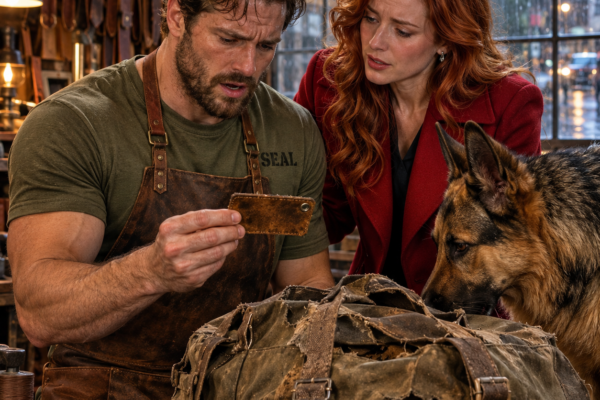
“Paul said you were a killer. He said that’s why Denise is scared of you.”
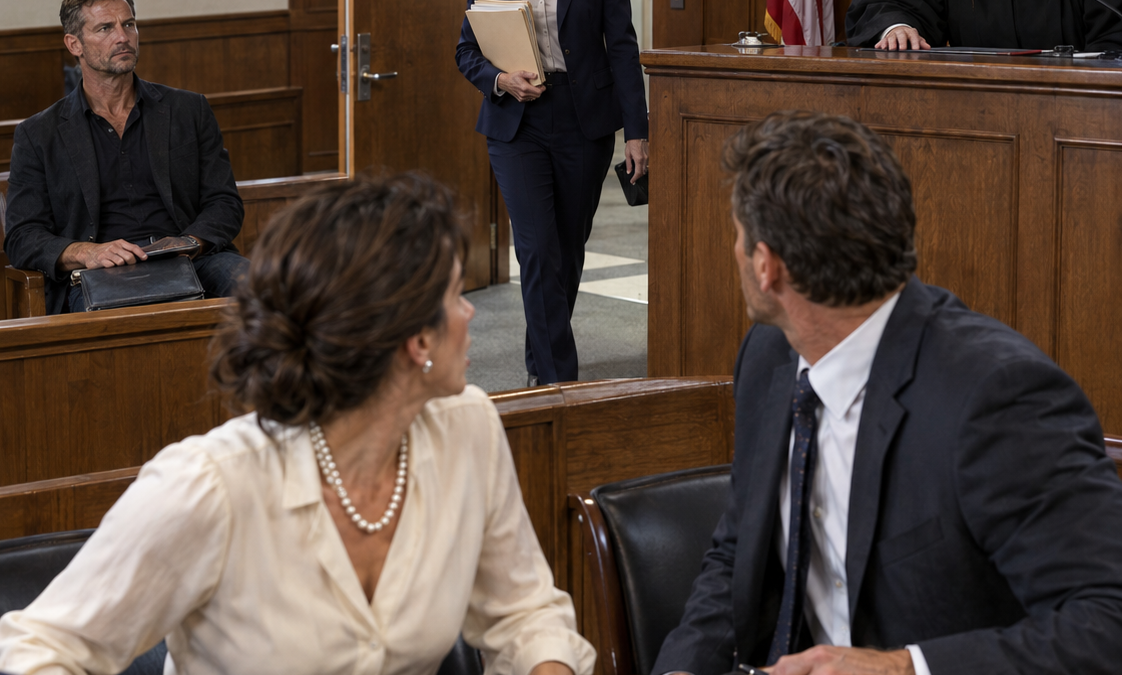
“Paul said you were a killer. He said that’s why Denise is scared of you.”
“The petition said I was dangerous. Not difficult. Not unreliable. Not unfit in the ordinary ways people fail each other. Dangerous.”
Denise thought a false psychological evaluation and a courtroom lie would take Riley away from me forever → she ended up in jail, stripped of her teaching license, and barred from contact with Riley until adulthood, while I stood in a room full of Recon Marines who called me brother.
The petition said I was dangerous.
Not difficult. Not unreliable. Not unfit in the ordinary ways people fail each other. Dangerous. The word sat in black ink on a county courthouse document, filed by a woman who had known me for four years and had never once asked what I did before I came home.
I read it three times in the parking lot of the Justice Center. February cold coming off the river. My breath fogging the windshield of a truck I’d owned since before she was in the picture.
Exhibits A through F: prior psychological evaluation, treatment records, character affidavits.
Prior psychological evaluation. There it was. What they didn’t know — what nobody in that family had ever bothered to ask — was that the last person to evaluate me professionally had been a Navy doctor who called me the most stable man in the room.
My name is Caleb Maddox. I was forty-one years old when my daughter’s stepmother stood up in a family court hearing and told a judge I was a threat to my own child. I spent eleven years in Marine Corps Force Recon, three deployments, one I don’t talk about. I’m not going to pretend the war left nothing behind. I’m going to tell you exactly what it left, and who decided to use it against me.
But first you need to understand how I got to that parking lot.
My daughter’s name is Riley. She was ten that February, which means she was six when her mother died and seven when I met Denise.
Riley’s mother — Beth — was a NICU nurse at Portsmouth. She was the one who held our family together while I was gone, and then one night a drunk driver ran a red light on I-264 and she was gone too, and it was just me and a six-year-old who kept asking when Mommy was coming home from the hospital.
I got out. That’s the part the court petition didn’t mention. I had eleven years in, I was up for a major’s board, and I put in my papers three weeks after the funeral because Riley needed a parent more than the Corps needed another major. I took a job at a maritime security firm in Norfolk. Good pay. Flexible hours. I coached her soccer team. I learned to braid hair, badly at first, then well enough that she stopped fixing it in the car.
For two years it was just us. Then I met Denise at a parent-teacher night. She taught fifth grade at a private school across town. She was polished, funny, organized in a way that felt like relief after two years of surviving on autopilot. She liked that I was a veteran. She said it made her feel safe.
What she actually liked, I came to understand, was that I was quiet. That I didn’t fight. That I let her make the decisions because I was tired and grieving and grateful for someone who seemed to know how to run a household.
Denise ran everything. That was the arrangement from the beginning, and I let it happen because it made Riley’s life smoother and because I was still underwater from Beth. By the time I surfaced, the house was in her name. The bank accounts were joint but she controlled them. The school was her school, the pediatrician was her pediatrician, the church was her church. I was the guy who showed up, fixed things, and signed whatever she put in front of me.
And then she left.
Not dramatically. Not with a scene. She sat me down at the kitchen table one Sunday in October and told me she’d realized she was unhappy, that she needed to find herself, that she wasn’t built for the life we’d made. She moved out three weeks later. She moved back six months after that — into a bigger house, on the other side of town, with a man named Paul Ashworth.
Paul was a commercial real estate developer. His family had money going back to tobacco. He drove a Mercedes, hunted quail on a leased plantation, and had a laugh that made you feel like you were being evaluated. He was polite to me. Always polite. That’s how they got away with it for so long.
They married the following spring. Riley was nine. By then Denise had already filed for — and won — a modification that gave her primary physical custody during the school year, on the grounds that her school was better and her home was more stable. I didn’t fight it. I had weekends and summers. I told myself that was enough. I told myself the important thing was Riley, not me.
Then Riley started changing.
She got quiet. Then she got thinner. Then she stopped calling me on the phone during the week, stopped asking to come to my apartment on weekends, started saying things like Denise says and Paul thinks and It’s complicated, Dad.
I noticed. I noticed because noticing things is what I was trained to do, and because I knew my daughter better than anyone in that house ever did. I noticed the way she flinched when Paul came into a room. I noticed that she’d stopped drawing, that she’d stopped playing piano, that she’d stopped doing all the things she used to love.
I tried to talk to her. She said she was fine. I tried to talk to Denise. She said Riley was adjusting, that I was projecting, that maybe I needed to look at my own issues instead of manufacturing problems in a healthy blended family.
That was the first time she used the word. Issues.
She said it the way you’d say a diagnosis.
It escalated for about a year. Small things. A birthday party I wasn’t told about until the day before. A school recital where I showed up and found out it had been moved. A holiday schedule that kept getting rewritten so that my time with Riley kept shrinking by an hour here, a day there.
Denise never did anything I could point to. That was the trick. It was all plausible. It was all I thought we agreed and I must have forgotten to tell you and Caleb, don’t make this a thing.
I made it a thing.
I hired a family lawyer in Chesapeake, a woman named Harriett Cole who had thirty years of experience and a face that told you she’d seen every version of this story. She listened to me for two hours, took notes, and then said the thing I’d been avoiding.
“You’re going to need to document everything from now on. Every missed call. Every canceled visit. Every time she says she’ll do something and doesn’t. And you’re going to need to be very, very careful, because women like Denise Ashworth don’t lose custody battles. They win them, and they do it by making the father look unstable.”
I asked her what that meant.
“It means they weaponize whatever they can find. And in your case, they’ll start with your service.”
I told her there was nothing to weaponize. I had an honorable discharge, an honorable record, and I saw a counselor twice a year through the VA, mostly because I liked having someone to check in with.
Harriett looked at me for a long moment.
“Then why do you look like you’ve already lost?”
I didn’t have an answer for her. Not then.
The hearing was on a Tuesday. Denise had filed a petition to modify custody again — this time to suspend my weekend visitation entirely pending a psychological evaluation, citing concerns about my stability and Riley’s safety.
I hadn’t seen Riley in six weeks. Denise had found reasons for every scheduled visit. A fever that turned out not to be a fever. A scheduling conflict at school. A weekend trip to the Ashworths’ beach house in Nags Head that she’d forgotten to mention.
I walked into the courtroom with Harriett and a folder of documentation. Denise was already there, sitting between Paul and her attorney — a tall, gray-haired man named Sterling who charged more per hour than I made in a week. She was wearing a cream blouse and pearls. She looked like she was there to support a friend at a charity event.
Riley wasn’t in the room. She was in a conference room down the hall with a court-appointed advocate. Ten years old, sitting in a government building because the adults in her life couldn’t figure out how to share her.
The judge was a woman in her sixties, black robe, reading glasses on a chain around her neck, a face that had stopped being impressed by lawyers a long time ago. Judge Ellison. I’d read every opinion she’d written in the last five years. I did my homework.
Sterling stood up first.
“Your Honor, this is not a matter of parental fitness in the abstract. It is a matter of documented, sustained concern for the minor child’s emotional and physical safety. Ms. Ashworth has observed, over the course of the last eighteen months, a pattern of behavior in Mr. Maddox that includes volatility, withdrawal, and what mental health professionals describe as hypervigilance and emotional dysregulation consistent with untreated post-traumatic stress disorder. She has submitted an evaluation from Dr. Alan Pryor, a licensed clinical psychologist, who reviewed Mr. Maddox’s military records and reached the conclusion that his untreated PTSD makes him unsafe to be alone with the child.”
I kept my face still. Harriett had warned me this was coming. Dr. Alan Pryor had never met me. He had never spoken to me. He had reviewed a partial record that Denise’s attorney had somehow obtained — a record that, I now realized, I had never authorized anyone to see.
Harriett stood up.
“Your Honor, Mr. Maddox has been evaluated by Navy medical professionals within the last six months as part of his annual VA review. That evaluation — the actual evaluation, conducted in person by a licensed clinical psychologist who spent four hours with him and reviewed his complete record — reaches the opposite conclusion. We have submitted that evaluation as Exhibit J. We also have Dr. Pryor’s original report, which, I would note, relies entirely on records that were released without Mr. Maddox’s consent and which contain multiple factual errors.”
Sterling waved a dismissive hand.
“A records request is standard in these proceedings. The fact that the prior evaluation was more favorable doesn’t negate the validity of Dr. Pryor’s concerns.”
The judge looked over her glasses at him.
“What prior evaluation?”
“The one in Exhibit J, Your Honor. The one Mr. Maddox has apparently been sitting on.”
Harriett didn’t miss a beat.
“The one Mr. Maddox didn’t know he needed to produce because he didn’t know he was being evaluated by a psychologist who never spoke to him, Your Honor. The evaluation in Exhibit J was conducted by Dr. Maria Reyes at the Hampton Roads VA Medical Center. Dr. Reyes is here today. She’s willing to testify.”
I felt Denise shift in her chair. I didn’t look at her. I looked at the door.
Because I knew Dr. Reyes. I’d been seeing her for two years. She was the one who’d cleared me for continued maritime security work, who’d told me I was one of the healthiest veterans on her caseload, who’d said — and I remember this exactly — Caleb, whoever told you that you were broken didn’t know what they were talking about.
The door opened.
Dr. Maria Reyes walked in with a folder the size of a phone book. She was in her fifties, short gray hair, glasses, a plain navy suit. She looked like she was there to talk about a patient, not win a fight.
She sat down in the witness box.
And Denise’s attorney stood up.
PART 2 — THE WITNESS BOX
Harriett stood up first.
“Dr. Reyes, how long have you been treating Mr. Maddox?”
“Two years and four months. I see him approximately every six months for routine follow-up, and more frequently if he requests it.”
“And in that time, have you conducted a formal psychological evaluation?”
“Twice. Once at intake, which was a full battery — four hours of testing, clinical interview, collateral records review. And once again six months ago, as part of his annual VA review. Both evaluations are in the folder in front of you.”
Harriett opened her copy.
“Can you summarize your findings?”
Dr. Reyes put on her glasses.
“Mr. Maddox meets the criteria for mild adjustment-related anxiety, which is common in veterans who have experienced significant personal loss. He does not meet the criteria for post-traumatic stress disorder under the DSM-5. He does not meet the criteria for any mood disorder, personality disorder, or substance use disorder. He has no history of violence, no history of domestic incidents, no history of child endangerment. His cognitive testing places him in the ninety-fourth percentile. His impulse control scores are in the top decile.”
She paused.
“In plain language, Your Honor, he is one of the most psychologically healthy veterans I have evaluated in twenty-three years of practice. And I would note that his service record includes multiple commendations for leadership under extreme conditions, which is consistent with what the testing shows.”
Sterling stood up.
“Dr. Reyes, you’re aware that Dr. Pryor reached a different conclusion.”
“I’m aware of Dr. Pryor’s report.”
“And you disagree with it.”
“I disagree with its methodology. Dr. Pryor never met Mr. Maddox. He never interviewed him. He never administered a single test. He relied entirely on a partial records release that was obtained without Mr. Maddox’s authorization — and which, I would add, contains significant errors. It lists a hospitalization that never occurred. It lists a diagnosis that was never made. It lists a deployment that Mr. Maddox was never on.”
Sterling’s jaw tightened.
“Those are serious allegations.”
“They’re not allegations. They’re facts. I have the original records here. The hospitalization Dr. Pryor references was for a different Marine with a similar last name. The diagnosis he cites was a provisional note that was later ruled out. The deployment he lists was during a period when Mr. Maddox was stationed at Camp Lejeune.”
The judge leaned forward.
“Mr. Sterling, did you verify the records before submitting Dr. Pryor’s report?”
Sterling hesitated.
“We relied on Dr. Pryor’s professional judgment, Your Honor.”
“Did you verify the records?”
A pause.
“No, Your Honor. We did not.”
The judge made a note. I didn’t let myself feel relief. Relief is a trap. I’d learned that a long time ago.
Harriett kept going.
“Dr. Reyes, one more question. In your clinical opinion, is Mr. Maddox a danger to his daughter?”
“Not in any way. He is attentive, patient, and appropriate in every interaction I’ve observed. He has brought Riley to two of his sessions at her request. I’ve watched him with her. He is a good father.”
“Thank you. No further questions.”
Sterling tried to recover.
“Dr. Reyes, isn’t it true that Mr. Maddox has a history of — ”
“Objection,” Harriett said. “Counsel is about to introduce a fact not in evidence.”
“Sustained.”
Sterling sat down. Denise was staring at the table. Paul was whispering something to her. I still didn’t look at them.
The judge turned to the advocate.
“Ms. Okafor, you’ve been with the child. What’s your read?”
The advocate — a woman in her forties with a kind face and a no-nonsense voice — stood up.
“Your Honor, Riley is a bright, articulate ten-year-old. She’s been very clear about her wishes. She wants to live with her father. She has expressed this consistently across three separate interviews over the last month.”
Denise’s head snapped up.
“She’s being coached,” she said. Loud enough for the judge to hear.
The judge looked at her over her glasses.
“Ms. Ashworth, you’ll have an opportunity to speak through your counsel. Please don’t interrupt.”
Denise’s face flushed. Paul put a hand on her arm. She shook it off.
The judge turned back to the advocate.
“Continue.”
“Riley has also expressed concern about her stepmother’s rules and about what she describes as being ‘watched all the time.’ She says she’s not allowed to call her father without permission. She says her phone is checked every night. She says she’s been told that if she talks about wanting to live with her dad, it will ‘make things worse for everyone.'”
The courtroom was very quiet.
“Did she say who told her that?”
“She said her stepmother told her that. She also said her stepfather — Mr. Ashworth — told her that her father ‘wasn’t safe’ and that she needed to ‘be careful what she said.'”
Denise was shaking her head. Paul was staring straight ahead. Sterling was writing furiously.
The judge looked at the advocate.
“Anything else?”
“Yes, Your Honor. Riley asked me to give you something.”
She reached into her bag and pulled out a folded piece of paper.
“She wrote this two weeks ago and asked me to hold it until today.”
Sterling stood up.
“Objection. Your Honor, this is — ”
“Sit down, Mr. Sterling.”
He sat down.
The judge took the paper. She unfolded it. She read it. Her face didn’t change. She read it again.
Then she looked up.
“I’m going to read this into the record.”
Dear Judge,
My name is Riley Maddox. I am ten years old. I want to live with my dad.
My stepmom says my dad is dangerous but he is not. He is the one who taught me how to ride a bike. He is the one who came to my school when I was scared. He is the one who makes me feel safe.
My stepmom doesn’t like it when I talk to my dad. She says he is sick. She says he has problems. She says if I tell anyone she said that she will be sad and it will be my fault.
One time I heard her talking to Paul. She said, “We just need to get the evaluation and then we’re done.” I don’t know what that means. But it made me scared.
I don’t want to be scared anymore. I want to live with my dad.
Please let me live with my dad.
Love,
Riley
The judge set the paper down.
She looked at Sterling.
“Mr. Sterling, your client’s petition alleged that Mr. Maddox was dangerous. Her own stepdaughter is telling this court, in her own words, that she feels unsafe in your client’s home. I want to know what you’re going to do about that.”
Sterling was pale.
“Your Honor, we’d like a brief recess to consult with our client.”
“Granted. Fifteen minutes.”
The gavel came down.
Harriett turned to me.
“Don’t react. Don’t look at her. We’ll be back.”
I nodded.
I stood up and walked out into the hallway. I found a water fountain. I drank. I stared at the wall.
I didn’t feel triumphant. I felt like I’d been holding my breath for six weeks and had just now been allowed to exhale. Riley had written a letter to a judge. My ten-year-old daughter had stood up to the most powerful people in her life and told the truth.
That was not vindication. That was a kid who’d had to grow up too fast, because the adults around her failed her.
I heard footsteps behind me.
I turned around.
Denise was standing there. No lawyer. No Paul. Just her, in her cream blouse and her pearls, her face tight and her hands shaking.
“You did this,” she said.
I didn’t say anything.
“You coached her. You wrote that letter. You — ”
“I didn’t write that letter, Denise.”
“You — ”
“I didn’t write it. She did. Because she’s scared of you. Because she’s been scared of you for a year, and I didn’t do anything about it because I was trying to be polite.”
Her face changed.
“Polite?”
“Polite. Civil. I let you take everything, because I thought if I just stayed calm and took the hits, Riley would be okay. And she wasn’t. She’s been sitting in that conference room for three hours while we argue about her like she’s a piece of furniture.”
Denise’s eyes were wet.
“You don’t know anything about what I’ve done for her.”
“I know what she told the advocate. I know about the phone checks and the permission slips and the ‘it’ll be your fault’ speeches. I know you told her I was sick.”
“I never said that.”
“Dr. Pryor’s report says it. You signed the affidavit.”
She didn’t have an answer for that.
I walked past her and back into the courtroom.
The hearing resumed forty minutes later.
Sterling stood up.
“Your Honor, after consulting with our client, we are withdrawing the petition to modify visitation.”
The judge looked at him.
“You’re withdrawing.”
“Yes, Your Honor. We would like to propose a revised parenting plan that maintains the current schedule while allowing for additional time with Mr. Maddox.”
The judge looked at Harriett.
“Ms. Cole?”
“We’re willing to discuss a revised plan, Your Honor. But we’re also asking the court to appoint a guardian ad litem to review the child’s living situation in the Ashworth home. Given what the advocate reported, we have concerns that go beyond the current petition.”
Sterling’s face went red.
“Your Honor — ”
“I’m going to grant that request,” the judge said. “I’m also going to order a full custody evaluation by a neutral psychologist, at the parties’ shared expense. And I want Dr. Pryor’s report struck from the record, given the findings about its factual inaccuracies.”
She looked at Denise.
“Ms. Ashworth, I would strongly advise you to consider what your stepdaughter has told this court. She is not a witness. She is a child. And she’s telling us she doesn’t feel safe in your home.”
Denise was crying. Paul was staring at the table. Sterling was packing his briefcase like he wanted to be anywhere else in the world.
I sat still. I didn’t smile. I didn’t gloat.
I thought about Riley, sitting in that conference room, waiting for someone to tell her what happened next.
We got the revised plan in place. Temporary. Reviewed every ninety days. My weekends were restored, and I got Wednesday nights. Riley moved back into my apartment half the week.
The guardian ad litem started her review. She interviewed Denise. She interviewed Paul. She interviewed Riley. She filed her preliminary report six weeks later.
She recommended that Riley’s primary residence be with me.
Denise appealed. Sterling filed a motion to reconsider. The judge denied it.
That was when things got worse.
Denise and Paul hired a new attorney. A man named Victor Brandt, from Richmond. He had a reputation for making family court cases disappear. His first move was to request a full psychiatric evaluation of me by a court-appointed expert — not the VA, not my own doctor, but an independent contractor of his choosing.
Harriett fought it. She lost.
I was evaluated for six hours over two days by a man named Dr. Harold Keene. He was polite, clinical, and asked me about every deployment, every mission, every detail I’d spent years trying not to think about.
I answered everything. I didn’t lie. I didn’t minimize. I told him about the nightmares and the flinching and the way certain sounds still put me on the floor. I told him about Beth. I told him about the years when I thought I was broken and the years when I realized I wasn’t.
He wrote his report.
It didn’t say what I expected.
PART 3 — THE REPORT
Dr. Keene’s report came back on a Friday.
Harriett called me at seven in the morning. I was making coffee. Riley was still asleep in the guest room — my room, technically, but I’d given it to her and slept on the couch for three years. It was the only room in the apartment that felt like it belonged to someone.
“Caleb, I have Dr. Keene’s evaluation.”
“And?”
“Read it yourself. I’m emailing it now.”
I opened my laptop. I read it twice.
The report was thirty-two pages. It covered my childhood, my enlistment, my deployments, my marriage, my wife’s death, my transition out of the Corps, my parenting. It included interviews with Riley, with Denise, with Paul, with my former commanding officer, with two of my old teammates.
And it included a section that made me stop breathing for a second.
“Mr. Maddox presents with subclinical anxiety symptoms that do not meet diagnostic criteria for any disorder. His history of combat exposure is significant but he has demonstrated remarkable resilience and has engaged consistently with mental health support. He is not a danger to his daughter. He is, in this evaluator’s opinion, the more psychologically stable of the two custodial parties, and the one more attuned to the child’s emotional needs.”
The more psychologically stable of the two custodial parties.
Dr. Keene had interviewed Denise for four hours. He’d interviewed Paul. He’d reviewed the guardian ad litem’s notes, the school records, the pediatrician’s records, the therapist Riley had been seeing for six months.
His conclusion:
“The primary risk to the minor child’s emotional well-being is not her father. It is the ongoing conflict between the two households, which has been exacerbated by Ms. Ashworth’s pattern of controlling the child’s access to her father and by the stepfather’s active efforts to alienate the child from her surviving biological parent. I would recommend that the court consider this pattern carefully in any final custody determination.”
Alienation. He used the word alienation.
Harriett called back while I was still reading.
“Well?”
“He agrees with Dr. Reyes. And the advocate. And the judge.”
“Keene is a conservative evaluator. He rarely says things this clearly. This is as good as it gets, Caleb.”
“Then why do I feel like I’m about to get hit by a truck?”
Silence on the line.
“Because you’ve been through a lot,” she said. “And because Denise Ashworth has never lost anything in her life. She’s not going to start now without a fight.”
The fight came three weeks later.
I was at work when the call came. I worked for a private maritime security firm that contracted with commercial shipping companies operating in the Gulf of Aden and the Strait of Malacca. The job required a federal security clearance. The clearance required me to be above reproach. I’d kept it clean for seven years.
My supervisor, a man named Doug Kessler, called me into his office.
“Close the door.”
I closed it.
Doug was in his late fifties, ex-Navy, a submariner. He was direct in a way I respected.
“We got a letter this morning. Anonymous. Claims you’re involved in a custody dispute and that you’ve been diagnosed with PTSD. Claims you’re a ‘security risk.'” He held up a single sheet of paper.
I took it. I read it. It was typed. No signature. No return address. Postmarked from Richmond.
“Whoever wrote this,” Doug said, “doesn’t know you. I know you. You’re the guy who did three deployments and came home and took care of his kid. You’re the guy I’d put on any detail. But the letter went to HR, and HR has to investigate, and until the investigation’s done — ”
“I’m on administrative leave.”
“I’m sorry, Caleb. I fought it. But it’s policy.”
I nodded. I stood up.
“Do you want to tell me who’s behind it?”
“No.”
“Because you don’t know, or because you don’t want to say?”
He looked at me for a long moment.
“Because if I said it out loud, I’d have to do something about it. And I’m not allowed to do anything about it yet.”
That was Doug. He’d been in the Navy for twenty-six years. He knew how the game worked.
I drove home. I sat in the parking lot of my apartment complex for twenty minutes without going inside.
The letter had come from Richmond. Victor Brandt’s office was in Richmond. Denise had grown up in Richmond. Paul’s company had a regional office in Richmond.
It was a coincidence, maybe. I didn’t believe in coincidences. I hadn’t believed in them since I was twenty-three years old and a sniper round took the man next to me because he shifted his weight at the wrong second.
I went inside. Riley was at the table doing homework. She looked up.
“Dad, why are you home early?”
“Rough day.”
She studied my face. Ten years old, and she could read me better than any adult I’d ever known.
“Did something happen?”
“Nothing you need to worry about.”
“Was it Denise?”
I didn’t answer.
“Dad. Was it Denise?”
I sat down across from her.
“It might have been. I don’t know yet. And I don’t want you to worry about it, because it’s not your job to worry about adult problems. Your job is to do your homework and be a kid.”
She looked at me for a long moment.
“Dad, I’m not a kid anymore.”
I didn’t have an answer for that.
The investigation took three weeks. During that time I wasn’t allowed to work, which meant I wasn’t allowed to earn money, which meant I had to dip into my savings, which meant I had to have a conversation with Harriett about what would happen if the investigation didn’t go my way.
“The investigation will go your way,” she said. “You’ve got a perfect record. You’ve got Dr. Reyes, you’ve got Dr. Keene, you’ve got your CO, you’ve got two teammates who’ve already agreed to write letters. The letter is anonymous. Anonymous letters don’t win HR investigations.”
“They also don’t lose them.”
She didn’t have an answer for that.
Doug called me on a Tuesday afternoon.
“Investigation’s closed. You’re cleared.”
I exhaled.
“One more thing.”
“What?”
“HR got a second letter this morning. Same handwriting. Claims you falsified your clearance paperwork.”
I closed my eyes.
“And?”
“And I told HR to file it in the circular. We’ve got a guy on staff who was a federal investigator for twenty years. He took one look at the letters and said they were written by the same person, and that person was almost certainly a woman with a personal grudge. He said the syntax patterns matched the earlier letter almost exactly.”
“Can we use that?”
“Not officially. But unofficially — HR has noted it. If this escalates, we can produce it.”
I thanked him. I hung up. I sat in my truck for a long time.
Denise was not going to stop. She was going to keep coming until either I broke or she did. That was the kind of person she was. I’d known it for years. I’d just never had to admit it.
Riley was in the back seat when I picked her up from school that Friday. She was quiet for the first ten minutes. Then she said:
“Dad, can I ask you something?”
“Anything.”
“Did you kill people?”
I kept my eyes on the road.
“Why do you ask?”
“Because Paul said that’s what you did. He said you were a killer. He said that’s why Denise is scared of you.”
I was quiet for a moment.
“Paul shouldn’t have said that to you.”
“He said it to Denise. I heard him.”
I pulled into the parking lot of a Waffle House. I turned off the engine. I turned to face her.
“Riley, I’m going to tell you something, and I want you to listen carefully.”
She nodded.
“When I was in the Marines, I was a Recon Marine. That means I did a job that very few people do. Sometimes that job involved danger. Sometimes it involved things I can’t talk about. But I never — not once — did anything that would make me a danger to you. You understand that?”
She nodded again.
“Paul doesn’t know me. Denise doesn’t know me. They think they know what I am because of what I did. But they’ve never asked. They’ve never wanted to know. They just decided.”
“Decided what?”
“That I’m dangerous. Because it’s easier to say I’m dangerous than to admit they’re wrong.”
Riley was quiet for a long moment.
“Dad?”
“Yeah.”
“I don’t think you’re dangerous.”
I reached over and squeezed her hand.
“Thank you, kid.”
The custody evaluation was scheduled for a Thursday. Both parties, both households, two hours each with Dr. Keene. I brought Riley. Denise and Paul brought themselves.
The waiting room was small. Beige walls, uncomfortable chairs, a fish tank in the corner. Riley sat next to me reading a book. Denise sat across from us, Paul beside her.
Nobody spoke.
Dr. Keene came out to call Riley in first. She stood up, gave me a look, and walked into the office.
Denise watched her go.
Then she turned to me.
“You know this is your fault.”
I didn’t say anything.
“You couldn’t just let it go. You couldn’t just let her be happy with us. You had to make it a fight.”
I looked at her.
“Denise, I’ve been trying to avoid a fight for three years. You’re the one who filed the petition.”
“I filed it because I was worried about her.”
“Were you?”
Her face changed.
“Excuse me?”
“You heard me. Were you worried about her? Or were you worried about losing control of her?”
Paul stood up.
“You don’t get to talk to her like that.”
“I’m not talking to her. I’m answering her. She asked me a question.”
“You don’t — ”
“Paul.” Denise put a hand on his arm. He sat down.
She looked at me. Her eyes were hard.
“You think you’ve won something here. You haven’t. You’re a security guard with a file full of problems and a daughter who doesn’t know what’s good for her. I’m the one who gave her a home. I’m the one who gave her a future. And you’re going to take it all away because you can’t stand being second.”
I looked at her for a long moment.
“You’re right,” I said. “I can’t stand being second. But not for the reason you think.”
She waited.
“I can’t stand being second to a woman who told my daughter that I was sick. I can’t stand being second to a man who told my daughter that I was a killer. I can’t stand being second to people who’ve spent three years trying to erase me from her life.”
I stood up.
“You don’t know anything about me, Denise. You never did. You knew I was quiet. You knew I was tired. You knew I’d let you take the lead. And you decided that meant I was weak.”
I looked at Paul.
“Both of you decided that.”
Riley came out of the office. She looked at the three of us standing there. Her face was unreadable.
“Dad?”
“Yeah, kiddo.”
“I’m ready to go.”
I took her hand. We walked out.
Dr. Keene was standing in the doorway to his office. He watched us go. I didn’t see the look on his face until later, when I read the final report.
The final evaluation came in a month later. It was forty-eight pages. It went through everything.
And it recommended — formally, on the record, in black and white — that Riley’s primary residence be with me.
The judge signed the order two weeks after that.
Denise filed a notice of appeal. Victor Brandt filed a motion to stay. The judge denied it.
I moved into a bigger apartment. Two bedrooms. A small balcony. A room for Riley that she could paint whatever color she wanted. She chose blue.
The first night she slept there, she came into the living room at eleven o’clock.
“Dad?”
“Yeah.”
“I can’t sleep.”
I put down the book I was reading.
“Want some warm milk?”
“Gross.”
“Okay. Tea?”
“Okay.”
We sat at the kitchen table. She wrapped her hands around the mug. She was ten years old, and she looked at me like she was twenty.
“Dad, are you going to be okay?”
“Why wouldn’t I be?”
“Because of Denise. Because of the court. Because of everything.”
I thought about it.
“I’ve been through worse.”
“You mean the war?”
“I mean everything. The war. Losing your mom. Losing you, for a while. All of it.”
“You didn’t lose me.”
“I felt like I did.”
She was quiet for a moment.
“You didn’t. I was always there. I was just waiting for someone to ask me what I wanted.”
I looked at her.
“I’m sorry I didn’t ask sooner.”
She shrugged.
“You asked eventually.”
We sat there for a while longer. Then she finished her tea and went to bed.
I stayed at the table for a long time after that, thinking about all the years I’d spent trying to be polite. All the times I’d let things slide because I thought it was the right thing to do. All the times I’d told myself that staying quiet was the same as staying safe.
I was wrong. Staying quiet hadn’t kept Riley safe. It had kept me safe. And it had taught her that it was okay for people to treat her the way I’d let them treat me.
That was the part I couldn’t forgive myself for.
Not yet.
 [Tap here for the Next Part ]