A Freezing German Shepherd Guarded a Bundle in Snow—What the Officer Found Inside Left Him Stunned – Part 5
The Heartwells were no longer a mother struggling alone, a father watching from another continent, a baby unable to ask for help, and a dog carrying more responsibility than any animal should have needed to carry. They were together again and around them stood doctors, neighbors, friends, and a community finally close enough to notice.
Sometimes people believed helping required understanding another person’s entire story first.
Berlin had learned something simpler. A community did not need access to every secret in a home before recognizing that someone might need a hand.
Sometimes compassion began with a knock at the door, a cleared walkway, a warm meal, or the decision to remain nearby until the person inside was ready to answer. By the time spring returned to Berlin, New Hampshire, the snow banks along the roads had collapsed into gray patches beneath the warmer sun, and the pinecovered hills had begun to show color again. Several months had passed since Clark Dawson had stopped beside a trembling German Shepherd on a frozen roadside.
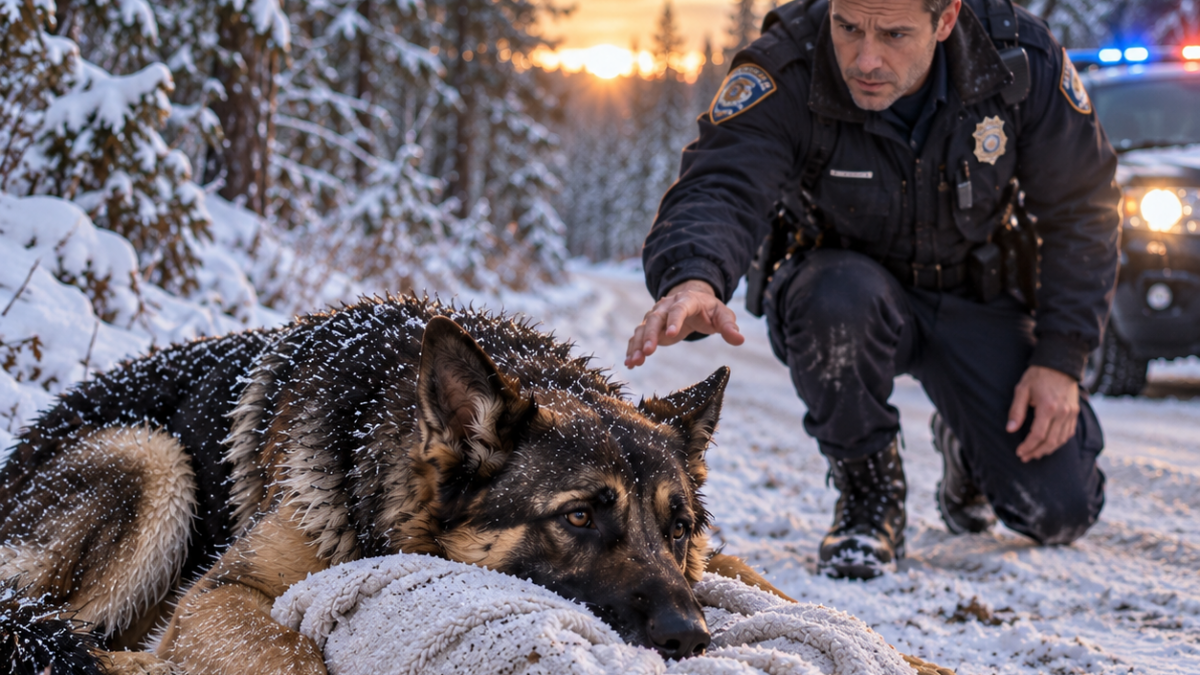
Yet there were still mornings when the memory returned with uncomfortable clarity. The dark blue bundle in the snow, Huck refusing to move away from it, and the tiny face that appeared when Clark pulled back the blanket.
The Hartwell family had changed considerably since then. Elise continued treatment and followed the recovery plan created with her doctors, counselor, and social worker.
She was no longer expected to carry every responsibility simply because she was capable of appearing strong. Mason had eventually returned to his unit, but the family no longer depended on hurried calls and hopeful assumptions. Their routine included regular appointments, scheduled check-ins, neighbors who knew when to stop by, and friends who understood that sometimes helping meant bringing dinner without waiting to be asked.
Lorraine Bishop had become particularly reliable.
She still respected the family’s privacy, but she no longer confused privacy with distance.
Anna had grown into a healthy, alert baby who had recently discovered the remarkable power of smiling at adults and making them forget whatever they had been doing.
Her cheeks had filled out, her eyes followed movement around the room, and she seemed especially fascinated by Huck’s ears.
Whenever the German Shepherd appeared beside her bassinet, Anna’s hands moved excitedly, and a broad smile spread across her face.
Huck had recovered just as noticeably. Regular meals had filled out the lean frame Clark remembered from the roadside, and his black and tan coat had become thick and glossy again. The scratches along his legs had disappeared beneath healthy fur.
His paw pads had healed, and his strength had returned.
He could run across the Hartwell’s backyard with the speed and confidence of a dog who had never spent a freezing night guarding a child in the snow.
Yet one habit remained untouched by time. Wherever Anna went, Huck found a position nearby. Clark visited the Hartwell house on a mild Saturday afternoon near the end of April.
He was off duty and wearing jeans, a work jacket, and boots instead of his police uniform. Though Huck recognized his truck before Clark had fully stopped in the driveway.
The shepherd appeared behind the front fence, tail moving steadily, then trotted toward the gate with considerably more energy than he had shown in the hospital. The house itself looked different, too. The winter silence that had surrounded it when Clark first arrived was gone.
One window stood open to the spring air. A small planter of early flowers sat on the porch railing, and the wooden rocking chair the neighbors had provided during the crisis had been moved outside for the warmer weather.
Elise sat beside that chair with a book resting open in her lap. She looked healthier than Clark had ever seen her, her long chestnut hair gathered loosely behind her shoulders, and her expression calmer without seeming artificially cheerful. Recovery had not transformed her into someone who never had difficult days.
She had simply stopped treating those days as something that needed to remain hidden. Anna rested nearby in a portable bassinet beneath the shaded portion of the porch, awake and content, while one small hand moved above the blanket.
Huck lay directly beneath the bassinet, his front paws stretched forward and his head positioned where he could see both Anna and the yard. Mason was repairing a section of fence near the side gate.
He had returned home again on scheduled leave and wore an old gray t-shirt, work jeans, and a baseball cap instead of his uniform. He had put a toolbox on the grass and was replacing a loose board, while Huck occasionally monitored the project from a distance, apparently unconvinced that fence repair ranked above guarding Anna.
When Clark approached, Mason set the hammer down and greeted him warmly. There was an ease in the yard that had been absent during the hospital reunion. No one behaved as if the family had forgotten what happened.
They had simply learned how to live beyond it. Clark spent the next hour on the porch while Elise described the small improvements that had mattered more than dramatic milestones.
She had learned to call someone when she felt overwhelmed instead of waiting until she could solve everything herself. Lorraine came by twice a week, usually pretending she had accidentally cooked too much food.
Mason’s brother helped with errands when Mason was away.
The medical appointments had gradually become less frequent as Elise stabilized, though she continued treatment and intended to keep doing so for as long as needed. Mason had also changed the way he called home from the unit.
He no longer accepted a quick answer that everything was fine simply because Elise smiled at the camera. They had learned to ask better questions and tolerate honest answers.
Anna made a small sound from the bassinet and Huck’s head rose immediately.
Clark noticed. Mason noticed Clark noticing. Some things did not require comment.
A few minutes later, Mason went inside and returned carrying a rectangular frame wrapped in brown paper. He handed it to Clark without ceremony.
Inside was a photograph taken shortly after Anna and Huck had both left the hospital. Anna was sleeping in her bassinet beneath a light blanket, and Huck lay beside her with his head resting near the lower frame, exactly as he had done through those first difficult days. His coat was still thin in the photograph, and exhaustion remained visible in the set of his body, but his eyes were open and fixed on Anna.
Beneath the photograph, Mason had written one line. He held the line until help came.
Clark looked at the picture for a long moment. There was nothing complicated about the sentence, which was probably why it fit Huck so well. The following Monday, Clark placed the frame on a shelf in his office at the Berlin Police Department.
It stood among ordinary objects accumulated through years of police work, commendations, an old department photograph, a coffee mug someone had given him as a joke, and a few thank you cards from people whose names he no longer remembered clearly. The photograph of Huck and Anna was different. Whenever Clark looked at it, he remembered how easily he might have driven past that morning if the dog had been farther inside the trees or if the snow had been falling harder.
At first, Clark had believed he had found a lost German Shepherd guarding an abandoned bundle. Huck had never been lost.
He had been exactly where he intended to be. He had chosen the edge of a road where vehicles sometimes passed after storms because that was where Elise had left Anna and where help had the best chance of seeing them. Huck could not call 911.
He could not explain that a mother was lying helpless inside a cabin nearly a mile through the woods.
He could not tell anyone that Anna’s father was serving thousands of miles away and did not know his family was in danger.
He could not describe the stranded Subaru, the dead phone, the empty fuel tank, or the notes scattered across the cabin table. He could only stay. So, he stayed beside Anna while the temperature fell.
He used his body to block the cold, refused food when moving too far from her felt dangerous, and stood between the bundle and the first stranger who approached. Then, when Anna was safe, he found a way to lead that stranger back toward the person who was still missing.
Months later, Huck still slept beneath Anna’s bassinet whenever she rested on the porch.
Still the same position, still the same guard. The Heartwells had survived because many things went right at the moment they most needed to. A police officer noticed something unusual and stopped.
Doctors recognized the emergency. A dog understood one simple instruction and refused to abandon it. Neighbors learned that concern did not have to become intrusion.
And a family learned that strength was not measured by how long someone could struggle without asking for help. Sometimes people imagined rescue as a great dramatic event, something announced by sirens or extraordinary acts of courage.
Clark had learned that it could be much quieter than that. Sometimes a family was saved because a tired dog refused to leave his post, because one person stopped instead of continuing down the road, and because several others decided that bringing someone home mattered more than asking why they had needed help in the first place.
On warm afternoons in Berlin, Anna would eventually fall asleep beneath the porch shade, while Elise read nearby, and Mason worked somewhere around the house. Huck would settle beneath the bassinet, place his head between his paws, and watch the yard until his eyes slowly closed. His mission had ended months earlier.
No one had managed to convince him of that. At the heart of this story is a simple truth. Real strength does not always mean carrying everything alone.
Sometimes strength is knowing when someone needs help, choosing to stop when others might keep driving and staying beside the vulnerable until they are safe. Huck could not speak, call for help, or explain what had happened in that lonely cabin.
But he understood one thing perfectly. Anna needed him, so he stayed.
Clark understood something just as important. When something felt wrong, he stopped long enough to care.
Elisa’s journey also reminds us that even loving and responsible people can become overwhelmed and that compassion can be far more powerful than judgment.
A family was saved not by one person alone, but by a chain of people who chose to notice, listen, help, and remain close when they were needed most.

