A Navy SEAL Saved a Mother K9 in a Blizzard—Then 9 Puppies Changed His Life – Part 1
A Navy SEAL Saved a Mother K9 in a Blizzard—Then 9 Puppies Changed His Life
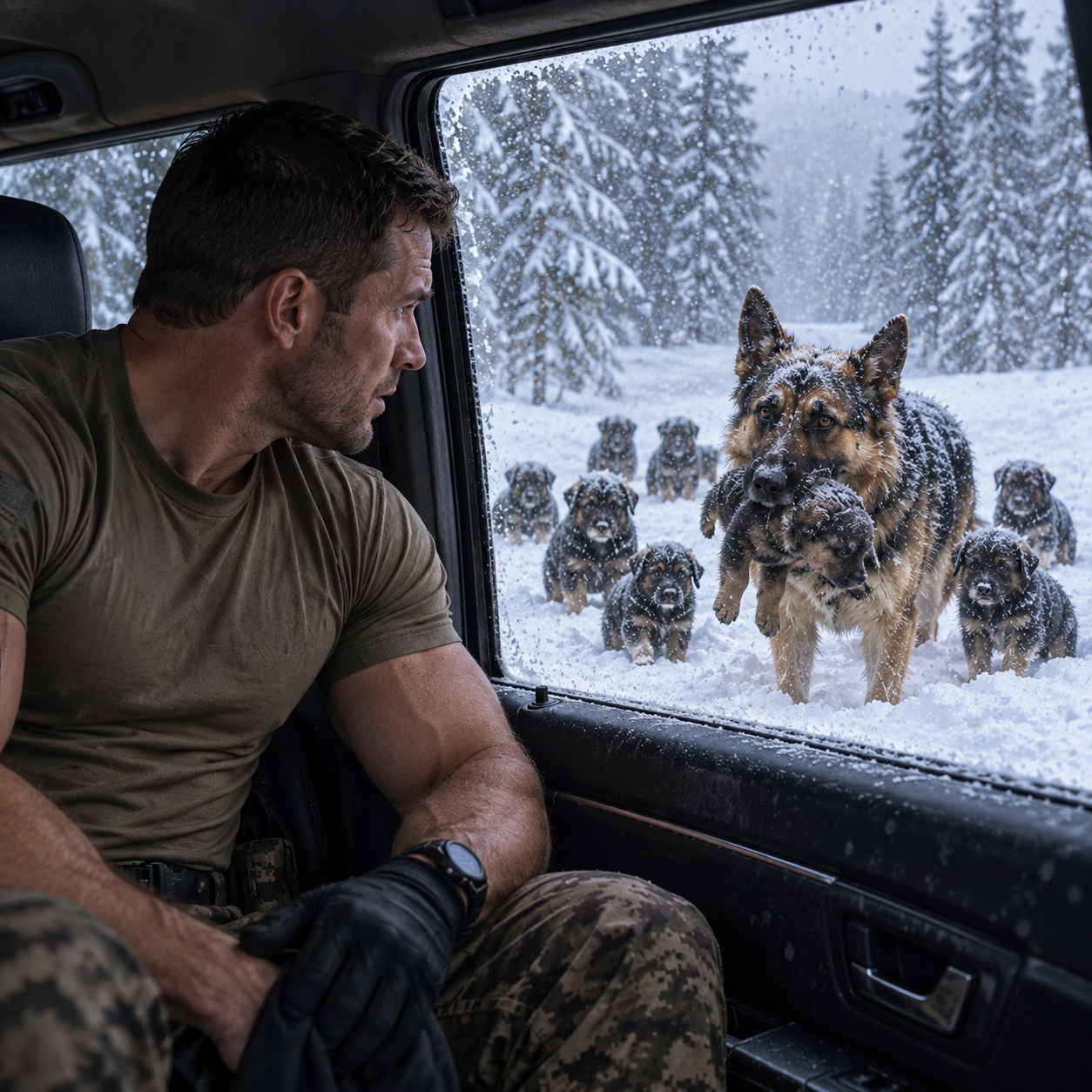
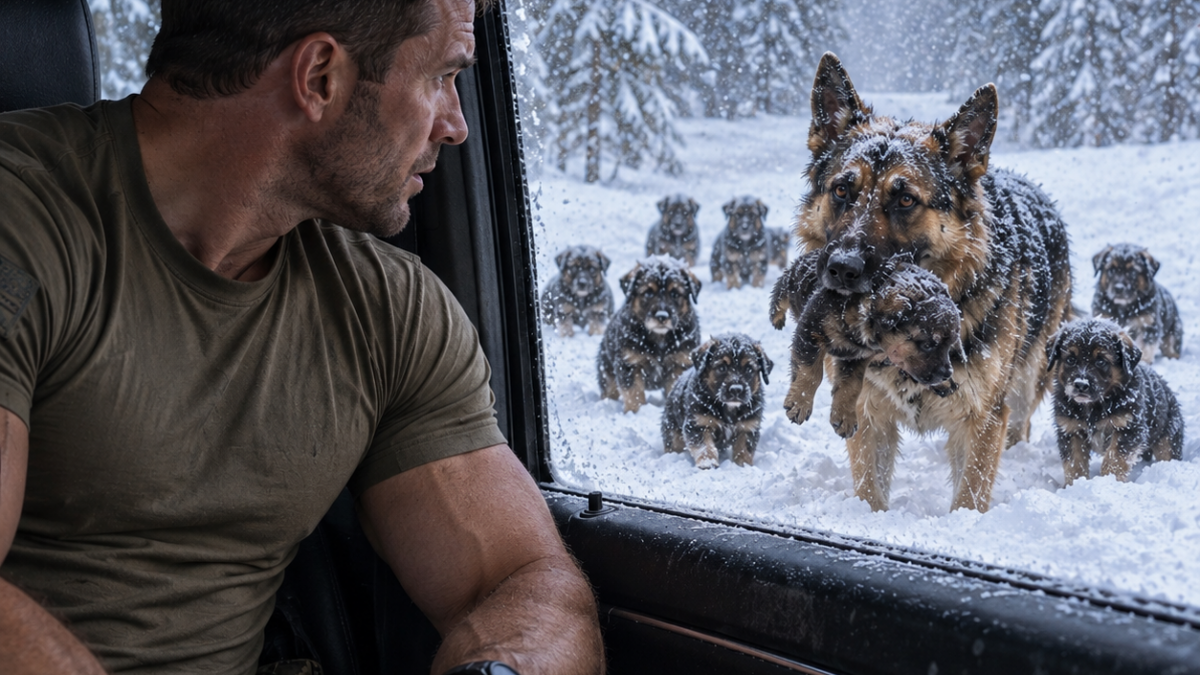
The snow had sealed the Idaho road when Caleb Mercer saw the German Shepherd through his fogged car window standing in his headlights, with one puppy held gently in her mouth, and nine more pressed along her side. The retired Navy Seal had spent years avoiding anything helpless enough to break his heart. That night, the mother dog chose him anyway.
Snow came down over the northshore of Lake Pere in thick, quiet sheets, the kind that made every sound smaller and every mistake feel permanent. Caleb Mercer drove with one gloved hand on the wheel of his old black SUV and the other resting near the heater vent, though the weak stream of warm air did almost nothing for his fingers. The road outside Sandpoint, Idaho, had vanished under a pale skin of powder and packed ice.
Pines leaned in from both sides. The lake was somewhere to his left, invisible beyond the storm.
A black depth breathing cold into the trees. His windshield wipers slapped back and forth with a tired rhythm clearing the glass just long enough for the next rush of snow to erase the world again.
On the passenger seat lay a folder from the real estate office, held shut by a bent paperclip.
Inside were the purchase offer, the inspection notes, and a polite letter from a developer who wanted to turn his father’s old boat repair property into luxury cabins with private dock access.
The words had been arranged gently, as if selling off the last place his family had loved could be made painless by good spacing and a signature line. Caleb had not signed.
Not yet. At 41, he still had the build of the Navy Seal he had once been, long through the shoulders, compact in every movement, his brown hair cut close and threaded faintly with gray near the temples.
A narrow scar crossed his right eyebrow and gave him the permanent look of a man listening for something nobody else heard. People in town called him calm. They were being kind.
Calm was not what lived inside him. calm was just discipline with the door locked.
He had left the teams 5 years earlier after a mission that ended with smoke silence and the loss of a military working dog named Bishop, a black and tan German Shepherd who had trusted Caleb’s hand signals more than most men trusted spoken prayer.
Bishop had done his job. Caleb had survived. Some debts did not know how to become memories.
The SUV fishtailed softly on a curve. Caleb corrected without thinking, easing off the gas, letting the vehicle find grip instead of bullying it back onto the road.
“Easy,” he said to no one.
His own voice sounded strange in the cabin. He had gone into town for coffee, a new alternator belt, and the meeting he had delayed for 3 weeks.
The agent had smiled with too many teeth and said the market was favorable, which was another way of saying the past could be priced if a man was tired enough. Caleb had nodded, taken the folder, and driven home through a storm that should have convinced any sensible person to stay put.
He was not always sensible. He was just usually prepared. a shovel, tow strap, blankets, first aid kit, road flares, two bottles of water, one stale protein bar, and an old pair of insulated gloves sat in the back.
Preparedness had become his substitute for hope. The road dipped toward a narrow bridge where a creek fed the lake. Caleb slowed before the bend, leaning forward a few inches, though it changed nothing.
The glass had fogged at the edges from his breath, and he wiped a small crescent clear with the heel of his glove. That was when he saw movement beyond the smear of snow. At first, it looked like a broken branch rocking in the wind.
Then, it stepped into the headlight beam. A German Shepherd stood in the road. She was leaned beneath a black sable coat crusted white at the tips, her back dark as wet coal, her chest and legs burnished with brown gold where a light reached through the storm.
Her ears stood high except for a V-shaped tear in the left one. Her eyes caught the headlights and held them amber steady and far too awake for an animal lost by accident.
In her mouth, held with impossible care, was a small puppy. Caleb brad.
The SUV slid half a yard and stopped with a soft crunch. The dog did not move away.
She turned broadside, placing herself between the vehicle and the shapes gathered along her right flank. Caleb narrowed his eyes. One puppy.
Two. Four.
No more than four. They were pressed together so tightly the snow made them look like one trembling shadow.
He lowered the window an inch and cold knifed into the cabin. The storm pushed sound through the gap.
Wind ticking ice against metal. The faint whimper of small lungs trying to work in bitter air.
Nine puppies, maybe 10 until he counted again. Nine following, plus the one in her mouth.
10 lives if he included the mother. He stared through the open inch of window, and the world inside him shifted with a force so quiet it almost passed for thought. The mother dog did not bark.
She did not snarl. She did not beg in any human way.
She simply stood there, snow building along her muzzle, one pup held in her jaws, the others huddled to her side, and looked at Caleb as if she had taken the measure of every other option, and found only this window, this vehicle, this tired man on a road almost
nobody traveled after dark.
“No,” Caleb whispered.
But the word was not for her. It was for the part of himself already opening the door.
He checked the mirrors. Nothing behind him but white. The temperature display on the dash read 11° and dropping.
His phone showed no service. A county warning had come through 10 minutes earlier advising drivers to avoid lakeside roads because of falling branches and ice slides.
He could turn around. He could mark the location when he reached signal. He could tell himself a professional would come.
That was the cleanest lie available. and Caleb had grown skilled at recognizing clean lies.
The puppy in the mother’s mouth shifted weakly, one tiny paw hanging low.
Caleb’s throat tightened.
Bishop had once carried a glove across a training yard and dropped it at Caleb’s feet with a look that said, “You lost this, and I am disappointed in your leadership.”
The memory arrived not like a wound opening, but like a hand on his shoulder. Not gentle, necessary.
Caleb turned off the high beams so they would not blind the dog, set the brake, and reached behind him for a wool blanket. He moved slowly because speed was for enemies and emergencies already understood. This was neither.
This was trust, and trust punished clumsy hands.
He opened the driver’s door.
Wind hit him hard enough to steal his breath. Snow slid off the roof and down the back of his jacket.
He stepped onto the road and kept his body angled sideways, eyes lowered, hands visible. The shepherd stiffened. The puppies crowded closer.
One small black-faced pup tried to climb over a sibling and sank nose first into powder, then popped back up with an offended squeak. Caleb might have smiled in another life.
In this one, the almost smile hurt.
Easy, girl,” he said, soft enough that the words belonged more to the space between them than to him.
The shepherd’s right ear twitched.
He took one step, then another, and laid the blanket on the snow halfway between them. He removed his left glove and placed it on the blanket, palm up, because gloves carried scent, and scent told fewer lies than faces.
Then he backed away and crouched. His knees complained. The cold found the old ache in his right hip, a souvenir from a fast rope insertion in weather that had also not asked permission to be dangerous.
The shepherd watched him. She shifted the puppy in her mouth, gentle, precise. Her back legs trembled, not dramatic, just factual.
Muscles reaching the end of what duty could demand. The puppies pressed against her side, their coats damp, their bellies low. One, the smallest, had a pale blaze across her chest, and kept leaning left, as if the wind had convinced her that straight lines were optional.
Another had a dark muzzle and a bossy posture despite being no taller than Caleb’s boot.
He counted them again because counting was a promise. Nine beside her, one carried.
He listened. Somewhere beyond the road, ice groaned along the lake edge. It was a long, strained sound, not breaking yet, but considering it.
The shepherd heard it, too. Her eyes flicked left. The pup in her mouth made a faint sound.
Caleb did not reach.
“I see him,” he murmured.
“I see all of you.”
The words surprised him. He had spent years speaking only when needed, and now he was narrating to a dog in a blizzard like a man bargaining with grace. The shepherd took one step toward the blanket.
Her paw touched the wool. She lowered her nose to the glove. Caleb held still.
Snow gathered on his eyelashes and melted down his cheek. His breath fogged between them. She sniffed the glove, then the blanket, then lifted her head and looked past him at the open passenger door.
Warm air leaked from the SUV and vanished into the storm. Another low crack came from the lake, sharper this time.
The puppy startled. Two broke from the cluster and wobbled toward the roadside ditch.
Caleb’s body wanted to move before thought arrived.
He stopped himself. A sudden lunge would scatter them.
He clapped once, a firm, flat sound. The mother turned.
Caleb pointed toward the open door, then tapped the blanket. Here, bring them here. The command came out with old authority, and he hated himself for using it before he knew whether she had ever been trained by kind hands.
But the shepherd did not flinch. Her head tilted by a fraction. Canine, he thought.
Not a pet lost from a porch. There was discipline in the way she assessed his gesture, in the way she blocked the two drifting pups with one step and pressed them back into formation. She had worked for someone.
Maybe someone good. Maybe not.
The thought landed cold. He pushed it aside. First the living, later the story.
He slowly opened the rear passenger door as well, making a pocket of warmth and light.
The SUV’s dome lamp came on yellow and humble, illuminating the cracked vinyl seat, the emergency blanket, the mess of old receipts in the cup holder.
Not much of a rescue station. Better than the road. The shepherd moved another step onto the blanket.
The puppies followed because she did. Caleb backed toward the SUV, keeping low.
The dog stopped within arms reach. Up close, he smelled wet fur, cold pine, lake, ice, and something metallic from the road.
Maybe rust, maybe fear. The puppy in her mouth was small, black and tan.
His eyes sealed against the snow, his body too quiet. Caleb placed both hands forward, palms up, stopping 6 in short.
“Your call,” he said.
“I won’t take him from you.”
The shepherd’s eyes searched his face.
He had seen that look in men before, doorways in young corman before. Bad news in his own mirror when morning came too early. Judgment, not surrender.
Behind them, the ice cracked again, and a shelf of snow slid from the bank beside the road with a soft, collapsing rush. Not onto them, not yet, but close enough that the puppies cried out in small, breathy bursts. The shepherd stepped closer.
Caleb felt the warmth of the puppy before he touched him. The dog loosened her jaw. For one heartbeat, mother and man held the little body together, her teeth still curled around the scruff.
Caleb’s hands supporting chest and hips.
Her amber eyes did not leave his. Then she let go.
The puppy weighed almost nothing. That was the detail that undid him.
Not the storm, not the danger, not the old memory of Bishop. The weight. A life should have weight.
It should insist on itself. This one lay in his palms like a question whispered into winter.
Caleb tucked the puppy inside his jacket against his sweater, careful to keep the small head clear. A flutter moved beneath his hand. Alive.
There you are,” he breathed.
The mother dog watched the shape beneath his jacket, then looked to the other puppies. Caleb stood slowly and carried the pup to the SUV.
He set him on the blanket across the front passenger seat, supported the weak paw, and turned back for the others. The shepherd remained on the road, still between danger and her children.
“I know,” Caleb said.
We’re not done.
He lifted the pale-chested pup first after the mother touched her nose to his wrist. The pup smelled like snow and milk and mud. One, he said, setting her beside her brother.
He returned.
A roundbellied male sneezed directly onto Caleb’s sleeve as if filing a complaint.
Two noted. The mother watched, her jaw eased by one degree. He carried two together when they fit safely, one tucked in each forearm, their bodies wriggling with weak indignation.
Three. Four.
Another tried to gum the zipper of his jacket and refused to release. Five.
Bold legal position. The wind shoved at his back. Snow hissed across the road, gathering in the tire tracks.
The lake groaned again, and somewhere up the slope, a branch snapped under weight. Caleb moved faster but kept his hands steady.
Six. Seven.
He counted aloud because if he stopped counting, fear would start inventing numbers.
The eighth puppy slipped from the blanket and planted both front paws on Caleb’s boot as if ordering him to improve the operation.
He lifted her with a huff that might have become laughter if the storm had not swallowed it. Eight.
supervisor.
The ninth was hiding under the mother’s belly, too cold to make a proper protest.
Caleb waited for the shepherd to nudge him forward.
“Nine.”
He placed the last follower in the rear seat among the warm folds, then turned to the mother. She stood alone in the road, black sable coat rimmed with white, head high, body trembling. The SUV was full of tiny sounds now.
Squeaks, size, the scratch of paws against wool. The injured pup gave one thin chirp from the front seat.
The mother’s ears came forward.
Caleb opened the front passenger door wider and stepped away. He did not pat the seat.
He did not command. She had carried them this far by choosing again and again. He would not steal the last choice from her.
The shepherd looked down the road behind them. Snow had already covered most of their tracks. Whatever place she had fled was being erased by the storm, which was merciful and troubling at the same time.
Then she looked into the SUV. Nine small bodies shifted in the back. The injured pup lifted his head a fraction, then dropped it.
The shepherd jumped in. Caleb shut the door gently as if closing a church door after prayer.
He rounded the hood, climbed behind the wheel, and pulled the driver’s door shut against the wind.
For a moment, he sat with both hands on the steering wheel, breathing hard. Not from fear, he told himself.
From cold, from effort, from the fact that his empty vehicle now smelled like wet dog puppy breath, and something dangerously close to purpose. The mother stood in the passenger footwell with her head over the injured pup, eyes on Caleb.
He put the SUV in reverse, the tire spun.
“Of course,” he said.
“Would have been rude to make this simple.”
One puppy answered with a squeak. The shepherd looked at him as if squeaking was an official performance review. Caleb tried again, rocking gently, feeling for traction.
The rear wheels caught, slipped, caught again. He turned the wheel toward the forest road, away from the bridge, where the ice continued to speak in low warnings. His direct route home crossed that bridge.
The longer route cut through timber and old logging grades, unplowed and narrow. The safer road was no longer safe.
The worse road might save them. That was the kind of math life enjoyed handing him. He glanced at the shepherd.
“You made your gamble,” he said.
“Now I make mine.”
Her eyes held his bright and exhausted. The SUV crawled forward. Behind them, the place where she had stood, disappeared into blowing snow.
Ahead, the trees closed around the headlights, and Caleb Mercer, who had spent 5 years refusing to be needed, drove into the storm with 10 lives breathing in his car.
The forest road rose above the lake in a slow white curve, and the snow under Caleb’s tires made a dry, grinding sound that reminded him of sand poured over metal.
The storm was less violent among the trees. But that did not make it kind.
It had simply changed tactics.
Instead of striking the SUV sideways, it waited in the dips, hid the ruts, softened the shoulders, and made every familiar landmark look like a stranger wearing his father’s coat.
Caleb drove by memory, and by the faint shape of the road where the pines opened on either side. The dashboard glowed dull green.
The heater roared.
Behind him, nine puppies had become a warm shifting pile inside the wool blanket, and the injured one lay on the front seat near the mother dog’s paws.
He had not named any of them. He told himself that twice. Naming was how people lied to themselves about distance.
Still, the smallest pale-chested female was already supervisor in his head, and the one who had sneezed on him was complaint department, which showed how well his rules were holding. The mother German Shepherd stood braced in the passenger footwell, too tired to sit and too watchful to rest. Her nose moved from the puppy on the seat to the pups behind them, counting without numbers.
Every time she reached the end, she looked at Caleb. Nine in back, he said. One up front.
I have them. Her ear turned.
It was not trust. Not yet.
It was the beginning of a temporary contract. He could respect that. In another life, temporary contracts had kept people alive.
The puppy on the seat shifted and made a sound so small the engine almost swallowed it. Caleb glanced over.
The little male’s front paw curled inward, not dramatically, just wrong enough for a man who had seen bodies in bad situations to understand that the cold was the bigger enemy than the injury.
He did not examine it again while driving. He had warmth. He had time if the road allowed it.
He had no right to waste either by panicking over what he could not treat until they were home.
“You picked an excellent night for a family road trip,” he told the mother dog.
“The words had no humor in them until the end when one puppy in the back responded with a grumble that sounded almost offended.”
Caleb’s mouth twitched.
Noted. Poor destination planning. The mother watched his face with solemn attention as if deciding whether he was competent or merely noisy.
A signpost appeared on the right, half buried and tilted under snow. West Cedar Cutoff.
The main county road would have taken 20 minutes in good weather. This route could take an hour if no tree had fallen, no wash out had widened, no careless driver had abandoned a truck across the track.
Caleb knew better than to pray for no trouble. That sounded too much like bargaining.
Instead, he prayed the way he had learned after leaving the teams badly, briefly, and mostly without words. Let me see what I need to see.
That was all. The SUV climbed.
Snow brushed the undercarriage. A branch scraped the passenger window with a brittle screech.
The mother dog did not flinch at the branch. She flinched at the metallic click of Caleb adjusting the gear selector.
It was slight, almost hidden, but he saw it. Her shoulders tightened. Her eyes went to the door, then to the rear seat.
Okay, he said softly. Metal sounds are bad news in your book. We can work with that.
He kept his right hand still on the wheel for a few seconds before shifting again, slower this time, letting the sound come without surprise.
The shepherd’s breathing eased by one careful measure.
There was a story behind that reaction. He did not need the details now.
Details had a way of turning pain into a display if a man was not careful. What mattered was the result. Sitting beside him.
A mother dog who had judged the storm safer than wherever she had been. The road narrowed between two granite shoulders. Caleb slowed to a crawl.
His headlights found the snow packed ahead in a smooth slope where wind had filled the hollow. He could punch through if the drift was shallow. If it was deep, he could beach the SUV with 10 dogs inside and no signal.
He stopped. The sudden quiet after the engine idled low made the puppies stir.
The mother lifted her head. Caleb rolled down his window an inch and listened. Wind threw pine needles, the ticking of ice against the hood.
Farther off, a faint mechanical hum. Not close. Maybe a plow on the highway below.
Maybe memory inventing rescue because it was tired. He opened his door only enough to step out, then paused.
The mother rose immediately.
“You stay,” he said and held up one hand.
She placed one paw on the seat. Caleb gave her a look.
“Your current assignment outranks mine.”
Her paws stayed there for a beat, then lowered. He shut the door gently and moved to the front of the SUV.
The cold took the heat from his face as if collecting a debt. He walked the drift with a shovel handle probing 8 in near the edges, maybe 18 in the center. Powder overpacked snow, not ice.
Passable if he kept momentum and did not overcorrect.
He returned to the driver’s seat, bringing a cloud of cold with him.
The puppies protested. I agree, he said, teeth chattering once before discipline caught them. Outside receives one star.
He backed up 20 ft, set the wheels straight, and eased forward, steady, not fast. The SUV entered the drift with a muffled push.
Snow climbed the hood. The tires slowed. Caleb felt the vehicle begin to float.
“Come on,” he murmured.
The mother dog leaned forward as though her weight could help. In the back, one puppy squeaked.
The wheels caught the packed layer beneath and crawled through. The SUV broke out on the far side with a lurch that made the rear blanket slide.
The mother turned so quickly her nails scratched the floor mat. Caleb stopped.
“Count,” he said, already reaching back.
The puppies were bundled against the seat, complaining, but together. He touched each small head with his fingertips.
1 2 3 4 5 6 7 8 9. The injured pup on the front seat lifted his nose into the air as if insulted by being excluded from the census. 10, Caleb said.
You, too. The mother stared at his hand until he placed it on the seat near her pup, palm down and still. She sniffed his knuckles.
Then, very briefly, she touched her nose to his sleeve. The contact was gone almost before it existed. It warmed him more than the heater.
they continued. The road dipped through a stand of cedar where snow clung to the branches in heavy shelves.
Caleb’s thoughts drifted where he did not want them to go.
Bishop had loved winter training because snow held scent differently, softening some trails and preserving others with strange mercy. He had been all business until the work ended. Then he would roll once, exactly once, as if indulgence needed procedure.
Caleb could see him now, ears high, waiting for the hand signal. The last day had been hot, not cold.
Dust had hung in the air. The building had smelled of old concrete and diesel. Bishop had looked back at Caleb before entering, not afraid, only ready.
Stop. Caleb pressed his thumb against the seam of the steering wheel until the leather creaked.
The mother dog looked at him. Dogs noticed departures. People asked questions later or avoided them forever.
Dogs simply watched the soul leave the room and waited to see if it would return. Different road, he said.
Different dog. The mother blinked.
The injured pup breathed against the blanket. A mile later, the headlights found a gate where no gate should have been closed.
It was a rusted forest service barrier, usually chained open during logging season, now swung halfway across the road. Beyond it, something dark sat in the snow.
Caleb stopped well short. His whole body changed before he told it to.
Shoulders low, jaw set, eyes moving. The shape beyond the gate was not a person. It was a pickup track fresh enough that the falling snow had not filled it.
Someone had turned around here recently. The gate chain dangled, broken from one post.
On the right side of the road, another set of tire marks led into a smaller track that Caleb knew only because his father had once used it to haul scrap lumber from a shed that should have been condemned before Caleb was born.
That track connected eventually with the old Holt Salvage yard, a place of stacked metal, stubborn engines, and rumors that changed depending on who was buying coffee at Norah Whitam’s diner.
The mother dog lowered her head. No growl, no bark.
Every muscle in her body became in tension. Caleb did not like how quiet she went.
“You know that smell?”
he asked. Her eyes stayed on the broken chain.
He shifted into park slowly, mindful of the click. The shepherd trembled once, then steadied.
He took a flashlight from the console, but he did not get out. Not with the dogs inside. Not for curiosity.
The road around the gate was narrow, but if he took the right shoulder, he could pass without touching the chain. He eased forward.
As the SUV approached, the injured pup raised his head and gave a thin cry. The mother stepped over him, placing herself between the puppy and the window.
Caleb looked at the fresh tire marks again. Wide tread pickup or work truck.
He filed it away with the broken gate, the mother’s reaction, and the direction of the tracks.
Facts, not stories. Stories could wait.
They slipped past the barrier branches, brushing the side mirrors. For the next 15 minutes, the road became an argument between gravity and patience.
Twice the rear end slid toward the ditch. Twice Caleb corrected without drama, talking low to the dogs because the sound of his voice seemed to give the puppies something to lean against.
“My father hated this road,” he said.
Claimed it was built by men who thought straight lines were arrogant. He also thought soup could fix most illnesses, so his opinions varied in quality. One puppy sneezed.
Exactly. The mother, who had endured gunmetal skies and ice roads with heroic dignity, finally sat when a curve nudged her shoulder against the seat.
She did not lie down. Her head remained above the injured pup.
Caleb watched her from the corner of his eye. You need a name, he said.
Not because I own you.
Because ma’am sounds like you might ask for my badge number.
The shepherd ignored him.
A dark coal glowed in his memory, not from a fire, but from the little emergency stove Bishop’s handler once carried on winter field exercises, a stubborn point of warmth that refused to die in bad weather.
Caleb almost chose Ember, then stopped. That name belonged to another story somewhere. Maybe to another dog, another road, another man trying not to need saving.
He studied the way this shepherd had stood in front of the SUV with one pup in her mouth and nine at her side, not asking for pity, demanding witness. Mercy, he said.
The word came out before he could dress it in irony.
The mother dog’s right ear turned.
temporary,” he added.
Because he was a coward in small domestic ways, her gaze moved to him unimpressed.
“Fine, semi-mporary.”
The injured pup wiggled under the blanket and managed to get his nose onto Caleb’s folded glove.
The glove shifted and the pup slid half an inch, deeply offended by physics. Caleb adjusted the blanket with one hand.
“And you,” he said, “are button.”
The puppy’s nose twitched because if anyone presses you, something loud happens.
In the rear seat, supervisor tried to climb onto another pup’s back and ended up sitting backward with great confidence.
Caleb felt a laugh rise in his chest. It came out quiet and rough, but it came out.
Mercy watched him, and for the first time, her jaw softened enough to show that she had noticed more than danger. The forest thinned.
Through the snow, Caleb saw the darker line of his driveway, where it cut toward the lake. The house waited beyond, low and square, built of cedar logs his grandfather had shaped by hand. Behind it stood the old boat repair shop, its roof patched in three colors of metal, its windows boarded on the north side after a spring storm broke them years ago.
The place had been too large for one man for a long time, too full of rooms that expected voices. Too patient. He turned into the drive and stopped beside the kitchen door, leaving the engine running so the heat would stay on.
The porch light glowed because he had forgotten to turn it off that morning. For once, forgetfulness looked like welcome.
He opened the rear door first. Mercy jumped down before he could stop her, then immediately turned back toward the puppies.
I know, Caleb said. Nobody gets left. He carried them two at a time when he could, one at a time when he should, speaking the count with each trip.
Snow squeaked under his boots. The lake wind moved through the trees with a low hollow sound. Inside, the kitchen smelled of cold wood, old coffee, and the faint lemon soap his mother had used.
He laid quilts on the floor near the wood stove, far enough away for gradual warmth, then placed each puppy in the soft hollow.
1 2 3 4 5 6 7 8 9 Button came last, tucked against Caleb’s chest.
Mercy crossed the threshold after him, inspected the kitchen, the hallway, the pantry door, and the shadow beneath the table. Only then did she lie down near the puppies, body curved around them, but eyes on Caleb.
He warmed water, mixed a small amount of electrolyte solution from the emergency kit, and offered it, dropped by careful drop. No big meals, no sudden heat, no heroic foolishness.
Mercy watched every movement when he supported Button’s sore paw with soft gauze.
He kept his touch light and his voice lower than the stove’s crackle.
Temporary rap, he said. Doctor gets the final vote.
Button tried to chew the gauze. Strong legal objection.
Mercy sniffed the bandage, then Caleb’s wrist.
Her nose rested there for less than a second. It was enough to quiet the room.
By 2 in the morning, the puppy slept in a warm heap. Each breath a tiny claim against the storm. Mercy finally lowered her head.
Caleb sat on the floor with his back against a cabinet, still wearing his wet boots, the real estate folder on the table above him. The purchase offer had slid partly out, its signature line visible in the yellow kitchen light.
He looked from the paper to the dogs. The house did not feel healed. That would have been too simple and too fast.
It felt interrupted, like silence had been caught in the act and made to explain itself. Outside, a vehicle moved somewhere beyond the trees. Far off at first, then gone.
Caleb lifted his head. Mercy opened her eyes at the same time. Neither of them made a sound.
On the counter, his phone buzzed once as a single bar of signal appeared, then vanished. A message began to load, but failed halfway. unknown number.
The preview showed only five words. I know you have her.
Morning came without sunrise. Only a thinning of gray against the kitchen windows and the soft drip of snow melting from the eaves whenever the stove breathed warmer than the room.
Caleb had slept for 20 minutes at a time in the chair beside the wood stove, waking at every puppy sound, every shift of mercy’s paws, every complaint from the old house settling under the weight of winter.
He had once slept through mortar noise because his body understood which sounds belonged to him and which belonged to someone else’s problem.
Now a puppy hiccup could bring him upright with both hands searching for a task. The irony was not lost on him. Mercy lay curved around the litter black sable coat drying in uneven waves, her amber eyes half-c closed but never surrendered to sleep.
Button, the little male with the supported paw, had wedged himself beneath her chin and looked satisfied with this arrangement, as if he had drafted the entire rescue plan and was pleased to see subordinates executing it.
The pale-chested female had found Caleb’s left boot and was sleeping with her nose inside it.
Supervisor has questionable taste, Caleb murmured.
Mercy’s ear moved.
That was not a criticism of your child, more a footwear concern. He stood slowly, knees stiff, and checked the water bowl.
The puppies were warmer, their gums had better color. No one seemed distressed beyond the normal outrage of being alive and small.
Caleb wrote the observations in a notebook because facts steadied him.
Time, temperature, water movement, buttons, paw, mercy’s appetite.
He had already taken photographs, not the kind that made suffering into spectacle, but the kind a veterinarian or deputy might need.
Each puppy’s face, the mother’s ear notch, the road salt on her legs, the condition of the blanket, the time stamp on the dash camera before the memory card filled.
evidence care a thin wall against chaos. He had just set water to heat when headlights brushed the kitchen window.
Mercy rose without sound. One instant she was resting.
The next she stood over her puppy’s head level body between them and the door.
Caleb moved to the side window and lifted the curtain. An old green pickup sat in the drive, engine running, snow crusted along the wheel wells.
Norah Witkim climbed out wearing a red knit hat, a brown parka, and the expression of a woman who had already decided the world could complain after she was done helping. In one hand, she carried a stockpot. In the other, two canvas bags.
Caleb opened the door before she could knock.
“You look terrible,” Norah said.
“Good morning to you, too.”
“It is morning.
Good is pending review.”
She peered past him. Mercy stared back from the kitchen, still and unsmiling in the way only a German shepherd could make feel like a legal proceeding.
Norah did not step in. She lowered the stockpot to the porch boards, set the bags beside it, and opened her empty hands at her sides.
“Well,” she said softly, “Aren’t you a beautiful mother with no patience for foolishness?”
Mercy’s eyes narrowed slightly.
Caleb said she may consider that accurate.
Norah’s silver hair had escaped beneath her hat, and a dusting of flower marked one sleeve because she had probably opened the diner before dawn, even in a storm.
She had known Caleb’s mother had fed Caleb pancakes when he was 10, had mailed him cookies during deployments until he wrote back that sand and chocolate chips did not improve each other.
After his sister died, Norah had left casserles on his porch without knocking because she understood pride better than most people understood grief.
“Now she waited on the porch until Mercy looked away first.”
“Nine puppies?”
Norah asked, “Plus the one up front last night.
10 dogs total. I brought enough towels for a small flood and enough soup for a man who forgot soup exists.
I didn’t call you.
You left every light on at 2 in the morning and drove in with a dog battalion. The lake community has eyes, Caleb.
We are nosy in the service of civilization. He stepped back and Norah entered sideways, slow and respectful, as if joining a room where someone was praying.
Mercy watched her place the bags on the bench. Out came towels, two hot water bottles, powdered puppy formula, a collapsible crate, a sleeve of paper bowls, and three pairs of clean dish gloves.
“You robbed a veterinary clinic?”
Caleb asked.
“I robbed my pantry and Dr.
Leah’s voicemail.
She called me back while I was scraping ice off the truck.
She is on her way when the county road opens enough for chains.”
Relief moved through him so suddenly he had to turn toward the stove. Norah saw it. She did not comment.
Good neighbors knew when to leave a man’s face alone.
They worked in a quiet rhythm. Caleb warmed the hot water bottles and wrapped them in towels.
Norah sat on the floor several feet from mercy, not reaching, not couping, simply being present in the way older women sometimes could. as though patients were a chair they had carried in with them. The smallest puppy waddled toward her boot, bumped it, and fell asleep with his chin on the rubber toe.
Nora looked at Caleb. That one has excellent judgment.
That one tried to eat a receipt earlier. Paper has fiber. Mercy lowered her head a little, not fully relaxed, but less braced.
humor Caleb had forgotten could move through a tense room like warm water. He checked Button again, touching the paw only enough to make sure the wrap had not tightened.
The puppy protested by licking his thumb with great seriousness.
He’s stronger, Caleb said.
He Norah asked.
Don’t start.
I have said nothing. Your eyebrows are naming him.
My eyebrows are independent citizens. A sound almost left Caleb. Not quite laughter, close enough that Mercy looked up.
At 9:30, the county road was still a mess. But Dr.
Leah Bennett arrived anyway in a white truck with chains on all four tires and a dent in the front bumper that suggested long familiarity with weather. She was 36, compact, dark-haired, and moved with the efficient calm of someone who had handled frightened animals, frightened people, and billing paperwork, perhaps in that order of difficulty.
She paused at the kitchen entrance until Caleb said, “Mother is protective, canine trained.
I think she responds to hand signals.
Metal sounds bother her.”
Leah nodded once. Then we go slow and boring.
Boring saves fingers and hearts. Caleb liked her immediately for that.
Leah sat on the floor, opened her kit with no sudden clatter, and let Mercy study every motion.
What’s her name?
Mercy.
Norah’s eyes lifted.
Caleb added, “Temporary.”
Leah did not smile. That was kind of her.
Mercy, I’m Leah.
I’m going to check your babies without making a ceremony of it.
One by one, with Mercy’s permission earned in inches, Leah examined the puppies.
No graphic drama, no big speech, just temperature, hydration, breathing, weight, reflexes, tiny hearts working hard under her stethoscope. The litter was cold, stressed, but improving.
Button’s paw appeared strained rather than severely damaged, though he would need rest and a proper follow-up.
You did well, Leah told Caleb. The words landed badly as compliments often did when they touched places shame had been guarding.
He shrugged. I did what was in front of me. That is often what doing well means.
Norah gave Leah a look of approval so complete it could have been notorized. Mercy tolerated the exam until Leah reached for a handheld scanner. The device beeped when turned on.
a small electronic sound. Mercy stiffened and moved between Leah and Button. Leah turned it off immediately.
“All right, not that way yet.”
Caleb crouched beside Mercy, not touching her.
“It’s a scanner,” he said softly.
“No harm.
We can wait.”
Mercy’s gaze went to his face, then to the device.
Leah placed it on the floor and slid it away from the puppies.
We can scan later after she eats or from a distance if she’ll allow it.
Mercy stood over Button for another long breath, then lowered herself. Caleb felt the whole room exhale.
They fed Mercy a small meal and gave the puppies supervised access to their mother once Leah confirmed everyone was warm enough. While the pups nursed, Leah examined Mercy visually, keeping respectful distance.
She’s had training, Leah said.
Not backyard obedience. Real work.
See how she watches corners and people’s hands.
See her check count after every interruption. Caleb nodded.
He had seen it. He had been trying not to.
There’s an old collar line, Leah continued.
And that ear tear healed a while ago.
She may have been out in poor conditions before the storm, but I don’t want to build a story from a few signs.
Facts first, Caleb said. Leah glanced at him. Exactly.
Norah poured soup into a bowl and pushed it toward Caleb. Fact. You have not eaten.
He took it because resisting Norah used more energy than soup required. The first spoonful tasted of chicken rosemary and being remembered. That was unfair of it.
After Mercy ate and rested, Leah tried the scanner again, this time without the beep and with Caleb holding a towel near Mercy’s shoulder as a scent bridge.
Mercy allowed it, though her eyes stayed on Leah’s hands.
The scanner found a chip between the shoulder blades. Leah read the number aloud while Caleb wrote it down twice. She entered it into a registry on her tablet.
The first search took too long. The second returned a partial record.
Leah’s eyebrows drew together.
Registered to Inland K9 search response. Formerly based near Cordelane.
Status inactive. Last update 3 years ago.
Norah leaned closer. Inactive as in closed.
Looks that way. Contact number disconnected. Handler listed as Daniel Pike.
Leah tapped the screen. Emergency secondary contact Elaine Pike.
No current address in the public field. Caleb repeated the name under his breath.
Daniel Pike. Something about it brushed memory. A newspaper article.
Maybe a search team finding a lost boy near Priest Lake.
A dog photographed beside a sheriff’s deputy.
Mercy lifted her head when Leah said the name again, not sharply, slowly like a door opening in a dark hallway. Caleb noticed.
So did Leah.
You know that name, don’t you?”
Leah said softly to the dog. Mercy placed her chin back over button.
No answer. Plenty of answer.
Caleb’s phone buzzed on the counter.
This time, the signal held long enough for the message to load. Unknown number. I know you have her.
Do not make this difficult. He turned the screen so Leah could see.
Norah’s face changed.
Not fear. Norah was not built to give fear the first chair. It was anger refined into usefulness.
“Do we know who sent it?”
she asked. Caleb shook his head. Outside, tires crunched in the drive.
Mercy was on her feet before the sound reached the porch. The puppy stirred.
Caleb moved to the side window and saw a dark blue pickup idling behind Leah’s truck.
A man climbed out, broad through the middle, sandy hair masked beneath a cap, wearing a heavy coat that looked new enough to have opinions about mud. He looked toward the house, then toward the old boat shop, then back to the house.
He did not hurry. That bothered Caleb more than hurry would have. The man came up the steps and knocked twice.
“Open up,” he called.
“I’m looking for my shepherd.”
Mercy made no sound. She gathered all her puppies behind her with one sweep of her body, then stood facing the door.
Caleb stepped into the hall, putting himself where she could see him and the entrance. Norah rose from the floor, soup forgotten.
Leah closed her medical kit quietly. Caleb opened the door as far as the security chain allowed.
Cold air pushed into the hall. The man on the porch offered a tired smile that did not reach his eyes.
“Travis Hol,” he said.
“I hear you found a dog last night.
Caleb studied him through the gap. Where did you lose one? Travis shifted his weight.
My yard off Bottle Bay Road. Storm tore up a latch.
She spooked.
She’s got a litter with her.
Black Shepherd answers to Sadi.
Behind Caleb, Mercy’s head lowered.
He did not look back. Do you have records?
Records? Proof of ownership? Veterinary file?
Photos? Chip number?
Travis’s smile thinned.
They’re dogs, not boats with titles.
Then you should still have something. Travis looked past Caleb, trying to see through the narrow opening. Look, friend, I appreciate you keeping them warm.
Truly. But those pups are worth good money, and the mother took off from my property. I can give you something for your trouble.
Caleb’s mind became very still.
Not empty. Exact worth good money. He felt Norah behind him like a banked fire.
Leah’s hand moved near a phone.
Caleb kept his voice level. They are under veterinary care. County will be contacted.
If you have documents, bring them to Deputy Rachel Price or Animal Control. You making this official?
Travis asked. you did when you came to my door without proof.
For a second, Travis’s face showed irritation raw enough to be useful.
Then it was gone, covered by another poor smile.
“You don’t want trouble, Mercer.”
Caleb had not given his name. The hallway seemed to narrow around that fact.
“Neither do the dogs,” Caleb said and closed the door.
He slid the bolt, then the chain, then stood with his palm flat against the wood until the truck engine started. Travis remained in the drive for nearly 2 minutes talking on his phone.
Caleb photographed the truck through the curtain, catching the plate and the dent near the rear fender. He wrote the time, words, and sequence in his notebook. Leah called Deputy Rachel Price.
Norah went back to the kitchen and sat near Mercy, not close enough to intrude.
Well, Norah said to the dog voice low, “You chose an interesting porch.”

