Part 2: “Paul said you were a killer. He said that’s why Denise is scared of you.”
PART 4 — THE APPEAL
Victor Brandt didn’t waste time.
The notice of appeal was fourteen pages long. It alleged that Judge Ellison had abused her discretion, that Dr. Keene’s evaluation was biased, that the guardian ad litem had exceeded her authority, and that I had — and I quote — “manipulated the court through a carefully orchestrated campaign of emotional appeals and unverified documentation.”
Unverified documentation. That was Dr. Reyes’s evaluation. The one she’d testified about under oath.
Harriett read it and laughed.
“He’s throwing everything at the wall. None of this holds up on appeal. The standard is abuse of discretion, and Ellison was meticulous. Every ruling she made was supported by the record.”
“Then why does it feel like a punch in the gut?”
“Because it is. Appeals take time. They cost money. And they keep you in limbo. That’s the point. Brandt isn’t trying to win. He’s trying to make you quit.”
I didn’t quit.
The appeal took four months. In that time, I went back to work. Doug had me on light duty for two weeks, then put me back on the rotation. The anonymous letters stopped. HR filed them somewhere and forgot about them. Life went on.
Riley started fifth grade at a new school. Public school this time, not the private academy Denise had chosen. She made friends. She joined the soccer team. She started drawing again.
I bought her a desk and put it in her room. She covered it with sketches — horses, mostly, and a few portraits of me that made me look like a cartoon character. I kept them all.
The appeal was heard by a three-judge panel in Norfolk. Harriett argued. Brandt argued. The panel took it under advisement.
They ruled three weeks later.
Affirmed.
Denise’s petition was denied in its entirety. The custody order stood.
Harriett called me at work. I was on a conference call with a shipping company in Dubai. I excused myself and took the call in the hallway.
“We won.”
“That’s it?”
“That’s it. She can petition the state Supreme Court, but she won’t. Brandt will tell her it’s a waste of money. And she knows it.”
I leaned against the wall.
“So it’s over.”
“It’s over, Caleb. You can breathe.”
I didn’t breathe. I’d learned a long time ago that the moment you relax is the moment you get hit.
Denise didn’t petition the Supreme Court. But she didn’t disappear either.
She started showing up at Riley’s soccer games. Sitting on the opposite side of the field with Paul. Watching. Not talking to anyone. Just watching.
Riley noticed. She didn’t say anything, but I saw her glance over there during warmups. I saw her shoulders tighten. I saw her play a little more carefully, like she was being evaluated.
I didn’t confront Denise. That’s what she wanted. Instead I talked to Riley’s coach — a woman named Tammy who’d played Division I soccer and had a no-nonsense approach to drama — and asked her to keep an eye on things.
Tammy nodded.
“I’ve seen this before. Exes showing up at games. It’s a control thing. She wants Riley to know she’s there.”
“Is there anything I can do?”
“You can keep being the dad who shows up. That’s what matters. Kids remember who was in the stands when they scored.”
I showed up to every game. I stood on the sideline. I cheered. I brought orange slices. I did the dad stuff.
Denise kept coming. She didn’t cause a scene. She just sat there, a hundred feet away, watching.
It was the quietest form of harassment I’d ever experienced. And I couldn’t do anything about it, because technically she wasn’t doing anything wrong.
The private investigator was Harriett’s idea.
“Not to dig up dirt on her,” she said. “We’re not going to do that. But if she’s going to keep showing up at Riley’s games, I want a record. Dates. Times. Whether she interacts with Riley. Whether Paul does. If this ever goes back to court, I want to be able to show a pattern.”
I hired a woman named Claudia Reyes — no relation to Dr. Reyes — who’d spent fifteen years as a fraud investigator for an insurance company before going private. She was in her fifties, drove a Honda, and had a way of blending into any environment so thoroughly that you forgot she was there.
Claudia started coming to games too. She sat in the bleachers with a paperback. She took notes on her phone. She never spoke to anyone.
After three weeks, she sent me a report.
Subject Ashworth, Denise. Attended four games, all home games. Sat in the visitor bleachers, approximately 80-100 feet from subject’s daughter. Did not attempt to contact daughter. Departed immediately after final whistle. Subject Ashworth, Paul. Attended two of the four games. On both occasions, appeared to be on his phone for much of the game. No interactions with Riley.
Additional notes: On 10/14, observed subject Denise Ashworth speaking with an unidentified male in the parking lot after the game. Duration approximately 12 minutes. Male departed in a dark-colored pickup, Virginia plates. Partial plate: KTR. Male appeared to hand subject Ashworth a folder or envelope. Unable to confirm contents.
I read that last part three times.
“Harriett, who is this guy?”
“I don’t know. Could be nothing. Could be a colleague. Could be her attorney. Could be someone she’s hiring to do something.”
“Something like what?”
“Like what happened to your security clearance. Or something worse.”
I didn’t like the sound of that.
Two weeks later, I found out what it was.
I was at home. Riley was at soccer practice. The doorbell rang. I opened it.
A man was standing there. Sixties, gray hair, a brown jacket, a folder under his arm. He looked like an accountant. He looked like someone who’d spent forty years pushing paper and was now tired of it.
“Mr. Maddox?”
“That’s me.”
“My name is Gerald Pryor. I’m Alan Pryor’s father.”
I didn’t move.
“I think we need to talk.”
I let him in. He sat at my kitchen table. I made coffee. He didn’t touch it.
“I read my son’s report,” he said. “The one he wrote about you.”
“That report was discredited. The judge struck it from the record.”
“I know. I read the transcript. That’s why I’m here.”
He opened the folder. Inside were emails. Printed emails, dozens of them, between Alan Pryor and an email address I didn’t recognize. The address belonged to a domain I’d never heard of.
“I found these on his computer,” Gerald said. “He doesn’t know I have them. He’s been — struggling. He lost his license last year. Substance issues. I’ve been trying to help him get clean, and I was going through his old files, and I found this.”
He slid one of the emails across the table.
From: [redacted]
To: Alan Pryor
Subject: Re: Evaluation
Dr. Pryor — As discussed, the attached records should be sufficient to support your findings. The client is willing to pay your standard fee plus a retainer for your time. Please keep this correspondence confidential. The client’s identity should not appear in any documentation.
I looked at Gerald.
“Who sent this?”
“I don’t know. The address is anonymous. But the payment went through a shell company. I traced it. It’s registered in Delaware. The registered agent is a law firm in Richmond.”
“Brandt’s firm?”
“One of his partners.”
I set the email down.
“Why are you telling me this?”
Gerald Pryor looked at me for a long moment.
“Because my son is a coward and a fraud, and he let himself get used by people who wanted to hurt you. And because I spent thirty years as a court reporter, and I’ve seen what happens when people like that win.”
He stood up.
“You don’t have to do anything with this. You can burn it. But I wanted you to have it. Because someone should know the truth.”
He left.
I sat at the table for a long time.
Then I called Harriett.
She came over that night. She read the emails. She read them twice.
“This is a conspiracy to commit fraud on the court,” she said. “This is serious. This is — Caleb, this could send someone to jail.”
“Denise?”
“Denise, Paul, Brandt, Pryor. All of them. If we can prove they colluded to introduce false evidence in a custody proceeding, that’s a felony.”
I thought about it.
“Can we prove it?”
“We can prove Pryor was paid by Brandt’s firm. We can prove the records were obtained without your consent. We can prove the report contained factual errors that Pryor couldn’t have made if he’d done any actual work. Whether that’s enough to convict someone — I don’t know. But it’s enough to take to the Commonwealth’s Attorney.”
I looked at the folder.
“Riley just got settled. She’s happy. She’s making friends. If I do this, it all comes back. The court dates. The interviews. The stress.”
“It does.”
“She’s ten.”
“She is.”
I sat with that for a long time.
“Harriett, what would you do?”
She didn’t answer right away.
“I’d think about what I want Riley to learn,” she said finally. “Not what I want her to have. What I want her to learn.”
I thought about that.
I thought about all the years I’d spent staying quiet. All the times I’d let things slide. All the times I’d told myself that the right thing to do was to avoid conflict, to be the bigger person, to take the hit and keep moving.
And I thought about Riley, sitting in that conference room, writing a letter to a judge because nobody else would listen to her.
I looked at Harriett.
“I want her to learn that you don’t get to lie about people and get away with it.”
Harriett nodded slowly.
“Then we take it to the Commonwealth’s Attorney.”
We met with an assistant Commonwealth’s Attorney named Dana Whitfield. She was in her forties, sharp, and had a reputation for taking on cases that other prosecutors thought were too complicated.
She read the emails. She read Dr. Pryor’s report. She read Dr. Reyes’s evaluation. She read the transcript of the hearing.
Then she looked at me.
“Mr. Maddox, I want to be honest with you. This is a strong case for conspiracy. But it’s not a slam dunk. The emails don’t explicitly say ‘we’re going to lie to a judge.’ They say ‘the attached records should be sufficient to support your findings.’ That’s ambiguous. A good defense attorney will argue that Pryor genuinely believed the records were accurate, and that the payment was for his time, not his conclusion.”
“But?”
“But the factual errors in the report are significant. He cited a hospitalization that never happened. He cited a diagnosis that was ruled out. He cited a deployment you were never on. Those aren’t mistakes you make when you’re reviewing a full record. Those are mistakes you make when you’re working from a partial record and you don’t care enough to verify it.”
She leaned back.
“And the shell company is a problem for them. If they were paying him legitimately, they’d have paid him directly. The fact that they routed it through a Delaware LLC with a registered agent at Brandt’s law firm tells me they knew what they were doing was wrong.”
She looked at Harriett.
“I’ll take it to the grand jury. No promises. But I think there’s enough here to indict.”
The grand jury met in March. They indicted Dr. Alan Pryor on three counts of perjury and one count of conspiracy to commit fraud. They indicted Victor Brandt on the same charges. They indicted Denise and Paul Ashworth on conspiracy to commit fraud.
The indictments were unsealed on a Thursday.
I was at work when the news broke. Doug came into my office.
“Did you see this?”
He held up his phone. The headline was from the Virginian-Pilot.
Richmond attorney, psychologist indicted in Norfolk custody case.
I read the article. It was short. It said the indictments stemmed from a two-year investigation into allegations that a psychologist had submitted a false evaluation in a custody proceeding. It named Brandt, Pryor, and two unnamed co-conspirators.
The unnamed co-conspirators were Denise and Paul. They’d be named eventually. For now, they had a little time.
I put the phone down.
“You okay?” Doug asked.
“I don’t know.”
“You want to take the rest of the day?”
“No. I want to work.”
He nodded and left.
I sat at my desk. I looked out the window. It was raining.
I thought about Denise, sitting in her big house on the other side of town, reading the news. I thought about Paul, in his office, getting the call from Brandt. I thought about the life they’d built, the life they’d tried to take from me, the life that was now going to be picked apart in a courtroom.
I didn’t feel good about it. I didn’t feel bad about it either.
I felt like someone who’d been holding a door shut for three years while someone else tried to break it down. And now the door was open, and the person on the other side was going to have to explain why they’d been trying to break it.
Riley came home from school that day with questions.
“Dad, is Denise in trouble?”
I sat her down at the kitchen table.
“Yeah, kiddo. She is.”
“Because of what she did to you?”
“Because of what she did in court. She and Paul and their lawyer lied to a judge. That’s against the law.”
Riley was quiet for a moment.
“Is she going to go to jail?”
“I don’t know. That’s up to the courts.”
“Are you going to testify?”
“Probably.”
She looked at me.
“Will I have to testify?”
“I don’t know. Maybe. If they need you to.”
She thought about that.
“I’ll do it if I have to.”
“Riley — ”
“I’ll do it, Dad. I’m not scared of her.”
I looked at my ten-year-old daughter, who had written a letter to a judge because nobody else would listen, and I realized that she was braver than I’d ever been.
“Okay,” I said. “If you have to.”
She nodded.
“Can I have a snack?”
“Yeah. Help yourself.”
She got up and went to the pantry. I sat at the table, listening to her rustle around in the cabinets, and I thought about the road ahead.
The trial. The testimony. The cross-examination. The media. The whispers at school. The looks from other parents.
It was going to be hard. Harder than the custody case. Harder than anything I’d done in a long time.
But Riley would be okay. And that was the only thing that mattered.
PART 5 — THE GRAND JURY
The grand jury testimony was closed to the public. No cameras. No press. Just twelve people in a room, a prosecutor, and a court reporter.
I testified for two hours. I told them about the petition. I told them about Dr. Pryor’s report. I told them about the anonymous letters to my employer. I told them about Denise showing up at Riley’s soccer games.
Dana Whitfield asked me questions. I answered them. I didn’t embellish. I didn’t speculate. I just told them what happened.
When I was done, she walked me out.
“You did good. You were calm. That matters.”
“I’ve had practice.”
She smiled slightly. “I’m sure you have.”
Riley testified the following week. Harriett was with her. Dana was gentle. She asked simple questions. Riley answered them clearly.
She told them about the phone checks. The permission slips. The “it’ll be your fault” speeches. The night she heard Denise and Paul talking in the kitchen. The letter she wrote to the judge.
When she was done, Dana walked her out to me. Riley looked tired but steady.
“You okay, kiddo?”
“Yeah.”
“You want ice cream?”
“Yeah.”
We went to a Dairy Queen. We sat in a booth. She ate a Blizzard. I drank coffee.
“Dad?”
“Yeah.”
“Did I do okay?”
“You did great.”
“I was scared.”
“I know. But you did it anyway. That’s what brave is.”
She thought about that.
“Are you scared?”
“Of what?”
“Of the trial.”
I looked at her.
“A little.”
“Why?”
“Because it’s hard to talk about things in front of strangers. Because I don’t like people looking at me. Because I’m worried about you.”
“I’m okay, Dad.”
“I know you are.”
She went back to her ice cream. I watched her. Ten years old, and she’d already been through more than most adults. She’d lost her mom. She’d been manipulated by a woman who was supposed to care for her. She’d been told her father was dangerous. And she’d stood up in front of a grand jury and told the truth anyway.
I was proud of her. More proud than I’d ever been of anything in my life.
The trial date was set for October. Six months away. In that time, Denise and Paul’s lives fell apart.
The indictments were unsealed in full. Their names were made public. The Virginian-Pilot ran a story. Then the Richmond Times-Dispatch. Then the Associated Press picked it up.
Couple accused of conspiring with attorney, psychologist to falsify custody evaluation.
Paul’s company put him on leave. Denise’s school district put her on administrative leave pending an internal review. Their neighbors started avoiding them. The Ashworth family — Paul’s parents, his brothers, the whole extended clan — issued a statement saying they were “shocked and saddened” and that they were “praying for everyone involved.” They hired a lawyer for Paul. They didn’t hire one for Denise.
I heard all of this through the grapevine. Claudia Reyes kept me updated. She sent me reports with headlines, screenshots, social media posts. I didn’t ask her to stop. I wanted to know.
Denise called me twice. I didn’t answer. She left voicemails. The first one was angry. The second one was pleading. I deleted both without listening to them.
Harriett told me I should keep a record. I told her I didn’t want to hear Denise’s voice. She said that was fine. She had Claudia.
The trial was set for October 14. Judge Ellison would preside. Dana Whitfield would prosecute. Victor Brandt had been suspended from the bar pending the outcome of his case. His replacement was a criminal defense attorney from Richmond named Marcus Webb. He had a reputation for being aggressive and effective.
I wasn’t worried about Marcus Webb. I was worried about Riley.
The pre-trial hearing was in September. I sat in the gallery with Harriett. Denise and Paul sat at the defense table with Marcus Webb. Brandt wasn’t there. Pryor wasn’t there. They’d been severed from the case and would be tried separately.
Webb argued that the case should be dismissed because the emails between Pryor and the unknown sender were “ambiguous” and didn’t prove “any conspiracy to defraud the court.”
Judge Ellison listened. She asked questions. She took notes.
Then she ruled.
“The emails may be ambiguous on their own, Mr. Webb. But they’re not on their own. They’re part of a pattern. The court has reviewed the full record, including the factual errors in Dr. Pryor’s report, the shell company payments, and the anonymous letters sent to Mr. Maddox’s employer. The commonwealth has presented sufficient evidence to proceed to trial. Motion denied.”
Webb sat down. Denise was staring at the table. Paul was rubbing his temples.
I didn’t smile.
The trial began on a Monday. I wore a suit. Riley stayed home from school with a note. Harriett picked her up at noon and brought her to the courthouse. She’d be testifying the following day.
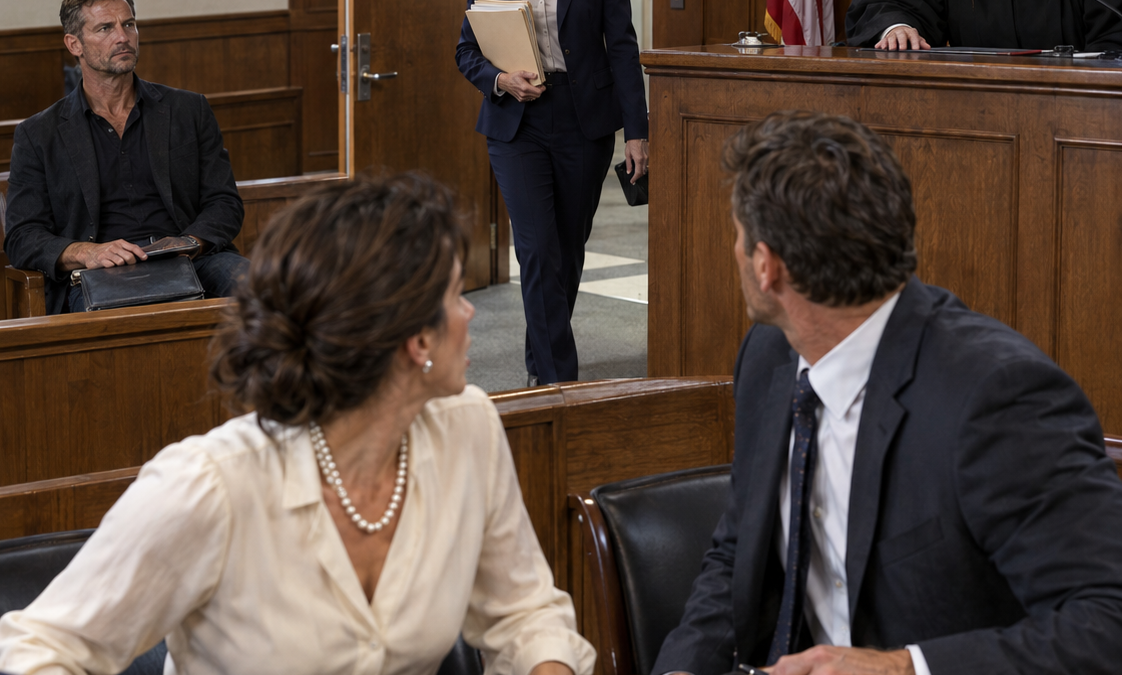
The courtroom was small. Wood paneling. Fluorescent lights. A flag in the corner. Maybe thirty seats in the gallery. Half of them were filled with reporters.
Dana Whitfield stood up.
“Your Honor, this case is about a lie. A lie told to a family court judge by people who thought they could get away with it. A lie that was designed to take a child away from her father. A lie that almost worked.”
She laid out the case. The petition. The evaluation. The false records. The payments. The anonymous letters. The pattern of manipulation.
Then she called her first witness.
Dr. Maria Reyes.
She testified for two hours. She explained her evaluation. She explained the differences between her findings and Dr. Pryor’s. She explained the factual errors in Pryor’s report. She explained, in clinical terms, why those errors mattered.
Marcus Webb cross-examined her.
“Dr. Reyes, isn’t it true that you’ve been treating Mr. Maddox for two years, and that you have a vested interest in his well-being?”
“I have a professional obligation to his well-being. That’s not the same thing.”
“Isn’t it true that you’ve become friendly with him over the course of your treatment?”
“I’m friendly with all my patients. That’s part of good care.”
“Isn’t it true that you were angry when you learned about Dr. Pryor’s report?”
“I was concerned. Not angry.”
“Concerned enough to testify against him in a criminal trial?”
“Concerned enough to tell the truth.”
Webb didn’t get anywhere with her. He sat down.
Dana called Dr. Keene next. He testified for three hours. He explained his evaluation. He explained his findings. He explained why he’d concluded that Riley should live with me.
Webb tried to trip him up. He asked about his methodology. He asked about his credentials. He asked about his relationship with the court.
Dr. Keene answered everything calmly. He was a professional. He’d testified hundreds of times. Webb wasn’t going to rattle him.
The third witness was Doug Kessler.
He testified about the anonymous letters. He testified about the HR investigation. He testified about the federal investigator’s conclusion that the letters were written by the same person.
Webb objected. “Relevance.”
Judge Ellison overruled. “The letters establish a pattern of harassment. That pattern is relevant to the conspiracy charge.”
Doug sat down.
Dana called Claudia Reyes next.
She testified about the soccer games. The parking lot meeting. The envelope. The dark pickup truck with the partial plate.
Webb objected again. “Speculation.”
Overruled.
By the end of the first day, the prosecution had laid out a clear case. Denise and Paul had conspired with Victor Brandt and Alan Pryor to fabricate a psychological evaluation and use it to take Riley away from me. They had paid Pryor through a shell company. They had sent anonymous letters to my employer to damage my career. They had tried to destroy me.
The defense had not yet presented its case.
That would come tomorrow.
I went home that night. Riley was at a friend’s house. Harriett had arranged it. She didn’t want Riley in the house alone while I was dealing with the trial.
I sat on the couch. I didn’t turn on the TV. I didn’t read. I just sat there.
The apartment was quiet. I could hear the refrigerator humming. I could hear a car passing outside. I could hear my own breathing.
I thought about Beth. She’d been gone for six years. She’d never met Denise. She’d never met Paul. She’d never seen any of this.
She would have hated it. All of it. The fighting. The lawyers. The courtroom. She would have hated what it was doing to Riley.
But she would have understood why I did it. She would have understood that I couldn’t let them win. Not because I wanted revenge, but because I wanted Riley to know that the truth mattered.
I fell asleep on the couch.
I woke up at six the next morning. I made coffee. I showered. I put on my suit.
Then I drove to the courthouse.
Riley testified on the second day.
She walked into the courtroom with Harriett. She was wearing a blue dress. Her hair was braided. She looked small and serious.
She sat in the witness box. She was sworn in. She looked at me once. I nodded.
Dana Whitfield asked her questions. Simple ones. About her life with me. About her life with Denise. About the letter she wrote to the judge.
Riley answered them clearly. She didn’t cry. She didn’t hesitate. She told the truth.
Then Marcus Webb stood up.
“Riley, you love your father, don’t you?”
“Yes.”
“And you want to live with him?”
“Yes.”
“And you’d say anything to make that happen, wouldn’t you?”
Riley looked at him.
“No.”
“You wouldn’t?”
“I wouldn’t lie. My dad taught me not to lie.”
Webb paused.
“Your dad taught you that?”
“Yes.”
“And did your dad also teach you to say bad things about your stepmother?”
“No. My dad never said anything bad about Denise. I heard her say bad things about him.”
The courtroom was silent.
Webb tried to recover.
“But you’re angry at your stepmother, aren’t you? For what she did?”
“I’m not angry. I’m sad. She was supposed to take care of me. And she didn’t.”
Webb didn’t have a follow-up.
He sat down.
Dana Whitfield stood up.
“No further questions, Your Honor.”
Judge Ellison looked at Riley.
“You can step down, sweetheart.”
Riley climbed down from the witness box. She walked past the defense table. She didn’t look at Denise. She walked straight to me.
I hugged her.
“You did good, kiddo.”
“I know.”
The defense called Denise to the stand.
She testified for two hours. She denied everything. She said she’d never asked Dr. Pryor to falsify his report. She said she’d never sent anonymous letters. She said she’d only been trying to protect Riley.
Marcus Webb asked her about the emails.
“I never saw those emails.”
“Did you know Dr. Pryor was being paid through a shell company?”
“No.”
“Did you know Victor Brandt’s firm was involved?”
“No.”
“Did you ever tell Dr. Pryor what to write?”
“No.”
Dana Whitfield cross-examined her.
“Ms. Ashworth, you signed an affidavit in support of Dr. Pryor’s report, correct?”
“Yes.”
“And that affidavit said Mr. Maddox was dangerous, correct?”
“Yes.”
“And that affidavit was based on Dr. Pryor’s evaluation, correct?”
“Yes.”
“And that evaluation was later found to contain multiple factual errors, correct?”
“I didn’t know that at the time.”
“But you know it now.”
“Yes.”
“And yet you’ve never apologized to Mr. Maddox. You’ve never withdrawn the affidavit. You’ve never admitted that you were wrong.”
Denise didn’t answer.
“Ms. Ashworth, did you ever tell your stepdaughter that her father was sick?”
“No.”
“Did you ever tell her that she couldn’t call him without permission?”
“No.”
“Did you ever tell her that if she talked about wanting to live with her dad, it would make things worse?”
“No.”
“Then why did she tell the grand jury that you did?”
Denise’s face tightened.
“I don’t know.”
“You don’t know.”
“She’s a child. She’s confused.”
“She’s not confused, Ms. Ashworth. She’s telling the truth. And you’re not.”
Webb objected. Judge Ellison overruled.
Dana sat down.
Denise stayed on the stand for another hour. She didn’t change her story. She didn’t admit anything. She just kept denying.
It didn’t matter. The jury had already heard enough.
Closing arguments were on Thursday.
Dana Whitfield stood up.
“Ladies and gentlemen, this case is not complicated. The defendants conspired to fabricate a psychological evaluation, use it to take a child away from her father, and then cover it up when they got caught. They paid a psychologist through a shell company. They sent anonymous letters to the father’s employer. They manipulated a ten-year-old girl. And they did it all because they wanted control.”
She paused.
“The evidence is clear. The emails. The payments. The factual errors. The letters. The testimony. All of it points to one conclusion: these two people lied to a court, and they almost got away with it. You have the power to make sure they don’t.”
Marcus Webb stood up.
“Ladies and gentlemen, this case is not about a conspiracy. It’s about a custody dispute that got out of hand. My clients made mistakes. They trusted the wrong people. But they never intended to commit a crime. They were trying to protect a child they loved.”
He paused.
“The prosecution wants you to believe that Dr. Pryor’s report was fabricated. But the evidence shows that Dr. Pryor genuinely believed the records he reviewed were accurate. He made errors. That doesn’t make him a criminal. And it doesn’t make my clients criminals either.”
He sat down.
The judge gave the jury their instructions. They deliberated for two days.
They came back on a Friday afternoon.
Guilty on all counts.
PART 6 — THE VERDICT
The jury foreman stood up.
“On count one, conspiracy to commit fraud on the court, we find the defendant Denise Ashworth guilty.”
Denise didn’t move. Paul grabbed her hand. She pulled it away.
“On count two, conspiracy to commit fraud on the court, we find the defendant Paul Ashworth guilty.”
Paul’s face went white. He looked at his lawyer. Marcus Webb was already writing something on a legal pad.
“On count three, perjury, we find the defendant Denise Ashworth guilty.”
“On count four, perjury, we find the defendant Paul Ashworth guilty.”
The foreman sat down.
Judge Ellison looked at the defendants.
“Sentencing will be scheduled for a later date. The defendants are remanded to the custody of the United States Marshals pending sentencing. Bail is revoked.”
Denise stood up.
“Your Honor, please — ”
“Ms. Ashworth, you’ll have an opportunity to speak at sentencing. Not now.”
The marshals moved in. Denise looked at me. Her eyes were wet. Her face was crumpled. She looked like a woman who had just realized that the rules she’d spent her whole life believing in didn’t apply to her anymore.
I didn’t look away. I didn’t smile either. I just watched.
They led her out.
Paul followed. He didn’t look at me. He looked at the floor.
The courtroom emptied. The reporters rushed out to file their stories. Harriett turned to me.
“It’s over.”
“It’s not over. Sentencing is in six weeks.”
“The trial is over. The hard part is done.”
I nodded.
Riley was in the hallway with a victim’s advocate. She was sitting on a bench, reading a book. She looked up when I came out.
“Dad?”
“Yeah.”
“Did they find her guilty?”
“Yeah.”
She closed her book.
“Good.”
I sat down next to her.
“How are you feeling?”
“I don’t know. Weird.”
“Weird how?”
“Like I should be happy, but I’m not. I just feel tired.”
I put my arm around her.
“That’s okay. You don’t have to feel anything in particular. You just have to be you.”
She leaned into me.
“Can we go home?”
“Yeah. Let’s go home.”
The six weeks between the verdict and sentencing were strange.
Denise and Paul were out on bond — the judge had reconsidered and released them pending sentencing, on the condition that they surrender their passports and have no contact with Riley. They stayed at their house in Norfolk. They didn’t leave much.
Paul’s company fired him. The official statement cited “conduct inconsistent with the values of the organization.” His family issued another statement. This one was longer and more carefully worded. They said they were “deeply saddened by the events that have transpired” and that they were “committed to supporting Paul through this difficult time.” They didn’t mention Denise.
Denise lost her job at the private school. The headmaster sent a letter to parents explaining that she had been placed on administrative leave pending an internal review, and then a second letter three weeks later confirming that her employment had been terminated. The second letter was short and professional. It didn’t say why.
I heard all of this from Claudia. She sent me a report every Friday. I read them. I didn’t enjoy them. I just read them.
Riley started seeing a therapist. A woman named Dr. Yolanda Price. She was in her fifties, warm, patient. Riley liked her. She went every Tuesday after school. I waited in the lobby. I read old magazines. I drank bad coffee.
After the fourth session, Dr. Price asked to speak with me.
“Riley is doing well. She’s resilient. She’s also angry.”
“Angry at who?”
“At Denise. At Paul. At you, a little. At herself.”
“Why at herself?”
“Because she thinks she should have said something sooner. She thinks she should have figured out what was happening before it got this far.”
“She’s ten.”
“I know. But she’s a ten-year-old who’s been through a lot. She’s trying to make sense of it. That’s normal.”
I nodded.
“What can I do?”
“Keep doing what you’re doing. Be consistent. Be patient. Let her be angry when she needs to be angry. Don’t try to fix it.”
“I’m not good at that.”
“Not good at what?”
“Not fixing things.”
Dr. Price smiled.
“Most people aren’t. That’s why therapy exists.”
Sentencing was on a Monday in December.
I wore the same suit I’d worn to the trial. Riley stayed home from school. Harriett picked me up at seven. We drove to the courthouse in silence.
The courtroom was fuller than it had been for the trial. Denise’s parents were there. Paul’s parents. A few reporters. A few people I didn’t recognize.
Denise and Paul sat at the defense table. They looked smaller than they had six weeks ago. Denise had lost weight. Paul had stopped dyeing his hair. They looked like people who had been waiting.
Judge Ellison came in. We all stood.
“Be seated.”
Dana Whitfield stood up.
“Your Honor, the commonwealth recommends a sentence of eighteen months for each defendant, with credit for time served and mandatory participation in a fraud prevention program. We also recommend that both defendants be ordered to pay restitution to Mr. Maddox for legal fees incurred as a result of their actions.”
Marcus Webb stood up.
“Your Honor, my clients have no prior criminal record. They are both first-time offenders. They have already suffered significant consequences — loss of employment, public humiliation, damage to their reputations. We ask for a sentence of probation, with community service.”
Judge Ellison listened. She took notes.
Then she looked at Denise.
“Ms. Ashworth, do you have anything to say?”
Denise stood up. She was shaking.
“Your Honor, I want to apologize. To the court. To Mr. Maddox. To Riley. I made mistakes. I let my fear and my insecurity get the better of me. I never intended for any of this to happen.”
She paused.
“I love Riley. I’ve always loved Riley. I was trying to protect her.”
Judge Ellison looked at her for a long moment.
“Ms. Ashworth, you didn’t protect Riley. You used her. You used her as a weapon in a fight that had nothing to do with her. You told a court that her father was dangerous. You tried to take her away from the only parent she had left. And when that didn’t work, you kept fighting. You kept lying. You kept trying to destroy him.”
Denise was crying.
“I’m sorry.”
“I believe you’re sorry now. But I don’t think you were sorry then. I think you were sorry when you got caught.”
Denise sat down.
Paul stood up.
“Your Honor, I want to apologize too. I supported Denise because I loved her. I believed her. I didn’t know what she was doing.”
Judge Ellison looked at him.
“Mr. Ashworth, you wrote a check to a shell company. You knew what that money was for. You knew Dr. Pryor was being paid to produce a specific result. You knew the evaluation was fraudulent. And you went along with it.”
Paul didn’t answer.
“I’m not going to pretend you’re a victim, Mr. Ashworth. You’re not. You’re a co-conspirator.”
She looked at the file in front of her.
“I’m going to sentence each of you to twelve months in the Norfolk City Jail, with credit for time served. I’m also going to order you to pay restitution to Mr. Maddox in the amount of thirty-five thousand dollars, to cover his legal fees. And I’m going to order that neither of you have any contact with Riley Maddox until she reaches the age of eighteen, unless she initiates contact of her own accord after she turns eighteen.”
Denise’s mouth opened.
“Your Honor — ”
“That’s the sentence, Ms. Ashworth. If you violate the no-contact order, you’ll go back to jail. Do you understand?”
Denise nodded. She was crying again.
“Yes, Your Honor.”
The marshals moved in.
They led them out.
I sat in the gallery. I didn’t move.
Harriett put a hand on my arm.
“It’s over, Caleb.”
I nodded.
“I know.”
I drove home alone. Harriett offered to come with me. I told her I needed some time. She understood.
I parked in front of my apartment. I sat in the truck for a few minutes. I thought about the last three years. The petition. The hearing. The evaluation. The anonymous letters. The trial. The verdict. The sentence.
It was over. Denise and Paul were going to jail. Riley was with me. The truth had come out.
But I didn’t feel triumphant. I didn’t feel vindicated.
I felt tired. And sad. And a little bit empty.
I went inside.
Riley was on the couch, watching TV. She looked up.
“Dad?”
“Yeah.”
“Did they go to jail?”
“Yeah.”
“For how long?”
“A year.”
She thought about that.
“Is that enough?”
“I don’t know. That’s for other people to decide. I just wanted them to stop.”
She nodded.
“Okay.”
She turned back to the TV.
I sat down next to her.
“What are you watching?”
“Some show about houses. I don’t know. It was on.”
I put my arm around her.
“You okay, kiddo?”
“Yeah.”
“You sure?”
She was quiet for a moment.
“I’m glad she’s gone.”
“I know.”
“I feel bad that I’m glad.”
“You don’t have to feel bad.”
“She was my stepmom. She was supposed to love me.”
“She was supposed to. She didn’t. That’s on her, not you.”
Riley leaned into me.
“Dad?”
“Yeah.”
“Are you going to be okay?”
I thought about it.
“Yeah. I think I am.”
“Good.”
We watched the show. It was about a couple renovating a house in Oregon. They kept arguing about the color of the kitchen cabinets. It was boring and normal and exactly what I needed.
We stayed on the couch until it was dark.
 [Tap here for the Next Part ]


