Part 3: The sliding doors closed behind them. I watched my mother’s back through the glass. She didn’t turn around.”
PART 8 — THE PHONE CALL
I waited two days before I called him.
Not because I was playing games. Because I needed to know what I wanted to say.
I sat with the text for two days. I walked the beach. I went to physical therapy. I ate dinner at Danny’s.
Then on Saturday morning, I called.
He answered on the first ring.
“Sean.”
“Dad.”
“Thank you for calling.”
“You said not to call Mom.”
“No. I said don’t call your mother. I meant call me first.”
“Why?”
“Because I need to tell you something before she does.”
I sat down at the kitchen table.
“Okay.”
“I’m going to say this once. And I need you to let me finish.”
“Go ahead.”
He took a breath.
“Your mother has been lying about you for ten years. I knew. I let it happen. I told myself it didn’t matter. I told myself you wouldn’t care.”
“I did care.”
“I know. I know now.”
Silence.
“The email. The one she sent to the family. I didn’t know she was going to send it.”
“Would you have stopped her?”
He paused.
“I don’t know.”
“That’s not an answer.”
“It’s the honest one.”
I looked out the window. A pelican was sitting on the railing of my deck. It didn’t move.
“Why are you calling me now?” I asked.
“Because Hollis Reynolds called me.”
I sat up.
“What?”
“Hollis Reynolds. He called me yesterday. He told me about the reunion. He told me they’re making you the guest of honor.”
“And?”
“And he asked me a question I couldn’t answer.”
“What question?”
“He asked me why my son was being honored by a community I’d spent ten years telling people he wasn’t part of.”
I didn’t say anything.
“I didn’t have an answer,” my father said. “I sat there on the phone and I couldn’t say a word.”
“Because there isn’t one.”
“No. There isn’t.”
He was quiet for a moment.
“Sean, I’m not going to pretend I’m a good father. I wasn’t. I was busy. I was building something. I thought if I built enough, it would make up for everything else.”
“Did it?”
“No.”
“Then why did you do it?”
“Because I didn’t know how to be anything else. Your mother—” He stopped.
“What?”
“Your mother and I have been married for forty-nine years. I’ve spent most of those years trying to keep her happy. Trying to keep things calm. Trying to avoid the fight.”
“And I was a fight.”
“You were. Not because of anything you did. Because of what you represented.”
“What did I represent?”
“That we’d failed. That our son didn’t want what we had. That the life we built wasn’t enough for him.”
I closed my eyes.
“Dad.”
“Yeah.”
“It wasn’t about you. It was never about you. I didn’t join the Navy to hurt you. I joined because it was what I wanted to do.”
“I know.”
“Do you?”
“I do now.”
Silence.
“What do you want me to say, Dad?”
“I don’t want you to say anything. I want you to know I’m going to be there.”
“Where?”
“The reunion. I’m going to be there. With your mother.”
“You don’t have to.”
“I know. I want to.”
“Why?”
“Because it’s the first time in twenty-three years I’ll get to see my son be who he is.”
I didn’t cry. I don’t cry. But something in my chest moved.
“Dad.”
“Yeah.”
“Are you going to tell Mom?”
“I already did.”
“What did she say?”
“She said I was betraying her.”
“Are you?”
“I don’t know. Maybe. But I’ve been betraying you for ten years. I think I owe you one.”
We talked for another hour.
He told me about the early days. Before I was born. When he and my mother were young and broke and happy. He told me about the first property he bought. The first deal that almost went under. The night I was born.
He told me he held me in the delivery room. He told me he was scared. He told me he promised himself he’d give me everything he never had.
“I gave you everything except the one thing you needed,” he said.
“What was that?”
“To be seen.”
I hung up after that.
I sat at the table for a long time.
Then I called Danny.
“How’d it go?”
“He’s coming.”
“To the reunion?”
“Yeah.”
“With your mom?”
“Yeah.”
“How do you feel about that?”
I thought about it.
“I don’t know yet.”
The next three weeks were quiet.
I kept going to therapy. I kept walking. I went fishing twice. I read a book.
My mother didn’t call. I didn’t expect her to.
My father texted every few days. Small things. A photo of the house. A question about the reunion schedule. A line about the weather.
I answered. Short. Polite. I didn’t know what else to do.
Sarah called the week before the reunion.
“Sean. I heard about your dad.”
“Yeah.”
“How do you feel?”
“I don’t know.”
“That’s okay.”
“Is it?”
“It’s okay to not know. You’ve spent ten years not knowing. It’s not going to clear up in three weeks.”
“I guess.”
“Sean.”
“Yeah.”
“Your father reaching out doesn’t mean you have to forgive him. It doesn’t mean you have to let him in. It just means he’s trying. What you do with that is up to you.”
“I know.”
“Do you?”
I paused.
“Not really.”
“That’s okay too.”
The day before the reunion, I got a package.
It came to my house in Oceanside. No return address. A small box. I opened it with a knife.
Inside was a photo.
It was old. Faded. From 1981. My father was holding me. I was maybe six months old. He was young. He was smiling.
On the back, in his handwriting:
Sean. First day home. I was scared. I didn’t know what to do. But I promised I’d try.
I sat on the floor and looked at it for a long time.
The reunion was the next day.
Coronado. The Hotel del. Fifteen hundred people. Flags. Bands. A ceremony.
I didn’t sleep the night before.
I lay in bed and stared at the ceiling.
I thought about my mother. I thought about my father. I thought about the man I used to be and the man I’d become.
I thought about Danny. I thought about the Humvee. I thought about the men I lost.
I thought about Hollis Reynolds. About his mother. About the funeral where nobody knew he was alive.
I thought about what it would mean to be seen.
At 6 a.m., I got up.
I made coffee. I took a shower. I put on my suit. Plain black. No medals.
I looked in the mirror.
Gray hair. Lines around my eyes. A scar on my cheek from a knife fight in Fallujah.
I wasn’t a young man anymore. I wasn’t the kid who joined the Navy. I wasn’t the son my parents wanted.
I was just me.
Danny and Sarah picked me up at eight.
Mia and Connor were in the back seat. Mia was holding a sign she’d made. It said GO SEAN in purple marker.
“You made me a sign?”
“Because you’re the guest of honor.”
I looked at Danny. He shrugged.
“She insisted.”
We drove to Coronado.
The Hotel del was packed. Black SUVs. Men in dress uniforms. Women in evening gowns. Cameras everywhere.
Hollis met us at the entrance.
“Sean.”
“Hollis.”
He looked at my suit.
“You look good.”
“Thanks.”
“Are you ready?”
“No.”
“Good. That means you’re sane.”
He walked us inside.
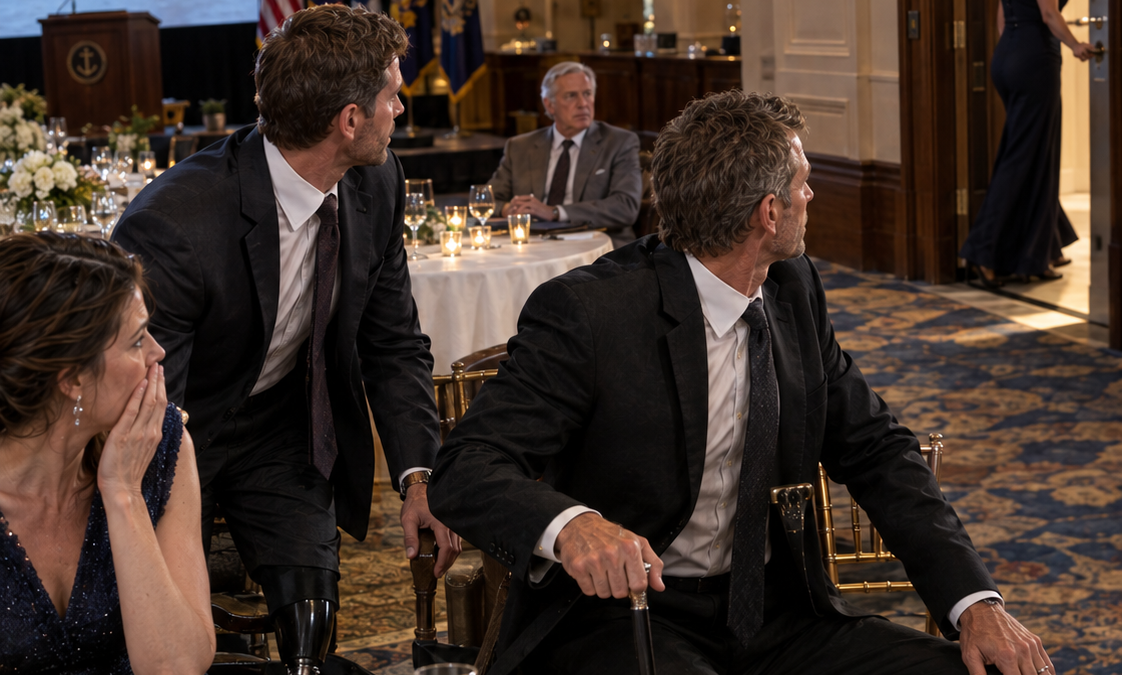
The ballroom was enormous. Chandeliers. Navy flags. A stage at one end with a podium and a screen.
There were tables everywhere. Fifteen hundred people.
Hollis pointed to a table near the front.
“That’s yours. The guest of honor table.”
“Where’s my parents’ table?”
He looked at me.
“Table twelve. Back of the room.”
I looked. I couldn’t see them. Not yet.
We sat down. Danny on my right. Sarah on my left. Mia and Connor at a kids’ table nearby.
The room filled.
I watched the door. I couldn’t help it.
At seven-fifteen, my father walked in.
He was alone.
He was wearing a gray suit. He looked older than I remembered. Smaller.
He saw me. He nodded once.
I nodded back.
He walked to table twelve. He sat down.
My mother wasn’t with him.
PART 9 — THE REUNION
My father sat alone at table twelve for twenty minutes.
He didn’t look at his phone. He didn’t get a drink. He just sat there, hands folded on the table, watching the room fill.
I watched him from across the ballroom.
Danny leaned over. “He came alone.”
“Yeah.”
“Where’s your mom?”
“I don’t know.”
“You okay?”
I didn’t answer.
At seven-forty, the doors opened again.
My mother walked in.
She was wearing a navy blue gown. Pearls. Her hair done. She looked like she was walking into a charity luncheon, not a SEAL reunion.
She scanned the room. She found table twelve. She found my father.
Then she found me.
Her eyes stopped.
I didn’t look away.
She walked to table twelve. She sat down next to my father. She didn’t say anything to him. She didn’t look at me again.
The room kept filling.
Hollis came over to my table.
“Your mother is here.”
“I saw.”
“She came in through the side door. She was waiting in the car.”
“For how long?”
“Since six.”
The ceremony started at eight.
The national anthem. A color guard. A moment of silence for the fallen.
Then Hollis took the stage.
He was slow. He was deliberate. He didn’t use notes.
“Ladies and gentlemen. Thank you for being here. This reunion is about service. It’s about sacrifice. It’s about the men and women who gave everything for this country.”
He paused.
“Tonight, we have a guest of honor. Someone whose story needs to be told. Someone who served for twenty-three years and came home to a life nobody knew about.”
He looked at me.
“Lieutenant Commander Sean Halloran. United States Navy, retired.”
The room applauded.
I stood up. My leg ached. I walked to the stage. Slow. With my cane.
I shook Hollis’s hand. I turned to the crowd.
Fifteen hundred people.
I looked at table twelve.
My mother was looking at the tablecloth.
My father was looking at me.
“Thank you,” I said.
“I’m not going to give a long speech. I’m not good at them.”
A few laughs.
“I served twenty-three years. Six deployments. I lost friends. I lost part of myself. I came home.”
I paused.
“For ten years, I’ve been told I was broken. Not by strangers. By people who were supposed to love me. For ten years, I’ve been told I was sick. That I was in a facility. That I couldn’t function.”
Silence.
“That wasn’t true.”
I looked at the crowd.
“I’m not sick. I never was. I was just quiet. And someone decided to fill in the silence with a story that wasn’t mine.”
The room was still.
“I’m not here to expose anyone. I’m not here to get revenge. I’m here because I want to be seen. Not as a tragedy. Not as a problem. Just as a man who served.”
I paused.
“That’s all.”
I walked off the stage.
The room applauded. Loud. Long.
Danny was standing. Sarah was standing. Mia was holding her sign over her head.
I sat down at my table.
My hands were shaking.
The ceremony continued.
An admiral spoke. A Gold Star mother spoke. A young SEAL spoke.
I didn’t hear any of it.
I was watching table twelve.
My mother was leaning toward my father. Her mouth was moving fast. His jaw was tight.
Then she stood up.
She walked out.
My father didn’t follow her.
He sat there. He watched her go. Then he looked at me.
I looked back.
He nodded.
I nodded.
Hollis came over after the ceremony.
He sat down next to me.
“Your mother left.”
“I saw.”
“She didn’t say goodbye.”
“I know.”
“She went out the side door. The same way she came in.”
“Okay.”
He looked at me.
“How do you feel?”
I thought about it.
“Tired.”
“That’s normal.”
Danny and Sarah took the kids home around ten.
I stayed.
I sat at the table and watched the room empty. Cleaning crews came in. The chandeliers dimmed.
Hollis came back.
“Sean. There’s someone who wants to talk to you.”
I looked up.
My father was standing in the doorway.
He walked over. Slow. He sat down across from me.
We didn’t say anything for a long time.
Then he said, “Your mother went home.”
“I figured.”
“She’s angry.”
“I know.”
“She said I betrayed her.”
“What did you say?”
“I said she betrayed you first.”
I looked at him.
He looked older than I’d ever seen him. Small. Tired.
“I’m not going to ask you to forgive me,” he said.
“Good.”
“I’m not going to ask you to forgive your mother.”
“Good.”
“I just want you to know I heard you. Tonight. I heard you.”
I didn’t say anything.
“I spent forty-nine years letting her make the rules,” he said. “I told myself it was easier. I told myself it kept the peace.”
“Did it?”
“No. It just kept the silence.”
He reached into his pocket. He pulled out something small.
A challenge coin.
It was old. Worn. A Navy crest on one side.
“This was my father’s,” he said. “He was in the Navy. World War II. Pacific theater.”
I looked at it.
“I never told you that.”
“No.”
“I didn’t think it mattered.”
“It matters.”
“I know.”
He set the coin on the table.
“He would have been proud of you. I know that now. I should have told you.”
I picked up the coin.
I turned it over in my hand.
Then I put it in my pocket.
“Dad.”
“Yeah.”
“I’m not ready to forgive you.”
“I know.”
“But I heard you too.”
He nodded.
He stood up.
“I’m going home tomorrow. Your mother will be there. I don’t know what happens next.”
“Okay.”
“I’ll call you. If you want.”
I paused.
“Okay.”
He left.
I sat at the table alone.
The cleaning crew worked around me. The lights went out one by one.
I looked at the empty ballroom.
Fifteen hundred chairs. A stage. A flag.
I thought about Hollis Reynolds. About his mother. About the funeral where nobody knew he was alive.
I thought about my father. About the coin in my pocket.
I thought about my mother. About the side door. About the silence.
I drove home at midnight.
The highway was empty. The ocean was black.
I pulled into my driveway at one.
I sat in the car for a long time.
Then I went inside.
The next morning, I woke up to a text.
It was from Angela.
I heard what happened. Are you okay?
I looked at it.
I didn’t answer right away.
PART 10 — THE COIN
The story didn’t end that night.
It kept going. That’s the thing nobody tells you about vindication. It doesn’t come in one clean moment. It comes in pieces. Over weeks. Over months.
The Monday after the reunion, my phone wouldn’t stop ringing.
Old teammates. Former commanders. People I hadn’t heard from in years.
They’d all seen the ceremony. They’d all seen the clip. Someone had posted it online. Two million views in three days.
The comments were what got me.
This man served his country and his own mother hid him.
I can’t imagine doing that to my son.
The quiet ones are always the ones who did the most.
I didn’t read all of them. I read enough.
Hollis called on Tuesday.
“Sean. How are you holding up?”
“I’m okay.”
“The video’s going viral. We didn’t plan that.”
“I know.”
“The foundation wants to do more with you. Interviews. Speaking. Maybe a book.”
“I don’t want a book.”
“Then don’t do a book. But think about the rest. You have a story people need to hear.”
“I’ll think about it.”
Angela called on Wednesday.
I answered.
“You okay?” she asked.
“Getting there.”
“I talked to your mom.”
I paused.
“What did she say?”
“She’s not talking to me. She told Aunt Carol that I was a traitor.”
“Because you sent me the email.”
“Because I took your side.”
“I’m sorry.”
“Don’t be. I’m not.”
She told me what had happened in Sacramento.
My mother had gone to her charity board meeting on Monday. Two of the women confronted her. They’d seen the video. They’d heard what she’d done.
She’d tried to explain. She’d said the documentary was edited. She’d said I was manipulating people. She’d said I’d always been difficult.
They didn’t believe her.
One of them—a woman named Diane Hargrove—had known my mother for twenty years. She’d donated to the SEAL Foundation because of my mother’s involvement. She’d written checks for years thinking she was helping veterans like me.
She stood up in the meeting and said, “Patricia, you told us your son was in a facility. You told us he couldn’t function. You raised money off his suffering. And none of it was true.”
My mother had left the meeting early.
The next week, more came out.
It turned out my mother hadn’t just told the story to friends and family. She’d told it to the SEAL Foundation. To the gala committee. To donors.
She’d used it to raise money.
Not directly. She never said “my son is sick, give me money.” She said “my son is a veteran who struggles, and that’s why this cause matters to me.”
It was subtle. It was effective.
She’d raised hundreds of thousands of dollars over the years using a lie about me.
Richard Cole called me on Friday.
“Sean. I owe you an apology.”
“You do.”
“I believed her. I shouldn’t have. But I did.”
“Okay.”
“The board met this morning. We’re removing your mother from the committee.”
I paused.
“You’re removing her?”
“Effective immediately. We’re also reviewing all donations she solicited. We may need to return some of them.”
“Why?”
“Because they were given under false pretenses.”
I sat with that for a long time.
I hadn’t asked for it. I hadn’t wanted it. But there it was.
Consequences.
Not the kind I’d imagined. Not revenge. Just the truth, doing its slow work.
My father called every few days.
Small things. The weather. A photo of the dog. A question about the reunion video.
I answered. Short at first. Then longer.
He told me my mother had stopped speaking to him. She’d moved into the guest room. She was talking to a lawyer.
“A lawyer?”
“She’s talking about divorce.”
I didn’t know what to say.
“I’m not going to fight her,” he said. “I’m too tired.”
“Dad.”
“Yeah.”
“Are you okay?”
Silence.
“No,” he said. “But I will be.”
I went up to Sacramento in April.
I hadn’t been to the house in years. It looked the same. The fountain. The gate. The manicured lawn.
My father met me at the door.
He looked thinner. Older.
“You came.”
“I said I would.”
We sat in the living room. The same room where my mother had hosted her charity lunches. The same room where she’d looked at me like I was a stray dog.
“She’s not here,” he said.
“I figured.”
“She’s at her sister’s. In Napa.”
“Okay.”
He poured me a glass of water. He didn’t drink anything.
“I want to show you something,” he said.
He went to his study. He came back with a folder.
“This is from the company. When I sold it.”
He opened the folder. He pulled out a document.
It was a trust. Established in 2015. My name on it.
I looked at him.
“What is this?”
“It’s yours. It’s always been yours.”
“What is it?”
“A third of the sale. About eighteen million.”
I stared at the paper.
I hadn’t known.
I hadn’t known there was any money. I hadn’t known he’d set anything aside. I hadn’t known anything.
“You never told me.”
“I was going to. After you retired. But then your mother—”
“Then Mom what?”
He looked at the floor.
“She wanted to give it to your sister.”
“You don’t have a sister.”
“Your cousin. Kelly. She’s been helping with the business. Your mother wanted her to have it.”
“So you were going to give my inheritance to Kelly.”
“No. I wasn’t. We fought about it. For years.”
“Who won?”
“I did. Barely. The trust is still in your name.”
I sat there.
Eighteen million dollars.
I’d been living on a military pension. I’d been fixing my own roof. I’d been fishing for dinner.
I wasn’t poor. I wasn’t struggling. But I wasn’t rich either.
And my father had been holding eighteen million dollars in a trust with my name on it.
“Why didn’t you tell me?”
“Because I was afraid.”
“Of what?”
“Of your mother. Of the fight. Of everything.”
“Dad.”
“I know. I know.”
I stood up. I walked to the window.
The fountain was running. The gate was closed. The lawn was green.
“Dad.”
“Yeah.”
“I don’t want the money.”
He looked at me.
“Sean—”
“I don’t want it. I didn’t earn it. I didn’t ask for it. And I don’t want to be the reason for another fight.”
“It’s yours.”
“Then put it in a foundation. For veterans. For the families who get left behind.”
He was quiet.
“You’re serious.”
“I’m serious.”
He nodded slowly.
“I’ll talk to the lawyers.”
“Good.”
“Sean.”
I turned around.
“I’m sorry.”
“I know.”
“I’m sorry for all of it.”
“I know.”
I left Sacramento that afternoon.
I didn’t see my mother. I didn’t want to.
I drove down I-5 with the windows down. The valley was green. The sky was wide.
I thought about the coin in my pocket. My grandfather’s. World War II. Pacific theater.
He’d served. My father had never told me. I’d never asked.
Maybe that was the whole thing. Maybe the silence went back further than I thought.
Danny called that night.
“How’d it go?”
“I don’t know.”
“What happened?”
I told him about the trust. About the money. About the foundation.
He was quiet for a moment.
“You gave away eighteen million dollars.”
“I didn’t give it away. I redirected it.”
“Same thing.”
“No. It’s not.”
He laughed.
“You’re the only person I know who could turn down eighteen million dollars and feel good about it.”
“I don’t feel good about it. I feel free.”
“Free?”
“I spent my whole life trying to be what they wanted. Now I’m not. I’m just me.”
“That’s a good place to be.”
“Yeah.”
The foundation launched in June.
We called it the Quiet Ones Fund. It supported veterans who’d been isolated from their families. Men and women who’d come home to silence.
Hollis helped. Danny helped. Captain Meyers helped.
We raised money. We built a network. We started small.
But we started.
My father came to the launch.
He stood in the back. He didn’t speak. He just watched.
Afterward, he came up to me.
“Your grandfather would have loved this.”
“You think?”
“I know.”
He handed me something.
Another coin. Silver. A Navy anchor on one side.
“This was his too. He had two. I want you to have this one.”
I looked at it.
“Thank you.”
My mother never called.
I heard she stayed in Napa. I heard she filed for divorce. I heard she sold the house.
I didn’t reach out. She didn’t either.
I don’t know if we’ll ever speak again.
I’ve made my peace with that.
It’s been two years.
I live in Oceanside. I walk on the beach every morning. I fish on Sundays.
Danny and Sarah are still in Carlsbad. Mia is ten now. Connor is eight. They call me Uncle Sean.
The foundation has helped over three hundred veterans. We’ve reunited families. We’ve paid for treatment. We’ve buried men whose families didn’t know they’d served.
My father comes down once a month. We have lunch. We talk about the old days. We don’t talk about my mother.
It’s not perfect. But it’s real.
Sometimes I sit on my porch and look at the ocean.
I think about the parking lot. The Lexus pulling away. The sliding doors closing.
I think about what I thought then. That I’d been abandoned. That nobody was coming.
I was wrong.
Danny came. Sarah came. Hollis came. Captain Meyers came.
They came because I’d been there for them. Because I’d carried Danny three hundred meters under fire. Because I’d served. Because I’d done the work.
The people who left me weren’t the only people in my life.
I just hadn’t known it yet.
I carry two coins now.
One from my grandfather. One from a man who told me I wasn’t broken.
I keep them in my pocket. I touch them sometimes when I’m thinking.
They remind me of something.
Not that I was saved. That I saved myself.
By not quitting. By not becoming what they said I was. By staying.
The sun is going down now.
The ocean is loud. The pelicans are fishing. A dog is barking somewhere down the beach.
I’m going to sit here a while longer.
Then I’ll go inside.
Then I’ll get up tomorrow and do it all again.
That’s the thing about being seen.
You have to keep showing up.