He Drained the Millpond to Save the Dam—A Forgotten School Rose First – Part 5
That was all. No speech, no tears, no swelling music from heaven.
Just one tired man realizing he could sit in a warm room without explaining why his whole body expected the chair to vanish. EMTT saw it and looked away before the moment became embarrassed. He had learned that healing, like wildlife, often fled when stared at directly.
Within a month, three more veterans had come through the mill. Not all stayed.
Not all wanted help that looked like help. One man only came for two meals and a shower, then left before dawn with a cleaner coat and no goodbye.
EMTT counted that as a success because May did, and no one in Alder Creek had the courage to dispute her accounting. Elias became the woodworking instructor by accident. then by habit, then by decree.
He arrived most mornings with sawdust already in his beard, though everyone suspected he applied it before leaving home to maintain authority. He still complained constantly.
He complained about dull chisels, crooked cuts, soft pine, hard oak, wet boots, government forms, young men who did not know how to sweep properly, and old men who did but pretended not to. June named him Thunder Saw.
Elias hated it for 9 seconds. Then he carved a small thundercloud into the handle of his favorite mallet and claimed it had been there for years.
The work mattered. A veteran who could not sleep through the night could still sand a chairle smooth. A man who had lost the habit of answering phones could learn to square a board.
Someone who had forgotten how to trust his own hands could measure, cut, fail, curse softly, try again, and discover the wood did not hate him for needing a second attempt. Emmett understood that better than anyone. He had come to the mill thinking a wall needed saving, then a schoolhouse, then a town.
But slowly, under the smell of cedar shavings and soup, he began to suspect the place had been saving him too. Not in one grand rescue, not with trumpets or absolution, but through the embarrassing insistence of daily tasks. Stack this lumber.
Sign this form. Feed the dog. Patch that window.
Teach Rey the difference between pressure and force. Do not skip lunch. just because sorrow has poor manners.
Norah made the nonprofit official on a Wednesday afternoon. She arrived with the approved documents in her black leather case, wearing her dark blue blazer and the expression of someone who had wrestled a government portal and returned with its pelt.
She placed the papers on the workbench where Clara Witam’s letter had once lain.
“It exists,” she said.
EMTT wiped his hands on a rag. The workshop, the organization, the bank account, the liability framework, the temporary housing classification, the fire inspection schedule, the thing you kept calling just letting some guys sleep upstairs, which would have aged me into dust.
What’s it called?
Norah looked at him. You never chose.
The room quieted. Elias stopped planing aboard. May leaned in from the doorway with a pot of stew.
Ruth, who had come only to verify nothing foolish had collapsed, stood near the wall with her arms folded. Caleb looked up from labeling donated blankets. June, perched on a stool she had been told not to perch on, swung her boots once and stopped.
Emmett glanced at Anker. The dog was awake watching him.
Of course he was. EMTT had considered names. Hollis Mill Veterans Workshop.
Alder Creek Relief House. The Schoolhouse Project. Good names, useful names, names that would satisfy donors and grant committees and people who liked plaques to behave.
But none of them held the truth. Anker had stood beside the first crack. Anker had pulled him from storm water.
Anker had sat before the schoolhouse roof when people still wanted to call it haunted. Anker had pressed his aging body against EMTT every time the past tried to drag him under. Anker had taught the whole town the sacred discipline of staying.
EMTT cleared his throat. The large room, he said.
The one with the benches and the bell.
Norah’s pen waited.
Anchor’s classroom.
No one spoke at first. The name entered the room softly like snow beginning.
June slid off the stool and walked to anchor. She knelt beside him, careful of his hips, and placed one hand on his graying head.
“He’ll need a sign,” she said.
Elias wiped his nose with the back of his hand. I can make a sign.
Macy squinted at him. You crying? Sawdust.
You’re across the room from the saw.
Airborne. Ruth looked toward the ceiling. Miraculous local weather.
EMTT laughed. Not much, not loudly, but enough.
The sound surprised him. It surprised Anker too, whose ears lifted in immediate concern, as if laughter from EMTT might require medical review. That made June laugh, then May, then even Nora, who tried to hide it behind a cough and failed with less dignity than she deserved.
The sign went up 3 days later. Elias carved it from Maple, the letters deep and plain.
anchor’s classroom.
Beneath the words, he carved a small bell, a waterline, and the outline of a German Shepherd sitting still, not standing heroic, not leaping, sitting, watching, staying. They hung it above the double doors to the main room. Caleb blessed the room without making the blessing too long because May had threatened to time him.
Ruth inspected the brackets. Norah photographed the sign for the grant file. June rang the school bell once, and this time the sound did not feel like mourning.
It felt like an invitation. EMTT stood under the sign with anchor beside him. The dog leaned against his leg.
Not as hard as before. Not with the old strength, but still there.
Later that week, a letter arrived. EMTT recognized the handwriting before he opened it.
For a while, he only held the envelope. He had written to his wife weeks earlier, not asking for return, not apologizing in the shapeless way men sometimes use apology to request comfort, but telling the truth as clearly as he could.
I understand more than I did. Her reply was three pages.
He read it alone in the upstairs room while afternoon light lay across the floorboards. Anchor slept below near the stove where Rey was sanding a chair and Elias was criticizing the angle of existence. His wife wrote that she was sorry for selling the house so abruptly, sorry for making the leaving colder than it needed to be.
She wrote that she had been afraid all the time. Afraid of his nightmares, afraid of her own anger, afraid that loving him meant disappearing into a war she had never agreed to enter. She did not ask him to come back.
She did not offer to return either. That hurt.
It also freed something.
At the end, she wrote, “I hope Vermont gives you a room where the sounds are only sounds.
” EMTT folded the letter and sat very still.
Then he carried it downstairs and placed it in the iron chest beside Clara Wickham’s letter and Nathaniel Hollis’s confession.
Not because the letters were the same, because each had been written by someone trying imperfectly to survive grief without becoming cruel. Autumn deepened.
The first frost silvered the grass around the pond. The schoolhouse memorial stood quiet in the eastern basin, its preserved roof sheltered from weather, its chimney still leaning with stubborn grace. Visitors came sometimes, but Alder Creek learned how to guide them gently.
Read the names. Keep your voice low.
Do not step past the rope. Do not call it haunted unless you are willing to be corrected by a child in red boots.
The mill pond remained smaller now, safer, its level marked and watched. It reflected the sky without swallowing everything beneath it.
That EMTT thought was the difference between memory and drowning. On the morning after the first hard rain of late autumn, EMTT walked to the basin with anchor. He carried the old olive duffel in one hand.
He did not need to. Most of his things now had places. Boots by the stove, spare shirts in a drawer, tools on the wall, letters in the chest, a bed that no longer felt borrowed.
But he carried the duffel because endings deserve witnesses, and that bag had followed him from the green door to this cold Vermont morning. The sky was overcast.
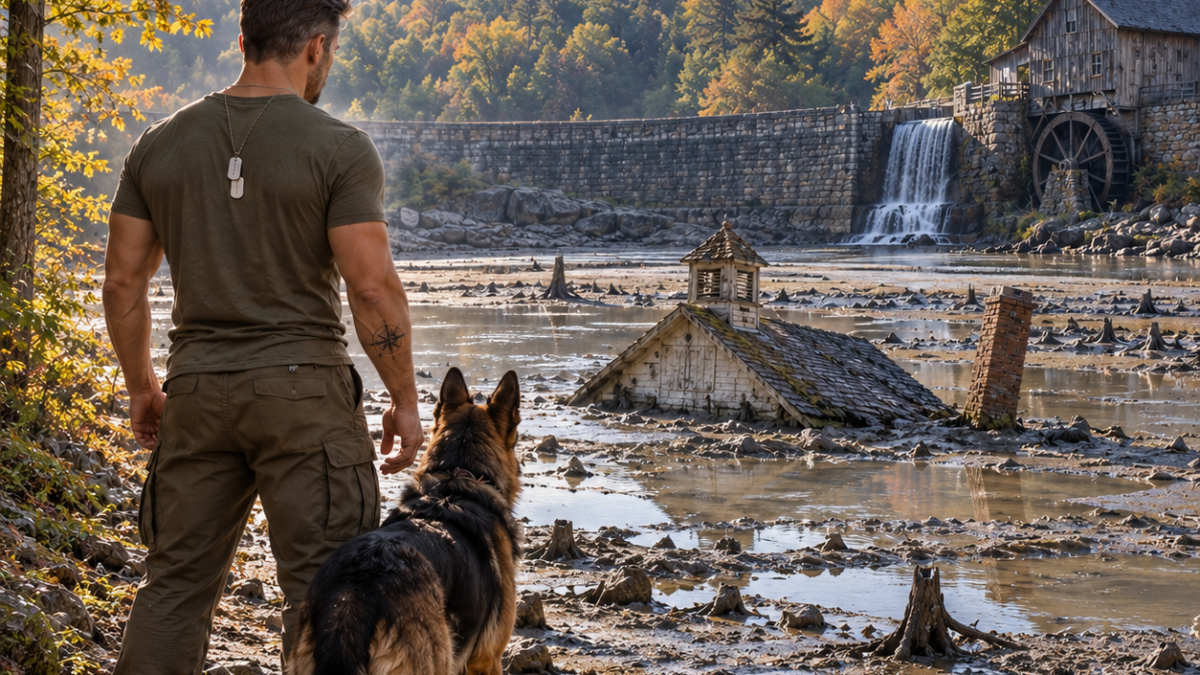
The light came blue and clean through the mist. Mud still patched the exposed basin in dark islands, though frost had hardened the surface near the memorial. The old mill stood behind him, stronger than before, but not pretending youth.
The repaired stone wall curved beyond it, pale yellow stones still visible where weakness had once spoken first. Anchor walked slowly at his left side.
His muzzle was silver. His scar showed faintly beneath the thickening winter coat.
His eyes remained bright, though his body asked for shorter distances now.
EMTT matched the dog’s pace without comment.
That too was love, not dragging loyalty faster than age allowed. They reached the safe edge of the basin.
Across the mud, the preserved schoolhouse roof rested under its shelter, small and dark, with the leaning chimney beside it. Six names waited on the memorial board. Water moved softly through the relief channel, no longer a threat, just a voice.
EMTT set the duffel at his feet. For a while, he and Anker stood looking. There had been a time when EMTT thought home was a structure someone could sell without him.
four walls, a door painted navy blue, a mailbox with a name. Then he thought home might be a mission, a wall to save, a town to warn, a problem sharp enough to keep the ghosts busy.
Now he was less certain and more at peace. Maybe home was the place where grief did not have to hide underwater.
Maybe it was the room where men with shaking hands learned to build tables.
Maybe it was an old dog’s blanket near a stove.
Maybe it was the sound of a school bell that no longer sent a soldier to the floor. Anchor leaned against him.
EMTT rested one hand on the dog’s head.
Behind them, from inside the mill, June rang the bell for breakfast because May had declared all spiritual transformations useless without pancakes. The sound crossed the yard, clear and small. EMTT did not flinch.
Anker’s ears lifted.
The bell faded into the mist, over the roof, over the pond, over the six names, over the repaired wall, over the man who had arrived with no home, and somehow become the keeper of one. EMTT looked down at Anchor.
You hear that? The dog looked toward the mill, then back at him.
“Class is in,” Emmett said.
And together, slowly, they turned from the old water toward the warm light waiting inside.
“Sometimes the things we bury are not evil.
They are grief we did not know how to carry.”
M. EMTT came to Alder Creek with no home, one old duffel bag, and a loyal dog who refused to leave his side. But beneath the water, he found more than a forgotten schoolhouse.
He found names. He found sorrow.
And slowly, he learned that healing does not always mean forgetting the pain. Sometimes healing begins when we finally give that pain a place to rest. Maybe there is something in your own life that has been hidden under quiet waters for too long.
A loss, a regret, a goodbye, a memory you could never name. May God give you the courage to face it gently, the grace to forgive what cannot be changed, and the peace to build something good from what once broke your heart.