Part 3: My husband called my military career a phase in front of four hundred people. He said it into a microphone, at a fundraiser, with my name on the donor list. He smiled when he said it. He put his hand on my shoulder like he was patting a dog that had learned a trick.”
PART 8 — THE CEREMONY
The call came in March.
I was in my office at the Pentagon — a real office, with a window and a desk and a flag in the corner — when my assistant patched it through.
“Ms. Morrow,” the voice said. “This is Colonel James Whitfield. I’m with the Army’s public affairs office.”
“Colonel.”
“I’m calling about the Distinguished Service Cross ceremony. We’d like you to attend.”
I set down my pen.
“I’m sorry?”
“The ceremony. For Sergeant First Class Okafor and Specialist Reyes. They’re being posthumously awarded the Distinguished Service Cross. The Army is holding a ceremony at Fort Bragg next month. We’d like you to be there.”
I sat there.
“Ms. Morrow?”
“I’m here.”
“We’d also like you to speak. If you’re willing.”
I didn’t say anything.
“Ms. Morrow?”
“Yes,” I said. “I’ll be there.”
I called General Vance that night.
“Kate,” he said. “I heard.”
“You heard?”
“I heard about the ceremony. I was going to call you.”
“They want me to speak.”
“I know.”
I sat down on the couch.
“General,” I said. “I don’t know if I can do it.”
“You can.”
“I’ve spoken at hearings. I’ve spoken to the Secretary of Defense. I’ve spoken to the press. But this is different.”
“I know.”
“This is Okafor and Reyes. This is their families. This is — ”
I stopped.
“Kate,” General Vance said. “You’re the only person who can do it.”
“Why?”
“Because you were there. Because you carried Reyes. Because you knew them. Because their families deserve to hear from someone who was with them at the end.”
I closed my eyes.
“I don’t know what to say.”
“You’ll figure it out.”
He hung up.
The ceremony was at Fort Bragg.
I flew in the night before. Marcus came with me. Lily stayed home with her grandparents — Eleanor had offered, and I had said yes.
Marcus was quiet on the flight. He had been quiet for weeks. Not the cold quiet of before. A different quiet. A listening quiet.
“Are you okay?” he asked.
“No.”
“Do you want to talk about it?”
“No.”
He nodded.
“Okay.”
He reached over and took my hand.
I let him.
The ceremony was in a chapel on base.
It was small and plain. Wooden pews. A simple altar. Flags on either side — the American flag and the Army flag.
The families were there.
Sergeant Okafor’s wife, Adaeze. His two children, Daniel Jr. and Amara. They were teenagers now. They sat in the front row.
Specialist Reyes’s mother, Rosa. His sister, Elena. They sat beside the Okafors.
I had met Adaeze once, at the funeral. I had met Rosa once, at the hospital. I hadn’t seen either of them since.
I walked in with Marcus. Adaeze looked up. She saw me. She stood.
She walked over to me.
“Mrs. Morrow,” she said.
“Adaeze.”
She hugged me.
It was a long hug. The kind that says everything.
“Thank you for coming,” she said.
“I wouldn’t miss it.”
She stepped back.
“My children wanted to meet you. They’ve heard stories.”
I looked at the two teenagers. They were standing behind their mother. Daniel Jr. was tall, like his father. Amara had her father’s eyes.
“Hello,” I said.
“Hi,” Daniel Jr. said.
“Your father was a good man,” I said. “He was brave. He was kind. He talked about you all the time.”
Amara’s eyes were wet.
“He did?”
“Every day. He had a picture of you in his helmet. He showed it to everyone.”
She nodded.
“Thank you,” she said.
I nodded.
Rosa Reyes was sitting in the front row. She was older than I remembered. Gray-haired. Small. She held a rosary in her hands.
I walked over to her.
“Mrs. Reyes.”
She looked up.
“Kate,” she said.
She stood. She hugged me.
“I’m sorry,” I said. “I’m sorry I didn’t come sooner.”
She shook her head.
“You came,” she said. “That’s what matters.”
I sat down next to her.
“Miguel,” I said. “He was — ”
I stopped.
“He was brave,” she said.
“Yes.”
“He was young.”
“Yes.”
“He was my baby.”
I looked at her.
“I know.”
She took my hand.
“You carried him,” she said.
“Yes.”
“He died in your arms.”
“Yes.”
She nodded slowly.
“Then he wasn’t alone,” she said.
I looked at her.
“No,” I said. “He wasn’t alone.”
The ceremony began.
There were speeches. A general spoke. A chaplain spoke. The medals were presented to the families.
I watched Adaeze accept the medal for her husband. I watched her children stand beside her.
I watched Rosa accept the medal for her son. I watched her hold it in her hands like it was made of glass.
Then it was my turn.
I stood up. I walked to the podium.
I looked out at the room.
The families. The soldiers. The flags. Marcus, in the back row.
I took a breath.
“My name is Kate Morrow,” I said. “I was a captain in the United States Army. I served in 7th Special Forces Group. I was deployed to Afghanistan twice.”
I paused.
“I was with Sergeant Okafor and Specialist Reyes when they died.”
The room was silent.
“I was their team leader. I was responsible for them. I was supposed to bring them home.”
I looked at Adaeze. At Rosa.
“I didn’t.”
I paused.
“On August 14, 2009, we were ambushed outside a village called Sangin. We were outnumbered. We were outgunned. We fought for forty minutes. We lost two men.”
I looked at the medals on the altar.
“Daniel Okafor was thirty-two years old. He had a wife and two children. He was the best soldier I ever served with. He was calm under fire. He was kind to the Afghans we worked with. He never complained. Not once.”
I looked at Adaeze.
“He talked about you all the time. He talked about the kids. He talked about the house you were going to buy when he got home. He had a plan. He always had a plan.”
She nodded. Tears were running down her face.
“Miguel Reyes was twenty-two years old. He was the youngest man on the team. He was funny. He was brave. He was the first one to volunteer for every mission.”
I looked at Rosa.
“He died in my arms. I carried him three hundred meters to the evacuation helicopter. He didn’t make it.”
Rosa closed her eyes.
“But he wasn’t alone. He knew he wasn’t alone. I told him. I told him he was going home. I told him his mother was waiting for him.”
Rosa nodded. She was crying.
“I don’t know if that helped. I don’t know if he heard me. But I said it.”
I paused.
“I’ve spent fifteen years carrying these men with me. Not just their memory. Their weight. The weight of what I couldn’t do. The weight of surviving when they didn’t.”
I looked at the room.
“But I’ve also spent fifteen years trying to live in a way that honors them. Trying to be the kind of person they would be proud of.”
I looked at Adaeze. At Rosa.
“I don’t know if I’ve succeeded. But I’ve tried.”
I stepped back from the podium.
“Thank you.”
After the ceremony, we went to the reception.
There was food. There was coffee. There were people I hadn’t seen in years — soldiers I had served with, now older, grayer, softer around the edges.
One of them was a man named Marcus Webb. No relation to my Marcus. He had been my radio operator in Afghanistan. Now he ran a security company in North Carolina.
He walked up to me.
“Captain,” he said.
“Webb.”
He hugged me.
“It’s been a long time.”
“Fifteen years.”
“You look good.”
“You look old.”
He laughed.
“I am old.”
We stood there for a moment.
“I heard about the council,” he said. “That’s good work.”
“Thank you.”
“You’re going to help a lot of people.”
“I hope so.”
He looked at me.
“Captain,” he said. “I never got to say thank you.”
“For what?”
“For Sangin. For what you did. For carrying Reyes. For getting the rest of us out.”
I looked at him.
“That’s not something you need to thank me for.”
“Yes it is.”
I didn’t say anything.
“You saved my life,” he said. “You saved all of our lives. You made a call. You made the right call.”
I looked at the floor.
“I don’t know if it was the right call.”
“It was.”
“How do you know?”
He looked at me.
“Because I’m still here,” he said. “Because my kids are still here. Because I got to go home and have a life.”
I looked at him.
“I’m glad you did.”
“Me too.”
He hugged me again.
Then he walked away.
That night, Marcus and I sat in the hotel room.
I was exhausted. I had cried more in one day than I had in years.
Marcus was sitting on the bed. He hadn’t said much all day.
“Kate,” he said.
“Yes?”
“I watched you today.”
“I know. You were there.”
“I watched you speak. I watched the families. I watched the soldiers.”
“And?”
He looked at me.
“I finally understand,” he said.
“Understand what?”
“Everything. Why you are the way you are. Why you’re calm. Why you’re quiet. Why you don’t talk about the past.”
I looked at him.
“I understand now,” he said. “And I’m sorry I didn’t before.”
I sat down on the bed next to him.
“You didn’t know,” I said.
“I didn’t want to know.”
“That’s different.”
“I know.”
He looked at me.
“Kate,” he said. “I’m going to spend the rest of my life trying to be the man you deserve.”
I looked at him.
“You don’t have to be the man I deserve. You just have to be the man you are. And let me be the woman I am.”
He nodded.
“Okay.”
“Okay?”
“Okay.”
He took my hand.
We sat there in the quiet.
The next morning, we flew home.
Lily was waiting for us at the airport. She ran to me and hugged me.
“Mom,” she said. “I watched it.”
“You watched what?”
“The ceremony. They live-streamed it. Grandma and I watched it together.”
I looked at her.
“You did?”
“She cried,” Lily said. “Grandma cried.”
I didn’t know what to say.
“She said she was proud of you,” Lily said. “She said she was sorry she never said it before.”
I stood there.
“Mom,” Lily said. “I’m proud of you too.”
I hugged her.
That night, I sat on the porch.
The sun was going down. The sky was orange and pink.
Marcus came out and sat next to me.
“Kate,” he said.
“Yes?”
“I’ve been thinking.”
“About what?”
“About what you said. About being the man I am.”
“And?”
“I think I’ve been trying to be someone else my whole life. Someone my father wanted. Someone my board wanted. Someone the world wanted.”
“And now?”
“Now I think I just want to be me.”
I looked at him.
“Who is that?”
“I don’t know,” he said. “But I want to find out.”
I nodded.
“That’s a good start.”
He looked at me.
“Kate,” he said. “Will you help me?”
I looked at him.
“Help you what?”
“Find out who I am.”
I sat there.
“I can try,” I said.
He smiled.
“That’s all I need.”
The next month was different.
Marcus started therapy. He started going to a men’s group. He started reading — books about military history, books about Afghanistan, books about the things I had done and the places I had been.
He asked questions. Real questions. Not the polite questions he used to ask at dinner parties. Questions that meant something.
He asked about Okafor. About Reyes. About Sangin.
I told him.
He listened.
He didn’t flinch.
One night, he came into the kitchen while I was making dinner.
“Kate,” he said.
“Yes?”
“I want to ask you something.”
“Okay.”
He sat down at the island.
“Why did you marry me?”
I set down the knife.
“What?”
“Why did you marry me? You could have married anyone. You could have married someone who understood you. Someone who had been there. Someone who knew what it was like.”
I looked at him.
“I married you because I loved you.”
“But why?”
I thought about it.
“Because you made me laugh,” I said. “Because you were kind. Because you looked at me like I was the most interesting person in the room.”
“But I didn’t know you.”
“No. But you wanted to. Or at least, I thought you did.”
He looked at the counter.
“I’m sorry I stopped wanting to.”
“People get comfortable. They stop trying. It happens.”
“It shouldn’t.”
“No. It shouldn’t.”
He looked at me.
“I’m trying now.”
“I know.”
“I’m going to keep trying.”
“I know.”
He reached out and took my hand.
“Thank you,” he said.
“For what?”
“For giving me another chance.”
I looked at him.
“You gave yourself another chance,” I said. “I just didn’t stop you.”
He nodded.
“That’s all I needed.”
The summer came.
The council was up and running. We had funding. We had staff. We had a mandate. I was working sixteen-hour days, but it didn’t feel like work. It felt like purpose.
Marcus was running the company again. He had restructured the board. He had brought in new people. He had cut ties with Blackridge entirely. He was different. More serious. More present.
Lily was finishing her sophomore year. She had done her presentation on women in special operations. She had gotten an A.
She had also started talking about the Army.
“Mom,” she said one night at dinner. “I’ve been thinking.”
“About what?”
“About what I want to do. After high school.”
I set down my fork.
“And?”
“I want to go to West Point.”
I looked at her.
“West Point?”
“I want to serve. Like you.”
I sat there.
“Lily,” I said. “It’s not easy.”
“I know.”
“It’s not just the physical part. It’s the emotional part. It’s the things you see. The things you carry.”
“I know.”
“And you still want to do it?”
She looked at me.
“Yes.”
I looked at Marcus. He was watching us.
“What do you think?” I asked.
He looked at Lily.
“I think she’s her mother’s daughter,” he said.
Lily grinned.
I looked at her.
“Then I’ll support you,” I said.
“Really?”
“Really.”
She got up and hugged me.
“Thank you, Mom.”
“Don’t thank me yet. You have to get in first.”
She laughed.
“I will.”
That night, I sat on the porch alone.
Marcus was inside, reading. Lily was in her room, studying.
I looked out at the Hill Country.
I thought about my life. I thought about the Army. I thought about Afghanistan. I thought about Sangin. I thought about Okafor and Reyes. I thought about the Silver Star in the shoebox. I thought about Marcus. I thought about Lily.
I thought about who I was.
I thought about who I had become.
I wasn’t the same person who had walked into that gala two years ago. I wasn’t the same person who had sat in the back of the room while her husband called her career a phase.
I was someone else now.
Someone who had been seen.
Someone who had been heard.
Someone who had been respected.
I looked up at the sky.
The stars were out.
I thought about Okafor. I thought about Reyes.
I hoped they were proud.
I hoped they knew.
I hoped they understood.
Then I went inside.
PART 9 — THE SECOND GALA
The invitation came in September.
It was for the same charity. The same gala. The same ballroom at the Fairmont.
I opened it at the kitchen table. Marcus was sitting across from me, reading the paper.
“Kate,” he said. “What is it?”
I handed him the invitation.
He read it.
“They want you to be the keynote speaker.”
“Yes.”
He looked at me.
“Are you going to do it?”
I sat there.
“Last time we were in that room,” I said, “you called my service a phase.”
He set down the invitation.
“I know.”
“Four hundred people watched.”
“I know.”
“And now they want me to stand on that same stage and give the keynote.”
He looked at me.
“Are you going to do it?”
I folded the invitation.
“Yes.”
“Why?”
I looked at him.
“Because I have something to say.”
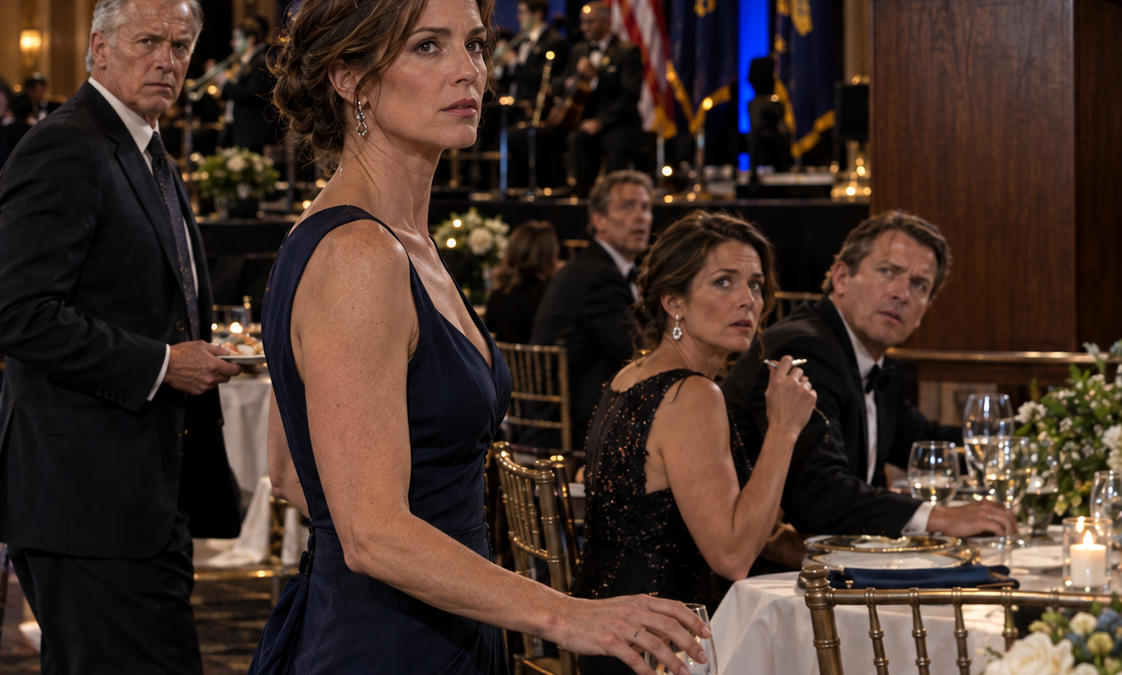
The gala was in October. Same ballroom. Same white tablecloths. Same military flags on the stage. Same brass quartet near the bar.
Different woman.
I wore a black dress. Simple. My hair was down. I wore the small gold studs Marcus had given me for our tenth anniversary.
Marcus walked in beside me. He was wearing a tuxedo. He looked good. He always looked good.
But this time, he wasn’t the center of attention.
I was.
People came up to me before the program started. They shook my hand. They told me they had watched the hearing. They told me they had read about the council. They told me they had seen the ceremony at Fort Bragg.
One woman — a colonel, retired, in her sixties — took both my hands.
“You’re the reason my daughter joined the Army,” she said. “She saw you testify. She said if you could do it, she could do it.”
I didn’t know what to say.
“Thank you,” I said.
She nodded and walked away.
Marcus was standing beside me. He had heard the whole thing.
“People know who you are,” he said.
“Some people.”
“More than you think.”
The program began.
There were speeches. A welcome from the board chair. A video about the charity’s work. An appeal for donations.
Then the chair stood up again.
“Ladies and gentlemen,” she said. “Our keynote speaker tonight is someone many of you know. She’s a former Army Special Forces officer. She’s a Silver Star recipient. She’s the chair of the Veterans’ Transition Council. She’s also a wife and a mother and a Texan.”
She looked at me.
“Please welcome Kate Morrow.”
The room applauded.
I stood up. I walked to the stage.
I looked out at the crowd. Four hundred faces. Some of them I recognized. Some of them I didn’t.
I saw General Vance in the back. He was standing near the buffet table, just like last time. He had a small plate of shrimp. He was smiling.
I saw Harold Ellsworth near the front. He was sitting with his general counsel. He nodded at me.
I saw Marcus at a table near the center. He was watching me. He wasn’t looking at his phone. He wasn’t talking to anyone. He was just watching.
I took a breath.
“Good evening,” I said.
The room went quiet.
“Two years ago, I stood in this room. I was standing near the back. I wasn’t on the stage. I wasn’t speaking. I was just there. Supporting my husband. Supporting the charity.”
I paused.
“And I heard something that night that I’ve thought about every day since.”
I looked at the crowd.
“I heard my service called a phase.”
The room was silent.
“I heard my career — eleven years in the Army, seven in Special Forces, two deployments to Afghanistan — reduced to a phase. Something I did before I became a wife. Something I did before I became a mother. Something I did before I became the person someone thought I was supposed to be.”
I looked at Marcus.
“He was wrong,” I said. “But he wasn’t the only one who thought that. A lot of people thought that. A lot of people still think that.”
I paused.
“Here’s what I want to say to you tonight. Service isn’t a phase. Service is a life. It’s not something you do and then stop doing. It’s something that becomes part of you. It shapes how you see the world. It shapes how you respond to problems. It shapes how you love and how you fight and how you survive.”
I looked at the crowd.
“I served with men who died in Afghanistan. I served with men who came home and struggled. I served with men who are still serving, in uniform and out. They didn’t stop being soldiers when they took off the uniform. They just became something else.”
I paused.
“I’m not just a wife. I’m not just a mother. I’m not just a consultant. I’m a soldier. I always will be. And that’s not a phase. That’s who I am.”
I looked at the crowd.
“Thank you.”
The room applauded.
It was loud. Louder than the applause for Marcus two years ago. Louder than any applause I had ever heard.
I stood there on the stage and let it wash over me.
After the speech, people came up to me.
Many people. More than I could count. They shook my hand. They hugged me. They told me their stories — their own service, their parents’ service, their children’s service. They told me about the struggles they had faced. The transitions. The losses. The things they couldn’t talk about.
I listened.
That was what I was good at.
General Vance found me near the bar.
“Kate,” he said.
“General.”
He hugged me.
“That was the best speech I’ve ever heard,” he said.
“Thank you, sir.”
“No. I mean it. That was the best speech I’ve ever heard.”
I looked at him.
“You were standing in the back,” I said. “Two years ago.”
“I was.”
“You heard what he said.”
“I did.”
“You didn’t say anything.”
“No.”
“Why not?”
He looked at me.
“Because it wasn’t my place,” he said. “It was yours.”
I looked at him.
“You could have corrected him. You could have told everyone who I was. You could have made him look small.”
“I could have.”
“Why didn’t you?”
He looked at me.
“Because you didn’t need me to. You needed to do it yourself.”
I stood there.
“General,” I said.
“Yes?”
“Thank you.”
He nodded.
“You did it yourself,” he said. “That’s all I wanted.”
He walked away.
Marcus found me near the end of the night.
“Kate,” he said.
“Marcus.”
He stood there. He looked nervous.
“I listened to your speech,” he said.
“I know. You were there.”
“I listened to every word. And I wanted to say something.”
“Okay.”
He took a breath.
“I’m sorry,” he said. “I’m sorry for what I said two years ago. I’m sorry for calling your service a phase. I’m sorry for treating you like you were less than you are.”
I looked at him.
“You’ve said that before.”
“I know. But I mean it more now. Every day I mean it more.”
I looked at him.
“Marcus,” I said. “I forgive you.”
He stared at me.
“You do?”
“I do.”
“Why?”
I looked at him.
“Because you’ve changed. Because you’ve tried. Because you’ve been there for me. Because you’re Lily’s father and my husband and I love you.”
He closed his eyes.
“Thank you,” he said.
I reached out and took his hand.
“Let’s go home,” I said.
That night, I sat in the living room alone.
Everyone else was asleep. Marcus was in our room. Lily was in hers.
I was sitting in the dark, looking at the shoebox.
The Silver Star was still in it.
I hadn’t taken it out since that night in the kitchen. I hadn’t looked at it. I hadn’t touched it.
But tonight was different.
I opened the box.
I took out the medal.
I held it in my hand.
It was heavy. Heavier than I remembered.
I thought about Okafor. I thought about Reyes. I thought about Sangin. I thought about the desert. I thought about the men I had served with. The men I had lost.
I thought about the ceremony at Fort Bragg. I thought about Adaeze. I thought about Rosa. I thought about the way they had hugged me. The way they had forgiven me. The way they had told me that Miguel hadn’t died alone.
I thought about Lily. I thought about her going to West Point. I thought about the kind of soldier she would be. The kind of person she would become.
I thought about Marcus. I thought about the way he had changed. The way he had tried. The way he had been there for me.
I thought about myself.
I held the medal in my hand.
And for the first time, I didn’t feel like I was carrying it.
I felt like it was carrying me.
I put it back in the box.
But I didn’t close the lid.
I left it open on the table.
So I could see it.
So I could remember.
The next morning, Lily came downstairs.
“Mom,” she said. “What’s that?”
I looked at the table.
“That’s my Silver Star.”
She walked over and looked at it.
“Can I hold it?”
“Yes.”
She picked it up. She held it in her hands.
“It’s heavier than I thought.”
“Yes.”
She looked at it for a long time.
“Mom,” she said.
“Yes?”
“I’m going to get one of these someday.”
I looked at her.
“Maybe,” I said.
“No,” she said. “I will.”
I smiled.
“Okay.”
She put the medal back on the table.
“Let’s eat breakfast,” she said.
“Okay.”
We walked into the kitchen together.
The rest of the year went by.
The council grew. We launched programs. We hired staff. We helped thousands of veterans transition back into civilian life. We built housing. We provided healthcare. We created jobs.
The work was hard. The work was endless. The work was everything.
I was featured in magazines. I was on television. I was invited to speak at conferences and universities and military bases.
I said no to most of it. I said yes to the things that mattered.
I was still a wife. I was still a mother. I was still a soldier.
I was still Kate Morrow.
One night, General Vance called.
“Kate,” he said.
“General.”
“I have news.”
“What kind of news?”
“The White House called. They want you to receive the Presidential Medal of Freedom.”
I sat down.
“What?”
“The Medal of Freedom. For your service. For your work with veterans. For everything you’ve done.”
I didn’t know what to say.
“Kate,” he said. “Are you there?”
“I’m here.”
“Are you okay?”
“I don’t know.”
He laughed.
“That’s the right answer.”
I closed my eyes.
“General,” I said. “Why me?”
“Because you’re the best person for it.”
“That’s not an answer.”
“It’s the only one I have.”
I sat there.
“Kate,” he said. “This is your moment. You’ve earned it. You’ve earned every bit of it.”
I looked out the window.
The sun was setting.
“Okay,” I said.
“Okay?”
“I’ll accept it.”
“Good.”
He hung up.
The ceremony was in the spring.
The White House. The Rose Garden. The President. The press. The families.
I wore a navy suit. My hair was up. I wore the small gold studs Marcus had given me for our tenth anniversary.
Marcus was in the front row. Lily was next to him. General Vance was next to her.
Adaeze was there. Rosa was there. Daniel Jr. and Amara were there.
The President spoke. He talked about service. He talked about sacrifice. He talked about the men and women who served their country and asked for nothing in return.
Then he called my name.
I walked to the podium.
I looked out at the crowd.
I saw Marcus. I saw Lily. I saw General Vance. I saw Adaeze. I saw Rosa.
I saw the flag.
I took a breath.
“Thank you,” I said.
I paused.
“I accept this medal on behalf of every soldier who served and came home. On behalf of every soldier who served and didn’t. On behalf of the families who waited. On behalf of the men and women who still serve.”
I looked at Adaeze.
“I accept it on behalf of Sergeant First Class Daniel Okafor, who died in Afghanistan on August 14, 2009.”
I looked at Rosa.
“I accept it on behalf of Specialist Miguel Reyes, who died in my arms on that same day.”
I paused.
“They were soldiers. They were heroes. They were my friends.”
I looked at the crowd.
“I’m not a hero. I’m just someone who did her job. But I’m honored to stand here today and represent the people who did theirs.”
I stepped back.
“Thank you.”
The President put the medal around my neck.
The crowd applauded.
I stood there.
I didn’t cry.
I just stood there.
After the ceremony, I found a quiet spot near the Rose Garden.
I sat on a bench and looked at the flowers.
Marcus came and sat next to me.
“Kate,” he said.
“Yes?”
“You did it.”
“I did it.”
He looked at me.
“How do you feel?”
I thought about it.
“I feel like myself,” I said.
He nodded.
“That’s all I ever wanted for you.”
I looked at him.
“Thank you,” I said.
“For what?”
“For being here. For changing. For trying.”
He took my hand.
“I love you,” he said.
I looked at him.
“I love you too,” I said.
He smiled.
It was a real smile.
That night, I sat in the hotel room.
Lily was asleep in the next room. Marcus was in the shower.
I was holding the medal.
The Presidential Medal of Freedom.
It was heavier than the Silver Star.
But I could carry it.
I thought about my life.
I thought about the girl who had joined the Army at eighteen. The girl who had gone through the Q course. The girl who had served in Afghanistan. The girl who had lost two men. The girl who had carried a dying soldier through enemy fire.
I thought about the woman who had married Marcus. The woman who had raised Lily. The woman who had stood in the back of a ballroom and heard her service called a phase.
I thought about the woman who had testified before the Senate. The woman who had taken on Blackridge. The woman who had stood at Fort Bragg and honored her fallen soldiers.
I thought about the woman who had been named to the Veterans’ Transition Council. The woman who had been honored by the President. The woman who had been given the Medal of Freedom.
I thought about all of it.
I thought about all of them.
I put the medal down.
I looked out the window.
The city was lit up. The Washington Monument. The Lincoln Memorial. The Capitol.
It was beautiful.
I sat there and looked at it.
Then I went to bed.
The next morning, I woke up early.
I walked outside. The streets were quiet. The city was still.
I walked to the Lincoln Memorial.
I stood at the steps and looked at the statue.
Abraham Lincoln. The man who had held the country together. The man who had freed the slaves. The man who had been assassinated for doing the right thing.
I thought about him.
I thought about what he had said.
“With malice toward none, with charity for all.”
I thought about that.
I thought about the men who had wronged me. Marcus. His parents. The people who had doubted me. The people who had dismissed me. The people who had called my service a phase.
I didn’t hate them.
I didn’t want revenge.
I just wanted to be seen.
And now I was.
I stood there for a long time.
Then I turned around and walked back to the hotel.
That afternoon, I flew home.
Marcus was beside me. Lily was behind us.
I looked out the window.
The clouds were thick and white.
I thought about the first time I had flown home from Afghanistan. The duffel bag. The Silver Star. The body that didn’t feel like mine.
I thought about the first time I had flown to D.C. The meeting with Harold. The dinner with General Vance. The decision to testify.
I thought about the first time I had flown home after the hearing. Marcus waiting at the gate. The awkward hug. The first step toward something new.
I thought about all of it.
I closed my eyes.
When I opened them, we were landing.
That night, I sat on the porch.
The sun was going down. The sky was orange and pink. The Hill Country stretched out in front of me.
Marcus came out and sat next to me.
“Kate,” he said.
“Yes?”
“I’ve been thinking.”
“About what?”
He looked at me.
“About what you said. About being seen.”
“And?”
“I see you now.”
I looked at him.
“I know.”
“I’m going to keep seeing you.”
“I know.”
He took my hand.
We sat there.
The sun went down.
PART 10 — THE PORCH
The news about Blackridge came in June.
The FBI had finished its investigation. Three partners were indicted. Two were convicted. One fled the country and was arrested in Spain six months later.
The DoD official who had taken bribes was sentenced to twelve years in federal prison.
Marcus was not charged. He had come forward. He had cooperated. He had testified before a grand jury. The prosecutors called him a “cooperative witness” in the press release.
But the damage was done.
Morrow Logistics lost three major contracts. Two board members resigned. The company’s stock dropped forty percent in a single day.
Marcus didn’t panic. He didn’t hide. He held a press conference and told the truth. He said he had made mistakes. He said he had trusted the wrong people. He said he was going to fix it.
The stock recovered. The contracts came back. The board stabilized.
But Marcus was different after that.
He was quieter. More serious. He didn’t talk about the company the way he used to — like it was the most important thing in the world. He talked about it like it was a job. A responsibility. Something he did, not something he was.
One night, we were sitting on the porch and he said something I didn’t expect.
“Kate,” he said. “I’m thinking about stepping down.”
I looked at him.
“From the company?”
“Yes.”
“Why?”
He looked at the sky.
“Because I don’t want to be the guy who runs a company anymore,” he said. “I want to be the guy who does something that matters.”
I looked at him.
“What would you do?”
He was quiet for a moment.
“I’ve been talking to Harold Ellsworth,” he said. “About the council. About the work you’re doing.”
“And?”
“He said there’s a need for someone with business experience. Someone who can help veterans start companies. Someone who can teach them how to build something from nothing.”
I looked at him.
“You want to work with veterans?”
He looked at me.
“I want to work with you,” he said. “I want to do something that matters. Something that isn’t just about money.”
I sat there.
“Marcus,” I said. “That’s a big change.”
“I know.”
“It’s not going to be easy.”
“I know.”
“You’re going to have to learn a lot.”
“I know.”
I looked at him.
“Okay,” I said.
He smiled.
“Okay?”
“Okay.”
He stepped down in September.
The board named a new CEO. Marcus stayed on as chairman, but he gave up the day-to-day operations. He started working with the council’s small business program. He taught classes. He mentored veterans. He helped them write business plans and find funding and navigate the bureaucracy.
He was good at it.
Better than he had been at running the company, I thought. Because it wasn’t about him anymore. It was about something bigger.
One night, he came home and told me about a veteran he had been working with. A young man, twenty-eight, who had lost a leg in Afghanistan. He wanted to start a landscaping business.
“He’s got a great plan,” Marcus said. “He’s got the skills. He’s got the drive. He just needs someone to believe in him.”
I looked at him.
“You believe in him.”
He nodded.
“I do.”
I sat there.
“Marcus,” I said.
“Yes?”
“Who are you?”
He looked at me.
“What do you mean?”
“I mean — two years ago, you were the guy who called my service a phase. And now you’re the guy who helps veterans start businesses.”
He looked at the table.
“I was an asshole,” he said.
I laughed.
“That’s one way to put it.”
“I mean it. I was an asshole. I was selfish. I was insecure. I was everything I didn’t want to be.”
“And now?”
He looked at me.
“Now I’m trying to be better.”
I looked at him.
“You’re doing a good job.”
He looked at me.
“Really?”
“Really.”
He smiled.
It was a real smile.
Lily got into West Point in April.
She came running into the house with the letter. She was screaming. She was crying. She was laughing.
“I got in!” she said. “I got in!”
I hugged her. Marcus hugged her. We all stood in the kitchen and cried and laughed and hugged each other.
Then she looked at me.
“Mom,” she said. “I’m going to be a soldier.”
I looked at her.
“Yes,” I said. “You are.”
“I’m going to be like you.”
I looked at her.
“You’re going to be better than me,” I said.
She shook her head.
“No,” she said. “I’m going to be exactly like you.”
I hugged her again.
The day she left for West Point was hard.
Marcus and I drove her to the airport. She was wearing jeans and a t-shirt and carrying a duffel bag. She looked young. She looked scared. She looked determined.
At the gate, she hugged Marcus first.
“I love you, Dad,” she said.
“I love you too, sweetheart.”
Then she hugged me.
“I love you, Mom,” she said.
“I love you too.”
She stepped back.
“Mom,” she said.
“Yes?”
“Thank you.”
“For what?”
“For showing me who I could be.”
I looked at her.
“You showed yourself,” I said.
She smiled.
Then she walked through the gate.
She didn’t look back.
Marcus and I stood there and watched her go.
“She’s going to be fine,” he said.
“I know.”
“She’s going to be great.”
“I know.”
He took my hand.
“Let’s go home,” he said.
The house was quieter without her.
Marcus and I sat on the porch most nights. We talked. We listened. We watched the sun go down.
One night, he asked me something.
“Kate,” he said. “Do you ever think about what would have happened if you hadn’t testified?”
I looked at him.
“What do you mean?”
“If you hadn’t gone to D.C. If you hadn’t told Harold about Blackridge. If you hadn’t come forward.”
I sat there.
“I think about it,” I said.
“And?”
“I think we’d still be married. I think we’d still be living in this house. I think we’d still be going to galas and shaking hands and pretending everything was fine.”
“But?”
“But I’d be miserable. And you’d be oblivious. And eventually, something would have broken.”
He nodded.
“I think you’re right.”
I looked at him.
“Marcus,” I said.
“Yes?”
“I didn’t testify to hurt you.”
“I know.”
“I testified because it was the right thing to do.”
“I know.”
“I testified because I couldn’t live with myself if I didn’t.”
He looked at me.
“I know.”
He took my hand.
“Thank you,” he said.
“For what?”
“For not letting me become someone I didn’t want to be.”
I looked at him.
“You became who you are,” I said. “I just didn’t stop you.”
He nodded.
“That’s all I needed.”
General Vance died in November.
He was eighty-three years old. He died in his sleep. His heart gave out.
I got the call early in the morning.
“Ms. Morrow,” the voice said. “This is Colonel Whitfield. I’m calling with some sad news.”
I knew before he said it.
“General Vance passed away last night.”
I sat down.
“Ms. Morrow?”
“I’m here.”
“I’m sorry.”
“Thank you.”
I hung up.
I sat in the kitchen for a long time.
Marcus came downstairs.
“Kate,” he said. “What’s wrong?”
I looked at him.
“General Vance died.”
He sat down next to me.
“I’m sorry.”
“He was my friend.”
“I know.”
“He was the only one who believed in me.”
Marcus looked at me.
“That’s not true.”
“It is true. When I came home from Afghanistan, he was the only one who checked on me. When I left the Army, he was the only one who stayed in touch. When you called my service a phase, he was the only one who understood.”
“Kate — ”
“He gave me a second chance. He gave me a purpose. He gave me everything.”
Marcus took my hand.
“He gave you the truth,” he said. “You did the rest.”
I looked at him.
“I don’t know how to do this without him.”
“You don’t have to do anything without him. He’s still with you. In everything you do.”
I looked at the floor.
“I hope so.”
The funeral was at Arlington.
Full military honors. A horse-drawn caisson. A flag-draped coffin. A twenty-one-gun salute.
I sat in the front row with Marcus. Lily flew in from West Point. She sat next to me.
The chaplain spoke. A general spoke. Three soldiers folded the flag and presented it to General Vance’s daughter.
Then they played taps.
I stood there and listened.
The sound of the bugle echoed across the cemetery. It was sad and beautiful and final.
I thought about General Vance.
I thought about the night he sat with me in Afghanistan. The night he didn’t say anything. The night he just sat there.
I thought about the porch at his house in Alexandria. The flag. The dog. The glass of wine.
I thought about the way he had looked at me when he said, “Kate, I’ll be sitting in the front row.”
I thought about all of it.
I didn’t cry.
I just stood there.
After the funeral, Lily came home with us for a few days.
She was different. Taller. Stronger. More serious.
“How’s West Point?” I asked.
“Hard,” she said.
“Good.”
She laughed.
“It’s good,” she said. “It’s really good.”
I looked at her.
“You’re going to be an officer.”
She nodded.
“I’m going to be like you.”
I looked at her.
“No,” I said.
She looked at me.
“What do you mean?”
“You’re going to be better than me.”
She shook her head.
“No,” she said. “I’m going to be exactly like you.”
I looked at her.
“Why?”
She looked at me.
“Because you’re the bravest person I know.”
I didn’t say anything.
“I mean it, Mom. I’ve met a lot of people at West Point. I’ve met a lot of soldiers. And none of them are like you.”
I looked at her.
“What do you mean?”
“You don’t talk about what you did. You don’t brag. You don’t ask for anything. You just do the work.”
I looked at her.
“That’s what soldiers do.”
“No,” she said. “That’s what you do.”
She hugged me.
I held her tight.
That night, I sat on the porch alone.
Marcus was inside. Lily was in her room. The house was quiet.
I looked up at the sky.
The stars were out. The Hill Country stretched out in front of me.
I thought about my life.
I thought about the girl who had joined the Army at eighteen. The girl who had gone through the Q course. The girl who had served in Afghanistan.
I thought about the woman who had lost two men. The woman who had carried a dying soldier through enemy fire. The woman who had been awarded the Silver Star.
I thought about the woman who had married Marcus. The woman who had raised Lily. The woman who had stood in the back of a ballroom and heard her service called a phase.
I thought about the woman who had testified before the Senate. The woman who had taken on Blackridge. The woman who had stood at Fort Bragg and honored her fallen soldiers.
I thought about the woman who had been named to the Veterans’ Transition Council. The woman who had been honored by the President. The woman who had received the Medal of Freedom.
I thought about all of it.
I thought about who I was.
I was a soldier. I was a wife. I was a mother. I was a leader.
I was Kate Morrow.
I sat there and looked at the stars.
I thought about Okafor. I thought about Reyes. I thought about General Vance.
I hoped they were proud.
I hoped they knew.
I hoped they understood.
Then I went inside.
The next morning, I woke up early.
I made coffee. I read the paper. I checked my emails.
There was a message from Harold Ellsworth.
Ms. Morrow — I wanted to let you know that the council’s budget has been approved for next year. Full funding. We’re going to be able to expand the program. We’re going to be able to help more people. I wanted to thank you for everything you’ve done. You’ve changed lives. You’ve changed mine. — Harold
I read it twice.
Then I typed a reply.
Thank you, Mr. Ellsworth. I couldn’t have done it without you.
I sent it.
Then I got up and got dressed.
It was going to be a long day.
The council was growing.
We had offices in three cities now. We had programs for housing, healthcare, employment, and mental health. We had helped more than ten thousand veterans in the past year.
I was proud of what we had built.
But I was prouder of the people we had helped.
The veteran who had started the landscaping business. The veteran who had gone back to school. The veteran who had reconciled with his family. The veteran who had gotten sober. The veteran who had found a purpose.
They were the reason I did the work.
They were the reason I got up every morning.
They were the reason I kept going.
One night, Marcus asked me something.
“Kate,” he said. “Are you happy?”
I looked at him.
“What do you mean?”
“I mean — are you happy? With your life? With me? With everything?”
I thought about it.
“I’m not unhappy,” I said.
“That’s not the same thing.”
I looked at him.
“No,” I said. “It’s not.”
He looked at the table.
“I want you to be happy,” he said.
“I know.”
“I want to make you happy.”
I looked at him.
“You do,” I said.
“I do?”
“Yes.”
“How?”
I thought about it.
“You try,” I said. “You show up. You listen. You change. You do the work.”
He looked at me.
“That’s enough?”
“It’s everything.”
He took my hand.
“I love you,” he said.
I looked at him.
“I love you too.”
He smiled.
The summer came and went.
Lily went back to West Point. Marcus kept working with the veterans. I kept running the council.
We were busy. We were tired. We were happy.
One night, we were sitting on the porch and Marcus said something.
“Kate,” he said.
“Yes?”
“I’ve been thinking about the gala.”
“Which gala?”
“The first one. The one where I called your service a phase.”
I looked at him.
“What about it?”
He looked at the sky.
“I think about it all the time,” he said. “I think about what I said. I think about the way you looked. I think about the way you didn’t say anything.”
I sat there.
“Why didn’t you say anything?”
I looked at him.
“Because it wasn’t the time,” I said.
“What do you mean?”
“I mean — you weren’t ready to hear it. And I wasn’t ready to say it. And if I had said something, it would have been a fight. And you would have dug in. And I would have dug in. And nothing would have changed.”
He looked at me.
“So you waited.”
“I waited.”
“For two years.”
“I waited for the right moment.”
He looked at me.
“How did you know when it was the right moment?”
I looked at him.
“When Harold Ellsworth told me the truth. When General Vance told me the truth. When I realized that the deal — the biggest deal of your life — existed because of me.”
He looked at the floor.
“That was the moment.”
“Yes.”
He sat there.
“I’m sorry,” he said.
“I know.”
“I’m sorry for everything.”
“I know.”
He looked at me.
“Thank you for waiting.”
I looked at him.
“You’re welcome.”
He took my hand.
We sat there in the quiet.
The sun went down.
The stars came out.
We sat on the porch and watched the sky.
I thought about my life.
I thought about the girl who had joined the Army. The woman who had served in Afghanistan. The wife who had been called a phase. The soldier who had been seen.
I thought about all of it.
I thought about who I was.
I was Kate Morrow.
I was a Green Beret.
I was a wife.
I was a mother.
I was a leader.
I was a veteran.
I was a woman who had been underestimated and disrespected and dismissed.
And I had been vindicated.
Not by revenge. Not by anger. Not by tearing anyone down.
By the truth.
By doing the work.
By being who I was.
I sat there and looked at the stars.
I thought about Okafor. I thought about Reyes. I thought about General Vance.
I hoped they were proud.
I hoped they knew.
I hoped they understood.
Then I went inside.








