Marine Found a Wounded K9 at His Door—Then the Dog Led Him to a 3 Year Old Secret – Part 1
Marine Found a Wounded K9 at His Door—Then the Dog Led Him to a 3 Year Old Secret
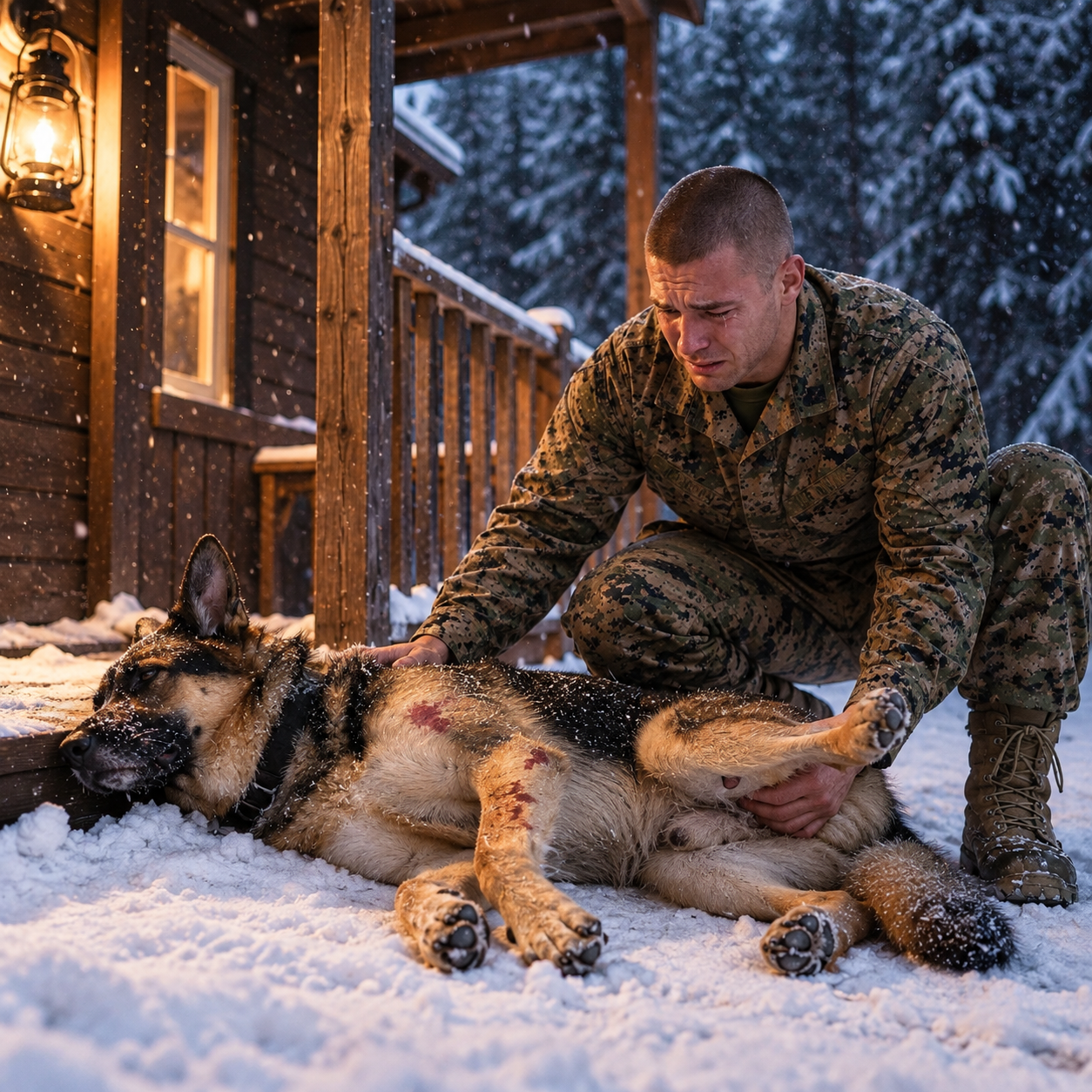
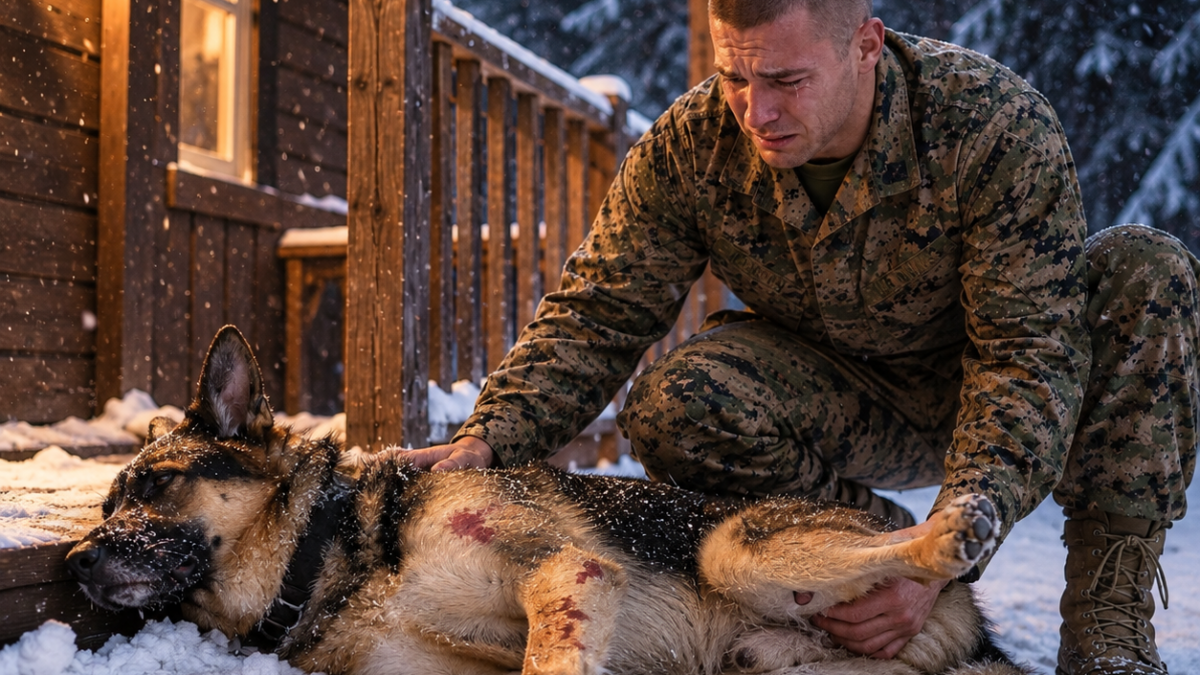
The night US Marine Staff Sergeant Mason Reed was staying alone in his Aderondac cabin, he heard a faint scratching at the door. Outside, he found a wounded German Shepherd collapsed in the snow wearing a damaged canine collar with its identification destroyed. Mason brought the dog inside and called him Rex.
Then Rex obeyed a military command instantly and kept staring toward the forest as if he needed Mason to follow. By morning, Mason uncovered the truth.
Military records claimed Rex had died three years earlier alongside his handler, Marine Daniel Hayes, Mason’s closest friend.
What Rex led Mason to next would reveal hidden evidence, stolen military supplies, and the truth about Daniel’s death.
The Aderondac Mountains had disappeared beneath the storm.
By 11 that night, snow was sweeping sideways across the forests outside Lake Placid, burying the narrow mountain roads beneath white drifts and turning the world beyond the cabin windows into a shifting wall of darkness. No traffic moved along the ridge.
No porch lights burned through the trees. Only one cabin remained awake.
Staff Sergeant Mason Reed, 36, sat alone beside the stone fireplace with a mug of coffee slowly cooling between his hands. Mason was a US Marine with the solid build of a man who had spent most of his adult life carrying packs, equipment, and responsibility. He stood just over 6 feet tall with broad shoulders, closecropped dark brown hair, gray green eyes, and a faint line near his left eyebrow from an old training accident.
He rarely smiled unless something genuinely deserved it. People who served with Mason described him as dependable, patient under pressure, and almost impossible to rattle.
Family members would have used another word, distant. Years of deployments had taught Mason how to leave quickly, sleep anywhere, and keep important feelings packed away where they could not interfere with the next assignment. It was useful in uniform.
It was less useful everywhere else. He had returned to New York 5 days earlier after another long deployment and borrowed the old family cabin near Lake Placid because he needed time to think.
His current enlistment was approaching a decision point. He could remain on the operational side of the Marine Corps, or he could accept a quieter position helping train younger Marines.
Mason hadn’t decided which frightened him more, the thought of leaving the life he understood, or admitting he might be ready for something different.
The cabin had belonged to his father, and very little had changed since Mason was a teenager. Same wooden beams, same cast iron stove, same faded fishing photograph above the fireplace.
On the small table beside the couch rested his father’s old wristwatch, a heavy steel thing with scratches across the face.
It no longer kept perfect time, but Mason wound it every morning anyway.
Some things didn’t need to work perfectly in a matter.
His phone rested face down beside it. It had vibrated twice that evening. Mason already knew who it was.
His younger sister, Emily Reed, 33, was a veterinarian in Lake Placid. Emily was tall and slender with shoulderlength auburn hair, practical brown eyes, and the direct manner of someone accustomed to frightened animals and worried owners. She had once been naturally easygoing, but after years of watching Mason disappear into deployments and answer family messages weeks late, patience with her older brother had become one of the few things she no longer had much of.
The message was simple.
Sophie’s birthday is Saturday.
She keeps asking if Uncle Mason is coming.
Sophie, Emily’s 11-year-old daughter, was a small, energetic girl with dark curls, bright hazel eyes, and a habit of collecting photographs of every dog she met.
Unlike her mother, Sophie had never learned to be irritated with Mason. She simply missed him. Mason read the message, then locked the phone without answering.
He told himself he would decide tomorrow. The storm gave him a convenient excuse to postpone almost everything. Outside, wind pressed snow against the windows.
Mason added another piece of wood to the fire and glanced toward the clock. 11:47 p.
m. He was reaching for his coffee when he heard something.
A soft scrape. Mason stopped. The sound disappeared beneath the wind.
He waited. Nothing. Probably a branch rubbing against the porch.
He lifted the mug again. Scratch.
This time, Mason lowered it slowly. The noise had come from the front door. He stood.
Years of training changed his posture almost immediately. His shoulders straightened, his attention sharpened. The tired man beside the fireplace disappeared, replaced by the marine who noticed exits before furniture.
Another faint scrape came from outside. Mason walked toward the door and looked through the narrow window beside it.
Snow, dark trees, an empty porch. Then something moved low near the steps.
Mason pulled on his winter coat, unlocked the door, and opened it carefully. Cold air rushed inside.
Snow swirled across the porch boards. Mason looked down. A German Shepherd was lying beside the bottom step.
For several seconds, neither moved. The dog appeared to be about 7 years old, largeframed, but currently much thinner than a working shepherd should have been.
His coat was the traditional black and tan of a German Shepherd, though snow clung heavily to the darker fur along his back. His ears were upright but tired, one leaning slightly sideways whenever the wind struck him. One rear leg was held awkwardly enough that Mason immediately knew the dog was uncomfortable putting weight on it.
But it was the shepherd’s eyes that held him.
Deep brown, alert despite exhaustion, not wild, not confused, watching, assessing. Mason slowly crouched. Easy.
The shepherd didn’t growl.
He didn’t retreat.
He simply lifted his head a few inches and studied Mason as though trying to make a decision. Around his neck was a thick black working collar.
Mason brushed snow away from it. Three faded letters remained visible.
canine. His expression changed. Where did you come from?
The dog tried to rise. His front paws found the porch.
His injured leg did not. He sank back down.
“All right,” Mason murmured.
“That’s enough.”
He slipped one arm beneath the dog’s chest and another beneath his body.
The shepherd stiffened for half a second, then relaxed. Mason carried him inside.
The difference between the frozen porch and the cabin’s warmth was immediate.
Mason placed the dog on an old wool blanket several feet from the fireplace, close enough to warm gradually without overwhelming him. The shepherd remained lying down, but his eyes followed Mason everywhere. Mason filled one bowl with water and another with pieces of plain chicken left from dinner.
The dog ignored the food. Mason moved the water closer. Still nothing.
“You’re making this difficult.”
The shepherd continued watching him. Then Mason understood. He stepped away, turned his back.
A few seconds later, he heard the quiet movement of the bowl against the floor. When Mason glanced over his shoulder, the shepherd was drinking.
Mason said nothing. Trust apparently had conditions. After the dog finished, Mason examined the collar more closely.
A serial sequence had once been stamped along the inside. Most of it was unreadable now, not faded from age, damaged. Only a few partial characters remained.
Mason ran his thumb over the rough section. His instincts tightened again.
Working dogs didn’t usually lose identification this neatly.
But there was something even more interesting than the collar. Mason shifted the blanket.
Stay. The shepherd froze instantly. No hesitation, no confused tilt of the head.
He stayed exactly where he was. Mason stared at him.
Well, the dog’s eyes remained fixed on his ou.
Mason walked three steps toward the kitchen.
The shepherd didn’t move.
Release.
The dog’s shoulders relaxed.
Mason slowly exhaled. This animal had been trained and not casually.
He returned to the fireplace and sat on the floor several feet away. For a while, they simply watched each other. Mason eventually reached for his wallet.
Inside, behind his military identification was an old photograph he hadn’t removed in years.
Two younger Marines stood beside a transport vehicle under a desert sun. One was Mason.
The other was Daniel Hayes. Daniel had been 34 in the photograph, lean and athletic with sandy brown hair, a square jaw, and an easy grin that made strangers trust him faster than they probably should.
He had been the opposite of Mason in almost every social way. Quick to joke, quick to make friends, and stubbornly unwilling to leave anyone behind. Years earlier, during a difficult overseas assignment, Daniel had helped Mason through one of the worst nights of his career.
Mason had never forgotten it. He looked at the photograph for a moment before putting it away. Across the room, the shepherd had finally lowered his head.
“Can’t keep calling you dog,” Mason said.
The shepherd’s ear twitched, Mason thought for a second.
“Rex, another twitch.
That’ll work for tonight.
Near 1:00 in the morning, the storm remained heavy. Mason prepared a sleeping place beside the fireplace and checked the doors once more.
Rex had finally begun to relax. Then, somewhere beyond the cabin, a distant engine moved along the mountain road.
Rex’s head snapped up.
His entire posture changed. Not panic. Attention.
The engine faded. Rex continued listening long after Mason could hear nothing. Mason noticed.
He filed it away. Minutes later, Mason switched off the main lamp. He was halfway toward the bedroom when he heard claws touched the wooden floor.
Rex was standing. The shepherd moved slowly toward the northern window. He stopped directly in front of it.
Outside was nothing but darkness, snowfall, and miles of forest. Rex stared through the glass.
No barking, no growling, no restless pacing, just absolute focus. Mason stepped beside him. What is it, boy?
Rex didn’t look at him.
His gaze remained fixed somewhere beyond the trees. Mason followed that gaze into the storm. There was nothing he could see.
But Rex continued standing there as if somewhere beneath all that snow and darkness, something important was still waiting for him. And for the first time since opening the cabin door, Mason wondered whether the German Shepherd had come there looking for shelter at all.
Maybe Rex had been looking for someone, and somehow he had chosen Mason. Morning arrived without sunlight.
The storm had weakened just enough for the mountains to become faint shapes beyond the windows, but snow still moved steadily across the Aderondac forest, filling the tracks around Mason Reed’s cabin almost as quickly as the wind uncovered them.
Mason had slept less than 2 hours. Rex had slept even less. Every time Mason opened his eyes during the night, the German Shepherd was either watching the northern window or listening toward the road, as though some part of him refused to believe the cabin was truly safe.
By 7, Mason had made coffee and warmed a little plain chicken for Rex. The dog accepted a few pieces this time, though he ate slowly and kept one ear turned toward the room. His rear leg remained uncomfortable, but after warmth and rest, he could stand for short periods.
Mason avoided pushing him. Whatever had happened before Rex reached the cabin could wait.
Keeping him calm came first. He picked up his phone and called the person he should probably have answered months ago.
Dr. Emily Reed arrived just after 9.
Mason’s younger sister was 33, tall and slender with auburn hair pulled into a practical ponytail beneath a knitted cap and steady brown eyes that made dishonesty difficult around her.
She had spent nearly a decade working as a veterinarian in Lake Placid, and the years had made her gentle with frightened animals, but direct with people. Emily had once been the more care-free Reed sibling, always the first to laugh and the last to stay angry. But years of watching Mason disappear into assignments, miss holidays, and answer family messages long after everyone had stopped expecting him had changed that.
She still loved her brother completely. She simply no longer protected him from uncomfortable truths. Behind her came 11-year-old Sophie Reed, carrying a folded blue blanket nearly as large as she was.
Sophie had inherited her mother’s auburn brown curls, but Mason’s gray green eyes.
She was small for her age, energetic, observant, and completely incapable of passing a dog without wanting to know its name. Emily often said Sophie trusted animals because animals never pretended to be less interested than they really were. You brought her through this weather?
Mason asked as he took Emily’s medical case.
The main road is open enough, Emily replied. And somebody refused to stay with Mrs. Palmer once she heard there was a German Shepherd involved.
Sophie raised the blanket. I brought supplies. Mason almost smiled.
Almost. Rex was lying near the fireplace when they entered.
His head rose immediately. Emily stopped several feet away.
She didn’t approach.
That alone told Mason she had understood him when he described Rex over the phone.
“He’s watching our hands,” she said quietly.
“He watches everything.”
Emily removed her coat slowly and crouched at a distance.
Rex’s eyes followed her, but his body remained relaxed.
Sophie started forward. Emily held out one hand.
“Let him decide.”
To Mason’s surprise, Sophie didn’t argue.
She placed the blue blanket on the floor about 6 ft from Rex, then sat cross-legged behind it with her hands folded in her lap.
“Hi,” she whispered.
“I’m Sophie.”
Rex stared at her.
Sophie didn’t reach, didn’t whistle, didn’t slap her knees, or call him toward her.
She simply waited. Emily glanced at Mason. You could learn something from her.
Good morning to you, too. Emily unpacked her equipment and began examining Rex only after the dog allowed her closer.
Her movements were slow and predictable. She checked his general condition, watched the way he shifted his weight, and carefully examined the older marks beneath his coat without dwelling on them.
“This dog worked,” she said eventually.
Mason leaned against the table.
“I figured.
No, I mean worked for years.”
Emily gently moved one of Rex’s front legs and studied his response.
His body tells you that repeated conditioning, long-distance movement, probably obstacle training. Nothing here looks like a pet who occasionally went hiking. Rex watched her face.
Emily sat back. Seven, maybe 8 years old, give or take.
Mason looked at the shepherd. Rex looked older in the daylight, not weak exactly, but experienced. There were subtle signs of a life spent doing difficult work, the disciplined posture, the way he responded to movement near doors, the habit of placing himself where he could see most of the room.
Emily took a handheld scanner from her medical case.
Let’s see if you’ve got a name.
She passed it slowly over Rex’s shoulders.
Nothing. She tried again, then along the opposite side. Still nothing.
Emily frowned. What? Most working dogs are chipped.
Could it have failed? Possible, her tone said unlikely.
Emily ran the scanner again, then parted Rex’s fur near the usual implantation area.
She studied it for several seconds.
There are signs that something used to be registered here, but I’m not getting anything readable.
Mason’s expression hardened.
Meaning? Emily put the scanner down.
meaning I don’t want to guess beyond what I can confirm, but paired with that damaged identification collar, I don’t think we should assume this is normal wear.
Mason looked toward the mantle where he’d placed the black canine collar.
Emily followed his gaze. Show me. He handed it to her.
She turned it beneath the window light.
The stamped serial sequence was still mostly unreadable, but when Emily rotated the collar, Mason noticed something he’d missed the night before.
A tiny symbol had been pressed into the leather near the buckle. A triangle, not decorative, deliberate. Emily traced it with her thumb.
Does that mean anything to you? No.
Across the room, Sophie had remained completely still. Rex had not. While Mason and Emily examined the collar, the German Shepherd pushed himself upright.
He took one careful step toward the blue blanket, then another. Sophie held her breath. Rex reached the edge of the blanket, circled once, and lowered himself onto it.
His head rested less than 2 feet from Sophie’s knee.
The girl’s face brightened, but she still didn’t touch him.
Mason stared. Rex had accepted Mason because Mason had carried him out of the storm. This was different.
Rex had chosen Sophie.
Sophie whispered, “Can we call him Sergeant Rex?”
Emily gave her daughter a look.
You’ve known him 20 minutes.
That’s enough.
Mason folded the collar in his hand. Sergeant Rex, it is.
For the first time that morning, he smiled.
It didn’t last long.
By late morning, Emily was preparing to leave when the storm strengthened again. County alerts warned that the smaller roads were deteriorating.
Mason looked at the snow piling against the porch and told her what she already knew.
You’re not driving Sophie back in that.
Emily glanced through the window. I was about to say the same thing.
The cabin had two spare bedrooms. Sophie immediately claimed the smaller one overlooking the trees.
Emily protested that they were staying only until conditions improved. Sophie had already put her backpack on the bed.
While Emily made lunch, Mason went to his desk and opened the old laptop. If Rex had belonged to a government or military program, there had to be something somewhere.
Mason still had one person who knew how to find records everyone else had forgotten. He dialed. Chief Warrant Officer Tyler Brooks answered on the third ring.
Tyler was 41, a compact, broad-chested Marine with dark skin, closely shaved hair, rectangular glasses, and the permanent expression of a man who had already spotted the mistake in your plan, but was waiting to see whether you would notice it yourself. He had spent most of his career in logistics systems and operational records.
Where Mason was quiet because he preferred observation, Tyler was quiet because he disliked wasting words. Years earlier, an inventory error had nearly delayed critical supplies to his unit, and Tyler had responded by becoming almost obsessively thorough.
“If a file existed, Tyler could usually find it.
If it had been altered, he wanted to know why.
” “Mason Reed,” Tyler said.
“I was starting to think retirement had taken you without paperwork.”
“Not retired.”
“Then this call is already disappointing,” Mason explained.
and Rex. There was silence.
You’ve got a military working dog in your cabin.
I’ve got a German Shepherd with canine training, a damaged collar, no readable chip, and a symbol I don’t recognize.
What symbol? Small triangle.
Tyler’s tone changed.
Send me pictures. Mason photographed Rex, the collar, and the surviving serial fragments. Tyler hung up.
An hour passed, then two. Mason tried not to watch his phone. Instead, he helped Emily prepare soup while Sophie sat beside Rex reading a book aloud.
Rex didn’t understand the story, but he appeared content with the arrangement.
Emily noticed Mason checking the screen again. Who are you waiting for? Tyler Brooks.
About the dog. Mason nodded. Emily studied him.
That’s not the only thing bothering you.
Mason kept cutting vegetables.
I don’t know what you mean.
Of course you don’t.
Before he could respond, his phone rang. Tyler, Mason answered immediately. I found something, Tyler said.
Mason walked toward the desk. Emily followed.
The photo match isn’t perfect, Tyler continued.
But it’s close enough that I went deeper.
3 years ago, there was a German Shepherd assigned to a small recovery and logistics support program, K9 recovery unit 12.
Mason’s hand stopped on the chair.
Name? There was a pause. Rex.
The room seemed suddenly smaller. Tyler continued.
Male German Shepherd. Same approximate age, same coat patterns, and the triangle on your collar. Unit 12 used a triangle inventory mark on some field equipment.
Mason looked toward the fireplace. Rex was watching him. Handler?
Mason asked.
Tyler didn’t answer immediately.
When he finally spoke, his voice had lost all humor. Daniel Hayes.
Mason stared at nothing. Three years disappeared in an instant.
Daniel’s photograph, his grin, the old transport vehicle, and the phone call Mason had never returned.
Daniel had called him 7 days before his reported death. Mason had been overseas, busy, tired, convinced there would always be another chance.
There hadn’t been.
Emily saw his face change. Mason.
He didn’t respond, Tyler continued quietly.
The official record lists Daniel’s death as a vehicle accident.
It also lists his canine as lost in the same incident. Mason looked directly at Rex.
What exactly does the dog record say? Tyler read it. Deceased during incident.
Silence filled the cabin. Rex was alive.
He was lying on Sophie’s blue blanket less than 15 ft away.
Emily slowly sat down.
“That’s impossible.”
“No,” Mason said, his voice was quiet.
“The record is wrong.”
Tyler exhaled through the phone.
“There’s more,” Mason closed his eyes briefly.
“Go ahead.”

