Part 3: “You used me. You threatened me. You made me a criminal. I’m not going to let you do it to anyone else.”
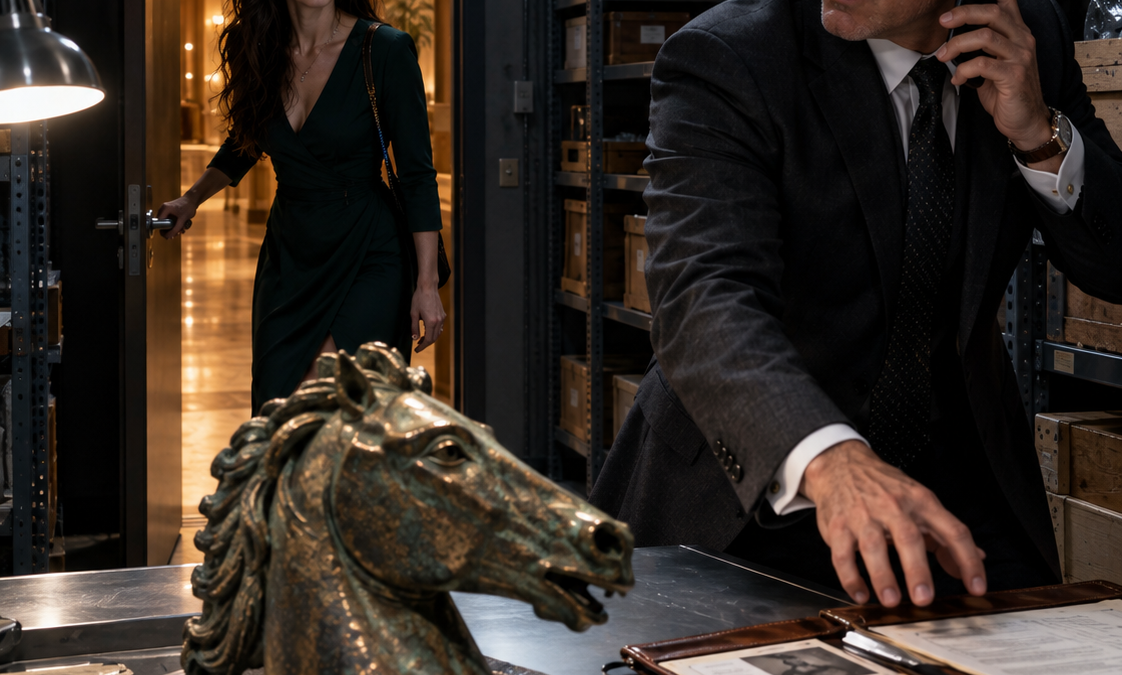
CHAPTER 13: The Confrontation
They found Marcus in his studio.
It was late—after midnight—and the building was empty. Marcus was sitting at his worktable, a magnifying glass in his hand, examining a small bronze figurine under the lamp. He looked up when they walked in, and his face—that familiar, paternal face—shifted into something guarded.
“Adrian. Elena. What a surprise.”
“We need to talk,” Adrian said.
“I’m busy.”
“It wasn’t a request.”
Marcus set down the magnifying glass. He looked at Elena, and something flickered in his eyes—something that might have been regret. Or might have been calculation.
“You told him,” he said.
“I told him everything.”
“I see.” Marcus stood up. He was wearing a gray cardigan and worn corduroys, and he looked like what he was: an old man, past his prime, trying to hold onto something that was already slipping away. “And what do you want? An apology? I’m sorry, Elena. I’m sorry you got caught up in this. But you were useful. And I needed someone useful.”
“You used me. You forged my signature. You opened a bank account in my name. You made me a criminal.”
“I made you successful. Without me, you’d still be a graduate student with no future and no money. I gave you a career. I gave you a life.”
“You gave me nothing but a target on my back.”
Marcus sighed. He looked at Adrian. “You should have stayed out of this. Both of you. You don’t know who you’re dealing with.”
“Liu Wei?” Adrian said. “I know exactly who I’m dealing with. I’ve been dealing with men like him my entire life. And I’ve destroyed every single one.”
“Liu Wei isn’t just a collector. He’s connected. He has people. If you go after him, you’ll start a war.”
“Then let it be a war.”
Marcus’s face changed. The regret was gone. What was left was something harder. Colder.
“You’re making a mistake,” he said. “Both of you. You think you can take down Liu Wei with a few documents and a customs officer? He owns people. He owns judges. He owns cops. He owns—”
He stopped. His eyes flicked to the door behind them.
Elena turned.
Eleanor Ashford was standing in the doorway.
She was wearing a long coat over a silk dress, and her face was pale but composed. She looked at Marcus, and then at Adrian, and then at Elena.
“I told you to stay out of this,” she said to Adrian.
“I don’t take orders from you anymore.”
“You’re making a mistake.”
“So I’ve been told.” Adrian stepped forward. “It’s over, Mother. You’re going to testify. You’re going to tell the authorities everything you know about Marcus and Liu Wei. And then you’re going to step down.”
“I won’t.”
“You will. Or I’ll release the wire transfer records. And the truth about the woman in Shanghai. And everything else.”
Eleanor’s face went white. “You wouldn’t.”
“Try me.”
For a long moment, mother and son stared at each other. The air in the room was thick with tension. Elena could feel her heart pounding in her throat.
Then Eleanor did something unexpected. She laughed.
“You think you have power over me?” she said. “You think those documents mean anything? I’ve been protecting this family for forty years. I’ve buried secrets you can’t even imagine. And you think a few wire transfers are going to bring me down?”
“I think you’re about to find out,” Adrian said.
Eleanor’s smile faded. She looked at Marcus. “You should have handled her,” she said. “I told you she was a liability.”
“I tried,” Marcus said.
“Not hard enough.” Eleanor turned back to Adrian. “You want a war? Fine. You’ll get one. But don’t come crying to me when you lose everything you’ve ever loved.”
She turned and walked out of the room.
Marcus looked at Adrian. “You should have listened to her.”
“I never listen to her.”
“Then you’re a fool.”
Adrian stepped forward. “You’re going to confess, Marcus. Tonight. You’re going to write a statement. You’re going to name Liu Wei. And you’re going to tell the authorities everything you’ve done.”
“And if I don’t?”
“Then I’ll make sure you spend the rest of your life in a cell. Not a comfortable one. Not a white-collar prison. A real one. With real criminals. The kind of people who don’t care about your art credentials or your connections.”
Marcus’s face went pale. “You wouldn’t.”
“I would. And I will.”
Marcus looked at Elena. “You’re just going to let him do this?”
Elena met his eyes. “You used me. You threatened me. You made me a criminal. I’m not going to let you do it to anyone else.”
“I made you. Without me, you’re nothing.”
“Without you, I’m free.”
Marcus stared at her. Then he laughed—a bitter, broken sound. “You think you’re free? You think any of this makes you free? You’re working for Adrian Ashford. You’re standing in his shadow. You’re just as trapped as you were with me.”
“No,” Elena said. “I’m not. Because I chose this. I chose to fight back. And that’s the difference between you and me.”
Marcus was silent for a long moment. Then he sat down at his desk and picked up a pen.
“Fine,” he said. “I’ll write your statement. But I want immunity. Full immunity. For everything.”
Adrian shook his head. “No immunity. But I won’t press charges for the forgery. You’ll serve time for the smuggling. Maybe five years. Maybe less with good behavior.”
“Five years.”
“That’s the deal.”
Marcus looked at him. Then at Elena. Then at the pen in his hand.
“Alright,” he said. “I’ll take it.”
He began to write.
CHAPTER 14: The Statement
Marcus wrote for forty minutes. The pen scratched across the paper in a steady rhythm, and Elena watched his hand move, remembering all the times she had seen that hand guide a brush across a painting, steady and sure. He wrote without stopping, without looking up, without any sign that what he was doing cost him anything.
When he finished, he slid the paper across the table. Adrian picked it up and read it in silence. Then he handed it to Elena.
She read it twice.
It was a full confession. Names. Dates. Amounts. The shell companies. The Cayman account. Liu Wei. The shipping routes. The bribes. The forged signatures—including hers. It was everything they needed and more.
“It’s not enough,” Adrian said.
Marcus looked up. “What do you mean?”
“You named Liu Wei. You named the accounts. But you didn’t name my mother. You didn’t say she authorized the wire transfer. You didn’t say she knew.”
“Because she didn’t know. Not at first. I told her the money was for a legitimate acquisition. She didn’t find out the truth until later.”
“And when she did?”
Marcus hesitated. “She was angry. She wanted to go to the authorities. But I convinced her not to. I told her it would destroy the foundation. I told her it would destroy you.”
Adrian’s expression didn’t change. “Write that down. Everything you just said. Including the part about my mother.”
Marcus picked up the pen again. He wrote for another ten minutes. When he was finished, he handed the paper back to Adrian.
Adrian read it. Nodded. Then he folded the paper and put it in his jacket pocket.
“Thank you,” he said. “You’ve been very helpful.”
“What happens now?”
“Now we take this to Daniel Okafor. He’ll use it to build a case against Liu Wei. And against you.”
“You said you wouldn’t press charges for the forgery.”
“I won’t. But the smuggling charges are out of my hands. You’ll serve time, Marcus. Maybe five years. Maybe less. But you’ll serve it.”
Marcus looked at Elena. “And her? What happens to her?”
“She gets her name cleared. She gets to go back to her life. And she gets to watch you go to prison.”
Marcus’s face twisted. For a moment, Elena thought he might lunge at her—might try to hurt her, the way he had hurt her career, her reputation, her sense of self. But he didn’t. He just sat there, his hands folded on the table, his eyes hollow.
“I should have fired you,” he said. “The day you started asking questions. I should have let you go.”
“You should have told me the truth,” Elena said. “You should have trusted me. I would have helped you. I would have found a way out.”
“There is no way out. Not from this.”
“There’s always a way out. You just have to be brave enough to take it.”
Marcus laughed—a bitter, broken sound. “Brave. You think you’re brave? You’re standing in the shadow of the most powerful man in the city, holding his hand, wearing his protection like a coat. You’re not brave. You’re lucky.”
Elena stepped forward. She was close enough to see the lines around his eyes, the tremor in his hands, the way his breath hitched in his chest. He was old. He was tired. And he was afraid.
“Maybe I am lucky,” she said. “But I’m also done letting you define me. You don’t get to tell me who I am anymore.”
She turned and walked out of the studio. Adrian followed her.
CHAPTER 15: The Boardroom
The board meeting was scheduled for ten o’clock the next morning. By nine-thirty, the conference room on the 60th floor was full.
Twelve people sat around the long table. Eleanor Ashford at the head, in a navy suit and pearls, her face composed and unreadable. Victoria on the other side, her laptop open, her eyes sharp. Four board members—three men and one woman—all of them old money, all of them looking uncomfortable. Two lawyers. A representative from the foundation’s PR firm. And Marcus Vane, sitting alone at the far end of the table, his hands folded in front of him.
Adrian stood by the window. Elena stood beside him.
She had never been in a room like this before. The table was mahogany. The chairs were leather. The view was fifty miles of city skyline. She felt like an intruder—a scruffy, underpaid, over-stressed intruder who had somehow wandered into a world she didn’t belong in.
But she didn’t leave. She stood her ground.
“Thank you all for coming,” Adrian said. “I know this was short notice. But we have a situation that requires immediate attention.”
Eleanor’s eyes flicked to Elena. “Why is she here?”
“Because she’s a witness. And because what I’m about to tell you concerns her directly.”
“I don’t see how—”
“Let me finish.” Adrian’s voice was quiet, but it cut through the room like a blade. “For the past eighteen months, the Ashford Foundation has been used to smuggle stolen antiquities. The pieces were sourced by Liu Wei, a collector with ties to organized crime networks in Hong Kong and Macau. They were authenticated by Marcus Vane, using forged signatures and falsified provenance documents. And they were stored in a hidden room in the basement of this building.”
The room went very still. One of the board members—a man named Gerald Hasting, whose family had been in shipping for four generations—cleared his throat.
“That’s a serious accusation,” he said.
“It’s not an accusation. It’s a fact.” Adrian pulled a folder from his briefcase and slid it across the table. “These are the wire transfer records. The shipping manifests. The forged documents. And a signed confession from Marcus Vane.”
Marcus didn’t move. Didn’t speak. He just sat there, his eyes fixed on the table.
Eleanor picked up the folder. She flipped through it slowly, her face betraying nothing.
“This is—” She stopped. “This is outrageous.”
“It’s the truth. And you knew about it.”
“I did not.”
“Your signature is on the authorization form for the wire transfer. You approved half a million dollars to a shell company in the Caymans. The money went to Liu Wei.”
Eleanor set the folder down. Her hands were steady. Her voice was calm. But Elena saw something flicker in her eyes—something that looked almost like fear.
“I approved the transfer because Marcus told me it was for a legitimate acquisition,” she said. “I had no idea it was connected to anything illegal.”
“That’s not what your son told me,” Marcus said quietly.
Every head in the room turned. Marcus was still looking at the table, but his voice was clear.
“I told Eleanor the truth six months ago,” he said. “I told her about Liu Wei. I told her about the smuggling. I told her everything. And she agreed to help me cover it up. She said the foundation couldn’t survive a scandal. She said we had to protect the family name.”
Eleanor’s face went white. “That’s a lie.”
“It’s the truth. And you know it.”
“I never—”
“You gave me the money. You let me use the foundation. You let me use her.” He gestured at Elena. “You let me use an innocent woman as a scapegoat. And you did it to protect yourself.”
The room erupted.
Gerald Hasting was on his feet, demanding answers. The PR representative was typing furiously on her phone. The lawyers were exchanging glances. And Eleanor—Eleanor was staring at Marcus with an expression of pure hatred.
“You’ll regret this,” she said.
“I already regret everything,” Marcus said. “But at least now I’m telling the truth.”
Adrian stepped forward. “That’s enough. The confession is with the authorities. Daniel Okafor from Customs has been building a case against Liu Wei for eleven months. With this evidence, he can make an arrest. Marcus will be charged with smuggling and fraud. And my mother—” He paused. “My mother will resign as chair of the board, effective immediately.”
“I will not.”
“You will. Or I’ll release the full records to the press. Including the part about the woman in Shanghai.”
Eleanor’s face crumpled. For the first time since Elena had met her, she looked old. Defeated. Human.
“Fine,” she whispered. “Fine.”
She stood up and walked out of the room. The door closed behind her with a soft click.
Adrian turned to the board members. “I’m sorry you had to hear that. But I believe in transparency. And I believe in accountability. The foundation will cooperate fully with the authorities. We will return the stolen pieces to their rightful owners. And we will rebuild.”
Gerald Hasting nodded slowly. “And what about her?” He gestured at Elena.
“Ms. Morozov is a victim of Marcus Vane’s fraud. She was deceived. Her signature was forged. Her reputation was damaged. And she is the reason we uncovered this scheme in the first place. She deserves our gratitude, not our suspicion.”
The board member looked at Elena. Then at Adrian. Then back at Elena.
“Well,” he said. “I suppose that settles it.”
The meeting adjourned. The board members filed out. The lawyers followed. Marcus was escorted from the room by two security guards, his hands cuffed in front of him.
And then it was just Elena and Adrian, alone in the conference room.
“That was—” Elena started.
“I know.”
“I didn’t expect it to be that easy.”
“It wasn’t easy. It was necessary.” He turned to face her. “You did well. You stood your ground.”
“I didn’t do anything.”
“You did everything. You walked into that room as a consultant and walked out as a witness of good faith. You held your ground while my mother tried to destroy you. You didn’t flinch.”
“I was terrified.”
“So was I. But we did it anyway.”
He reached out and took her hand. His fingers were warm, his grip firm. And for a moment, the conference room disappeared—the mahogany table, the city skyline, the weight of everything they had just done. It was just the two of them, standing in the wreckage of a war they had won.
“What happens now?” Elena asked.
“Now we go to the authorities. We give them the confession. We testify. And then—” He paused.
“And then what?”
“And then we figure out what comes next.”
He let go of her hand. But the warmth lingered.
CHAPTER 16: The Testimony
The next two weeks were a blur of meetings, depositions, and legal paperwork.
Elena testified before a federal grand jury. She sat in a small, windowless room and answered questions for six hours. She told them everything—about Marcus, about Liu Wei, about the forged signatures and the hidden room and the Cayman account. She told them about her own unwitting involvement. She didn’t try to hide anything. She didn’t try to protect herself.
When it was over, Daniel Okafor walked her out of the building.
“You did good in there,” he said.
“I feel like I just ran a marathon.”
“You did. And you finished. That’s what matters.”
“What happens now?”
“Now we build the case. Liu Wei will be arrested. Marcus will plead guilty. And you’ll be cleared of all charges.”
“And my career?”
Okafor shrugged. “That’s up to you. But if I were you, I wouldn’t give up. You’re good at what you do. And you didn’t do anything wrong.”
Elena nodded. She wanted to believe him. She wanted to believe that everything would be okay. But she had spent too many months living in fear to trust good news.
She went home. She slept for twelve hours. And when she woke up, she found a text from Adrian.
Dinner tonight. My place. 8 o’clock.
She stared at the message for a long time. Then she typed back: Okay.
CHAPTER 17: The Penthouse
Adrian’s apartment was on the top floor of the Ashford Building. It was three thousand square feet of glass and steel and pale wood, with a view of the city that made her feel like she was floating above it. There was a kitchen with appliances she didn’t recognize, a living room with a single, enormous painting on the wall, and a terrace that wrapped around the entire apartment.
He was standing on the terrace when she arrived, a glass of wine in his hand, looking out at the city. He didn’t turn when she walked in.
“You came,” he said.
“You asked me to.”
“I wasn’t sure you would.”
“Why wouldn’t I?”
“Because I’m the reason your life fell apart. Because I’m the reason you almost went to prison. Because I—” He stopped.
“Because what?”
He turned. His face was unreadable, but his eyes were tired. Dark. He looked like a man who hadn’t slept in weeks.
“Because I don’t deserve you,” he said.
Elena walked across the terrace and stood next to him. The city sprawled below them, a million lights flickering in the darkness. The wind was cold on her face.
“You didn’t do this to me,” she said. “Marcus did. Liu Wei did. Your mother did. You didn’t.”
“I could have stopped it. If I had been paying attention. If I hadn’t been so focused on the business, on the numbers, on—”
“On what?”
“On everything except the people who mattered.” He set his wine glass on the railing. “I’ve spent my entire life trying to prove that I was worthy of my father’s legacy. Trying to be better than him. Trying to be stronger. Trying to be—” He stopped. “I don’t know what I was trying to be.”
“A good man?”
“No. I don’t think I’ve ever been that.”
Elena looked at him. The sharp lines of his profile. The tension in his shoulders. The way his hands gripped the railing like he was afraid of falling.
“You’re not a bad man, Adrian. You’re just a man who’s been alone for too long.”
He turned to face her. His eyes were dark, searching, and for a moment, she saw something underneath the armor—something raw and wounded and almost childlike.
“I don’t know how to be anything else,” he said.
“Then learn.”
He stared at her. Then, slowly, he reached out and touched her face. His fingers were cold from the wine glass, but his touch was gentle—surprisingly gentle.
“You’re the only person who’s ever seen me,” he said. “The real me. Not the CEO. Not the heir. Not the Ashford name. Just—me.”
“I see you because you let me.”
“I didn’t let you. You just—you looked. And you didn’t flinch.”
“I flinched plenty. You just didn’t notice.”
He smiled—a small, almost imperceptible smile. Then he leaned in and kissed her.
It was not a gentle kiss. It was hungry, desperate, the kiss of a man who had been holding himself back for weeks and had finally given up the fight. His hand slid from her face to her neck, and then to her waist, and he pulled her close, closer than she had been to anyone in a long time.
She kissed him back. She didn’t think about the consequences. She didn’t think about the power imbalance, or the complications, or the fact that he was her boss and her protector and the most dangerous man she had ever met.
She just kissed him. And for the first time in months, she felt like she was exactly where she was supposed to be.
CHAPTER 18: The Morning After
She woke up in his bed. The sheets were white and impossibly soft, and the light coming through the window was pale gold. She was wearing one of his shirts—a white oxford that smelled like him. And she was alone.
For a moment, she panicked. She sat up, her heart hammering, and looked around the room. It was spare and elegant, with a single photograph on the nightstand—a black-and-white portrait of a man she assumed was his father.
Then she heard the sound of footsteps in the corridor.
Adrian appeared in the doorway, holding two cups of coffee. He was wearing sweatpants and a t-shirt, and his hair was still wet from the shower. He looked almost human.
“You’re awake,” he said.
“I’m awake.”
“Good. I made coffee. I don’t know how you take it.”
“Black. No sugar.”
He handed her a cup and sat down on the edge of the bed. He didn’t look at her—he looked at the window, at the light, at anything except her face.
“About last night,” he said.
“Yes?”
“I—” He stopped. “I don’t do this. I don’t bring people here. I don’t—” He stopped again.
“Don’t what?”
“Don’t let people in.”
Elena took a sip of her coffee. It was strong and bitter and exactly what she needed.
“I don’t do this either,” she said. “I don’t sleep with my boss. I don’t sleep with men who have this much power over me. I don’t—”
“Don’t what?”
“Don’t trust people. Not anymore. Not after Marcus.”
Adrian was quiet for a moment. Then he turned to look at her.
“I’m not Marcus,” he said.
“I know.”
“Do you?”
“Yes.”
“Because I need you to know that. I need you to know that I’m not using you. I’m not stringing you along. I’m not—”
“Adrian.” She reached out and touched his hand. “I know.”
He looked at her hand on his. Then he looked at her face. And something in his expression shifted—softened, maybe. Or broke.
“I don’t know what this is,” he said. “I don’t know what I’m doing. I don’t know how to do this.”
“Neither do I.”
“Then what do we do?”
She thought about it. The coffee was warm in her hands. The light was gold on the sheets. And Adrian Ashford—the most powerful man in the city, the man who terrified boardrooms and rival CEOs and his own mother—was sitting on the edge of his bed, looking at her like she was the only thing in the world that made sense.
“We figure it out,” she said. “Together.”
He stared at her. Then he leaned in and kissed her again—softer this time. Slower.
“Together,” he repeated.
And for the first time in her life, Elena believed it.
CHAPTER 19: The Gallery
Three months later, Elena stood in the center of her own gallery.
It was a small space on the ground floor of a converted warehouse in the arts district—two rooms, white walls, polished concrete floors. The sign above the door read Morozov Restoration. The gallery was hers. The business was hers. The future was hers.
She had spent the first month after the trial in a daze. The charges against her had been dropped, but the damage to her reputation had been done. Restorers talked. Collectors talked. Museums talked. For a while, it seemed like no one in the industry would touch her.
But then something unexpected happened. Daniel Okafor had given an interview to a trade publication about the case. He had described her as a “witness of exceptional integrity” whose cooperation had been “instrumental in dismantling a major smuggling network.” The article had been picked up by a larger outlet. And then another. And then, somehow, she had become a minor celebrity—a symbol of integrity in an industry that had always been comfortable with its shadows.
The offers had started coming in. Museums wanting her to authenticate pieces. Collectors wanting her to restore family heirlooms. A university wanting her to teach a seminar on ethics in restoration.
She had turned most of them down. She had taken the money she’d earned from the foundation—her consulting fee, paid in full despite the chaos—and she had leased the warehouse. She had bought the equipment. She had hung the sign.
And now, on a cool autumn evening, she was standing in her own gallery, surrounded by her own work, waiting for her own guests to arrive.
The bell above the door chimed.
Adrian walked in, wearing a dark coat and a scarf she had given him for his birthday. He was carrying a bottle of champagne and a look of mild surprise.
“You actually did it,” he said.
“You didn’t think I would?”
“I thought you might. But I wasn’t sure.”
He set the champagne on a worktable and walked slowly around the gallery. There were six pieces on display—all of them hers, all of them restored over the past three months. A Ming vase. A Tang figurine. A Song landscape scroll. Each one accompanied by a small placard detailing its history and provenance.
“These are beautiful,” he said.
“They’re mine.”
“I know.” He turned to face her. “Everything in this room is yours. You built it. You earned it.”
“I had help.”
“You had support. That’s different. The work is yours. The vision is yours. The name on the door is yours.”
Elena walked over to him. She was wearing a dark dress she had bought for the occasion—not expensive, but elegant. She felt different in this space. Stronger. More certain.
“I wanted to thank you,” she said. “For everything. For the protection. For the legal fees. For—”
“You don’t have to thank me.”
“I do. Because without you, I would have gone to prison. Without you, Marcus would still be smuggling antiquities. Without you—”
“Without me, you would have figured it out on your own. You’re smarter than you think, Elena. Braver than you think. You didn’t need me. You just needed someone to stand beside you while you did it.”
She looked up at him. The light from the gallery fixtures caught his face, softening the sharp lines, making him look almost gentle.
“I want you to know something,” she said.
“What?”
“I’m not the same person I was six months ago. I was scared. I was reactive. I let people use me because I didn’t think I deserved better. But I’m not that person anymore.”
“I know.”
“I don’t need you to protect me. I don’t need you to save me. I can save myself.”
“I know that too.”
“But—” She took a breath. “I want you. Not because I need you. Not because I’m scared. But because you’re the only person who’s ever seen me—the real me—and didn’t look away.”
Adrian was quiet for a long moment. Then he reached into his coat pocket and pulled out a small box.
“Before you say anything else,” he said, “I want you to have this.”
He opened the box. Inside was a key. Just a key—not a ring, not a jewel. A simple brass key.
“What is it?” Elena asked.
“It’s a key to my apartment. To my house in the Hamptons. To every door I own.” He closed the box and pressed it into her hand. “I’m not asking you to move in with me. I’m not asking you to marry me. I’m not asking you for anything. I’m just—I’m giving you access. To all of it. To all of me. Whenever you want it. However you want it.”
Elena looked at the key in her hand. Then she looked at him.
“That’s a lot of doors,” she said.
“I have a lot of doors.”
“And you’re giving me a key to all of them?”
“I’m giving you a key to all of them. And I’m not asking for anything in return.”
She closed her hand around the key. Then she stepped forward and kissed him—not hard, not desperate, but slow and certain.
“Okay,” she said. “I’ll take the key. And I’ll keep it. And I’ll use it when I want to. And I’ll stay away when I need to. And we’ll figure out the rest as we go.”
Adrian smiled—a real smile, the kind that reached his eyes. “That sounds like a plan.”
“It’s not a plan. It’s a promise.”
“Then I promise too.”
He pulled her close, and they stood there in the center of her gallery, surrounded by her work, her future, her life.
For the first time in years, Elena Morozov felt like she was exactly where she was supposed to be.
CHAPTER 20: The New Chair
Two weeks later, the Ashford Foundation held its annual board meeting. It was a smaller affair than usual—no gala, no champagne, no donors. Just twelve people around a conference table, discussing the future.
Eleanor Ashford was not among them. She had resigned, as promised, and had retreated to the family estate in the Hamptons, where she was reportedly “recovering her health.” No one believed that. But no one said anything.
The new chair of the board was Victoria Ashford.
She sat at the head of the table, her laptop open, her posture straight. She looked younger than her twenty-nine years, but there was something in her eyes—something sharp and determined—that made the board members sit up straighter.
“I want to thank you all for your confidence,” she said. “I know this has been a difficult year. The foundation has been through a scandal. We’ve lost donors. We’ve lost credibility. But we have not lost our purpose. And I intend to restore it.”
She laid out her plan. A new ethics committee. A new provenance review process. A commitment to returning stolen pieces to their rightful owners. A partnership with the customs agency to help train other institutions on how to spot smuggled art.
“This is a new chapter,” she said. “Not just for the foundation, but for the Ashford family. We’ve spent too long protecting our name at the expense of our integrity. That ends now.”
The board members nodded. They voted. It was unanimous.
After the meeting, Adrian found his sister in the corridor.
“That was impressive,” he said.
“I learned from the best.” She smiled. “Or at least, from you.”
“I’m proud of you.”
“I know.” She touched his arm. “And I’m proud of you too. For what you did. For Elena. For standing up to Mother.”
“I didn’t do it alone.”
“No. You didn’t.” She looked at him. “She’s good for you, you know. Elena. She doesn’t let you get away with anything.”
“That’s what I like about her.”
“I know.” Victoria laughed. “It’s also what scares you.”
Adrian didn’t deny it. He just smiled and walked away, leaving his sister standing in the corridor, looking after him with an expression that was equal parts pride and amusement.
CHAPTER 21: The Restoration
On a quiet Sunday afternoon, Elena sat in her gallery, working.
She was restoring a small oil painting—a landscape, nineteenth-century, anonymous. It had been brought in by an elderly woman who said it had been in her family for generations and she wanted it cleaned and stabilized before she passed it on to her granddaughter.
Elena worked slowly, carefully, removing the yellowed varnish with a cotton swab and a steady hand. The painting was revealing itself beneath the grime—a sky, a tree, a small figure walking along a path. It was nothing special. It was not valuable. But it was beautiful.
Her phone buzzed. A text from Adrian.
What are you doing?
Working.
On what?
A painting. A landscape. Very peaceful.
Can I come over?
She smiled. You don’t have to ask. You have a key.
I know. But I like asking.
She set down the cotton swab and looked at the painting. The little figure on the path, walking toward something she couldn’t see. She thought about her own path—the years of struggle, the sudden danger, the slow recovery. She thought about Marcus, in prison, serving his sentence. She thought about Eleanor, in exile, nursing her wounds. She thought about Adrian, standing on his terrace, looking out at the city, waiting for her to call.
She thought about herself. The woman she had been. The woman she was becoming.
She picked up her phone and typed: Come over. I’ll make tea.
She set the phone down and went back to work. The light through the window was golden, and the painting was slowly coming back to life, and somewhere in the city, a man was walking out of his office and getting into a car.
Elena smiled.
She had spent years trying to restore things—paintings, sculptures, antiquities. She had spent months trying to restore her reputation. But the thing she had really been restoring, all this time, was herself.
And she had done it. On her own terms.
That was the victory that mattered.

