Part 2: “You always get away with it. That’s not the same thing. And I’m not going to let you get away with it anymore.”
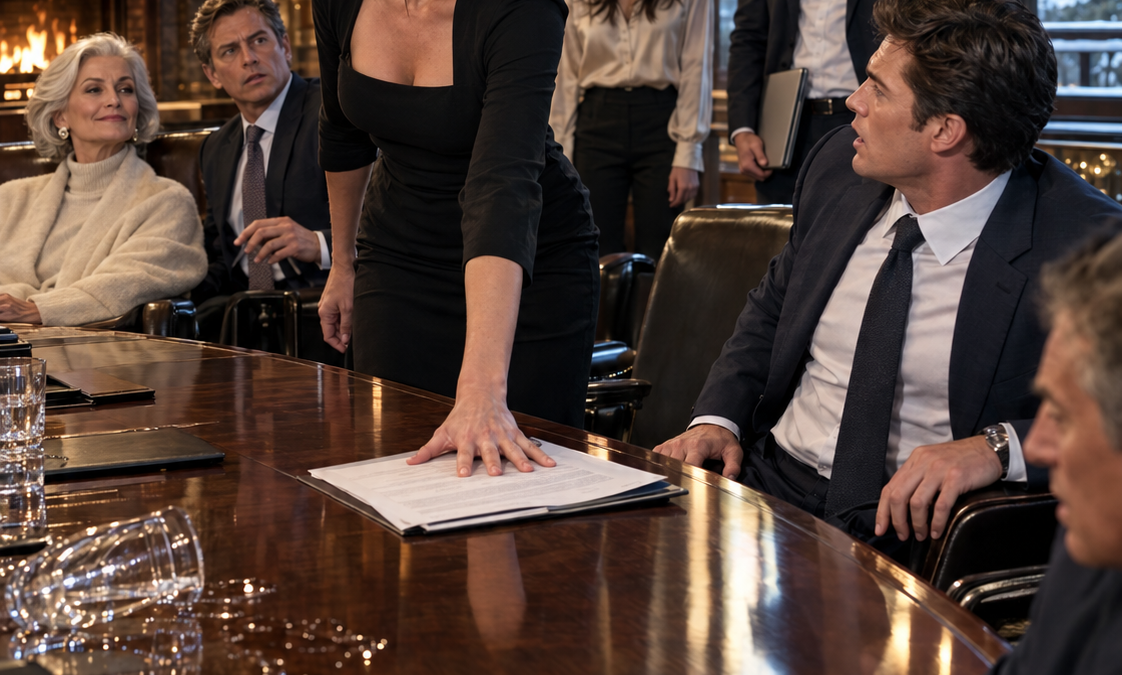
CHAPTER SEVEN: The Quiet After the Storm
Three days passed.
Elena slept for most of the first one, catching up on the nights she’d spent awake, staring at ceilings and making plans. The second day she spent with the resort’s attorney, going over the deed, confirming the clause, figuring out exactly what it meant for the property’s future. The third day she walked the grounds—the trails her father had cut, the slopes she’d learned to ski on, the lodge her mother had decorated with hand-sewn quilts and local pottery.
She’d almost lost all of it. She still might.
The divorce petition was still active. Julian had filed it, and he hadn’t withdrawn it, and the lawyers said it could take months to resolve. The resort’s finances were still precarious. The water rights were still in limbo. And Julian—Julian was still out there, somewhere, planning his next move.
But she was still standing.
That night, she sat alone in the lodge’s main room, a fire burning in the hearth, a glass of wine in her hand. The guests had gone to bed. The staff had gone home. It was just her and the crackling fire and the snow falling softly outside the windows.
She heard the door open before she saw him.
Marcus Chen came in quietly, snow melting on his shoulders, a folder tucked under his arm. He’d stayed in town, helping her with the legal filings, offering his expertise. She hadn’t asked him to stay. He’d just… stayed.
“You’re still here,” she said.
“I’m still here.” He sat down across from her, setting the folder on the table. “I wanted to make sure you were okay.”
“I’m okay.” She looked at him—really looked, for the first time. He was tired. His clothes were rumpled. He’d been sleeping in a motel room, eating at the diner, and still he’d shown up at the conference room with everything he needed to take down a corporation. “Why are you doing this? You don’t owe me anything. You don’t even know me.”
Marcus was quiet for a moment. Then he leaned back, stretching his legs toward the fire, and said, “I grew up in a town like this. Small. Family-owned. One corporation came in and bought up all the water rights, and within five years, the town was gone. Dead. Everyone moved away.” He looked at her. “I’ve spent my whole career trying to prevent that from happening to other places. And when I saw the memo—when I saw what Harrow was planning—I couldn’t just walk away. I couldn’t let it happen again.”
“That’s not an answer.” She sipped her wine. “That’s a reason. There’s a difference.”
He almost smiled. “You sound like your father.”
“You keep saying that. But you never met him.”
“I read his master plan. The one he submitted in 1992. He was trying to do what I do—protect the land and the people who live on it. He just didn’t have the lawyers and the accountants and the politicians on his side.” Marcus picked up his folder, opened it, and pulled out a single page. “This is a copy of his original conservation easement proposal. He wanted to protect the water source, but he also wanted to keep the resort operating—for the community, for his family, for the people who depended on it. He wrote a letter to the state board, explaining his reasoning. It’s…” He paused, searching for the word. “It’s beautiful. I’ve never read anything like it.”
He handed her the letter.
Elena read it slowly.
The water that flows through these mountains is not a resource to be owned—it is a trust to be protected. My family has lived here for three generations. We have built our home on this land, raised our children here, buried our parents here. The water is part of us. It is our responsibility to protect it—not to sell it, not to trade it, not to let it fall into the hands of those who would use it for profit alone. This place is not just a business. It is a legacy. And I will do everything in my power to ensure that it remains a legacy—not just for my family, but for everyone who calls these mountains home.
She read it twice, and then a third time. When she looked up, her eyes were wet.
“He wrote this when I was twelve,” she said. “I remember him working on it. I remember him staying up late, writing and rewriting, trying to find the right words.”
“He found them.”
She nodded. Then she folded the letter carefully and put it in her pocket. “Thank you.”
“For what?”
“For bringing it back to me.” She stood, and Marcus stood with her, and for a moment they were standing very close, the fire crackling beside them, the snow falling outside. “You should stay.”
“At the lodge?”
“At the lodge. Not the motel.” She almost smiled. “We have plenty of rooms. And I could use the help—with the legal filings, with the board, with all of it. If you’re willing to stay.”
Marcus looked at her for a long moment. “I’m willing.”
“Good.” She turned toward the stairs. Then she paused, looking back at him. “Marcus.”
“Yeah?”
“Thank you. For giving me the memo. For standing up for me. For…” She trailed off. “For believing me.”
He smiled. It was a real smile, warm, and it transformed his face. “You’re welcome.”
She went upstairs, and slept, and dreamed of water and mountains and her father’s voice.
CHAPTER EIGHT: The Mistress
Elena hadn’t been looking for the mistress.
She’d been going through the resort’s accounts, trying to figure out how much money Julian had siphoned out of the business over the past five years. The answer was: a lot. Enough to buy a house. Enough to buy several houses. Enough to keep a woman in luxury for years, apparently, because there was a property in Denver—a penthouse, expensive, paid for in cash—that Julian had purchased two years ago and never mentioned.
She found the deed in the safe. She found the name on the deed. And then she sat in the small office behind the front desk and stared at the wall for a very long time.
Clara Bennett.
She knew the name. Clara Bennett was Julian’s assistant—his executive assistant, as he’d always been careful to say, the one who handled his calendar and made his travel arrangements and accompanied him on business trips. Elena had met her a dozen times, at company events and holiday parties. She’d always been perfectly polite, perfectly professional, perfectly invisible.
Elena had never suspected anything.
Now she wondered if that was exactly what Clara had been trained to do.
She called Vivian.
“Did you know?”
“About Clara?” Vivian’s voice was carefully neutral. “Yes. I’ve known for two years.”
“Two years.” Elena closed her eyes. “And you didn’t tell me.”
“I didn’t tell you because I was watching. Waiting. I told you about the divorce petition because I wanted you to understand what you were facing. But Clara…” A pause. “Clara is a different kind of problem.”
“What do you mean?”
“Come to my house. I’ll explain.”
Elena drove there that night. Vivian was waiting for her in the library, the fire burning, a photograph in her hand.
“This is Clara Bennett,” Vivian said, handing her the photograph. “Five years ago.”
Elena looked at the photo. It was a young woman—younger than she’d expected—with dark hair and dark eyes and a smile that looked rehearsed. She was standing in front of a building Elena didn’t recognize, wearing a business suit and holding a diploma.
“She graduated from business school five years ago,” Vivian said. “Summa cum laude. Top of her class. She had offers from every major firm in the country. And she turned them all down to become Julian’s assistant.”
“That doesn’t make sense.”
“No. It doesn’t.” Vivian sat down, folding her hands. “Unless you know that Clara Bennett is my husband’s niece. My late husband’s sister’s daughter. Julian’s cousin.”
Elena felt the floor shift beneath her. “His cousin.”
“His cousin.” Vivian’s voice was flat. “They grew up together. Summer vacations, family holidays, the whole thing. When Julian’s father died, Clara’s mother took him in for a year—supported him while he grieved, helped him get into college. Clara was like a sister to him. And then—” She stopped.
“And then what?”
“And then Clara’s mother died, and Clara was alone, and Julian was the only family she had left.” Vivian looked at Elena with those pale, unblinking eyes. “I’ve been watching them for five years. I’ve seen the way Clara looks at him. I’ve seen the way he looks at her. It isn’t romantic, Elena. It’s something else. Something worse.”
“Worse than an affair?”
“It’s not an affair.” Vivian’s voice was hard. “It’s a conspiracy. Clara isn’t Julian’s mistress—she’s his partner. She’s been helping him plan this from the beginning. The water rights, the Harrow deal, the divorce—all of it. She’s the one who crafted the strategy. She’s the one who wrote the memo Marcus found. She’s been working against you for five years, and you never even noticed.”
Elena sat down heavily in the chair across from Vivian. The room was spinning. The fire was too hot, the air too thick, and she couldn’t seem to catch her breath.
“Why?” she asked. “Why would she do this?”
“Because she’s in love with him.” Vivian’s voice was almost gentle. “She’s been in love with him since they were children. And he’s been using that—using her—to get what he wants. He doesn’t love her back. He doesn’t love anyone. But she doesn’t see that. She thinks that if she helps him destroy you, he’ll finally see her. He’ll finally choose her.”
“He’s using her.”
“Yes.”
“And she’s helping him destroy my resort.”
“Yes.”
“Because she thinks he’ll love her.”
“Yes.”
Elena stood. She walked to the window and looked out at the snow, falling softly on the dark mountains. Her mountains. Her home.
“She’s a victim,” she said quietly. “Just like me.”
“Elena—”
“No. I know what you’re going to say. That she’s the enemy. That she chose this. And she did. But she also—” She stopped, searching for the words. “She also loved someone who didn’t love her back. And that made her do terrible things. I can’t forgive that. But I can understand it.”
Vivian was silent for a long moment. Then she said, “What are you going to do?”
Elena turned back to face her. “I’m going to fight her. I’m going to fight both of them. I’m going to save my resort. And I’m going to make sure that Clara Bennett understands exactly what she’s thrown away.”
“How?”
“By showing her what she could have had. If she’d chosen differently.” Elena picked up her coat. “Where does she live?”
CHAPTER NINE: The Woman in the Penthouse
The penthouse was exactly what Elena had expected: expensive, modern, cold. White walls, white furniture, white flowers in a white vase on the table. It looked like a hotel suite designed by someone who’d never actually stayed in one.
Clara opened the door before Elena could knock.
“I’ve been expecting you.”
“Have you?”
“Julian called. He told me you’d found the deed.” Clara stepped back, gesturing Elena inside. She was wearing a silk blouse and tailored trousers, her dark hair pulled back, her makeup perfect. She looked like a woman who had never made a mistake in her life. “Would you like something to drink? I have wine. Or tea, if you prefer.”
“I don’t want anything from you.”
“Then why are you here?” Clara closed the door, and they stood facing each other in the white, cold living room. “To gloat? To threaten me? To tell me that you’ve won?”
“I’m here to understand.” Elena sat down on the white sofa, uninvited. “I’m here to understand why a woman with every opportunity in the world would throw it all away to help a man who doesn’t love her.”
Clara’s expression didn’t change. “You don’t know anything about me.”
“I know you’re Julian’s cousin. I know you grew up together. I know you’ve been in love with him since you were children.” Elena looked up at her. “And I know he’s been using you—using your feelings—to get what he wants. Which means I know more about you than you think.”
Clara’s jaw tightened. “He loves me.”
“No. He doesn’t.”
“He does.” Her voice cracked, just slightly. “He just—he doesn’t know how to show it. He’s been through so much. His father died, his mother was cold, he never had anyone who—”
“He had you.” Elena stood. “He had you, Clara. You were his family. You were the one person in the world who loved him unconditionally, who supported him, who believed in him. And he used that. He used you to destroy me. And when this is over—when he’s taken everything he wants—he’s going to discard you, too.”
“You’re wrong.”
“Am I?” Elena walked toward her. “Where is he now, Clara? He’s not here. He’s not with you. He’s somewhere, planning his next move, and he’s not thinking about you. He’s never thinking about you. You’re a tool to him. A useful tool. And when you’re no longer useful—”
“Stop.” Clara’s voice was shaking. “Stop it.”
“I won’t stop.” Elena stopped in front of her, close enough to see the tears in her eyes. “I won’t stop, because someone needs to tell you the truth. You’ve spent five years—five years—destroying a woman you never met, helping a man who never loved you, and for what? For a promise he never made? For a future he never intended to give you?”
Clara turned away. Her shoulders were shaking. She pressed her hands to her face, and for a moment, she looked like the young woman in the photograph—brilliant, ambitious, full of potential, standing at the beginning of her life with the whole world ahead of her.
“I loved him,” she whispered. “I’ve always loved him.”
“I know.” Elena’s voice softened. “And that’s the saddest part. Because he doesn’t deserve it. He never did.”
She walked to the door, then paused, her hand on the knob.
“The memo,” she said. “The one Marcus found. You wrote it, didn’t you?”
Clara didn’t answer.
“You wrote it, and you gave it to Julian, and you helped him plan the whole thing. But I have to ask—why did you leave a copy on the shared drive? Why didn’t you delete it?”
Silence.
“Because you wanted someone to find it.” Elena turned back to look at her. “You wanted someone to stop him. You knew what he was doing was wrong, and you couldn’t stop it yourself, so you left a trail. You wanted to be caught.”
Clara looked up. Her face was wet with tears, but her eyes—her eyes were clear for the first time since Elena had walked in the door.
“I didn’t think anyone would find it,” she said. “I just… I just wanted it to exist. I wanted there to be a record. In case…”
“In case you ever needed to prove that you tried.”
Clara nodded.
Elena opened the door. “I’m not going to tell anyone about the memo. About you. I’m not going to expose you, or humiliate you, or destroy your career. That’s not who I am.”
“Why not?”
“Because you’re not the enemy.” Elena looked at her. “Julian is. And I’m going to destroy him. But not you. You’re going to have to live with what you’ve done—and that’s punishment enough.”
She walked out, closing the door behind her, and left Clara Bennett alone in her white, cold penthouse, with her white, cold life, and the ruins of everything she’d thrown away.
CHAPTER TEN: The Will
The letter arrived three days later.
It was from a law firm in Denver—a firm Elena had never heard of—and it was addressed to her, care of the resort. She opened it in the small office behind the front desk, her hands steady, her heart calm. She’d learned to expect surprises.
Dear Ms. Ashford,
We represent the estate of your late father, Thomas Ashford. In the course of our records review, we discovered a codicil to his will that was never filed with the court. This codicil was drafted six months before his death and signed by two witnesses. It appears to have been deliberately suppressed.
In this codicil, your father amended his will to remove Julian Ashford as a beneficiary and to transfer his shares of the resort to you, outright, with no conditions. He also included a letter, which we have enclosed.
We apologize for the delay in bringing this to your attention. We only discovered the codicil because of the recent legal filings in the water rights case, which prompted us to conduct a full review of the estate.
Please contact us at your earliest convenience.
Elena read the letter twice. Then she opened the enclosure—a single page, handwritten, in her father’s sprawling, messy script.
My dearest Elena,
If you’re reading this, I’m gone. I’m sorry I didn’t tell you in person. I’m sorry I didn’t have the courage to say this while I was alive.
I knew Julian was going to try to take the resort. I knew it from the moment you told me you were marrying him. I saw something in him—something cold, something calculating—and I was afraid. Not for myself. For you. For everything I’d built.
I tried to warn you. I tried to tell you, in my own clumsy way, that he wasn’t who he seemed. But you were so happy, and I didn’t want to be the father who ruined your wedding. So I stayed silent. And I’ve regretted it every day since.
This codicil is my attempt to make it right. I’m removing Julian from my will. I’m giving you everything—the resort, the land, the water rights, all of it. Not because I don’t trust you to share it. But because I know he’ll try to take it from you, and I want you to have the law on your side.
I don’t know if this will be enough. I don’t know if any piece of paper can protect you from a man like Julian. But I hope it helps. I hope it gives you the foundation you need to fight.
I love you, Elena. I’ve always loved you. And I’m sorry I wasn’t brave enough to say it while I was alive.
Your father,
Thomas
She read the letter three times. Then she folded it carefully and put it in her pocket, next to the copy of his conservation proposal that Marcus had given her. Then she picked up the phone and called her lawyer.
“Get the codicil filed,” she said. “And get me a meeting with Julian. Tomorrow. At the resort. Tell him it’s about the divorce.”
CHAPTER ELEVEN: The Last Negotiation
Julian arrived at the resort the next morning with his lawyer, his accountant, and a look on his face that Elena had never seen before: uncertainty.
She was waiting for him in the study. Her father’s study. The room where she’d found him, six months ago, with the pen still in his hand and his heart stopped in his chest. She’d avoided this room for months. Now she sat in her father’s chair—the leather one, the one that still smelled faintly of pipe tobacco and cedar—and watched her husband walk through the door.
“You wanted to see me.”
“Sit down.”
He sat. His lawyer sat next to him. Elena’s lawyer sat next to her. The room was silent except for the crackling of the fire and the ticking of the grandfather clock in the corner.
“I found something,” Elena said. “A codicil to my father’s will. Dated six months before his death. It removes you from the will and transfers all his shares to me.”
Julian’s face went very still. “That’s impossible. I would have known.”
“You would have known if it had been filed. But it wasn’t. Someone suppressed it.” She watched him carefully. “Someone who didn’t want it to be found.”
“I didn’t—”
“I didn’t say it was you.” She leaned back in the chair. “I’m just saying someone did. And now I have it. And my lawyer says it’s legally binding.”
Julian’s lawyer leaned over and whispered something in his ear. Julian’s jaw tightened. Then he said, “Even if the codicil is valid—which I’m not conceding—it doesn’t change the fact that we’re married. The resort is marital property. I have a claim.”
“You have a claim to what I brought into the marriage. But the resort was my inheritance—it was never marital property. And now, with the codicil, it’s not even a question.” Elena smiled. It was a small smile, and not a nice one. “You’ve lost, Julian. The water rights deal is dead. The Harrow acquisition is dead. Your shares in the resort—which you only had because you married me—are gone. And the divorce petition you filed? I’m going to contest it. I’m going to take you to court, and I’m going to make sure everyone knows what you did.”
“You can’t prove anything.”
“I can prove the memo. I can prove the deed transfer. I can prove the divorce petition you filed behind my back.” She stood. “And I can prove that my father was trying to change his will—trying to protect me from you—when he died.”
Julian stood too. His face was pale, his hands were shaking. “What are you saying?”
“I’m saying I know he was trying to cut you out. I’m saying he told a friend, the week before he died, that he didn’t trust you. And I’m saying—” She stopped, the words catching in her throat. “I’m saying I don’t know what happened the night he died. But I’m going to find out.”
The silence stretched between them like a wire pulled tight.
“You’re bluffing,” Julian said.
“Am I?”
“You have no proof. You have nothing. You’re just—”
“I have the codicil. I have the memo. I have the deed. I have your mother, who’s willing to testify. I have Marcus Chen, who’s willing to testify. I have Clara Bennett, who—” She stopped, watching his face. “Who I’m not going to call. Because she’s not the enemy. You are.”
Julian stared at her. For a moment—just a moment—she saw something in his eyes that she’d never seen before: fear. Real fear. The kind of fear that came from knowing you’d finally been caught.
“What do you want?” he asked.
“I want you to sign the divorce papers. I want you to give up any claim to the resort. I want you to leave this town and never come back.” She walked toward him, stopping close enough that she could see the sweat on his forehead. “And I want you to know that you didn’t win. You didn’t win, Julian. I did.”
He looked at her for a long moment. Then he turned to his lawyer and nodded.
The lawyer pulled out a pen.
CHAPTER TWELVE: The Reckoning
The divorce was finalized six weeks later.
Julian signed everything—the papers, the waivers, the agreements. He gave up his claim to the resort, his shares in the company, his right to the Ashford name. He left town on a Tuesday morning, in a black SUV with tinted windows, and no one watched him go.
Elena stood in the lobby of the lodge and watched the taillights disappear down the mountain road. She felt… nothing. Not relief. Not joy. Not even anger. Just a quiet, steady calm, like the surface of a lake on a windless day.
Marcus found her there an hour later.
“You okay?”
“I’m okay.” She turned to look at him. “I’m better than okay. I’m free.”
He smiled. “What are you going to do now?”
“Rebuild.” She gestured at the lodge, the mountains, the snow falling softly outside the windows. “The water rights are secure. The deed is clean. The resort is mine—actually mine, for the first time since my father died. And I have a lot of work to do.”
“I could help.” He said it casually, like it was nothing. But his eyes were serious. “If you want.”
She looked at him for a long moment. The firelight flickered across his face, and she saw—for the first time—what she’d been too busy to notice before. He was kind. He was patient. He was steady.
“I want,” she said.
He smiled. It was a real smile, warm, and it transformed his face.
They spent the winter rebuilding the resort. Marcus handled the environmental compliance—the real compliance, the kind that actually protected the land and the water and the people who depended on them. Elena handled the business—the bookings, the staffing, the endless small decisions that kept the place running. Vivian handled the legal—the estate, the deed, the codicil, making sure everything was airtight.
And slowly, the resort came back to life.
The guests returned. The staff returned. The snow fell, and the skiers came, and the lodge was full again. Elena stood at the front desk and checked people in and smiled and laughed and felt—for the first time in years—like she was home.
One night, late, she sat alone in the lodge’s main room, a fire burning in the hearth, a glass of wine in her hand. Marcus came in and sat down across from her, and they sat in comfortable silence for a long time.
“Thank you,” she said finally.
“For what?”
“For staying. For helping. For…” She trailed off. “For everything.”
He looked at her. “You don’t have to thank me.”
“I know. But I want to.” She set her wine down. “I spent five years married to a man who never saw me. Who never listened to me. Who never—” She stopped. “You see me. You listen. You’re here.”
“I’m here,” he said.
She reached across the space between them and took his hand. His fingers were warm, and rough, and steady.
“I’m not ready for anything,” she said. “Not yet. I need time.”
“I know.”
“But I want you to stay.”
He smiled. “I’m not going anywhere.”
They sat like that, hand in hand, watching the fire, as the snow fell softly outside the windows. And for the first time in a very long time, Elena felt like she was exactly where she was supposed to be.
CHAPTER THIRTEEN: The Spring Thaw
Spring came late that year.
The snow melted slowly, feeding the streams and the rivers and the reservoirs, and the water flowed down the mountain the way it had for a thousand years—free, and clean, and protected. Elena stood on the deck of the lodge and watched the runoff cascade down the rocks, and she thought about her father, and her aunt Catherine, and all the people who had fought to keep this place alive.
She’d won.
Not just the resort—though she had that, too. She’d won something bigger. She’d won her freedom. Her voice. Her power.
She’d won herself.
Marcus came up behind her, two cups of coffee in his hands. He handed her one and stood beside her, looking out at the mountains.
“What are you thinking about?”
“The future.” She sipped her coffee. “I’m thinking about the future.”
“What does it look like?”
She turned to look at him. The sun was rising over the peaks, painting the snow in shades of gold and pink, and his face was warm in the light.
“It looks like this,” she said. “It looks like home.”
He smiled. And she smiled back.
And somewhere in the distance, a river ran through it.
CHAPTER FOURTEEN: The New Deed
The signing ceremony was small—just Elena, Marcus, Vivian, and the lawyer. They gathered in the study, her father’s study, the one she’d avoided for so long. But today, for the first time, it felt like a place of possibility. Not a place of death. A place of beginning.
“This is the amended deed,” the lawyer said, sliding the document across the desk. “It transfers full ownership of the Ashford Resort to Elena Ashford, free and clear. The water rights are secure, protected by the conservation easement your father originally proposed—the one that retains usage rights in perpetuity. The property can never be sold outside the family, per the 1987 clause, which has been reaffirmed.”
Elena picked up the pen. It was her father’s pen—the one he’d used to sign the original deed, the one he’d been holding when he died. She’d found it in the desk drawer, and she’d kept it, and now she used it to sign her name.
“Congratulations,” Vivian said quietly. “You’ve done what your father couldn’t.”
“I’ve done what we all couldn’t.” Elena set the pen down. “Together.”
Vivian nodded. Then she did something Elena had never seen her do before: she smiled. It was a real smile, warm and tired and a little sad.
“Catherine would be proud of you,” she said. “So would your father.”
“I hope so.” Elena stood. “I hope they’re both proud.”
Marcus took her hand. “They are.”
She looked at him, and the room, and the mountains outside the window. Then she said, “Let’s go home.”
They walked out of the study together, into the lobby of the lodge, where the fire was burning and the guests were laughing and the resort—her resort—was alive.
CHAPTER FIFTEEN: The Water Runs Clear
Six months later.
The wedding was small—just family, just friends, just the people who had stood beside her when everything else had fallen apart.
Elena wore her mother’s dress. It had been altered to fit, and the lace had been repaired, and it smelled faintly of lavender and cedar—the same scent that had lingered in her father’s study, the same scent that meant home.
Marcus waited for her at the end of the aisle. He was wearing a simple suit, no tie, and he was smiling—that real smile, the one that transformed his face.
Vivian walked her down the aisle. It had been Elena’s idea. “You’re the closest thing to family I have left,” she’d said, and Vivian had looked at her for a long moment, and then nodded.
The ceremony was short. The vows were simple. And when Marcus kissed her, the small crowd of guests—the resort staff, the neighbors, the friends who had become family—burst into applause.
Later, at the reception, Elena stood on the deck and looked out at the mountains. The summer sun was setting, painting the sky in shades of orange and gold, and the river ran below them—clear, and cold, and free.
Marcus came up beside her. “What are you thinking about?”
“The future.” She took his hand. “Our future.”
“What does it look like?”
She turned to look at him. “It looks like this. It looks like us. It looks like home.”
He kissed her, and the sun set, and the water ran clear.
EPILOGUE: The Legacy
Ten years later.
The girl was seven years old, and she had her mother’s dark hair and her father’s quiet eyes. She stood on the deck of the lodge, looking out at the mountains, and she asked, “Mommy, who built this place?”
Elena knelt beside her. “Your grandfather built it. And your great-aunt Catherine. And me. And your father. And all the people who loved it.”
“And it’s ours?”
“It’s ours.” Elena smiled. “But it’s also theirs. The water, the mountains, the trees—they don’t belong to anyone. We just take care of them. That’s our job.”
The girl nodded seriously. “I can do that.”
“I know you can.” Elena stood, taking her daughter’s hand. “Come on. Let’s go find Daddy.”
They walked into the lodge, into the warmth and the light and the laughter. And outside, the water ran through the mountains, clear and cold and free—the way it always had, the way it always would.
THE END

