“You Handle the House. Stay Out of My Way,” the Former Navy SEAL Said—Until Her Scarf Slipped – Part 3
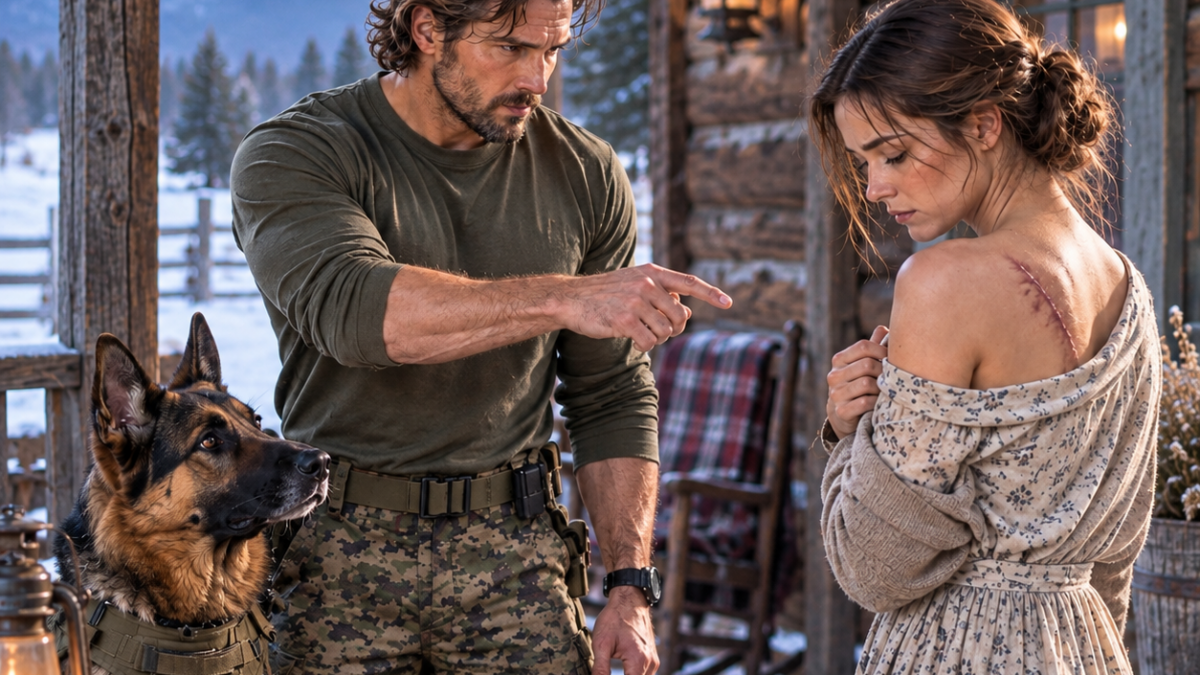
At one place, she lasted 9 months before a supervisor searched her name after a disagreement over payroll. At another, someone recognized her from an article reposted online. Neither employer fired her outright.
They simply became different, more watchful, less certain. People stopped leaving keys near her.
Conversations ended when she entered rooms. Eventually, she learned to leave before anyone had to ask. Red Willow was the sixth place in four years where she had believed the past might stay farther away than she could drive.
While Mara spoke, the radio remained on, soft, almost too low to hear. Ridge moved once, rose from the floor, and settled closer to the table without touching either of them.
Harlon said very little. The part of him that wanted details had gone quiet.
Mara reached for the scarf once during the telling and adjusted the fabric over her left shoulder. The gesture was small enough that she probably did not know she had done it.
When she finished, the carrots were still sitting half cut on the board. Outside, a truck door shut near the barn. Walt was on the porch.
He had come up carrying paperwork and stopped before entering when he heard voices. He had not meant to listen, but leaving would have made more noise than staying, so he stood there with his hat in his hands and heard enough.
Inside, Mara picked up the knife. She did not resume cutting.
I can be gone tonight. Harlon looked at her. There was no self-pity in the offer.
That was what made it land. Mara had made this arrangement before. Pack the suitcase.
Take the metal box. Leave before suspicion hardened into something uglier. She was already making the calculation.
Harlon could see it. Which stores would still be open? How far she could drive before dark?
Whether she had enough money for a motel, whether the next employer would search her name sooner. The same kind of contingency planning Harlon recognized in himself.
Only hers had been built around disappearing. He looked toward the kitchen window.
Walt’s shadow sat faintly against the porch glass.
For almost 3 months, Mara had been putting things in order at Red Willow. The pantry, the kitchen, a broken door, routines nobody had realized were broken. Now the ranch had reached the point where it would have to decide what kind of place it actually was.
Mara waited. Harlon did not answer yet. Mara waited beside the kitchen table with one hand resting near the knife she had set down.
Haron looked toward the porch once, then back at her.
You’re not leaving because of a headline.
She said nothing.
If facts change, I’ll deal with facts right now.
You still have a job here. That was all.
No speech about trust. No promise that he knew everything. No attempt to turn the decision into something noble.
Harlon had spent enough of his life around certainty to know when he did not have it. What he had was four months of watching Mara work.
The article Walt had sent and a story that fit more closely with what he had observed than the version Richard Talbot had given years earlier. For the moment, that was enough.
Outside, Walt remained on the porch until he realized the conversation was over. He came in carrying the paperwork he had forgotten he was holding. His face made it plain he was not comfortable.
Haron did not ask him to be.
“I don’t like it,” Walt said.
Harlon took the papers.
“You don’t have to.”
That ended the discussion. Mara returned to the carrots. Walt left.
The kitchen became quiet again, though not the same kind of quiet it had been before. Something had shifted between Mara and Haron.
Not trust exactly. Trust was too large a word for what had happened. Harlon had simply refused to let fear make the decision for him.
For Mara, that was unfamiliar enough. She had lived four years inside the expectation that once people learned about Ashdown house, everything afterward became temporary.
A room, a job, a friendship. Even the way someone said good morning. At Red Willow, the article had arrived and the roof had not fallen in.
The crew remained uneasy. So did she. But breakfast still needed making the next day.
that mattered more than it should have. The rest of July passed unevenly.
Some days were hot enough to drive the cattle toward shade before 10. Others brought sudden rain that darkened the roads and left the grass steaming when the sun returned. The hills never stayed one color long.
Green faded toward gold on the higher ground, then deepened again in the low places after a storm. Walt kept his distance from Mara without becoming cruel.
He stopped sitting at the kitchen table unless someone else was already there. He carried lunch from home more often. When Mara asked whether he wanted coffee, he always said yes and always took it outside.
Ry noticed but wisely kept his opinions to himself. Ridge behaved as though human suspicion were a problem outside his job description.
He continued appearing in the kitchen at the same times, sleeping near the same doorway, and bringing Mara his leash with the confidence of a dog who believed repetition could eventually turn preference into policy. Mara was grateful for that. Dogs did not search old newspapers.
They knew who filled the water bowl, who opened the back door, who spoke sharply and who did not. They lived in the day they were given. People had a harder time with that.
The rain that opened August came after dark. It struck the windows in hard bursts and washed dust from the porch boards in pale streams.
Lightning stayed mostly to the west, but the weather radio issued a warning for wind and possible hail. The crew had already gone. Haron was in the office checking cattle records while Mara reorganized a drawer in the kitchen that had collected 3 years of dead batteries, takeout menus, screws, rubber bands, and objects nobody had wanted badly enough to throw away.
Near the back, she found a thin folder. The label from a cancer center in Topeka was still visible on the front. Inside were appointment cards, notes written in two different hands, medication schedules, and a folded sheet listing questions for an oncologist.
Mara knew what it was before she read a name. She closed the folder.
Harlon was standing in the doorway. Neither spoke at first.
Mara held it out. I was cleaning the drawer. I know.
He took the folder, but did not put it away. The radio in the kitchen shifted from weather coverage into music.
An old song played low enough that the rain still filled most of the room. Harlon looked down at the stack of appointment cards. Catherine was diagnosed about 3 years before she died.
Mara waited. He sat at the table. This time he did not need to be asked.
When Harlon left the Navy, he had believed the difficult part of life was behind them. He had been away too often, missed holidays, arrived home tired enough to fall asleep in chairs, and learned to measure time with Catherine in departures and returns.
Red Willow was supposed to end that. For a while, it did. Then Catherine got sick.
The diagnosis was aggressive. Treatment began quickly. Haron responded the way training had taught him to respond to uncertainty.
He built structure around it. Appointments went on calendars in two places.
Medication times were written down. He researched treatment options until the words began to sound like another language.
The truck never dropped below half a tank. An overnight bag stayed packed by the mudroom. If weather threatened the main route to Topeka, Harlon already knew the second one.
Then the third, he kept lists of questions for doctors because he had learned long ago that people forgot important things when they were tired or afraid. Some of that helped.
It made bad days less chaotic. It ensured Catherine never missed what could be done.
What it could not do was change the part that mattered most. The disease continued. Harlon had lived most of his adult life believing preparation changed outcomes.
Often it did. With Catherine, preparation changed only the quality of the time they had left. It let him be there.
It did not let him keep her. He did not explain this dramatically.
He simply turned one of the appointment cards over between his fingers.
When she got worse, I kept thinking I’d miss something.
Mara looked at him.
Harlon’s mouth tightened faintly.
There was always supposed to be another option. Rain pressed against the windows.
Mara did not tell him that grief was not his fault. She did not tell him Catherine would want him to move on.
People often said those things because silence frightened them. Instead, she folded the kitchen towel in front of her.
“There isn’t always another option,” Harlon nodded.
He understood the sentence differently than most people would. After Catherine died, he made Red willow easier to control. Fell, schedules, gate checks, tool placement, radio charging, emergency supplies.
Those things responded to attention. Loss did not.
The ranch became orderly enough that very little surprised him. The house became quiet enough that nothing reminded him how little control he had ever really possessed.
Mara did not say that either. She did not need to. The radio played through another song.
When the rain softened, Harlon returned the folder to the drawer. He did not push it as far toward the back this time.
The weeks after that conversation contained nothing large enough to mark on a calendar. That was why they mattered.
Mara tightened Red Willow’s supply system without turning it into an office.
She combined feed store and household runs when the roots made sense. She stopped buying pantry items simply because nobody remembered whether they were already there.
Cleaning products were ordered before they ran out instead of after. Freezer shelves were labeled by month. Leftovers became lunches instead of trash.

