He Grabbed the Quiet Nurse — Then Her Hidden Rank Silenced the Entire Chow Hall – Part 5
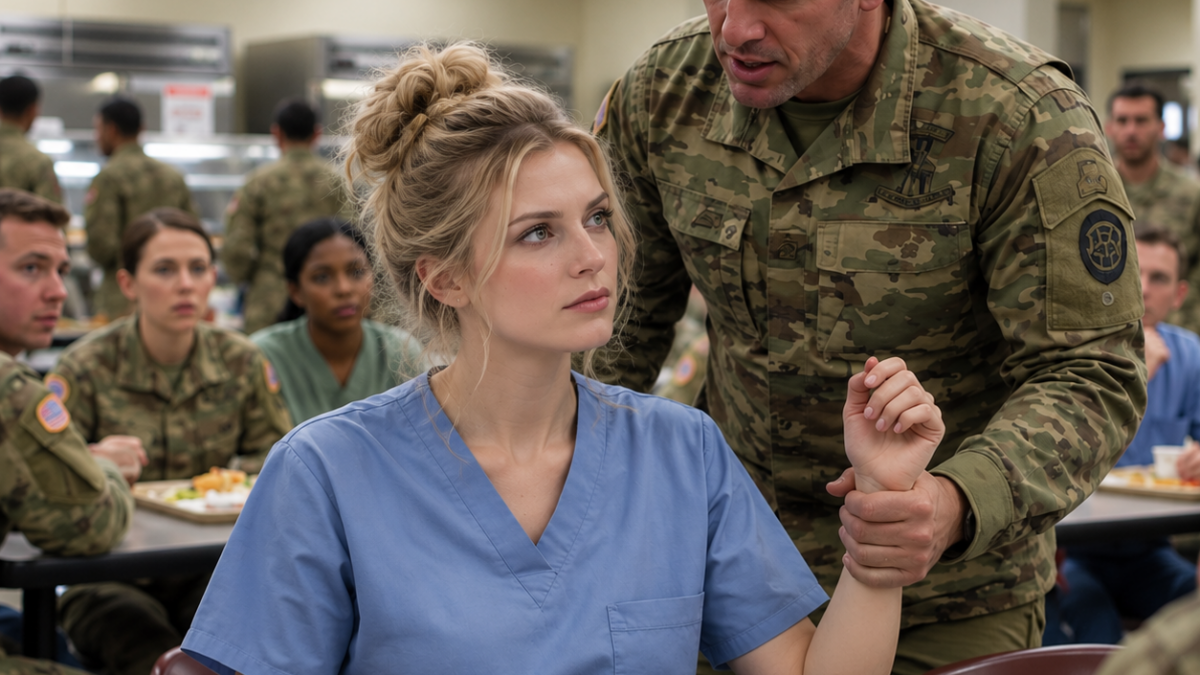
Mercer held her gaze. Did your prior rank make his conduct more serious?
No, ma’am.
Did it make the incident more visible?
Yes, ma’am.
Explain the difference. Nora breathed once. The conduct was wrong before anyone knew my record.
The record only made it harder for people to dismiss me as someone without standing. Mercer nodded, not approving, only marking the distinction. They moved to the code red.
Nora described the ambulances, the burn patient, Sergeant Pierce’s falling pressure, the young medic freezing at the side of an open fracture.
She described it because it had happened in the same morning, because Ethan had watched from above, because the complaint paper in his hand had disappeared only after he saw the work he had interrupted. Then, Mercer asked about Carolyn Briggs. Nora gave only the facts.
Mara found the contact. Nora called because the review was facing delay.
Carolyn consented. Carolyn sent her statement.
Nora forwarded it to the designated intake address. Then, Nora stopped.
Mercer’s eyes lifted slightly.
You stopped because my office instructed you to.
Yes, ma’am.
And before that instruction, I acted to preserve testimony under time pressure.
Do you believe you influenced the content of Nurse Briggs’ statement?
No, ma’am.
Did you advise her what to say? No. I told her to include dates, location, exact conduct, exact words if she had them, witnesses, and what happened after she filed.
That is structure.
Yes, ma’am.
Not content.
No, ma’am.
Mercer looked down at the folder.
Nurse Briggs’ statement has been independently verified in relevant portions.
Nora did not react, but something in her chest moved. Then came Hannah Keen. Nora spoke carefully.
Caroline gave the name. Nora requested permission before calling. Hannah confirmed consent.
Hannah described Port Haven, the storage room, Roark blocking the doorway, Captain Owen Slater’s warning about contract renewal.
Mercer listened without interruption. At the end, she closed the folder. That is all for now.
Nora’s hands remained folded on the table.
Ma’am?
Yes. Will they be protected? Mercer did not ask who.
Briggs and Keen have both been placed under witness protection protocols for retaliation monitoring. Their current employers have been notified only to the extent required and without unnecessary detail.
Any adverse personnel action connected to their cooperation will trigger review. Nora nodded. Mercer leaned back.
You are not responsible for them now. Nora almost smiled.
I was told that. By people who know you.
Yes, ma’am.
Mercer stood. The room stood with her.
Nurse Whitcomb, you may return to duty after medical rest clearance. Not before.
Nora blinked. I am scheduled tonight. No.
Ma’am, Ward C is short.
Ward C will survive a night without you.
Mercer’s face did not change.
If a trauma nurse collapses from exhaustion during an inquiry about the safety of medical staff, I will find the irony unacceptable. Nora had no useful answer.
Yes, ma’am.
When she stepped into the hallway, Mara was waiting with two coffees, neither touched. How bad? Nora took one.
Cold room, warm questions. That means it means she knew where to cut. Mara nodded toward the elevator.
Medical rest clearance. Nora stared at her.
How did you know General Mercer called the ward before you came out? Of course, she did. She scares me.
She should. Mara handed Nora her jacket.
Go home before I enjoy enforcing orders. Nora went home.
For once, she slept before sunset. The findings came 6 days later. Not all at once.
Not as a dramatic announcement in a room full of silent witnesses. They arrived the way official consequences often arrived in controlled documents, secure messages, closed briefings, signatures, and language carefully shaped to survive appeal.
Ethan Roark was removed from the Fort Whittaker medical rotation. A formal reprimand entered his permanent record.
His promotion eligibility was delayed. He was barred from medical liaison duties and supervisory training environments for 2 years.
He was ordered into a command accountability program with quarterly evaluation. Nora read that section twice. It was not the punishment some people wanted.
It was not nothing. Mara stood beside her at the nurses station arms folded. He keeps his rank.
For now.
Mara’s mouth tightened.
He grabbed three nurses across three facilities and the inquiry says the conduct escalated because prior interventions failed. That is a very official way to say people let him keep doing it.
Yes. Nora turned the page.
Miles Varic was removed from liaison duties and referred for ethics review. His unauthorized entry into the Fort Whittaker review suite was documented. His access to scheduling information was found improper.
His claim of courtesy advisory status was rejected.
Captain Owen Slater’s section was longer.
Slater had discouraged Hannah Keen from filing a complaint by tying the complaint to contract risk.
He later supervised the administrative closeout of Caroline Briggs’s Redstone report where witness statements were not attached and the matter was marked resolved without complainant agreement.
He had communicated with Varic before the Fort Whittaker review and failed to disclose prior involvement. Slater was relieved of administrative duties pending disciplinary action.
Mara read over Nora’s shoulder.
That one sounds like blood in the water. Nora kept reading. A separate systemic finding identified failure points in civilian medical staff complaint handling.
Reports involving military personnel had been too easily routed through command channels connected to the subject. Contract nurses lacked protection from implied retaliation. Witness preservation was inconsistent.
Cross facility name flags existed, but were not required to trigger independent review. Mara exhaled slowly. They put it in writing.
Yes. The words looked plain on the screen, but plain words could still change doors.
Two days later, Fort Whittaker issued new protocol. Civilian staff reports involving unwanted physical contact would bypass local command filtering.
Witness statements had to be preserved within 24 hours. Repeat name flags triggered mandatory outside review.
Contract medical personnel received retaliation monitoring. Staff safety records could no longer be closed without complainant notification and documented response.
Mara printed the protocol and pinned it to the nurse’s station board.
She did not announce it. She did not make a speech. She used four pushpins and pressed each one into the cork board with unnecessary force.
Lilly Carter rolled up in a wheelchair during afternoon physical therapy, leg braced, hair braided badly this time, probably by herself. She read the paper. This is because of the cafeteria thing.
Nora checked the wheelchair brake. This is because multiple people wrote things down.
Lilly looked at her. You always dodge credit like it owes you money.
Credit causes paperwork. Everything causes paperwork here.
That is true. Lilly read the first paragraph again. So, if someone grabs a nurse now, it goes somewhere else.
It goes to people who are not allowed to make it disappear quietly. Lilly sat with that. Good.
Nora looked at the board at Mara’s pushpins, at the printed lines that had come from red marks, old notes, failed scans, closed rooms, and women who had been told to be careful.
“Yes,” she said.
“Good.”
Caroline Briggs visited Fort Whittaker 3 weeks later. She came on a Thursday afternoon wearing a navy coat and carrying a canvas bag full of documents she no longer needed to carry, but had brought anyway.
Nora met her in a small conference room near the chapel. Caroline was in her early 50s with silver at her temples and the posture of someone who had spent years standing beside beds. She did not look fragile.
Nora was glad. Fragile was a word people used when they wanted to stop listening to anger. For a moment, neither woman spoke.
Then Caroline set her bag on the table.
“You are taller than I thought.”
Nora looked at her.
“You are angrier than you sounded.”
Caroline laughed once, surprised by it.
“Good.”
They sat. Hannah Keane joined by video from Oregon. She had a blanket around her shoulders and a dog moving in and out of frame.
Rebecca Sloan, the fourth nurse who had come forward after the inquiry opened, sat beside Caroline, hands wrapped around a paper cup. Mara entered last with coffee and a file box.
“No speeches,” she said.
Caroline looked at the box.
“What is that?
Copies? Receipts?
Confirmation pages? Protocol update?
Things people used to lose.”
Mara placed it in the center of the table.
Hannah’s face on the screen went still.
“I have my notebook.”
“You keep it.”
Mara said.
“This box is not replacing what you carried.
It is proving you are not the only one carrying it.”
Caroline opened her canvas bag and removed a folder. The edges were soft from handling.
My original Redstone copy. She placed it in the box. Rebecca added printed emails.
Hannah held up a scanned copy of her first notebook page on the screen. Nora had already placed a certified print inside the folder. Nora took the new Fort Whittaker protocol from her own folder and laid it on top.
Mara pulled a small white label from her pocket. She had written on it in black marker.
The record exists. It goes nowhere.
She stuck it inside the lid. No one spoke for a while. Outside the conference room, a chaplain passed with a cart of donated books.
Somewhere overhead, the paging system called for transport to radiology. The hospital kept being a hospital, which meant pain and repair kept sharing the same hallways.
Caroline touched the edge of the box. I thought I wanted someone to say they were sorry.
Nora looked at her. Do you still?
Yes.
Caroline’s fingers pressed down.
But this is better than sorry. Hannah nodded on the screen. Sorry ends when the person saying it feels finished.
Rebecca looked at the label. This stays.
Mara closed the lid. It stays. Ethan Roark returned to Fort Whittaker once 2 months later for a required accountability review.
Nora saw him in the courtyard before he saw her. The afternoon was cold and clear.
The small trees near the entrance had lost most of their leaves. Patients in jackets moved slowly along the walking path with therapists at their elbows. Ethan stood near the stone bench by the flagpole, cap in hand, uniform perfect as ever.
But the easy ownership of space had left him. He did not look smaller.
He looked less certain that being large gave him the right to fill a room. He noticed Nora and straightened.
She could have kept walking. She stopped.
Specialist Rourke. Nurse Whitcomb. His voice carried no challenge now.
For a few seconds the courtyard moved around them. A wheelchair rolled across the pavement. Someone laughed near the entrance.
The flag snapped once in the wind. I started the accountability program, he said. Nora waited.
They asked us to write about the first time we used rank to end a conversation instead of improve one. He looked down at his cap.
I had more examples than I wanted. Nora did not rescue him from that.
He looked back up. I am not asking you to forgive me.
Good. That seemed to steady him more than kindness would have.
I wrote letters to Briggs and Keene. The program instructor said they may never read them.
That is their choice. It is. I keep thinking about what you said.
That you should not have to become impressive to be treated like a person. Nora looked toward the hospital doors. And and I think I understood it for about 5 minutes when you said it.
Then I spent weeks realizing I still wanted credit for understanding it. That was the first honest thing he had said to her without trying to stand on it.
Nora looked at him then. Change is not what you understand in a room where consequences are watching.
He nodded slowly. It is what you do after.
Yes. A gust moved across the courtyard.
Ethan put his cap back on. I am sorry. Nora heard the words.
She did not pick them up. Goodbye, specialist.
She walked past him into the hospital. Behind her, Ethan stayed where he was.
Months passed. Fort Whittaker did what institutions do after being forced to look at themselves. Some people changed.
Some people learned new language for old avoidance. Some people left. Some stayed and became careful in ways that were useful.
A few became resentful, which also revealed information. The new protocol call was tested sooner than anyone wanted. A civilian physical therapist reported that a senior enlisted patient had cornered her in a treatment room after she refused to clear him early for duty.
No one touched her, but he blocked the door and told her she did not understand how careers worked. The report entered the system at 3:12 p.
m. At 3:18, staff safety acknowledged receipt.
At 3:26, the witness preservation notice went out. At 3:41, the report copied to the independent oversight office. At 4:05, the therapist received written confirmation that retaliation monitoring had been activated.
At 4:22, Mara walked to the board, looked at the protocol, and tapped the paper once with two fingers. Nora stood beside her. It moved.
Mara said. Nora looked at the confirmation receipt on the screen.
Yes. No one celebrated.
There was work to do. Room C7 had a new patient now. Lilly Carter had been discharged weeks earlier and had sent one postcard from physical therapy in Texas.
On the back, she had written, “Still hate pudding.
Still keeping my pillow where you put it.”
Nora kept it in her locker. That evening, she went to the cafeteria for coffee. The room was busy.
A surgeon argued with a vending machine. Two orderlies shared fries. A young nurse laughed into her phone near the windows.
The coffee station had a full stack of cups. Nora picked one, poured, two sugars, no cream. A man in uniform stepped up behind her, stopped at a respectful distance, and waited.
Nora placed the lid on her cup. The click was small, ordinary. She moved aside.
“Thanks, ma’am.”
He said. Nora nodded and walked toward the exit.
Her coffee was hot. Her wrist did not ache.
Behind her, the cafeteria kept talking.








