“You’re making a mistake.” / “Maybe. But it’s mine to make.
“The paper was taped to my door with packing tape. Not painter’s tape. Not even masking tape. Cheap, brown packing tape, the kind you use to seal boxes, pressed across all four edges of a folded sheet of legal paper like whoever did it wanted to make sure the wind couldn’t take it.”
They thought a disabled veteran on crutches would just pack up and leave → They learned he was a former Green Beret with a network of thousands.
It cited “lease violation” as the cause. It didn’t specify what violation. It was signed by a property management company I’d never heard of — Copperline Property Solutions, LLC — and it listed a phone number with a 512 area code, which was Austin, which was ninety minutes north of the small town where I’d lived for the past six years.
I read it three times. Then I folded it along the original creases and put it in the pocket of my jacket, the one I wore when I walked to the mailbox even though there was nothing in the mailbox worth walking to.
My name is Jacob Mercer. I’m fifty-four years old. I spent twenty-two years in the United States Army, the last fourteen of them in 7th Special Forces Group, which means when people ask what I did, I usually say “I was in the Army” and leave it there, because the rest of it — the deployments, the teams, the men — isn’t something you hand out to strangers at a gas station or a church potluck. I retired as a master sergeant in 2017. My body came home with a list of problems that I won’t bore you with, except to say that the foot was the newest entry and the traumatic brain injury was the oldest, and between them they made some days harder than others.
What the landlord didn’t know — what nobody in that town knew, because I’d never told them — was that the quiet man with the limp who rented the small house on Cypress Street had spent the better part of two decades doing things that people write books about and get the details wrong. That he had friends in places that mattered. That one of those friends had a son who was now a senior partner at the largest veteran legal advocacy firm in the state of Texas.
But I’m getting ahead of myself.
The day I got the notice, I called the number on it. A woman answered. She said her name was Brenda and she sounded like she was reading from a script.
“Copperline Property Solutions, how can I help you?”
“My name is Jacob Mercer. I rent the house at 412 Cypress Street. I found a notice on my door this morning.”
“One moment.”
I waited. The phone clicked. A man came on the line.
“Mr. Mercer. This is Dale Whitcomb. I’m the property manager.”
“Mr. Whitcomb, I’ve lived in that house for six years. I’ve paid rent on time every month. I have receipts. What violation are you talking about?”
“The owner has decided not to renew.”
“The notice says lease violation. Not non-renewal. Those are different things.”
A pause. Short. Dismissive.
“The owner has decided not to renew,” he said again, slower, like I was hard of hearing.
“I have a lease through August. That’s four months from now.”
“The owner is exercising his right to terminate due to the condition of the property.”
“What condition?”
“Deferred maintenance. The property has fallen into disrepair.”
I looked around my living room. Clean. Neat. The floors swept. The windows washed. The yard, when I could stand long enough to mow it, was mowed. I’d fixed the leaky faucet in the bathroom myself. I’d patched the screen door. I’d planted tomatoes in the side yard three springs running.
“I’ve maintained the property,” I said. “I can show you photos.”
“The owner’s decision is final.”
“Who is the owner?”
Another pause. Longer this time.
“Copperline Property Solutions represents the owner.”
“Who is the owner?”
“I’m not at liberty to disclose that.”
“That’s not how leases work, Mr. Whitcomb. I have a right to know who I’m paying.”
“You pay Copperline. That’s all you need to know.”
The line went dead.
I stood in my kitchen for a long time after that, the phone still in my hand, the crutches digging into my armpits. My foot throbbed. I’d forgotten to take the pain pill that morning. I set the phone down on the counter and looked out the window at the empty street, the oak tree in the front yard, the neighbor’s cat walking along the fence line.
Then I did what I’ve done my whole life when something doesn’t add up.
I started paying attention.
The first thing I noticed was that I wasn’t the only one.
I went to the mailbox that afternoon and ran into Rosa Delgado, who lived three houses down. She was in her seventies, a widow, her husband had been a Marine in Vietnam, and she’d lived in her house for thirty-one years. She was standing at her mailbox with a piece of paper in her hand, and when she saw me, her face did something I recognized. The tightness around the eyes. The way she held the paper like it might bite her.
“They gave you one too?” I asked.
She nodded. Her hands were shaking.
“Thirty days,” she said. “They say I have thirty days. I’ve been here thirty-one years. My husband planted that tree in the front yard the week we moved in. He’s buried at Fort Sam. I can’t—”
She stopped. Pressed the paper against her chest.
“What’s the reason?” I asked.
“Code violation. They say my roof is bad. But I had a man look at my roof last year. He said it was fine for another ten years.”
I walked over to her. Slowly, because of the foot.
“Mrs. Delgado, can I see that notice?”
She handed it to me. Same format. Same font. Same legal paper, folded the same way. Different property management company — this one called Lone Star Asset Group — but the phone number had the same 512 area code. Same Austin exchange.
“Have you called them?”
“I called. They said the same thing. The owner decided. They wouldn’t tell me who the owner was.”
I handed the paper back to her.
“How many other people on this street got one of these?”
She looked at me. Something shifted in her face.
“Mr. Mercer,” she said quietly, “I think you should come with me.”
We walked the block together. Slowly, because of me. Mrs. Delgado carried a cane and I had my crutches and between the two of us we made a pretty sorry picture, but we made it to every house.
By the end of the afternoon, I had a list of nine.
Nine households on Cypress Street and the two streets that ran parallel to it, all with the same notice format, all signed by different property management companies, all with the same Austin phone exchange, all giving thirty days to vacate, all citing vague “violations” that the tenants had never heard of before.
Seven of the nine were veterans. Six of them were disabled. Four of them lived on fixed incomes. Two of them, like me, had service-connected injuries that made it hard to move, hard to pack, hard to find a new place on short notice.
Mrs. Delgado was the only one who wasn’t a veteran. She was the widow of one.
I sat at my kitchen table that night with the list in front of me and a cold cup of coffee going colder. My foot was propped on a chair. The pain pill had finally kicked in but it made my thoughts slow, so I wrote everything down on a legal pad, in pencil, the way I’d been taught to write after action reports. Facts in one column. Questions in another.
Facts: Nine households. Same notice format. Different management companies. Same phone exchange. All veterans or veteran-adjacent. All given thirty days. All low-income. All with some kind of disability or fixed income.
Questions: Who owned the properties? Why now? Why these houses? What was the endgame?
I didn’t have answers. But I knew someone who might.
I picked up my phone and scrolled through my contacts until I found a name I hadn’t called in almost two years. A man I’d served with in 7th Group, back in the day, who’d gotten out after a knee replacement and gone to law school on the GI Bill and now ran a small practice in San Antonio. He wasn’t the friend with the son at the big firm. He was someone better. Someone who owed me a favor.
His name was Marcus Webb.
I hit call.
He answered on the second ring.
“Jake Mercer. Tell me you’re not dying.”
“I’m not dying.”
“Then why are you calling me at ten o’clock on a Tuesday?”
I told him. It took fifteen minutes. When I finished, there was a long silence on the other end of the line.
“You’re telling me nine veterans on the same block all got eviction notices from different management companies with the same phone number.”
“Yes.”
“And none of them can get the owner’s name.”
“Correct.”
“And the notices all cite vague violations that don’t hold up.”
“That’s right.”
Marcus exhaled slowly.
“Jake, that’s not an eviction. That’s a land grab.”
“What do you mean?”
“I mean somebody’s trying to clear those properties. Buy low, sell high. Scare the tenants out with bogus legal threats, then swoop in and offer to buy the houses from the owners at a discount before the properties sit empty. It’s a classic play. But targeting veterans specifically—”
He stopped.
“Targeting disabled veterans,” he said quietly. “On fixed incomes. People who can’t afford to fight back. People who’ll just pack up and leave.”
“That’s what I thought.”
“You’ve got the list?”
“I’ve got the list.”
“Send it to me. I’ll make some calls. I know a guy at the Texas Veterans Commission. And Jake—”
“Yeah.”
“Don’t sign anything. Don’t agree to anything. Don’t talk to the management companies again until I tell you to.”
“I won’t.”
“And Jake?”
“Yeah.”
“You still know how to keep your mouth shut and your eyes open?”
I almost smiled.
“I’ve been doing it my whole life, Marcus.”
“Good. Keep doing it. I’ll call you back.”
He hung up.
I sat at the kitchen table for a while longer. The house was quiet. The clock on the wall ticked. Outside, the streetlight flickered, then steadied.
I thought about the nine houses. The nine families. The trees planted thirty years ago. The husbands buried at Fort Sam. The service-connected injuries. The fixed incomes. The fear in Mrs. Delgado’s eyes.
I thought about the fact that someone had looked at this neighborhood and seen not people, but inventory. Not homes, but assets. Not veterans, but obstacles to be cleared.
I thought about what I’d been trained to do when I saw an enemy setting up an ambush.
You don’t run. You don’t charge. You get quiet. You get low. You call for backup. And then you wait for the right moment.
I stood up, slowly, balancing on my good foot. I put the legal pad in a drawer. I checked the locks on the doors. I turned off the lights.
The last thing I did before I went to bed was take the eviction notice out of my jacket pocket and read it one more time.
Copperline Property Solutions, LLC.
I didn’t know who they were. But I was going to find out.
The next morning, I got a phone call from a number I didn’t recognize.
I almost didn’t answer. Old habit. But something made me pick up.
“Mercer.”
“Mr. Mercer, my name is Elena Vasquez. I’m an attorney with the Veteran Defenders Legal Fund. Marcus Webb sent me your information.”
“I know Marcus.”
“He said you might need some help.”
“I might.”
“Can you come to San Antonio? Tomorrow? I’d like to sit down with you and go over what you’ve found.”
“I can do that.”
“Good. Bring everything you have. The notices. The list. Names. Addresses. Anything you’ve written down.”
“I’ll be there.”
“One more thing, Mr. Mercer.”
“What’s that?”
“Marcus told me a little about your background. He said you were with 7th Group.”
“That’s right.”
“He said you were a team sergeant.”
“I was.”
“He said you had a reputation for being very good at what you did.”
I didn’t say anything.
“I’m not asking about your service record,” she said. “I’m asking if you still know how to stay calm when people are trying to push you around.”
“I’ve had some practice.”
“Good. Because whoever’s behind this, they’re not going to like what we do next. And they’re going to try to make it personal.”
“It’s already personal.”
I heard her smile through the phone.
“That’s what Marcus said you’d say.”
She gave me the address. I wrote it down on the back of an envelope. Then I hung up and stood in my kitchen and looked at the eviction notice one more time, still pinned to the fridge with a magnet I’d bought at the Alamo gift shop six years ago.
Thirty days to vacate.
I had thirty days.
That was more than enough.
PART 2 — THE FIRM
The Veteran Defenders Legal Fund occupied the fourth floor of a brick building on Broadway, just north of downtown San Antonio. The elevator was slow and smelled like carpet cleaner. The hallway was narrow. The door had a brass plaque that said VDLF in letters you had to squint to read.
Elena Vasquez met me at the reception desk. She was younger than I expected — maybe late thirties — with dark hair pulled back and a no-nonsense way of moving that reminded me of the best intel officers I’d ever worked with. She didn’t waste time on small talk.
“You brought everything?”
I held up the folder.
“Conference room’s this way.”
She led me down a hall lined with framed photographs of veterans — old ones, young ones, men and women in every branch, every era. At the end of the hall was a conference room with a long table, a whiteboard, and windows that looked out over the highway.
Three other people were already seated.
“This is Tom Bradley,” Elena said. “He’s our lead investigator. Former Army CID.”
Bradley was a big man with a shaved head and a handshake like a vise.
“This is Priya Raman. She’s our research director.”
Priya was small and sharp-eyed, with a laptop open in front of her and three phones arranged in a neat row.
“And this is Danny Okafor. He’s our community outreach coordinator. He’s the one who first started hearing about these notices.”
Danny was younger, maybe thirty, with a prosthetic right hand that he didn’t try to hide. He nodded at me.
“Mr. Mercer.”
“Jake.”
“Jake. Good to meet you. I wish it were under better circumstances.”
I sat down. Put the folder on the table. Elena opened it and spread the contents out: the nine notices, my legal pad with the list, the photographs I’d taken of the houses, the notes I’d made about the phone numbers.
For the next hour, we went through everything.
Priya typed while we talked, her fingers moving fast over the keyboard, cross-referencing addresses, phone numbers, property records, corporate registrations. Tom asked questions about the management companies, the notices, the dates. Danny listened, occasionally adding a detail about another veteran he’d heard from in a different part of the city.
By the end of the hour, a picture was starting to form.
“Okay,” Priya said, turning her laptop so we could see the screen. “Here’s what I’ve got so far. The nine properties on your list — and I’ve found four more in other parts of Bexar County — are all owned by a network of LLCs. Copperline, Lone Star Asset Group, Alamo Ridge Holdings, Hill Country Property Partners. Different names, same registered agent.”
“Who’s the registered agent?” Tom asked.
“A law firm in Austin. Brenner and Associates. They specialize in commercial real estate and asset management.”
“Who owns the LLCs?”
“That’s where it gets interesting.” Priya clicked through a few screens. “The LLCs are owned by other LLCs. Shell companies. The trail dead-ends in Delaware and Nevada. But I found one common thread.”
She highlighted a name on the screen.
“Randall Kessler.”
Elena leaned forward. “Who’s that?”
“A developer. Based in Austin. He’s been buying up distressed properties in Central Texas for the past decade. Low-income housing, mobile home parks, small apartment complexes. His pattern is always the same. Buy low, clear the tenants, renovate, sell high.”
“Clear the tenants how?”
Priya looked at me.
“Usually through legal pressure. Frivolous eviction notices. Code violation complaints. Anything to make the tenants leave without a fight. But lately—”
She clicked to another screen.
“Lately he’s been targeting veterans. Specifically, disabled veterans. I’ve found at least twenty cases in the past three years where his companies have acquired properties occupied by veterans with service-connected disabilities. In every case, the tenants received eviction notices citing vague violations. Most of them left. A few tried to fight. None of them got far.”
“Why veterans?” Danny asked.
“Because we’re easy targets,” I said.
Everyone looked at me.
“Disabled veterans on fixed incomes,” I said. “We’re less likely to have lawyers. Less likely to have resources. More likely to have health problems that make moving difficult. More likely to be isolated. And if we’re getting VA disability, we’ve got a steady income stream that makes us look like reliable tenants on paper — until someone decides they want the property for something else.”
Elena nodded slowly.
“That’s what we’ve been seeing,” she said. “A pattern of predatory behavior targeting a vulnerable population. But it’s been hard to prove. The shell companies make it almost impossible to trace back to Kessler. And the tenants who leave don’t usually file complaints. They just—”
“Disappear,” I said.
“Yes.”
I looked at the whiteboard. Someone had written KESSLER in the middle and drawn lines out to the different LLCs, the management companies, the properties. It looked like a spiderweb.
“So what do we do?” I asked.
Elena met my eyes.
“We build a case. We document everything. We find every veteran who’s been targeted. And then we take it to the attorney general’s office.”
“The AG?”
“Consumer protection division. Predatory real estate practices fall under their jurisdiction. But they need evidence. They need victims who are willing to come forward. They need a pattern that’s documented and undeniable.”
I thought about Mrs. Delgado. The fear in her eyes. The thirty-one years in her house. The tree her husband planted.
“How long will that take?”
“Months. Maybe longer.”
“I have thirty days.”
Elena nodded.
“I know. That’s why we’re going to file for an emergency injunction. Tom’s already working on it. We can argue that the eviction notices are retaliatory and fraudulent. We can ask for a temporary restraining order to stop the evictions while we build the case.”
“Will that work?”
“It might. But it depends on the judge. And it depends on how much pressure Kessler’s willing to apply.”
I looked at the folder on the table. The nine notices. The nine families.
“He’s not going to like it.”
“No,” Elena said. “He’s not.”
I stayed in San Antonio that night. Danny Okafor offered me a couch at his place, but I didn’t want to put him out, so I checked into a Motel 6 near the airport. The room was small and smelled like bleach, but it was clean and quiet and the bed was soft enough.
I lay awake for a long time, staring at the ceiling.
I thought about Randall Kessler. A developer in Austin. A man who’d figured out that veterans were easy prey. A man who’d built a business on the backs of people like Mrs. Delgado and the other families on Cypress Street.
I thought about the fact that I’d spent twenty-two years in the Army, fourteen of them in Special Forces, and the thing that had finally gotten me evicted wasn’t a combat injury or a failed mission or an enemy I could see. It was paperwork. A legal notice taped to my door. A faceless company in a city I’d never lived in.
I thought about what Marcus had said. “That’s not an eviction. That’s a land grab.”
I thought about the other veterans. The nine on my list. The four Priya had found. The twenty from the past three years. Every one of them a person. Every one of them with a story.
I thought about the fact that I’d been trained to handle ambushes. To stay calm. To assess the situation. To find the enemy’s weakness. To wait for the right moment.
This was no different.
I got up early the next morning. Took a shower. Dressed in jeans and a button-down shirt. Checked out of the motel and drove back to the VDLF office.
Elena was already there. So was Tom.
“We filed the injunction this morning,” she said. “The judge is going to hear it in two weeks.”
“Two weeks.”
“It’s the fastest we could get.”
I nodded. Two weeks was tight. But it was something.
“In the meantime,” Tom said, “I want to start canvassing. Find every veteran in those properties. Get their statements. Build the record.”
“I can help with that,” I said.
Tom looked at me. “You’re on crutches.”
“I can still knock on doors.”
He smiled. “Fair enough.”
We spent the rest of the day dividing up the list. Tom took the properties in Bexar County. I took the ones on Cypress Street and the surrounding blocks — the ones I knew. Danny would handle outreach to veteran service organizations. Priya would keep digging into Kessler’s corporate structure.
By the time I left the office that afternoon, I had a stack of blank affidavit forms and a list of names. Nine households. Forty-two people, including children. I knew some of them. I’d nodded at them at the mailbox. I’d seen them at the grocery store. I’d waved at them from my porch.
I didn’t know their stories. I was about to learn.
The first person I talked to was Mrs. Delgado.
She invited me in for coffee. Her house was small and warm and filled with photographs — her husband in his Marine uniform, their children at various ages, grandchildren, great-grandchildren. A flag folded into a triangle sat on the mantel above the fireplace. The tree her husband had planted was visible through the front window, its branches bare in the late winter light.
“I don’t know what to do,” she said. “I’ve lived here thirty-one years. I don’t have anywhere else to go.”
“You have rights,” I said. “The notice they gave you is probably illegal.”
“Probably?”
“Almost certainly. But we need to prove it.”
I explained what the VDLF was doing. The injunction. The investigation. The case they were building. She listened carefully, her hands wrapped around her coffee cup.
“What do you need from me?” she asked.
“Your story. In writing. Everything you can remember about the notice, the phone calls, the people you talked to.”
“I can do that.”
“And Mrs. Delgado—”
“Yes?”
“Don’t leave. Whatever they tell you, whatever they threaten, don’t leave. Not yet.”
She looked at me for a long moment. Then she nodded.
“I’ve been through worse,” she said. “My husband was in Vietnam. I waited for him for two years. I can wait a little longer.”
I finished my coffee. Stood up. Thanked her.
“Mr. Mercer?”
I turned.
“You were in the Army too, weren’t you?”
“Yes, ma’am.”
“What did you do?”
I hesitated. Then I said, “I was in Special Forces.”
Her eyes widened. Just a little.
“My husband’s cousin was in Special Forces,” she said. “He never talked about it either.”
“No, ma’am. We usually don’t.”
She nodded slowly.
“I thought so,” she said. “You have that look.”
“What look?”
“The look of someone who’s been through things they don’t talk about.”
I didn’t know what to say to that. So I just nodded and walked out.
Over the next two weeks, I knocked on every door on my list. I talked to veterans in their seventies and eighties. I talked to widows and single mothers and a man in a wheelchair who’d lost both legs in Afghanistan. I talked to a woman whose son was deployed and who was terrified she’d lose the house before he came home. I talked to a man who’d been homeless for three years before he found his little apartment and who was now facing the street again.
Every one of them had a story. Every one of them had received the same kind of notice. Every one of them had called the number and gotten the same runaround. Every one of them was scared.
I collected affidavits. I took photographs. I wrote everything down on my legal pad, in pencil, the way I’d been trained.
Tom did the same in other parts of the county. By the end of the two weeks, we had statements from forty-seven veterans and their families. We had documentation of sixty-three eviction notices. We had a pattern that was impossible to ignore.
And we had a court date.
The morning of the hearing, I woke up at 4:30. Old habit. I lay in bed for a few minutes, listening to the house settle around me, then got up and made coffee and sat at the kitchen table with the eviction notice still pinned to the fridge.
I thought about Randall Kessler. I’d never met him. I’d never seen his face. But I knew him. I knew the type. A man who saw people as obstacles. A man who measured value in dollars and cents. A man who would never understand why someone like me would fight for a house I rented, for neighbors I barely knew, for a principle that couldn’t be quantified.
I finished my coffee. Got dressed. Picked up my crutches.
The hearing was at 9:00.
PART 3 — THE HEARING
The courtroom was on the fourth floor of the Bexar County Courthouse, a big stone building downtown with high ceilings and marble floors and echoes that made every footstep sound like a gunshot. I’d been in courtrooms before — once as a witness in a court-martial, once for a traffic ticket — but this was different. This time I was one of the plaintiffs. This time I was asking a judge to stop something from happening.
Elena met me outside the courtroom doors. She was dressed in a dark suit, her hair pulled back, a folder in one hand and a legal pad in the other.
“You ready?” she asked.
“Ready.”
“Good. We’re in Judge Ramirez’s court. She’s known for being tough but fair. She doesn’t like games. She doesn’t like lawyers who waste her time. And she doesn’t like bullies.”
“Sounds promising.”
“It is. But Kessler’s lawyers are here. They’ve filed a motion to dismiss.”
“On what grounds?”
“That the eviction notices are a private landlord-tenant matter and not subject to the AG’s jurisdiction. That we’re wasting the court’s time.”
“What do you think the judge will do?”
Elena smiled.
“I think she’s going to want to hear the evidence.”
We walked in together.
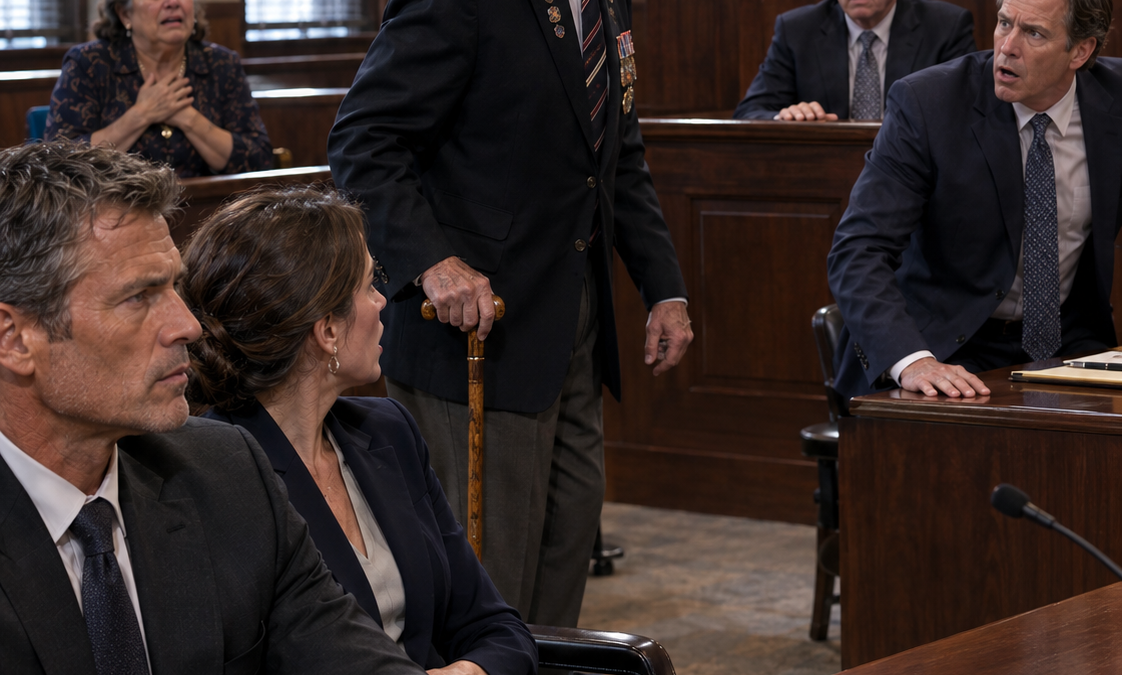
The courtroom was smaller than I expected. A raised bench at the front, where Judge Ramirez sat in black robes, her reading glasses perched on her nose. Two tables facing the bench — one for us, one for Kessler’s lawyers. A few rows of benches for observers, most of them empty except for the back row, where a handful of veterans from Cypress Street had gathered. Mrs. Delgado was there. Danny Okafor was there. Tom Bradley was there, his arms crossed, his face unreadable.
I sat down at our table. Elena sat next to me. A court reporter sat off to the side, her fingers poised over a stenograph machine.
Kessler’s lawyers were already there. There were two of them, both in expensive suits, both young, both with the kind of polished confidence that comes from never having lost a case that mattered. They didn’t look at me. They didn’t look at anyone. They shuffled papers and whispered to each other and waited for the judge to call the hearing to order.
Judge Ramirez rapped her gavel.
“Alright. This is the matter of Mercer et al. versus Copperline Property Solutions et al. We’re here on the plaintiffs’ motion for a temporary restraining order. Ms. Vasquez, you may proceed.”
Elena stood up. She was calm. Precise. She didn’t raise her voice or wave her arms or try to make the case dramatic. She just laid it out.
“Your Honor, the plaintiffs are nine residents of a neighborhood in Hays County who have received eviction notices that we believe are retaliatory, fraudulent, and part of a larger pattern of predatory behavior targeting disabled veterans. We are asking the court to issue a temporary restraining order to halt these evictions while we build our case.”
Judge Ramirez looked at the papers in front of her.
“These notices cite lease violations. What’s the evidence they’re fraudulent?”
“Three things, Your Honor. First, the notices are legally insufficient. They cite ‘violations’ without specifying what those violations are. Under Texas law, an eviction notice must state the specific grounds for the eviction. These don’t.”
She paused. Judge Ramirez nodded slightly.
“Second, the properties are owned by a network of shell companies that all trace back to the same individual — Randall Kessler, a developer based in Austin. Mr. Kessler has a documented history of acquiring properties occupied by low-income tenants and clearing them out through legal pressure.”
“Objection,” one of Kessler’s lawyers said. “That’s speculation.”
“Overruled,” Judge Ramirez said. “Continue, Ms. Vasquez.”
“Third, and most importantly, Your Honor — the timing. These notices were sent within days of each other, to a specific population of tenants. Disabled veterans. People on fixed incomes. People who are least able to fight back. This isn’t a coincidence. This is a pattern.”
Elena sat down.
Kessler’s lawyer stood up. His name was Harrison something — I didn’t catch the last name. He looked like he’d been born in a suit.
“Your Honor, this is a private landlord-tenant matter. My clients have the right to terminate leases according to the terms of their agreements. The plaintiffs are asking the court to interfere with a legitimate business decision.”
“Your clients?” Judge Ramirez asked.
“Copperline Property Solutions and the associated entities.”
“Who owns those entities?”
Harrison paused. “The ownership structure is complex, Your Honor.”
“Is it? Because Ms. Vasquez just told me they all trace back to a single individual. Are you saying that’s incorrect?”
“I’m saying the ownership structure is a private matter that has no bearing on the legal question before the court.”
Judge Ramirez took off her glasses. Rubbed her eyes. Put them back on.
“Mr. Harrison, I’ve been on the bench for eighteen years. I’ve seen a lot of landlord-tenant cases. I’ve seen a lot of lawyers try to hide behind corporate structures. And I’ve seen a lot of developers try to push out tenants who can’t afford to fight back. So let me ask you a direct question. Who owns Copperline Property Solutions?”
Harrison shifted his weight. “My client is the registered agent.”
“Who’s the owner?”
“I’m not at liberty to disclose that.”
“You’re in a court of law, Mr. Harrison. You’re at liberty to disclose whatever I tell you to disclose. Who owns Copperline Property Solutions?”
Another pause. Longer this time. Harrison glanced at his co-counsel. Then back at the judge.
“The beneficial owner is Randall Kessler.”
“Thank you. Was that so hard?”
Harrison didn’t answer.
Judge Ramirez looked at the papers again. Then she looked at me.
“Mr. Mercer. You’re one of the plaintiffs, is that correct?”
“Yes, Your Honor.”
“You’re a veteran?”
“Yes, Your Honor. Twenty-two years in the Army. Fourteen in Special Forces.”
“Are you currently disabled?”
“One hundred percent service-connected, Your Honor. TBI, PTSD, and a foot injury that required surgery two weeks ago.”
“And you received an eviction notice while you were recovering from that surgery?”
“Yes, Your Honor. It was taped to my door the day after I got home from the hospital.”
Judge Ramirez was quiet for a moment. Then she turned to Harrison.
“Mr. Harrison, your clients sent an eviction notice to a hundred-percent-disabled veteran two days after major surgery. They cited violations they can’t specify. They hid behind shell companies to avoid disclosing ownership. And they did the same thing to at least eight other veterans in the same neighborhood. Is that about right?”
Harrison opened his mouth. Closed it. Opened it again.
“Your Honor, my clients deny any wrongdoing.”
“I’m sure they do. Motion for temporary restraining order is granted. The evictions are halted pending a full hearing. Ms. Vasquez, I want a full evidentiary hearing in sixty days. Mr. Harrison, I want your clients to produce every document related to these properties. Every lease. Every notice. Every communication. And I want them to disclose the full ownership structure of every entity involved. Is that clear?”
“Yes, Your Honor.”
“Good. Court is adjourned.”
She rapped her gavel.
I sat at the table for a moment, letting it sink in. We’d won. Not the whole case — just the first round. But it was something.
Elena turned to me. She was smiling.
“That went well.”
“It did.”
“The judge saw through them.”
“She did.”
“But it’s not over.”
“No,” I said. “It’s not.”
Mrs. Delgado came up to me as we were leaving the courtroom. Her eyes were wet.
“Thank you,” she said. “Thank you.”
“I didn’t do anything.”
“You did. You knocked on doors. You listened. You made them see us.”
I didn’t know what to say to that. So I just nodded.
Danny Okafor shook my hand. “That was a good day, Jake.”
“One good day.”
“One good day is more than we had yesterday.”
Tom Bradley clapped me on the shoulder. “You did good, Sergeant.”
“I just answered questions.”
“You stayed calm. That’s what mattered.”
I looked at him.
“When you’re in a fight, the other side expects you to flinch. When you don’t, they get nervous. Kessler’s lawyers were nervous. I could see it.”
“They didn’t look nervous.”
“They never do. But they were. You could tell by the way Harrison kept touching his tie. Little tell. He does it when he’s rattled.”
I filed that away.
We celebrated that night at a barbecue place near the courthouse. Danny, Tom, Elena, Priya, a few of the veterans from Cypress Street. Mrs. Delgado came. So did a man in a wheelchair named Carl who’d been in the Navy and who told jokes that made everyone laugh until they cried. There was brisket and ribs and sweet tea and pecan pie. For a few hours, it felt like we’d already won.
But I knew better.
The hearing had been a skirmish. The real battle was still ahead. Kessler wasn’t going to roll over. He wasn’t going to admit defeat. He was going to come back harder. He was going to try to discredit us, divide us, intimidate us.
I’d seen it before. In a different context. In a different country. But the playbook was the same.
I drove home that night with the windows down and the radio off. The road was dark. The stars were out. My foot ached. My head ached. But my mind was clear.
I knew what we were up against. I knew what we had to do.
We had to find every veteran Kessler had ever targeted. We had to document every eviction, every threat, every lie. We had to build a case so strong that no lawyer, no developer, no amount of money could make it go away.
And we had to do it before Kessler found a way to make us disappear.
I pulled into my driveway. Turned off the engine. Sat in the dark for a moment.
Then I went inside, locked the door, and started making a list.
PART 4 — THE PATTERN
Over the next three weeks, I didn’t sleep much.
Not because I couldn’t. Because there was too much to do. I got up at 4:30 every morning, made coffee, and sat at my kitchen table with my legal pad and a stack of records Priya had printed out for me. Property deeds. Corporate registrations. Eviction filings. Court records. Anything and everything that could connect Randall Kessler to the veterans he’d pushed out.
The pattern was worse than we’d thought.
Kessler had been at it for twelve years. He’d started small — a few apartment complexes in Austin, a mobile home park in San Marcos — and expanded from there. But about five years ago, he’d shifted his strategy. Instead of buying occupied properties and waiting for tenants to leave, he’d started buying properties that were already in distress, and then using legal pressure to clear them out fast.
The veterans were a deliberate target. We found internal emails, leaked from a company server, in which Kessler and his associates discussed the “veteran market.” The emails talked about “high value targets” and “low resistance profiles.” They noted that disabled veterans often had steady income from VA disability and that they were “less likely to hire legal representation.”
They called it “Operation Hometown.”
I read those emails in my kitchen, in the dark, with my coffee going cold, and I felt something I hadn’t felt in a long time. Not anger. Anger was too simple. It was something colder. Something quieter.
Disgust.
These men had looked at people like Mrs. Delgado and Carl and the woman whose son was deployed and they had seen dollar signs. They had seen weaknesses to exploit. They had seen obstacles to clear.
They had never seen the people.
But I saw them. I saw all of them.
And I wasn’t going to let Kessler win.
The sixty days before the evidentiary hearing passed quickly. We worked every day. Tom canvassed more neighborhoods. Priya dug deeper into the corporate records. Danny organized community meetings so the veterans could share their stories and support each other. Elena prepared the legal case, filing motion after motion, building a record that was almost impossible to refute.
And I kept knocking on doors.
I found more veterans. More families. More victims of Kessler’s operation. They were scattered across the county — some in apartments, some in duplexes, some in small houses like mine. Some had already left, driven out by fear or exhaustion or the simple inability to fight. Others were still there, holding on, waiting for someone to tell them they weren’t alone.
I told them. I told every one of them.
“You’re not alone. We’re going to fight this. We’re going to win.”
Some of them believed me. Some of them didn’t. But all of them listened.
One of them was a man named Raymond Foster.
He was seventy-eight years old, a Vietnam veteran, and he’d been living in the same house for forty years. His wife had died the year before. His children lived out of state. He was alone, and he was scared.
“They told me I have to leave by the end of the month,” he said. “I don’t know where to go. I don’t have any money. I don’t—”
His voice broke. He stopped. Wiped his eyes with the back of his hand.
“I’m sorry,” he said. “I don’t usually—”
“It’s okay,” I said. “You don’t have to apologize.”
“You were in the service too?”
“Yes, sir. Army. Special Forces.”
“Vietnam?”
“Later. Desert Storm. Afghanistan. Iraq. A few other places.”
He nodded slowly.
“I was in the 1st Cavalry,” he said. “Quang Tri. 1968.”
“I’ve heard of it.”
“Bad year.”
“Yes, sir.”
We sat in silence for a moment. Then he looked at me.
“You really think we can win this?”
“I know we can.”
“How?”
“Because we have the truth on our side. And because we’re not alone.”
He looked at me for a long time. Then he nodded.
“Okay,” he said. “Okay. What do you need me to do?”
The day before the evidentiary hearing, I got a phone call from an unknown number.
I almost didn’t answer. But something made me pick up.
“Mr. Mercer.”
The voice was smooth. Cultured. The kind of voice that belonged to a man who’d never had to raise it to be heard.
“This is Randall Kessler.”
I didn’t say anything.
“I’ve been following your case,” he said. “I have to say, I’m impressed. You’ve been very thorough.”
“Thank you.”
“I wanted to reach out personally. I think there’s been a misunderstanding. I’m not the villain you think I am. I’m a businessman. I buy properties. I improve them. I sell them. That’s all.”
“Is that why you targeted disabled veterans?”
“I didn’t target anyone. I bought properties that were on the market. If veterans happened to be living there, that’s not my concern.”
“Your emails say otherwise.”
A pause. Just a fraction of a second.
“Emails can be misleading. Taken out of context.”
“Your emails said ‘high value targets.’ ‘Low resistance profiles.’ You called it Operation Hometown.”
Another pause. Longer this time.
“Mr. Mercer, I’m going to be direct with you. I’m prepared to make this go away. I’ll drop the eviction proceedings. I’ll pay you for your trouble. I’ll even help you find a new place to live. All you have to do is walk away.”
“Walk away from what?”
“From this case. From the other veterans. From the lawyers. Just walk away. It’s that simple.”
I looked out the window. The sun was setting. The oak tree in my front yard was throwing long shadows across the grass.
“No,” I said.
“No?”
“I’m not walking away.”
“Mr. Mercer, I think you’re making a mistake.”
“I’ve made mistakes before. This isn’t one of them.”
“You don’t know who you’re dealing with.”
“I know exactly who I’m dealing with. I’ve been dealing with men like you my whole life.”
The line went quiet. When Kessler spoke again, his voice was different. Colder.
“You’re going to regret this.”
“No,” I said. “I don’t think I will.”
I hung up.
That night, I called Marcus Webb.
“You were right,” I said. “Kessler called me.”
“What did he say?”
“Offered me money to walk away.”
“What did you say?”
“No.”
Marcus laughed. It was a short, sharp sound.
“Good.”
“He threatened me. Not directly. But it was there.”
“I figured he would.”
“What do I do?”
“You do what you’ve been doing. You stay calm. You stay focused. You show up tomorrow and you tell the truth. And Jake—”
“Yeah?”
“I’ve made some calls. You’re not going to be alone tomorrow.”
“What does that mean?”
“You’ll see.”
He hung up.
I sat in the dark for a while, wondering what he meant. Then I went to bed. I had a feeling I was going to need my rest.
 [Tap here for the Next Part ]